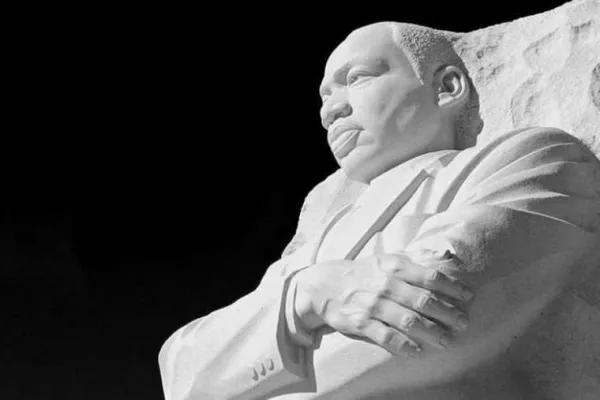
Washington D.C., Jan 20, 2020 / 03:37 am (CNA).- The example of Martin Luther King, Jr., is still sorely needed in the United States, given continued injustices, racism and discrimination against minorities, the U.S. Conference of Catholic Bishops said in a message for MLK Day.
“As our nation prepares to commemorate the life and witness of Rev. Martin Luther King, Jr., we are grateful for his courageous stand in solidarity with all who suffer injustice and his witness of love and nonviolence in the struggle for social change,” Archbishop Jose Gomez of Los Angeles, president of the U.S. Conference of Catholic Bishops, said Jan. 16.
“But we are once again painfully aware that we are still far off from his dream for America, the ‘beloved community’ for which he gave his life.”
King is remembered as an African-American Baptist minister and the most visible leader of the civil rights movement, for which he was awarded the Nobel Peace Prize in 1964. He was the founding president of the Southern Christian Leadership Conference. He was assassinated in 1968 at the Lorraine Motel in Memphis, Tennessee, at age 39.
The United States has celebrated a federal holiday in his memory since 1983. This year the holiday falls on Jan. 20.
Archbishop Gomez, writing on behalf of the U.S. bishops, warned of continuing “disturbing outbreaks of racism and prejudice” against minority groups in the U.S. today.
“Racism is a sin that denies the truth about God and his creation, and it is a scandal that disfigures the beauty of America’s founding vision,” he said.
“Too many hearts and minds are clouded by racist presumptions of privilege and too many injustices in our society are still rooted in racism and discrimination,” the archbishop continued.
“Too many young African American men are still being killed in our streets or spending their best years behind bars. Many minority neighborhoods in this country are still what they were in Rev. King’s time, what he called ‘lonely islands of poverty.’ Let us recommit ourselves to ensuring opportunity reaches every community,” he said.
The archbishop spoke in the wake of deadly racially motivated violence.
A mass shooting at an El Paso WalMart, not far from the U.S. border with Mexico, killed 22 people and injured 24 others in August 2019. Authorities believe the gunman authored an anti-immigrant, anti-Hispanic manifesto that depicted immigrants as invaders. The gunman apparently took inspiration from a deadly attack on a New Zealand mosque.
In October 2018 a shooter killed 11 people at a synagogue in Philadelphia. In April 2019, a shooting at a synagogue in Poway, California left one dead and several wounded, including the congregation’s rabbi.
“There has been a rise of anti-Semitic attacks and also ugly displays of white nationalism, nativism, and violence targeting Hispanics and other immigrants. Such bigotry is not worthy of a great nation,” Gomez said. “As Catholics and as Americans, we must reject every form of racism and anti-Semitism.”
He cited the U.S. Conference of Catholic Bishops’ 2018 pastoral letter on racism, “Open Wide Your Hearts.”
“What is needed, and what we are calling for, is a genuine conversion of heart, a conversion that will compel change and the reform of our institutions and society,” the letter said.
If you value the news and views Catholic World Report provides, please consider donating to support our efforts. Your contribution will help us continue to make CWR available to all readers worldwide for free, without a subscription. Thank you for your generosity!
Click here for more information on donating to CWR. Click here to sign up for our newsletter.

This photo of Father Allan Travers was featured in the local newspaper after his pitching “performance” for the Detroit Tigers against the Philadelphia A’s on May 18, 1912. The photo featured the caption “strikebreaker,” which worried Travers’ mother, since there was a street trolley strike in Philadelphia earlier in the month, and she didn’t want her son caught in the confusion. / Photo credit: Public domain
Detroit, Mich., Jul 23, 2023 / 08:00 am (CNA).
The worst pitcher ever to take the mound for the Detroit Tigers became a Catholic priest.
Granted, Allan Travers was already on the path to the priesthood before suiting up for Detroit on May 18, 1912. But his story — and place in baseball history — is the prime example of being in the right place at the right time (or the wrong place at the wrong time).
Travers played in only one game, but one was enough to show that God had plans for him that didn’t involve the big leagues.
The story begins, as most stories of Tigers lore do, with Ty Cobb.
The Tigers were in New York on May 15 to play the Highlanders (the precursor to the Yankees). Cobb was playing in the outfield when he was verbally abused by a New York fan who was using profanity and racial slurs to describe Cobb’s play.
Cobb — never known for keeping his cool — stormed into the stands and unleashed a volley of punches on the fan. Tigers players rushed to the scene of the chaos, yelling at Cobb to lay off the man, who was missing one hand and three fingers on his other hand after suffering an industrial accident.
Cobb didn’t care and continued the barrage.
Ban Johnson, president of the American League, happened to be at the game, checking on the family-friendly excitement of what was turning into America’s pastime.
Having one of the league’s star players beat up a disabled spectator didn’t jibe well with Johnson’s vision for baseball, so Cobb was suspended indefinitely.
The Tigers felt Cobb’s punishment was unfair, so the players voted to strike until Cobb was reinstated for the club’s next game in three days against the two-time defending World Series champion Philadelphia Athletics.
Detroit Tigers legend Ty Cobb is pictured in 1911. Not one to keep his cool, Cobb launched himself into the stands to attack a fan who insulted him in 1912, resulting in a league suspension and sparking his teammates to strike in protest. Credit: Public domain
Johnson called the Tigers’ bluff, informing then Tigers owner Frank Navin the team would face a $5,000 fine for every game Detroit forfeited.
Navin needed to field a team, and quick, so he and Tigers manager Hughie Jennings collaborated with Athletics owner/manager Connie Mack to field a team of players to take the field.
This was well before the age of expansive minor league rosters — or commercial airlines, for that matter — so it wasn’t as though the Tigers could call up the farm team in Toledo and get them to Philadelphia in time to play the A’s. Instead, scouting was done the old-fashioned way, spreading word throughout town, asking who wanted to play baseball.
And this is where Aloysius Joseph “Allan” Travers, the student manager on the St. Joseph’s College baseball team, comes into the story.
Jennings worked with a friend of his, Joe Nolan, a sportswriter for The Philadelphia Bulletin,to field a team. Nolan knew Travers, a junior at St. Joseph’s who lived in Philadelphia, from the time the A’s fielded a second-stringer team to play St. Joseph’s College.
Nolan asked Travers to find 10-12 amateur players in the area who could suit up for the Tigers in case the Tiger players followed through on their strike threats. The idea was that the amateurs would never actually take the field; rather, it was just a tactic to get Jennings’ “real” players on the field.
Father Allan Travers, SJ, was a priest who taught at St. Joseph’s College (now St. Joseph’s University) in Philadelphia. But in 1913, while a student at St. Joseph, he was the improbable pitcher for the Detroit Tigers, where he secured a bizarre spot in baseball history. Credit: Public domain
Travers rounded up eight players who were free that day and enticed by the $25 Navin offered to each player.
Jennings had his team of strike-breakers, as requested by Navin.
When the umpire called “play ball,” the Tiger regulars took the field, but when the umpire spotted Cobb and told him to take a seat, the rest of the team walked out and took off their uniforms.
The strike-breakers would have to play after all. They were ushered into the locker room and donned the Tigers’ gray uniforms (this was in the days before names were on the back of uniforms). Two bench coaches joined the group to offer the squad some big league experience.
The question was, who would pitch?
There were no takers at first, so Navin offered an extra $25. Travers volunteered; $50 was good money for a college kid in 1912. There was one small problem — Travers had never played organized ball.
He was the assistant manager on the college baseball team, tasked with keeping stats and writing game summaries.
But there he was, the college student with plans to join the seminary after graduation, pitching before 20,000 fans at Shibe Park against the two-time defending World Series champions. A modern David versus Goliath, a plucky underdog story.
This time Goliath won.
Travers did as well as one would expect the assistant manager of a college baseball team to do against professionals. He pitched a complete game, surrendering 24 runs on 26 hits (both American League records), walking seven and striking out one. He got an MLB strikeout — they can’t take that away from him.
But the 15.75 ERA leaves a mark. He also batted 0-for-3 at the plate.
Travers’ time in the major leagues was abrupt. After the 24-2 shellacking the A’s put on the strikebreaking Tigers, Cobb persuaded his teammates to end the strike before the team’s upcoming series against the Washington Senators.
Travers’ calling was the priesthood, not pitching.
After graduating from St. Joseph’s College in 1913, he joined the Society of Jesus, studying at St. Andrew on the Hudson in New York and Woodstock College in Maryland. He was ordained a priest in 1926, making him the only priest ever to play in a Major League game.
His ministry took him to teaching positions at St. Francis Xavier High School in Manhattan and St. Joseph’s Prep and St. Joseph’s College in Philadelphia.
Father Travers didn’t speak about his baseball exploits, but he did give an interview about his bizarre start for the Tigers.
“About noon when Nolan told me about the strike of Detroit, he told me the club would be fined and might lose its franchise if 12 players didn’t show up,” Travers told sportswriter Red Smith. “He told me to round up as many fellows as I could. We never thought we’d play a game.”
The replacement Detroit Tigers are pictured in the dugout against the Philadelphia A’s on May 18, 1912. Photo credit: Public domain
The priest said Jennings told him to avoid throwing fastballs to “avoid getting killed out there,” but the A’s didn’t hold back, even resorting to bunting when they found out the third baseman had never played baseball before.
“I fed ‘em nothing but slow stuff after Frank Baker almost hit one out of the park on me, which fortunately went foul,” Travers said. “I was doing fine until they started bunting. The guy playing third base had never played baseball before. I just didn’t get any support. I threw a beautiful slow ball and the A’s were just hitting easy flies. Trouble was, no one could catch them.”
Curious enough, the only “fame” Travers got from his start was his picture in the newspaper with the word “Strikebreaker” printed above. There was a trolley strike in Philadelphia that month, and Travers’ mother was worried for her son’s safety because people might suspect he was a scab.
Travers didn’t like talking about his baseball “career” with his students, and his story is not well known, save for a few baseball history blogs.
He did sign a ball from that fateful day that wound up in the collection of Ada, Michigan, resident Steve Nagengast, who claims to have the largest collection of Tigers autographs. Nagengast was featured in the Detroit News, and the anecdote about Travers piqued Detroit Catholic’s interest.
Travers didn’t have the greatest impact on Tigers history. But the $5,000-per-game fine the Tigers faced for each game the club forfeited would have been devastating, especially in an era when professional teams folded and changed towns all the time.
So who knows.
Father Travers’ one-game career might have just saved the Tigers.
Washington D.C., Jul 12, 2019 / 10:00 am (CNA).- International human rights experts have praised the creation of a State Department advisory body on human rights, calling it a very much needed contribution to global affairs.
Washington D.C., Sep 18, 2019 / 11:40 am (CNA).- The Senate voted Wednesday to confirm a prominent Catholic law professor to a high-ranking State Department position.
By a margin of 49 to 44, Robert Destro, a law professor at Catholic University of America’s Columbus School of Law, was confirmed by the Senate as the next Assistant Secretary of State for Democracy, Human Rights, and Labor. Sen. Susan Collins (R-Maine) joined Democrats in opposition to Destro’s confirmation.
“Robert Destro is one of the nation’s experts on human rights, both in terms of international law and the moral basis for human rights,” Thomas Farr, president of the Religious Freedom Institute, told CNA in a statement, noting Destro’s experience both as a human rights scholar and activist “in the best sense of that term.”
Destro’s new role at the State Department is tasked with promoting democracy, civic and religious freedom around the world.
It “is the senior human rights position in American diplomacy,” Farr said, charged with promoting human rights “not simply as the right thing to do (which it is), but also as a strategic interest of the United States.”
“Destro will excel in both tasks,” Farr said.
Destro is the founding director of the Interdisciplinary Program in Law & Religion at Catholic University; he previously served as a Commissioner on the U.S. Commission on Civil Rights from 1983 to 1989, addressing issues of discrimination on the basis of disability, national origin, and religion.
He has also served on the State Department’s Working Group on Religion in Foreign Affairs, as well as the special counsel for voting rights for the Ohio Secretary of State from 2004 to 2006.
Stephen C. Payne, dean of Catholic’s law school, said he was “thrilled” by the appointment, and that in Destro the “country — and the rest of the world — is getting a strong advocate and leader for Democracy and Human Rights, and we wish him well.”
The appointment was also welcomed by Toufic Baaklini, president of the group In Defense of Christians (IDC), who cited Destro’ years of work with the group and called him “a critical leader in the fight for genocide recognition for victims of ISIS in Iraq and Syria” and “a powerful voice for religious freedom in the Middle East, and throughout the world.”
Senate Democrats questioned Destro at his confirmation hearing in March over the role of religion in foreign affairs as well as the redefinition of marriage.
Destro said that he would work to improve both training on religious freedom and understanding of the role of religion in foreign affairs within the State Department, and cited his own past work bringing various religious groups together on the international stage.
Destro said that he had learned from “the many years that I have been dealing with the State Department” that many at the agency “have had a hard time dealing with the issue of religion, and that’s one of the issues I’d like to bring to their attention.”
Later in the hearing, he explained that the Frank R. Wolf International Religious Freedom Act of 2016—authored by Rep. Chris Smith (R-N.J.) and signed into law by President Obama—required religious freedom training for all foreign service officers.
Destro said he would work to expand on that, saying that “not only do the foreign service officers need to be trained, but so do the lawyers at the State Department and at USAID.”
“I think that we need to bring people together, and I’ve devoted most of my career, for at least the last 16 years, to doing just that,” he said of bringing religious groups together.
We are actually getting very close to the socialistic, anti-white, multicultural utopia King was working to bring about. And the USCCB continues to do its part to hasten the day. It is pretty disappointing when some outlets run by people who surely know better refuse to acknowledge the deeply problematic aspects of King and his “dream.” It can be done without denying that the injustices of the era existed or that the man had his strong points.
Not King but his followers.
It is inevitable fate of Christian culture planted inside entirely gnostic civilization. Fate silently ignored with bishops, the New York Times, artists and writers, and so on.
King was not communist. That’s all.
You have to learn to distinguish. For example you can compare King with peoples like Noam Chomsky or Bill Clinton and you will see.
If his FBI files are unsealed in a few years you will learn the truth as to whether he himself was a Communist. The point was that the civil Rights movement was aided by Communist agitation.
SOL,
FBI files are irrelevant. In fact the aforementioned trio just demonstrates this irrelevancy: proponent of Christian culture was killed while proponents of idealitic gnosis has achieved considerable careers. Despite tons of “files”.
Can’t have inconvenient historical facts bursting your narrative, can we?
SOL,
What “inconvenient historical facts” you mean? Read through King’s speech to the sanitation workers and compare it with Chomsky’s mathematized linguistic or Bill Clinton’s Vietnamese “people”. There are no other secret or unrecognisable “facts”.
Within 50 years we went from Bull Connor to Barack Obama – the last hole on the white liberal guilt punch card was punched on Tuesday November 4, 2008.
We white folks do NOT have the monopoly on racism – we never really did and we CERTAINLY don’t now.
We are actually getting very close to the socialistic, anti-white, multicultural utopia King was working to bring about. And the USCCB continues to do its part to hasten the day. It is pretty disappointing when some outlets run by people who surely know better refuse to acknowledge the deeply problematic aspects of King and his “dream.” It can be done without denying that the injustices of the era existed or that the man had his strong points.
Not King but his followers.
It is inevitable fate of Christian culture planted inside entirely gnostic civilization. Fate silently ignored with bishops, the New York Times, artists and writers, and so on.
Communists fostered and aided the civil rights movement from its inception.
https://www.npr.org/templates/story/story.php?storyId=123771194
King was not communist. That’s all.
You have to learn to distinguish. For example you can compare King with peoples like Noam Chomsky or Bill Clinton and you will see.
If his FBI files are unsealed in a few years you will learn the truth as to whether he himself was a Communist. The point was that the civil Rights movement was aided by Communist agitation.
SOL,
FBI files are irrelevant. In fact the aforementioned trio just demonstrates this irrelevancy: proponent of Christian culture was killed while proponents of idealitic gnosis has achieved considerable careers. Despite tons of “files”.
Can’t have inconvenient historical facts bursting your narrative, can we?
SOL,
What “inconvenient historical facts” you mean? Read through King’s speech to the sanitation workers and compare it with Chomsky’s mathematized linguistic or Bill Clinton’s Vietnamese “people”. There are no other secret or unrecognisable “facts”.
Within 50 years we went from Bull Connor to Barack Obama – the last hole on the white liberal guilt punch card was punched on Tuesday November 4, 2008.
We white folks do NOT have the monopoly on racism – we never really did and we CERTAINLY don’t now.