The Holy Father on July 11 hosted “Lunch with the Pope,” a day of hospitality and fraternity at Borgo Laudato Si’ within the papal gardens of Castel Gandolfo.
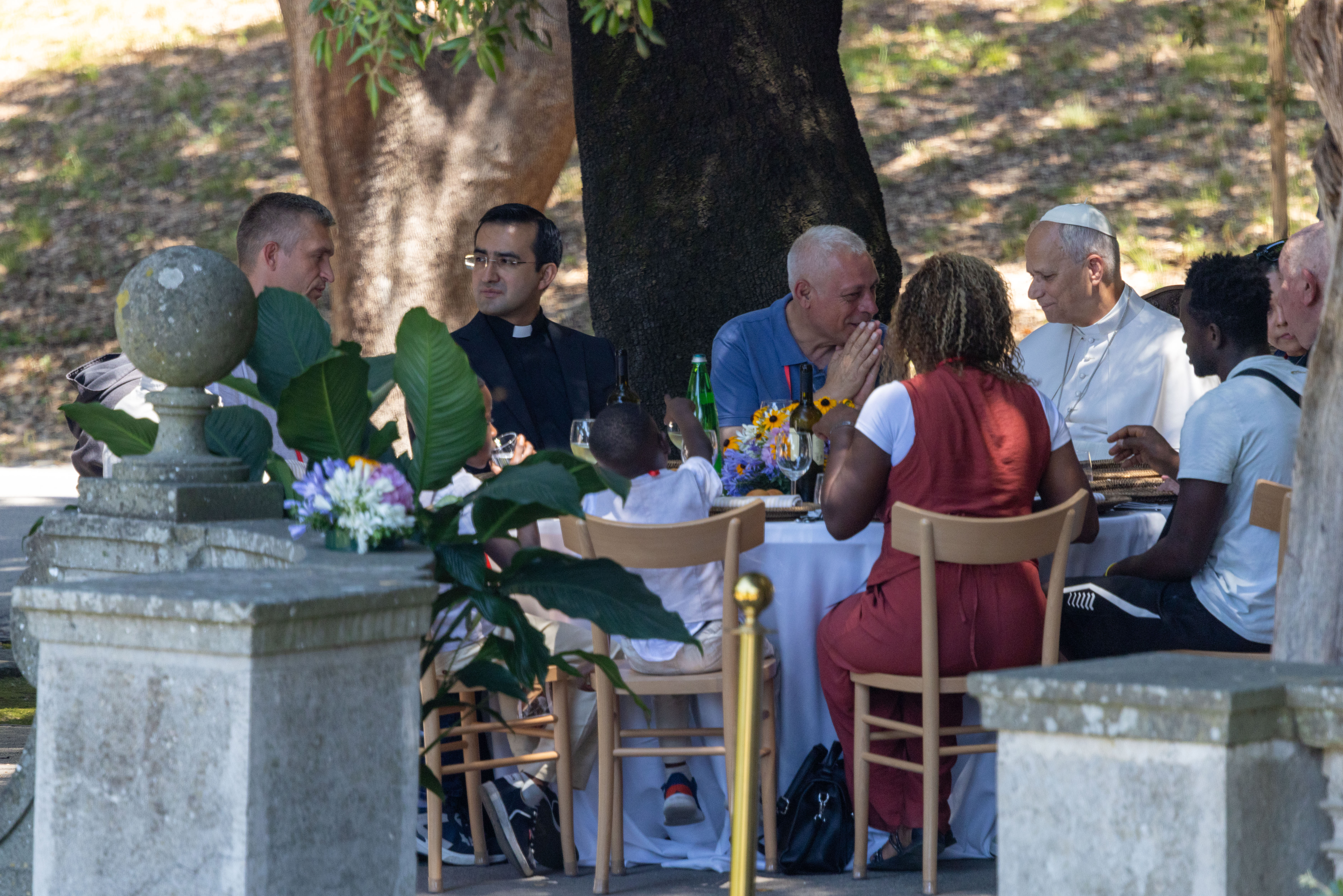
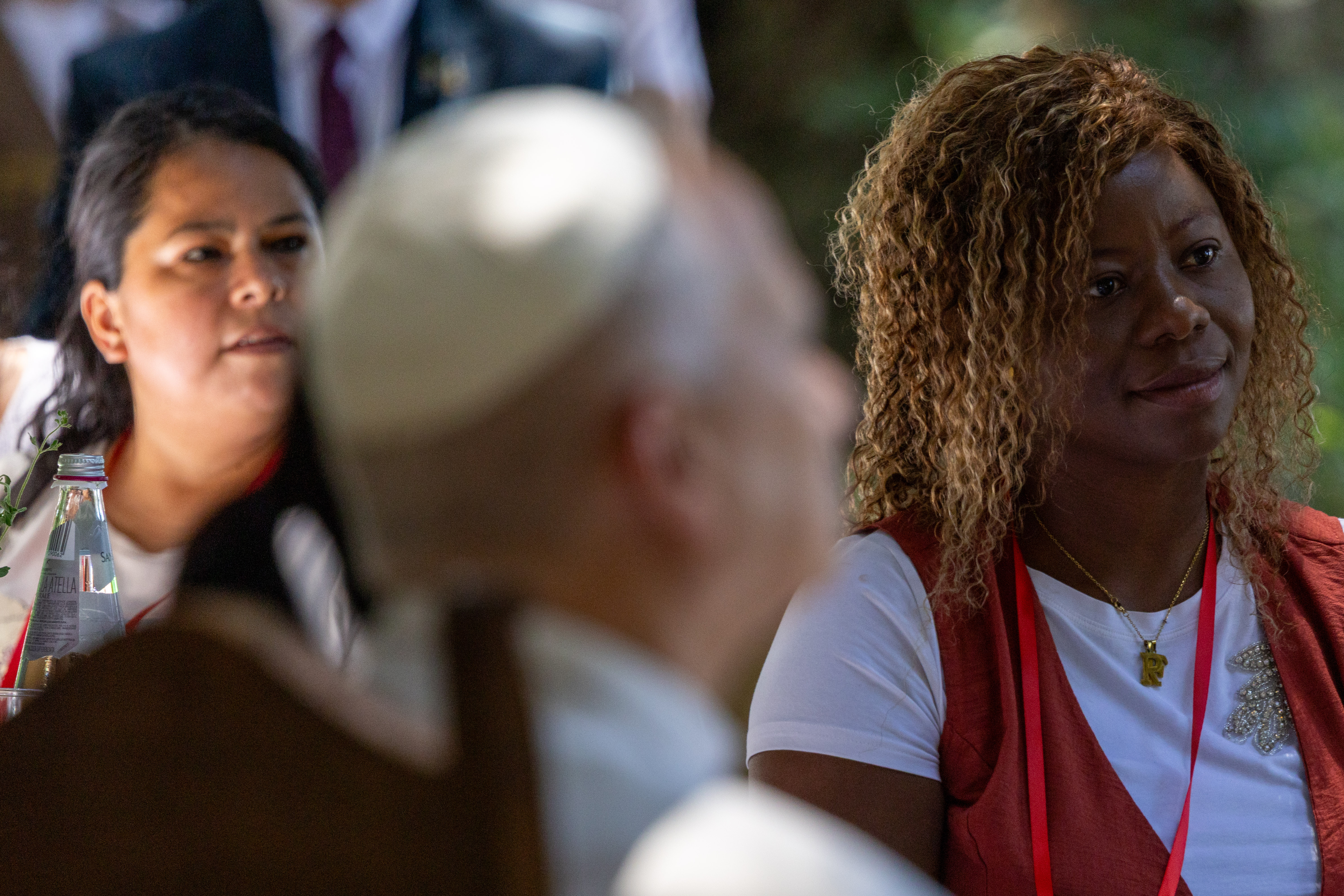
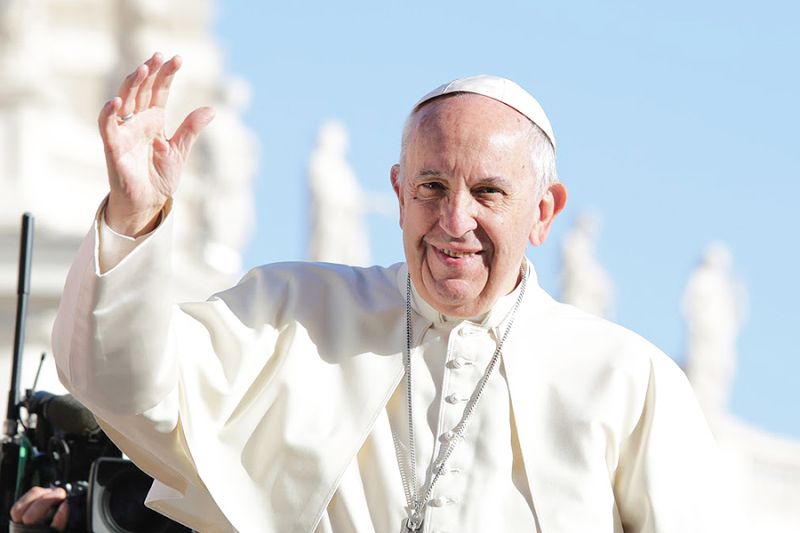
Pope Leo XIV greets guests during a lunch for poor people at Castel Gandolfo outside of Rome, July 11, 2026. The event was the second lunch the pope has hosted with those facing poverty since the beginning of his pontificate. | Credit: Daniel Ibáñez/EWTN News
Pope Leo XIV on July 11 expressed a “hunger for justice [and] authentic charity” while attending a lunch with poor people at Castel Gandolfo outside of Rome.
“[I have] a hunger for a Church that truly knows how to open its doors and receive everyone — where there is love for all and no one is an enemy, where we all know how to live out reconciliation, forgiveness, and peace,” the pope told the crowd at the lunch, hosted in the gardens of the Borgo Laudato Si’.
Pope Leo XIV dines with guests during a lunch for poor people at Castel Gandolfo outside of Rome, July 11, 2026. The event was the second lunch the pope has hosted with those facing poverty since the beginning of his pontificate. | Credit: Daniel Ibáñez/EWTN News
Leo pointed out that the historic papal title of “pontiff” means “a builder of bridges.”
“Today, we too wish to build a bridge with all of you, with your families, and with the society in which we want to live — but to live with justice, to live where the causes of poverty can be eliminated, where the causes of the injustices that still exist in our world can be removed,” he said.
Pope Leo XIV and guests sit for lunch at Castel Gandolfo outside of Rome, July 11, 2026. The event was the second lunch the pope has hosted with those facing poverty since the beginning of his pontificate. | Credit: Daniel Ibáñez/EWTN News
“This is the Church we want to be,” he said while thanking the organizers of the lunch, the second such event the pope has hosted since his pontificate began.
“When we gather together, when we experience this spirit of encounter around the table — the very table where Jesus is present with us — we are truly building a different world, a world of hope. Let us strive always to embody this experience of a Church of justice, peace, and love,” he said.
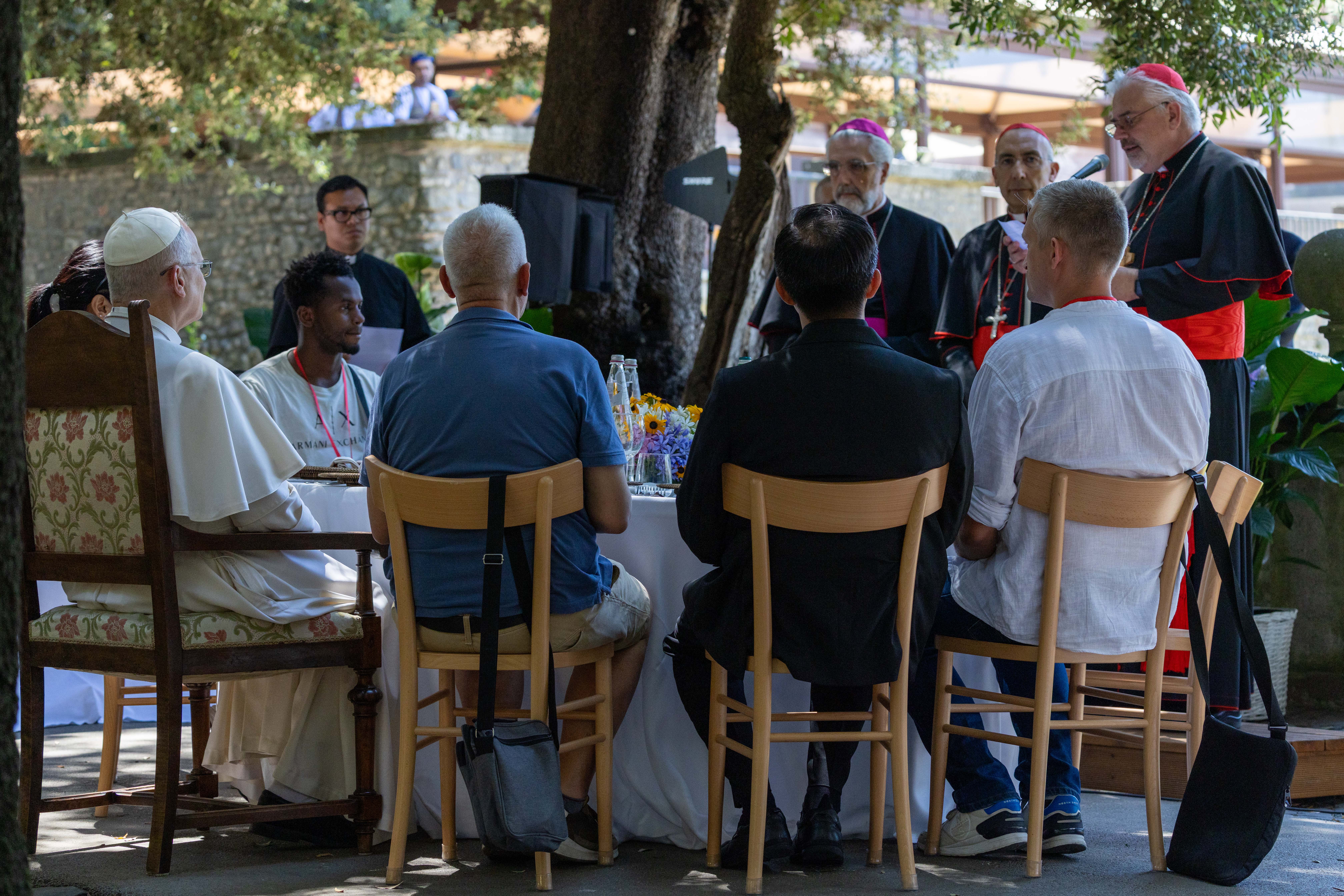
Before the pope spoke, Cardinal Fabio Baggio — the incoming pro-prefect of the Dicastery for Promoting Integral Human Development — had addressed the gathering.
Cardinal Fabio Baggio speaks during a lunch for poor people at Castel Gandolfo outside of Rome, July 11, 2026. The event was the second lunch Pope Leo XIV has hosted with those facing poverty since the beginning of his pontificate. | Credit: Daniel Ibáñez/EWTN News
“At a time when the ‘throwaway culture’ risks relegating many people to the margins, this place seeks to be a small sign of hope,” the cardinal said. “Here, we wish to remind everyone — through our lives rather than just our words — that no one is superfluous in the eyes of God and that every person is a gift to the entire community.”
About 200 people facing social vulnerability from the Diocese of Rome attended the lunch with the pope.
On Aug. 17, 2025 the pope hosted a similar lunch with people living in poverty from the Diocese of Albano; he held another such luncheon on Nov. 16 of that year.
This story was first published by ACI Stampa, the Italian-language sister service of EWTN News. It has been translated and adapted by EWTN News English.
If you value the news and views Catholic World Report provides, please consider donating to support our efforts. Your contribution will help us continue to make CWR available to all readers worldwide for free, without a subscription. Thank you for your generosity!
Click here for more information on donating to CWR. Click here to sign up for our newsletter.
Pope Francis gives his Christmas ‘Urbi et Orbi’ blessing Dec. 25, 2021. / Vatican Media.
Vatican City, Dec 25, 2021 / 04:50 am (CNA).
On Christmas Day 2021, Pope Francis delivered his “Urbi et Orbi” message and blessing from the central balcony… […]
Pope Francis at the general audience in St. Peter’s Square, Oct. 5, 2016. / Credit: Daniel Ibanez/CNA
CNA Staff, Mar 13, 2025 / 04:00 am (CNA).
March 13 marks the 12th anniversary of the election of Pope Francis as the 265th successor of St. Peter. Here is a timeline of key events during his papacy:
2013
March 13 — About two weeks after Pope Benedict XVI steps down from the papacy, Cardinal Jorge Bergoglio is elected pope. He takes the papal name Francis in honor of St. Francis of Assisi and proclaims from the central balcony of St. Peter’s Basilica: “Let us begin this journey, the bishop and people, this journey of the Church of Rome, which presides in charity over all the Churches, a journey of brotherhood in love, of mutual trust. Let us always pray for one another.”
March 14 — The day after he begins his pontificate, Pope Francis returns to his hotel to personally pay his hotel bill and collect his luggage.
July 8 — Pope Francis visits Italy’s island of Lampedusa and meets with a group of 50 migrants, most of whom are young men from Somalia and Eritrea. The island, which is about 200 miles off the coast of Tunisia, is a common entry point for migrants who flee parts of Africa and the Middle East to enter Europe. This is the pope’s first pastoral visit outside of Rome and sets the stage for making reaching out to the peripheries a significant focus.
Pope Francis gives the Wednesday general audience in St. Peter’s Square on Oct. 2, 2013. Elise Harris/CNA.
July 23-28 — Pope Francis visits Rio de Janeiro, Brazil, to participate in World Youth Day 2013. More than 3 million people from around the world attend the event.
July 29 — On the return flight from Brazil, Pope Francis gives his first papal news conference and sparks controversy by saying “if a person is gay and seeks God and has goodwill, who am I to judge?” The phrase is prompted by a reporter asking the pope a question about priests who have homosexual attraction.
Nov. 24 — Pope Francis publishes his first apostolic exhortation Evangelii Gaudium (The Joy of the Gospel). The document illustrates the pope’s vision for how to approach evangelization in the modern world.
2014
Feb. 22 — Pope Francis holds his first papal consistory to appoint 19 new cardinals, including ones from countries in the developing world that have never previously been represented in the College of Cardinals, such as Haiti.
March 22 — Pope Francis creates the Pontifical Commission for the Protection of Minors. The commission works to protect the dignity of minors and vulnerable adults, such as the victims of sexual abuse.
Pope Francis greets pilgrims during his general audience on Nov. 29, 2014. Bohumil Petrik/CNA.
Oct. 5 — The Synod on the Family begins. The bishops discuss a variety of concerns, including single-parent homes, cohabitation, homosexual adoption of children, and interreligious marriages.
Dec. 6 — After facing some pushback for his efforts to reform the Roman Curia, Pope Francis discusses his opinion in an interview with La Nacion, an Argentine news outlet: “Resistance is now evident. And that is a good sign for me, getting the resistance out into the open, no stealthy mumbling when there is disagreement. It’s healthy to get things out into the open, it’s very healthy.”
2015
Jan. 18 — To conclude a trip to Asia, Pope Francis celebrates Mass in Manila, Philippines. Approximately 6 million to 7 million people attend the record-setting Mass, despite heavy rain.
March 23 — Pope Francis visits Naples, Italy, to show the Church’s commitment to helping the fight against corruption and organized crime in the city.
May 24 — To emphasize the Church’s mission to combat global warming and care for the environment, Pope Francis publishes the encyclical Laudato Si’, which urges people to take care of the environment and encourages political action to address climate problems.
Pope Francis at a Wednesday general audience in St. Peter’s Square on June 17, 2015. Bohumil Petrik.
Sept. 19-22 — Pope Francis visits Cuba and meets with Fidel Castro in the first papal visit to the country since Pope John Paul II in 1998. During his homily, Francis discusses the dignity of the human person: “Being a Christian entails promoting the dignity of our brothers and sisters, fighting for it, living for it.”
Sept. 22-27 — After departing from Cuba, Pope Francis makes his first papal visit to the United States. In Washington, D.C., he speaks to a joint session of Congress, in which he urges lawmakers to work toward promoting the common good, and canonizes the Franciscan missionary St. Junípero Serra. He also attends the World Meeting of Families in Philadelphia, which focuses on celebrating the gift of the family.
Pope Francis speaks to the U.S. Congress in Washington, D.C. on Sept. 24, 2015. . L’Osservatore Romano.
Oct. 4 — Pope Francis begins the second Synod on the Family to address issues within the modern family, such as single-parent homes, cohabitation, poverty, and abuse.
Oct. 18 — The pope canonizes St. Louis Martin and St. Marie-Azélie “Zelie” Guérin. The married couple were parents to five nuns, including St. Therese of Lisieux. They are the first married couple to be canonized together.
Dec. 8 — Pope Francis’ Jubilee Year of Mercy begins. The year focuses on God’s mercy and forgiveness and people’s redemption from sin. The pope delegates certain priests in each diocese to be Missionaries of Mercy who have the authority to forgive sins that are usually reserved for the Holy See.
2016
March 19 — Pope Francis publishes the apostolic exhortation Amoris Laetitia, which discusses a wide variety of issues facing the modern family based on discussions from the two synods on the family. The pope garners significant controversy from within the Church for comments he makes in Chapter 8 about Communion for the divorced and remarried.
April 16 — After visiting refugees on the Greek island of Lesbos, Pope Francis allows three Muslim refugee families to join him on his flight back to Rome. He says the move was not a political statement.
Pope Francis at the General Audience in St. Peter’s Square, Feb. 24, 2016. Daniel Ibanez/CNA.
July 26-31 — Pope Francis visits Krakow, Poland, as part of the World Youth Day festivities. About 3 million young Catholic pilgrims from around the world attend.
Sept. 4 — The pope canonizes St. Teresa of Calcutta, who is also known as Mother Teresa. The saint, a nun from Albania, dedicated her life to missionary and charity work, primarily in India.
Sept. 30-Oct. 2 — Pope Francis visits Georgia and Azerbaijan on his 16th trip outside of Rome since the start of his papacy. His trip focuses on Catholic relations with Orthodox Christians and Muslims.
Oct. 4 — Pope Francis makes a surprise visit to Amatrice, Italy, to pray for the victims of an earthquake in central Italy that killed nearly 300 people.
2017
May 12-13 — In another papal trip, Francis travels to Fatima, Portugal, to visit the Shrine of Our Lady of Fatima. May 13 marks the 100th anniversary of the first Marian apparition to three children in the city.
July 11 — Pope Francis adds another category of Christian life suitable for the consideration of sainthood: “offering of life.” The category is distinct from martyrdom, which only applies to someone who is killed for his or her faith. The new category applies to those who died prematurely through an offering of their life to God and neighbor.
Pope Francis greets a participant in the World Day of the Poor in Rome, Nov. 16, 2017. L’Osservatore Romano.
Nov. 19 — On the first-ever World Day of the Poor, Pope Francis eats lunch with 4,000 poor and people in need in Rome.
Nov. 27-Dec. 2 — In another trip to Asia, Pope Francis travels to Myanmar and Bangladesh. He visits landmarks and meets with government officials, Catholic clergy, and Buddhist monks. He also preaches the Gospel and promotes peace in the region.
2018
Jan. 15-21 — The pope takes another trip to Latin America, this time visiting Chile and Peru. The pontiff meets with government officials and members of the clergy while urging the faithful to remain close to the clergy and reject secularism. The Chilean visit leads to controversy over Chilean clergy sex abuse scandals.
Aug. 2 — The Vatican formally revises No. 2267 of the Catechism of the Catholic Church, which concerns the death penalty. The previous text suggested the death penalty could be permissible in certain circumstances, but the revision states that the death penalty is “inadmissible.”
Aug. 25 — Archbishop Carlo Viganò, former papal nuncio to the United States, publishes an 11-page letter calling for the resignation of Pope Francis and accusing him and other Vatican officials of covering up sexual abuse including allegations against former Cardinal Theodore McCarrick. The pope initially does not directly respond to the letter, but nine months after its publication he denies having prior knowledge about McCarrick’s conduct.
Aug. 25-26 — Pope Francis visits Dublin, Ireland, to attend the World Meeting of Families. The theme is “the Gospel of family, joy for the world.”
Pope Francis at the 2018 World Meeting of Families in Ireland. Daniel Ibanez/CNA.
Oct. 3-28 — The Synod on Young People, the Faith, and Vocational Discernment takes place. The synod focuses on best practices to teach the faith to young people and to help them discern God’s will.
2019
Jan. 22-27 — The third World Youth Day during Pope Francis’ pontificate takes place during these six days in Panama City, Panama. Young Catholics from around the world gather for the event, with approximately 3 million people in attendance.
Feb. 4 — Pope Francis signs a joint document in with Sheikh Ahmed el-Tayeb, the grand imam of Al-Azhar, in Abu Dhabi, United Arab Emirates, titled the “Document on Human Fraternity for World Peace and Living Together.” The document focuses on people of different faiths uniting together to live peacefully and advance a culture of mutual respect.
Pope Francis and Ahmed el-Tayeb, grand imam of al-Azhar, signed a joint declaration on human fraternity during an interreligious meeting in Abu Dhabi, UAE, Feb. 4, 2019. Vatican Media.
Feb. 21-24 — The Meeting on the Protection of Minors in the Church, which is labeled the Vatican Sexual Abuse Summit, takes place. The meeting focuses on sexual abuse scandals in the Church and emphasizes responsibility, accountability, and transparency.
Oct. 6-27 — The Church holds the Synod of Bishops for the Pan-Amazon region, which is also known as the Amazon Synod. The synod is meant to present ways in which the Church can better evangelize the Amazon region but leads to controversy when carved images of a pregnant Amazonian woman, referred to by the pope as Pachamama, are used in several events and displayed in a basilica near the Vatican.
Oct. 13 — St. John Henry Newman, an Anglican convert to Catholicism and a cardinal, is canonized by Pope Francis. Newman’s writings inspired Catholic student associations at nonreligious colleges and universities in the United States and other countries.
2020
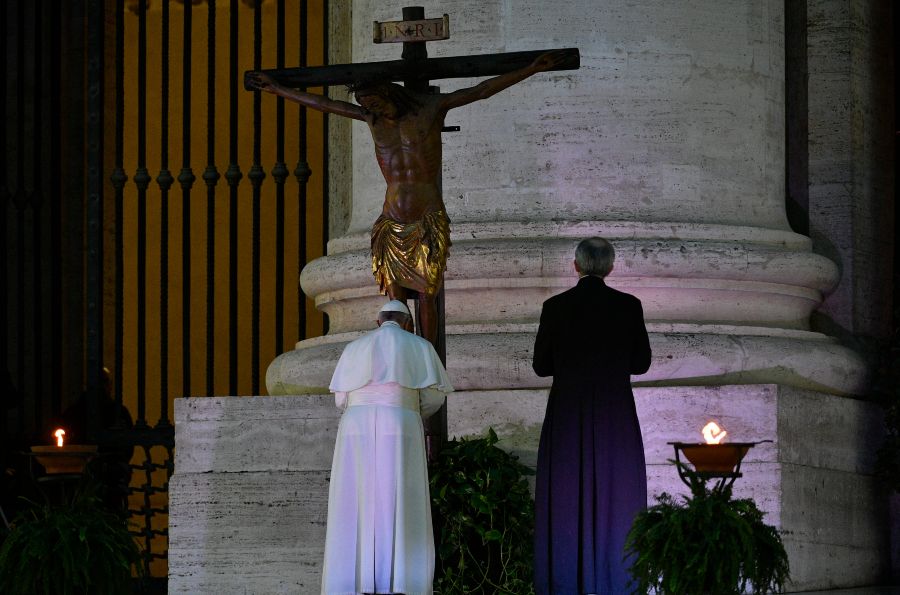
March 15 — Pope Francis takes a walking pilgrimage in Rome to the chapel of the crucifix and prays for an end to the COVID-19 pandemic. The crucifix was carried through Rome during the plague of 1522.
March 27 — Pope Francis gives an extraordinary “urbi et orbi” blessing in an empty and rain-covered St. Peter’s Square, praying for the world during the coronavirus pandemic.
Pope Francis venerates the miraculous crucifix of San Marcello al Corso in St. Peter’s Square during his Urbi et Orbi blessing, March 27, 2020. Vatican Media.
2021
March 5-8 — In his first papal trip since the start of the COVID-19 pandemic, Pope Francis becomes the first pope to visit Iraq. On his trip, he signs a joint statement with Grand Ayatollah Ali al-Sistani condemning extremism and promoting peace.
July 3 — Cardinal Giovanni Angelo Becciu, who was elevated to the College of Cardinals by Pope Francis, is indicted in a Vatican court for embezzlement, money laundering, and other crimes. The pope gives approval for the indictment.
July 4 — Pope Francis undergoes colon surgery for diverticulitis, a common condition in older people. The Vatican releases a statement that assures the pope “reacted well” to the surgery. Francis is released from the hospital after 10 days.
July 16 — Pope Francis issues a motu proprio titled Traditionis Custodes. The document imposes heavy restrictions on the celebration of the Traditional Latin Mass.
Dec. 2-6 — The pope travels to Cyprus and Greece. The trip includes another visit to the Greek island of Lesbos to meet with migrants.
Pope Francis greets His Beatitude Ieronymos II in Athens, Greece on Dec. 5, 2021. Vatican Media
2022
Jan. 11 — Pope Francis makes a surprise visit to a record store in Rome called StereoSound. The pope, who has an affinity for classical music, blesses the newly renovated store.
March 19 — The pope promulgates Praedicate Evangelium, which reforms the Roman Curia. The reforms emphasize evangelization and establish more opportunities for the laity to be in leadership positions.
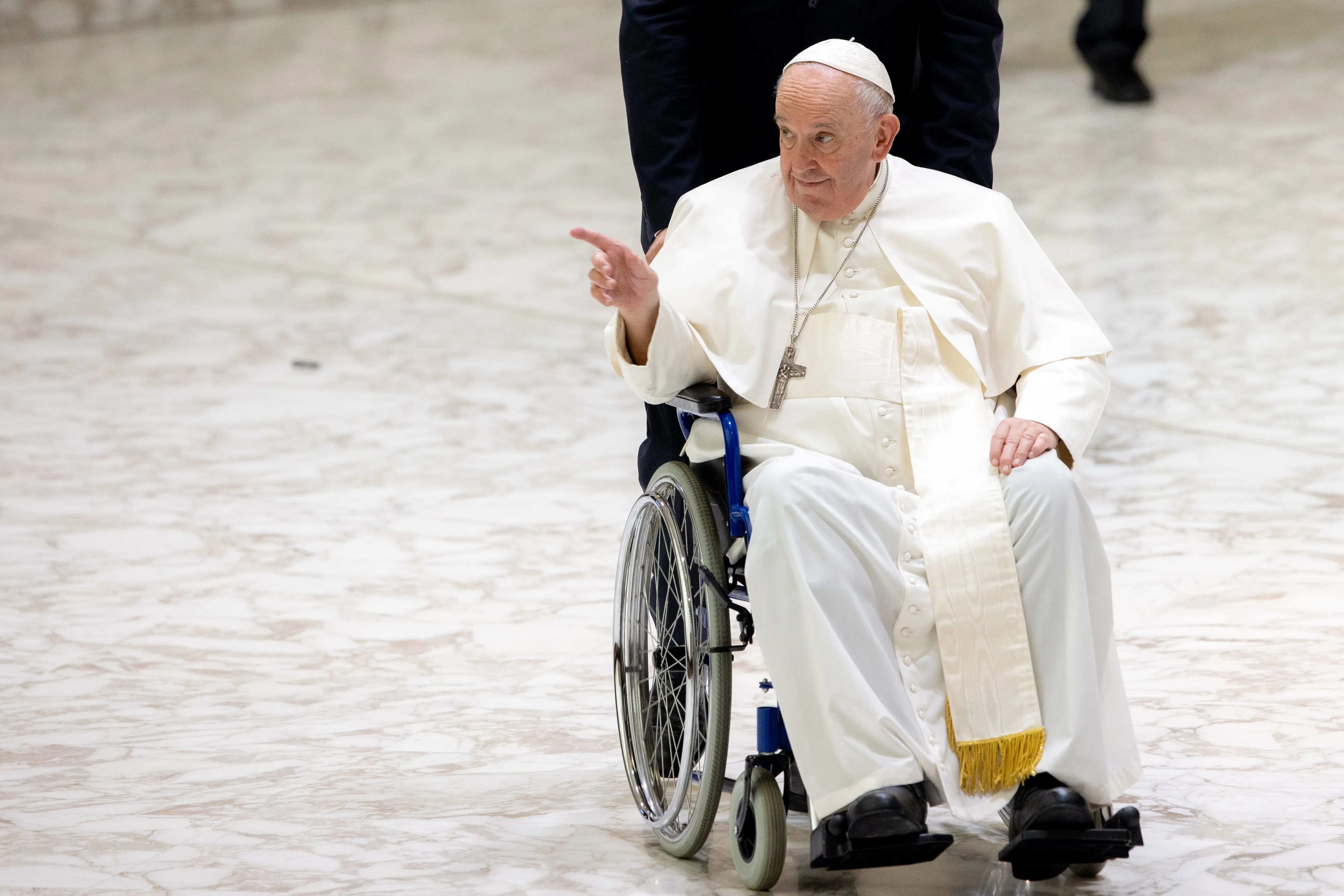
May 5 — Pope Francis is seen in a wheelchair for the first time in public and begins to use one more frequently. The pope has been suffering from knee problems for months.
Pope Francis greeted the crowd in a wheelchair at the end of his general audience on Aug. 3, 2022. Daniel Ibanez/CNA
July 24-30 — In his first papal visit to Canada, Pope Francis apologizes for the harsh treatment of the indigenous Canadians, saying many Christians and members of the Catholic Church were complicit.
2023
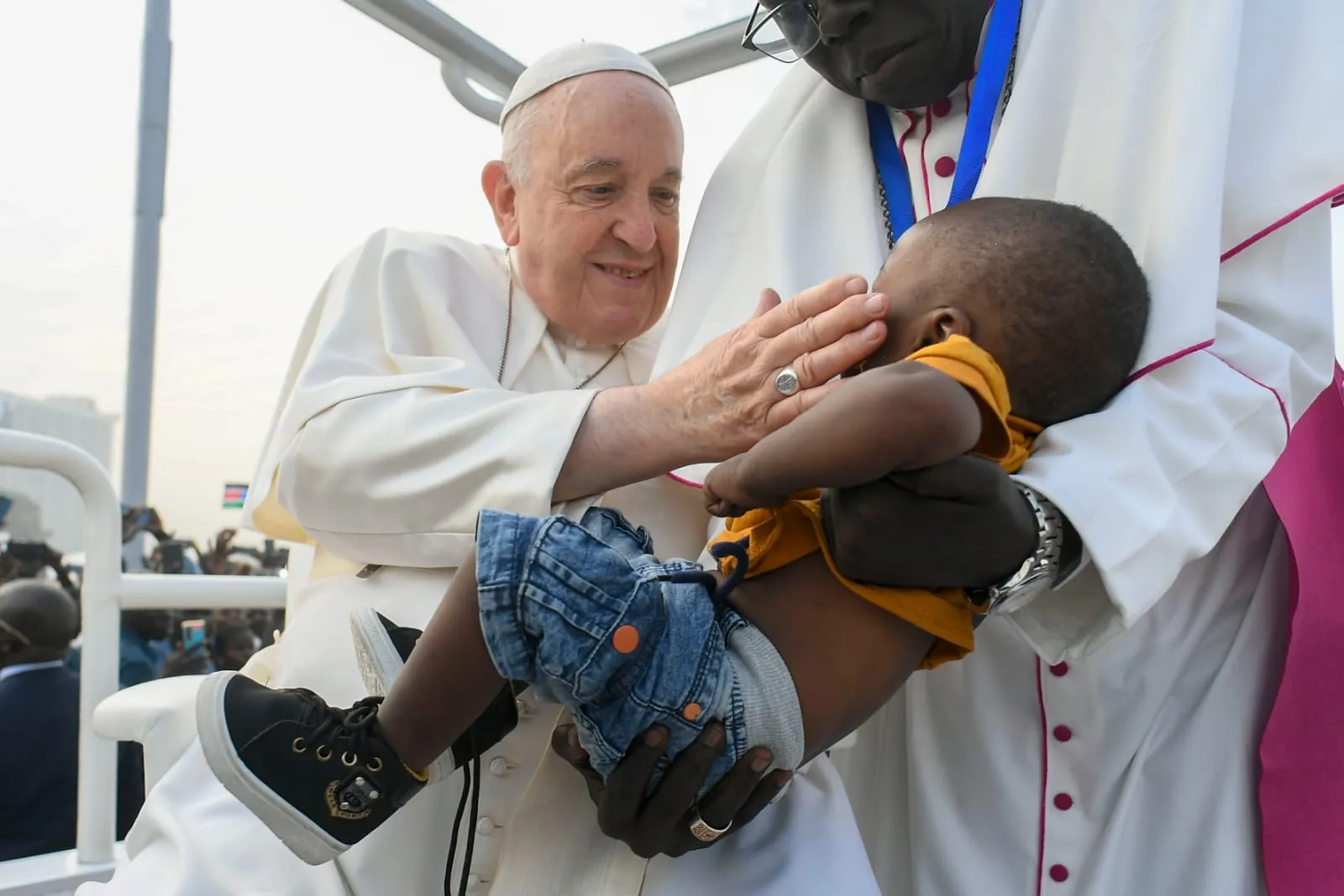
Jan. 31-Feb. 5 — Pope Francis travels to the Democratic Republic of Congo and South Sudan. During his visit, the pope condemns political violence in the countries and promotes peace. He also participates in an ecumenical prayer service with Anglican Archbishop of Canterbury Justin Welby and Moderator of the Church of Scotland Iain Greenshields.
Pope Francis greets a young boy a Mass in Juba, South Sudan on Feb. 5, 2023. Vatican Media
March 29-April 1 — Pope Francis is hospitalized for a respiratory infection. During his stay at Rome’s Gemelli Hospital, he visits the pediatric cancer ward and baptizes a newborn baby.
April 5 — The pope appears in the Disney documentary “The Pope: Answers,” which is in Spanish, answering six “hot-button” issues from members of Gen Z from various backgrounds. The group discusses immigration, depression, abortion, clergy sexual and psychological abuse, transgenderism, pornography, and loss of faith.
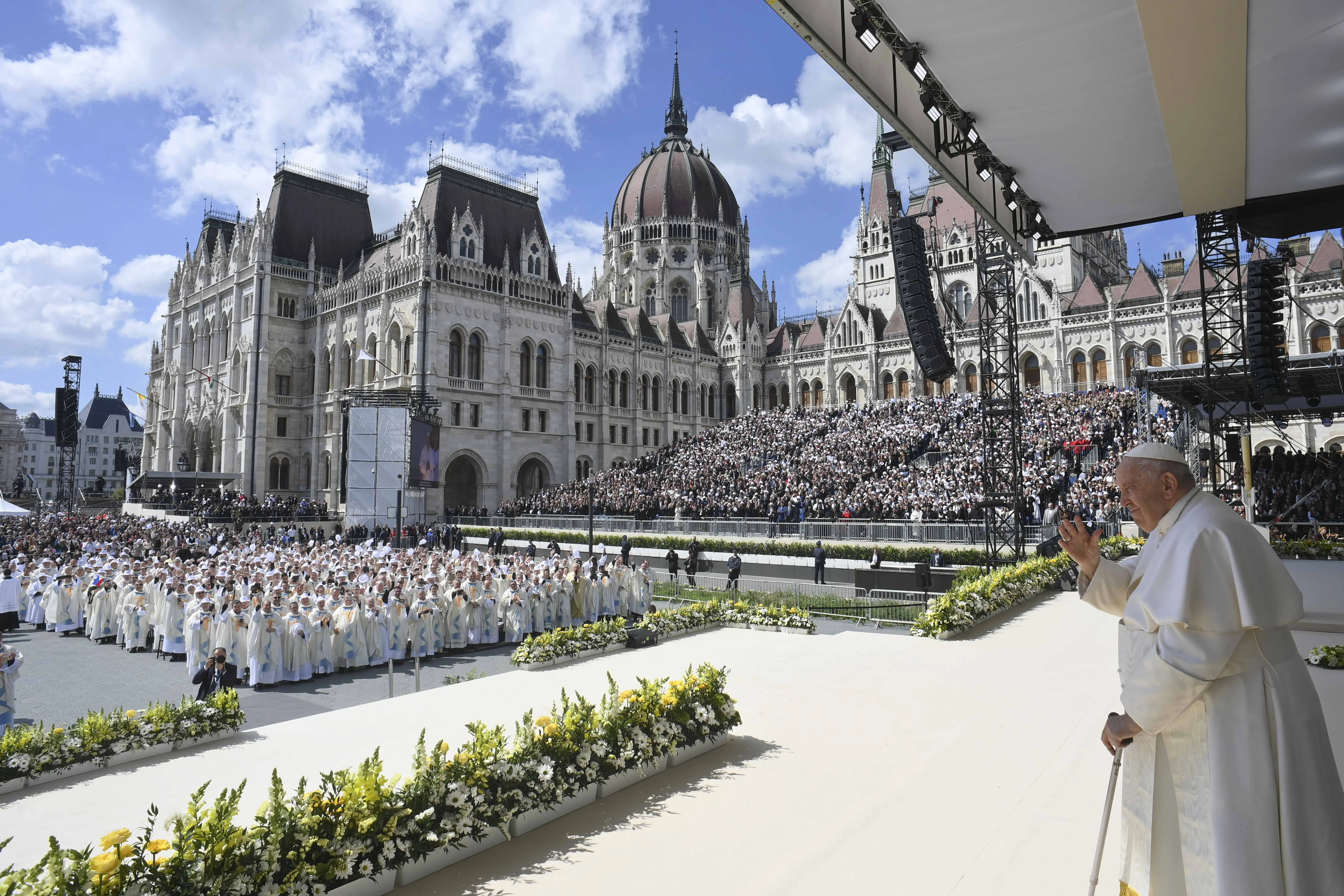
April 28-30 — Pope Francis visits Hungary to meet with government officials, civil society members, bishops, priests, seminarians, Jesuits, consecrated men and women, and pastoral workers. He celebrates Mass on the final day of the trip in Kossuth Lajos Square.
Pope Francis stands on an altar erected outside the Parliament Building in Budapest’s Kossuth Lajos’ Square during a public outdoor Mass on April 30, 2023. Vatican Media
June 7 — The Vatican announces that Pope Francis will undergo abdominal surgery that afternoon under general anesthesia due to a hernia that is causing painful, recurring, and worsening symptoms. In his general audience that morning before the surgery, Francis says he intends to publish an apostolic letter on St. Thérèse of Lisieux, “patroness of the missions,” to mark the 150th anniversary of her birth.
June 15 — After successful surgery and a week of recovery, Pope Francis is released from Gemelli Hospital.
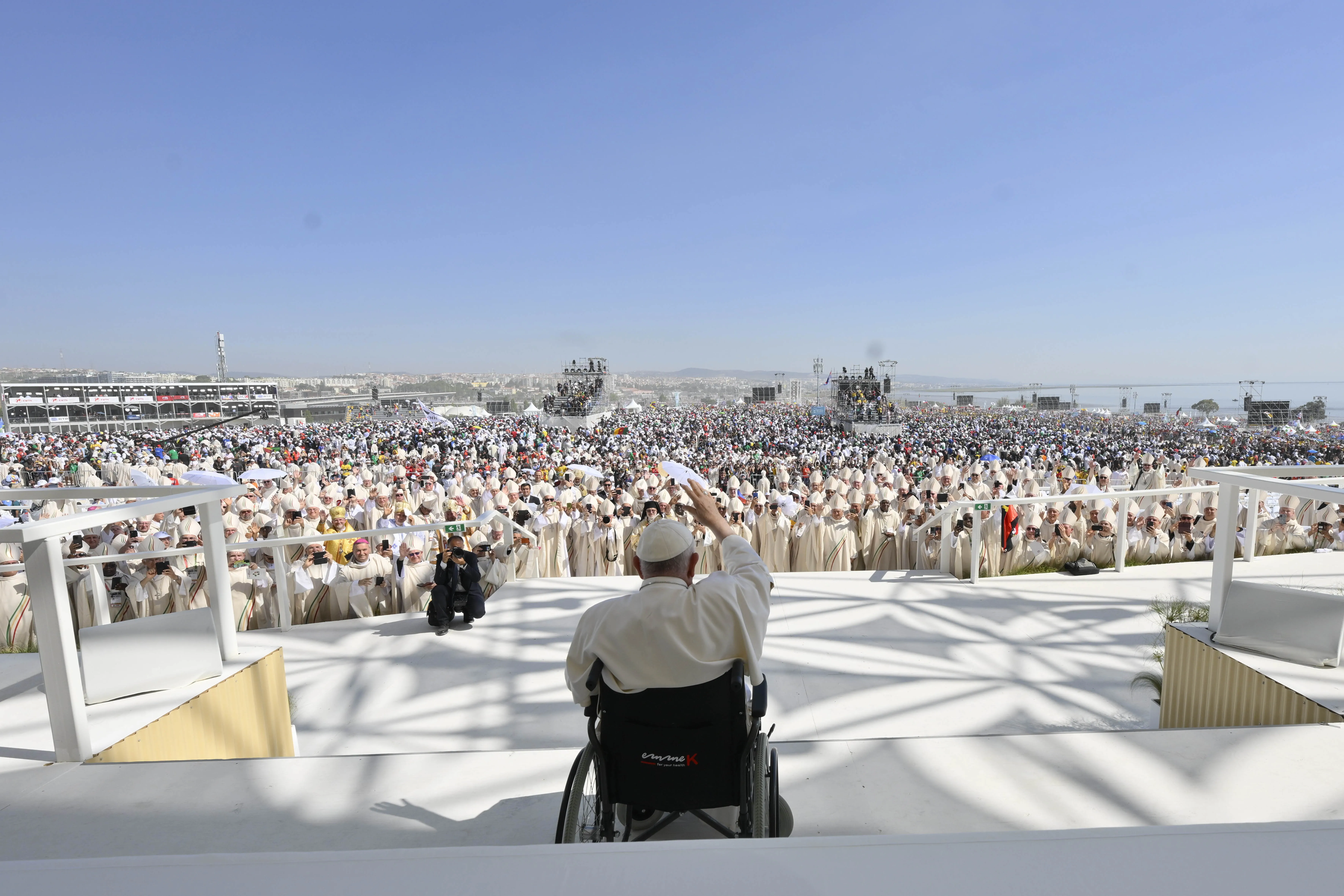
Aug. 2-6 — Pope Francis travels to Lisbon, Portugal, for World Youth Day 2023, taking place from Aug. 1-6. He meets with Church and civil leaders ahead of presiding at the welcoming Mass and Stations of the Cross. He also hears the confessions of several pilgrims. On Aug. 5, he visits the Shrine of Our Lady of Fátima, where he prays the rosary with young people with disabilities. That evening he presides over the vigil and on Sunday, Aug. 6, he celebrates the closing Mass, where he urges the 1.5 million young people present to “be not afraid,” echoing the words of the founder of World Youth Days, St. John Paul II.
Pope Francis waves at the crowd of 1.5 million people who attended the closing Mass of World Youth Day 2023 in Lisbon, Portugal on Aug. 6, 2023. Vatican Media.
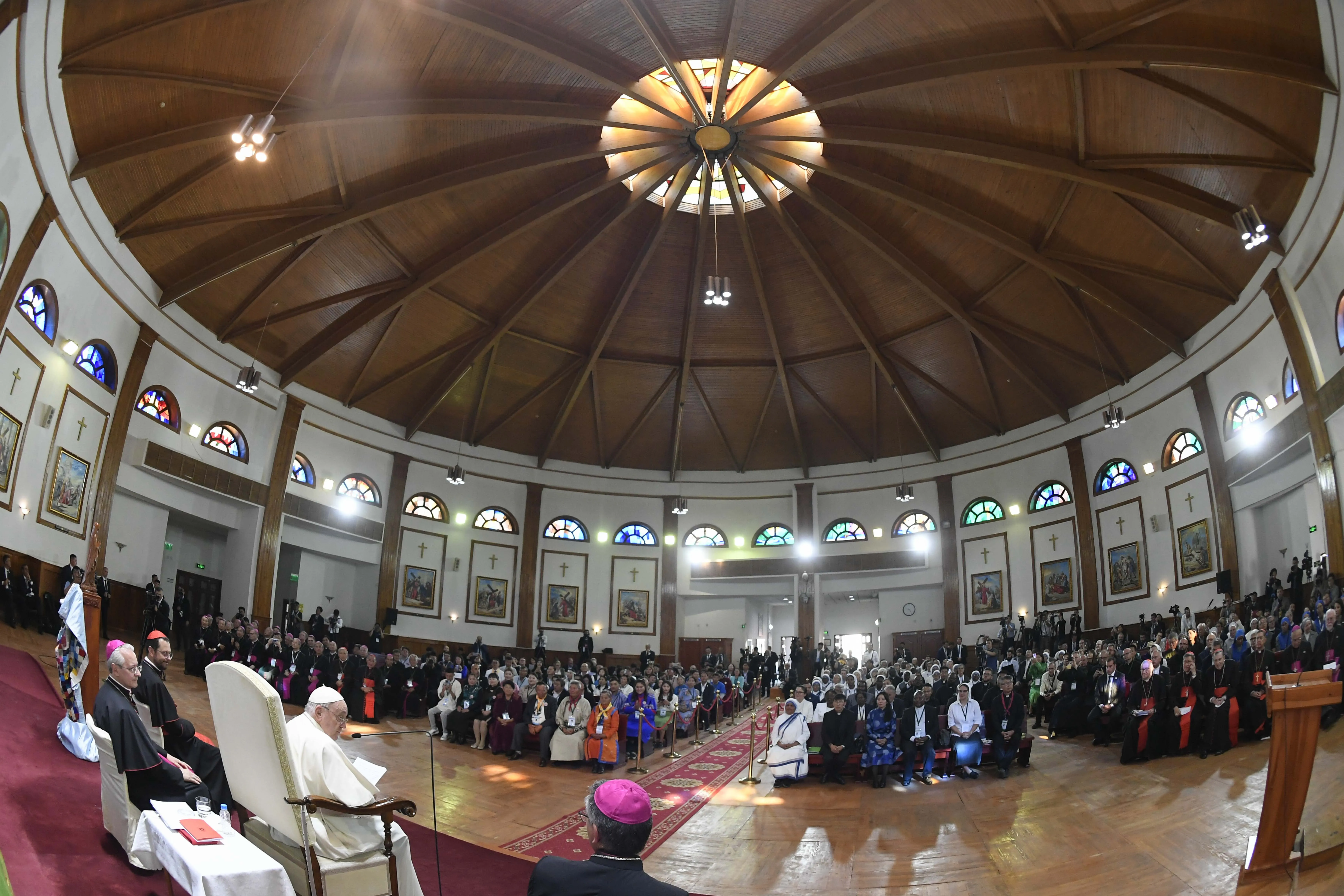
Aug. 31-Sept. 4 — Pope Francis travels to Mongolia, the world’s most sparsely populated sovereign country. The trip makes Francis the first pope to visit the Asian country that shares a 2,880-mile border with China, its most significant economic partner. Mongolia has a population of about 1,300 Catholics in a country of more than 3 million people.
Pope Francis meets with local priests and religious of Mongolia, which includes only 25 priests (19 religious and six diocesan), 33 women religious, and one bishop — Cardinal Giorgio Marengo — in Ulaanbaatar’s Cathedral of Sts. Peter and Paul on Sept. 2, 2023. Credit: Vatican Media
Sept. 22-23 — On a two-day trip to Marseille, France, Pope Francis meets with local civil and religious leaders and participates in the Mediterranean Encounter, a gathering of some 120 young people of various creeds with bishops from 30 countries.
Pope Francis asks for a moment of silence at a memorial dedicated to sailors and migrants lost at sea on the first of a two-day visit to Marseille, France, Sept. 22, 2023. A Camargue cross, which comes from the Camargue area of France, represents the three theological virtues of faith, hope, and charity. The three tridents represent faith, the anchor represents hope, and the heart represents charity. Credit: Daniel Ibañez/CNA
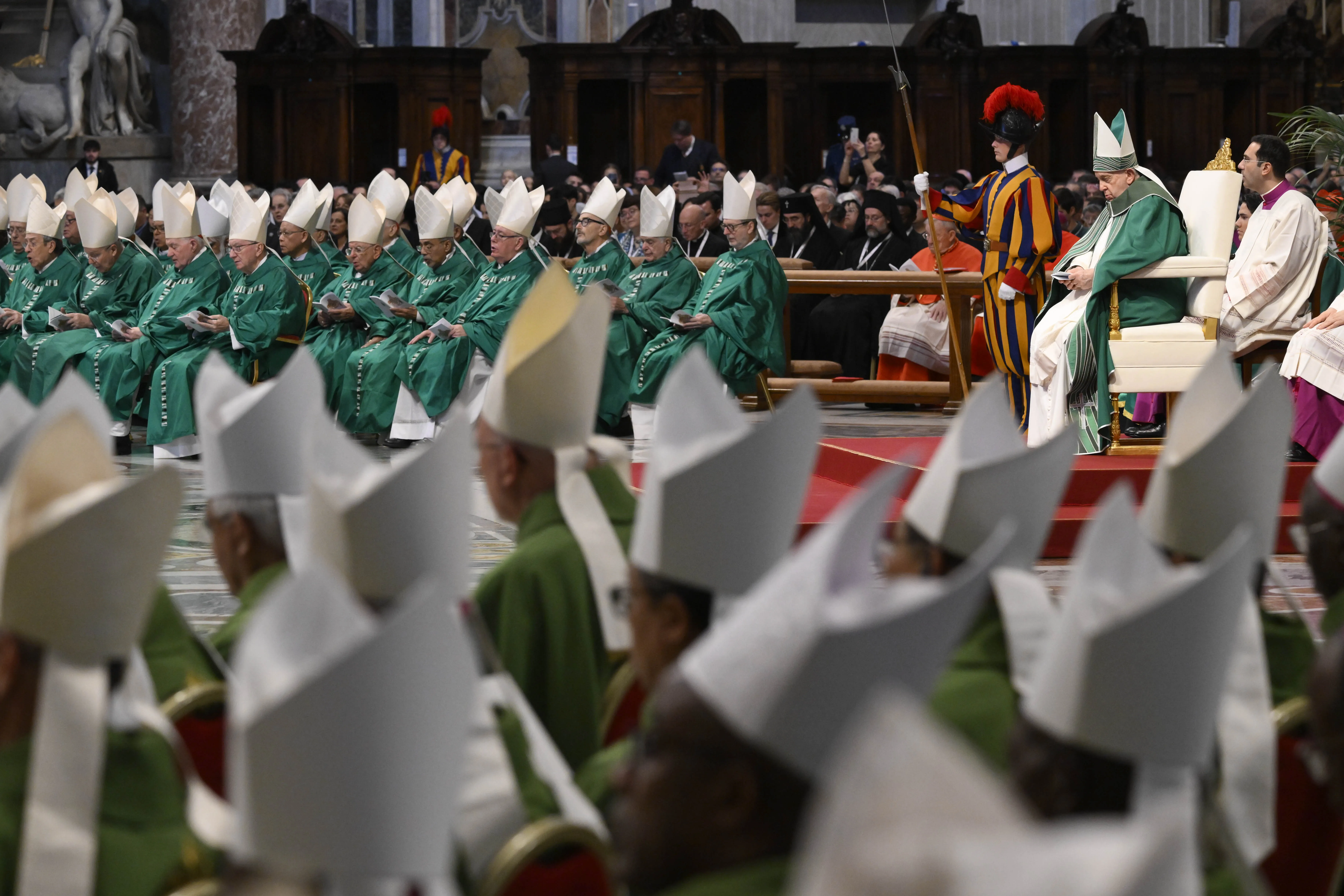
Oct. 4-29 — The Vatican hosts the first of two monthlong global assemblies of the Synod on Synodality, initiated by Pope Francis in 2021 to enhance the communion, participation, and mission of the Church. Pope Francis celebrates the closing Mass of the synod at St. Peter’s Basilica on Oct. 29. The second and final global assembly will take place at the Vatican in October 2024.
Pope Francis at the Synod on Synodality’s closing Mass in St. Peter’s Basilica on Oct. 29, 2023. Vatican Media
Nov. 25 — Pope Francis visits the hospital briefly for precautionary testing after coming down with the flu earlier in the day. Although he still participates in scheduled activities, other officials read his prepared remarks. The Vatican on Nov. 28 cancels the pope’s planned Dec. 1–3 trip to Dubai for the COP28 climate conference, where he was scheduled to deliver a speech, due to his illness.
Dec. 18 — The Dicastery for the Doctrine of the Faith issues the declaration Fiducia Supplicans, which authorizes nonliturgical blessings for same-sex couples and couples in “irregular situations.” Various bishops from around the world voice both support for and criticism of the document.
2024
Jan. 14 — Pope Francis for the first time responds publicly to questions about Fiducia Supplicans in an interview on an Italian television show. The pope underlines that “the Lord blesses everyone” and that a blessing is an invitation to enter into a conversation “to see what the road is that the Lord proposes to them.”
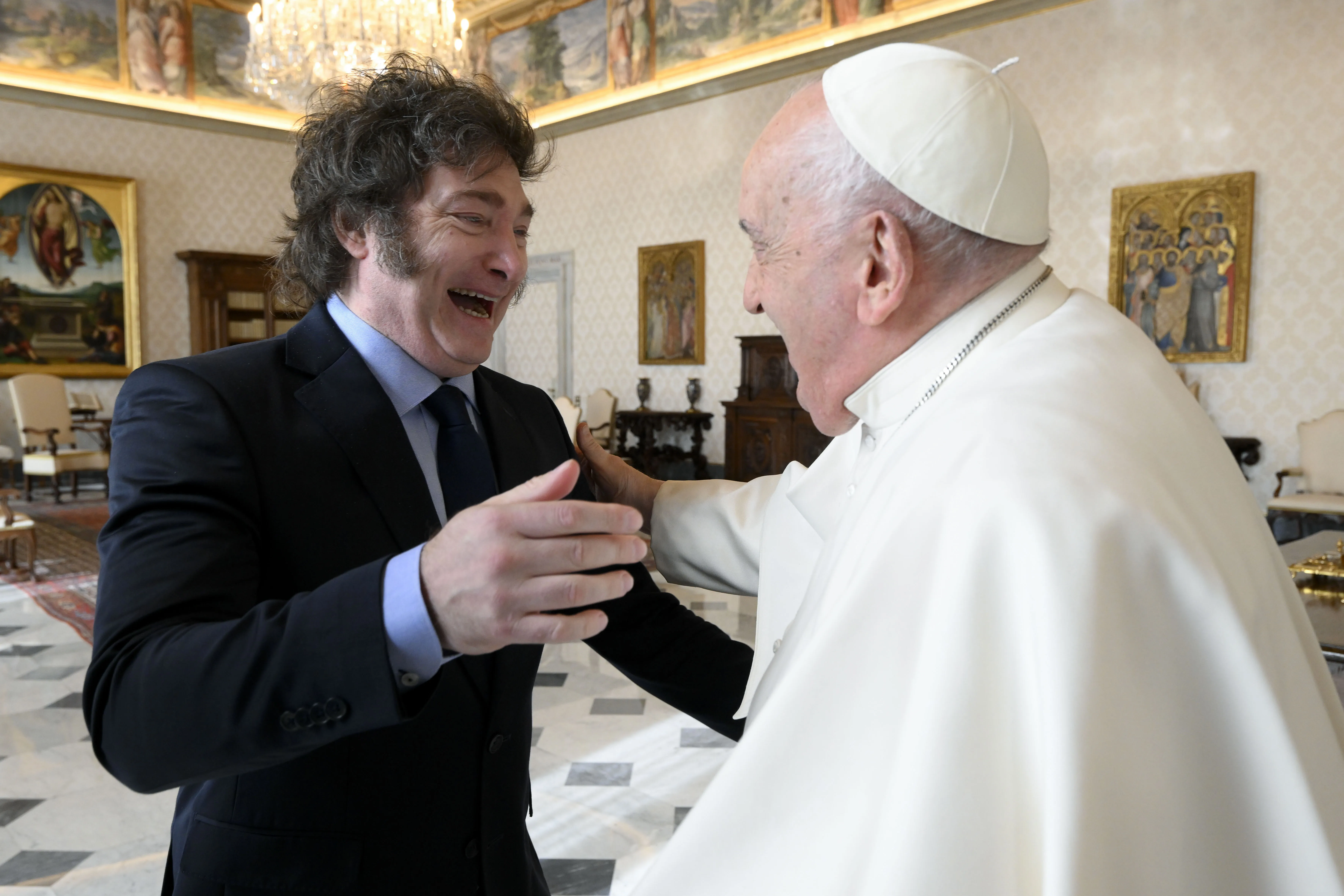
Feb. 11 — In a ceremony attended by Argentine president Javier Milei, Pope Francis canonizes María Antonia of St. Joseph — known affectionately in the pope’s home country as “Mama Antula” — in a Mass at St. Peter’s Basilica. The president and the former archbishop of Buenos Aires embrace after the ceremony. Pope Francis, who has not returned to his homeland since becoming pope in 2013, has said he wants to visit Argentina in the second half of this year.
Pope Francis meets with Argentina President Javier Milei in a private audience on Feb. 12, 2024, at the Vatican. Credit: Vatican Media
March 13 — Pope Francis celebrates 11 years as supreme pontiff of the Roman Catholic Church.
April 8 — The Dicastery for the Doctrine of the Faith releases Dignitas Infinita (“Infinite Dignity”), a document that reaffirms the Church’s perennial opposition to abortion, euthanasia, and gender ideology.
May 19 — Pope Francis appears on CBS’ “60 Minutes” in an interview with Norah O’Donnell, where he states categorically that women’s ordination to the priesthood and the diaconate is off the table.
In an interview with 60 Minutes’ Norah O’Donnell, Pope Francis took aim at his “conservative critics” in the United States. Credit: CBS News/Adam Verdugo
June 14 — Pope Francis becomes the first pope to address the G7 Summit in the southern Italian region of Puglia. In his remarks, he stresses that human dignity requires that the decisions of artificial intelligence (AI) be under the control of human beings. During the three-day event, the pope also meets with U.S. President Joe Biden.
Sept. 2-13 — Pope Francis embarks on a 12-day trip of more than 20,000 miles over seven flights through Asia and Oceania. The trip to Indonesia, Papua New Guinea, East Timor, and Singapore is his most ambitious international trip yet and the longest of his 11-year pontificate. In East Timor, 600,000 Catholics attend Mass with the Holy Father.
Pope Francis celebrates Mass at the Esplanade of Taci Tolu in Dili, Timor-Leste, Tuesday, Sept. 10, 2024. Credit: Daniel Ibáñez/CNA
Oct. 2-27 — The three-year Synod on Synodality concludes with the final session in Rome and the adoption of the final report, which in a surprise move Pope Francis signs immediately, stating he will not issue a separate postsynodal document.
Dec. 7 — Pope Francis holds a consistory at the Vatican in which he creates 21 new cardinals, including Archbishop Frank Leo of Toronto; Archbishop Dominique Joseph Mathieu of Tehran-Isfahan, Iran; and Archbishop Tarcisio Isao Kikuchi of Tokyo, reflecting the pope’s emphasis on the Church’s global mission.
Pope Francis places the red biretta on Cardinal Domenico Battaglia, archbishop of Naples, during the consistory for the creation of 21 new cardinals in St. Peter’s Basilica, Dec. 7, 2024. Credit: Daniel Ibáñez/CNA
Dec. 24 — On Christmas Eve, Pope Francis opens the Holy Door at St. Peter’s Basilica to officially launch the 2025 Jubilee Year of Hope.
Pope Francis opens the Holy Door of St. Peter’s Basilica before Mass on Christmas Eve, Dec. 24, 2024, officially launching the Jubilee Year 2025. Credit: Vatican Media
2025
Jan. 14 — “Hope,” Pope Francis’ autobiography, is released. The book marks the first time a pope has provided a first-person narration of the episodes that have marked his entire life, in this case from his childhood in Argentina in a family of Italian immigrants to becoming the successor of St. Peter.
Feb. 14 — Pope Francis is hospitalized with bronchitis and later develops double pneumonia.
March 13 — While still in Gemelli Hosptial in Rome for treatment for respiratory illnesses, Pope Francis celebrates the 12th anniversay of his election to the papacy.
Vatican City, Jan 3, 2019 / 05:01 pm (CNA/EWTN News).- The Congregation for the Doctrine of the Faith published Thursday a response clarifying that a hysterectomy is a licit act when a woman’s womb is not suited for procreation and medical experts are certain an eventual pregnancy will bring about a spontaneous abortion before viability.
The CDF said its response regards “situations in which procreation is no longer possible,” and it completes responses, “which retain all of their validity,” given in 1993 to questions proposed concerning “uterine isolation” and related matters.
The 1993 responses stated that hysterectomy is licit when there is a grave and present danger to the life or health of the mother (because it is chosen for therapeutic reasons; its aim is to curtail a serious present danger such as hemorrhage which cannot be stopped by other means), but that hysterectomy and tubal ligation are illicit when they are intended to make impossible an eventual pregnancy which can pose some risk for the mother (because they are direct sterilization).
In an illustrative note accompanying its response, the CDF said the question at hand is different from the cases of direct sterilization discussed in the 1993 responses because of “the certainty reached by medical experts that in the case of a pregnancy, it would be spontaneously interrupted before the fetus arrives at a state of viability.”
“Here it is not a question of difficulty, or of risks of greater or lesser importance, but of a couple for which it is not possible to procreate,” the CDF wrote.
The congregation wrote that the “object of sterilization is to impede the functioning of the reproductive organs, and the malice of sterilization consists in the refusal of children: it is an act against the bonum prolis.”
By contrast, in this case “it is known that the reproductive organs are not capable of protecting a conceived child up to viability,” or that the reproductive organs “are not capable of fulfilling their natural procreative function.”
“The objective of the procreative process,” the CDF said, “is to bring a baby into the world, but here the birth of a living fetus is not biologically possible.”
“Therefore, we are not dealing with a defective, or risky, functioning of the reproductive organs, but we are faced here with a situation in which the natural end of bringing a living child into the world is not attainable.”
In such a case a hysterectomy “should not be judged as being against procreation, because we find ourselves within an objective context in which neither procreation, nor as a consequence, an anti-procreative action, are possible. Removing a reproductive organ incapable of bringing a pregnancy to term should not therefore be qualified as direct sterilization, which is and remains intrinsically illicit as an end and as a means.”
The CDF noted that whether a pregnancy could continue to viability is a medical question, and that morally, “one must ask if the highest degree of certainty that medicine can reach has been reached.”
The congregation added that its response “does not state that the decision to undergo a hysterectomy is always the best one, but that only in the above-mentioned conditions is such a decision morally licit, without, therefore, excluding other options (for example, recourse to infertile periods or total abstinence).”
“It is the decision of the spouses, in dialogue with doctors and their spiritual guide, to choose the path to follow, applying the general criteria of the gradualness of medical intervention to their case and to their circumstances.”
The response also noted that it had been approved by Pope Francis, who ordered its publication.
Justice and peace are two sides of the same coin. Where there is justice, there is peace. “Let us strive always to embody this experience of a Church of justice, peace, and love” – His Holiness Pope Leo XIV.
[I have] a hunger for a Church that truly knows how to open its doors and receive everyone — where there is love for all and no one is an enemy, where we all know how to live out reconciliation, forgiveness, and peace,” the pope told the crowd at the lunch, hosted in the gardens of the Borgo Laudato Si’.
A wonderful image. Although we cannot justifiably achieve by forms of punitive policy like condemning American efforts at removal of illegal migrants, deifying the migrant, placing all one’s energy on climate control, criticizing governments for using fossil fuels. Pope Leo’s dream can only be achieved by the interior conversion of hearts. The Church must focus on the original Apostolic, as compared to new age sanctification.
The Pope’s and many Catyolics ignorance of economics is abysmal. They hate capitalism, for example. They could start by reading Economics in One Lesson by Henry Hazlitt: https://www.amazon.com/Economics-One-Lesson-Shortest-Understand/dp/0517548232
Before capitalism, most of the global population were living in extreme poverty. From 90 percent in 1820, the rate has now fallen to 10 percent.
—IN THE FORMER SOCIALIST COUNTRIES THE INCREASE IN LIVING STANDARDS after the fall of communist Russia has been dramatic.
—In China, the abysmal conditions UNDER MAOIST SOCIALISM, WHERE MILLIONS DIED, have been replaced by much better standards of living since the pro-capitalist reforms of the system where NOW WE FIND MANY CHINESE MILLIONAIRES IN “COMUNIST” CHINA.
DENG XIAOPING WAS THE PRIMARY LEADER RESPONSIBLE FOR INITIATING AND DRIVING THE PRO-CAPITALIST ECONOMIC REFORMS IN CHINA. EMERGING AS THE “PARAMOUNT LEADER” IN 1978 FOLLOWING THE DEATH OF MAO ZEDONG, DENG DISMANTLED COLLECTIVE FARMING, LEGALIZED PRIVATE BUSINESSES, AND OPENED THE COUNTRY TO GLOBAL TRADE, ENTREPRENEURSHIP AND FOREIGN INVESTMENT UNDER THE POLICY KNOWN AS “REFORM AND OPENING UP.”
Pragmatic Ideology: Deng famously stated that “it does not matter if a cat is black or white so long as it catches the mouse,” prioritizing economic growth over strict adherence to communist ideology. His approach, termed “Socialism with Chinese Characteristics,” introduced market mechanisms and supply-and-demand pricing while maintaining the political dominance of the Chinese Communist Party.
Implementation and Impact: The reforms began with decentralized local experiments, such as the household responsibility system in rural areas, before being adopted nationally. These changes transformed China from a stagnant, state-controlled economy into a rapidly growing market economy, lifting millions out of poverty and integrating China into the global economic system.
The central argument of Economics in One Lesson by Henry Hazlitt is that the art of economics consists in looking not merely at the immediate but at the longer effects of any act or policy, and tracing those consequences not merely for one group but for all groups. Hazlitt argues that bad economic policies result from a common fallacy: focusing only on the visible, short-term benefits to a specific group while ignoring the invisible, long-term costs to society as a whole.
To illustrate this principle, Hazlitt dissects numerous economic fallacies, arguing that:
• Destruction does not create wealth: The “broken window” fallacy demonstrates that destroying property harms the economy by diverting funds from other potential uses, such as buying new goods, rather than creating net new value.
• Government spending is not free: Every dollar spent by the government must be raised through taxation, meaning public works projects destroy private sector jobs and production that would have otherwise occurred.
• Labor-saving technology creates jobs: Machinery and innovation increase productivity and lower prices, which boosts overall demand and creates more employment opportunities than they destroy, contrary to the belief that automation leads to mass unemployment.
• Taxes and price controls are harmful: High taxes discourage production and investment, while price controls and minimum wage laws distort market signals, leading to shortages, inefficiencies, and increased unemployment.
• Saving is beneficial: Saving is a form of spending on capital goods that increases production capacity, and policies that encourage consumption over saving ultimately reduce economic growth and living standards.
Hazlitt advocates for free markets, free trade, and sound money, opposing government interventions such as inflationary monetary policies, fiscal stimulus, and protective tariffs. He posits that the ultimate goal of economic policy should be to maximize production and efficiency, as full employment is a natural by-product of a healthy, productive economy rather than a goal to be achieved through artificial means. https://www.adamsmith.org/blog/is-capitalism-to-blame-for-hunger-and-poverty
See also the work of the great economist Ludwig von Mises: https://mises.org/
Also worth reading is Bastiat, who described the “broken window fallacy”.
Bastiat was born in Bayonne in 1801 to a Catholic family, like the majority of French families of the time. He received all the sacraments required by the Catholic Catechism but, for most of his life, he was not religious. He returned to “the Catholic world in the last years of his life, in conjunction with the writing of his best-known works, but also in conjunction with the development of a serious respiratory disease due to which he struggled to speak. To treat this disease, doctors invited him to travel to Italy, hoping that the Mediterranean climate of the peninsula could help him. He made a first brief stop in Pisa and then moved permanently to Rome where he continued to write. Bastiat died on December 24, 1850 at the age of 49.”
“The Christian Faith in the Thought and Life of Frédéric Bastiat”
Mises Institute
Claudio Restani
October 8, 2024
“Here, we wish to remind everyone — through our lives rather than just our words — that no one is superfluous in the eyes of God and that every person is a gift to the entire community.”
Amen. Hopefully those that call themselves followers of Christ will be reminded to walk the walk not just talk the talk.
“Here, we wish to remind everyone — through our lives rather than just our words — that no one is superfluous in the eyes of God and that every person is a gift to the entire community.”
Lamenting new technology is useless. When horses ceased being the principal method of transportation, blacksmithing ceased to be a means of earning a living. Likewise no more need for stables. Of course wheel and tire technicians emerged and the streets are no longer are filled with horse manure and flies.
The purpose of a business is to provide goods or services to customers. If a new technology emerges that allows the business to be more effective or efficient, those that adopt it will prosper.
A few days ago, I was able to see the Union Pacific “Big Boy”. As fascinating as steam is, it required an army to keep it on the rails. It’s replacement began in the late 1940’s (postponed by the war) and was complete by 1960. It meant the loss of huge numbers of hostlers, mechanics, oilers, pipe fitters, welders. The change came just as the railroads were facing emergent competitive threats from airplanes and trucks. Some roads were resistant (the Norfolk and Western only started getting diesels in the mid 1950’s and had one of the best steam rosters, plus the capacity to build their own), but they threw in the towel as well.
Had they not, a lot more employees would have lost their jobs, engineers, firemen, conductors, dispatchers, yardmasters and stockholders (not all are “fat cats” bemoaned by poster William), ranging from insurance companies relying on dividends to pay claims or pensioners would have lost out.
Unless somebody is actually assisting people adapt to the ever changing labor market, their laments about those changes are useless.
It’s obvious that fewer employees are needed in today’s world to get more work done. What figure did Mitt Ronney get caught on that tape which helped him lose – “50 million pay no taxes at all?” That’s partly caused by these people not having adequate employment, for lack of ability, skills or iniative.
It’s tone deaf saying that employment difficulties don’t contribute towards poverty. In my small business I had to buy technology because the cost and availability of labor got too high. Plus, the labor laws always seem skewed in favor of the complainer, and it’s harder and harder for a small business person to be in compliance.
“It’s tone deaf saying that employment difficulties don’t contribute towards poverty.”
Another red herring. Never said that. It’s like a fish market here today. It is entirely possible to lose a job (and most are lost due to reasons other than technology) at precisely the wrong time.
“In my small business I had to buy technology because the cost and availability of labor got too high.”
So you operate exactly as the law of economics suggests you would, although I rarely hear about availability being too high. So if you terminated employees, what sort of transitional assistance did you offer? Did your former employees become impoverished or did they find new employment?
Let me restate: “Unless somebody is actually assisting people adapt to the ever changing labor market, their laments about those changes are useless.”
Now let’s talk about a specific technology, those annoying grocery scanners. They exist for a few reasons. A lack of people with enough honesty and numeracy to make change-and minimum wages that make the acquisition of those “each item must placed” nags and other human eliminating machinery a rational decision.
I bought the neighbor kid his own lawn mower, one of those push types without a motor and told him to go out make some money.
Contrary to popular belief, the Luddites were not fundamentally opposed to all machinery. Instead, they were protesting how the technology was utilized. Mill owners used machines as a way to lower wages, hire unskilled, underpaid labor, and produce lower-quality goods, effectively tearing up the established social contract of trade labor. The Luddites fought back through organized “collective bargaining by riot,” which involved sending threatening letters to employers and smashing the industrial machines. The British government aggressively suppressed the uprising, eventually making machine-breaking a capital offense punishable by death.
Somewhat related, when the great textile mills of the US closed and moved to other countries, that put a lot of 50 year olds in the unemployment line. I can tell you from experience having your employer shutter your place of employment at age 54 is not a pleasant experience. The HR computers now look at your year of graduation and kick you out from that filter alone when applying. I have read where older workers are making a comeback, because they can solve a problem when they arise, and they also work a full shift or day! There’s a lot of older workers at fast food too.
“Contrary to popular belief, the Luddites were not fundamentally opposed to all machinery.”
Red Herring. I made no such assertion and nobody I know, has made such an assertion. It also doesn’t matter.
“someone who is opposed or resistant to new technologies or technological change.”
I understand to be a leftist once must have deficient knowledge of economics illiterate, but comments such the one quoted here that show the problem might not be a a mere lack of aptitude, education or experience, but a more profound cognitive disorder and a simple lack of effort to engage thing as they are, not how one imagines them.
If you mis-understand the Luddites as anti technology rather than pro worker even when explained you have an ideological blind spot screaming for correction. I wish you luck.
In response to your comment about job fairs instead of complaints about the free world, below, you’re on the right track. I have helped people get jobs before, one is going to retire from it, and it’s a good feeling.
Our parenting and education system is not preparing the recently weaned for employment today. In the past, you could teach them now it’s harder to teach a newly hired employee in part because many never held an entry level position prior.
“send money when you can” is loosely from the depression (when they didn’t print money), like when John-boy would go work in the city on the Waltons so they could pay their property tax bill. In the one episode, he gets his first job, tells his new buddy how much his first check was even after having to pay his room and board, then two robbers who overhear him jump him when he’s on the street. He sends a letter back home and the family eagerly gathers around the envelope opening, like witnessing the signing of a peace agreement, only to be terribly disappointed in that he needs $5 to make it to the next paycheck. He does show up that weekend with the reward money for later catching the crooks!
The market is overpriced, so lock in your gains. Once the realities of the real economic situation are felt when the money supply is further tightened at the federal level, there could be some tough times ahead. AI is not going to save the economy.
If you’ve ever seen “How Green was my Valley,” the story centers around the relative prosperity of Welsh miners working in the dangerous coal mines, but then hard times hit when neighboring workers come in and will work for less, to avoid starvation. The head of the household tells his sons not to utter the word “socialism,” when they want to go on strike — the father finds it hard to believe the mine owners would not be loyal to them.
I’ve seen the movie, but better I grew up in Northeastern Pennsylvania and had a grandfather and a great grandfather that were miners. What do you want to know about mining? The difference between pea and rice coal, or perhaps what a “Menzes cone” does?
My grandfather died of COPD in his early 50’s (smokes played a role) and my grandmother was forced got a job as a seamstress, leveraging skills she learned from her mother and Singer-until decaying vision forced her retire-and no help from the ILGWU that took her dues, either.
My father, at the age of 53, found his 20 year “career” (it was a job, its always a job, nobody should confuse what they do with what they are) as a production planner ended not by technology, but economic pressures of the employer that struggled on for a few more years before being no more. Of course, the product was unique and he like many men of his age, no college degree.
It was years before I realized that what that look on his face was (the fusion of defeat and desperation) until he got another job. Around there it is called “up the creek, without a paddle”. He did get another job, then another as a factory worker, and while he felt like he lost some status, the drive was shorter and the money was better, even though in his late 50’s, after a heart attack, he had to keep up with one of my gym buddies, half his age and sporting a 365 pound bench press.
The point is, damn few people can avoid a job loss over their working lives. There’ll always be something going on to cause somebody to get a “pink slip” and its never convenient, even if you’re good at reading the tea leaves.
And the biggest risk no one expects is disability. When have you ever heard a priest or bishop tell people to make sure they are adequately insured? To exercise prudence and have a “rainy day” fund?
The point is, when people lose a job, they need encouragement, leads and marketing services-not moral grandstanders complaining about an economy that they are insulated from and ignorant of. I’m waiting for the Bishop that runs a job fair, instead of his er, pen. I guess if you can’t even recognize a candle, you curse the darkness.
This fall will be forty years since “Economic Justice for All”. Because surely, we all needed to lectured on justice by the lead in that endeavor, Rembert Weakland, who conducted a war orthodoxy, while stealing money from the Diocese to keep his homosexuality a secret. Can somebody tell me why he wasn’t referred for criminal prosecution?
And of course now, flooding the country with illegals is “justice”.
Pitchfork: yes, not all shareholders are “fat cats.” My portfolio has done quite well over the years, recently earning about $50K per year, which is satisfactory for a Bolshevik. So yes, some of the shareholders are even oppressed proletariat.
Couldn’t Pope Leo just have lunch with the poor and leave at that? Does everything come with “virtue signalling?” This harkens back to one of my gripes about the modern papacy- over exposure resulting in irrelevance.
The words you quote are from a popular refrain of a hymn written by Jesuit John Foley and the St. Louis Jesuits. The song was said to be based on Psalm 34. The ‘versified’ psalm hymn is included in hymnals such as Glory & Praise, Gather, Breaking Bread, and many others commonly used in diocesan parishes, typically sung or said as a refrain to selected verses of a psalm within the Sunday Lectionary.
If one reads both psalm and hymn side-by-side, the difference between the words of the psalm and the hymn becomes stark for those with eyes to see.
Psalm 34 contains more depth of meaning than the versified focus of the Jesuit hymn.
Psalm 34
I will extol the Lord at all times;
his praise will always be on my lips.
2 I will glory in the Lord;
let the afflicted hear and rejoice.
3 Glorify the Lord with me;
let us exalt his name together.
4 I sought the Lord, and he answered me;
he delivered me from all my fears.
5 Those who look to him are radiant;
their faces are never covered with shame.
6 This poor man called, and the Lord heard him;
he saved him out of all his troubles.
7 The angel of the Lord encamps around those who fear him,
and he delivers them.
8 Taste and see that the Lord is good;
blessed is the one who takes refuge in him.
9 Fear the Lord, you his holy people,
for those who fear him lack nothing.
10 The lions may grow weak and hungry,
but those who seek the Lord lack no good thing.
11 Come, my children, listen to me;
I will teach you the fear of the Lord.
12 Whoever of you loves life
and desires to see many good days,
13 keep your tongue from evil
and your lips from telling lies.
14 Turn from evil and do good;
seek peace and pursue it.
15 The eyes of the Lord are on the righteous,
and his ears are attentive to their cry;
16 but the face of the Lord is against those who do evil,
to blot out their name from the earth.
17 The righteous cry out, and the Lord hears them;
he delivers them from all their troubles.
18 The Lord is close to the brokenhearted
and saves those who are crushed in spirit.
19 The righteous person may have many troubles,
but the Lord delivers him from them all;
20 he protects all his bones,
not one of them will be broken.
21 Evil will slay the wicked;
the foes of the righteous will be condemned.
22 The Lord will rescue his servants;
no one who takes refuge in him will be condemned.
*************************************************************
Hymn:
The Lord hears the cry of the poor
Blessed be the Lord
The Lord hears the cry of the poor
Blessed be the Lord
I will bless the Lord at all times
His praise ever in my mouth
Let my soul glory in the Lord
For He hears the cry of the poor
The Lord hears the cry of the poor
Blessed be the Lord
Let the lowly hear and be glad
The Lord listens to their pleas
And to hearts broken He is near
For He hears the cry of the poor
The Lord hears the cry of the poor
Blessed be the Lord
Every spirit crushed He will save
Will be ransomed for their lives
Will be safe, sheltered for their fears
For He hears the cry of the poor
The Lord hears the cry of the poor
Blessed be the Lord
We proclaim the greatness of God
His praise ever in our mouth
Every face brightened in His love
For He hears the cry of the poor
The Lord hears the cry of the poor
Blessed be the Lord
Is anyone able to look at anything now with new eyes?
Thanks for the summary; we sing it several times a year, (somewhat modified) as it’s in our permanent missal.
The plight of the poor is one of great mysteries of suffering. People don’t seem any happier if they “have money” and some poor people I know are more appreciative of what they do have. Too much money ruins many people, and our country’s manipulation of the money supply is making matters worse. When young people can’t afford to procreate there’s something amiss.
That was one of the hymns we sang way too many times in our choir.Definitely not one of my favorites. But to be fair, there are any number of scripture verses about God hearing the poor & needy.
Whether we heard & noticed them & did something about it will be what He asks us when we meet Him.
Leo should consider for just a moment that it is the poor who are ministering to the hardness in his heart rather than the other way around. Maybe, just maybe, it’s the poor who are feeding Leo!
My preference is that when I purport to help the poor I keep my mouth shut about it when I do.
Do you recall that Francis gave a washing machine to the homeless? It seemed to me a bald-faced sort of chutzpah to have the Vatican Press publicize that.
I couldn’t help but imagine God meeting Francis at his pearly gate reception, then mete out His justice. He’d give Francis a washing machine and ask him to consider how it could save him.
The Ole joke back when HMOs first were significant and causing shocks to inpatients and families: Guy dies suddenly and when his turn comes up with St. Pete, he gives his vitals then St. Pete asks him, what was your occupation? and the deceased replies. HMO CEO. He waves him in then yells after him, But you’re out on 3 days!
I’m not sure about publishing our works of mercy but the poor and homeless need clean clothing as well as nutrition.
Our local Catholic Charities has several washers and dryers availble for that purpose.
Leo grew up in a tiny home, so he’s not from the elite crowd. He’s just bringing the need to light. A majority of the people in the US are one or two paycheck or wealth transfer payments away from daily living problems, and the personal debt is staggering.
I grew up poor, with five kids in the family. When dad lost his job during a recession, my parents determined to live on the $150 or so/month left over in the unemployment benefit, after paying the mortgage. Homelessness was just something they would not allow to happen to them.
We lived off peanut butter sandwiches made from home baked bread (It was cheaper than the store-bought sliced Wonder), and many was the summer day my brothers ate tomato sandwiches for lunch, picking tomatoes off the vines in the homegrown garden dad and the boys put in most years. Mom canned fruit from our trees (cherries, peach, pear) and preserved applesauce and vegetables. I could go on. We had Christmas gifts from the KOC or American Legion, and we had hand-me-downs from cousins. We couldn’t afford chocolate milk at school; white was a few cents cheaper, so that’s what we had, and it was delicious compared to the government surplus ‘powdered’ milk (skim) which was our usual fare at home. There were no free school lunches in those days, no community food bank, and the government surplus meat was something like spam. A neighbor who raised chickens gave us a couple/month, and that was Almost Heaven, Near West Virginia.
Speaking of the mortgage. If you’ve heard the story of Lindsey Graham’s family home, your vision of my childhood home wouldn’t be too far off. Dad built the small house we called home. It had a few closets but most of the rooms didn’t have doors until the kids went off to college.
One problem facing some of the poor today is that they are single parents with a low grade education, no prospects, no community of faith, and few friends who can help with moral support, teaching job skills, or more. Homelessness looms for many. Also, these poor folk don’t know how to stretch the money they do have. Home economics and budgeting are not part of their survival repertoire. One can actually live in the US on very little money if one has the know-how to do it, and not many have the resources to learn. Schools don’t teach many practical skills…in my day boys learned to make or repair common things in “Shop” class, and girls learned to sew and cook and clean and budget. Poverty is an overwhelming thing. And some people are poor because they are, let’s be honest, lazy. Some learn to con. Others check out on drugs. All around, it’s a big problem, and one lunch with a pope doesn’t really solve much, does it?
I also know quite a few well-to-do folk, and many of them live beyond their means, with large homes and new upscale appliances, renovations, vacations, summer camps and trips for the few kids, new clothes and cars and gardens. They are in serious debt, with large mortgages on very large homes. No one seems to have his head on straight these days. It is all a very sad farce.
I remember the government powdered milk too, meiron. We had a milk cow but the powdered milk came in handy when she was dry.
The cheese was very useful and the peanut butter was great, also. So was the recipe for peanut butter cookies that came with it. No flour needed. The USDA was non gluten before non gluten was cool.
🙂
How are you and your family today? I hope this finds your son doing well. 🙏
God bless!
There was a lot of that government cheese in the 80s. Stored in WISC caves even.
Panem et Circenses.
Do you understand how wasteful and stupid it was for the government to buy and store those things in order to manipulate commodity prices only to give them away for political favor?
The govt. cheese we had was basically Velveeta. I have a feeling you could probably store on the shelf indefinitely but I kept it in the icebox just in case. It made amazing macaroni & cheese.There’s a recipe using it to make fudge also.
Home economics and basic financial management should be required starting in middle school. Warren Buffett still lives in his starter home, or close to it.
People have no idea how to make food from scratch. like boil potatoes for dinner then the leftovers you fry for breakfast as hash browns (in bacon grease if you have some left over). The USDA or whomever is scaring people with these “expiration dates” is not helping. Who was it that ran on “a chicken in every pot?”
I knew a rural township supervisor who was going around updating the assessments on some of the new homes. He said one couple were arguing about whether they were going to pay the mortgage or car payments that month – that was 30 years ago.
One of the retirees at the coffee table remarked that they had brown bread and how come the families down the road had white bread. Turned out the ones on relief were given white bread, he found out later. They also used cardboard in their shoes if they were worn out.
Or maybe they bought white bread at the bakery outlet like we did.
🙂
The outlet we drove to sold entire shopping buggies full of stale bread & bakery items for $5.00 They had to label it “Hog Bread” because it was so out of date but most of it was perfectly ok to make dressing or bread pudding, etc. The rest went to the hog or chickens.
The teen birth rate is currently lower than at any point in history. You can relax about that worry. Use your energy for hosting a lunch with poor families.
But it’s still fornication even if/if not artificial bc is used.
I think DR was thinking about out of wedlock births in general. Not just out of wedlock pregnancies for teens.
In my mother’s high school, graduating wearing an engagement ring wasn’t uncommon. People married earlier back then.
What makes you think that’s the only impoverishing aspect of teens engaging in sex without marriage?
Geard: You’ve missed the point so I’ll try to explain it to you. When a child is born out of wedlock and with no intention of the mother and father to marry and remain together, the child has a great likelihood of living in poverty for his/her childhood. Now, do you understand the reason to encourage young unmarrieds not to engage in sexual intercourse?


 By
By 

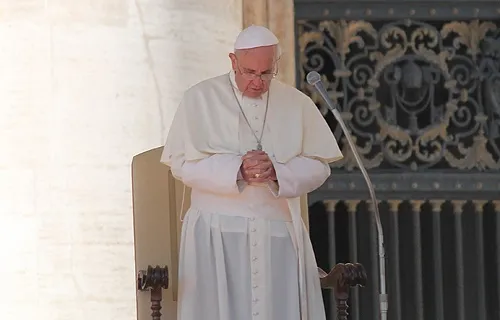
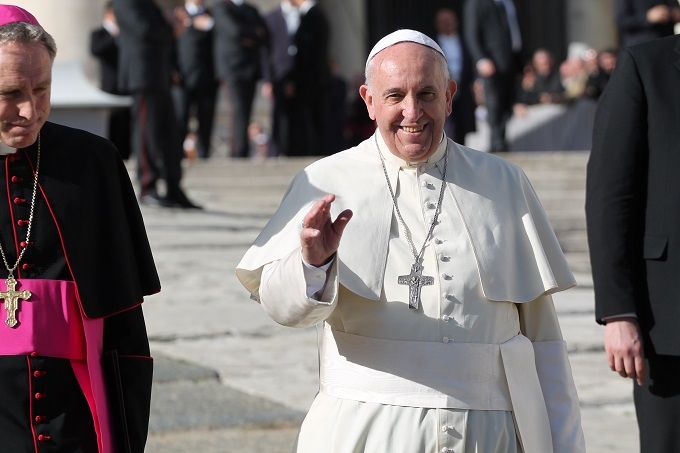
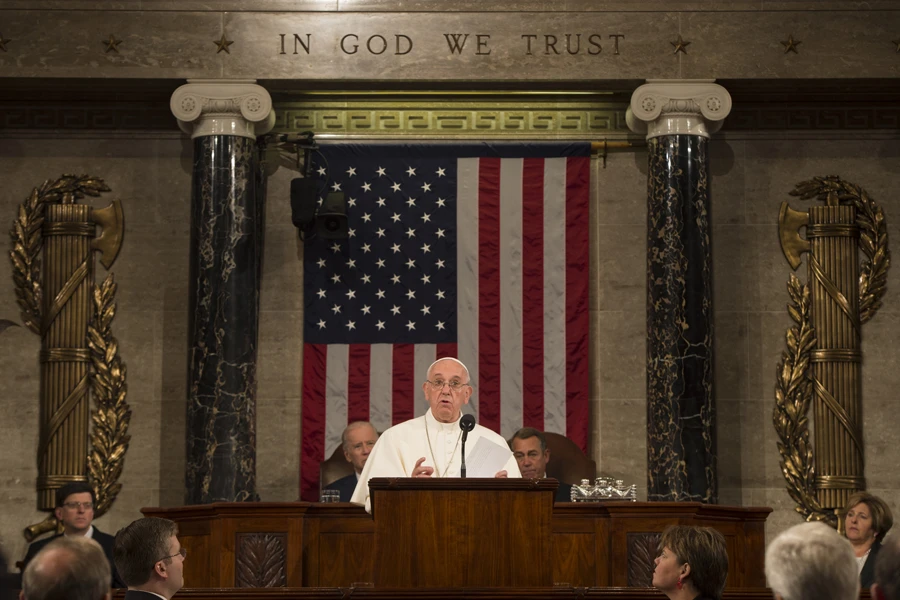
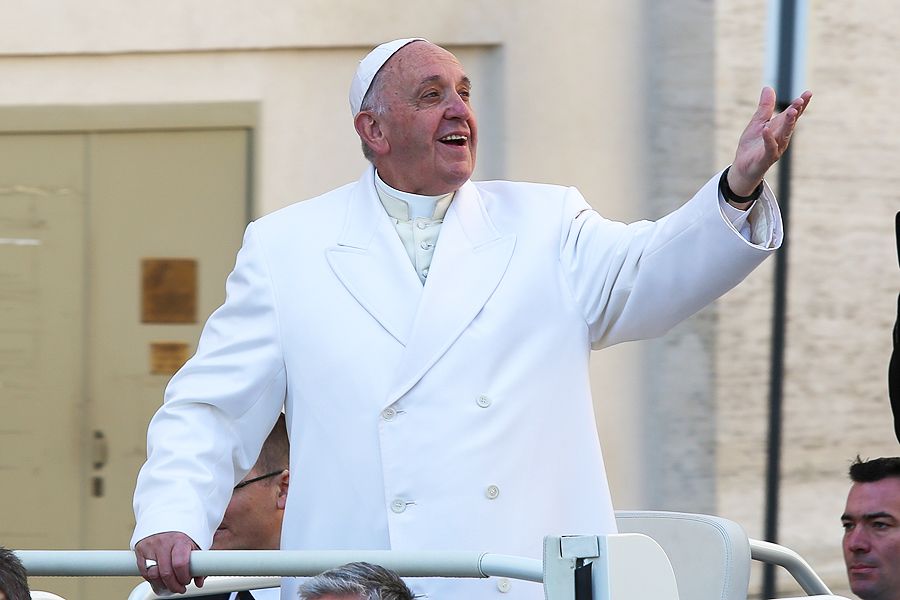
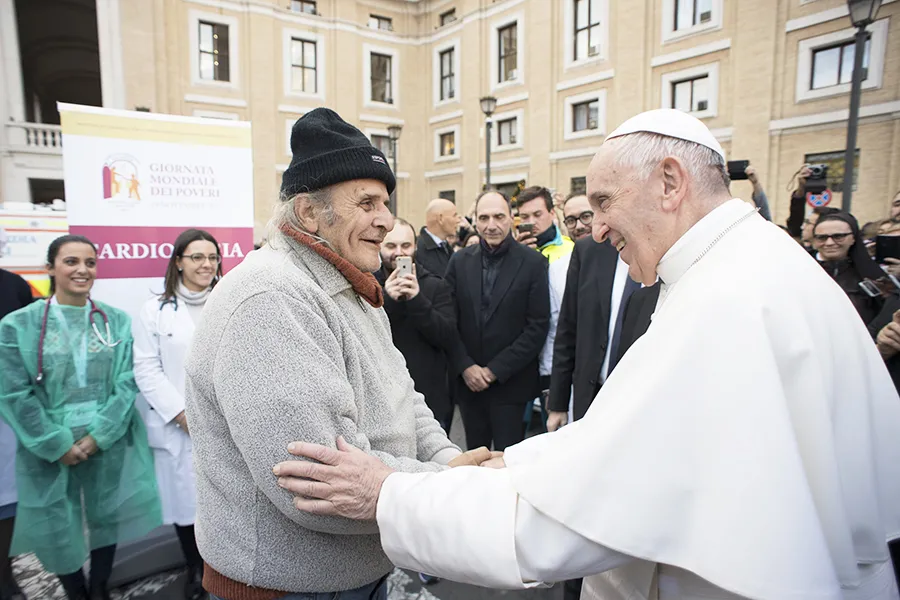
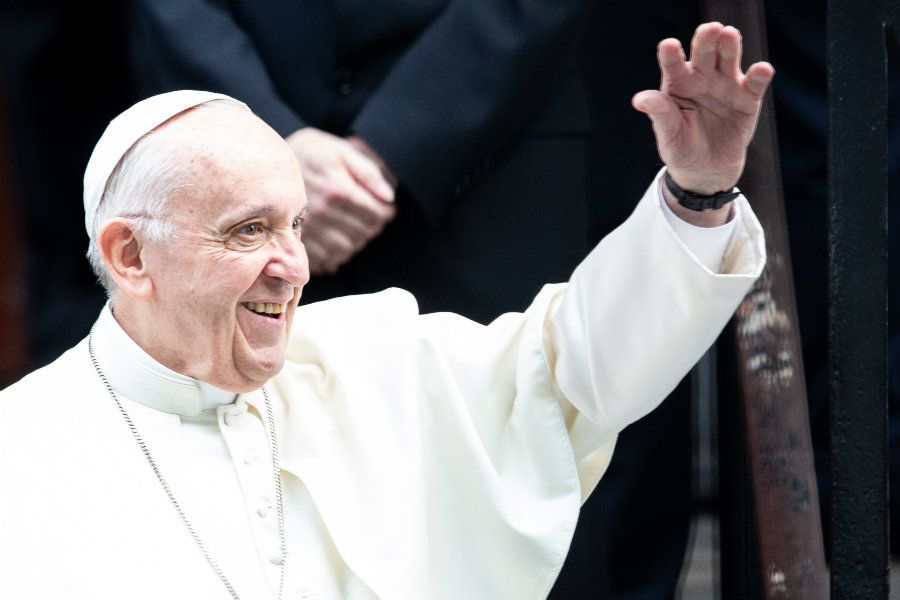
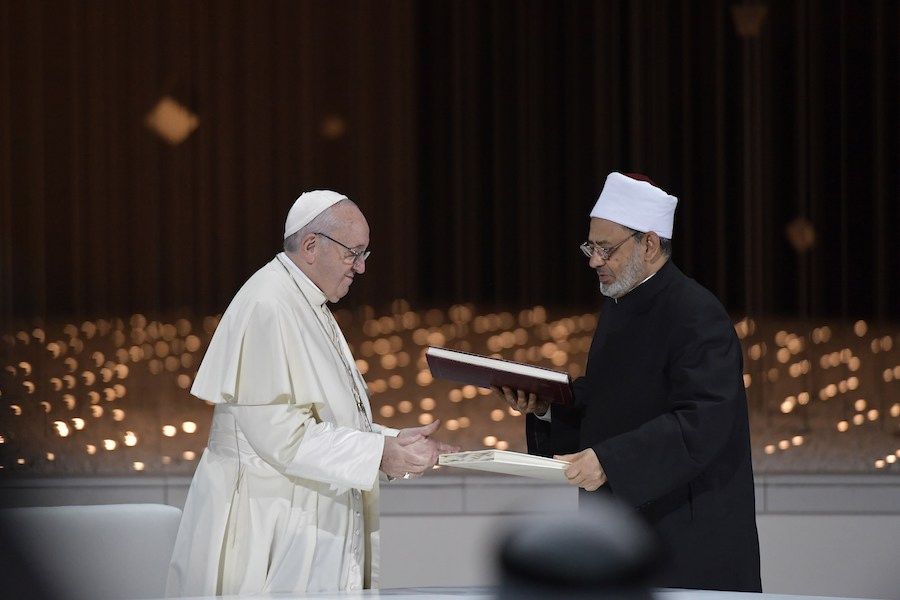




Justice and peace are two sides of the same coin. Where there is justice, there is peace. “Let us strive always to embody this experience of a Church of justice, peace, and love” – His Holiness Pope Leo XIV.
[I have] a hunger for a Church that truly knows how to open its doors and receive everyone — where there is love for all and no one is an enemy, where we all know how to live out reconciliation, forgiveness, and peace,” the pope told the crowd at the lunch, hosted in the gardens of the Borgo Laudato Si’.
A wonderful image. Although we cannot justifiably achieve by forms of punitive policy like condemning American efforts at removal of illegal migrants, deifying the migrant, placing all one’s energy on climate control, criticizing governments for using fossil fuels. Pope Leo’s dream can only be achieved by the interior conversion of hearts. The Church must focus on the original Apostolic, as compared to new age sanctification.
Vapid platitudes.
Socialism is the cause of poverty.
Socialism is one cause, but not the only one. Moral degeneracy is another.
MrsHess: the two – socialism and moral degeneracy – go hand-in-hand.
The Pope’s and many Catyolics ignorance of economics is abysmal. They hate capitalism, for example. They could start by reading Economics in One Lesson by Henry Hazlitt:
https://www.amazon.com/Economics-One-Lesson-Shortest-Understand/dp/0517548232
Before capitalism, most of the global population were living in extreme poverty. From 90 percent in 1820, the rate has now fallen to 10 percent.
—IN THE FORMER SOCIALIST COUNTRIES THE INCREASE IN LIVING STANDARDS after the fall of communist Russia has been dramatic.
—In China, the abysmal conditions UNDER MAOIST SOCIALISM, WHERE MILLIONS DIED, have been replaced by much better standards of living since the pro-capitalist reforms of the system where NOW WE FIND MANY CHINESE MILLIONAIRES IN “COMUNIST” CHINA.
DENG XIAOPING WAS THE PRIMARY LEADER RESPONSIBLE FOR INITIATING AND DRIVING THE PRO-CAPITALIST ECONOMIC REFORMS IN CHINA. EMERGING AS THE “PARAMOUNT LEADER” IN 1978 FOLLOWING THE DEATH OF MAO ZEDONG, DENG DISMANTLED COLLECTIVE FARMING, LEGALIZED PRIVATE BUSINESSES, AND OPENED THE COUNTRY TO GLOBAL TRADE, ENTREPRENEURSHIP AND FOREIGN INVESTMENT UNDER THE POLICY KNOWN AS “REFORM AND OPENING UP.”
Pragmatic Ideology: Deng famously stated that “it does not matter if a cat is black or white so long as it catches the mouse,” prioritizing economic growth over strict adherence to communist ideology. His approach, termed “Socialism with Chinese Characteristics,” introduced market mechanisms and supply-and-demand pricing while maintaining the political dominance of the Chinese Communist Party.
Implementation and Impact: The reforms began with decentralized local experiments, such as the household responsibility system in rural areas, before being adopted nationally. These changes transformed China from a stagnant, state-controlled economy into a rapidly growing market economy, lifting millions out of poverty and integrating China into the global economic system.
The central argument of Economics in One Lesson by Henry Hazlitt is that the art of economics consists in looking not merely at the immediate but at the longer effects of any act or policy, and tracing those consequences not merely for one group but for all groups. Hazlitt argues that bad economic policies result from a common fallacy: focusing only on the visible, short-term benefits to a specific group while ignoring the invisible, long-term costs to society as a whole.
To illustrate this principle, Hazlitt dissects numerous economic fallacies, arguing that:
• Destruction does not create wealth: The “broken window” fallacy demonstrates that destroying property harms the economy by diverting funds from other potential uses, such as buying new goods, rather than creating net new value.
• Government spending is not free: Every dollar spent by the government must be raised through taxation, meaning public works projects destroy private sector jobs and production that would have otherwise occurred.
• Labor-saving technology creates jobs: Machinery and innovation increase productivity and lower prices, which boosts overall demand and creates more employment opportunities than they destroy, contrary to the belief that automation leads to mass unemployment.
• Taxes and price controls are harmful: High taxes discourage production and investment, while price controls and minimum wage laws distort market signals, leading to shortages, inefficiencies, and increased unemployment.
• Saving is beneficial: Saving is a form of spending on capital goods that increases production capacity, and policies that encourage consumption over saving ultimately reduce economic growth and living standards.
Hazlitt advocates for free markets, free trade, and sound money, opposing government interventions such as inflationary monetary policies, fiscal stimulus, and protective tariffs. He posits that the ultimate goal of economic policy should be to maximize production and efficiency, as full employment is a natural by-product of a healthy, productive economy rather than a goal to be achieved through artificial means.
https://www.adamsmith.org/blog/is-capitalism-to-blame-for-hunger-and-poverty
See also the work of the great economist Ludwig von Mises:
https://mises.org/
Also worth reading is Bastiat, who described the “broken window fallacy”.
Bastiat was born in Bayonne in 1801 to a Catholic family, like the majority of French families of the time. He received all the sacraments required by the Catholic Catechism but, for most of his life, he was not religious. He returned to “the Catholic world in the last years of his life, in conjunction with the writing of his best-known works, but also in conjunction with the development of a serious respiratory disease due to which he struggled to speak. To treat this disease, doctors invited him to travel to Italy, hoping that the Mediterranean climate of the peninsula could help him. He made a first brief stop in Pisa and then moved permanently to Rome where he continued to write. Bastiat died on December 24, 1850 at the age of 49.”
“The Christian Faith in the Thought and Life of Frédéric Bastiat”
Mises Institute
Claudio Restani
October 8, 2024
Thank you for this about Bastiat, Pitchfork, which I did not know. Yes, Bastiat on The Candlemakers Petition is priceless.
https://mises.org/mises-daily/candlemakers-petition
China twists the arms of its residents in every facet ot their lives. You cannot believe the numbers the ccp quotes, either
“Here, we wish to remind everyone — through our lives rather than just our words — that no one is superfluous in the eyes of God and that every person is a gift to the entire community.”
Amen. Hopefully those that call themselves followers of Christ will be reminded to walk the walk not just talk the talk.
“Here, we wish to remind everyone — through our lives rather than just our words — that no one is superfluous in the eyes of God and that every person is a gift to the entire community.”
Excerpt the SSPX and seekers of the Vetus Ordo.
Except. Dang autocorrect.
Cheap sentimentality never puts food on the table.
Well since the Gerardo offered this quote “no one is superfluous in the eyes of God and that every person is a gift to the entire community.”
Does this seem cheaply sentimental given the treatment of the SSPX?
Who doesn’t want to eliminate the causes of poverty and injustice?
Not exactly riveting teaching.
At Deuteronomy 15:11 God says, “There will never cease to be poor in the land.”
At Matthew 26:11 Jesus says, “For you will always have the poor with you, but you will not always have me.”
“This is the Church we want to be,” the pope said. As opposed to how the Church IS?
If the pope likes the Church at a picnic table, he could cause a tent to be placed over it and celebrate the sacraments from there, couldn’t he.
Jesus said we’ll always have the poor with us, but it’s heartening to see our Pope meeting with them. Technology displaces many in today’s economy.
And just like that Luddism rears its ugly head.
Lamenting new technology is useless. When horses ceased being the principal method of transportation, blacksmithing ceased to be a means of earning a living. Likewise no more need for stables. Of course wheel and tire technicians emerged and the streets are no longer are filled with horse manure and flies.
The purpose of a business is to provide goods or services to customers. If a new technology emerges that allows the business to be more effective or efficient, those that adopt it will prosper.
A few days ago, I was able to see the Union Pacific “Big Boy”. As fascinating as steam is, it required an army to keep it on the rails. It’s replacement began in the late 1940’s (postponed by the war) and was complete by 1960. It meant the loss of huge numbers of hostlers, mechanics, oilers, pipe fitters, welders. The change came just as the railroads were facing emergent competitive threats from airplanes and trucks. Some roads were resistant (the Norfolk and Western only started getting diesels in the mid 1950’s and had one of the best steam rosters, plus the capacity to build their own), but they threw in the towel as well.
Had they not, a lot more employees would have lost their jobs, engineers, firemen, conductors, dispatchers, yardmasters and stockholders (not all are “fat cats” bemoaned by poster William), ranging from insurance companies relying on dividends to pay claims or pensioners would have lost out.
Unless somebody is actually assisting people adapt to the ever changing labor market, their laments about those changes are useless.
It’s obvious that fewer employees are needed in today’s world to get more work done. What figure did Mitt Ronney get caught on that tape which helped him lose – “50 million pay no taxes at all?” That’s partly caused by these people not having adequate employment, for lack of ability, skills or iniative.
It’s tone deaf saying that employment difficulties don’t contribute towards poverty. In my small business I had to buy technology because the cost and availability of labor got too high. Plus, the labor laws always seem skewed in favor of the complainer, and it’s harder and harder for a small business person to be in compliance.
“It’s tone deaf saying that employment difficulties don’t contribute towards poverty.”
Another red herring. Never said that. It’s like a fish market here today. It is entirely possible to lose a job (and most are lost due to reasons other than technology) at precisely the wrong time.
“In my small business I had to buy technology because the cost and availability of labor got too high.”
So you operate exactly as the law of economics suggests you would, although I rarely hear about availability being too high. So if you terminated employees, what sort of transitional assistance did you offer? Did your former employees become impoverished or did they find new employment?
Let me restate: “Unless somebody is actually assisting people adapt to the ever changing labor market, their laments about those changes are useless.”
Now let’s talk about a specific technology, those annoying grocery scanners. They exist for a few reasons. A lack of people with enough honesty and numeracy to make change-and minimum wages that make the acquisition of those “each item must placed” nags and other human eliminating machinery a rational decision.
I bought the neighbor kid his own lawn mower, one of those push types without a motor and told him to go out make some money.
Contrary to popular belief, the Luddites were not fundamentally opposed to all machinery. Instead, they were protesting how the technology was utilized. Mill owners used machines as a way to lower wages, hire unskilled, underpaid labor, and produce lower-quality goods, effectively tearing up the established social contract of trade labor. The Luddites fought back through organized “collective bargaining by riot,” which involved sending threatening letters to employers and smashing the industrial machines. The British government aggressively suppressed the uprising, eventually making machine-breaking a capital offense punishable by death.
Somewhat related, when the great textile mills of the US closed and moved to other countries, that put a lot of 50 year olds in the unemployment line. I can tell you from experience having your employer shutter your place of employment at age 54 is not a pleasant experience. The HR computers now look at your year of graduation and kick you out from that filter alone when applying. I have read where older workers are making a comeback, because they can solve a problem when they arise, and they also work a full shift or day! There’s a lot of older workers at fast food too.
“Contrary to popular belief, the Luddites were not fundamentally opposed to all machinery.”
Red Herring. I made no such assertion and nobody I know, has made such an assertion. It also doesn’t matter.
“someone who is opposed or resistant to new technologies or technological change.”
I understand to be a leftist once must have deficient knowledge of economics illiterate, but comments such the one quoted here that show the problem might not be a a mere lack of aptitude, education or experience, but a more profound cognitive disorder and a simple lack of effort to engage thing as they are, not how one imagines them.
And there is no “social contract”, Rousseau.
If you mis-understand the Luddites as anti technology rather than pro worker even when explained you have an ideological blind spot screaming for correction. I wish you luck.
In response to your comment about job fairs instead of complaints about the free world, below, you’re on the right track. I have helped people get jobs before, one is going to retire from it, and it’s a good feeling.
Our parenting and education system is not preparing the recently weaned for employment today. In the past, you could teach them now it’s harder to teach a newly hired employee in part because many never held an entry level position prior.
“send money when you can” is loosely from the depression (when they didn’t print money), like when John-boy would go work in the city on the Waltons so they could pay their property tax bill. In the one episode, he gets his first job, tells his new buddy how much his first check was even after having to pay his room and board, then two robbers who overhear him jump him when he’s on the street. He sends a letter back home and the family eagerly gathers around the envelope opening, like witnessing the signing of a peace agreement, only to be terribly disappointed in that he needs $5 to make it to the next paycheck. He does show up that weekend with the reward money for later catching the crooks!
The market is overpriced, so lock in your gains. Once the realities of the real economic situation are felt when the money supply is further tightened at the federal level, there could be some tough times ahead. AI is not going to save the economy.
If you’ve ever seen “How Green was my Valley,” the story centers around the relative prosperity of Welsh miners working in the dangerous coal mines, but then hard times hit when neighboring workers come in and will work for less, to avoid starvation. The head of the household tells his sons not to utter the word “socialism,” when they want to go on strike — the father finds it hard to believe the mine owners would not be loyal to them.
I’ve seen the movie, but better I grew up in Northeastern Pennsylvania and had a grandfather and a great grandfather that were miners. What do you want to know about mining? The difference between pea and rice coal, or perhaps what a “Menzes cone” does?
My grandfather died of COPD in his early 50’s (smokes played a role) and my grandmother was forced got a job as a seamstress, leveraging skills she learned from her mother and Singer-until decaying vision forced her retire-and no help from the ILGWU that took her dues, either.
My father, at the age of 53, found his 20 year “career” (it was a job, its always a job, nobody should confuse what they do with what they are) as a production planner ended not by technology, but economic pressures of the employer that struggled on for a few more years before being no more. Of course, the product was unique and he like many men of his age, no college degree.
It was years before I realized that what that look on his face was (the fusion of defeat and desperation) until he got another job. Around there it is called “up the creek, without a paddle”. He did get another job, then another as a factory worker, and while he felt like he lost some status, the drive was shorter and the money was better, even though in his late 50’s, after a heart attack, he had to keep up with one of my gym buddies, half his age and sporting a 365 pound bench press.
The point is, damn few people can avoid a job loss over their working lives. There’ll always be something going on to cause somebody to get a “pink slip” and its never convenient, even if you’re good at reading the tea leaves.
And the biggest risk no one expects is disability. When have you ever heard a priest or bishop tell people to make sure they are adequately insured? To exercise prudence and have a “rainy day” fund?
The point is, when people lose a job, they need encouragement, leads and marketing services-not moral grandstanders complaining about an economy that they are insulated from and ignorant of. I’m waiting for the Bishop that runs a job fair, instead of his er, pen. I guess if you can’t even recognize a candle, you curse the darkness.
This fall will be forty years since “Economic Justice for All”. Because surely, we all needed to lectured on justice by the lead in that endeavor, Rembert Weakland, who conducted a war orthodoxy, while stealing money from the Diocese to keep his homosexuality a secret. Can somebody tell me why he wasn’t referred for criminal prosecution?
And of course now, flooding the country with illegals is “justice”.
Pitchfork: yes, not all shareholders are “fat cats.” My portfolio has done quite well over the years, recently earning about $50K per year, which is satisfactory for a Bolshevik. So yes, some of the shareholders are even oppressed proletariat.
“Sell all you have and give it to the poor”
“send money when you can”
That’s not what the Lord said.
If he can brag about his investment earnings, he can now.
Thank you knowall. 🙂
Couldn’t Pope Leo just have lunch with the poor and leave at that? Does everything come with “virtue signalling?” This harkens back to one of my gripes about the modern papacy- over exposure resulting in irrelevance.
“The Lord hears the cry of the poor, blessed be the Lord!”
Amen
The words you quote are from a popular refrain of a hymn written by Jesuit John Foley and the St. Louis Jesuits. The song was said to be based on Psalm 34. The ‘versified’ psalm hymn is included in hymnals such as Glory & Praise, Gather, Breaking Bread, and many others commonly used in diocesan parishes, typically sung or said as a refrain to selected verses of a psalm within the Sunday Lectionary.
If one reads both psalm and hymn side-by-side, the difference between the words of the psalm and the hymn becomes stark for those with eyes to see.
Psalm 34 contains more depth of meaning than the versified focus of the Jesuit hymn.
Psalm 34
I will extol the Lord at all times;
his praise will always be on my lips.
2 I will glory in the Lord;
let the afflicted hear and rejoice.
3 Glorify the Lord with me;
let us exalt his name together.
4 I sought the Lord, and he answered me;
he delivered me from all my fears.
5 Those who look to him are radiant;
their faces are never covered with shame.
6 This poor man called, and the Lord heard him;
he saved him out of all his troubles.
7 The angel of the Lord encamps around those who fear him,
and he delivers them.
8 Taste and see that the Lord is good;
blessed is the one who takes refuge in him.
9 Fear the Lord, you his holy people,
for those who fear him lack nothing.
10 The lions may grow weak and hungry,
but those who seek the Lord lack no good thing.
11 Come, my children, listen to me;
I will teach you the fear of the Lord.
12 Whoever of you loves life
and desires to see many good days,
13 keep your tongue from evil
and your lips from telling lies.
14 Turn from evil and do good;
seek peace and pursue it.
15 The eyes of the Lord are on the righteous,
and his ears are attentive to their cry;
16 but the face of the Lord is against those who do evil,
to blot out their name from the earth.
17 The righteous cry out, and the Lord hears them;
he delivers them from all their troubles.
18 The Lord is close to the brokenhearted
and saves those who are crushed in spirit.
19 The righteous person may have many troubles,
but the Lord delivers him from them all;
20 he protects all his bones,
not one of them will be broken.
21 Evil will slay the wicked;
the foes of the righteous will be condemned.
22 The Lord will rescue his servants;
no one who takes refuge in him will be condemned.
*************************************************************
Hymn:
The Lord hears the cry of the poor
Blessed be the Lord
The Lord hears the cry of the poor
Blessed be the Lord
I will bless the Lord at all times
His praise ever in my mouth
Let my soul glory in the Lord
For He hears the cry of the poor
The Lord hears the cry of the poor
Blessed be the Lord
Let the lowly hear and be glad
The Lord listens to their pleas
And to hearts broken He is near
For He hears the cry of the poor
The Lord hears the cry of the poor
Blessed be the Lord
Every spirit crushed He will save
Will be ransomed for their lives
Will be safe, sheltered for their fears
For He hears the cry of the poor
The Lord hears the cry of the poor
Blessed be the Lord
We proclaim the greatness of God
His praise ever in our mouth
Every face brightened in His love
For He hears the cry of the poor
The Lord hears the cry of the poor
Blessed be the Lord
Is anyone able to look at anything now with new eyes?
Thanks for the summary; we sing it several times a year, (somewhat modified) as it’s in our permanent missal.
The plight of the poor is one of great mysteries of suffering. People don’t seem any happier if they “have money” and some poor people I know are more appreciative of what they do have. Too much money ruins many people, and our country’s manipulation of the money supply is making matters worse. When young people can’t afford to procreate there’s something amiss.
That was one of the hymns we sang way too many times in our choir.Definitely not one of my favorites. But to be fair, there are any number of scripture verses about God hearing the poor & needy.
Whether we heard & noticed them & did something about it will be what He asks us when we meet Him.
Leo should consider for just a moment that it is the poor who are ministering to the hardness in his heart rather than the other way around. Maybe, just maybe, it’s the poor who are feeding Leo!
My preference is that when I purport to help the poor I keep my mouth shut about it when I do.
Do you recall that Francis gave a washing machine to the homeless? It seemed to me a bald-faced sort of chutzpah to have the Vatican Press publicize that.
I couldn’t help but imagine God meeting Francis at his pearly gate reception, then mete out His justice. He’d give Francis a washing machine and ask him to consider how it could save him.
The Ole joke back when HMOs first were significant and causing shocks to inpatients and families: Guy dies suddenly and when his turn comes up with St. Pete, he gives his vitals then St. Pete asks him, what was your occupation? and the deceased replies. HMO CEO. He waves him in then yells after him, But you’re out on 3 days!
Good one!
I’m not sure about publishing our works of mercy but the poor and homeless need clean clothing as well as nutrition.
Our local Catholic Charities has several washers and dryers availble for that purpose.
We all hope we don’t wash out when we get vetted by St. Pete and Mother Theresa!
Me, too knowall.
🙂
Leo grew up in a tiny home, so he’s not from the elite crowd. He’s just bringing the need to light. A majority of the people in the US are one or two paycheck or wealth transfer payments away from daily living problems, and the personal debt is staggering.
I grew up poor, with five kids in the family. When dad lost his job during a recession, my parents determined to live on the $150 or so/month left over in the unemployment benefit, after paying the mortgage. Homelessness was just something they would not allow to happen to them.
We lived off peanut butter sandwiches made from home baked bread (It was cheaper than the store-bought sliced Wonder), and many was the summer day my brothers ate tomato sandwiches for lunch, picking tomatoes off the vines in the homegrown garden dad and the boys put in most years. Mom canned fruit from our trees (cherries, peach, pear) and preserved applesauce and vegetables. I could go on. We had Christmas gifts from the KOC or American Legion, and we had hand-me-downs from cousins. We couldn’t afford chocolate milk at school; white was a few cents cheaper, so that’s what we had, and it was delicious compared to the government surplus ‘powdered’ milk (skim) which was our usual fare at home. There were no free school lunches in those days, no community food bank, and the government surplus meat was something like spam. A neighbor who raised chickens gave us a couple/month, and that was Almost Heaven, Near West Virginia.
Speaking of the mortgage. If you’ve heard the story of Lindsey Graham’s family home, your vision of my childhood home wouldn’t be too far off. Dad built the small house we called home. It had a few closets but most of the rooms didn’t have doors until the kids went off to college.
One problem facing some of the poor today is that they are single parents with a low grade education, no prospects, no community of faith, and few friends who can help with moral support, teaching job skills, or more. Homelessness looms for many. Also, these poor folk don’t know how to stretch the money they do have. Home economics and budgeting are not part of their survival repertoire. One can actually live in the US on very little money if one has the know-how to do it, and not many have the resources to learn. Schools don’t teach many practical skills…in my day boys learned to make or repair common things in “Shop” class, and girls learned to sew and cook and clean and budget. Poverty is an overwhelming thing. And some people are poor because they are, let’s be honest, lazy. Some learn to con. Others check out on drugs. All around, it’s a big problem, and one lunch with a pope doesn’t really solve much, does it?
I also know quite a few well-to-do folk, and many of them live beyond their means, with large homes and new upscale appliances, renovations, vacations, summer camps and trips for the few kids, new clothes and cars and gardens. They are in serious debt, with large mortgages on very large homes. No one seems to have his head on straight these days. It is all a very sad farce.
I remember the government powdered milk too, meiron. We had a milk cow but the powdered milk came in handy when she was dry.
The cheese was very useful and the peanut butter was great, also. So was the recipe for peanut butter cookies that came with it. No flour needed. The USDA was non gluten before non gluten was cool.
🙂
How are you and your family today? I hope this finds your son doing well. 🙏
God bless!
There was a lot of that government cheese in the 80s. Stored in WISC caves even.
Panem et Circenses.
Do you understand how wasteful and stupid it was for the government to buy and store those things in order to manipulate commodity prices only to give them away for political favor?
The govt. cheese we had was basically Velveeta. I have a feeling you could probably store on the shelf indefinitely but I kept it in the icebox just in case. It made amazing macaroni & cheese.There’s a recipe using it to make fudge also.
Home economics and basic financial management should be required starting in middle school. Warren Buffett still lives in his starter home, or close to it.
People have no idea how to make food from scratch. like boil potatoes for dinner then the leftovers you fry for breakfast as hash browns (in bacon grease if you have some left over). The USDA or whomever is scaring people with these “expiration dates” is not helping. Who was it that ran on “a chicken in every pot?”
I knew a rural township supervisor who was going around updating the assessments on some of the new homes. He said one couple were arguing about whether they were going to pay the mortgage or car payments that month – that was 30 years ago.
One of the retirees at the coffee table remarked that they had brown bread and how come the families down the road had white bread. Turned out the ones on relief were given white bread, he found out later. They also used cardboard in their shoes if they were worn out.
Or maybe they bought white bread at the bakery outlet like we did.
🙂
The outlet we drove to sold entire shopping buggies full of stale bread & bakery items for $5.00 They had to label it “Hog Bread” because it was so out of date but most of it was perfectly ok to make dressing or bread pudding, etc. The rest went to the hog or chickens.
Turns out you are not the Pope!
If you want to put a HUGE dent in poverty then encourage young people to refrain from sexual intercourse until they are married….PERIOD!
And get rid of no-fault divorce.
The teen birth rate is currently lower than at any point in history. You can relax about that worry. Use your energy for hosting a lunch with poor families.
But it’s still fornication even if/if not artificial bc is used.
I think DR was thinking about out of wedlock births in general. Not just out of wedlock pregnancies for teens.
In my mother’s high school, graduating wearing an engagement ring wasn’t uncommon. People married earlier back then.
What makes you think that’s the only impoverishing aspect of teens engaging in sex without marriage?
Geard: You’ve missed the point so I’ll try to explain it to you. When a child is born out of wedlock and with no intention of the mother and father to marry and remain together, the child has a great likelihood of living in poverty for his/her childhood. Now, do you understand the reason to encourage young unmarrieds not to engage in sexual intercourse?