


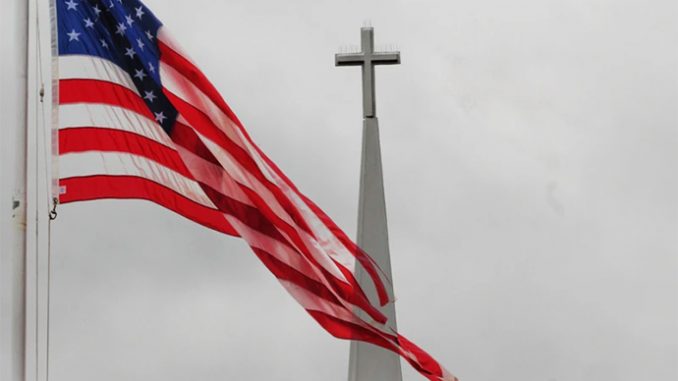
A recent article by Kenneth Craycraft, here at Catholic World Report, asked the question: “Should Catholics say the Pledge of Allegiance?” It suggested that Catholics need to think about what they are saying when they recite the pledge. I think, however, the author is overthinking the words of the pledge.
Craycraft writes: “When we say the Pledge to the flag, we are voluntarily expressing an oath to support and submit to the regime for which the flag is a proxy.” But while allegiance is support, it is not submission. And we are not pledging support for a regime but, rather, support for our republic. And we are certainly not taking an oath.
He also writes, “The words mean what the words say. And the words do not contain a qualification.” I have to disagree with this statement. No law that our representatives make can trump our free exercise of our religion. The First Amendment to the Constitution of our republic clearly states, “Congress shall make no law respecting an establishment of religion, or prohibiting the free exercise thereof . . .” This is a qualification par excellence.
I think he is also mistaken when he writes:
The words mean that allegiance to the flag and its republic are our highest commitment, and that all other commitments are subordinated to it. Regardless of any mental reservations, when we recite the Pledge of Allegiance, we perpetuate the myth (whether we embrace it or not) that American citizenship subordinates all other commitments. By the language of the pledge, the flag and the republic trump everything, including religious faith.
We are not pledging “unreserved allegiance” when we say the Pledge of Allegiance. We are only pledging loyalty to “the republic” for which the flag is a symbol. And as citizens of a country that is not “contrary to the natural law, to the public order, and to the fundamental rights of persons” (CCC, 1901), such loyalty is perfectly acceptable.
There is also a considerable difference between a pledge and an oath. A pledge is a serious promise of loyalty, but it is not morally or legally binding. I might, for instance, pledge support for a candidate for some office, but that pledge can be revoked if I find out the candidate has been hiding some nefarious past deeds. Similarly, a pledge of allegiance to our republic can be revoked if the government abandons our Constitution and suddenly turns fascist.
An oath, on the other hand, is both morally and legally binding. In a court of law, witnesses swear (i.e., take an oath) to tell the truth. If they lie, they commit perjury and can be punished. But the Pledge of Allegiance is not an Oath of Allegiance. It is a simple pledge of loyalty to the republic.
What’s more, every person who wants to become a U.S. citizen has to do more than just pledge loyalty to the republic. They are expected to recite the Citizenship Oath that goes far beyond the words of the Pledge of Allegiance. Fortunately, in taking this oath, the prospective citizen swears that he or she will “support and defend the Constitution,” which is the very heart of our republic. Should some regime discard the Constitution, that oath would no longer be binding.
Why, then, should any U.S. citizen have a problem with the Pledge of Allegiance?
And, just as an aside, compare the U.S. Oath of Citizenship to the UK Oath of Citizenship. In the UK, new citizens swear fealty to the king and his successors “according to law.”
Since the UK does not have a codified Constitution, the UK Constitution “can be altered relatively easily by the government of the day, meaning it changes more frequently than many other constitutions.” So, citizens of the UK are, to some degree, swearing loyalty to a set of laws that can change with the wind. (To some extent, this explains how “250,000 young British women have been exposed to repeated sexual exploitation” by “predominantly . . . Pakistani Muslim men” over the last two decades. But I digress.)
The Pledge of Allegiance also does not subordinate our religious faith. It’s actually the other way around. Our religious beliefs trump the pledge. Our laws and our Constitution guarantee this. Citizens of the United States even have the right to refuse to fight for their country if their religion forbids taking human lives. Approximately 25,000 men, for example, served in non-combat roles within various branches of the armed forces during World War II because their religion forbade taking lives.
So when we say the pledge, we are not “pledging unreserved allegiance to another sovereign [a sovereign other than Jesus Christ].” We are merely pledging to be good citizens of the republic. And this is required of us by our Catholic Faith.
The Catechism of the Catholic Church is clear: “The duty of obedience requires all to give due honor to authority and to treat those who are charged to exercise it with respect, and, insofar as it is deserved, with gratitude and good-will” (#1900)
The author also wrote, “If we give unqualified allegiance to the flag, even if we reserve mental qualifications, we are publicly suggesting that all things are subordinated to that fundamental commitment.” He then queried, “And how can we consistently proclaim that Christ is King over all things from one side of our mouth, while pledging unreserved allegiance to another sovereign from the other?”
But, again, the pledge is not an oath requiring our “unreserved allegiance to another sovereign.” And I would argue that the words “one Nation under God” make it pretty clear that our allegiance to God is paramount.
In short, the Pledge of Allegiance is a simple pledge of loyalty to what is, so far, the best system of government devised by man. Ours is a republic that recognizes “that all men are created equal, that they are endowed by their Creator with certain unalienable rights, that among these are life, liberty and the pursuit of happiness.”
Personally, I have no compunctions in reciting the Pledge of Allegiance. Neither should any good citizen of the United States of America.
If you value the news and views Catholic World Report provides, please consider donating to support our efforts. Your contribution will help us continue to make CWR available to all readers worldwide for free, without a subscription. Thank you for your generosity!
Click here for more information on donating to CWR. Click here to sign up for our newsletter.

The title says it all.
Once again I’ll remind you, anyone who actually knows anything about US history is well aware that the origin of the pledge of allegiance was an advertisement to sell flags. It’s nothing more than a commercial jingle. Are we going argue about whether or not Catholics are allowed sing commercial jingles from TV ads that become ear worms next? 🙄🙄🙄🙄
Nicole, the origin of the pledge of allegiance was NOT an advertisement to sell flags.
You are referring to Francis Bellamy’s revised version of the pledge that was part of an 1892 Youth’s Companion magazine promotion. The first version [of the pledge] was written in 1885 by Captain George Thatcher Balch, a Union army officer in the Civil War. Balch also wrote a book on how to teach patriotism to children in public schools.”
Again, other off the hip comment, completely at odds with the history.
The Pledge was not concocted by anything but flag selling merchants. It would be a lot less insidious and noxious if it had been. Instead, it was designed to promote fealty to the state, by a socialist masquerading as a Baptist preacher.
From:
The Pledge vs. The Oath
James Peron, The Foundation for Economic Education
May 1, 2001.
“…Bellamy, like his cousin, wanted to use government schools to help promote a socialist agenda. He felt that one way of encouraging this agenda would be the teaching of state loyalty. To this end he wrote a pledge, which students across the country were asked to take. With a few minor changes this pledge is what is now called the Pledge of Allegiance. (According to Black’s Law Dictionary, “allegiance” is an “Obligation of fidelity and obedience to government in consideration for protection that government gives.”)
Bellamy attempted to accomplish several goals with his Pledge of Allegiance. He saw it as a means of inculcating support for a centralized national government over the federalist system of the Founding Fathers. …”
Errata:
by, not but
Not all historians agree on everything. According to a Wall Street Journal article (https://web.archive.org/web/20151210183610/http://www.wsj.com/articles/SB10001424052748703735804575536041452086002) Bellamy found Balch’s pledge but thought it too juvenile, so he re-wrote it. It has been revised five times.
Thank you, Mr. Van Son, for this response. I had a similar reaction to the original article but could not generate a civil response.
The same goes for me. The article was unsound, to put it mildly.
The latest issue of First Things has an excellent essay by Notre Dame professor Vincent Phillip Munoz “The Founders and the Common Good” that addresses other notions about natural law and natural rights promoted by Kenneth Craycraft.
Sandra,
If you have the link to that article, can you send it? I cannot find the essay in the latest FT issue.
You’ve got your finger on the early first pulse of early release~! It wasn’t there yesterday on my feed, but it is there today!
Gene M. Van Son writes about this issue with common sense. As I wrote in response to the Craycraft article, Christ lives in me and I live in Him. Christ is my identity. I am a son of God as Christ is but only by adoption, not by nature. Therefore, to pledge allegiance to the flag, and to my country that I would defend against those wishing her harm does nothing to detract from my identity as one with Christ.
On yet another matter, many in our country swear oaths, most frequently in our lawcourts, but do NOT swear an oath “to God.” My contention is that an oath NOT sworn to God is meaningless and no oath at all. A person who “lies under oath” not taken to God cannot be committing perjury. If an oath is not sworn to God who is it that is insuring the truth of my words – the air? the environment? my neighbor? my family. An oath is sworn in the name of a Person to Whom I owe supreme allegiance and power over my life such that, if I defile this Person’s Name by lying when I’ve sworn to tell the truth IN HIS NAME, then I have committed a most sacrilegious act worthy of a most severe penalty. Our oath-taking only can have meaning if we have a culture with a common and shared belief in God. It’s no wonder that so many public figures these days lie under oath. Our justice system is seriously damaged. So, taking a pledge or an oath to a country without a common belief in God is, at most, just words.
Well said, Father. The dichotomy between the importance of God and the flag should not be a challenge. “One nation under God” should provide the moral courage for the faint of heart. Stand beside her and guide her” is not a “sales pitch. I don’t have a flag for sale. I did see a bible for sale at a bargain price of only $89.
Betsy Ross was one of the early makers of the first US Flag, having 13 stars in 1777. Historical accounts suggest she held Christian beliefs.
An interesting history of Betsy Ross…
https://www.ushistory.org/betsy/flagtale.html
God save our diverse Republic
Beautifully and wonderfully written. Mr. Van Son so clearly differentiates the rhetoric from the truth of our Pledge of Allegiance. Thank you, sir.
All a matter of subjective opinion, that is my opinion.
Matthew 5:34-37
New International Version
34 But I tell you, do not swear an oath at all: either by heaven, for it is God’s throne; 35 or by the earth, for it is his footstool; or by Jerusalem, for it is the city of the Great King. 36 And do not swear by your head, for you cannot make even one hair white or black. 37 All you need to say is simply ‘Yes’ or ‘No’; anything beyond this comes from the evil one.
Gerard, your quote Matthew 5, 34-47 and if I understand you correctly, you believe that these verses must be interpreted litterally. Is that correct?
What about Mk 9, 46-48: “And if your foot causes you to stumble, cut it off; it is better for you to enter life lame than to have two feet and to be thrown into hell. And if your eye causes you to stumble, tear it out; it is better for you to enter the kingdom of God with one eye than to have two eyes and to be thrown into hell, where their worm never dies, and the fire is never quenched.” Should these verses also be interpreted litterally? If not, why not? Who decides how to interpret the Bible, please?
This article is excellent! Very well developed thoughts. I agree as a citizen and a Veteran that without the Constitution and the Plegde, and a unique Flag, we have no Country to be loyal to while living life on earth. It in no way detracts from our focus on our faith and the promise of a Heavenly home when this life is over.
God Bless the USA…250 years!and many more!
There’s nothing sinful about being patriotic. There’s nothing evil about pledging your allegiance to the greatest country in the world.
I can pledge my allegiance, my fealty, my obedience to an ideal (to take the pledge of abstaining from alcohol, once a very common thing to do). I can pledge a fraternity, I can even pledge a furniture polish. But an oath is different. In the early church oaths were considered pagan because as followers of Christ, they held to his exhortation to let yes mean yes. Later under Christian Roman Emperor Constantine, oaths relating to governmental affairs became acceptable. This is a non-issue brought up by a writer craving attention or dissention.
I have no problem with the Pledge of Allegiance today. But from January 22, 1973, to June 24, 2022, the Roe v. Wade era, I certainly did have a problem. The right to kill little people had been read into our Constitution by our highest authority. Even to walk the streets of Washington DC was for me ominous and frightening during that time.
I agree wholeheartedly with Mr. Van Son.
Mr. Craycraft’s essay asserted a preposterously tortured set of presumptions about the Pledge of Allegiance.
Mr. Craycraft in a prior essay presented himself as a writer who is not only possessed of rather tortured thinking, but also intentionally provocative, and utterly disdainful of any opinions contrary to his own.
It seems altogether that Mr. Craycraft presents a very brittle way of thinking and writing.
Thanks for correcting the mistaken and ill conceived remarks in the previous article.
It caused much backlash, which you have skillfully corrected. Thank you.