
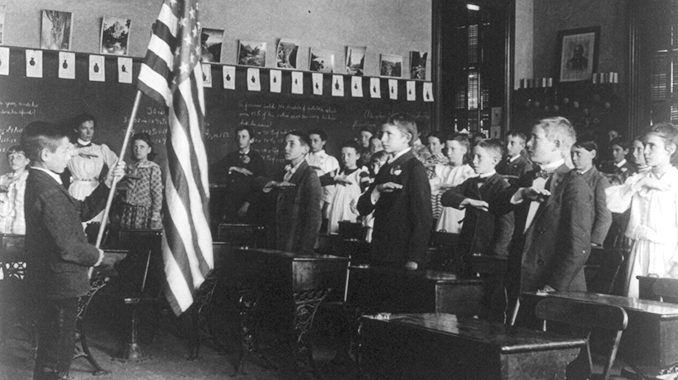
Many years ago, when my oldest daughter came home from her first day of second grade in our local public elementary school (after having been home-schooled for two years), I asked her how she liked it. “It was fine,” she said. “We started with a prayer that I didn’t know, but I think I’m learning it.”
“Prayer?” I asked her in astonishment. What prayer? What were the words? “Well,” she replied, it started with. “I pledge allegiance…”
It is not surprising that Abigail associated the Pledge of Allegiance with a prayer, not surprising that she did not know the words. She had been immersed in the liturgical practices of home and parish, so the form of the pledge resonated as a prayer. And, because I am not sure about the propriety of saying the pledge, my wife and I had not taught it to her.
As we celebrate the 250th anniversary of the Declaration of Independence of the nation whose flag Abigail was asked to pledge allegiance, it is an appropriate to ask: “Can Catholics give unqualified allegiance to our (or any) national flag?”
It’s not an idle or moot question. The Pledge of Allegiance isn’t merely an expression of loyalty (or patriotism). It has a performative effect on how we think about our relationship to the state. While we might toss off the pledge by rote without thinking about its implications, the collective impact of the Pledge is to instill and perpetuate moral and political commitments. It is as much an oath as a pledge.
When we say the Pledge to the flag, we are voluntarily expressing an oath to support and submit to the regime for which the flag is a proxy.
As far as I can tell, the United States is unique in having such a pledge. Even though it is largely taken for granted by most Americans, it is a very odd institution. It is not a pledge to a familial, linguistic, ethnic, or other natural demographic. Rather, the pledge is to a symbol (the flag) and an ersatz “republic”—a political entity, conceived in 1776 and born in 1789. When we say the pledge, we are not confirming a national identity, but rather submitting to the authority of a set of philosophical ideas and the political entity established by those ideas.
The fact that the Pledge is an expression of allegiance to a set of ideas and the state is of paramount importance. Unlike virtually every nation-state in the world, the United States is not the political expression of a national identity. Unlike the emergence, for example, of modern Italy in 1861 or Germany in 1871, the United States of America is not the consolidation of geographic regions under a common national identity. The American “state” does not emerge from an organic ethnic, linguistic, or other national demographic marker. Rather, it is invented by a document or a series of documents.
Arguably, there is no such thing as an “American” national identity. The United States is a State. But at least at its founding, it was not a “nation.” The Pledge of Allegiance is a pledge to the “Republic” (for which the flag is a proxy). But it is not an expression of solidarity with, or allegiance to, a national identification. It’s a pledge to an entity, not an identity. One might argue that indigenous Americans have a national identity. But that probably doesn’t work, as most indigenous Americans identify as members of a nation within the geographic area of the U.S., but distinct from it.
To illustrate, a Japanese national who is also a citizen of the state of Japan may renounce his citizenship by, for example, becoming a citizen of the state of France. But he cannot renounce his Japanese national identity. He is no longer a citizen of Japan, but he is still Japanese. But if an American renounces his U.S. citizenship, he ceases to be an American for all purposes. He might be “from” the U.S., but, unlike the Japanese person, he ceases to be an American when he renounces his citizenship. He no longer pledges allegiance to the state and its ideas, which constitute what it means to be an American.
But what if those political ideas are in tension (or even conflict) with the truths of the Catholic Faith?
When we say the Pledge of Allegiance, are we subordinating our faith to this invented national symbol and fictional state? Given that the pledge contains no limitation to the allegiance we are pledging, the logical conclusion is that any competing commitments must be subordinated to that unqualified oath. Faith must defer to the flag. Needless to say, that is a very serious problem, regardless of the actual content of the pledge or the political nation-state to which it commits us.
The problem is multiplied if we consider the provenance of the Pledge of Allegiance and the person responsible for inventing it. It was probably written by Francis Bellamy in 1892 as part of a promotional campaign for his magazine, Youth’s Companion. (Some historians think Bellamy might have cribbed it from someone else. But he was its promoter.) Bellamy’s purpose was less to encourage an assertion of allegiance to the U.S. than it was to renounce any national or religious commitment that might be seen to trump loyalty to the United States. A Baptist minister, Bellamy was an anti-Catholic, anti-immigrant nativist. Typically of late 19th-century nativists, his purpose was to effect the assimilation of southern and eastern European—and mostly Catholic—post-Civil War immigrants.
The Pledge is more about renunciation of national and religious commitment than affirmation of allegiance. It might not be unfair to conclude that the Pledge—at least as originally intended—is an expression of bigotry rather than patriotism.
Please note that by no means am I asserting that everyone who says the Pledge is participating in this bigotry. Its origins—and Bellamy’s intention—are mostly unknown to most of us when we say the Pledge as an act of patriotism.
One might counter that the Pledge itself contains the qualification “under God.” Indeed, Catholics are fond of pointing out that the phrase was added in 1954 by President Eisenhower, after the tireless campaign of Blessed Fr. Michael J. McGivney. But this compounds rather than reduces the problem. The phrase is not a qualification of allegiance, but rather an assertion of divine sanction of it. It is the “nation” (according to the Pledge) that is “under God,” not the person reciting it. Contrary to qualifying allegiance to the republic, it asserts divine favor for it.
Now, I know that many readers of this column both recite the Pledge of Allegiance without compunction and reserve qualifications in their own minds. “I pledge allegiance,” so the process goes, “but this allegiance is subordinated to my Catholic faith. When there is a conflict, my allegiance to the flag must yield to my fidelity to the Gospel.” This is a perfectly reasonable position. Indeed, if one does recite the Pledge, I would contend it is a necessary practice for the Catholic Christian.
However, that does not resolve the problem. The words mean what the words say. And the words do not contain a qualification. The words mean that allegiance to the flag and its republic are our highest commitment, and that all other commitments are subordinated to it. Regardless of any mental reservations, when we recite the Pledge of Allegiance, we perpetuate the myth (whether we embrace it or not) that American citizenship subordinates all other commitments. By the language of the pledge, the flag and the republic trump everything, including religious faith.
The 250th anniversary of the Declaration of Independence is an auspicious time to ask ourselves what it means to be American Catholics (or Catholic Americans?), and to reevaluate how our faith commitments do or don’t align with American values and commitments. I am not suggesting that we cannot be good American citizens, nor that we cannot sincerely embrace the good things about the United States. We can and we should.
On the other hand, celebrations of American identity must be subordinated to the truth of the Faith, not vice versa. Our unqualified allegiance is to the Gospel of Jesus Christ. Everything else—family, country, or nation—must be subordinated to, and relativized by, that primary allegiance.
If we give unqualified allegiance to the flag, even if we reserve mental qualifications, we are publicly suggesting that all things are subordinated to that fundamental commitment. What kind of witness is that to non-Christians?
And how can we consistently proclaim that Christ is King over all things from one side of our mouth, while pledging unreserved allegiance to another sovereign from the other?
These are questions that a short column cannot answer. But a short column can raise them and, thus, challenge us to think more deeply about what it means to be a Catholic in secular America. If we think it is easy, we are probably doing it wrong.
If you value the news and views Catholic World Report provides, please consider donating to support our efforts. Your contribution will help us continue to make CWR available to all readers worldwide for free, without a subscription. Thank you for your generosity!
Click here for more information on donating to CWR. Click here to sign up for our newsletter.


“And how can we consistently proclaim that Christ is King over all things from one side of our mouth, while pledging unreserved allegiance to another sovereign from the other?”
When we say, “One Nation, Under God”, and thus Indivisible, with Liberty and Justice for all, we are first and foremost pledging allegiance to The Author Of Love, Of Life, And of Marriage, The Most Holy Blessed Trinity, and thus The Author of our inherent unalienable Right to Life, to Liberty, And The Pursuit of Happiness, the purpose of which is what God intended, and we mean it.
1970s Catholic school grade 1-8. morning routine was prayer then face the flag and recite the pledge. Simple, reverent, and educational. The Dominicans understood the price paid 2000 and 200 years ago.
Freedom of religion & respect for freedom evident. If you prefer the opposite, go to China and try publicly converting; you’ll likely end up in the same status as the peaceful Falun Gong; many reportedly with parts missing.
Deliciously perfect! The understanding of the price paid 2000 and 200 years ago!!
Yes, when the pledge was first published, it did not have the qualifying phrase “under God.”
Yes, the phrase “under God” was added to the pledge by President Eisenhower in 1954. I understand, as stated in the essay, that Fr. McGivney, of Knights of Columbus fame, campaigned for this change. Perhaps he was the leader of this movement, or one among many leading this movement.
Certainly, the idea that the US Republic is “this nation, under God” long preceded the 1950s, as that phrase was used by Abraham Lincoln in 1863 in his Gettysburg Address.
The essay makes a dubious and over-reaching assertion where it states that the idea that the US Republic is “a nation under God” merely means that those citizens who coined and use the term and believe in that idea are declaring the notion that ‘God is on the side of the United States of America,’ and NOT the principle that the US Republic is subordinate to God.
Of course, many Americans are atheists and radical secularists, and in fact do believe that the US Republic (and hence its government), is supreme, and is not subordinate to God. There are in fact political societies in the USA that advertise this belief by publishing an edited version of the Gettysburg Address that deletes Lincoln’s phrase “under God.”
Indeed, the conceptual idea of the US Republic is that our civil rights are an endowment from God, and thus must not be violated by any government or agency or person or group of persons or majority of persons, because any such government or person or persons etc are guilty of tyranny.
In contrast, it seems preposterous to suggest that Fr. McGivney intended anything other than to assert that the US Republic is subordinate to God.
It seems likewise preposterous to suggest that Abraham Lincoln intended anything other than that the US Republic is subordinate to God. His Second Inaugural Address is profound evidence to that Lincoln believed that God had punished the United States with the Civil War because of the sin of allowing the injustice of slavery.
Thus, while it is true that some US citizens can interpret, as the author suggests, that the pledge of allegiance is to be construed that it is only a pledge of ”unqualified allegiance” to the US nation or state or government, that’s clearly not what is intended by such citizens as Lincoln or Fr. McGivney. When they use the words “under God,” we know from their own beliefs that by “under” they mean “beneath.”
And as Abraham Lincoln replied to an admirer, who expressed her confidence that God was on the side of the Union in the Civil War, “Pray instead madame that we remain on God’s side.”
So to those who love the US Republic and celebrate our 250th Day of Independence, may God bless and keep America, and give us, as Catholic citizens, the grace to do only what God wills, and to be what he created us to be, “the salt of the earth.
Amen! Well phrased response to what appears to be WOKE propaganda.
So many times after I reconverted to our beautiful Catholic faith , I found myself hesitating to the pledge for the very reasons listed. It felt awkward to put an allegiance to my country in place of my allegiance to God.
“Give unto Ceaser what is Ceaser’s, give unto God what is God’s.”
Amen.
The ultimate answer from The Word Made Flesh.
Amen. For those who misconstrue His meaning? Happy Fourth of July to you!
I also was raised not to swear an oath as it can be idolatry. Pledging allegiance to a flag was not done.
In what country did you grow?
The USA. Born and bred.
Were you ever called to jury duty? Jurors have to take an oath or make a pledge or a solemn affirmation “that they will try the case fairly, listen only to the evidence presented in court, follow the judge’s instructions on the law, and base their verdict solely on that evidence.” Would this be against your beliefs?
Yet none of us would be here, in our current form of freedom, were it not for the revolution. It seems like some on here are comparing apples and oranges of idealisms, which I don’t understand. The Brits never would have given up the colonies and their tyranny over our forefathers if not forced to. Never.
For those feeling America is all about racism, William Flora, a free born Black, was a hero at the Battle of Great Bridge in Dec 1775, mostly by ripping a plank from the bridge making a British crossing impossible.
I don’t believe the US was ever all about racism. But a free person of colour in the 1700’s might have had a differing perspective than that of a slave.
I was listening to a history podcast this morning knowall, & they pointed out that of the 20k people of colour who fought in the revolution approx. 5,000 fought on the side of the rebellion. 15,000 fought for the Crown. The British offered freedom to those slaves who fought on their side & after the war the British Navy evacuated thousands of Black Loyalists, including a slave of Washington’s, to Nova Scotia & freedom. Some of their descendents still live there today.
John chapter 18: 33)Pilate therefore again entered into the praetorium, and he summoned Jesus, and said to him, “Art thou the king of the Jews?”
34)Jesus answered, “My Kingdom is not of this world. If my kingdom were of this world, my followers would have fought that I might not be delivered to the Jews. But, as it is, my kingdom is not from here. 37) Pilate therefore said to him, “Thou art then a king?” Jesus answered, “Thou sayest it; I am a king. That is why I was born, and why I have come into the world, to bear witness to the truth. Everyone who is of the truth hears my voice.” Pilate said to him, “What is truth?”
“This treaty, signed on September 3, 1783, between the American colonies and Great Britain, ended the American Revolution and formally recognized the United States as an independent nation.”
The Treaty was declared “In The Name Of The Holy Undivided Blessed Trinity”.
Treaty of Paris (1783) | National Archives
The Pledge of Allegiance reads: “”I pledge allegiance to the Flag of the United States of America, and to the Republic for which it stands, one Nation under God, indivisible, with liberty and justice for all”
In my country the UK the Oath of Allegiance to King Charles III reads: “I, [name], swear by Almighty God that I will be faithful and bear true allegiance to His Majesty King Charles III, his Heirs and Successors, according to law.”
Both of these are licit. The following, the Wehrmacht Oath is not:
“I swear by God this holy oath that I shall render unconditional obedience to the Führer of the German Reich and people, Adolf Hitler, supreme commander of the armed forces, and that as a brave soldier I shall at all times be prepared to give my life for this oath.”
https://www.archives.gov/milestone-documents/treaty-of-paris
“This treaty, signed on September 3, 1783, between the American colonies and Great Britain, ended the American Revolution and formally recognized the United States as an independent nation.”
Our Nation was declared a Nation in “The Name Of The Most Holy Undivided Trinity”, thus we have always recognized we are One Nation, Under God, and thus Indivisible, with Liberty and Justice for all.
Happy 4th of July!
Thank you for this article.
I’m not a fan of the American Revolution, I believe both we and Britain missed an opportunity. But I don’t have a problem with pledging *allegiance *. Or with patriotism as a virtue of filial piety.
Of course, any objectively good thing can be hijacked .
Thank you for sharing the history behind the Pledge. A number of things during the 19th and early 20th centuries were motivated at least in part by anti immigrant and eugenic ideologies. It’s good to be informed about that because those kind of ideologies have been recycling right up to the present.
Why are columns like this being published in CWR?
I agree. It causes confusion. One should never dissect a piece of writing into separate parts and destroy the full meaning of its unified, intended purpose as stated in the complete Pledge of Aliance. This is poor, misguided analysis.
I agree. This article is confusing.
It reasonably discusses an issue about which some people disagree.
I was in Catholic elementary school in the 1940s. We recited the Pledge every morning, first thing. Never then, nor since, have I recognized the Pledge as anything more than a reminder of my responsibilities as a citizen in a democratic republic that relies on allegiance to a set of principles rather than “blood and soil” identity to unify its people. Perhaps I have been naive in not recognizing the the subtle implications in the recitation of dthe Pledge. Still, I remain content with my understanding.
Excellent article excellent, I have eight children and they were mostly raised in a traditional catholic family we went to Latin Mass but we also went to Novus ordo but traditional prayers family prayers at the dinner table. I can’t remember exactly but I do remember that either one child or a couple of the children when they came home from school and they were about the age of your child did say we prayed to the flag today and we found that very interesting. My father cradle Catholic and a Korean war veteran, dislike the Constitution and the flag very much he did not want to go to war but he went but he fought to end the draft during the Vietnam era with the barrigan brothers Dorothy Day and the whole Catholic worker group.. they too are Americans and their Catholic.. your child is blessed and your family is raising them properly.. your article is excellent and needs to be circulated more and more to get people to start thinking on a higher level. God bless you and your family and let’s be careful about praying to a flag.
Excellent article, so so true. I have eight children and I don’t remember if it was one or a couple of them but when they went to school and they came home they said to us during dinner we prayed to the flag today and I was so impressed with that that they had that insight. My father a Korean war veteran, hated war and during the Vietnam era he fought with the Catholic worker movement the barrigan brothers Dorothy Day and others who were catholic to end the draft. Remember they were catholic and our Holy Father has just mentioned Dorothy Day in his first encyclical. Your daughter and your family are blessed to have that insight I wish I could go to mass on Sunday and talk to people who had some kind of insight about something anything and fellowship with them. God bless you and your family, and Catholic world report for giving me a little hope that there are real people in the world today
The word “allegiance,” from “liege,” does not mean supreme loyalty–but only earthly political authority. The medieval knight calling some dude “my liege” is promising obedience, but not in all things.
You need to understand the Pledge of Allegiance in its entirety, right up to its final statement “one nation under God with liberty and justice for all.”
And I would add the right to life (which is the first stated right (for all living persons both born and preborn babies in their mother’s womb), in our Declaration of Independence. Amen
yes, the unborn dependent on the parent prior to and after birth!
“It is as much an oath as a pledge.
“When we say the Pledge to the flag, we are voluntarily expressing an oath to support and submit to the regime for which the flag is a proxy.”
Merriam-Webster and many other analyses of semantics distinguish between oath and pledge. Oaths are typically more formal, involving individuals, and invoking a legal or religious authority as witness to bind performing the oath. Pledges are more aspirational, inspirational, without holding individuals to any sense of dishonorable long-term ramification if the pledge is not honored.
My generation and those following grew up reciting the Pledge and I don’t think any of us believe we’re hellbound if we refuse to owe the country much of anything beyond a gratitude for good streets, running potable water, safety, free markets, and INALIENABLE, UNALIENABLE RIGHTS to include freedom to practice our religion and own property. Of course we pay taxes to keep the system running.
***********************************
What is the ‘regime’ to which Craycraft refers? “Regime” connotes a dictatorship, authoritarian, or militaristic government. Is that what the author images as the dominant US character? If so, I’ve got an Antarctic ice chunk he NEEDS to chill his overwrought brainwave sizzling.
Hey Crafty! Enjoy your hotdog! Hope the firewords don’t keep you up tonight!
Just because a statement lacks an explicit qualification doesn’t mean that it’s an unqualified statement. If a mother says to her baby, “I love you best,” this doesn’t prove automatically that she’s committing idolatry. It would in fact be absurd for her always to add “among all creatures” or whatever. So while the author is correct to say that no one should take the pledge in an unqualified way, I think he’s incorrect to say that the pledge is automatically unqualified because of the way it’s written.
The Pledge of Allegiance needs to be read and understood in its entirety right up to its final declaration “One nation under God with liberty and justice for all.” As reinforced by our Declaration of Independence with its first stated right to Life (all lives both those that are already born and those preborn babies in their mother’s womb). Amen
I am extremely puzzled by the whole thrust of this article.
First, as a baptized Catholic, my relationship with Jesus Christ is that of union. I am a member of His mystical body. I pray that my union with Him may become so total that I am, as St. Paul wrote, “one spirit with Him.” No form of allegience can come close to this.
Second, a study of the word “allegience” refers to the mutual relationship established between a feudal lord and his vassal. J.R.R. Tolkien describes this relationship in The Lord of the Rings, where Merry is accepted as a liege vassal of the King of Rohan, and Pippin becomes the liege vassal of the Steward of Gondor. (It may interest Mr. Craycraft that I and many other religious use the same gesture of placing our hands between the hands of our superior when we say or renew our religious vows.)
Third, Mr. Craycraft is correct that the United States, as a nation, is not an ethnic reality. It exists as a political unit solely by adherence to a document (not to the ideas behind the document, but to the document itself; members of the government pledge themselves by oath to “support and defend the Constitution of the United States against all enemies, foreign and domestic; that I will bear true faith and allegiance to the same; that I take this obligation freely, without any mental
reservation or purpose of evasion; and that I will well and faithfully discharge the duties of the office on which I am about to enter. So help me God.”)
Fourth, patriotism is a virtue in the Catholic Faith under the “order of charity.”
Since my relationship with Jesus Christ far surpasses anything that any form of allegience can possibly require, since adherence to the government (not the “regime”) of the United States is in the framework of the Constitution, and since I am bound by the virtue of patriotism to uphold the foundations on which this country exists, I cannot see any conflict of interest in pledging allegience “to the flag and to the Republic for which it stands.” In fact, I understand that for me to do so flows naturally from my union with Christ, since patriotism is part of charity.
So does the United States of America now or as it was in 1783 have a right to exist? Why or why not? If not, what form of government would the author prefer? If the USA isn’t a “nation,” what about Canada, Australia, New Zealand? Or the rest of our hemisphere, all former colonies and many, like Mexico, transformed into republics by armed revolt. What about India and Indonesia, states encompassing a wide variety of ethnic and linguistic and religious groups united by colonial powers. India gained its independence by negotiation, Indonesia by rebellion. Most African countries are colonial creations with borders that did not necessarily correspond to the borders of pre-existing tribes and kingdoms. Each European present nation emerged from waves of settlement, wars, dynastic and political changes since Paleolithic times.
To my eye, the author isn’t happy with the United States government–calling it a regime gives the game away–and therefore tries to construct arguments against pledging allegiance to it. Naturalization requires signing and reciting an oath of allegiance, too. Should Catholic immigrants naturalize?
Ms. Miesel:
I concur with your question to the author.
As you have noted, regarding mere countries, the question about the assessment of the US Republic is: “As compared to what alternative?”
Oaths of allegiance have been a standard feature of European political life for over a thousand years (vassals to lords, nobles to kings, officers to sovereigns) and all built on the same unspoken premise: an oath to Caesar is bound beneath a higher duty to God with no footnote required to make it so. The author’s real argument depends on ignoring that premise entirely. He insists that because the Pledge contains no printed exemption for religious faith, it must logically demand total, unqualified submission, as if oaths only mean what’s typed on the page. What oath in Christendom has ever worked that way? A knight swearing fealty didn’t recite a Church exemption clause; a soldier swearing to obey orders doesn’t state “except unlawful ones” each time. The limit is built into what an oath is, not bolted on by explicit text. So the author is holding the Pledge to an unreasonable standard and then treating the absurd result as a discovery about America, when it’s really just a defect in the method.
Lane,
Here, here. Craycraft seems to work hard to make things problematic, which he can then use to criticize America. Much of his writing, here and elsewhere, is all about finding fault with various aspects of the country, and he spends a good deal of time and effort criticizing the history of America. It’s almost like he feels stuck living here and wishes he were in a catholic confessional state, which, of course, no longer exists anyway, and there is arguably not even such a general thing anymore as a catholic country.
Thanks for the comment and agreed. I see this phenomena often with liberal baby boomers but also in the NYT opinion section. It seems to be an adolescent spirit of state of mind that doesn’t want to see or understand.
I grew up around older siblings who would be what were called “hippies,” with their anti establishment attitudes, Boone’s Farm and that stinking smoke that escaped when they finally started breathing again. Guess what, they all now are on Medicare and SS, and most of them detest Trump! They remark as if they would be happier moving to another country, even though when they decided to use the talents God bestowed them with, they did quite well in this country in a middle class way. They also think the Democratic party is a mirror of JFK. As Lane notes, there is no desire to change their thinking, and don’t try.
Matthew 5:33-37 says:
“Again, ye have heard that it hath been said by them of old time. Thou shalt not forswear thyself, but shalt perform unto the Lord thine oaths: But I say unto you, Swear not at all; neither by heaven; for it is god’s throne; Nor by the earth; for it is his footstool: neither by Jerusalem; for it is the city of the great King. Neither shalt thou swear by thy head, because thou canst not make one hair white or black. But let your communication be yea, yea; Nay, nay: for whatsoever is more than these cometh of evil.”
I have no special affection for the Pledge, for several reasons.
Principally it was concocted by one Francis Bellamy who was a Baptist Minister and a Socialist, who preached that Christ was a socialist. In other words, he was socialist and found the ministerial life a good vehicle to spread the gospel-of Marx-in other words-he was a subversive parasite. We have them in our episcopacy-so not “throwing shade” on Baptists.
It was no published in initial form after publication in 1892. It no doubt spread because in 1892, there were still families missing sons and men missing limbs from the great war, but it’s still statism masquerading as patriotism. The words are constantly changed. It wasn’t until 1954, that “under God” was added by Congress at Eisenhower’s urging. The SCOTUS initially ruled in its mandatory recitation by school children was required in Minersville School District v. Gobitis, 310 US 586 (1940). Three years later, with three Justices changing their opinion the court reversed that decision in West Virginia State Board of Education v. Barnette, 319 U.S. 624 (1943).
It opposes the idea foundational to the Republic that governments derive their authority from consent of the governed, not indoctrination. And since the “Republic” has no been transmogrified into an kritarchist administrative superstate rapidly adopting novel technologies to erect a digital panopticon, “the Republic for which it stands” itself has fallen.
With that, this is the standard pedantry and provocation from Craycraft, (who on the rare occasion when he bothers to read the comments of the hoi polloi misquotes them). For such a consequential topic, one likely to arouse ossified opinions, it deserved a less condescending author.
Should Catholics say the “Pledge of Allegiance?”
Dumbest question to ask.
(I tried posting this earlier, but I seem to have problems with posting today.)
I am extremely puzzled by the whole thrust of this article.
First, as a baptized Catholic, my relationship with Jesus Christ is that of union. I am a member of His mystical body. I pray that my union with Him may become so total that I am, as St. Paul wrote, “one spirit with Him.” No form of allegience can come close to this.
Second, a study of the word “allegience” refers to the mutual relationship established between a feudal lord and his vassal. J.R.R. Tolkien describes this relationship in The Lord of the Rings, where Merry is accepted as a liege vassal of the King of Rohan, and Pippin becomes the liege vassal of the Steward of Gondor. (It may interest Mr. Craycraft that I and many other religious use the same gesture of placing our hands between the hands of our superior when we say or renew our religious vows.)
Third, Mr. Craycraft is correct that the United States, as a nation, is not an ethnic reality. It exists as a political unit solely by adherence to a document (not to the ideas behind the document, but to the document itself; members of the government pledge themselves by oath to “support and defend the Constitution of the United States against all enemies, foreign and domestic; that I will bear true faith and allegiance to the same; that I take this obligation freely, without any mental
reservation or purpose of evasion; and that I will well and faithfully discharge the duties of the office on which I am about to enter. So help me God.”)
Fourth, patriotism is a virtue in the Catholic Faith under the “order of charity.”
Since my relationship with Jesus Christ far surpasses anything that any form of allegience can possibly require, since adherence to the government (not the “regime”) of the United States is in the framework of the Constitution, and since I am bound by the virtue of patriotism to uphold the foundations on which this country exists, I cannot see any conflict of interest in pledging allegience “to the flag and to the Republic for which it stands.” In fact, I understand that for me to do so flows naturally from my union with Christ, since patriotism is part of charity.
What does the author mean by “ersatz” republic?
Yo, Craycaft…”Problem”? What problem?
In 1955-56 I (the same year as “one nation under God”) I was in a sixth-grade classroom that looked a lot like the one in the photo above. Every morning the entire class stood at our desks to recite both the Pledge of Allegiance and the Lord’s Prayer. This was a public school…
The teacher, Mrs. Lester, was 5’4″ of fire-eating personal conviction. A widow raising three you daughters on a measly teacher’s salary, she had lost her 6’4″ husband who was on a torpedoed troop ship just before Normandy. He died while helping four others escape the flooded engine room.
Mrs. Lester had this thing about Nazis and about academic smoke. Her reasoning was clear: “The REASON we do this is so if ‘they’ ever drag me out of this room and down the hall, you will know the reason why!”
Now, she was Nazorean while a third of the class were Catholic. The solution to this “problem” was that we Catholics were respected equally while we did not continue with the Protestant lines at the end of the Lord’s Prayer. And then, during recess, we all joined in an overlaid American civic religion–we routinely beat the other classes down the hall at baseball. (The Brooklyn Dodgers won the World Series in 1955 and, about this, the class remained sectarian.)
As for flags, the alternative today is the banner of rainbow ideology. Wake up and smell the coffee…and choose one.
(p.s., Since Vatican II the lines now appear in the words of the Mass but are clearly separated from the intact Lord’s Prayer with an insulating invocation from the priest.)
Certainly the author’s misgivings are understandable, given the legalization of abortion, etc., and the decay of the public school system in the U.S. Nevertheless, to paraphrase St. Thomas More, who was a lifelong Catholic, a lawyer, and at one point chancellor of England, I consider myself “the Republic’s good servant, but God’s first.”
This is just a side note but the “Protestant” lines at the end of the Lord’s Prayer ultimately derive from the Byzantine liturgy. They wandered into the Biblical text from a gloss because someone thought they originally belonged there. Adding the phrase to the Novus Ordo restores the practice of the East. Checking my copy of the Divine Liturgy of Our Father Saint John Chrysostom, the priest says: “For Thine is the kingdom. . . after the congregation has recited the Lord’s Prayer together.
Thank Miss Sandra, I hadn’t heard that before.
My daddy always prayed The Our Father with that ending and I still do the same.
It’s pretty cool. Sandra’s right, in the Byzantine Rite, the priest will say “For thine is the kingdom, the power and the glory, Father, Son and Holy Spirit, now and ever and forever” after the Our Father is sung.
The congregation says it in the Roman Rite. That’s one of the good things that came out of Vatican II. It allowed both the Eastern and Western Rites to better complement each other.
“…There is no such thing as an “American” national identity.” Really??? That is quite a false statement. Well honey, MY family has been here since the early 1600’s, and I NEVER think of myself as ANYTHING but American. I am American FIRST, always. If some of you want to agonize over your religious identity, and somehow feel that is a conflict, I will remind you that the US is one of the FEW places on the planet where you can worship as you wish. THAT is largely because of folks who called themselves AMERICANS and were willing to die so you could have that right. Nit-picking about it seems massively ungrateful to me. That they saw themselves as American did nothing to diminish their closely held religious identity, which they valued. And history revisionists be damned.
I have three documented Revolutionary War ancestors. One fought at Bunker Hill. One helped hold Fort Ticonderoga. One fought at the Battle of Yorktown. Of the three, two were SHOT during the war. One of them, an 18 year old, was shot in the chest in a location so close to his heart. according to records, that they couldn’t remove the musketball. He didnt return home to Connecticut or quit the service, but continued on with other American troops to Yorktown. Part of who they were is part of me. And you expect me to turn my back on that and worry about how many angels dance on the head of a pin?? No thanks. The rest of you are welcome to the OCD recriminations.
My feelings about my identity as a Catholic are cherished and intensely private. I will hold to my belief that Jesus knows exactly where I stand and why. There is nothing which prevents one from having an American identity and still being a Catholic. Period.
My daddy’s side of the family has been here also since the early 1600s. They *mostly* didn’t agree with armed rebellion or secession and some joined other Loyalists in regiments to defend against the rebels.
From what I’ve read, in the beginning about a third of colonists supported secession. Another third were loyal to the Crown. And a third didn’t have strong feelings one way or the other.
Wars are terrible things and revolutions/ civil Wars are the most destructive.
Should Catholics say the pledge of allegiance?
Tes
Would a simple “whoops” suffice?
Replace “Tes” with “Yes”
My bad
It happens to us all, Mr. Terence. And no editing options make those a permanent whoops.
🙂
One can make a pledge to something and yet have another pledge or committed faithfulness to a higher purpose. I can pledge an allegiance to the USA but in my hierarchy of commitments, it comes below by commitment to Jesus Christ.
I live in Christ and Christ lives in me. Therefore, I don’t fret about pledging allegiance to the flag, pledging allegiance to the Constitution, pledging to defend the Republic, and pledging to conform to the laws of the country. I sometimes think that some Catholics are wilting pansies with no common sense.
You are overthinking and reading too much into the Pledge of Allegiance. I don’t see in there anything that implies that my loyalty to the country is first, above God. In fact, “with liberty and justice for all” seem consistent with Christian virtues to me. Anyway, I am the “King’s good servant but God’s first.” It’s good to be proud of this country’s founding ideals and to pray for our leaders.
ersatz republic? What?
Who cares? Anyone who knows anything about US history knows that the pledge of allegiance was literally a made up advertisement to sell flags. You may as well argue about whether or not Catholics are allowed sing commercial jingles from TV ads that become ear worms. 🙄🙄🙄🙄