

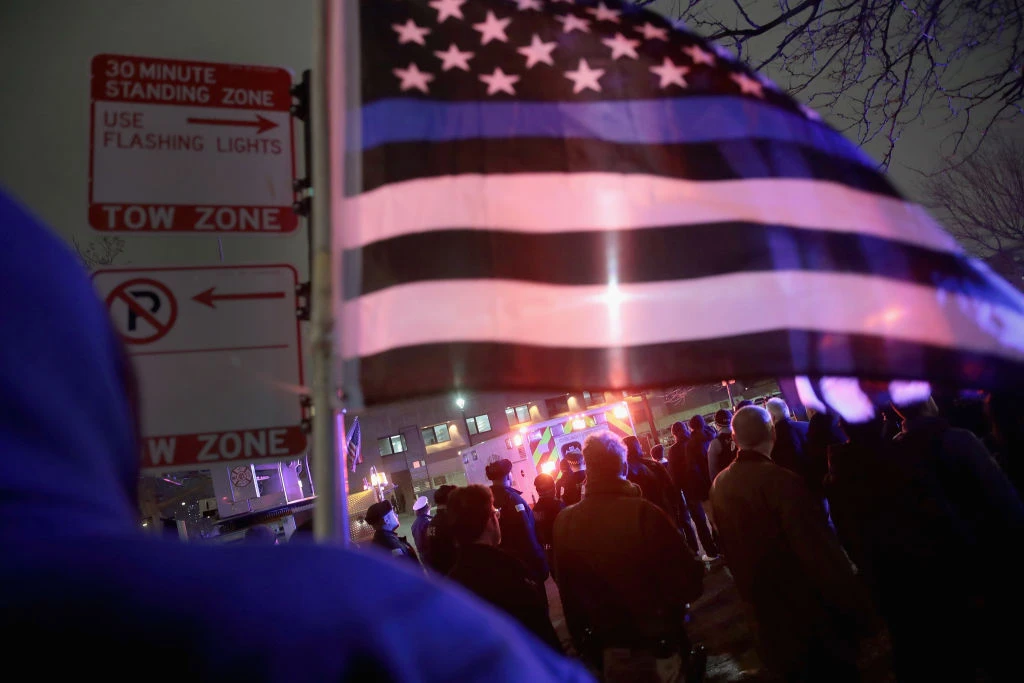
Chicago, Ill., Nov 20, 2018 / 12:29 pm (CNA/EWTN News).- After a shooting at Mercy Hospital in Chicago left four dead, including the gunman, on Monday afternoon, the president of the U.S. bishop’s conference offered prayers for the victims and called for reasonable gun restrictions.
“Yesterday, at a place which should be a center of healing, a police officer, a doctor and a pharmaceutical resident lost their lives in a senseless act of gun violence,” Cardinal Daniel DiNardo of Galveston-Houston said in a Nov. 20 statement.
“We entrust to Almighty God the victims and their loved ones and for [sic] the intercession of Our Lady of Guadalupe. May her love and compassion embrace and bring comfort to those who sorrow,” he said.
According to reports, the shooting is being investigated as a domestic dispute. Dr. Tamara O'Neal, one of the victims, had been engaged to gunman Juan Lopez until September.
The other victims of the shooting were Dayna Less, 25, a pharmacy resident and recent graduate of Purdue University, and police officer Samuel Jimenez, 28, who was responding to the shooting.
Lopez was found dead with gunshot wounds to the head; it is unclear if they were self-inflicted or if they were sustained while he exchanged gunfire with police.
Lopez had worked for Chicago Housing Authority, which said in a statement after the shooting that Lopez had cleared background checks and did not have a history of complaints against him during his employment there.
In his statement, DiNardo said the shooting yet again called into question how someone “capable of such violence was able to obtain a firearm to carry out this heinous act.”
“In our desire to help promote a culture of life, we bishops will continue to ask that public policies be supported to enact reasonable gun measures to help curb this pervasive plague of gun violence. Our prayers are with the staff of Mercy Hospital and the people of the Archdiocese of Chicago as they continue God’s healing work.”
If you value the news and views Catholic World Report provides, please consider donating to support our efforts. Your contribution will help us continue to make CWR available to all readers worldwide for free, without a subscription. Thank you for your generosity!
Click here for more information on donating to CWR. Click here to sign up for our newsletter.

While I support background checks and banning felons and the mentally ill from owning guns, Chicago already has very strict gun laws and they have failed miserably in curbing violence.
Did the archbishop even bother to learn this fact?
Cardinal needs to shut his mouth and mind his own business. Take the beam out of your own eye Cardinal before worrying about the mote in your neighbor’s.
I find it dispiriting that you think it’s more appropriate to castigate DiNardo for speaking out against a senseless loss of life… and that he should “mind his own business”? This is a website whose writers and users proffer almost exclusively in minding others’ business. The moment someone speaks out against gun violence, they are getting too uppity?
I urge you to think more with charity and empathy, instead of venting hate and anger as your first recourse. It’s bad for the soul.
What utter nonsense. There is no such thing as “gun violence”. The gun is a tool. Do we characterize the genocide of the 1990s in Rwanda as “machete violence”? no we do not because the tool used to commit the horrendous acts of violence is simply the material at hand. The Cardinal should pull his head out of his fourth point of contact and focus on the underlying hatred, mental distress, and the triggering causes of the act of violence. We don’t focus on the crack pipe when helping addicts heal, we focus on their mental and physical state, and those things that cause the addict to reach out for the crack pipe (or the bong, or the bottle). Its not the presence of the crack pipe that made the addict light-up, it was an mental/emotional disorder. Cardinal DiNardo’s continuance of the myth of “gun violence” is yet another entry on the scroll of reasons the laity do not trust the judgement of the “leaders” of the Catholic Church in America. They continue to prove their judgment clouded by emotion, false reasoning, and lack of focus on authentic Catholic Apostolic Teaching.
Begs the question, when was the last time that the Cardinal purchased a firearm from a federally licensed firearms dealer? Has he ever? My guess is that he has not because anyone who executes a legal purchase from a federally licensed firearm dealer is well aware of the extensive ‘reasonable’ restrictions already in place. And there are many.
Additionally Cardinal DiNardo’s calling into question how someone ‘capable of such violence was able to obtain a firearms to carry out this heinous act’ betrays a stunning naiveté on at least two fronts. First, does the Cardinal really lack imagination to such a degree that he cannot consider any number of ways both legal and illegal that the weapon was acquired? Was his question rhetorical or an irresponsible and ill-informed throw away comment indicting the legal firearms market?
Secondly, does the Cardinal not realize that we are all fallen and capable of committing evil? That someone is capable of acquiring a firearm and committing such a heinous act is a surprise to him? Really? Murders happen everyday in Chicago and only now is he surprised that people commit murder? At risk of putting too fine a point on it, on what planet does he live?