Washington D.C., Dec 15, 2017 / 02:45 pm (CNA/EWTN News).- <iframe width=”560″ height=”315″ src=”https://www.youtube.com/embed/dXoCmKN2XHo” frameborder=”0″ gesture=”media” allow=”encrypted-media” allowfullscreen></iframe>
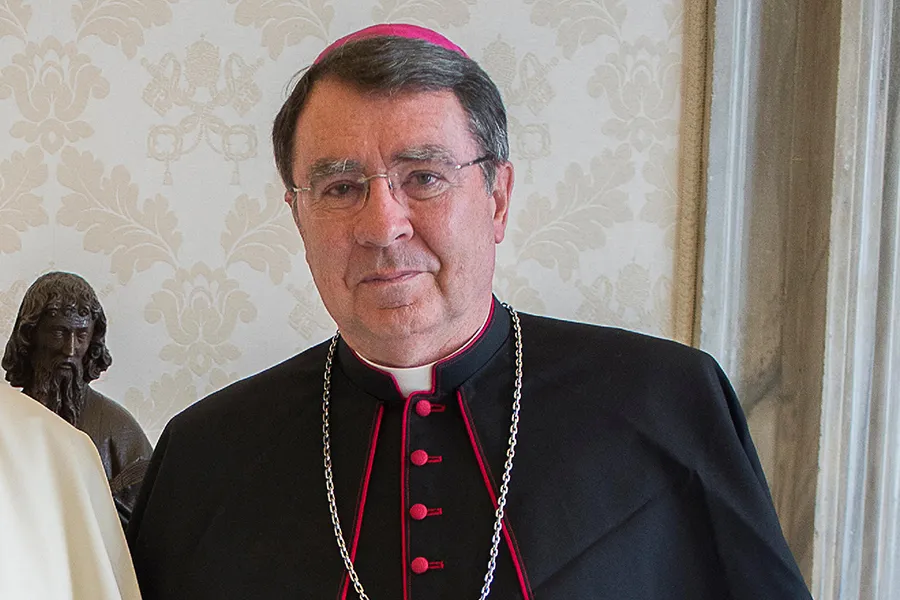
Archbishop Christophe Pierre, apostolic nuncio to the US, spoke with EWTN News Nightly’s Lauren Ashburn on Wednesday, discussing Pope Francis, his background, and his reception within the Church.
He mentioned the recently published work Jorge Mario Bergoglio: Una biographia intellettuale (Jorge Mario Bergoglio: An Intellectual Biography) by Massimo Borghesi, which discusses the influence on Pope Francis of Fr. Gaston Fessard, among others,.
Fr. Fessard was a French philosopher of the 20th century who has been called “a penetrating critic of Marxism.” He was central to the revival of Hegelian thought on history in France, and sought to be in dialogue with Hegel, considering his widespread influence in modern philosophy. Fr. Fessard was also active in the French Resistance and a critic of the collaborationist Vichy government.
Please read excerpts from the first half of Archbishop Pierre’s conversation with Ashburn, edited for clarity and length. The first half aired Dec. 14, and the second will air Dec. 15 on EWTN News Nightly.
Lauren: Archbishop Christophe Pierre, thank you so much for joining us this evening.
Archbishop Pierre: Thank you for the invitation.
Lauren: Archbishop, in the fast-moving four and a half years Pope Francis has been Pope, much has been written about him – his “option” for the poor, his evident pastoral approach, the reform of the Vatican. Now we seem to be witnessing a new phase of his interest: the intellectual and cultural roots that drive him. What are they?
Archbishop Pierre: Well, your observation is very interesting, you know, because we have to recognize that the coming of this Pope has created wonder, and a lot of questions. And if you allow me, I would say, during my one year and a half presence in this country, I’ve noticed this sense of wonder. Especially from the people themselves. They are happy to see this Pope. They feel that he is near them. They feel that he understands their problems. And I think this is one of the characteristics of the Pope. But may I say, many of us, a lot of people say, ‘Who is he? Where is he coming from?’ I would say there are two directions. One direction is coming from South America. This is his background. I’ve been living in four countries, and working in countries in South America.
(Lauren: Including Mexico) Including Mexico. And I arrived in Mexico at the time of the famous Aparecida conference of the Latin American bishops of the last century. This conference is very important to understand Pope Francis, because he was one of the main actors, because he was the Archbishop of Buenos Aires. But he was one of the main actors. So this is one aspect. The second one is intellectual background. And precisely a couple of weeks ago, an Italian author, Massimo Borghesi, published a book.
Lauren: That would be this book. (Laughter)
Archbishop Pierre: Ah, you read it.
Lauren: It’s in Italian, however, so you are going to have to tell me what it says. Let me talk to you about this book. It claims that behind this simplicity lies a “deep and original thinking,” based largely on French philosophers and theologians. That comes as a surprise to the Argentinian and populist stereotype of Francis. You are a Frenchman, who has spent years serving many different countries worldwide. What is this “deep and original thinking”?
Archbishop Pierre: Well first and foremost this Pope has been educated in our own time. The book tells us that maybe the first important author having contributed to his formation is the Jesuit Gaston Fessard. Maybe Gaston Fessard is not well known in the United States. I happened, when I was pursuing my master’s in theology in the French Catholic Institute of Paris, to make a credit on Gaston Fessard. [sic] So I was very happy when I read this book; I said, ‘My God!’
Lauren: You both are following after Gaston Fessard.
But there is unease among bishops over his approach. How can that be that be rectified?
Archbishop Pierre: I have read the Pope is not very precise. The Pope is not, eh, not a great intellectual, he is more pastoral than dogmatic. I would say these things are stereotypes. And maybe also prejudice. So I think there is a great — we especially with the bishops — we have a great responsibility, to try to understand our Pope. And to understand him in all aspects of his personality before making a judgment. And I think this is precisely what we should try to do. And not to remain with a superficial judgement of who he is or what he is supposed to be according to our own judgement. And by the way, he is also the Pope.
Lauren: Archbishop Christophe Pierre, thank you for joining us.
Archbishop Pierre: Thank you.
 […]
[…]



While I support background checks and banning felons and the mentally ill from owning guns, Chicago already has very strict gun laws and they have failed miserably in curbing violence.
Did the archbishop even bother to learn this fact?
Cardinal needs to shut his mouth and mind his own business. Take the beam out of your own eye Cardinal before worrying about the mote in your neighbor’s.
I find it dispiriting that you think it’s more appropriate to castigate DiNardo for speaking out against a senseless loss of life… and that he should “mind his own business”? This is a website whose writers and users proffer almost exclusively in minding others’ business. The moment someone speaks out against gun violence, they are getting too uppity?
I urge you to think more with charity and empathy, instead of venting hate and anger as your first recourse. It’s bad for the soul.
What utter nonsense. There is no such thing as “gun violence”. The gun is a tool. Do we characterize the genocide of the 1990s in Rwanda as “machete violence”? no we do not because the tool used to commit the horrendous acts of violence is simply the material at hand. The Cardinal should pull his head out of his fourth point of contact and focus on the underlying hatred, mental distress, and the triggering causes of the act of violence. We don’t focus on the crack pipe when helping addicts heal, we focus on their mental and physical state, and those things that cause the addict to reach out for the crack pipe (or the bong, or the bottle). Its not the presence of the crack pipe that made the addict light-up, it was an mental/emotional disorder. Cardinal DiNardo’s continuance of the myth of “gun violence” is yet another entry on the scroll of reasons the laity do not trust the judgement of the “leaders” of the Catholic Church in America. They continue to prove their judgment clouded by emotion, false reasoning, and lack of focus on authentic Catholic Apostolic Teaching.
Begs the question, when was the last time that the Cardinal purchased a firearm from a federally licensed firearms dealer? Has he ever? My guess is that he has not because anyone who executes a legal purchase from a federally licensed firearm dealer is well aware of the extensive ‘reasonable’ restrictions already in place. And there are many.
Additionally Cardinal DiNardo’s calling into question how someone ‘capable of such violence was able to obtain a firearms to carry out this heinous act’ betrays a stunning naiveté on at least two fronts. First, does the Cardinal really lack imagination to such a degree that he cannot consider any number of ways both legal and illegal that the weapon was acquired? Was his question rhetorical or an irresponsible and ill-informed throw away comment indicting the legal firearms market?
Secondly, does the Cardinal not realize that we are all fallen and capable of committing evil? That someone is capable of acquiring a firearm and committing such a heinous act is a surprise to him? Really? Murders happen everyday in Chicago and only now is he surprised that people commit murder? At risk of putting too fine a point on it, on what planet does he live?