Cardinal Collins of Toronto calls for resistance to a controversial new government requirement
“It’s very odd, and I think unique in Canadian history, that applicants for for a summer – or any – program, any grant from the government, have to attest not that they are going to obey the law or that they are legitimate applicants, [but] they have to attest to their beliefs…”
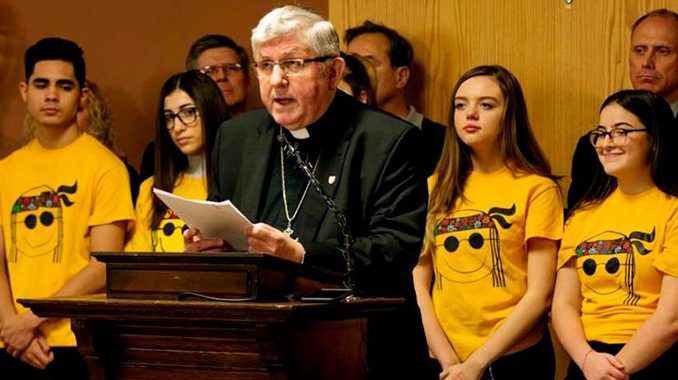
Toronto Cardinal Thomas Collins, flanked by students who have staffed a summer day camp at St. Benedict Church, addresses media in Toronto Jan. 26. (CNS photo/Michael Swan, The Catholic Register)
The Archbishop of Toronto, Canada, Thomas Cardinal Collins, is calling for resistance to a controversial new government requirement on organizations applying for summer hiring assistance. Canada’s government has introduced the change to the standard application form used to request funding through a program that provides wage subsidies to various outfits for summer hires.
Until recently, applicants have had to attest to having read and understood the terms of the agreement, that the job or jobs for which the applicant is requesting the funding would not be created without the assistance being requested, and that the applicant has all the necessary authorities, permissions and approvals to submit this application.
A Calgary-based pro-life group allegedly used some of its government funding to produce and distribute materials containing graphic images of aborted babies, in response to which the Canadian government introduced a new requirement. All applicants must now attest to the following:
[That] both the job and the applying organization’s core mandate respect individual human rights in Canada, including the values underlying the Canadian Charter of Rights and Freedoms as well as other rights. These include reproductive rights and the right to be free from discrimination on the basis of sex, religion, race, national or ethnic origin, color, mental or physical disability, sexual orientation, or gender identity or expression.
This new language is not only proving problematic for faith-based organizations. It is not sitting well with many people who find themselves broadly sharing the government’s social policy commitments, but do not believe persons or organizations ought to be required to take what amounts to an oath of ideological purity.
“It’s very odd, and I think unique in Canadian history, that applicants for for a summer – or any – program, any grant from the government, have to attest not that they are going to obey the law or that they are legitimate applicants, [but] they have to attest to their beliefs,” Collins said during an interview with the Thinking with the Church podcast hosted by CWR contributor Chris Altieri. “There’s an ideological test here,” Cardinal Collins went on to say, “your thinking must be correct.”
Cardinal Collins said he is not alone in finding the new attestation requirement at odds with the words and plain sense of Canada’s Charter of Rights and Freedoms — a document, he explained, which is designed to protect citizens from government intrusion, not to empower government to enforce political orthodoxy. “Not only have people of faith objected to this intrusion, but people who have not faith at all,” Cardinal Collins said. “What amazes me is that the government representatives say, ‘Well, we love what you’re doing – we don’t mean you we like you – just check the [attestation] box [on the application form] and get the money.’ I suspect they truly don’t understand that you sign your soul away. It’s like Thomas More,” said Cardinal Collins. “Are our signatures so cheap,” he asked, “that we can say, ‘Cross your fingers and sign’?”
He said any society that values citizens’ given word so cheap is in serious trouble. “The issue is of conscience and of integrity: that, if we are in a society where [the government] can even suggest, ‘Well, sign. Don’t worry we’ll give you the money, as long as you say in writing what you do not believe,’ — have we come to that? That is really, profoundly sick,” Cardinal Collins said. “Words have meaning,” Cardinal Collins concluded, “and when we forget that, we are on a short path to destruction.”
If you value the news and views Catholic World Report provides, please consider donating to support our efforts. Your contribution will help us continue to make CWR available to all readers worldwide for free, without a subscription. Thank you for your generosity!
Click here for more information on donating to CWR. Click here to sign up for our newsletter.
CNA Staff, Jan 14, 2021 / 05:47 pm (CNA).- Canada’s highest court has ruled that the Archdiocese of St. John’s in Newfoundland and Labrador will be responsible for Mount Cashel Orphanage child abuse lawsuits against the Congregation of Chri… […]
Amanda Achtman’s last photo with her grandfather, Joseph Achtman. / Credit: Photo courtesy of Amanda Achtman
CNA Staff, Nov 5, 2023 / 06:00 am (CNA).
When the Canadian government began discussing the legalization of euthanasia for those whose deaths were “reasonably foreseeable,” 32-year-old Amanda Achtman said something in her began to stir. Her grandfather was in his mid-90s at the time and fit the description.
“There were a couple of times, toward the end of his life, that he faced some truly challenging weeks and said he wanted to die,” Achtman recalled. “But thank God no physician could legally concede to a person’s suicidal ideation in such vulnerable moments. To all of our surprise — including his — his condition and his outlook improved considerably before his death at age 96.”
Achtman said she and her grandfather were able to have a memorable final visit that “forged her character and became one of the greatest gifts he ever gave me.”
The experience of walking with her grandfather in his last days led Achtman to work that she believes is a calling. On Aug. 1, she launched a multifaceted cultural project called Dying to Meet You, which seeks to “humanize our conversations and experiences around suffering, death, meaning, and hope.” This mission is accomplished through a mix of interviews, short films, community events, and conversations.
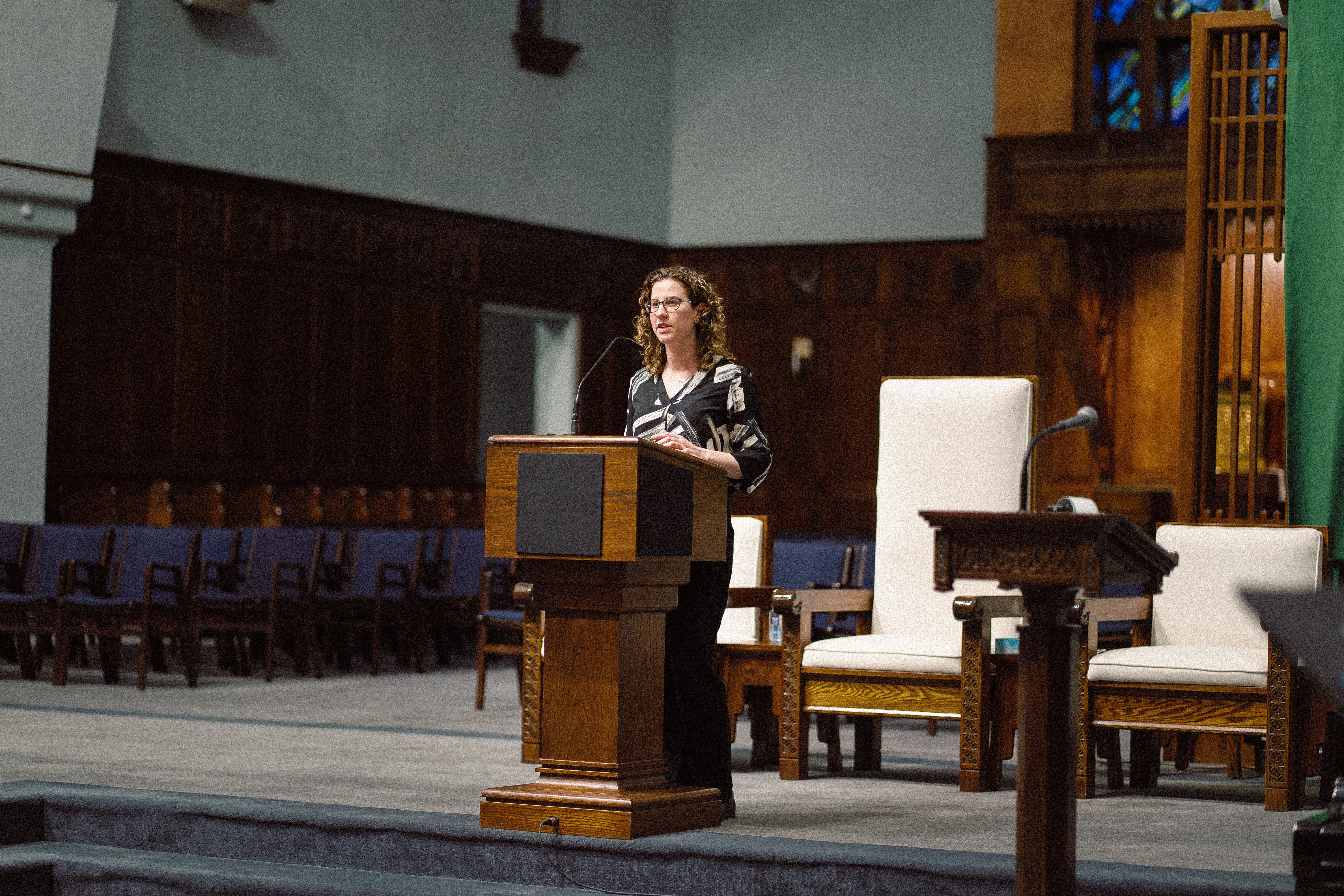
Amanda Achtman speaks during the Evening Program at St. Mary’s Cathedral during “The Church as an Expert in Humanity” event in Calgary Sept. 23, 2023. Credit: Edward Chan/Community Productions
“This cultural project is my primary mission, and I am grateful to be able to dedicate the majority of my energy to it,” Achtman told CNA.
Early years
Achtman was born and raised in Calgary, Alberta, Canada. She grew up in a Jewish-Catholic family with, she said, “a strong attachment to these two traditions that constitute the tenor of my complete personality.”
Her Polish-Jewish grandfather, with whom she had a very close relationship as a young adult, had become an atheist because of the Holocaust and was always challenging her to face up to the big questions of mortality and morality.
“One of the ways I did this was by traveling on the March of Remembrance and Hope Holocaust study trip to Germany and Poland when I was 18,” Achtman said. “My experiences listening to the stories of Holocaust survivors and Righteous Among the Nations have undeniably forged my moral imagination and instilled in me a profound sense of personal responsibility.”
Shortly after her grandfather’s death, Achtman discovered a new English-language master’s program being offered in John Paul II philosophical studies at the Catholic University of Lublin in Poland.
“Immediately, I felt as though God were saying to me, ‘Leave your country and go to the land that I will show you — it’s Poland.’ At the time, the main things I knew about Poland were that the Holocaust had largely been perpetrated there and that Sts. John Paul II, Maximilian Kolbe, and Faustina were from there,” Achtman explained. “I wanted to be steeped in a country of saints, heroes, and martyrs in order to contemplate seriously what my life is actually about and how I could spend it generously in the service of preventing dehumanization and faithfully defending the sanctity of life in my own context.”
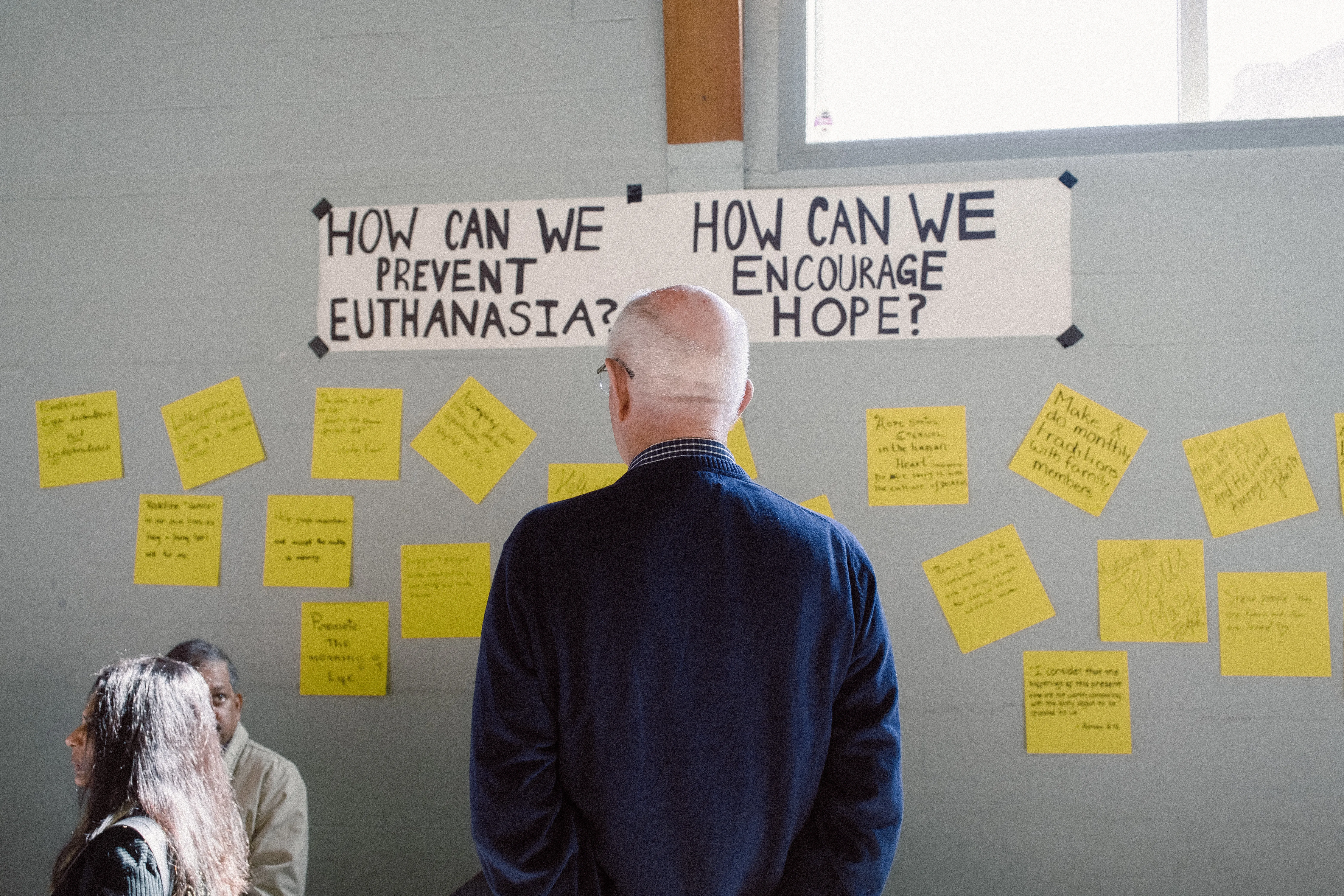
On Sept. 23, 2023, Amanda Achtman organized a daylong open-house-style event called “The Church as an Expert in Humanity” in Calgary, Alberta. Participants added ideas for how we, the Church, can prevent euthanasia and encourage hope. Credit: Edward Chan/Community Productions
The rise of euthanasia in Canada
In 2016, the Canadian government legalized euthanasia nationwide. The criterion to be killed in a hospital was informed consent on the part of an adult who was deemed to have a “grievous and irremediable condition.”
“The death request needed to be made in writing before two independent witnesses after a mandatory time of reflection. And, consent could be withdrawn any time before the lethal injection,” Achtman explained.
Then, in 2021, the Canadian government began to remove those safeguards. “The legislative change involved requiring only one witness, allowing the possible waiving of the need for final consent, and the removal, in many cases, of any reflection period,” Achtman told CNA.
“Furthermore, a new ‘track’ was invented for ‘persons whose natural death is not reasonably foreseeable.’ This meant that Canadians with disabilities became at greater risk of premature death through euthanasia. Once death-by-physician became seen as a human right, there was practically no limit as to who should ‘qualify.’ As long as killing is seen as a legitimate means to eliminate suffering, there is no limit to who could be at risk.”
Euthanasia — now called medical assistance in dying (MAiD) in Canada — is set to further expand on March 17, 2024, to those whose sole underlying condition is “mental illness.” Last year, Dr. Louis Roy of the Quebec College of Physicians and Surgeons testified before a special joint committee that his organization thinks euthanasia should be expanded to infants with “severe malformations” and “grave and severe syndromes.”
Renewing the culture
Achtman followed the debates around end-of-life issues in Canada and wanted to figure out a way to restore “a right response to the reality of suffering and death in our lives.”
“The fact is, our mortality is part of what makes life precious, our relationships worth cherishing, and our lives worth giving out of love. That’s why we need to bring cultural renewal to death and dying, restoring our understanding of its meaning to the human condition.”
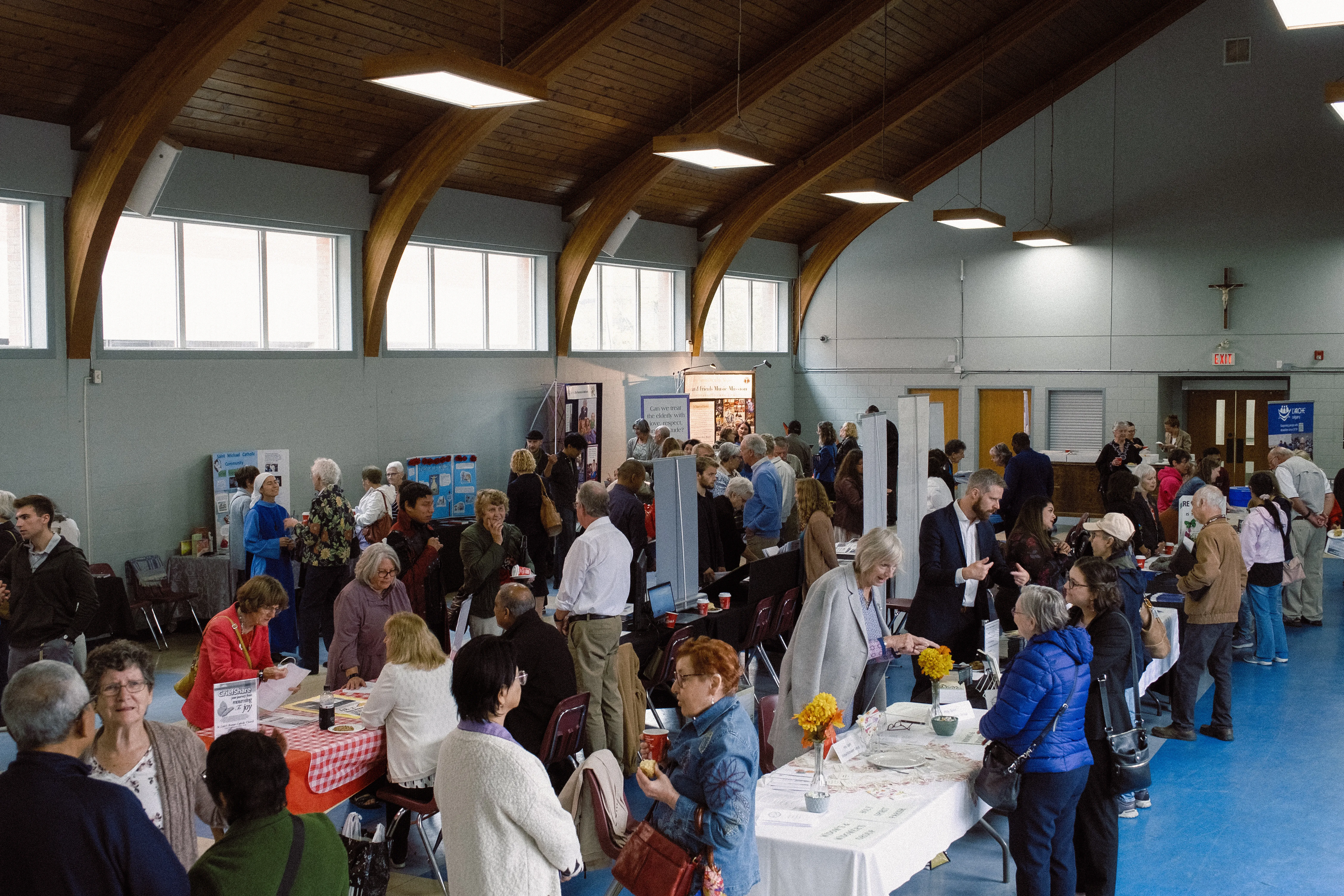
At the Sept. 23, 2023, open-house event called “The Church as an Expert in Humanity,” there were table displays of ministries in the diocese who are doing the best work on suffering, death, grief, and caregiving. Credit: Edward Chan/Community Productions
On Jan. 1, 2021, Achtman made a new year’s resolution to blog about death every single day for an entire year in a way that was “hope-filled and edifying.”
It ended up being very fruitful to Achtman personally, but she said “it also touched a surprising number of people, inspiring them to take concrete actions in their own lives that I could not have anticipated.”
The experience, Achtman said, made her realize that it’s possible to contribute to cultural renewal through things like coffee shop visits, informal interviews, posting on social media, being a guest on podcasts and webinars, organizing community events, and making videos.
“Basically, there are countless practical and ordinary ways that we can humanize the culture — wherever we are and whatever we do the rest of the time.”
The Dying to Meet You project
When it comes to the mission of Dying to Meet You, Achtman told CNA that “God has put on my heart two key objectives: the prevention of euthanasia and the encouragement of hope” and added that “the aim of this cultural project is to improve our cultural conversation and engagement around suffering, death, meaning, and hope through a mix of interviews, writing, videos, and events.”
Achtman said the project is an experiment in the themes Pope Francis speaks about often — encounter, accompaniment, going to the peripheries, and contributing to a more fraternal spirit.
“There is a strong basis for opposition to euthanasia across almost all religions and cultures, traditionally speaking,” Achtman said. “Partly from my own upbringing in a Jewish-Catholic family, I am passionate about how the cultural richness of such a plurality of traditions in Canada can bolster and enrich our value of all human life.”
To that end, one of the projects Achtman has in the works is a short film on end of life from an Indigenous perspective to be released mid-November.
“It’s not so much that we have a culture of death as we now seem to have death without culture,” said Achtman, who hopes her efforts will help change that.
An inspiring hometown event
This past Sept. 23, Achtman organized a daylong open-house-style event called “The Church as an Expert in Humanity” in her home city of Calgary, which took place at Calgary’s Cathedral, the Cathedral Hall, and the Catholic Pastoral Centre. The morning featured a ministry hall of exhibits with 18 table displays of ministries throughout the diocese doing the best work on suffering, death, grief, and caregiving. In the afternoon, there were three-panel presentations.
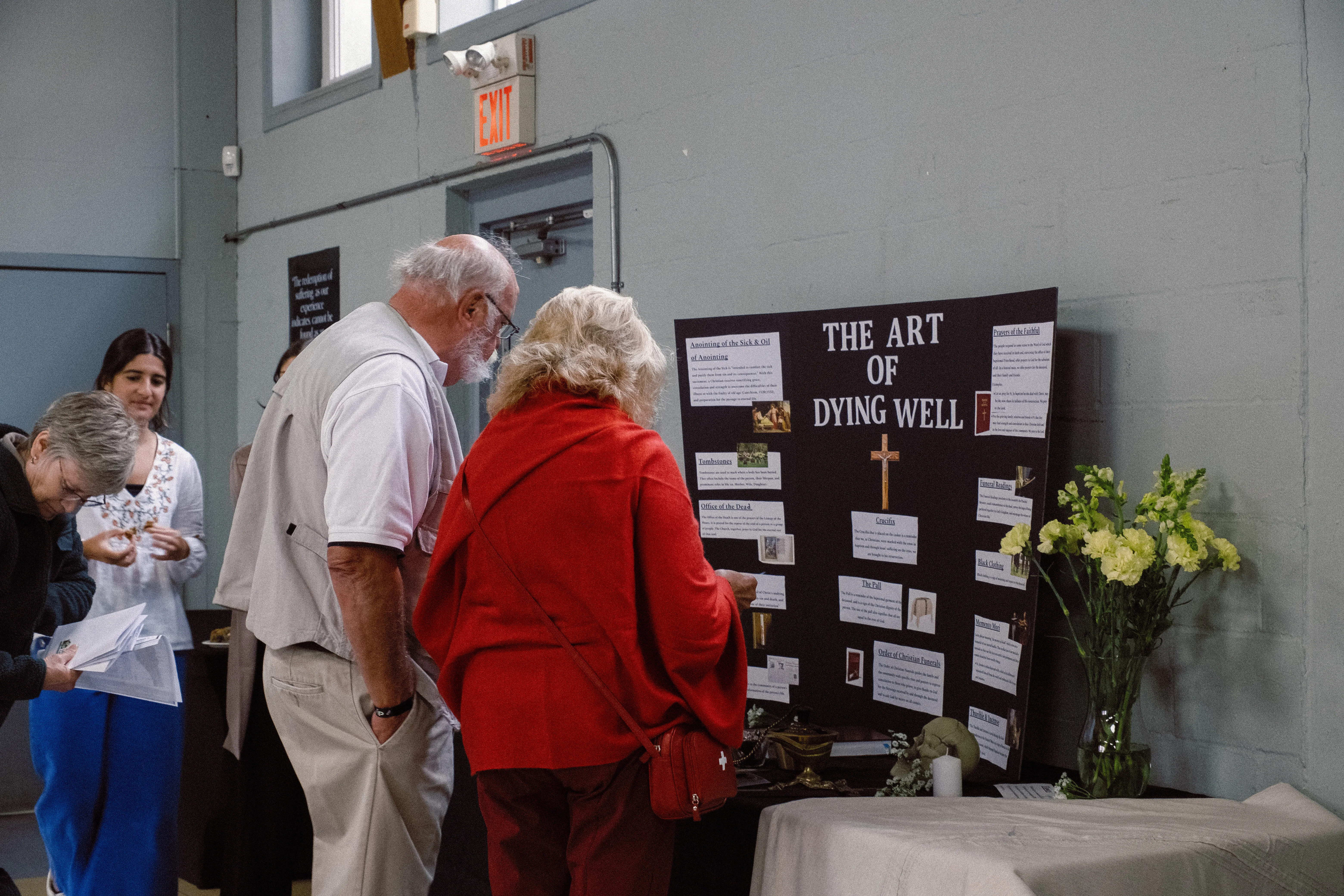
The morning of “The Church as an Expert in Humanity” in St. Mary’s Cathedral Hall in Calgary, Alberta, featured a ministry hall of exhibits with table displays of ministries in the diocese doing the best work on suffering, death, grief, and caregiving. Credit: Edward Chan/Community Productions
The first involved Catholics of diverse cultural backgrounds speaking about hospitality and accompaniment in their respective traditions. It included a Filipino diaconal candidate, a Ukrainian laywoman working with refugees, an elderly Indigenous woman who is a community leader, and an Iraqi Catholic priest.
The second was called “Tell Me About the Hour of Death,” where participants heard from two doctors, a priest, and a longtime pastoral care worker.
The third panel focused on papal documents pertaining to death, hope, and eternal life. A Polish Dominican sister who has worked extensively with the elderly spoke about John Paul II’s “Letter to the Elderly.”
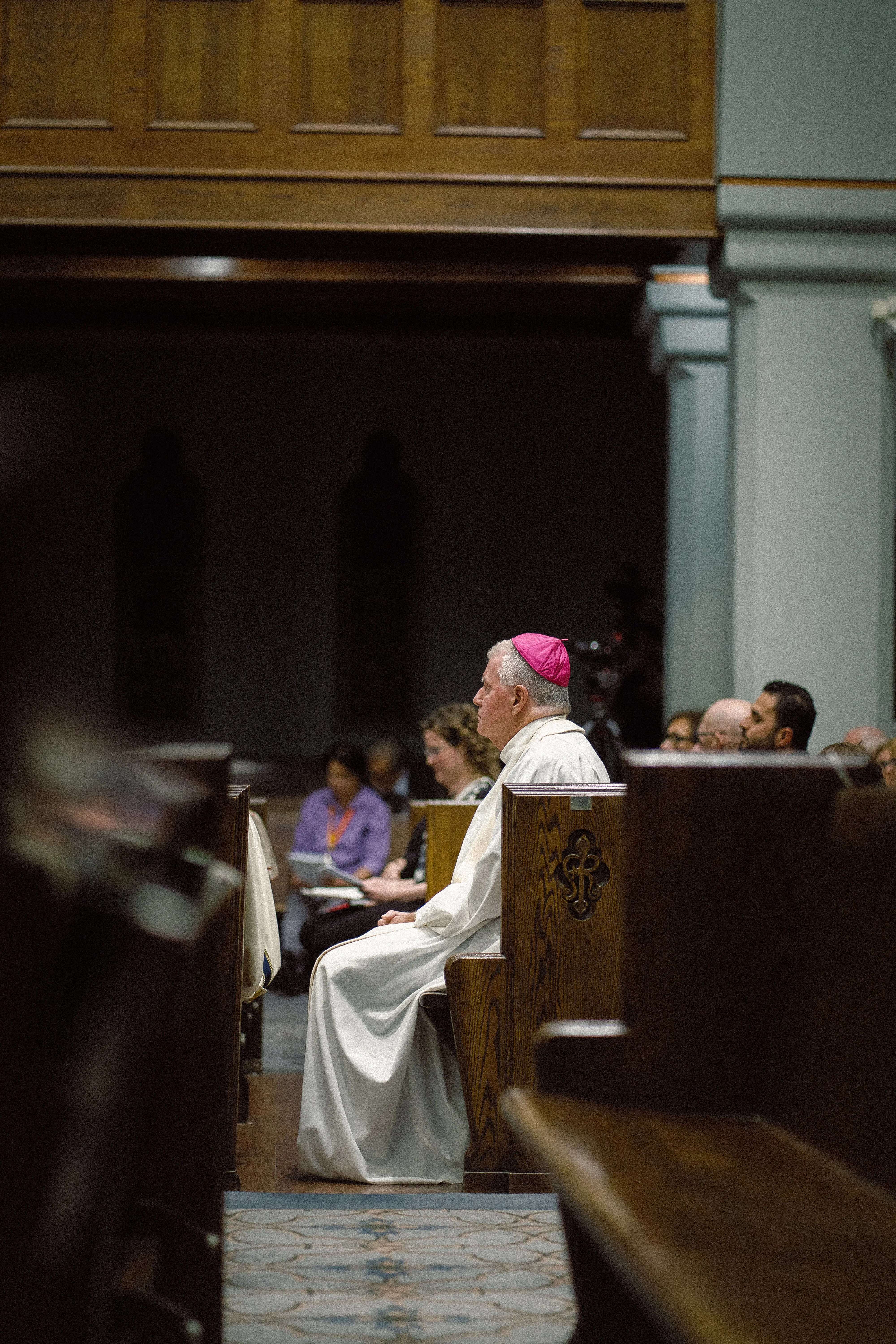
Later, an evening program was held in Calgary’s Catholic Cathedral and included seven short testimonies by different speakers that “were narratively framed as echoes of the Seven Last Words of Christ.” Among the speakers were a privately sponsored Middle Eastern Christian refugee, a L’Arche core member who has a disability, and a young father whose daughter only lived for 38 minutes. Afterward, Calgary’s Bishop William McGrattan gave some catechesis on the Anima Christi prayer, with a special emphasis on the line “In your wounds, hide me.”
“The day was extremely uplifting and instilled the local Church with confidence that the Church indeed is an expert in humanity, capable of meeting Christ in all who suffer with a gaze of love and the steadfast insistence, ‘I will not abandon you,’” Achtman told CNA.
Calgary’s Bishop William McGrattan listens to the seven testimonies echoing the seven last words of Christ during the evening program. Credit: Edward Chan/Community Productions
Our lives are not wholly our own
Many believe euthanasia is compassionate care for those who suffer. Shouldn’t we be able to do what we want with our own lives? And can suffering have any meaning for someone who doesn’t believe in God?
Achtman said these questions remind her of something Mother Teresa said: “If we have no peace, it is because we have forgotten that we belong to each other,” as well as the John Donne quote “Each man’s death diminishes me, for I am involved in mankind.”
“Our lives are not wholly our own and how we live and die affects the communities to which we belong,” Achtman said. “That is not a religious argument but an empirical observation about human life. If someone lacks ties and is without family and social support, then that is the crisis to which the adequate response is presence and assistance — not abandonment or hastened death. As one of my heroes, Father Alfred Delp, put it, a suffering person makes an ongoing appeal to your inner nobility, to your sacrificial strength and capacity to love. Don’t miss the opportunity.”
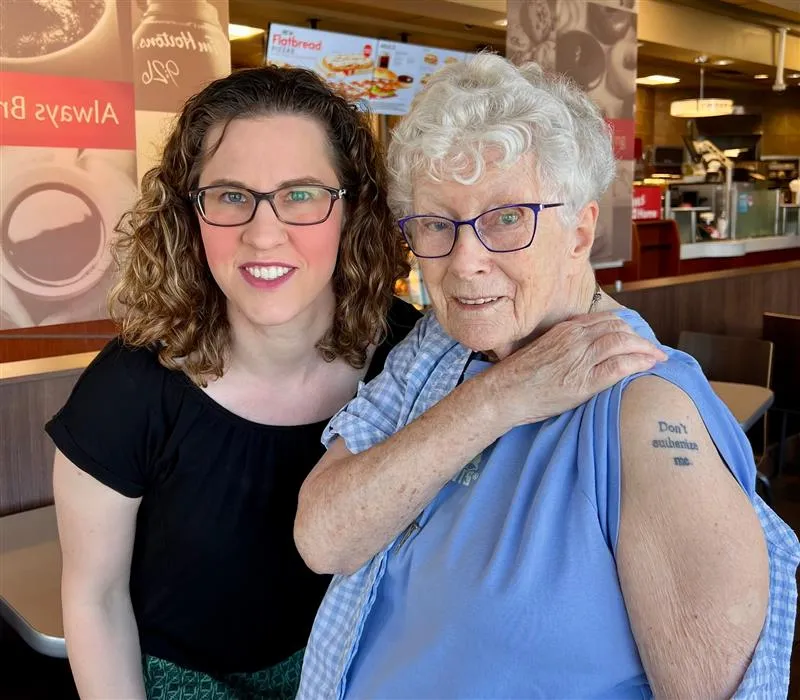
Amanda Achtman pictured with Christine, an 88-year-old woman who got a tattoo that says “Don’t euthanize me,” which is featured in a short four-minute documentary. Credit; Photo courtesy of Amanda Achtman
The mission continues
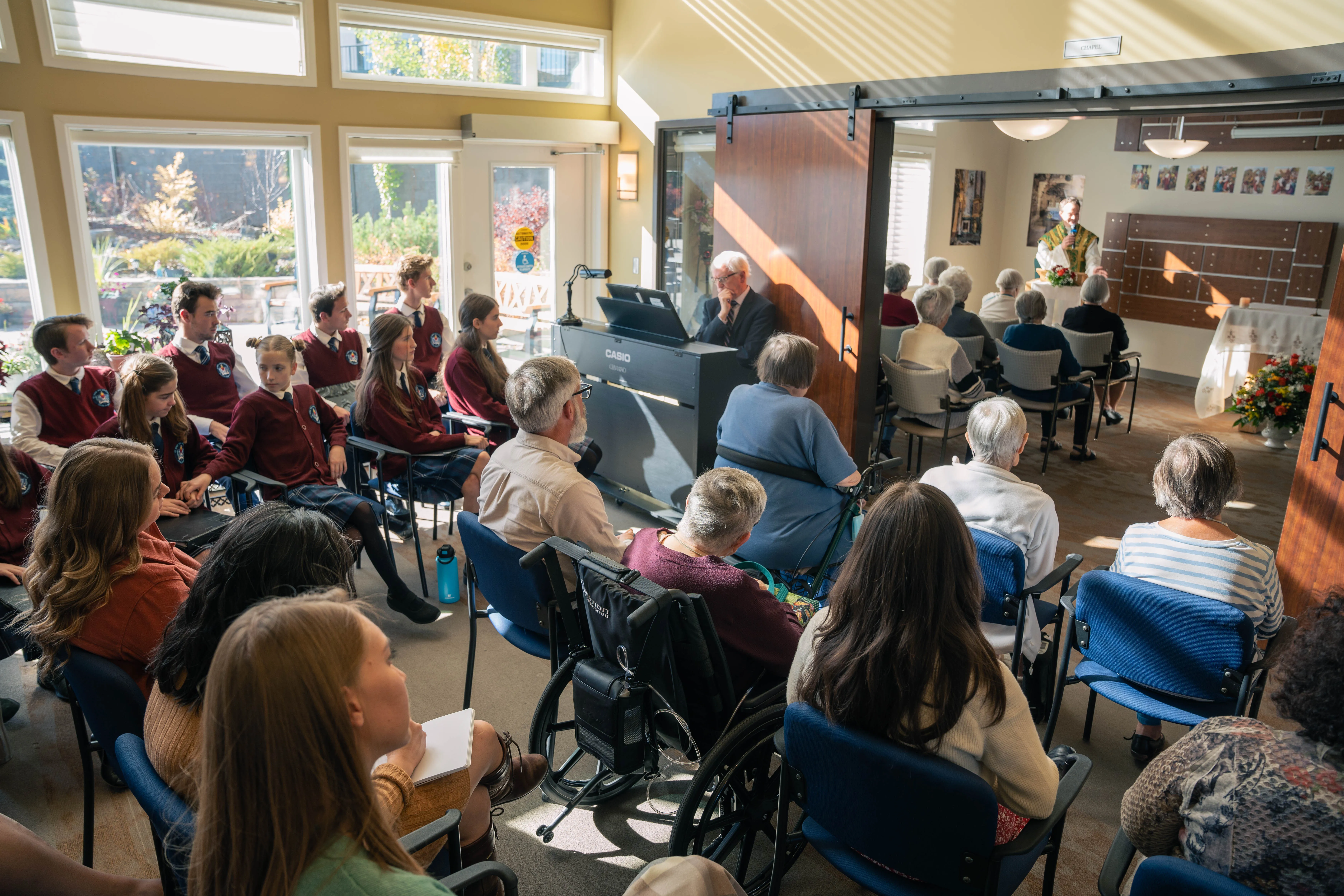
Achtman also organized a “Mass of a Lifetime,” a special Sunday Mass for residents of a local retirement home, on Oct. 15.
Attendees at the Mass of a Lifetime event, a special Sunday Mass for residents of a local retirement home held on Oct. 15, 2023, in Calgary, Alberta. Credit: Amanda Achtman
“I was inspired by a quotation of Dietrich von Hildebrand, who said: ‘Wherever anything makes Christ known, there nothing can be beautiful enough,’” Achtman said. “Applying that spirit to this Mass, we made it as elaborate as possible to show the seniors that they are worth the effort.”
Achtman also recently produced a four-minute short film about an 88-year-old woman named Christine who got a tattoo that says “Don’t euthanize me.” It can be viewed here:
Throughout 2023-2024, Achtman told CNA, she is basing herself in four different Canadian cities for three months each “in order to empower diverse faith and cultural communities in the task of preventing euthanasia and encouraging hope.” She started in her hometown of Calgary and is off to Vancouver this month.
In addition to her work with the Dying to Meet You project, Achtman does ethics education and cultural engagement with Canadian Physicians for Life and works to promote the personalist tradition with the Hildebrand Project.
The 37th Apostolic Journey of Pope Francis, which will take him to Canada from July 24-30, is a “penitential pilgrimage”: The Holy Father will “meet and embrace the indigenous peoples”, and he will apologize for the role of the Church in a system guilty of deadly neglect, suffering and abuse.
In doing so, the pope may also set in motion another process of healing and reconciliation: a normalization of the Holy See’s relationship with the government of Canada.
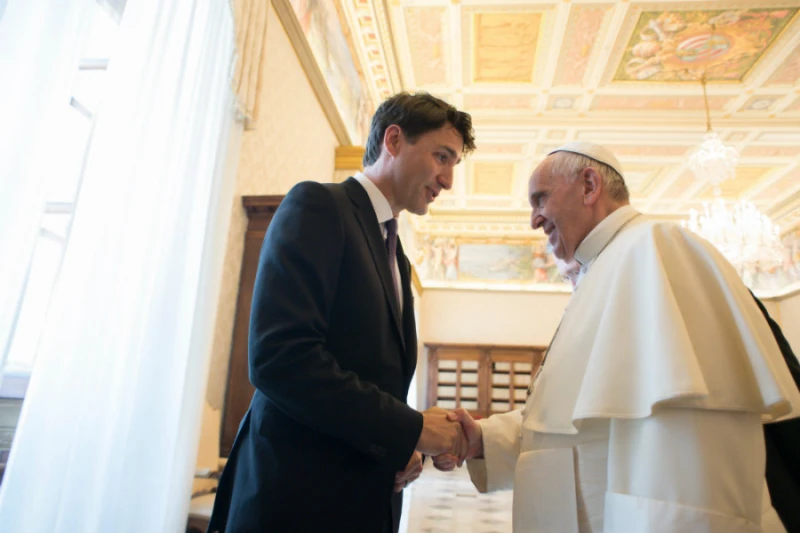
A key moment, preparing the portentous papal pilgrimage to Canada, took place in the Vatican on May 29, 2017.
On that day, Canada’s Prime Minister Justin Trudeau extended an invitation to Pope Francis to visit the country, during which time he could bring the Church’s apology for harm done to indigenous people in the mid-19th through 20th centuries.
The Truth and Reconciliation Commission, which ran from 2008-2015, concluded that thousands of children died whilst attending “Indian Residential Schools”, and called for action on 94 points.
In it, the commission called on Pope Francis “to issue an apology to Survivors, their families, and communities for the Roman Catholic Church’s role in the spiritual, cultural, emotional, physical, and sexual abuse of First Nations, Inuit, and Métis children in Catholic-run residential schools.”
The commission worked out its suggestions for healing and reconciliation by drawing on voluminous reports about the legacy of the residential schools system. Assessing these, including the question of responsibilities in what was perpetrated in those schools, turned out to be far more complex than many expected.
A government program run by Christian churches
The “Indian residential schools” system was a network of boarding schools created by the Canadian federal government in the 19th century. It was mainly supported by government funds and supervised by government officials
The system existed from 1833 to 1996, when the last of these schools was closed. The schools were run by several Christian denominations, including some Catholic dioceses and religious communities.
These schools did not simply provide education to children of First Nations, Inuit, and Métis peoples. In reality, they served to provide a program of assimilation, carried out against a population often mistakenly perceived as an “obstacle” to the nation’s “progress”.
The Canadian Bishops’ Conference explained on its website that this system had a burdensome human cost: “While many alumni and school staff have spoken positively about their experiences in some schools, many others today say of much more painful memories and legacies, such as the prohibition of Aboriginal languages and cultural practices, as well as cases of emotional abuse, physical and even sexual. “
The involvement of the Catholic Church
About 16 out of 70 Canadian dioceses have been associated with residential schools, in addition to about forty of a hundred or so religious communities in Canada.
The Canadian Bishops’ Conference acknowledged in a November 1993 brief for the Royal Commission on Aboriginal People that “the various types of abuse experienced in some residential schools have led us to a profound examination of conscience in the Church.”
The response also included the establishment of a $30 million national pledge made by Canadian Bishops in September 2021.
Similarly, the Holy See has increasingly come to terms with this chapter of the Church’s history in Canada.
Pope John Paul II visited in 1984 and 1987. On both occasions, he met indigenous people, exalting their culture and the renewal brought to them by Christianity.
Benedict XVI met with Phil Fontaine, Great Chief of the Assembly of the First Nations of Canada, at the end of the general audience on Apr. 29, 2009.
He “recalled that since the earliest days of her presence in Canada, the Church, particularly through her missionary personnel, has closely accompanied the indigenous peoples.” Referring to residential schools, Benedict XVI expressed “his sorrow at the anguish caused by the deplorable conduct of some members of the Church, and he offered his sympathy and prayerful solidarity.”
An early whistleblower and a recent warning
At the turn of the 20th century, Peter Henderson Bryce, a public health official and physician, was the first to report about unsanitary conditions in residential schools in Canada. He gathered all the information he could and then, in 1907, published his findings — according to which about a quarter of the indigenous children in residential schools had died of tuberculosis.
Bryce also pointed to the wider question of discrimination, noting that health funds for average citizens of Ottawa were about three times higher than those for First Nations peoples.
Government policies, in other words, had caused the deaths of many indigenous children.
Following attempts by government officials to silence him, Bryce published, at his expense, a small booklet on the issue, titled The Story of a National Crime.
Writing about “myth versus evidence”, Mark DeWolf noted in a 2018 essay — published by public policy think tank FCPP — that “cultural repression, abuse of all kinds, forceful incarceration and even avoidable deaths did happen, and a system that should have done much more to avoid these things should be justly condemned.”
He concluded that the residential schools system was bad and “a deeply flawed attempt to accomplish two main objectives: to give native children education and training that would help them survive economically and socially in a white man’s world, and to eradicate those aspects of native culture that would hold them back from achieving those goals.”
At the same time, pointing to low attendance numbers and other aspects of the system, DeWolf warned of making the residential schools “a scapegoat for 200 years of land appropriation, cultural invasion, deprivation, marginalization, and demoralization.”
Otherwise, little would be done to stop and reverse bad policies and practices today.
This point is pertinent, irrespective of whether one agrees with DeWolf otherwise: A 2019 Canadian Human Rights Court ruling established that between 2006 and 2017, the government had removed between 40,000 to 80,000 indigenous children from their families and deprived them of social services. In addition, the ruling sentenced Canada to pay $40,000 to each victim for discriminatory conduct. The government appealed the ruling, without success.
To further add to the complexity, critics have raised questions about irresponsible media reporting when the discovery of what was first described as unmarked graves on the grounds of the former Kamloops Indian Residential made international news.
On June 24, 2021, it was first announced that 751 unmarked graves had been discovered at the site of a former school. Leaders emphasized that the discovery was of unmarked graves, and not a “mass grave site.”
A gesture with consequences – and an open question
Pope Francis decided to apologize for the Catholic Church’s role and assume responsibility, neither commenting on the issue of sometimes questionable media coverage, nor pursuing the question of just how responsible the Church was within the wider historical context.
In short, this visit is a great act of goodwill by the pope, and one that intends to heal and reconcile.
This may also apply to relations between Canada and the Holy See, as these have been strained for a while. The issue of the “Indian residential schools” system was likely one of the reasons.
Currently, Canada has not formally appointed an ambassador to the Holy See. There is a chargée d’Affaires, Paul Gibbard. He took the position in the year 2021, after three years of vacancy. The last Canadian ambassador to the Holy See was Dennis Savoie, who was in office from 2014 to 2018.
This Papal trip might help to somewhat normalize relations, and the position of Gibbard might be upgraded to that of an ambassador. However, after the visit, the full reality and extent of the residential schools system still needs to be fully brought to light — and not just with a view to the role of the Church.
It is wonderful that Cardinal Collins made it clear our Church, our Faith and our Conscience.. just like the great Saint in England Thomas MOre…-
come first.
No government has the right to try to ‘force’ us as Christians to disobey God ..disobey our conscience. Mr. Trudeau take note………………..
you are way out of bounds and the only western leader to impose such a draconian law which will come back to bite you right out of a job….






why is it odd? this has been building for years, and it’s going to get worse.
thank you, Cardinal Collins.
It is wonderful that Cardinal Collins made it clear our Church, our Faith and our Conscience.. just like the great Saint in England Thomas MOre…-
come first.
No government has the right to try to ‘force’ us as Christians to disobey God ..disobey our conscience. Mr. Trudeau take note………………..
you are way out of bounds and the only western leader to impose such a draconian law which will come back to bite you right out of a job….
You need to retract it now………….
St. Thomas Moore, pray for us.
Dear Cardinal Collins, we must resist this controversial requirement, please advise us how to go about doing this.