Thiruvananthapuram, India, Dec 6, 2017 / 12:20 am (CNA/EWTN News).- At least 32 Catholic fishermen were killed when a tropical cyclone hit the southern coast of India over the weekend.
In addition, some 200 people are missing, and thousands of individuals have been displaced, after their homes were destroyed. The death toll is expected to rise.
The fishermen – who were all Catholic, according to local parish priest Fr. V. Wilfred of Vizhinjam – were not expecting stormy seas when they set out, according to UCA News. The fishermen were all from the Kerala and Tamil Nadu states.
Tropical Cyclone Ockhi began to develop near Sri Lanka last Thursday with heavy winds and rains. The hardest-hit region was the southwestern tip of India’s coast near Kerala’s capital, Thiruvananthapuram. The last major cyclone to hit that region was in 1941, making it a rare occurrence for the area.
The storm also affected thousands of locals who have relocated to relief camps that have been set up by the Kerala state government. Currently, there are 29 relief camps, which are sheltering around 3,000 people.
Local priests and Archbishop Soosa Pakiam of Trivandrum were said to have been visiting the affected area to help coordinate relief for the victims of the storm.
Additionally, Fr. Justin Jude of Poonthura noted that many of the locals have not only lost their homes and family members due to the cyclone, but also valuable equipment such as boats and nets. Fr. Jude also said that government aid should be provided to help the victims in their time of need, according to UCA News.
Tropical Cyclone Ockhi is still active and is threatening heavy downpours with potential flooding in northwestern India, including Mumbai. However, the storm is expected to weaken significantly by Wednesday.
If you value the news and views Catholic World Report provides, please consider donating to support our efforts. Your contribution will help us continue to make CWR available to all readers worldwide for free, without a subscription. Thank you for your generosity!
Click here for more information on donating to CWR. Click here to sign up for our newsletter.
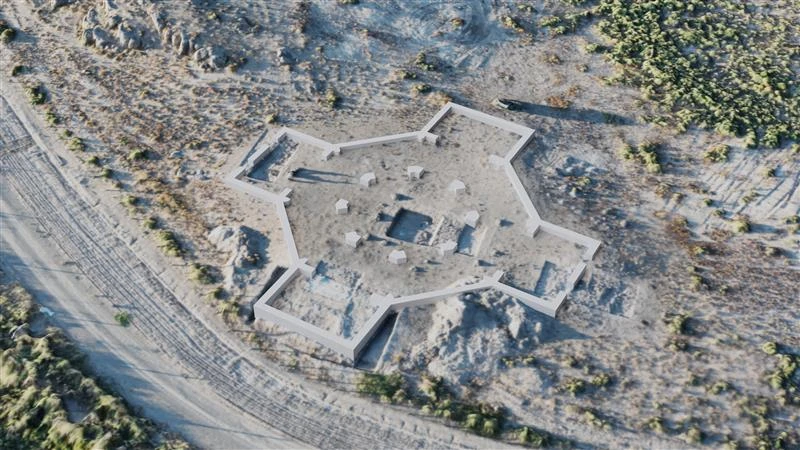
A reconstruction of an ancient church recently discovered in Armenia. The newly discovered church measures about 100 feet across and is shaped like an octagon with “cruciform annexes oriented east-west and north-south,” according to Achim Lictenberger, who noted the discovery of a similar structure from a slightly later period found in Abchazia (Sebastopol). / Credit: AGAP
Washington, D.C. Newsroom, Oct 24, 2024 / 08:00 am (CNA).
A team of German and Armenian researchers made a groundbreaking discovery last week of an ancient church in Armenia dating back to the fourth century, making it the oldest documented church in Armenia, which is considered the first Christian nation in the world.
In an email correspondence with CNA, co-directors of the project Achim Lichtenberger and Torben Schreiber of the University of Münster and Hayk Gyulamiryan of the Armenian Academy of Sciences explained the significance of the discovery made by the team at the site of the ancient city of Artaxata. The project’s fourth co-director, Mkrtich H. Zardaryan, could not be reached for comment by the time of publication.
Historic roots of Christianity in Armenia
“Being the first country which adopted Christianity at the state level, and where the apostles Thaddeus and Bartholomew preached Christianity in the early first century, this discovery is a very important fact for Armenians,” Gyulamiryan told CNA, further stating that “the findings are among the most important in Armenia in recent decades.”
Lichtenberger also emphasized the site’s particular importance, as the church was discovered near the monastery of Khor Virap, where Gregory the Illuminator had been kept in prison before he converted the Armenian king Tiradates III to Christianity in the fourth century.
The monastery of Khor Virap and Ararat in Armenia. Credit: AGAP
As Gyulamiryan stated, although the roots of Christianity may be traced back to the time of the apostles in Armenia, it was not until 301 that Christianity was proclaimed the official religion of Armenia.
According to tradition, Armenia’s conversion is attributed to St. Gregory the Illuminator, a Christian evangelist and convert from Zoroastrianism who miraculously cured the nation’s pagan king of a peculiar “illness” after no other pagan priest was able to do so.
The widely-adopted story of how Armenia became Christian draws from a mythical history promulgated by the fifth-century author Agathangelos, the Armenian researcher explained.
As the legend goes, the pagan king of Armenia had become fascinated by the beauty of St. Hripsime, a nun who had fled with her abbess and community from persecution in Rome. The king offered to marry and make her queen, but Hripsime refused and was able to ward off the king’s advances through miraculous strength.
After the king ultimately had Hripsime and her community killed, historians claim he was “turned into a wild boar who tore at his own flesh” and could not be cured by any priests of pagan or Zoroastrian temples who attempted the feat.
Eventually, the king’s sister persuaded him to appeal to St. Gregory, whom the king had imprisoned for the past 15 years. Once St. Gregory was released, he cured the king of his “disease” and converted him and the entire royal family to the Christian faith.
Artaxata, where these events are believed to have taken place, is “a major place related to early Christianity in Armenia,” Lichtenberger told CNA.
St. Gregory is revered both in the Orthodox Armenian Apostolic Church and in the Catholic Church traditions. In 2005, Pope John Paul II erected a 19-foot statue of St. Gregory in the north courtyard of St. Peter’s Basilica in Vatican City.
The excavation area of the archeological site where the remains of an ancient church were found in Armenia. Credit: AGAP
The discovery
The newly-discovered church measures about 100 feet across and is shaped like an octagon with “cruciform annexes oriented east-west and north-south,” according to Lichtenberger, who noted the discovery of a similar structure from a slightly later period found in Abchazia (Sebastopol).
Although the Araxata site was previously discovered, Lichtenberger told CNA that the church had been buried underground and gone undiscovered until the team carried out its magnetic prospections and excavations this past spring.
The researchers confirmed in September the age of the church to be from about 350 A.D. using radiocarbon dating techniques on a series of samples taken from a wooden platform belonging to the original construction of the building.
Ahead of the autumn excavations this year, Gyulamiryan told CNA he remembered thinking that the team “should confidently dig up the next chapter of the history of Armenia.”
The massive mortar wall of the recently discovered ancient church believed to be the oldest in Armenia. Credit: AGAP
According to Lichtenberger, the radiocarbon date from the wooden samples corresponded with pottery shards that were also discovered inside the church and with “the overall construction technique of the building using substantial amounts of mortar.”
“In the center of the church we encountered significant amounts of marble decoration that suggest that this part was prominently adorned,” he said. Interestingly, the German researcher noted that the state of the building upon discovery indicated that it had perhaps met a hostile end.
“The building was heavily destroyed (maybe intentionally),” he wrote, “the marble construction smashed, parts of the floor tiles removed, the roof set on fire, and all was buried in a huge collapse of roof tiles and burnt roof beams.”
However, according to Lichtenberger, there are no primary literary sources that correspond to the church, as “literary sources only relate to a seventh-century A.D. church in Artaxata.”
By contrast, while the Armenian literary tradition attests that the oldest church in the country is the Etchmiadzin Cathedral, Lichtenberger noted, “archeological evidence from this place does not date back to the mid-fourth century A.D.”
“This does not mean that Etchmiadzin is younger than the Artaxata church, it only means that the Artaxata church provides earlier archaeological evidence,” he added. “Therefore we assume that the Artaxata church is the oldest archaeologicallyattested church in Armenia.”
The Etchmiadzin Cathedral, which Armenian literary tradition attests is the oldest church in the country. But Achim Lichtenberger says this “does not mean that Etchmiadzin is younger than the Artaxata church, it only means that the Artaxata church provides earlier archaeological evidence. Therefore we assume that the Artaxata church is the oldest archaeologically attested church in Armenia.” Credit: Madalaine Elhabbal
Future of the project
Schreiber shared with CNA in another email chain that analysis of data collected from the site will play a significant role in future archeological measures.
“The interaction of the excavation results, the geophysical survey, and the scientific investigations (natural sciences) will keep us busy in the coming year,” Schreiber said. “However, we are certain that these measures will provide us with a very comprehensive picture of this extraordinary and important find.”
Excavations in the ancient ruins of a church recently discovered in Armenia, the oldest Christian nation in the world. Credit: AGAP
The research team from the University of Münster and the Armenian Academy of Sciences have been at the Artaxata site since 2018 and have also made other noteworthy discoveries, including an unfinished Roman aqueduct, a Hellenistic sanctuary, and the remains of an Urartian settlement, according to Lichhtenberger.
The team of researchers also includes 10 students from the German university along with various internal and external specialists who consulted with the team on different groups of materials at the site, including animal and human bones, plants, or “archaeobotanical” matter, marble, plaster, pottery, and roof tiles — “of which we found a lot,” Lichtenberger said.
“We will continue the work of the Armenian-German Artaxata Project in the future,” he told CNA.
CNA Staff, Jul 31, 2020 / 03:13 pm (CNA).- A U.S. citizen on trial for blasphemy in Pakistan was killed at a court hearing Wednesday, drawing strong objections to the country’s blasphemy laws from the U.S. State Department.
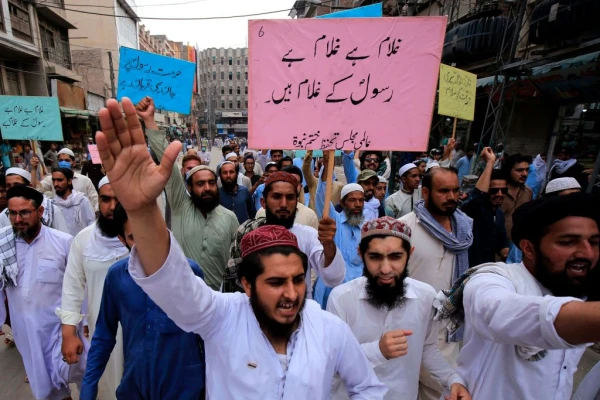
Tahir Ahmad Naseem was charged with claiming to be a prophet. He was being escorted by police in a courtroom in Peshawar, more than 100 miles west of Islamabad, when he was attacked and killed July 29.
Video shared on social media showed his body slumped over the seats in court, BBC News reports.
His attacker was arrested at the scene, and video shows him handcuffed and accusing Naseem of being “an enemy of Islam.”
Police are unsure how the attacker, named only as Khalid, acquired a gun in the courtroom. A police spokesman said he may have pulled the gun from a policeman’s holster, Agence France Prese reports.
The U.S. State Department said it was “shocked, saddened and outraged” by the killing.
“The U.S. government has been providing consular assistance to Mr. Naseem and his family since his detention in 2018 and has called the attention of senior Pakistani officials to his case to prevent the type of shameful tragedy that eventually occurred,” said State Department spokesman Cale Brown.
The State Department said he had been lured to Pakistan from Illinois.
Naseem was born into the Ahmadi sect, a marginalized group which faces persecution in Pakistan. However, an Ahmadi community spokesman said Naseem had left the sect and now describes himself as a prophet. The man in his YouTube videos claimed to be a messiah. The spokesman suggested he had been mentally ill, Agence France Presse reports.
In 2018 a Peshawar teenager named Awais Malik accused Naseem of blasphemy. Naseem, while living in the U.S., had begun speaking with him online.
Malik told BBC News he met Naseem in a shopping mall in Peshawar to discuss religion, and he then filed a case with police. Malik said he was not present at court and had no knowledge of the shooting.
The country’s blasphemy laws impose strict punishment on those who desecrate the Quran or who defame or insult Muhammad. Although the government has never executed a person under the blasphemy laws, accusations alone have inspired mob and vigilante violence.
The State Department urged Pakistan “to immediately reform its often abused blasphemy laws and its court system, which allow such abuses to occur.” It urged prosecution of the suspect in Naseem’s killing to the full extent of the law.
The Centre for Research and Security Studies reported that at least 65 people have been killed by anti-blasphemy vigilantes since 1990. According to the U.S. Commission on Interreligious Freedom, up to 80 people are imprisoned on blasphemy charges in Pakistan, and half of them face life in prison or the death penalty.
In 2018, the Supreme Court of Pakistan overturned the blasphemy conviction of Asia Bibi, a Catholic woman who was accused in 2009. Her initial conviction had also been upheld by the Lahore High Court.
The Ahmadi religious group self-identifies as Muslim, but many Muslims do not identify them as Muslim. The movement was founded in 1889 in British-ruled India. They consider their founder Mirza Ghulam Ahmad a “subordinate prophet.” Other Muslims see this as a violation of the tenet that Muhammad was the last prophet.
There are about 500,000 Ahmadis in Pakistan and up to 20 million adherents worldwide. Some observers estimate the Ahmadi population in Pakistan is higher, but persecution encourages Ahmadis to hide their identity.
Both government authorities and mobs have targeted their places of worship. In October 2019, police in Punjab partially demolished a 70-year-old Ahmadiyya mosque, according to the 2020 report from the U.S. Commission on International Religious Freedom.
In May Pakistan’s government declined to include the Ahmadi religious group in its National Commission for Minorities.
In January 2020, Archbishop Charles Chaput of Philadelphia wrote to Pakistan’s prime minister on behalf of Philadelphia’s Pakistani Catholic community, encouraging him to shape a culture of religious freedom in the country.






is there a relief fund to help these people ?