


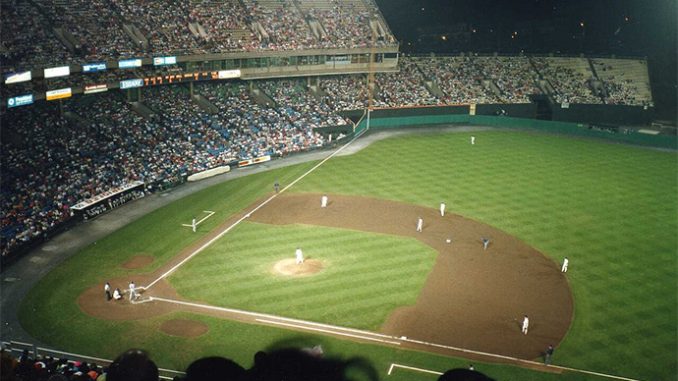
I am not usually given to apocalypticism, but I think I got the imagery exactly right when, in 2001, I called my brother and described the ruins left by the demolition of Baltimore’s Memorial Stadium as akin to “the abomination of desolation” (cf. Daniel 9:27, 11:31, 12:11).
What had once been our youthful field of dreams, where we encountered mythic figures — Triandos and Wilhelm, Robinson and Aparicio, Palmer and Weaver — was a field of rubble. And in a weird compromise that satisfied no one, the magnificent brick-and-concrete façade with stainless steel Art Deco lettering that had named the old ballyard was left in place for a few months before it, too, was torn down, adding insult to the desecration of memory. The façade’s stirring inscription should be remembered, a quarter-century later:
ERECTED BY THE CITY OF BALTIMORE 1954/
DEDICATED BY THE MAYOR AND THE CITY COUNCIL AND THE PEOPLE OF BALTIMORE CITY IN THE STATE OF MARYLAND/
AS A MEMORIAL TO ALL WHO SO VALIANTLY FOUGHT AND SERVED IN THE WORLD WARS WITH ETERNAL GRATITUDE TO THOSE WHO MADE THE SUPREME
SACRIFICE TO PRESERVE EQUALITY AND FREEDOM THROUGHOUT THE WORLD/
TIME WILL NOT DIM THE GLORY OF THEIR DEEDS
To be sure, Memorial Stadium could not boast the sybaritic comforts of today’s sports basilicas, and it is some satisfaction that the stadium’s successor, Camden Yards, inspired the recovery of classic baseball architecture over the past several decades. Moreover, the 33rd Street site in the Waverly neighborhood now houses a baseball field, “Youth Development Park,” made possible by the Cal Ripken Sr. Foundation. Its home plate is exactly where home plate was on the old stadium’s diamond, and there is something to be said for standing there, looking out toward the houses on 36th Street that lie beyond the scoreboard — and remembering.
Which brings me to a diamond (no pun intended) jubilee and two lessons for 21st-century America.
On the shirtsleeve-weather Sunday afternoon of October 9, 1966, my grandfather (and baseball tutor) Frank Weigel took me to Game Four of the World Series, as he had taken my brother to Game Three the day before. Then, the underdog Orioles had beaten the lordly (and not yet obscenely affluent) Los Angeles Dodgers, 1-0, behind 21-year-old Wally Bunker’s three-hit masterpiece. So as my grandfather and I settled into our seats in the lower deck, perhaps twenty rows above the first base dugout, there were serious questions to consider as I munched popcorn and sipped Coke. Could Orioles southpaw Dave McNally recover the form he didn’t show in Game One, when he had to be bailed out by the—somewhat shocking—relief pitching magic of Moe Drabowsky? Could the Dodgers’ drought of 24 innings without a run possibly continue? In sum: Could the underdog Birds somehow complete the sweep they had begun by taking the first two games of the Series at Dodger Stadium?
The answers turned out to be yes, yes, and yes, as McNally shut out the champs and the immortal Frank Robinson settled matters with a laser-like line drive into the left field bleachers off Dodgers intimidator Don Drysdale. I’ve seen pictures of the V-E and V-J Day celebrations in Times Square. Baltimore put on its best imitation of that jubilant spontaneity as Paul Blair caught the fly ball that sealed the deal and Memorial Stadium erupted, Brooks Robinson, Andy Etchebarren, and Boog Powell racing to the mound to embrace McNally. Everybody in the stands, white and black, started hugging everyone else, which in a city with a long, sad history of segregation was not an everyday sight.
And the lessons?
The camaraderie of the 1966 Orioles was made possible by Brooks Robinson, son of Little Rock and 1964 American League most valuable player, yielding his leadership role to Frank Robinson, proudly and often defiantly black, who would become the 1966 American League most valuable player. Their partnership, I’ve long been convinced, was a crucial factor in breaking down old prejudices in the old hometown. America could use some of that camaraderie, built on excellence ordered to a common cause, today.
The 1966 Orioles strike me in retrospect as craftsmen, doing something very difficult very well, and taking satisfaction and a certain joie de combat from the often-grinding work. They played hard but they played clean, and they were respected by their competitors for that. America could use more such men today, not least in politics.
Memorial Stadium is no more. But time has indeed not dimmed the glory of the deeds of those to whom it was dedicated, nor has time lessened the sweetness of my memories of being there on October 9, 1966, a seemingly impossible sixty years ago.
If you value the news and views Catholic World Report provides, please consider donating to support our efforts. Your contribution will help us continue to make CWR available to all readers worldwide for free, without a subscription. Thank you for your generosity!
Click here for more information on donating to CWR. Click here to sign up for our newsletter.

Leave a Reply