


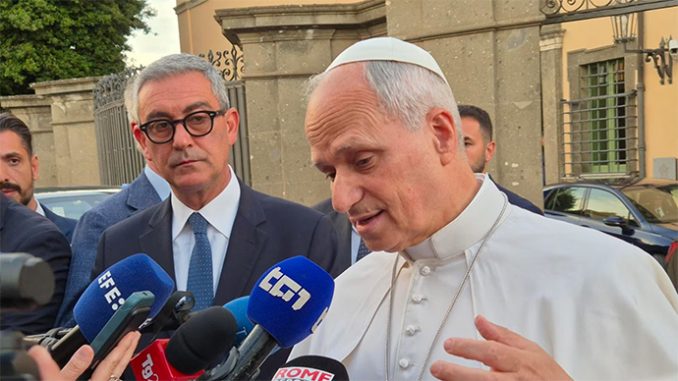
Has Leo found hidden value in reversing Francis’ financial policies? (The Pillar): “What does the pope have his predecessor didn’t: new information, improving results, or just a different attitude?”
The treasure the Jesuits squandered (Catholic Culture): “Some of us are determined that [Father Paul Mankowski’s] life and work—and the gross injustice done to him by the Society of Jesus—should not be forgotten.”
The Incomplete Work of Renewal (What We Need Now): “One of the most dangerous temptations that has grown for leaders advocating for this renewal is to define and attempt it by simply shifting the forms and structures of the Church.”
Secularism or Pluralism? Canada’s Effort to Balance Disestablishment with Religious Freedom (Providence): “Like many democratic countries, Canada continues to wrestle with the place of religion in public life, most recently in disputations on the role of military chaplains.”
Msgr. Roger Landry restricted from ministry during investigation into alleged misconduct (America): “Msgr. Roger J. Landry has taken a temporary leave from his position as director of the Pontifical Mission Societies USA, following allegations he violated priestly conduct codes for two dioceses with which he is affiliated.”
The “Synodality” Enigma. Cardinal Brandmüller Explains How Not to Fall Into Mephistopheles’s Traps (diakonos.be): “Leo also shows that he means to strengthen the old-style synods, on the classical model, like those made up only of bishops that govern the Eastern Catholic Churches, including the major archbishoprics, as in Ukraine.”
To Help Muslims, Reject Islamists (Wall Street Journal): “My fellow Americans went out of their way to support me after 9/11. They’re too accepting of extremists.”
The Medina ‘Constitution’ and the Myth of Islam’s Democratic Origins (The European Conservative): “Describing the Medina document as evidence of ‘constitutional democracy’ in contemporary terms imposes modern ideas onto a seventh-century Arabian society where such concepts were clearly not present.”
Third-Party’ Punishment is Not Catholic (The Catholic Thing):“The Church offers a different way of understanding correction, a truly Christian ethic based on a proper anthropology, an understanding of human weakness, of repentance, forgiveness, and redemption that enables us to overcome errors.”
Why Catholics Should Read Classic Fiction (Crisis Magazine):”Classic fiction will help Catholics to grow in wisdom and virtue through the literary presence of goodness, truth, and beauty.”
Craig on finitism and presentism (Edward Feser): “William Lane Craig’s influential presentation of the [kalām] argument defends the claim in several ways, one of which is by arguing that a beginningless universe would amount to an actual infinite, and that an actual infinite is impossible.
(*The posting of any particular news item or essay is not an endorsement of the content and perspective of said news item or essay.)
If you value the news and views Catholic World Report provides, please consider donating to support our efforts. Your contribution will help us continue to make CWR available to all readers worldwide for free, without a subscription. Thank you for your generosity!
Click here for more information on donating to CWR. Click here to sign up for our newsletter.
With regard to the allegations against Msgr Landry, we read “The diocese said that Msgr. Landry had requested the leave of absence from TPMS USA, and that he “is entitled to the presumption of innocence while the investigation continues.”
I always wonder how priests accused and found to have done nothing wrong ever get their reputations restored. And then I remind myself that what others think of you is of small value compared to what God thinks of you. What matters most is Truth…for all of us.
Ask Father Rutler.
#2 The treasure the Jesuits squandered –
“Some of us are determined . . .”
Hear, hear!
Author and priest Portella shows that the Medina Constitution (maybe A.D. 623) cannot be argued (by Muslims) to be an early constitution in the Western understanding of the term. And, that there is even “doubt concerning its historical authenticity” since only fragmentary references are made in the Ibn Ishaq’s first biography of Muhammad, written 150 years after his death.
Three Points and a Proposition:
FIRST, Ibn Ishaq’s fragmentary references to two closely-spaced events—the First Compact of Aqaba and the Second Compact of Aqaba—should lead to a quite opposite conclusion…
In the first agreement, Muhammad is given local protection (in Medina) from feared assassins from Mecca. In the second agreement—and as a new local leader—he agrees to protect the Bedouin tribes in Medina from the surrounding tribes. Arabia was a patchwork of tribes submerged in a blood-feud culture. Between the two compacts the monotheistic preacher Muhammad goes native.
SECOND, Muhammad flips from being a refugee from pagan Mecca—with its 360 deities at the Ka’ba—to being a permanent hood ornament for a warrior culture transplanted from the 7th century into our 21st century. Now, in Iran armed with ballistic missiles and an atomic bomb program rather than only camels and scimitars.
THIRD, with the Second Compact of Aqaba what began as internal jihad within the soul became the external jihad of conquest. Hence the anti-Trinitarian Qur’anic “principle of abrogation” under an inscrutable and arbitrary Allah. No aperture of the Incarnation enabling coherence between “revealed” faith and finite human reason.
The fragments in Ibn Ishaq’s bio support a possible narrative stressing that for 53 years the orphaned Muhammad was only a non-violent reformer against polytheism (and a threat to the lucrative trinket-trade economy in pilgrimage-site Mecca). And who for 28 years remained counterculturally in a monogamous marriage. But everything flipped—a “paradigm shift”!—in the last ten years, after his well-placed and protective wife and uncle, both, died near A.D. 622. Then came the Flight to Medina (the Hegira). Muhammad died in A.D. 632 at the age of 63.
“The rest is history”… and current events.
PROPOSITION: About the Medina Constitution supposedly predating Western constitutions; instead, and bypassing everything Western except the technology, the underlying fragments retain and transplant the early Arabian warrior code into the 21st century.
With regards to :
https://www.catholicculture.org/commentary/treasure-jesuits-squandered/
I am reminded of this :
https://www.catholicworldreport.com/2026/09/16/catholic-social-thought-and-the-corpus-leoninum/
And the fact that The Catholic Church’s Social Teaching is rooted in Divine Law, and thus in The Truth Of Perfect Divine Eternal Infinite Love , and cannot be separated from The Love Of God or “The Pursuit of Wisdom”, in relation to The Love Of God, without denying “its proper philosophical and theological context”, without which, it never was or could ever be The Catholic Church’s Social Teaching, thus the reordering of persons according to sexual desire/inclination/orientation which ipso facto sexually objectifies the human person and denies the inherent Sanctity and Dignity of all human persons in direct violation of God’s Commandment regarding lust and the sin of adultery, in order for those who desire to reorder persons according to sexual desire/inclination/orientation in direct violation of God’s Divine Law and thus God’s Divine Love, to claim that they can justify the engaging in of demeaning sexual acts if such acts are consensual and desirable, when The Faithful affirm through both Faith and reason that the desire to engage in a demeaning act of any nature, does not change the nature of the demeaning act.
“The Incomplete Work of Renewal”:
This is how Vatican II changed the Mass (For the priest turning from facing God to facing the people, and the Destruction of the altars, see below):
The Various Prayers Exorcised in the 1960’s from the Mass:
• The Prayers at the Foot of the Altar: Removed is Psalm 42 and the various prayers said by the priest and the servers expressing their own unworthiness to enter the sanctuary and calling on God for mercy.
•
• The Confiteor: The Confiteor (i.e., “I Confess”) has been completely reworded and watered down. No longer do we call on St. Michael the Archangel, St. John the Baptist, or the holy Apostles Saints Peter and Paul as our witnesses.
• The Introit: The introit is entirely optional in the Novus Ordo and rarely ever said.
•
• The readings:
THE LAST GOSPEL IS GONE FROM THE READINGS. The entire system of readings was radically deleted and replaced with a 3-year lectionary that often displaces the common of saints for readings from the temporal cycle AND REMOVES KEY VERSES THAT MODERN CHURCHMEN HAVE FOUND CONTROVERSIAL.
•
• ONE KEY EXAMPLE is 1 Corinthians 11:27 where St. Paul admonishes against unworthy Communions. This verse was repeated three times in the one-year cycle of readings at the Tridentine Mass, including on Holy Thursday and Corpus Christi – in addition to any Thursday Votive Masses in Honor of the Blessed Sacrament. In the Novus Ordo it is found not once. As a result, while there are still readings in the Novus Ordo, they are not the same as the Tridentine Mass for the vast majority of days.[3]
•
• THE OFFERTORY: THE OFFERTORY WAS COMPLETELY AND ENTIRELY DELETED AND REPLACED IN THE NOVUS ORDO BY TWO JEWISH MEAL BLESSINGS.
• The THEOLOGY OF THE OFFERTORY IN THE TRIDENTINE MASS IS ENTIRELY MISSING from the Novus Ordo in a radical departure from how the Mass has always been said.
•
• The Canon: The Roman Canon is the most sacred part of the Liturgy and has only been changed over time extremely gradually. Already in the very early Church the Canon was virtually set, and only small changes were made in the subsequent centuries, like the addition of Diesque nostros in tua pace disponas (“And mayst thou dispose our days in thy peace”) by Pope St. Gregory the Great, who reigned 590 – 604 AD. It has remained largely untouched since then.
The Novus Ordo permits several different Canons, which is a radical innovation.
According to The Ottaviani Intervention by Cardinal Ottaviani in his critique of Vatican II, concerning these other canons: “In the Eucharistic Prayers, moreover, the repeated petitions to God that He accept the Sacrifice have also been suppressed; thus, there is no longer any clear distinction between Divine and human sacrifice.”
Father Cassian Folsom, O.S.B also said: “This is a radical change in the Roman liturgy. Why aren’t more people aware of the enormity of this change? Perhaps since the canon used to be said silently, its contents and merits were known to priests, to be sure, but not to most of the laity. Hence when the Eucharistic Prayer began to be said aloud in the vernacular, with four to choose from — and the Roman canon chosen rarely, if ever — the average layman did not realize that 1600 years of tradition had suddenly vanished like a lost civilization, leaving few traces behind, and those of interest only to archaeologists and tourists.”
• The Communion: The prayers for Holy Communion have changed as well.
It was Martin Luther who desired that the priest and the people’s Communion should be united rather than the priest receive and then the people receive after another set of prayers are offered. And sadly, his error confusing the sacerdotal office of the priest and that of the people assisting at the Sacrifice has been codified in the Novus Ordo. This change, along with the allowance of Communion in the hand and Extraordinary Ministers of Holy Communion, has led to widespread apostasy and blasphemy. Yet sadly, in the Novus Ordo the words of St. Paul against unworthy Communions are no longer repeated. And the people are as sheep without a shepherd to guide them.
• THE LAST GOSPEL: REMOVED FROM THE MISSAL, THE LAST GOSPEL IS NOT TO BE FOUND IN THE NOVUS ORDO. Taken usually from the beginning of the Gospel according to St. John, it is said at nearly every Tridentine Mass. In the Novus Ordo, the Prologue of St. John’s Gospel is recited only once in the entire year.
• The Leonine Prayers: Gone are the Leonine Prayers, which are needed more than ever for the Consecration of Russia.
For a detailed section-by-section comparison of the Novus Ordo and the Tridentine Mass, please click here.[4]
Consequently, the fight for the Tridentine Mass is about far more than just the sacred language of Latin.”
https://fatima.org/news-views/catholic-apologetics-160/
—THE PRIEST TURNING HIS BACK TO THE EAST AND NOW FACING THE AUDIENCE INSTEAD OF THE EAST, A VERY 60’S SHIFT TO ME, ME, ME FROM THE SACRIFICE OF THE MASS TO GOD
• Ad orientem (“toward the east”) — priest and congregation face the same direction (traditionally east, toward the rising sun as a symbol of Christ). The priest has his back to the people.
• Versus populum (“toward the people”) — priest faces the congregation directly.
The physical distinction describes The theological framing — that versus populum shifts emphasis FROM THE SACRIFICE OFFERED TO GOD TOWARD A HUMAN-CENTERED, COMMUNAL GATHERING.
—THE DESTRUCTION OF THE ALTARS:
historical accounts describe the phenomenon as a “widespread abandonment” and a “veritable orgy of altar smashing,” with critics noting that “tens of thousands” of sanctuaries were altered or destroyed worldwide.
• Scope: The destruction affected “countless” churches and cathedrals, ranging from small rural parishes to major urban centers, with the U.S. and Europe being particularly significant sites of this “iconoclasm.”
• Terminology: This mass removal of high altars and replacement with freestanding “butcher block” or wooden tables is often pejoratively referred to as “Wreckovation” or “altar-bashing.”
More of the horrors of VII “reforms”: the priest turning his back to the East to face the people, and the Destruction of the Beautiful Altars to be replaced by tables.
—THE PRIEST TURNING HIS BACK TO THE EAST AND NOW FACING THE AUDIENCE INSTEAD OF THE EAST, A VERY 60’S SHIFT TO ME, ME, ME FROM THE SACRIFICE OF THE MASS TO GOD
• TRIDENTINE MASS: Ad orientem (“toward the east”) — priest and congregation face the same direction (TRADITIONALLY EAST, TOWARD THE RISING SUN AS A SYMBOL OF CHRIST). THE PRIEST HAS HIS BACK TO THE PEOPLE.
• NOVU ORDO MASS: Versus populum (“toward the people”) — PRIEST FACES THE CONGREGATION directly.
The physical distinction describes The theological framing — that versus populum shifts emphasis FROM THE SACRIFICE OFFERED TO GOD TOWARD A HUMAN-CENTERED, COMMUNAL GATHERING. A VERY 60’S SHIFT TO focusing on “ME, ME, ME,” INSTEAD OF FOCUSING ON GOD.
—THE DESTRUCTION OF THE BEAUTIFUL ALTARS:
historical accounts describe the phenomenon as a “WIDESPREAD ABANDONMENT” AND A “VERITABLE ORGY OF ALTAR SMASHING,” with critics noting that “tens of thousands” of beautiful sanctuaries were altered or destroyed worldwide.
• Scope: The destruction affected “countless” churches and cathedrals, ranging from small rural parishes to major urban centers, with the U.S. and Europe being particularly significant sites of this “iconoclasm.”
•
• Terminology: THIS MASS DESTRUCTION OF BEAUTIFUL HIGH ALTARS AND REPLACEMENT WITH FREESTANDING “BUTCHER BLOCK” OR WOODEN TABLES is often pejoratively referred to as “Wreckovation” or “altar-bashing.”
@ Craig on finitism and presentism
Our universe cannot be understood as beginningless simply because we cannot determine its beginning in time – there were no preexisting coordinates to measure its beginning.
Presentism has no means of disproving what always existed because there’s never a present moment that it does not exist. Whereas that it’s certain for the universe to have had a beginning makes it finiteness certain.
Infinity is not understood within the parameters of measure. What is infinite, God, simply is. What is measurable is not. Its isness is arbitrary. Its logical dependency is on what simply Is.
@ The “Synodality” Enigma.
Cardinal Brandmüller explains how not to fall into Mephistopheles’s traps. Sandro Magister gives Leo XIV his highest grade for quietly transforming the plebeian, clerical in short inscrutable mess into the prior bishops’ Synods.
Enter an original Dubia stalwart Cardinal Walter Brandmüller, who brilliantly quotes Goethe’s Faust where Mephistopheles says: “All in all, keep to words! Then you will go through the secure gate to the temple of certainty.”
What Brandmüller adds deserves note. “The student: But a concept must accompany words. Mephistopheles: Fair enough! Only one mustn’t worry too much about it, for just where concepts are lacking, a word comes along in good time”.
Best description award of Synodality goes hands down to Cardinal Brandmüller.
Brandmüller continues with an in depth, historical, ecclesiological precis dissertation for the benefit of the reader.
If the Cardinal’s expectations of Pope Leo on Synodality ring true this will be a major effort in rectification and revitalization of our Church.
The article on the Charter of Medina is good. It stops, however before pointing out the destruction of the Jewish and Christian communities in the Arabian peninsula. When Islam got strong enough, it implemented that in Arabia only Islam could exist.
Today, that implementation is still operative. No churches or synagogues can exist in Saudi Arabia. They are forbidden. This is the historican sequence of events:
“The expulsion of Jewish and Christian communities from the Arabian Peninsula (specifically the Hijaz) is rooted in reported sayings of the Prophet Muhammad that “two religions shall not coexist” in the region, leading to the systematic removal of non-Muslims from cities like Medina and Mecca.
• Jewish Tribes: Early conflicts resulted in the expulsion of the Banu Qaynuqa and Banu Nadir tribes from Medina, while the Banu Qurayza faced execution of men and enslavement of women and children after being accused of treason during the Battle of the Trench.
• Christian Communities: Pre-Islamic Christian Arab tribes, such as those in Najran, were initially granted protection via treaty but eventually faced pressure to convert, flee, or disappear, with Christianity largely vanishing from the peninsula by the 8th–13th centuries.
• Enforcement: The second Caliph, Umar ibn al-Khattab, actively enforced Muhammad’s directive by relocating Jewish populations from Khaybar and Fadak to other regions, ensuring that Islam remained the sole religion practiced within the holy lands of Arabia. “
See what is happening here in the US in Michigan:
Journalist Sues Dearborn and its Mayor for Anti-Christian and Anti-Jewish Discrimination
https://www.meforum.org/fwi/fwi-news/journalist-sues-dearborn-and-its-mayor-for-anti-christian-anti-jewish-discrimination