


 By
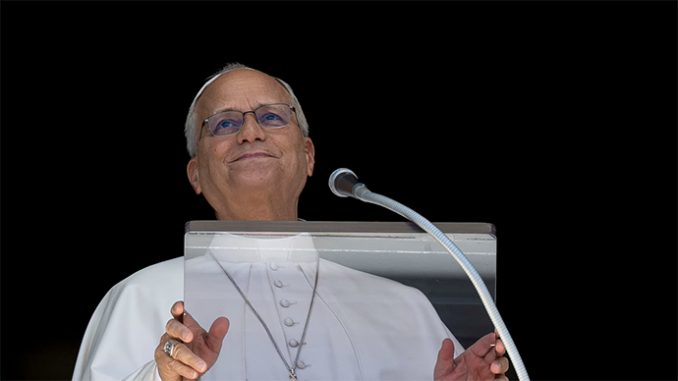
VATICAN CITY — Pope Leo XIV remembered the victims of the Sept. 11, 2001, terrorist attacks on Sunday and renewed his appeal for peace amid conflicts and violence around the world.
Speaking in English after praying the Angelus with the faithful gathered in St. Peter’s Square on Sept. 13, the pope recalled the 25th anniversary of the attacks, which was observed two days earlier.
“Two days ago marked the 25th anniversary of the Sept. 11th terrorist attacks in the United States of America. I renew my prayers for those who lost their lives and for those who continue to bear the wounds of that tragic day. At a time when conflict and violence afflict so many of our brothers and sisters, I invite everyone to pray that the Lord will bestow his gift of peace upon the world,” he said.
Continuing in Italian, Leo said the memory of the tragedy should prompt a renewed commitment to peace, above all through prayer entrusted to the intercession of the Virgin Mary.
The pope then greeted the Romans and pilgrims gathered in the square, including groups from Brazil and other countries, pilgrims who had traveled from Assisi along the Way of St. Francis, and motorcyclists gathered in support of peace and life.
Earlier, in his reflection before the Angelus, Leo focused on the Sunday Gospel and the Christian meaning of forgiveness, recalling that Christ taught forgiveness and bore witness to it even on the cross, when he prayed to the Father for his persecutors.
Reflecting on Peter’s question to Jesus about how many times he should forgive someone who sins against him, the pope noted that Peter’s suggestion of seven times already indicated abundance, since the number seven symbolizes fullness in Scripture. Jesus, however, went further, telling him to forgive “70 times seven” — without limit or measure.
Leo then recalled the parable of the servant whose enormous debt was forgiven by his master but who refused to show the same mercy to a fellow servant who owed him far less.
“All things are given to us by God out of pure love, and none of us can claim to be perfect in responding to such goodness. For this reason, gratuitousness — which is the source of our existence — is also the best rule for our life together,” the pope said.
“We experience this every day. Forgiveness is indispensable, and without it, we cannot live in peace.”
Without forgiveness, Leo warned, conflicts, accusations, grudges and acts of vengeance eventually arise, destroying relationships, dividing families and unleashing wars.
“Only forgiveness sets us free and restores the light, even where human material and moral poverty has darkened the horizon and made the path uncertain. Forgiveness, like a gentle breeze, sweeps away even the thickest clouds until the sun shines once more,” he said.
The pope also pointed to St. Peter’s own experience of forgiveness after denying and abandoning Jesus during the Passion. When Peter encountered the risen Christ on the shore of the Sea of Galilee, Jesus asked him only whether he loved him and once again called him to follow.
Leo said that forgiving and healing love confirmed Peter in his mission as the first of the apostles.
Concluding his reflection, the pope asked the Virgin Mary, Mother of Mercy, to help Christians forgive even when taking the first step is difficult, and to spread the healing light of a love that overcomes hatred and disarms resentment.
This story was first published in two parts by ACI Prensa, the Spanish-language sister service of EWTN News. It has been translated and adapted by EWTN News English.
If you value the news and views Catholic World Report provides, please consider donating to support our efforts. Your contribution will help us continue to make CWR available to all readers worldwide for free, without a subscription. Thank you for your generosity!
Click here for more information on donating to CWR. Click here to sign up for our newsletter.

I believe that how individuals and countries respond to harm inflicted are two different things. Individuals can forgive and move on.
It is a little hard to see what the Pope is calling for.
The Pope said, “Without forgiveness, Leo warned, conflicts, accusations, grudges and acts of vengeance eventually arise…”
Vengeance and retribution are not the same thing. A country may have to resort to retribution in order to exist.
A “tragic day?” Tragic, but also terrorism which is inadmissible…
Yes to forgiveness as freeing ourselves, but Pieper and Aquinas made an important DISTINCTION between the “readiness” to forgive and actual forgiveness—as a reciprocal relationship, as when sacramental absolution requires and follows repentance.
First PIEPER: “Christ drove the money-changers from the temple with a whip, and when the most patient of men stood before the high priest and was struck in the face by a servant, he did NOT turn the other cheek, but answered: ‘If there was harm in what I said, tell us what was harmful in it, but if not, why dost thou strike me?’” (Jn 18:23).
Then AQUINAS in his commentary on St. John’s Gospel:
“Holy Scripture must be understood in the light of what Christ and his saints have actually practiced. Christ did not offer his other cheek, nor Paul either. Thus to interpret the injunction of the Sermon on the Mount [turning the other cheek] LITERALLY [italics] is to misunderstand it. This injunction signifies rather the readiness [!] of the soul to bear, IF IT BE NECESSARY [italics], such things and worse, without bitterness against the attacker. This readiness our Lord showed, when he gave up his body to be crucified. That response of the Lord was useful, therefore, for our instruction” (both citations Pieper, “Fortitude and Temperance,” 1954; citing Aquinas John 18, lect. 4,2).
It seems to me that in the last 60 years, the church has chosen the path of heavily stressing the concepts of God’s love and forgiveness. That in itself is not a bad thing. But to stress only mercy, to the exclusion of the other half of the coin, halting any mention of the evil of sin, or need for repentance, results in these concepts being twisted out of shape until they are unrecognizable. In an increasingly violent and depraved world, it could not be clearer that the world is losing any semblance of morality and rule of law. Its because people are no longer taught the concept of right and wrong. Just an excessive emphasis on love and forgiveness. Well, I have noticed that the world is NOT better than before V2, If anything it is much worse, in an “every man for himself” sort of sense. People are no longer condemned or accused of crimes they commit, let alone punished for doing them. Shockingly, members of the public now support and defend those who are clearly breaking the law, even to murder, instead of demanding the criminals be jailed or otherwise punished for a good length of time. This morally bankrupt attitude extends to those who kill; like the death of Charlie Kirk, who was killed for trying to engage college students in honest discussion, the insurance executive shot in the back for the alleged “crimes” of his profession, or the woman who murdered her 3 children. Heroes all, to depraved members of the public. Its time to stop patting people on the head and telling them that God loves them, and start pointing out that God also hates sin and one day we will all be held accountable for our actions. The failure to do so is to give believers only half of the story, possibly to their eternal detriment.
Nonviolence is the weapon of the strong and violence that of the weak.
As pilgrims on journey, we need to complete the remaining stretch of our onward journey celebrating our joy-filled on-going-ness and harmonious togetherness.
There is something rather off about the clergy/Pope always calling for “peace and forgiveness,” but never repentence of sin and conversion to Christ.
MrsHess: BULLSEYE!!!!