

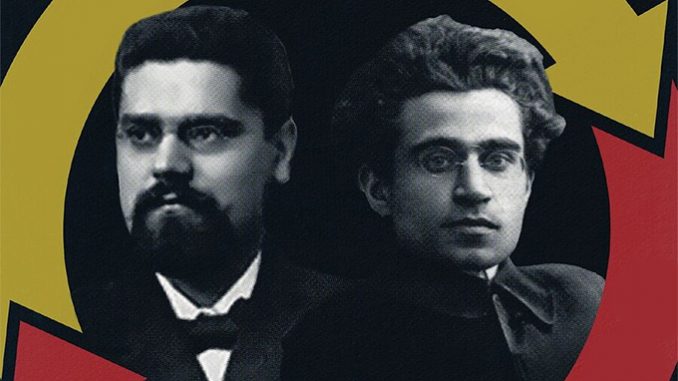
The Suicide of the Revolution is the newest installment of Carlo Lancellotti’s project of translating and editing the works of Augusto Del Noce into English, published by McGill-Queen’s University Press in Montreal.1 It is an attempt to reconstruct Italian cultural and political history from 1895 to 1976, with a focus on the development of Marxism, particularly as the latter was influenced by the works of Giovanni Gentile (1875-1944) and Antonio Gramsci (1891-1937).2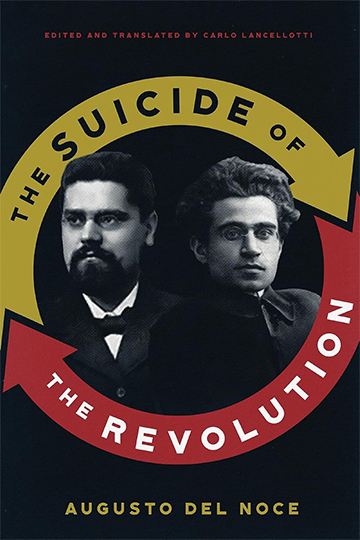
Lancellotti notes that, compared to these previous works, this one has at first glance a relatively narrower theme as it focuses on Italy in a certain time period. However, as he also states, this Italian history exemplifies a far broader pattern that emerged in Western culture and explains these patterns better than other approaches.
Specifically, Del Noce develops in detail his contentions that Gentile introduced sweeping changes in Marxism, and that these changes influenced Gramsci in ways that affected Marxism decisively at a global level.
The challenge of reading Del Noce
Before proceeding to discuss the more specific themes of the book, I need to explain the particular difficulties involved in reading Del Noce. His works are always a slog for most readers for the following reasons.
First, his process of thinking about the development of philosophical concepts over time is unique and therefore unfamiliar. He sees these concepts historically as developing through their interaction with other ideas, in the process changing them in some ways, while in another sense they remain the same. He calls this sublation, a Hegelian term he borrows despite the fact that his use of it is not the same as Hegel’s. We are accustomed to looking at philosophical notions more often in more abstract and universal ways, in hermetically sealed containers. We identify the features of, say, the Enlightenment, or Marxism, or Idealism, and tend to define and fix their meanings. Del Noce’s thinking is fundamentally different. For example, he sees Marxism as altered over time by its interaction with the Enlightenment, Idealism, and positivism, which would be quite different from one’s typical interpretation of Marxism. It is unfamiliar and thus confusing.
Secondly, Del Noce thinks of history in a fashion largely the opposite of where social and political philosophy has gone in recent generations. Today, we tend to interpret the world (thanks to Marxism and positivism) by “looking down” into the material realm. The world is explained by what is happening with capitalism and its effects on the class structure or other material factors, such as class, gender, and race. Even non-Marxist social science in general is heavily influenced by empiricism and positivism, giving us an essentially materialist interpretation of reality. Del Noce is the opposite; he interprets the world by “looking up.” He sees particularly twentieth-century history as the history of philosophy. In ways readers will struggle to follow, he believes that all the developments and sublations of various philosophies are the real drivers of history. This only compounds the problem associated with the first point.
Finally, in what might be an actual flaw in Del Noce, he is a genius, and, like many other geniuses, does not always take the time to elaborate and explain his points beyond simply stating them; Del Noce is one of the few contemporary philosophers a reader wishes wrote more explaining his process of reasoning. Nonetheless, I am convinced that Del Noce is unique and insightful in shedding light on our times and is therefore worth the considerable effort it takes to read him. Even if along the way one cannot follow the entirety of the reasoning, one can still derive a great deal of benefit from it.
Rethinking terms and interpretations
The title of the book is taken from the last of the four essays comprising the book, “Gramsci, The Suicide of the Revolution.” This controlling metaphor is based on Del Noce’s thesis that Gramscian Marxism, which calls for a “total revolution,” in the very act of succeeding, fatally undermines itself by its consistent focus on negation, to the point that no real substantive vision for a better society can emerge. Hence, the revolution “commits suicide” in its very actualization.
It is the labor of this book to explain the rather intricate philosophical history that prepared the way for Gramsci’s adoption of an interpretation of Marxism, which in fact destroyed the revolution it originally called for. This argument includes the controversial theory of a thorough interpenetration of originally “left” and “right” ideas. Herein lies one of the book’s unique and greatest contributions to the history of thought, revealing the inadequacy and even bankruptcy of the still common attempts to choose sides between putatively liberal and conservative interpretations of our times. Yet, for the most part, Del Noce’s work in this book is to explain the long historical developments that led up to this “suicide.” This entails a lengthy explanation of the background to Gramsci’s interpretation of Marxism.
Hence, three essays precede the final focus on the “suicide of the revolution.”
The first, “Giacomo Noventa and the ‘Mistake by the Culture’”, is present because Noventa was the sole precursor to Del Noce’s interpretation of Italian culture. The key similarity was Noventa’s assertion that Fascism was a “mistake by the [Italian] culture, which was a very unpopular and uncomplimentary interpretation as far back as the end of the Second World War. The prevalent views preferred to see fascism as a “mistake against the culture;” in this distinction we expose the central philosophical point, which is the “perfect parallelism between the development of Italian immanentist3 culture and the process of dissolution of Italy which began with Fascism and continues with anti-Fascism–that must continue because antifascism is dependent on the same culture from which Fascism derived. . . which, in fact, follows entirely from the historical defeat of Fascism and from a different judgment about contemporary history.”4
This point is often missed because Fascism and anti-Fascism clearly clashed. But Noventa insists that they were the products of the same deeper cultural framework, which was radically anti-transcendent, immanentist, secular and “modernist.”5 Anti-Fascism claimed to be modern but denied that Fascism was. In fact, anti-Fascism was a variation on modernism, which reassessed the Enlightenment and came to interpret it in a more decidedly anti-traditional vein. Del Noce emphasizes that, by the time of the Fascist period, Italy had already been handed a vision of the history of thought as “irreversibly directed to immanentism, secularization, “demythologization,” et cetera – in any case, towards the expunction of the supernatural, whose consequence will be the transformation of the meaning of transcendence, from vertical to horizontal. The idea, in short, is that God is dead.”6 All of Italy’s secular twentieth-century philosophers—Idealist, Marxist or neo-Positivist—are in effect “philosophers after the death of God.”7
The importance of Giovanni Gentile
In the second essay, “Gentile and Gramsci,” we learn that the philosopher and politician Giovanni Gentile is central to the theme of the book in that he merged Marxism with the Italian Risorgimento. More specifically, Del Noce contends that Gentile argued for a new form of Marxism, separated from Marx’s materialist economism, which was radically oriented to activism and became the basis of a new form of utterly subjective Idealism called “Actualism.” Gentile came to reinterpret Marxism as a “philosophy of praxis” conditioned by these insights. Del Noce holds that Gentile’s rereading of Marxism is the basis for Gramscian Marxism, which came later. Gramsci believed he had discovered a new philosophy of revolution ulterior to the Russian Revolution, but Del Noce believes he had discovered Gentile’s reinterpretation of Marxism.
As Lancellotti himself points out, the reader might wonder here what the significance of this is for anyone beyond an Italian historian of ideas tracing connections among Italian thinkers.8 For Del Noce, however, far more is at stake here than a question of how one Italian may have influenced another. Del Noce is convinced that Gentile’s rereading of Marxism, or “Actualism,” is a most important turning point in 20th-century philosophy. Gentile pushed the importance of action itself to the point of having no real regard for any preconceived end. Thus, Actualism was intrinsically anti-metaphysical and by implication anti-religious.9 “His system of philosophy,” Del Noce writes, “is the ultimate development of the German Idealism that had its climax in G. Hegel, the teacher of K. Marx, and is the negation of every transcendentalism, the identification of philosophy with history, with the act of thought in which verum and Factum are united in a dialectic progression which is never definitive and perfect.”10
Of course, the problem here is what such an idealist philosophy has to do with Marx. Del Noce contends that Gramsci’s belief that he had rediscovered Marx was a delusion, when in fact he had only rediscovered Gentile. Both Gentile and Gramsci represent the thorough abandonment of Marx’s historical materialism. It certainly was a “revolutionary turn without comparison.”11 Indeed, Gentile’s Actualism is so unique that it cannot communicate with other philosophies. This is so because it banished realism completely, both in its Platonist and empiricist forms. “The first consequence is the disappearance of every givenness. Thought is no longer the attribute of existing beings. . . the human species itself is an object.”
Gentile is aware that this philosophy completely annihilates all its predecessors. All previous philosophers moved within realism, looking at “the world of objects, at what is thought. They identify which of these objects are endowed with “thought that mirrors or reflects the rest of reality, and they have turned thought into a form of being. . . We need to untether thought from every particular and finite subject, which in this particularity and finitude is the object and not the subject of thought itself. Thought must switch from thought as a form of being to pure knowing. This is where Gentile definitively rejects Marx, whose materialist philosophy was simply “metaphysics inverted.”12
It is on the important Gramscian theme of “civil society” where we see Gramsci making moves he can only make because he has adopted Gentile. This is allegedly one of Gramsci’s greatest contributions to Marxist philosophy. Marx states as clearly as possible: “The totality of these relations of production constitutes the economic structure of society, the real foundation, on which arises a legal and social superstructure and to which correspond definitive forms of social consciousness.”13
In other words, for Marx, the structure of society is rooted in its economic system, and thoughts about it are based on the underlying material (economic) reality. But, for Gramsci, civil society is the product of ideology and culture without these particular economistic origins. History is no longer economic history but the history of different conceptions of the world.14 Del Noce attributes this departure from Marx to Gramsci’s reliance on Gentile’s Actualism, which liberates thought from dependence on material conditions. Gramsci will carry this further in his treatment of Leninism. Whereas for the latter, the “party” is the “vanguard party” that directed the proletariat, in Gramsci’s version, the civil society itself will provide the direction, rendering the older party subordinate to the current direction of the predominant culture.15
Defining and explaining “fascism”
In the third essay, “The Problem of the Historical Definition of Fascism,” Del Noce discusses the ongoing hole in Italy’s intellectual life—that is, its inability to articulate a historically accurate account of Fascism. It ties in with the overall theme of the book in that Gramsci participated in this failure, and Del Noce connects this hole in his thought with the failure of his thought to realize a genuinely Marxist revolution in Italy.
Del Noce, always consistent here, insists that the only way to come to a satisfactory historical account is to subject Fascism to a rigorous philosophical analysis.16 Fascism was “the integral experience of activism” influenced by Gentile’s Actualism. Negating transcendence, it grew out of naturalism, accompanied by a pessimistic outlook. But the reduction of reality to natural processes has enormous philosophical consequences, in particular the inability to subject it to any metaphysical or ethical critique. Metaphysically rudderless, naturalism tends to skepticism, and the corresponding collapse of morality prompts skepticism to degenerate into what Del Noce terms “decadentism,” which means the conversion of values into instruments that simply enhance our sense of “vitality,” which is clearly radically subjective and tied to whatever psychological stimulation the subject seeks.
For Del Noce, this was the deeper part of the culture that got passed on from Fascist to anti-Fascist culture. They never stopped to give a historically-based explanation of Fascism, which permitted them to overlook the cultural elements that united Italy’s Fascist and post-Fascist worlds. What replaced historical explanation was the creation of an ahistorical image of Fascism as “pure evil,” or “the demonic inside us,” even the “secularization of Satan.” But no historical account can be given of such an ahistorical formulation. The need to explain it passed quickly to the need to eradicate it. This manifested itself as a hostility to the past as broad, undefined, and unexplained as Fascism itself.
This leads us into the theme of “negative millennialism” that Del Noce discussed in The Age of Secularization. It is the direct and logical result of the combination of radical historicism and the disassociation with the older materialism of Marx. It combines two attitudes. On the one hand, there is the belief of the anti-fascists that the past is dead, and we have to “start from scratch” without reference to it. At the same time, radical historicism has undermined the notion that any new ideal has any real objective historical validity; no affirmation has any transcendent value or truth that can motivate or compel anyone. We have the hopeless combination of the dual convictions of “the death of the old ideals, but simultaneously the conviction that new ideals cannot be born.” 17
What the proponents of these intellectual movements failed to see is that what is left is only good for negation, desecration, and demythologization, but nothing positive. What is worse for those who professed to be revolutionaries is that all one can really do is to surrender to what is, to the existing reality. Hence, progressivism curiously unites with the powers that be, which formerly they condemned. As we shall see, this is what happened to Gramsci’s Communism.
What is the historically valid definition of why Fascism came to be? For Del Noce, the birth certificate of Fascism bears the date 1899, when Gentile published La filosofia de Marx.18 This was the prologue to the culture that would come in the 2oth century. This was when Gentile transferred Marxism from an objective philosophy to a radically subjective one in “the philosophy of praxis.” Mussolini saw that Marxism’s largest problem was cultural. Bolshevism was incompatible with the culture not only in Italy but in other “more civilized nations.” Mussolini had little in common with Gentile, but he needed the latter’s revolutionary thought for a more “forward-looking” revolution in Italy.
They settled on the Italian model of the Risorgimento as the fit for Italy.19The philosophy would be revolutionary, immanentist, and secularist. Politically, Mussolini could not simply eliminate the crown, the Church, the army, and the Italian egal system. His conception was to reform the traditional elements along the way. He seduced traditional elements with anti-liberal and anti-socialist rhetoric, but was unable to transform them or subvert them. Fascism fell apart.20
So, for Del Noce, Fascism was an attempt at a revolution ulterior to the Marxist-Leninist. It was an attempt at modernization on the way to a revolution designed to bring about a higher degree of civilization, which failed. The emphasis in Del Noce’s definition is on Fascism as a revolutionary alternative to the Marxist-Leninist. But such a rereading flew in the face of modern Italy; it attracted few followers in Italy or elsewhere. Progressives were content with the understanding of Fascism as the catch-all explanation for everything that had gone wrong. And so Del Noce’s reading never got traction inside or outside Italy.
Gramsci’s Communism and the “organic intellectual”
The last essay, “Gramsci, or the Suicide of the Revolution,” is undoubtedly the most important essay, to the point that French and Spanish translations of the work did not include the other three essays!
The theme is that Gramsci’s radically immanentist, anti-transcendent subjectivity, while very successful at undermining the values of the past, was unsuccessful at rebuilding civilization, leaving us in the situation of “negative millennialism” developed in the previous chapter. This is what ultimately became of Marx’s revolution under Gramsci’s guidance, influenced by Gentile. It was the unintended predominance of negativity, which became indistinguishable from nihilism. Gentile’s Actualism had shifted Marxism away from its original focus on modes of production and the social relations they generated. He replaced it with an emphasis on thought no longer constitutively linked to anything Gentile could objectively call real.
Hence, the centerpiece of revolution switched to the culture of civil society, which took the place of what Marx had defined as society’s material and economic base. We can only learn what the generators of thoughts, the intellectuals, think about social reality. It is inevitable under such presuppositions that intellectuals become the new center of power, which is now cultural-intellectual power, the only one that matters. Gramsci was famous for his articulation of the theory of the “organic intellectual.” 21 In his conception, these would be intellectuals similar to himself who would organize, lead, and direct the oppressed social classes. They would be intellectuals who are, to use an overworked contemporary academic term, “civilly engaged.”
Now, when we look around today, we can surely find people who fit Gramsci’s definition of the “organic intellectual” eighty-nine years after his passing. Yet, no one would want to say that such people are part of a leading or dominant class. We can search for various terms that might describe today’s dominant intellectual class. Many would call them “technocrats.” Others are “experts” in the fields of economics, finance, and advertising, as well as science. Some are still “demythologizers,” or, more negatively, “desecrators.” They have nothing to do with Gramsci’s organic intellectuals, serving as they do the industrial, financial, and intellectual-cultural powers that be. These intellectuals surely see themselves as instruments of progress, yet they are plagued with all the characteristics of negative millennialism. They are geniuses at making the current system function on its own terms, but are unable and do not even pretend to articulate any future other than the one we are in.
Gramsci’s Communism unwittingly served the transition from one stage of capitalism to another. The new capitalism works hand in glove with Gramsci’s Communism. The dominant intellectual-cultural class plays two tightly intertwined roles: (1) They ensure that the predominant culture stays within the bounds supporting the existing economic, social, political, and cultural structures. Thinking that is anti-transcendent, anti-traditional, positivism, eroticism, reflecting modernist (horizontal) interpretations of religion, all pass the cultural test and tend to circulate. Thinking that goes against these patterns is written off, criticized when necessary, and generally has a tough path to any major circulation in the media and intellectual worlds. (2) They ensure that the predominant culture preserves their roles and influence. Del Noce underlines that Gramsci himself never saw this coming, but prepared the way for it when he adopted Gentile’s critique of Marxism.
The meaning(lessness) of revolution
Del Noce invites us to reflect more thoroughly on the term revolution, which has been defined in different ways throughout history. For many centuries, its meaning was confined to a change in political constitution. Del Noce suggests that under the influence of the trends in twentieth-century Marxism outlined in this book, it came to mean opposition to change required by the very values that direct a particular civilization, such as, in our society, freedom and justice as understood historically. In other words, revolutionary thought today would oppose a transformation of society in the direction of freedom and justice so conceived. Under the influence of the later Marxist “total revolution,” revolution comes to mean an undermining of the core values themselves, with the consequent negation of any and every value conceived as absolute and eternal.22 Everything collapses into history.
This, of course, entails the negation of ethics, which makes no sense apart from some values that transcend today. Ethics becomes absorbed into politics, accompanied by a complete break with traditional religion.23 The revolution must be “totally other.” Lenin was the perfect example of this kind of thinking when he frankly admitted that morality reduced to whatever promoted the revolution; lies, any duplicity, fraud, even murder are acceptable.
In the end, what we have here on the philosophy side is the end of metaphysics, ethics, epistemology, and what fell under the term “speculative philosophy.” This is the real fulfillment of the Marxian phrase frequently repeated but infrequently grasped in its full meaning: “Philosophers have hitherto sought to understand the world, but the point is to change it” (from Theses on Feuerbach).24 When we interpret this in the light of Actualism, we can see that this means a call to change a world we do not understand. Del Noce sees this thinking as fatal and with good reason. Without an understanding of the world I live in, compared to one I am trying to build, with a reasoned belief that the one I am building is categorically “better” than the one I am living in now, then on what basis can a revolutionary call be issued? Such an approach can only terminate in nihilism.
The revolution, originally conceived as moving from a known and present state to a known and better future state, has become a philosophy that can only negate; there is no vision beyond negating the past. We have come to the understanding of the book’s central metaphor, “the suicide of the revolution.” It has committed suicide because, in the name of revolution, it unwittingly went down a path of sheer dissolution. The revolution “was left truncated at its negative aspect. . .[in an] inversion of the original intention.”25 All that is left is irreducible egoism, as the only meaning that can exist under such assumptions is one’s own, as meaning is itself reduced to the affirmation in any direction of the “I”.
In summary, Gramsci believed, following Gentile, that Marxism was to be reinterpreted with historicist premises, and in fact was the fulfillment of historicism, reducing reality to the ever-changing sets of circumstances that produce it day to day. He failed to see that this approach eliminated the criterion of truth altogether, and failed similarly to see the end to which such a process would lead. Without truth, power is the only answer, the only criterion left to determine social outcomes. Although Gramsci would go on to argue at length for a transformation of culture based on hegemony defined in terms of consensus, he failed to see that he had opened the door to what in fact came: a civil society and culture dominated mostly by the existing set of powerful actors in the economic, political, and cultural spheres.
A major change he missed was the transformation of the old bourgeoisie to the new bourgeoisie, which would be the bourgeoisie in its pure form, completely focused on material gain, having shed its previous ties to tradition and religion.26 The new bourgeoisie, along with the dominant intellectual class, is there to remind one that there are no alternatives to the materialistic, high-tech, globalized, consumer society, no alternatives to what is. This is the only end left. Proposals for anything other are invariably attacked by the intellectual guardian class, supported by billions of dollars flowing through the culture industries. Religion’s new role is to “update itself” so as to fit in with the prevailing intellectual and cultural winds.
The m
I will conclude this review on a somewhat more personal note, but one I think is very relevant for this book. As I noted at the outset, echoing Carlo Lancellotti, one might be tempted to back away from this book for its ostensibly more narrow focus on Italian cultural and intellectual history. I would suggest three strong reasons why you, the reader of this review, should push back on this temptation and read the book.
First, what can seem to be uniquely Italian is not once you get the larger point. Take, for example, the extensive discussion of historical Fascism. This, at first glance, might appear to be a good reason not to read the book, because Fascism is over, and debates over why it came to be seem insignificant today. Yet, as Del Noce argues persuasively, it was precisely here that global progressivism made the most serious error, which poisoned their entire thought and continues to today. Progressivism, in general, made the same mistakes that were made in Italy. They blamed Fascism broadly for the widest range of social evils for which it was not principally responsible, and they made the further error of linking Fascism with tradition, interpreting Fascism as a form of rancid traditionalism. They completely missed the actual thrust of Fascism as an alternative revolutionary modernity. These errors have plagued the entire intellectual appropriation of tradition for decades now and are therefore of enormous significance. The historical interpretation of Fascism, as Del Noce explains, has global repercussions even today.
Secondly, Del Noce’s reading of Marxist thought is unique and simply cannot be found elsewhere. It is true that Gramsci himself is of paramount importance in the history of Marxism, but the significance of what Del Noce does here far surpasses that fact. It is only in the decomposition of Marxism as Del Noce explains it that we really understand the twisted developments of the post-World War II West, with one side of decomposed Marxism continuing to exercise enormous influence even as the original revolution collapses for the reasons Del Noce uniquely articulates in this book. Again, I submit that Del Noce is the unique source of enlightenment here.
Finally, Del Noce gets to the bottom of the decomposition of what used to be broadly called “the right” and “the left.” Both of these have decomposed under the influence of the forces discussed in this book. Del Noce explains what would otherwise be unintelligible or expressed in hopelessly superficial formulas, mentioning that the right seems to have morphed into the left and the left into the right, but without a grasp of the underlying dynamics. Far too much is still written today about “the left” and “the right” as though they still exist in the forms they existed in decades ago, and remain impervious to the precise cultural and philosophical factors that guide the changes. Here again, Del Noce is an indispensable contributor to the grasp of the deeper philosophical dynamics that continue to propel our world.
As the nuns always told us, “put your thinking caps on,” and invest some days in the work of reading this important book.
Related at CWR:
• “Atheism: The core of modern Western culture in the thought of Augusto del Noce” (December 14, 2020) by Dr. Thomas R. Rourke
• “Secularization, Marxism, and the Enlightenment in Augusto Del Noce” (July 22, 2021) by Dr. Thomas R. Rourke
The Suicide of the Revolution
By Augusto Del Noce
Edited and translated by Carlo Lancellotti
Montreal: McGill-Queens University Press, 2026
Hardcover/Paperback/Ebook, 372 pages
Endnotes:
1 The previously translated works, all translated and edited by Carlo Lancellotti and published by McGill-Queens are: The Crisis of Modernity (20140, The Age of Secularization (2017) and The Problem of Atheism (2021).
2 The book also discusses at length the works of Benedetto Croce. For considerations of space, and the fact that Del Noce emphasizes the more direct influence of Gentile on Gramsci’s work, this review will not delve into the role of Croce.
3 In Del Noce, immanentism has the meaning of being anti-transcendent, or the tendency to reinterpret the transcendent as immanent.
4 Augusto Del Noce, The Suicide of the Revolution, 30.
5 Ibid.
6 Ibid., 37.
7 Ibid.
8 Carlo Lancellotti, “Translator’s Introduction,” in Augusto Del Noce, The Suicide of the Revolution, xiv.
9 Augusto Del Noce, The Suicide of the Revolution, 108.
10 Ibid., 118.
11 Ibid., 127.
12 The quotes in this paragraph are all from Augusto Del Noce, The Suicide of the Revolution, 127-28.
13 Karl Marx, from the Contribution to a Critique of Political Economy, quoted in Augusto Del Noce, The Suicide of the Revolution, 141.
14 Ibid.
15 Ibid., 143.
16 Ibid., 179.
17 Augusto Del Noce, The Age of Secularization, 44-45.
18 Augusto Del Noce, The Suicide of the Revolution, 203.
19 Ibid., 211.
20 Ibid., 215-16.
21 Augusto Del Noce, The Suicide of the Revolution, 166-67.
22 Augusto Del Noce, The Suicide of the Revolution, 318.
23 The alternative form of religion that accepts modernist premises is accepted, but this kind of religion plays down or negates traditional creeds and doctrines.
24 Augusto Del Noce, The Suicide of the Revolution, 318.
25 Ibid., 319.
26 Del Noce argues that the bourgeoisie at the end of WWII still had serious opposition on two fronts: (1) from the Marxist left who wanted to overturn them, and (2) the morally traditional Catholics who would resist the commodification and commercialization of everything. He notes that the emerging ideology swept them both away and allowed them to exist now in a pure state with far more power than before. See The Age of Secularization, 12-13.
If you value the news and views Catholic World Report provides, please consider donating to support our efforts. Your contribution will help us continue to make CWR available to all readers worldwide for free, without a subscription. Thank you for your generosity!
Click here for more information on donating to CWR. Click here to sign up for our newsletter.

Thomas R. Rourke’s brilliant review of The Suicide of the Revolution hits the philosophical center of our current civilizational crisis. Augusto Del Noce’s genius lay in foreseeing that Marxism would not be defeated by traditional Christian culture, but would instead dissolve into what he termed the “opulent society”. By stripping Marxism of its messianic hope while retaining its radical materialism, the modern West birthed a totalist consumerism far more effective at eradicating the sacred than any totalitarian regime.
Today, we witness the fulfillment of this prophecy in the historical alliance between corporate capitalism and the “individual rights” framework of the secularized Left—a movement that rapidly abandoned the protection of labor to become the ideological champion of subjective market desires.
A striking embodiment of this phenomenon can be observed in contemporary Europe, notably in Italy’s post-communist landscape. In the over-the-counter pharmacies (parafarmacie) of mainstream supermarkets, emergency contraceptives like EllaOne are sold on store shelves alongside everyday household goods. This is the biopolitical climax of the opulent society: the profound mysteries of human generation, life, and moral responsibility are stripped of their metaphysical gravity and reduced to de-moralized, immediate commodities.
Del Noce, of course, could not have foreseen artificial intelligence, yet this current biopolitical landscape raises a further question: what becomes of the opulent society in the age of algorithmic governance?
To answer this question, I find it useful to borrow two categories from the history of philosophy, not in a genealogical but in a structural sense.
The first is what might be called a new Averroism. In the Summa Theologiae (I, q.117), St. Thomas Aquinas rejects the theory of a separate and universal intellect because genuine knowledge belongs to concrete human persons. Today, however, increasingly vast systems of artificial intelligence and data processing function as external cognitive structures that tend to reduce individuals to nodes within a larger informational network. The analogy is structural: human intelligence risks being absorbed into an impersonal framework that increasingly thinks, predicts, and decides on our behalf.
The second category is a new Platonism. As technological society expands its power over nature—turning even the generation of life into a commercial commodity—it simultaneously encourages the view that the body is merely raw material to be redesigned according to subjective desire. The tendency to separate personal identity from embodied reality recalls, in a radically secularized form, the ancient temptation to regard the body as something secondary to the true self.
Seen from this perspective, the contemporary crisis extends far beyond the categories available to Marxism or liberalism. It concerns the very meaning of the human person. For this reason, Del Noce’s recovery of transcendence remains indispensable. Yet the deepest response may already be found in Aquinas: intelligence belongs to persons, not systems, and the human being is a unity of soul and body, not a consciousness temporarily inhabiting a biological machine.
So?
So, Fascism and Socialism are not opposites but are cut from the same cloth. Some would say that Fascism is not conservative but collectivist and that both are “leftist.”
So, we read: “The revolution, originally conceived as moving from a known and present state to a known and better future state, has become a philosophy that can only negate; there is no vision beyond negating the past.” Probably not a good idea for those in high places to brand the past as “backwardist.”
So, from the very top, and not limited to the Italian experience, we have the lens of “sublation” (seeing history as a congeries of interacting stuff rather than as reducible to homogeneous worldviews and steps like the Enlightenment; and, instead of viewing this stuff from the top-down, we can view it/them from the bottom-up (that it is not philosophies that drive history, but rather “all the developments and sublations of various philosophies….”)
THAT IS, it seems to me, we would do well to give more attention to the details and turning points—Butterfly Effect—within what is aggregated as “history.” The mystery of human freedom in every circumstance. (a mystery denied by Islam, which itself is an accident of 7th-century history).
The mystery that Pope St. John Paul II had in mind when he wrote “Man receives from God his essential dignity and with it the capacity to transcend every social order so as to move toward truth and goodness” (Centesimus Annus, 1991, n. 38). The denial of transcendence being the common element of all the modern historical “trends” in Italy (etc.) as examined by Del Noce.
So, the Church witnesses to the sublational (!) particularity and bottom-up “event” of the incarnate Second Person of the Triune One, into universal human “history”. After centuries of fallen “intellectuals,” the perennial Catholic Church once again finds itself in Apostolic times.
The Butterfly Effect of tiny wings in a backwater manger, altering stars and souls.
Simply this: if intelligence is increasingly understood as residing in algorithmic systems rather than in concrete human persons (in a structurally neo-Averroist sense), and if the body is reduced to raw material to be redesigned according to subjective desire (in a structurally neo-Platonic sense), then the central affirmations of Christianity gradually become unintelligible.
Without personal intellectual agency, conscience, moral responsibility, sin, and repentance lose their foundation. Without the ontological dignity of the body as an integral dimension of the human person, the Resurrection of the Body and the redemptive meaning of suffering cease to be fully intelligible. Even the Incarnation risks being reduced to the temporary use of a biological instrument.
That, I think, is why Del Noce remains so relevant. The opulent society does not primarily attack Christianity through persecution. Rather, it advances by reshaping anthropology, above all through the transformation of language and concepts. Once the person, the family, or even human nature itself are redefined, the Gospel is not formally denied; it simply becomes increasingly difficult to understand why it matters. Yet Christianity is decisive not only for eternal destiny, but also for the preservation of a genuinely human civilization.
Therefore, the only effective resistance against this techno-Gnostic dissolution is neither political nor ethical, but metaphysical: we must absolutely reclaim the analogical realist integration of faith and reason, reaffirming with Aquinas that truth is measured by reality, and that human dignity resides in concrete, embodied persons, not in the rationalistic and voluntaristic anonymous abstractions of systemic governance and surveillance, nor in the empirical and utilitarian debased frame of the age.
“Total revolution, in the very act of succeeding, fatally undermines itself by its consistent focus on negation, to the point that no real substantive vision for a better society can emerge. Hence, the revolution ‘commits suicide’ in its very actualization” (Rourke).
Gramsci, a Sardinian Catholic priest was incarcerated by Fascist Mussolini,
whose moderate Fascist socialism would remain alive in the post war Social Christian Party, whereas Gramsci’s total actualization requires a form of nihilism.
Where do we find Gramsci’s total destruction of culture and social framework if not in our own America with NYC mayor Mamdani, the catalyst for a nationwide social revolution. Not a promising scenario for Christianity.
Added to the last comment regarding the unearthly, godlike power of communist Xi, he actually has the power, instead of the Roman pontiff – to appoint Catholic priests for ordination as bishops.
This needless to say is a travesty of justice that the Vatican determined it had to comply with, the Sinisization of Catholicism demanded by the CCP, whereas the ‘underground’ Church held fast to the true faith.
Cardinal Zen strongly opposed this submission to Xi Jinping and Communism. A controversial agreement to disfigure the faith that Leo XIV is bound to rectify.
Hardly a Catholic priest Fr Peter, but certainly a secular saint, an ideologue for new cultural hegemony.
The irony is that he was last observed resting in a Christian cemetery (Rome’s Protestant cemetery) being lovingly attended to by young devotees.
He failed in death to escape the dominant hegemony he sought to overthrow.
The irony of it all.
My previous comment begins with essayist Rourke’s quote of Del Noce on nihilistic Marxism. The question raised in this is the durability of Communism elsewhere. Russia until the economic collapse in attempting to compete with the far wealthier U.S. war machine.
China has lasted, building a superb economic infrastructure, the world’s supplier of manufactured goods. Both Russia and China incorporated nationalism, Russia reviving religion during the Great Patriotic War. China turned to economics and a form of leadership deity that we also find in N Korea.
Xi Jinping is certainly more that a government leader exerting power far beyond channeling as it were, Mao tse Tung. Among the gods of the CCP are Lenin and the diabolic Marx. It is alleged that Mao, a type of sun god, coined the words it always is darkest before the dawn, although that epithet apparently belongs to English clergyman Thomas Fuller.
We do however believe that the darkness that now prevails in world and Church will at God’s choosing usher in a new Dawn with the second advent of Christ.
“The question raised in this is the durability of Communism elsewhere. Russia until the economic collapse in attempting to compete with the far wealthier U.S. war machine.”
Russia only lasted as long as it did because of its propensity to appropriate foreign intellectual property (the story of how chicken**** FDR allowed Stalin to keep four e B-29’s and then duplicate them into the Tu-4 is instructive) through their massive industrial espionage apparatus and fifth column in the U.S. Government.
My late grandmother visited Eastern Europe in the 1970’s, and found cousins who readily accepted her due to her being flawlessly fluent in that language and being from the United States. On her last trip, she was advised to bring a suitcase full of Levi’s jeans, as they would all but pay for her trip, however circumstances didn’t permit her return. She found out about the shortages and poor quality that exemplified the markets of the workers paradise. Imagine my shock a few years later when I’m reading the late Paul Samuelson shilling and extolling the wonders of central planning and its bounty in my undergraduate economics textbooks. He should burn in hell for his propaganda.
It’s not that the Soviets couldn’t (just) keep up with the American war machine-there was no machine they could keep up with. Even their great “achievements” were often Potemkin villages. The defection of the Soviet pilot with the Mig-25 showed a machine that sacrificed reliability, range and maneuverability for speed and altitude. They tried to reduce economies to Leontiff matrices, but economies don’t work with the “fatal conceit” of central planning, because it lacks effective price discovery and exchange mechanisms.
Yes. The other side of the story. Khrushchev was certain the USSR would ‘bury us’. That conviction was more a quasi religious belief. Interesting account of your grandmother.
“The inadequacy and even bankruptcy of the still common attempts to choose sides between putatively liberal and conservative interpretations of our times” How true. All these Enlightenment postures are vitiated by their common origin. Del Noce was preceded by the Church in recognising this. The Church recommends the metaphysical answer on scholasticism, especially Thomism. Those who play with Descartes and Pascal and their miserable scepticism, remain in the “modern” labyrinth.
I wouldn’t say, however, that “demythologization” is “the expunction of the supernatural”. Quite the opposite. Christianity is the eternal enemy of myth.