
New York City, N.Y., Oct 17, 2017 / 03:02 pm (CNA/EWTN News).- Anti-Christian persecution is “worse than at any time in history” and in many cases genocide and other crimes against humanity “now mean that the Church in core countries and regions faces the possibility of imminent wipe-out,” says a new report from Aid to the Church in Need.
The report, titled “Persecuted and Forgotten?”, covers the years 2015-2017. Its contents are bleak, describing Christianity as “the world’s most oppressed faith community.” Anti-Christian persecution in the worst regions has reached “a new peak” and its impact is “only now beginning to be felt in all its horror.”
“In 12 of the 13 countries reviewed, the situation for Christians was worse in overall terms in the period 2015–17 than within the preceding two years,” said the report’s executive summary, released Oct. 12.
John Pontifex, the report’s editor, commented that “In terms of the numbers of people involved, the gravity of the crimes committed and their impact, it is clear that the persecution of Christians is today worse than at any time in history. Not only are Christians more persecuted than any other faith group, but ever-increasing numbers are experiencing the very worst forms of persecution.”
China, Eritrea, Iraq, Nigeria, North Korea, Pakistan, Saudi Arabia, Sudan, and Syria were ranked “extreme” in the scale of anti-Christian persecution. Egypt, India, and Iran were rated “high to extreme,” while Turkey was rated “moderate to high.”
The report’s ratings draw from analyses like the Pew Forum’s Social Hostilities Index and Open Door’s World Watch List, in addition to other factors and sources, including fact-finding trips.
In some countries the state is the principal persecutor, while in other countries social groups are culpable, while in still others a combination of both are responsible.
Aid to the Church in Need, an international Catholic pastoral charity, provides emergency and pastoral relief in 140 countries. Its U.S. affiliate published the report.
The report’s foreword was written by Archbishop Issam John Darwish of the Melkite Archdiocese of Zahlé and Furzo, a Lebanese archdiocese near the Syrian border. He recounted the stories of Christian refugees fleeing the six-year-old Syrian civil war.
“Many refugees have told terrible stories of persecution: like the man whose brother, a priest, was kidnapped – and despite the family paying the ransom they killed the priest. They sent his family a box containing his severed wrist, tattooed with a cross, to show he was dead,” the archbishop said.
The Middle East is a major focus for the report.
“Governments in the West and the U.N. failed to offer Christians in countries such as Iraq and Syria the emergency help they needed as genocide got underway,” the report said. “If Christian organizations and other institutions had not filled the gap, the Christian presence could already have disappeared in Iraq and other parts of the Middle East.”
The exodus of Christians from Iraq has been “very severe.” Christians in the country now may number as few as 150,000, a decline from 275,000 in mid-2015. By spring 2017 there were some signs of hope, with the defeat of the Islamic State group and the return of some Christians to their homes on the Nineveh Plains.
However, the departure of Christians from Syria has also threatened the survival of their communities in the country, including historic Christian centers like Aleppo. Syrian Christians there suffer threats of forced conversion and extortion. One Chaldean bishop in the country estimates the Christian population to be at 500,000, down from 1.2 million before the war.
Many Christians in the region fear going to official refugee camps, due to concerns about rape and other violence.
The Islamic State group and other militants have committed genocide in Syria and Iraq. While Islamic State and other groups have been defeated in their major strongholds, many Christian groups are threatened with extinction and would not survive another attack.
In northern Nigeria, the radical Islamist group Boko Haram has engaged in genocide against Christians.
There are reports from North Korea of forced starvation of Christians and forced abortion. Some Christians have been hung on crosses over fire, and others have been crushed by steamrollers. Protestants and Catholics are ranked among those least sympathetic to the state, which limits their access to food, education, and health care. Christianity is linked with American influence, and Christians are executed as spies.
In Sudan, the government’s pursuit of an extremist Islamist agenda led to orders to tear down Christian churches. Christians are arrested for alleged proselytism, and women face fines for wearing “obscene” or immodest dress. The government stripped citizenship rights of people with origins outside Sudan, leading many to leave for their ancestral homelands in South Sudan. Many had lived in their homes for three decades or more.
In January 2017 the U.S. put a six-month waiver on human rights sanctions against Sudan, on condition that the country improve its human rights and religious freedom record.
In Pakistan, banned fundamentalist cells pose a great threat to Christians, but some charge that the government’s failure to crack down on these groups worsens the problem of violence. On Easter Sunday 2016 as many as 24 Christians were killed in targeted violence in Lahore. A faction of the Pakistan Taliban claimed responsibility for the attack.
In India, persecution has increased since 2014, with the rise of Prime Minister Narendra Modi’s right-wing Hindu nationalist Bharatiya Janata Party. Like-minded groups frequently accuse Christians of forced conversion, a charge local Christian leaders strongly deny. An India-based Catholic group reported 365 serious anti-Christian atrocities in 2016, with 10 people killed and more than 500 clergy or church leaders attacked for their faith.
Some Christians have faced pressure to convert under threat of force, while others have been forced to take part in Hindu rituals and deny their faith.
In China, church communities face increased hostility. Authorities in some provinces have removed crosses from some churches and destroyed church buildings. In some regions, Christmas trees and greeting cards have been banned.
President Xi Jinping has depicted Christianity as a means of “foreign infiltration” into China and has advocated more state control and targeting of unofficial churches. There are fears that China’s 2016 announcement of categorization of citizens based on political, commercial, social and legal “credit,” will create a system that disadvantages Christians in a way similar to North Korea.
Christians in Egypt suffered a major suicide bombing attack in December 2016 and again on Palm Sunday in April 2017. Dozens were killed and more injured in both attacks, for which the Islamic State group claimed responsibility.
Saudi Arabia has come under criticism from western powers and the U.S. Commission on International Religious Freedom. However, President Donald Trump signed a $110 billion arms deal with the country, a deal which had been held up under the Obama administration due to human rights concerns. The Aid to the Church in Need report said sources in the country are supplying arms and finances to Sunni extremist groups including the Islamic State, known in the region as “Daesh.”
“Given that Islamist groups such as Daesh are likely to be heavily reliant on undeclared external sources for weapons and intelligence, there is an urgent need to step up action to stop all entities collaborating with them,” the report continued. “Persecuted Christians are among the many who stand to be beneficiaries of progress in this area.”
Archbishop Darwish said it is imperative to help persecuted Christians.
“When the Christian families who have turned to us need the very basics for daily life – food, shelter and medical care – how can we refuse to help?” he asked, lamenting a lack of aid from the U.N. and other humanitarian organizations.
He praised Aid to the Church in Need’s efforts to report anti-Christian persecution and aid those persecuted.
 […]
[…]



 By
By 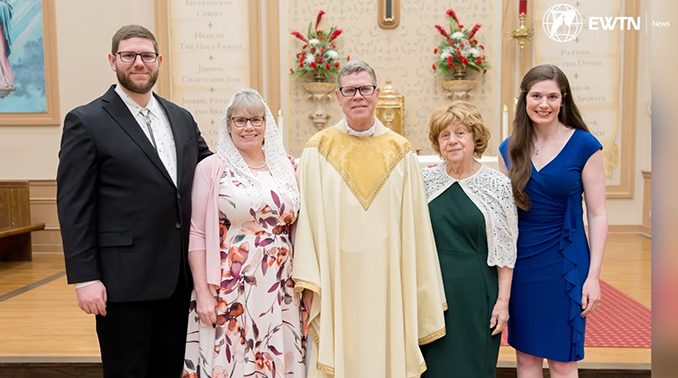

I fully admit that whether or not the clergy should be celibate is beyond my payscale, but if a married (former) Protestant can become a Catholic priest, why can’t a married Catholic? My best friend is an Orthodox priest. He’s a husband, a father, and a grandfather. He tells me that he understands all the reasons for opposing a married priesthood, but he feels that the benefits far outweigh them. (And believe me: I have no iron in this fire. Though married, I feel not so much as a whisper, let alone a call, to the priesthood.)
Married men can be ordained as deacons in both the Roman and Eastern Rites.
In the Byzantine Catholic Church, as well as the other various Eastern Catholic Churches, it’s not against tradition to admit married men to the priesthood, whereas in the Roman Church, priestly celibacy is viewed as a discipline. Many of the early Church fathers were married.
I’m in full support of a married Roman priesthood as an option.
Two of the best Byzantine priests I know are married, and they are very good in confession, because they have experienced the ups and downs of marriage.
There is no controversy with the prospect of a married priesthood.
Once they become a priest, they have to be celibate, married or not.
They do? Huh. News to me. As a longtime Eastern Catholic, I know quite a few married priests who have children and who are continuing to have children.
I think she means if their wife should die. I think that is the norm but may be dispensed.
Never heard of that rule…
No, we had an Episcopal priest who grew up in our hometown converted and became a Catholic priest. It seemed to work out fine
I agree with your friend that there are real struggles in having a celibate priest stood, but I believe the benefits far outweigh the difficulties. A celibate man better images and conforms too the image of a celibate Christ, who is totally wet to his bride the church and lays down his life for her and not his own will see Ephesians 5 and Matthew 19. Additionally living a life, totally committed to God now without the mediation of a wife is more a kin to, and is a sign of the heavenly reality where everybody will be totally devoted to God without mediation. The celibate is offered graces to do that now. I encourage you to make friends with happy celibate clergymen who can tell you of the grace of the sacraments and the way that prayer and a relationship with Mary has transformed and sustained him.
Since the article by Professor Spinello, The Second Vatican Council: A Guiding Star for the Church? is not available I wish to post a comment here on the Vatican II controversy.
Or a death star? A snare for large contingents of the progressive and traditional Church. Spinello apparently alludes to the multitude of progressive carpetbaggers who misused the Counsel’s documents to promote their new paradigm.
Reaction to the new paradigmers by traditionalists is that they, the radical left, are drawn into the alluring glitter of the death star only to be gripped by the devil. Whereas new paradigmers will contend it is the traditionalists who have closed their ears to the voice of the Spirit of the Council.
Ironically, Vat II has unfairly become a cause for distancing within the Church. Both reject what the Council actually teaches, injuring their faith in obedience to the Magisterium. Taking themselves to extremes that freeze compassion and Christian brotherhood.
For a test of manifest devotion to Christ present in the Holy Eucharist turn around at the consecration and note how very few are looking directly at the Eucharist, and are rather looking down piously or at a missalette. This is a hangover from the TLM. So the NO was intended to engage the parishioner in what is actually occurring before their eyes. To engage and participate, to learn what is being taught through the liturgy.
Professor Spinello analyzes all the pertinent Council documents to clearly demonstrate, one would wish once and for all, that both are out in Left Field. That if read properly sans a preconceived agenda will find the Council is indeed a Guiding Star.
If you are going to accuse people of rejecting what the Council teaches, perhaps you should include a quote of what that teaching is, and some evidence of rejection besides behavior. Sin is not generally evidence of heresy, and the direction of one’s gaze does not even amount to sin. Nor does it necessarily indicate what a person’s mind is on.
His argument subverts itself. He says the NO was intended to engage the parishioner in what is actually occurring before their [sic] eyes. And he now, as a practitionre of the NO, observes that few look.
Yesterday, a Dominican priest homilied on what “active participation” per Aquinas intends. One’s senses are not necessarily engaged. One’s spirit IS participating in sanctifying grace. One gains grace is through reconciliation and receipt. Reconciliation and receipt of Holy Eucharist are spiritually mindful, not sense-based acts.
One would have hoped that a doctorpriest would, late in life, have come across such notions.
“This is a hangover from the TLM.”
The stunningly arrogant bias and assumption by one human-mind led me to gasp. Have you been ill, Fr. Dr.? One who cares nothing for Who He Is will level such thoughtless uncharity to another of His Own.
Other persons adore the Eucharist at His Elevation within UA rubrics since that is the first time during the Mass the parishioner may view The Presence of the King. He is elevated. Not manhandled.
The premise underlying the changes to the Mass was to present the liturgy as a means to engage and instruct the faith. Few persons understood was was occurring at the altar, except for a few like yourselves who made the effort.
I don’t accuse you, although I accept your insults as a blessing.
Few persons understood [what] was occurring at the altar. A miracle of love to be adored. If laity continue to disregard the immense beauty of Christ’s real presence it’s in part due to those who condemn Vatican II and attempts to promote the Novus Ordo as a means of fulfilling the ancient dictum, ut legem credendi lex statuat. To allow what Benedict XVI envisioned as a parallel embellishment of the two liturgical forms.
If there’s sin, is may be in vilification. Examine your consciences before the Blessed Sacrament.
Seems odd that a married non Catholic can become a priest while denied to a life time Catholic. All the while we have a shortage of priests. Does not make any sense when you consider that we have always recognized the non celibate priesthood of the many Eastern Rite Churches. Since we now have severe financial problems in the Church and many congregations are struggling to afford a priest, it seems to me that new ways need to be found to solve these problems. A married priest with a family does not necessarily put a greater financial burden on a church. I have known many Protestant ministers who were self supporting by working at secular jobs. Another possibility would to look at the “worker priest model “ movement experimented with in post Vatican II France. The idea was that priests would take secular jobs in order to evangelize in the secular work place. This would also allow them to say masses on Sunday. Lay people could easily be employed to run the every day nut and bolt operations of the church- maintenance, business management etc. married deacons could also handle many of the sacraments as allowed. What I am trying to say is that we must be creative in trying new ways of meeting needs as they present themselves. Some of our traditions can be broken without damaging our faith. The life of the diocesan priest is becoming harder and harder as more and more have to live alone in their parsonages. Many also have to do their own cooking and housekeeping. This causes loneliness extra burdens and opens them to many needless temptations. Perhaps religious order priests living together and serving several nearby parishes would be another consideration. I think that it is becoming increasingly apparent that the old ways of doing things are no longer working and we must change.
Brilliant reply. You are so right. It makes no sense at all. Unfortunately, what you say here just continues to fall on deaf ears. Things will just have to get worse before they begin to consider more prudent alternatives.
I concur.
What bothers me MUCH MORE is that singular “right” of a priest to withhold the confession of a crime–no matter how heinous–from the authorities. How CONVENIENT: and no wonder so many boys were violated again and again! No womN of any faith would allow this outrage to continue, year after year after year. Seems God cannot protect the violated as long as the RC protects the violators!
Would you apply the same standard to a doctor/patient relationship or a lawyer/client relationship. If I was accused of sexually abusing a minor and retained legal council, should my attorney report my guilt to authorities?
A good chunk of the reason for repeat offenders was that a bunch of bishops decided to ignore their obligations under canon law and instead follow the advice of psychologists (who claimed they had cured the priests). It’s not like the only evidence they had was obtained in Confession.
Our legislators seem to also want to believe it can be easily solved in a few years too, judging by the typical penalties for child molesting.
The Catholic views on marriage for priests is incredibly short cited! Also denial of communion to CHRISTIANS of other faiths is DENIED!!! Now this former Baptist pastor can receive and GICE COMMUNION TO OTHERS BECAUSE WHY????
What’s changed?? Some Man priest said it’s okay now???? Surely God is amused by the teachings of the CATHOLIC RELIGION….
Ms Brechtel:
God is not amused by the teachings of the Catholic religion. God IS the founder of the Catholic religion.
Catholic priests are not allowed to marry after ordination, no matter whether they are Roman or Eastern.
Married men are admitted to the priesthood, even those who were formerly Roman, but underwent a formal change of rites, which transfers their canonical status from Roman (or Latin) to Eastern (Byzantine, Alexandrian, Maronite, etc) but again, most married men who are admitted to the priesthood are in the Byzantine Churches, or other Eastern-Rite branches of the Catholic Church.
Denial of Holy Communion to non-catholic Christians is a long standing law that will not change. Communion is for those who are in good standing with the Catholic Church, and who truly believe and profess that the Eucharist is the Body and Blood of Jesus Christ. How can someone who rejects the True Presence of Christ in the Eucharist receive Him in Holy Communion? They can’t, and you know it.
From the tone of your posted comment, I’m guessing that you are either a non-catholic, or someone who doesn’t like those who are.
Connie: I’m curious. Are you Catholic?
What changed is that he converted and then was ordained
In what way is Fr. Moger’s journey unique?
Fr Moger didn’t know there was a pathway for him to become a priest after converting.
Either way, even if it’s not unique to you, it is to him as a convert. If you’re a cradle Catholic like myself, it’s often harder to see the uniqueness of someone’s conversion.
In general, a typical Baptist believer is regenerated and saved according to the Bible. Christ lives in them and they have a relationship with God. A typical catholic is not regenerated, not saved, and has religion,which is void of a normal loving relationship with God. Therefore, this person never knew God and regressed to religion where there is no God. Pity
JF Acosta: Say what????
I am a trad. Catholic my whole life and always look up at the Eucharist during the Consecration and the 3x: Lord, I am not worthy. It is all about the presence of Jesus, of course.
Unfortunately many of Catholics do not believe in the Transubstantiation which is why so Sadly many Catholics drifted
Miss Connie , Christ may be amused or saddened sometimes by our actions but He founded the Catholic Church.
If you believe in Catholic teaching, especially about the Eucharist,and wish to be received into the Church the door is open. There’s a process though. You don’t just show up at the Communion rail.
Jesus Christ was celibate. Vatican II Council unequivocally endorsed priestly celibacy.
From Fr. John Hardon (Servant of God):
“If anyone asks me, and I have been asked more than once, what positive good has come from the Second Council of the Vatican, I could give a dozen answers. But somewhere near the top is its unmistakable support for priestly celibacy. As the following statement of the Council makes clear:
‘Based on the mystery of Christ and its mission, celibacy, which at first was recommended to priests, was afterwards on the Latin Church imposed by law on all who were to be promoted to Holy Orders. This Sacred Council approves and confirms this legislation. (Presbyterorum Ordinis, 16).'”
See: https://www.therealpresence.org/archive/archives/Priesthood/Priesthood_010.htm
Didn’t Think So above (8:16 p.m.) –
What I was getting at is that Fr. Moger is not the first Protestant pastor/minister/priest to become a Catholic priest.
Fr. Dwight Longenecker, e.g.
Maybe Fr. Moger is the first (American) Baptist pastor to make the trek?
Cleo
It almost seemed slightly downplaying to me.
I’m sorry for my snappy response.
Fr Moger could be the first American baptist minister to be ordained as a Catholic priest. As you said, many Lutheran and Anglican ministers have been ordained.
Fr. Longnenecker is a former Anglican priest. He became a Catholic priest under a special provision made by the Holy See for Anglican priests. Fr. Moger was given a dispensation from celibacy by Pope Francis to be ordained a Catholic priest in the Latin rite. These circumstances are not the norm in the Latin rite. The discipline of celibacy remains in the Church, that to be ordained a priest in the Latin rite one takes a vow of celibacy, which the Church teaches is a higher calling because Christ, himself, was celibate.
I bet that there are married, permanent Deacons who would be good priests.