Denver Newsroom, Aug 12, 2020 / 09:05 pm (CNA).-
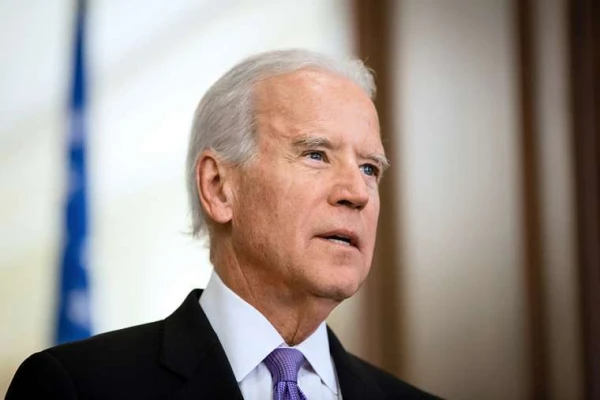
Presumptive Democratic presidential nominee Joe Biden has been working from home these last few months, like a lot of people have. Biden has been campaigning from his house in Delaware: livestreaming interviews, appearing on radio shows, and releasing videos.
But now that Biden has selected a running mate, and is less than three months from Election Day, the candidate is expected to hit the road again — while respecting social distance, of course.
Biden, a Catholic, is in the habit of going to Mass while traveling. If he resumes that habit, it will soon raise questions familiar both to bishops and to pundits: Can pro-choice politicians like Biden receive the Eucharist? And will anyone stop Biden if he approaches the communion line?
The norm of canon 915 itself is clear: Catholics “obstinately persevering in manifest grave sin are not to be admitted to holy communion.” But debate over that canon, and its application to pro-choice politicians, has vexed the Church in the U.S. every election year since John Kerry’s presidential campaign, and often in between elections, too.
In 2004, Cardinal Joseph Ratzinger, then head of the Church’s doctrinal office, wrote a memorandum to the U.S. Catholic bishops, explaining the application of canon 915 to the question of pro-choice politicians.
The case of a Catholic politician who is “consistently campaigning and voting for permissive abortion and euthanasia laws” would constitute “formal cooperation” in grave sin that is “manifest,” the letter explained.
In such cases, “his pastor should meet with him, instructing him about the Church’s teaching, informing him that he is not to present himself for Holy Communion until he brings to an end the objective situation of sin, and warning him that he will otherwise be denied the Eucharist,” Ratzinger wrote.
If the individual perseveres in grave sin and still presents himself for Holy Communion, “the minister of Holy Communion must refuse to distribute it.”
Shortly after Ratzinger wrote that memo, the U.S. bishops agreed the application of those norms should be decided by individual bishops, rather than by the bishops’ conference.
Some bishops have prohibited politicians advocating for “permissive abortion laws” from receiving communion, but others have demurred, or said outright they would not deny such politicians the Eucharist.
Asked by a journalist, Cardinal Timothy Dolan of New York said in October that he would not deny Biden the Eucharist. Before that, in January 2019, Dolan had said that he would not deny the Eucharist to New York’s Governor Andrew Cuomo, who signed into law one of the most permissive abortion laws in the country’s history.
Biden’s own shepherd, Bishop William Malooly, has said in the past that he does not want to “politicize” the Eucharist by denying communion to politicians. Washington, D.C.’s ordinary, Archbishop Wilton Gregory, has said that the Eucharist should be denied only as a last resort, and is not on record as ever having done so.
But while bishops are circumspect about the issue, many active Catholics are not. Practicing pro-life Catholics have in recent years lambasted bishops for their reticence to withhold the Eucharist from pro-choice politicians. Some have called the bishops’ approach a scandal. Many young priests have echoed those calls.
In the frustration of not being heard, and in the wake of the McCarrick scandal, those calls intensified last year as several states passed expansive abortion laws. The controversy widened an already broad gap of distrust between many Catholics and their leaders.
Biden, who supports the federal funding of abortion and in 2016 officiated at a same-sex wedding, is likely to prompt similar calls from lay Catholics in the months to come.
So here’s what’s likely to happen:
At some point between now and election day, a young priest will find Joe Biden in his communion line. Because of the priest’s convictions about the unborn and his sacramental theology, he will deny Biden the Eucharist.
Someone will see it, a report will get out. CNA may well break the story (our reporters are the best in the business.)
Biden will say very little himself, and he won’t have to.
The priest will issue a statement explaining himself, and then be roundly criticized. A cardinal will appear on television, and he’ll disagree with the young priest’s decision. Pro-choice or progressive leaning Catholics will on social media call the priest a fundamentalist, and point out, correctly but as a distraction, that Trump also takes positions contrary to the Church’s teaching. The priest’s diocese will say very little. Other priests will wonder whether their bishops will support them, if they too act to follow the Vatican’s guidance on the matter.
After a news cycle or two, the issue will mostly die down, leaving those who continue to raise their concern ever more alone, and looking ever more like zealots.
In their frustration, some will turn to a growing chorus of anti-episcopal conservative media figures who make a living criticizing the Church’s leaders. Bishops will lament the popularity of those figures.
If that prediction sounds quite specific, that’s because it’s what happened in October 2019, the last time Biden was denied the Eucharist.
Some version of that story will happen again because, as things stand, the policy and the practice of the Church on this issue diverge from each other, dramatically.
That leaves priests who put the policy into practice standing often by themselves. It leaves some Catholics confused about how seriously the Church takes its own teaching and its own sacramental discipline. Other Catholics, those who have watched that cycle play out a few times, are less confused than demoralized, and cynical.
But if election pollsters have it right, this issue isn’t going away. Biden, who would be the second Catholic president, has a big lead over Trump. Unless something changes, he’s likely to be the first Catholic president since Roe vs. Wade, and the first to publicly support abortion.
The U.S. bishops decided on a patchwork, diocese by diocese, approach to canon 915 in 2004, in part under the influence of Theodore McCarrick, who was then the Archbishop of Washington. In some senses, from an ecclesiological perspective, that localized approach might make sense.
But the country may soon find itself with an aggressively pro-abortion president who likes going to Mass, and a piecemeal approach to an important question of sacramental discipline. Practically, that situation is likely to foment further division in the Church, as bishops promulgate dueling policies under a national spotlight.
Nevertheless, it seems unlikely that any bishop will take up the project of making a nationwide change on this issue, and there are only a few positioned well to do so.
The Archbishop of Washington and the Bishop of Wilmington, both of whom have a platform as Biden’s shepherd, are among those who could.
If either of those bishops took the initiative to say that in his diocese the Church’s canonical discipline on the Eucharist would be applied fairly and consistently to politicians of all parties who break from the Church on grave and clear matters, a precedent would be set, and easily followed across the country.
Failing that possibility, if Cardinal Dolan had a change of heart, and announced that in the Archdiocese of New York the Church’s sacramental discipline would be applied in accord with the Church’s instructions, other bishops would likely follow suit. Church watchers would likely see that as a recovery of Dolan’s once praised legacy on pro-life issues, which was tarnished amid the controversy over Cuomo.
Bishops don’t like to go first, generally, but many are willing to follow the right leader. If a nationally leading Churchman set a change in motion, many would follow suit. Eventually, only a dozen or so bishops staunchly opposed to “politicizing” the Eucharist might be left.
Both Washington and Wilmington are led by bishops rarely characterized as conservative. Washington’s Archbishop Gregory is struggling to gain trust as a reformer, the job for which he was sent to Washington. Insistence on applying the Church’s law, as written, would likely bolster Gregory’s credibility on that front. But the archbishop led the U.S. bishops’ conference in 2004, when he and McCarrick were seen to push for a permissive interpretation of Ratzinger’s letter, and there is no evidence to suggest he has changed his thinking on the subject.
Bishop Malooly, who is almost 77, is even less likely to change his long-standing policy than Gregory is. But his successor, who could be appointed as early as September, might be of a different mind. And he would have to his advantage the unique window of time in which a new bishop can make a major change before getting bogged down in the myriad reasons he hears not to make any changes.
If he is appointed before the election, it would be all the easier to make his position clear.
There is one other bishop who might be expected to lead a charge on this issue: Archbishop Jose Gomez of Los Angeles, president of the U.S. bishops’ conference. Gomez, who is both pro-life and a strong advocate for the Church’s moral teaching on immigration, has the credibility among a broad swath of bishops to call for a unified approach to a vexing problem. But the conference has not passed major sweeping policies in recent years, and is still recovering from the shockwaves of McCarrick and 2018. Gomez would have little luck unifying the conference on anything so controversial.
But the L.A. archbishop has personal influence: If he decided to announce a policy for Los Angeles, after lobbying other prominent U.S. bishops to announce the same, a swath of bishops would probably follow them.
For any of those bishops, the media blowback of such a move would be immense, and difficult to get past. But the support among many practicing Catholics, and among priests, who are looking to the Church for leadership, would also be significant. Such a move would not soon be forgotten.
By many estimates, the result of those bishops taking the lead, however unlikely, is that the integrity of the Church’s moral witness might be strengthened. Catholics might grow in respect for their embattled bishops. And, just maybe, a few Catholic politicians who defy the Gospel, from either party, might be moved to conversion.
Whether any bishop will actually decide to break the cycle, or whether Catholics will watch the ‘Communion Wars’ play on for the next several years, is up to the handful of bishops who could meaningfully change the narrative. It seems unlikely they’ll do so. But as America contemplates a change, the Church’s leaders have the chance to make one too.
 […]
[…]



 By
By 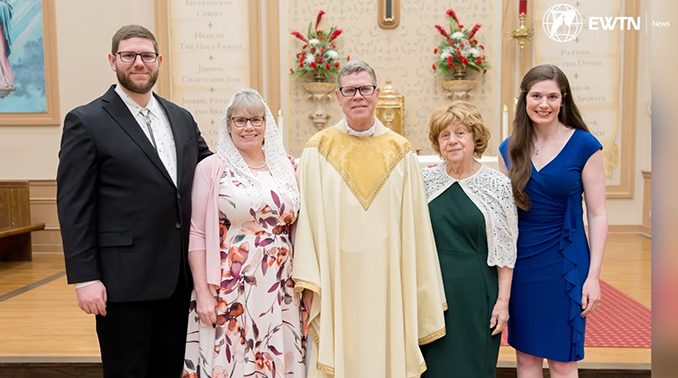

I fully admit that whether or not the clergy should be celibate is beyond my payscale, but if a married (former) Protestant can become a Catholic priest, why can’t a married Catholic? My best friend is an Orthodox priest. He’s a husband, a father, and a grandfather. He tells me that he understands all the reasons for opposing a married priesthood, but he feels that the benefits far outweigh them. (And believe me: I have no iron in this fire. Though married, I feel not so much as a whisper, let alone a call, to the priesthood.)
Married men can be ordained as deacons in both the Roman and Eastern Rites.
In the Byzantine Catholic Church, as well as the other various Eastern Catholic Churches, it’s not against tradition to admit married men to the priesthood, whereas in the Roman Church, priestly celibacy is viewed as a discipline. Many of the early Church fathers were married.
I’m in full support of a married Roman priesthood as an option.
Two of the best Byzantine priests I know are married, and they are very good in confession, because they have experienced the ups and downs of marriage.
There is no controversy with the prospect of a married priesthood.
Once they become a priest, they have to be celibate, married or not.
They do? Huh. News to me. As a longtime Eastern Catholic, I know quite a few married priests who have children and who are continuing to have children.
I think she means if their wife should die. I think that is the norm but may be dispensed.
Never heard of that rule…
No, we had an Episcopal priest who grew up in our hometown converted and became a Catholic priest. It seemed to work out fine
I agree with your friend that there are real struggles in having a celibate priest stood, but I believe the benefits far outweigh the difficulties. A celibate man better images and conforms too the image of a celibate Christ, who is totally wet to his bride the church and lays down his life for her and not his own will see Ephesians 5 and Matthew 19. Additionally living a life, totally committed to God now without the mediation of a wife is more a kin to, and is a sign of the heavenly reality where everybody will be totally devoted to God without mediation. The celibate is offered graces to do that now. I encourage you to make friends with happy celibate clergymen who can tell you of the grace of the sacraments and the way that prayer and a relationship with Mary has transformed and sustained him.
Since the article by Professor Spinello, The Second Vatican Council: A Guiding Star for the Church? is not available I wish to post a comment here on the Vatican II controversy.
Or a death star? A snare for large contingents of the progressive and traditional Church. Spinello apparently alludes to the multitude of progressive carpetbaggers who misused the Counsel’s documents to promote their new paradigm.
Reaction to the new paradigmers by traditionalists is that they, the radical left, are drawn into the alluring glitter of the death star only to be gripped by the devil. Whereas new paradigmers will contend it is the traditionalists who have closed their ears to the voice of the Spirit of the Council.
Ironically, Vat II has unfairly become a cause for distancing within the Church. Both reject what the Council actually teaches, injuring their faith in obedience to the Magisterium. Taking themselves to extremes that freeze compassion and Christian brotherhood.
For a test of manifest devotion to Christ present in the Holy Eucharist turn around at the consecration and note how very few are looking directly at the Eucharist, and are rather looking down piously or at a missalette. This is a hangover from the TLM. So the NO was intended to engage the parishioner in what is actually occurring before their eyes. To engage and participate, to learn what is being taught through the liturgy.
Professor Spinello analyzes all the pertinent Council documents to clearly demonstrate, one would wish once and for all, that both are out in Left Field. That if read properly sans a preconceived agenda will find the Council is indeed a Guiding Star.
If you are going to accuse people of rejecting what the Council teaches, perhaps you should include a quote of what that teaching is, and some evidence of rejection besides behavior. Sin is not generally evidence of heresy, and the direction of one’s gaze does not even amount to sin. Nor does it necessarily indicate what a person’s mind is on.
His argument subverts itself. He says the NO was intended to engage the parishioner in what is actually occurring before their [sic] eyes. And he now, as a practitionre of the NO, observes that few look.
Yesterday, a Dominican priest homilied on what “active participation” per Aquinas intends. One’s senses are not necessarily engaged. One’s spirit IS participating in sanctifying grace. One gains grace is through reconciliation and receipt. Reconciliation and receipt of Holy Eucharist are spiritually mindful, not sense-based acts.
One would have hoped that a doctorpriest would, late in life, have come across such notions.
“This is a hangover from the TLM.”
The stunningly arrogant bias and assumption by one human-mind led me to gasp. Have you been ill, Fr. Dr.? One who cares nothing for Who He Is will level such thoughtless uncharity to another of His Own.
Other persons adore the Eucharist at His Elevation within UA rubrics since that is the first time during the Mass the parishioner may view The Presence of the King. He is elevated. Not manhandled.
The premise underlying the changes to the Mass was to present the liturgy as a means to engage and instruct the faith. Few persons understood was was occurring at the altar, except for a few like yourselves who made the effort.
I don’t accuse you, although I accept your insults as a blessing.
Few persons understood [what] was occurring at the altar. A miracle of love to be adored. If laity continue to disregard the immense beauty of Christ’s real presence it’s in part due to those who condemn Vatican II and attempts to promote the Novus Ordo as a means of fulfilling the ancient dictum, ut legem credendi lex statuat. To allow what Benedict XVI envisioned as a parallel embellishment of the two liturgical forms.
If there’s sin, is may be in vilification. Examine your consciences before the Blessed Sacrament.
Seems odd that a married non Catholic can become a priest while denied to a life time Catholic. All the while we have a shortage of priests. Does not make any sense when you consider that we have always recognized the non celibate priesthood of the many Eastern Rite Churches. Since we now have severe financial problems in the Church and many congregations are struggling to afford a priest, it seems to me that new ways need to be found to solve these problems. A married priest with a family does not necessarily put a greater financial burden on a church. I have known many Protestant ministers who were self supporting by working at secular jobs. Another possibility would to look at the “worker priest model “ movement experimented with in post Vatican II France. The idea was that priests would take secular jobs in order to evangelize in the secular work place. This would also allow them to say masses on Sunday. Lay people could easily be employed to run the every day nut and bolt operations of the church- maintenance, business management etc. married deacons could also handle many of the sacraments as allowed. What I am trying to say is that we must be creative in trying new ways of meeting needs as they present themselves. Some of our traditions can be broken without damaging our faith. The life of the diocesan priest is becoming harder and harder as more and more have to live alone in their parsonages. Many also have to do their own cooking and housekeeping. This causes loneliness extra burdens and opens them to many needless temptations. Perhaps religious order priests living together and serving several nearby parishes would be another consideration. I think that it is becoming increasingly apparent that the old ways of doing things are no longer working and we must change.
Brilliant reply. You are so right. It makes no sense at all. Unfortunately, what you say here just continues to fall on deaf ears. Things will just have to get worse before they begin to consider more prudent alternatives.
I concur.
What bothers me MUCH MORE is that singular “right” of a priest to withhold the confession of a crime–no matter how heinous–from the authorities. How CONVENIENT: and no wonder so many boys were violated again and again! No womN of any faith would allow this outrage to continue, year after year after year. Seems God cannot protect the violated as long as the RC protects the violators!
Would you apply the same standard to a doctor/patient relationship or a lawyer/client relationship. If I was accused of sexually abusing a minor and retained legal council, should my attorney report my guilt to authorities?
A good chunk of the reason for repeat offenders was that a bunch of bishops decided to ignore their obligations under canon law and instead follow the advice of psychologists (who claimed they had cured the priests). It’s not like the only evidence they had was obtained in Confession.
Our legislators seem to also want to believe it can be easily solved in a few years too, judging by the typical penalties for child molesting.
The Catholic views on marriage for priests is incredibly short cited! Also denial of communion to CHRISTIANS of other faiths is DENIED!!! Now this former Baptist pastor can receive and GICE COMMUNION TO OTHERS BECAUSE WHY????
What’s changed?? Some Man priest said it’s okay now???? Surely God is amused by the teachings of the CATHOLIC RELIGION….
Ms Brechtel:
God is not amused by the teachings of the Catholic religion. God IS the founder of the Catholic religion.
Catholic priests are not allowed to marry after ordination, no matter whether they are Roman or Eastern.
Married men are admitted to the priesthood, even those who were formerly Roman, but underwent a formal change of rites, which transfers their canonical status from Roman (or Latin) to Eastern (Byzantine, Alexandrian, Maronite, etc) but again, most married men who are admitted to the priesthood are in the Byzantine Churches, or other Eastern-Rite branches of the Catholic Church.
Denial of Holy Communion to non-catholic Christians is a long standing law that will not change. Communion is for those who are in good standing with the Catholic Church, and who truly believe and profess that the Eucharist is the Body and Blood of Jesus Christ. How can someone who rejects the True Presence of Christ in the Eucharist receive Him in Holy Communion? They can’t, and you know it.
From the tone of your posted comment, I’m guessing that you are either a non-catholic, or someone who doesn’t like those who are.
Connie: I’m curious. Are you Catholic?
What changed is that he converted and then was ordained
In what way is Fr. Moger’s journey unique?
Fr Moger didn’t know there was a pathway for him to become a priest after converting.
Either way, even if it’s not unique to you, it is to him as a convert. If you’re a cradle Catholic like myself, it’s often harder to see the uniqueness of someone’s conversion.
In general, a typical Baptist believer is regenerated and saved according to the Bible. Christ lives in them and they have a relationship with God. A typical catholic is not regenerated, not saved, and has religion,which is void of a normal loving relationship with God. Therefore, this person never knew God and regressed to religion where there is no God. Pity
JF Acosta: Say what????
I am a trad. Catholic my whole life and always look up at the Eucharist during the Consecration and the 3x: Lord, I am not worthy. It is all about the presence of Jesus, of course.
Unfortunately many of Catholics do not believe in the Transubstantiation which is why so Sadly many Catholics drifted
Miss Connie , Christ may be amused or saddened sometimes by our actions but He founded the Catholic Church.
If you believe in Catholic teaching, especially about the Eucharist,and wish to be received into the Church the door is open. There’s a process though. You don’t just show up at the Communion rail.
Jesus Christ was celibate. Vatican II Council unequivocally endorsed priestly celibacy.
From Fr. John Hardon (Servant of God):
“If anyone asks me, and I have been asked more than once, what positive good has come from the Second Council of the Vatican, I could give a dozen answers. But somewhere near the top is its unmistakable support for priestly celibacy. As the following statement of the Council makes clear:
‘Based on the mystery of Christ and its mission, celibacy, which at first was recommended to priests, was afterwards on the Latin Church imposed by law on all who were to be promoted to Holy Orders. This Sacred Council approves and confirms this legislation. (Presbyterorum Ordinis, 16).'”
See: https://www.therealpresence.org/archive/archives/Priesthood/Priesthood_010.htm
Didn’t Think So above (8:16 p.m.) –
What I was getting at is that Fr. Moger is not the first Protestant pastor/minister/priest to become a Catholic priest.
Fr. Dwight Longenecker, e.g.
Maybe Fr. Moger is the first (American) Baptist pastor to make the trek?
Cleo
It almost seemed slightly downplaying to me.
I’m sorry for my snappy response.
Fr Moger could be the first American baptist minister to be ordained as a Catholic priest. As you said, many Lutheran and Anglican ministers have been ordained.
Fr. Longnenecker is a former Anglican priest. He became a Catholic priest under a special provision made by the Holy See for Anglican priests. Fr. Moger was given a dispensation from celibacy by Pope Francis to be ordained a Catholic priest in the Latin rite. These circumstances are not the norm in the Latin rite. The discipline of celibacy remains in the Church, that to be ordained a priest in the Latin rite one takes a vow of celibacy, which the Church teaches is a higher calling because Christ, himself, was celibate.
I bet that there are married, permanent Deacons who would be good priests.