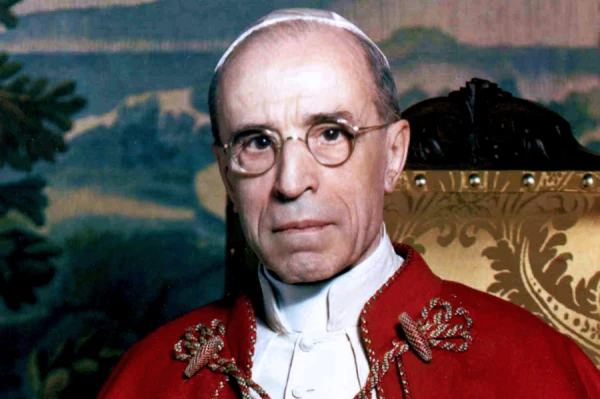
Denver Newsroom, Sep 9, 2020 / 04:00 am (CNA).- Scholars of Pope Pius XII have countered claims that the wartime pope and the Catholic Church hierarchy were complicit in a controversial post-war custody battle over two Jewish orphans who were baptized Christians in France, then hidden from their relatives.
Researcher William Doino Jr. told CNA a recent article on the topic in The Atlantic is “both flawed and misleading, because it misrepresents and cites out of context a small portion of the newly released archives to advance a one-sided view of Pius XII– and omits key documents and evidence which contradict the article’s main allegations.”
He responded to historian David I. Kertzer, writing in The Atlantic, who has claimed that the archives have now revealed “the central role that the Vatican and the pope himself played in the kidnapping drama.”
“The Vatican helped direct efforts by local Church authorities to resist French court rulings and to keep the boys hidden, while at the same time carefully concealing the role that Rome was playing behind the scenes,” Kertzer wrote Aug. 27.
Those claims have also drawn criticism from Matteo Luigi Napolitano, professor of history of international relations at Italy’s University of Molise said in L’Osservatore Romano Sept. 3.
“Things are obviously much more complex if we look at the Jewish sources,” he said. “The Rabbinate wanted to maintain dialogue with the Vatican, while other organizations would have gone to the clash, to be exploited on the media level.”
The archives on Pope Pius XII’s pontificate were opened in 2020 for only four days before being closed again due to coronavirus restrictions. Napolitano said scholars have only had about forty days’ worth of work on the new material.
Napolitano is thus critical of the claims of Kertzer regarding the wartime papacy of Pius XII and the Finaly brothers controversy.
In February 1944, agents of the Gestapo arrested a refugee Jewish Austrian couple, Fritz and Annie Finaly, in a French village. They were transported to Auschwitz and killed. Their children, three-year-old Robert and two-year-old Gerald, were taken in by a Catholic woman, Antoinette Brun, who ran a foundling home in Grenoble.
Brun began the legal process to adopt them in 1945, when she learned their parents had been killed. At the same time, the boys’ relatives sought to take custody of them. An aunt from New Zealand asked the boys be sent to her, but Brun resisted. In 1948, she baptized the boys, making them Catholic in the eyes of the Church.
A custody struggle ensued, with both religious and national elements, citing the father’s reported desire to have his sons brought up in France, the boys’ reported desire to stay with Brun, calls to have the boys brought up Christian, and calls to return the boys to their family.
When courts said the boys should be placed with their relatives, the boys were taken by friends of Brun and hidden near France’s border with Spain.
Brun, a Catholic nun who helped her, and several Catholic clergymen were arrested.
“Several arrests were made, and the Church got some bad press. Contrary to what the critics claimed, however, the Catholics involved were not acting on behalf of the institutional Church,” said Ronald Rychlak, a law professor at the University of Mississippi School of Law and an expert on the history of Pius XII and the Nazis in the Second World War, wrote in an essay he sent to CNA in late August.
“When she was asked by the press about her Catholicism, Brun said she ‘didn’t give a fig for the pope.’ Bishop Alexandre Calliot of Grenoble took to the radio airwaves to demand that anyone with information about the missing boys contact the authorities. One of the first to comply was a priest in Spain who reported on their whereabouts.”
Doino characterized Brun as “a renegade Catholic.”
“She and a small group of collaborators evaded Church officials at every turn, after they demanded she return the children to their Jewish relatives,” he told CNA.
Doino pointed to an article he co-authored with Rychlak for Inside the Vatican Magazine’s a January-February 2005 issue, which used primary source documents and first-hand testimonies to disprove a claim he helped refuse to return baptized Jewish children to their surviving family members after the Second World War.
He told a Polish Catholic woman to return a baptized child to its father, saying it “was her duty as a Catholic not only to give back the child, but do it with good will and in friendship,” said Doino, who recommended Peter Hellman’s 1980 book Avenue of the Righteous.
Rychlak said Pius XII approved an agreement negotiated between Cardinal Pierre-Marie Gerlier of Lyons and the chief rabbi of Paris: the children would go to their relatives in France, but would be allowed free choice of religion. The pope approved this despite some leading advisors who wanted to reject any agreement in which Catholic children would live in a Jewish home.
In Kertzer’s telling, a Vatican document from Catholic sources in Grenoble appeared to describe positively Brun’s refusal to return the children.
Napolitano, however, said that Jewish sources show that the Bishop of Grenoble and the Archbishop of Lyons both worked with the judicial authority to track down the brothers after they were concealed in Spain.
Jewish sources reported that “the French clergy have already intervened with the Spanish clergy and that they are on the point of taking the children home.”
Napolitano said Vittorio Segre, press officer at the Israeli Embassy in Paris during the controversy, shows a “much more complex picture.”
In Segre’s account, the embassy officer said it is “logical to assume that there was support from the Vatican” for the agreement of Cardinal Gerlier through the former secretary of Charles de Gaulle, who was charged with tracking down the Finaly brothers.
According to Segre, there was “never a conflict between the Catholic Church and the Jewish community.” De Gaulle’s former secretary “worked in complete freedom, without encountering obstacles in the hierarchies.”
“There were difficulties, but they came from a much lower level,” said Segre.
While Kertzer’s essay claimed that relevant documents were now reported for the first time, Rychlak compared his work to a 2004 controversy in which the New York Times reported on a document from a French archive purporting to show Vatican authorization for church authorities not to return “hidden” Jewish children to their families if they had been baptized.
“To those of us who had studied the work of Pius XII, the directive immediately seemed suspicious, and for good reason,” Rychlak wrote. “The real directive, dated October 23, 1946, and authorized by Pope Pius XII, was quickly found in the Vatican archives. It was quite different from what had been reported in the news.”
“The directive told the rescuers to return these children, baptized or not, to blood-related relatives who came to get them,” Rychlak said. “Over and above that, if no relatives survived to reclaim the children, and if individuals or organizations unrelated to the children now wished to adopt them or transfer them to a new environment, each request was to be examined on a case-by-case basis, always with a sense of justice for the child, and with a sense of what their parents would have wanted for them.”
“This directive is perfectly in line with Judeo-Christian compassion and responsibility. It is also very probative of Pius XII’s mindset on these issues,” he said, saying this is far better evidence than internal memoranda.
Kertzer said other newly revealed documents justify repeated claims that Pius XII had been persuaded “not to speak out in protest after the Germans rounded up and deported Rome’s Jews in 1943.” He claimed memoranda was “steeped in anti-Semitic language.”
“The silence of Pius XII during the Holocaust has long engendered bitter debates about the Roman Catholic Church and Jews,” he said, repeating a claim long disputed by the Pope’s defenders.
For Kertzer, one piece of evidence is a December 1943 memo from Monsignor Angelo Dell’Acqua, an official in the Vatican’s Secretariat of State, about whether it was right to openly and officially protest mistreatment of Jews by Germans. Kertzer interpreted the memo as a sign of anti-Semitism and Church silence.
However, Napolitano said the note came just two months after the Oct. 16, 1943 Nazi raid on Rome’s Jewish ghetto, which resulted in over 1,000 Jews being deported to Auschwitz.
Vatican officials objected to that raid, but were also aware of the danger of reprisals from the Nazis. Napolitano cited the diary of Slovakian ambassador Karl Sidor, which said: “On the orders of the Holy Father, more than one hundred Jews and Italian officers are hidden in the Jesuit Generalate. Likewise, Jews with their entire families are hidden in every convent. The Holy Father provides for their nourishment. Money and food arrive from the Vatican. This is very important news. This is the way the Vatican is dealing with the Jews.”
Documents from the Pius XII papacy, Napolitano said, come in the context of Church efforts “not to compromise the network of aid that had been activated throughout Rome to ensure that Jews and wanted people of all kinds escaped arrest and deportation.”
“It does not seem that Kertzer takes this into account,” Napolitano wrote in L’Osservatore Romano.
He also faulted Kertzer’s depiction of Dell’Acqua as an anti-Semite, given that the priest was a close collaborator with Pope John XXIII, who would not have named him a bishop and apostolic nuncio to France “if he had the slightest suspicion of his anti-Semitic inclinations.” Similarly, Paul VI, another pioneer in Catholic-Jewish relations, would not have elevated Dell’Acqua to the cardinalate.
“These are logical discrepancies that Kertzer does not resolve,” said Napolitano. “But history, like nature, does not allow for leaps.”

[…]




When it come to fasting and prayer, Muslims are second to none. They pray for themselves and pray for those of us in need of prayers. Long live their love for prayer.
Oh good for you. How do you know what they pray for, or to who?
Well they pray to the God of Abraham & they’ve prayed for my grandchild who was ill. His mother & I appreciated that very much.
Apart from the God of Abraham, we may part ways on a number of issues but that much we hold in common as children of Abraham
This is sugar coating something that never should have been allowed to happen. What next? A room for Satanists to pray? No. Just no. Ford doesn’t open a room at their headquarters library for GM to gather.
Would they allow a Christian prayer room at Masjid al-Haram or Al Aqsa?
Possibly yes…in the sense that in both cases—the Vatican Library (and the entire Vatican?) and the Christian prayer room—Christianity is subordinated and annexed to the central Islamic worldview… the madrassa! Jihad by another name…
Huh?
They “ rate this claim true, with important context”?
What context?
That the Muslim prayer room is actually a room where Muslims pray?
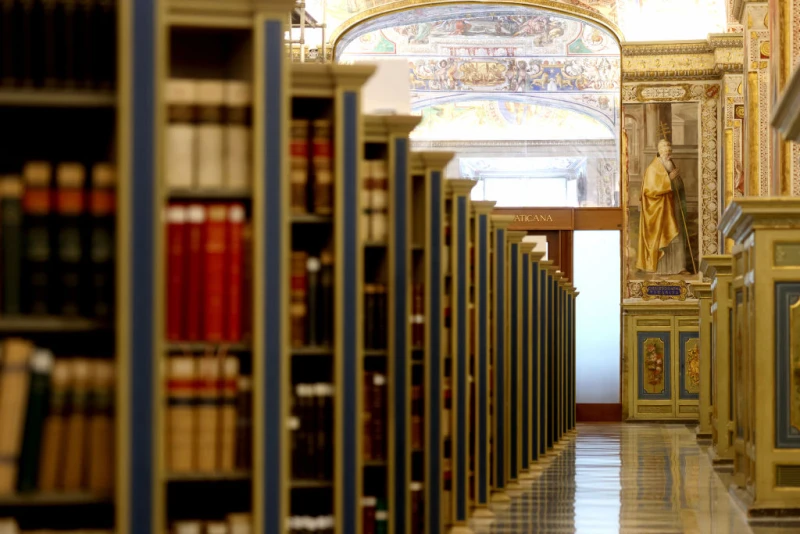
That the Muslim prayer room in the Vatican is actually in the Vatican Library?
I don’t see how the “important context” matters much.
The Vatican established a prayer room for Muslims. Period.
Now, I think a meaningful bit of context might be that Muslim fundamentalists are martyring Christians all around the world, including some ten thousand in this year alone in Nigeria.
The prayer room war. Will the Vatican pose no objection to a mosque and minaret calling Muslims to prayer day and night adjacent to Vatican City?
Cardinal Gerhard Muller alleged that the prayer room request was an encroachment, a statement that infers Islam is the superior faith. As a matter of arguable evidence we increasingly find mosques and minarets all over Europe, whereas we don’t find Muslim nations grading Christians ‘prayer spaces’ like churches. And if they do they’re subject to atrocities.
As an opinion it seems CNA’s Daniel Payne’s view is acceptable, that the request was made by Muslim scholars studying at the Apostolic library, and it should be reserved solely for them. A refusal aside from the politics would seem petty. It can also be viewed as an indication of Catholic magnanimity.
Islam has a 13 plus century history from which we can make a reasonably accurate assessment of its intent and nature.
It has always been imperial, martial and supercedent.
Muslims have already taken over parts of Michigan. About three months ago, Dearborn Mayor Abdullah H. Hammoud told local resident Edward “Ted” Barham, a Christian, that he was “not welcome” in the city after Barham raised concerns about new street signs honoring Arab American News publisher Osama Siblani.
Per Fox news: Christian minister Edward “Ted” Barham says he will not respond with hate after Dearborn Mayor Abdullah Hammoud told him he was “not welcome” during a heated city council exchange over a controversial honorary street sign naming that went viral.
In a new interview with Fox News Digital, Barham said the moment has only strengthened his resolve to speak out about freedom of speech and freedom of faith.
“I did not respond to the mayor with hate. I said, God bless you,” Barham said, adding that he takes seriously Jesus’ command to “love your enemies, bless those who curse you.” He said the incident was not isolated, pointing to earlier clashes with city officials over his public ministry.
Barham objected at the Sept. 9 council meeting to street signs honoring controversial Arab American News publisher Osama Siblani.
DEARBORN’S MUSLIM MAYOR TELLS CHRISTIAN HE’S ‘NOT WELCOME’…….
..the attack on free speech is very troubling but representative of the left’s attitude.
it seems the attitude here is that “hit the road Jack, and don’t come back”
The US, as well as European nations, require a cultural assimilation mandate for immigrants. Creating virtual alien nations within a host nation is antithetical to social integration and justice. Our Church, and the European Union have encouraged this indiscriminate open border policy.
Early in Francis’ Papacy, there was a PEP (Papal Excuse Patrol) ready to qualify the Pope’s innumerable and intemperate gaffes. Looks like a new squad is forming.
This situation reflects two very different impulses: on one hand, a kind of tribal reflex that Christians should avoid, and on the other, a legitimate concern rooted in history, prudence, and discernment — virtues the Christian tradition actually demands.
A sober reading of Islamic history makes one thing clear: for many of its political and religious movements, expansion has not been incidental but central. Across centuries, Islamic empires advanced not through dialogue but through territorial acquisition, often justified as a religious duty. That historical pattern isn’t speculation; it’s documented reality.
This is why the Vatican’s decision matters. Symbolically and strategically, granting even a small foothold in Rome carries weight far beyond the physical space involved. For over a millennium, Rome has been viewed by various Islamic powers as a coveted prize — not for coexistence, but for eventual dominance. In many interpretations of Islamic jurisprudence, once land is claimed for Islam, it is considered permanently Islamic territory, and there is a religious obligation to defend and expand it.
Christians view the world through the lens of Christ — a framework shaped by grace, reason, and moral restraint. But it is a mistake to assume that all others operate from the same moral or theological foundation. Prudence requires acknowledging that not every worldview reciprocates goodwill or interprets gestures of openness as invitations to peaceful coexistence.
Kindness is a Christian duty, but so is discernment. Extending goodwill does not obligate us to ignore historical patterns or the stated aims of ideological movements. Wisdom means recognizing that not every gesture of hospitality will be met with the same intentions.
Five times per day, special timing methods, call to prayer from a mosque somewhere, necessity of wudu, prayed aloud, facing Kasba/Mecca, Friday prayer “day of meeting” more elaborate including discussions “holiest/happiest day of the week”, sunni and shia pray differently/separate rooms, etc.
‘ The daily prayers are considered obligatory (fard) by many and they are performed at times determined essentially by the position of the Sun in the sky. Hence, salat times vary at different locations on the Earth. Wudu is needed for all of the prayers.
Some Muslims pray three times a day. ‘
https://en.wikipedia.org/wiki/Salah_times