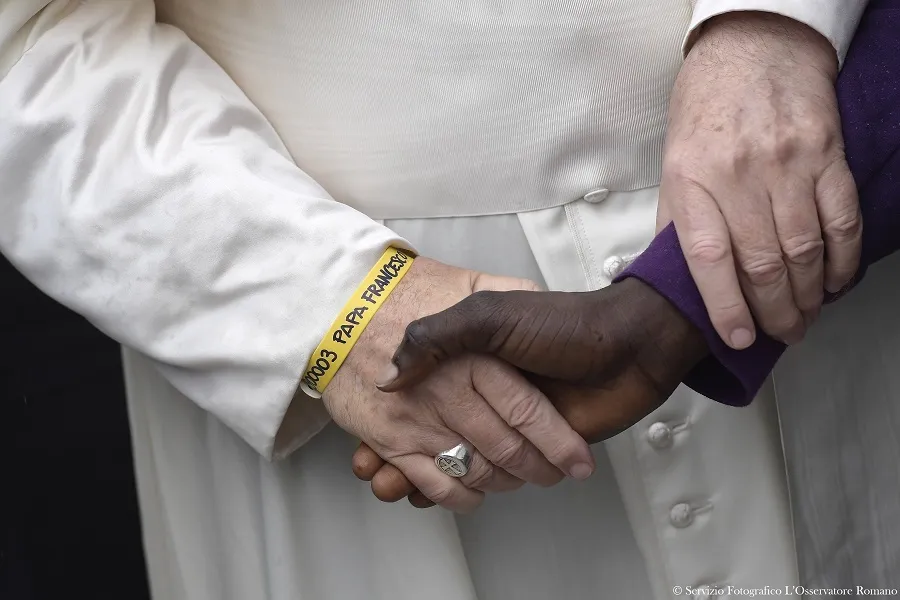
Vatican City, Nov 24, 2017 / 04:01 am (CNA/EWTN News).- When it comes to migration, Pope Francis said the world, particularly Christians, must approach the issue with a “contemplative gaze” that goes beyond polemics and is guided by justice and solidarity, helping to build peace at both the global and local level.
Quoting St. John Paul II’s message for the World Day of Peace in 2000, the Pope said, “we all belong to one family, migrants and the local populations that welcome them, and all have the same right to enjoy the goods of the earth whose destination is universal, as the social doctrine of the Church teaches.”
He referred to the biblical prophecies of Isaiah and the Apocalypse, which describe the “new Jerusalem” as a city whose gates are open to people from all nationalities. And in this city, “peace is the sovereign that guides it and justice the principle that governs coexistence within it.”
Christians must also have this “contemplative gaze,” he said, noting that when we look at migrants and refugees, we see that “they do not arrive empty-handed.” Rather, they bring with them their courage, skills, energy and aspirations, as well as the gift of their own culture, which enriches the lives of the nations that receive them.
Francis also pointed to the “creativity, tenacity and spirit of sacrifice” displayed by the many people, families and communities around who “open their doors and hearts to migrants and refugees, even where resources are scarce.”
A contemplative gaze on migration, he said, will also help guide global leaders in their discernment on the issue, and will encourage them to pursue policies of welcome “within the limits allowed by a correct understanding of the common good,” while at the same time keeping in mind the needs of both the whole of humanity and the good of the individual.
“Those who see things in this way will be able to recognize the seeds of peace that are already sprouting and nurture their growth,” the Pope said.
And with this gaze, “our cities, often divided and polarized by conflicts regarding the presence of migrants and refugees, will thus turn into workshops of peace.”
Pope Francis’ reflection was part of his message for the 2018 World Day of Peace, which this year is titled “Migrants and Refugees: men and women in search of peace.” Signed on the Nov. 13 feast of St. Frances Xavier Cabrini, the message was published Nov. 24.
Instituted by Bl. Pope Paul VI in 1968, the World Day of Peace is celebrated each year on the first day of January. The Pope gives a special message for the occasion, which is sent to all foreign ministers around the world, and which also indicates the Holy See’s diplomatic tone during the coming year.
So far Pope Francis’ messages have focused on themes close to his heart, such as fraternity, an end to slavery, including forced labor and human trafficking and nonviolence as a political strategy.
His messages for the event have consistently included bold pastoral and political advice for both ecclesial and international leaders, including his push for the abolition of the death penalty and amnesty for prisoners convicted of political offenses.
This year’s message focuses largely on the four-point “action plan” the Holy See has developed for the migration issue and which Pope Francis and his diplomatic representatives have spoken of often, particularly at the level of the U.N. This plan consists of four verbs: to welcome, protect, promote and integrate.
These are the four “milestones” for action, Francis said, explaining in his message that to welcome means above all broadening access to legal pathways for entry into host countries. Doing this, he said, will no longer push migrants and displaced people “towards countries where they face persecution and violence.”
It will also help in terms of “balancing our concerns about national security with concern for fundamental human rights.”
When it comes to protecting migrants and refugees, this imperative reminds us of the need to both recognize and defend “the inviolable dignity” of those who flee from precarious situations in search of safety and security, in order to prevent their exploitation.
On this point, the Pope turned specifically to women and children, who are often exposed to risks and abuses “that can even amount to enslavement.”
To promote migrants and refugees, he said, implies promoting an integral human development of migrants and refugees, particularly where education for children and young adults is concerned.
Integrating, then, means allowing refugees and migrants “to participate fully in the life of the society that welcomes them, as part of a process of mutual enrichment and fruitful cooperation in service of the integral human development of the local community.”
With more than 250 million migrants around the world, 22.5 million of whom are refugees, opening our hearts is not enough, Francis said, but action is needed.
The 20th century was marked by wars, conflicts, genocides and ‘ethnic cleansings,’ he said, noting that this has not changed, but now other factors are contributing to the migration issue, such as an increase in the number of families seeking a better future with more professional and educational opportunities.
Referring to his 2015 encyclical Laudato Si, the Pope noted that there is also a rise in the number of migrants fleeing growing poverty in their homeland caused by environmental degradation.
Most people migrate through regular channels, but some take more dangerous routes out of desperation when their own countries “offer neither safety nor opportunity, and every legal pathway appears impractical, blocked or too slow,” he said.
In many destination countries there has been a rise in rhetoric “decrying the risks posed to national security or the high cost of welcoming new arrivals.” And this rhetoric, he said, “demeans the human dignity due to all as sons and daughters of God.”
“Those who, for what may be political reasons, foment fear of migrants instead of building peace are sowing violence, racial discrimination and xenophobia, which are matters of great concern for all those concerned for the safety of every human being,” he said.
The numbers indicate that migrants will continue to play a major part in the international community in the future, Francis said. And while some consider this a threat, he invited the world “to view it with confidence as an opportunity to build peace.”
Pope Francis then turned to the proposal for the 2018 U.N. global compacts on migration and refugees, which he said will provide a framework for policy proposals and practical steps to be taken.
These compacts “need to be inspired by compassion, foresight and courage, so as to take advantage of every opportunity to advance the peace-building process,” he said. Only by doing this can international politics avoid “surrendering to cynicism and to the globalization of indifference.”
He stressed the need for greater dialogue and coordination within the international community, saying that beyond national borders, “higher numbers of refugees may be welcomed – or better welcomed – also by less wealthy countries, if international cooperation guarantees them the necessary funding.”
Quoting St. John Paul II’s 2004 message for the World Day of Migrants and Refugees, Francis said “if the dream of a peaceful world is shared by all, if the refugees’ and migrants’ contribution is properly evaluated, then humanity can become more and more of a universal family and our earth a true common home.”
Throughout history many people have believed in this dream, he said, including St. Frances Xavier Cabrini, a missionary who spent her life working with Italian immigrants in the United States.
“This remarkable woman, who devoted her life to the service of migrants and became their patron saint, taught us to welcome, protect, promote and integrate our brothers and sisters,” the Pope said.
He closed his message praying that through her intercession, the Lord would “enable all of us to experience that a harvest of righteousness is sown in peace by those who make peace.”
 […]
[…]






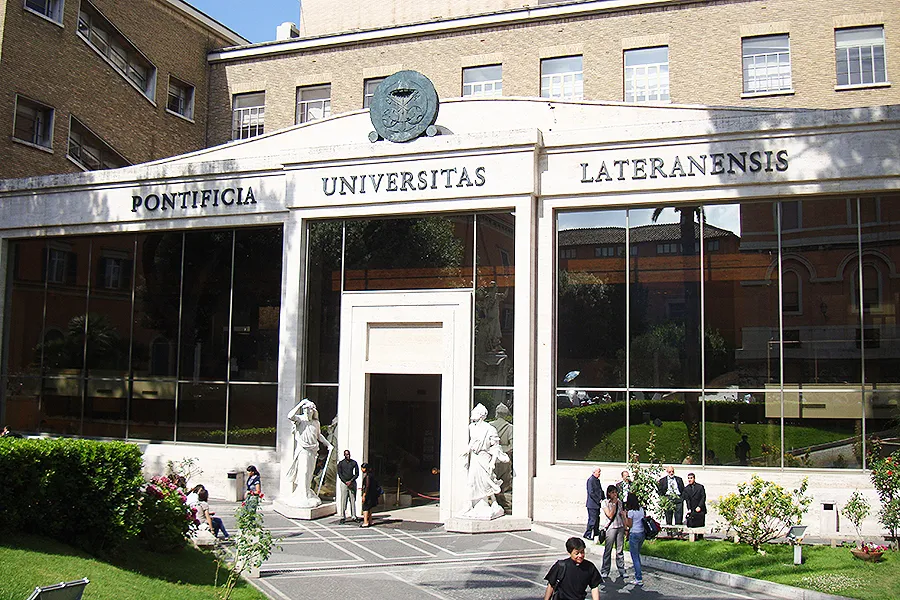
TO THOSE IN CHARGE OF THE VATICAN: This is what happens when you open your borders and allow free-access to “migrants.” Pope Leo ought to just consider this miscreant a “migrant.”
Why drag migrants into this?
Simply because this person illegally trespassed upon sacred ground. Please note that the Vatican police FORCIBLY removed him from the premises. However, according to Leonine Doctrine, this intruder should have been welcomed as Christ and permitted to do whatever he wanted to do since he “migrated” to that area of the sanctuary. Why didnt Leo treat him as a guest like he counsels our government to do? Please, dear Br. Jaques, let us know what the Vatican authorities did with this individual. Did they throw him in jail? Will they prosecute him? Maybe just give him a cupful of leftover ice and send him on his way? He’s a migrant simply because he went where he was not supposed to be (that is, unless Leo tells us otherwise).
It would seem the far greater desecration made than these mindless crazies was the Jubilee Celebration parade into St Peter’s Basilica homosexuals flaunting their ‘life choices’ [Pope Leo’s terminology] insulting Catholic doctrine with an expletive, and receiving the Holy Eucharist.
Leo XIV had to be informed beforehand to permit Fr James Martin SJ to arrange this depravity spectacle. Since his elevation to the papacy Leo XIV has made it consistently clear where he stands. Who would have conceived this occurring during Benedict’s or John Paul’s pontificates? This is a time for reparation and strengthening of faith in Christ.
I was thinking the same thing, Fr. Morello. It seems as if something very evil is at work over there and this last episode is just one more outward or blatant instance of it. It makes one cry. Francis of Assisi, pray for the Church that once you rebuilt; Anthony of Padua, pray for the Church that you so well helped once.
Oscar, you allude to what may well be the marker for “something very evil is at work over there”. I’ve referred to it elsewhere as the cultic Pachamama idolatry ceremonies that occurred at the Vatican under Francis I. Since that time there’ve been a chain of controversial events, allegedly contrary to Apostolic tradition.
In remarks regarding these altar desecrations Bishop Athanasius Schneider believes they are not as serious as those Pachamama worship ceremonies, which were violations of the first commandment. Sins of idolatry are more egregious than what followed. My opinion is that the Pachamama idolatry was the source of what has followed.
It doesn’t appear that there was a exorcism ritual [the formal blessing of a house is an exorcism ritual] to correct that idolatry due to the involvement and respect given to Pope Francis.
Fr Peter you are right that from a point of view of dates – Pachamama Ceremony was October 4 2019 – all the evil flows from that date onwards. The subsequent dessecrations are all also post Traditionis Custodes 16.07.2021. So, two major dates.
The sanctification of daily TLM on the side altars of “the panting heart of Rome” – as the priests loudly beat their chests – was axed by application of Traditionis Custodes brutally ending those daily masses which were calling down graces to the heart of the Church’s tresury.
Dessecration is the consequence of the dessacrilisation of St Peter’s: the application of Traditionis Custodes by Churchmen. It is an unprecedented punishment. The message is clearly a call back to faith of the fathers, as the Church continues to persecute thriving faithful parishes for the crime of TLM.
Holy father, hear the cry from the formerly panting heart of Rome: Bergoglioism is not the Faith of our Fathers.
Just when you think humans can’t possibly do anything more disgusting, along comes a story like this.
I am hopeful this guy will do a VERY long stint in jail. And personally, I am tired of hearing “by reason of insanity” used as a way to get people exempted from the punishment they so richly deserve. Jail for a bunch of years, and then throw him into a mental hospital when the prison term expires.
The steward who was forgiven?
As all catholics know, forgiveness does not mean you are exempt from punishment for your sins when you are judged. Why should you be exempt in this world? Further, is there a point in offering forgiveness when there has been no sign of repentance?
I am a little more than tired of what I call the “tyranny of nice”. That is, the way in which too much of secular society views sin, violence and and immorality. Which means everything is all ok, no matter what heinous crime you commit. Because no one wants anyone to “feel bad” by speaking the truth about what someone has done. Apparently, thats worse than the crime itself in some circles. Sorry, but I think the fact that we do not hold people accountable for bad behavior is part of the reason civil society is on the brink of dissolving.
Mill stone around the neck?? Jesus advised forgiveness. He never said the sins didnt matter.
LJ, you get my nomination for Pope. You get it!
“This is what happens when you open your borders and allow free-access to “migrants.”
No, this is what happens when the Church fails to repent for abuse. It also happens when the Church herself allows/invites “the abomination of desolation” into her buildings and her heart, and becomes a whore instead of a bride. One needs only to refer to the Old Testament to see that.
In a sense, a man urinated on the altar of St Peter’s gave a physical expression of a rapidly escalating spiritual abuse which has been dealt to Our Lord and to His Bride, the Church, by the hands of her hierarchy. Recently we saw “f*ck the rules” and other phenomena (invited in by the Vatican) exactly in the same place; St Peter’s was desecrated already.
Attention not deserved. As much as possible, do not broadcast. Do the purification without broadcast.
Clergy, abandon the adolescent mentality fixation with media.
One could also argue that loving and accepting ALL of God’s children as Pope Leo is doing is in line with reparation and strengthening faith in Christ.
It was reported elsewhere that a penitential rite was performed. My question: Was a penitential rite done after Bergoglio desecrated the Basilica with the worship of the Pachamama demon within its sacred walls?
The man is clearly not well. What happened is awful, but if he’s mentally ill he’s not responsible for his actions. He should get help, we should pray for that man, the altar should be cleaned and re-consecrated and we should move on. We shouldn’t make more out of this than needed.
Unless these people are crazy enough to think a person is a tree, they know what they are doing. This “mentally ill” plea is just a convenient way for those on the left to excuse uncivil behavior. Its said that many of those who are jailed have some level of emotional problem. That doesnt make them innocent. That does nothing to negate the crime they have committed or help heal their victims. “Mentally ill” gets the criminal off the hook and free to commit violence again. I am doubtful you or anyone else would think its ok to “move on” if your spouse were killed by a DWI driver, or some other violent crime was committed against a loved one. People like this seldom commit one crime. As long as they are not incarcerated, the record shows they commit crimes over and over again. Often violent crimes. Much like the young Ukrainian woman who was stabbed to death on the train recently in an unprovoked attack. She could have been any one of us. Being a Christian does not require you to cheerfully be a victim.
Psychosis is a whole different thing from an emotional trouble.
I have no idea what the man in this situation suffers from but I agree that the seriously mentally ill need better care and that can include commitment in psychiatric facilities.
Years ago an unbalanced man tried to burn down our cathedral. It wasn’t his first attempt at destroying a church.
Psychiatric hospitals have a place.
💯 percent. I say this as a therapist. Mental illness is an overused excuse for criminal behavior. It’s a ploy used to excuse even the most heinous crimes and puts repeat offenders back on the streets. If the insanity plea is used the criminal should be committed to a mental institution indefinitely and held there until they no longer pose a threat to the public according to stringent standards.
As to the Gospel of Nice? It has not saved one single soul.