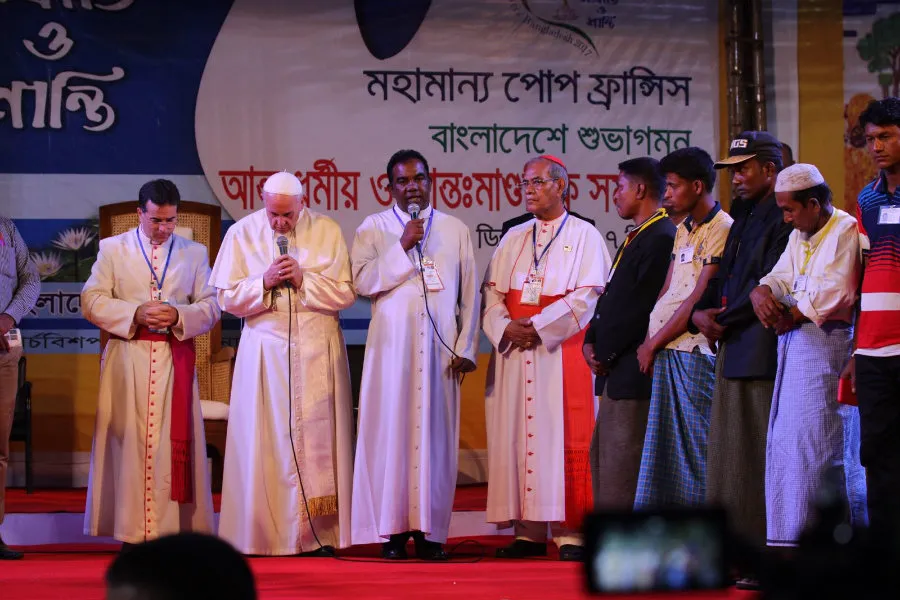
Vatican City, Dec 1, 2017 / 05:34 am (CNA/EWTN News).- In an encounter with interfaith leaders in Bangladesh, Pope Francis stressed the need to join together in promoting mutual respect and combating religiously-justified violence, saying this can’t achieved through mere tolerance, but requires real knowledge and trust of the other.
In a Dec. 1 meeting with interreligious leaders in Bangladesh, Pope Francis praised them for their commitment to live together in “mutual respect and goodwill” in the country, “where the right to religious freedom is a founding principle.”
The fact that they are all meeting together, he said, “stands as a subtle yet firm rebuke to those who would seek to foment division, hatred and violence in the name of religion.”
Pointing to the commitment of interfaith leaders in Bangladesh to building a culture of encounter, Francis said this goal “entails more than mere tolerance.”
“It challenges us to reach out to others in mutual trust and understanding, and so to build a unity that sees diversity not as a threat, but as a potential source of enrichment and growth,” he said, adding that it also serves as a challenge to “cultivate an openness of heart that views others as an avenue, not a barrier.”
Pope Francis with the interreligious leaders on his second day in Dhaka, Bangladesh, which is the second phase of his Nov. 27-Dec. 2 tour of Asia. He was in Burma Nov. 27-30, and will stay in Bangladesh until Dec. 2.
So far, the Pope has been outspoken on the need for peace and healing, specifically in Burma, and has stressed the importance of interfaith dialogue, praising the strides Bangladesh has made in this area.
The theme of interreligious unity has been a major talking point of the Pope’s visit to both countries, as Burma is a majority Buddhist nation and Bangladesh is majority Muslim. In Bangladesh, 86 percent of the population practices Islam. The 375,000 Catholics there represent less than 0.2 percent of the total population.
Pope Francis arrived to the interreligious encounter in a rickshaw, where he listened to testimonies from five leaders representing different religious communities in Bangladesh, including Muslims, Hindus, Buddhists, Anglicans and Catholics. Among the Catholics who spoke were a layman and Cardinal Patrick D’Rozario CSC, Archbishop of Dhaka, who is the first Bangladeshi cardinal, appointed by Francis in 2016.
Around 18 members of the Rohingya Muslim community were also present, including 5-year-old child. The Pope greeted them individually at the end of the event, listening as they each briefly explained their stories through an interpreter.
A largely Muslim ethnic group who reside in Burma’s Rakhine State, the Rohingya have recently faced a sharp increase in state-sponsored violence in their homeland, leading the United Nations to declare the crisis “a textbook example of ethnic cleansing.”
With an increase in persecution in their home country of Burma more than 600,000 Rohingya have fled across the border to Bangladesh, where millions are in refugee camps. The crisis, which boiled over ahead of the Pope’s trip, has been a focal point of the visit.
In his speech to the interfaith leaders, Francis said there are three essential elements of the “openness of heart” that allow us to really encounter others: a door, a ladder and a path.
The door, he said, “is not an abstract theory but a lived experience” which enables one to have real dialogue, “not a mere exchange of ideas.” And going through this door requires “good will and acceptance,” he said, but stressed that this attitude is “not to be confused with indifference or reticence in expressing our most deeply held convictions.”
Pope Francis then turned to the image of the ladder, saying it is one “that reaches up to the Absolute.” By looking to this transcendent aspect of interreligious activity, he said, “we realize the need for our hearts to be purified, so that we can see all things in their truest perspective.”
Finally, he said the path they must take is one that leads “to the pursuit of goodness, justice and solidarity.”
“It leads to seeking the good of our neighbors,” he said, explaining that when religious concern for the good of others comes from an open heart, it “flows outward like a vast river, to quench the dry and parched wastelands of hatred, corruption, poverty and violence that so damage human lives, tear families apart, and disfigure the gift of creation.”
This spirit of openness, acceptance and cooperation among believers doesn’t just contribute to a culture of harmony and peace, but is “its beating heart.”
The world desperately needs this heart to beat strongly, he said, in order “to counter the virus of political corruption, destructive religious ideologies, and the temptation to turn a blind eye to the needs of the poor, refugees, persecuted minorities, and those who are most vulnerable.”
“How much, too, is such openness needed in order to reach out to the many people in our world, especially the young, who at times feel alone and bewildered as they search for meaning in life!”
Pope Francis closed his speech thanking the leaders for their efforts to promote a culture of encounter among the different religions in Bangladesh, and prayed that they would help all believers “to grow in wisdom and holiness, and to cooperate in building an ever more humane, united and peaceful world.”
In his greeting to the Pope, Cardinal D’Rozario said the religious harmony that exists in Bangladesh “is rooted in our cultural identity.” The fact that they live peacefully in a multi-religious and multi-ethnic context, he said, is a heritage “we proudly enshrine in our hearts and we feel so much pain when this sacrosanct heritage is attacked and harmony is disturbed.”
He said Bangladesh continues to “march forward” with the hope of building up humanity through integral development and care of the planet, and voiced the Church’s commitment to “cherish harmony and love peace” in the nation.
Francis was also greeted by five leaders of the different religious communities in Bangladesh, including Grand Imam and Mufti of Bangladesh, Farid Uddin Masud, on behalf of the country’s Muslim community; Swami Dhruveshananda Adhyaksha on behalf of the Hindu community, and Sanghanayaka Suddhananda Mahathero on behalf of the Buddhist community, among others.
In his greeting, Imam Masud said the world today needs compassion and love more than anything else.
“The only remedy and solution to the problem of malice, envy and fighting among nations, races and creeds lies in the compassionate love preached and practiced by the great men and women of the world,” he said, and praised Pope Francis for his “tireless efforts” on behalf of the oppressed, regardless of religion, cast or nationality.
“This is a great inspiration for all of us,” he said, and pointed specifically to the Pope’s support of the Rohingya Muslims from Burma, saying the Pope’s concern for them “will bring a positive result in regard to the attempts to ensure their human rights.”
The Muslim community in Bangladesh, he said, “pay our tribute and show respect” to Pope Francis for his attention not only to the Rohingya, but to people of all faiths, adding that the Pope’s role in promoting world peace “deserves our wholehearted respect.”
On his part, Swami Dhruveshananda Adhyaksha, representing the Hindu community, said that while the religions of those gathered may be different, “the objective is the same.”
“Just as all the rivers which originate from different sources blend into the same ocean, so all religions, though different, lead to the same beatitude,” he said, adding that “we have the duty to remain firm in the ideals we believe in, showing due respect for others.”
Likewise, Sanghanayaka Suddhananda Mahathero, Chief Patriarch of the Buddhists of Bangladesh and President of Bangladesh Bouddha Kristi Prachar Sangha, said the Pope’s visit has “ushered a new horizon of interreligious harmony among all faiths” in Bangladesh.
He said he has been moved by Francis’ “deep sense of kindness and compassion” toward the marginalized, and that the image of Pope Francis washing the feet of young African refugees is something that constantly stays in his mind.
“The Holy Father has achieved greatness,” he said, explaining that Bangladesh is committed to religious cooperation.
Affirming the sentiments of Bangladeshi resident Abdul Harmid, who in yesterday’s speech to the Pope said the country has a “zero tolerance” policy on violent interreligious conflict, the Buddhist leader said “we gather here to invoke with one voice the blessings of peace and fraternity in our country.”
After the testimonies, the encounter closed with a prayer recited by Anglican Bishop Philip Sarkar, who asked for strength to fight together against the evils of discrimination, division and corruption in Bangladesh.
“There are many people today in our world who are the victims of terrorism, conflicts, oppression and exploitation,” he said, noting that religious and ethnic minorities all over the world are suffering hatred and discrimination, and pointing to the Rohingya crisis in neighboring Burma as an example.
He prayed that world leaders and those who have authority would be guided by “wisdom and kindness” so as to wield their power in service to their people with love and attentive care.
Sarkar then pointed to the “hypocrisy and pride” each of the religions present at times display, saying “we misunderstand and hate people of other faiths and create suspicion with each other. We don’t know how to respect other religions and people of other faiths.”
He asked forgiveness for this, and prayed that God would help them to realize the depth of his love in order to “love others and live in service for others, but not judge others because of their faith or creed.”
The bishop closes his prayer asking that the interfaith leaders would be led by a spirit “of love and wisdom” in order to “show the path of true light and true life in this confused and dark world.”
 […]
[…]






TO THOSE IN CHARGE OF THE VATICAN: This is what happens when you open your borders and allow free-access to “migrants.” Pope Leo ought to just consider this miscreant a “migrant.”
Why drag migrants into this?
Simply because this person illegally trespassed upon sacred ground. Please note that the Vatican police FORCIBLY removed him from the premises. However, according to Leonine Doctrine, this intruder should have been welcomed as Christ and permitted to do whatever he wanted to do since he “migrated” to that area of the sanctuary. Why didnt Leo treat him as a guest like he counsels our government to do? Please, dear Br. Jaques, let us know what the Vatican authorities did with this individual. Did they throw him in jail? Will they prosecute him? Maybe just give him a cupful of leftover ice and send him on his way? He’s a migrant simply because he went where he was not supposed to be (that is, unless Leo tells us otherwise).
It would seem the far greater desecration made than these mindless crazies was the Jubilee Celebration parade into St Peter’s Basilica homosexuals flaunting their ‘life choices’ [Pope Leo’s terminology] insulting Catholic doctrine with an expletive, and receiving the Holy Eucharist.
Leo XIV had to be informed beforehand to permit Fr James Martin SJ to arrange this depravity spectacle. Since his elevation to the papacy Leo XIV has made it consistently clear where he stands. Who would have conceived this occurring during Benedict’s or John Paul’s pontificates? This is a time for reparation and strengthening of faith in Christ.
I was thinking the same thing, Fr. Morello. It seems as if something very evil is at work over there and this last episode is just one more outward or blatant instance of it. It makes one cry. Francis of Assisi, pray for the Church that once you rebuilt; Anthony of Padua, pray for the Church that you so well helped once.
Oscar, you allude to what may well be the marker for “something very evil is at work over there”. I’ve referred to it elsewhere as the cultic Pachamama idolatry ceremonies that occurred at the Vatican under Francis I. Since that time there’ve been a chain of controversial events, allegedly contrary to Apostolic tradition.
In remarks regarding these altar desecrations Bishop Athanasius Schneider believes they are not as serious as those Pachamama worship ceremonies, which were violations of the first commandment. Sins of idolatry are more egregious than what followed. My opinion is that the Pachamama idolatry was the source of what has followed.
It doesn’t appear that there was a exorcism ritual [the formal blessing of a house is an exorcism ritual] to correct that idolatry due to the involvement and respect given to Pope Francis.
Fr Peter you are right that from a point of view of dates – Pachamama Ceremony was October 4 2019 – all the evil flows from that date onwards. The subsequent dessecrations are all also post Traditionis Custodes 16.07.2021. So, two major dates.
The sanctification of daily TLM on the side altars of “the panting heart of Rome” – as the priests loudly beat their chests – was axed by application of Traditionis Custodes brutally ending those daily masses which were calling down graces to the heart of the Church’s tresury.
Dessecration is the consequence of the dessacrilisation of St Peter’s: the application of Traditionis Custodes by Churchmen. It is an unprecedented punishment. The message is clearly a call back to faith of the fathers, as the Church continues to persecute thriving faithful parishes for the crime of TLM.
Holy father, hear the cry from the formerly panting heart of Rome: Bergoglioism is not the Faith of our Fathers.
Just when you think humans can’t possibly do anything more disgusting, along comes a story like this.
I am hopeful this guy will do a VERY long stint in jail. And personally, I am tired of hearing “by reason of insanity” used as a way to get people exempted from the punishment they so richly deserve. Jail for a bunch of years, and then throw him into a mental hospital when the prison term expires.
The steward who was forgiven?
As all catholics know, forgiveness does not mean you are exempt from punishment for your sins when you are judged. Why should you be exempt in this world? Further, is there a point in offering forgiveness when there has been no sign of repentance?
I am a little more than tired of what I call the “tyranny of nice”. That is, the way in which too much of secular society views sin, violence and and immorality. Which means everything is all ok, no matter what heinous crime you commit. Because no one wants anyone to “feel bad” by speaking the truth about what someone has done. Apparently, thats worse than the crime itself in some circles. Sorry, but I think the fact that we do not hold people accountable for bad behavior is part of the reason civil society is on the brink of dissolving.
Mill stone around the neck?? Jesus advised forgiveness. He never said the sins didnt matter.
LJ, you get my nomination for Pope. You get it!
“This is what happens when you open your borders and allow free-access to “migrants.”
No, this is what happens when the Church fails to repent for abuse. It also happens when the Church herself allows/invites “the abomination of desolation” into her buildings and her heart, and becomes a whore instead of a bride. One needs only to refer to the Old Testament to see that.
In a sense, a man urinated on the altar of St Peter’s gave a physical expression of a rapidly escalating spiritual abuse which has been dealt to Our Lord and to His Bride, the Church, by the hands of her hierarchy. Recently we saw “f*ck the rules” and other phenomena (invited in by the Vatican) exactly in the same place; St Peter’s was desecrated already.
Attention not deserved. As much as possible, do not broadcast. Do the purification without broadcast.
Clergy, abandon the adolescent mentality fixation with media.
One could also argue that loving and accepting ALL of God’s children as Pope Leo is doing is in line with reparation and strengthening faith in Christ.
It was reported elsewhere that a penitential rite was performed. My question: Was a penitential rite done after Bergoglio desecrated the Basilica with the worship of the Pachamama demon within its sacred walls?
The man is clearly not well. What happened is awful, but if he’s mentally ill he’s not responsible for his actions. He should get help, we should pray for that man, the altar should be cleaned and re-consecrated and we should move on. We shouldn’t make more out of this than needed.
Unless these people are crazy enough to think a person is a tree, they know what they are doing. This “mentally ill” plea is just a convenient way for those on the left to excuse uncivil behavior. Its said that many of those who are jailed have some level of emotional problem. That doesnt make them innocent. That does nothing to negate the crime they have committed or help heal their victims. “Mentally ill” gets the criminal off the hook and free to commit violence again. I am doubtful you or anyone else would think its ok to “move on” if your spouse were killed by a DWI driver, or some other violent crime was committed against a loved one. People like this seldom commit one crime. As long as they are not incarcerated, the record shows they commit crimes over and over again. Often violent crimes. Much like the young Ukrainian woman who was stabbed to death on the train recently in an unprovoked attack. She could have been any one of us. Being a Christian does not require you to cheerfully be a victim.
Psychosis is a whole different thing from an emotional trouble.
I have no idea what the man in this situation suffers from but I agree that the seriously mentally ill need better care and that can include commitment in psychiatric facilities.
Years ago an unbalanced man tried to burn down our cathedral. It wasn’t his first attempt at destroying a church.
Psychiatric hospitals have a place.
💯 percent. I say this as a therapist. Mental illness is an overused excuse for criminal behavior. It’s a ploy used to excuse even the most heinous crimes and puts repeat offenders back on the streets. If the insanity plea is used the criminal should be committed to a mental institution indefinitely and held there until they no longer pose a threat to the public according to stringent standards.
As to the Gospel of Nice? It has not saved one single soul.