Detail from "Portrait of Newman" (1881) by
John Everett Millais [Wikipedia]
Vatican City, Sep 28, 2025 / 06:25 am (CNA).
Pope Leo XIV announced on Sunday that he will proclaim St. John Henry Newman a doctor of the Church on Nov. 1, the Solemnity of All Saints.
“I will confer the title of doctor of the Church on St. John Henry Newman, who gave a decisive contribution to the renewal of theology and to understanding Christian doctrine in its development, in the context of the Jubilee of the world of education,” the pope said after celebrating Mass for the Jubilee of Catechists in St. Peter’s Square.
With the proclamation, Newman will become the 38th doctor of the Church, joining a select group of saints recognized for their enduring contribution to Catholic theology and spirituality. He is especially noted for his insights on the development of doctrine and the role of conscience.
A 19th-century English theologian, Newman was first a renowned Anglican priest before entering the Catholic Church in 1845 under the guidance of Blessed Dominic Barberi. Ordained a Catholic priest two years later, he founded the Oratory of St. Philip Neri in England and was created a cardinal by Pope Leo XIII in 1879.
If you value the news and views Catholic World Report provides, please consider donating to support our efforts. Your contribution will help us continue to make CWR available to all readers worldwide for free, without a subscription. Thank you for your generosity!
Click here for more information on donating to CWR. Click here to sign up for our newsletter.
Archbishop Stephen Ameyu Martin Mulla of Juba and his episcopal coat of arms (top left); Bishop Stephen Chow of Hong Kong and his episcopal coat of arms (top right); Bishop Américo Aguiar of Setúbal, Portugal, and his coat of arms (bottom left);… […]
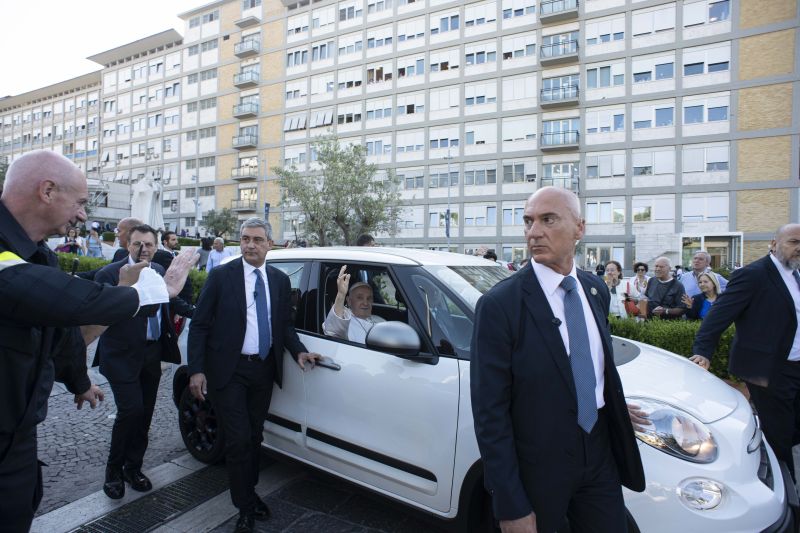
Pope Francis left Rome’s Gemelli Hospital shortly before 9:00 a.m. on June 16, 2023. Before returning to the Vatican, he stopped to pray in front of the historic Marian icon of Salus Populi Romani at St. Mary Major Basilica, and made a quick visit to a group of religious sisters close to St. Peter’s Square. / Vatican Media.
Rome Newsroom, Jun 16, 2023 / 03:10 am (CNA).
Pope Francis was discharged from Rome’s Gemelli Hospital to a round of applause on Friday, after an eight-day stay following abdominal surgery.
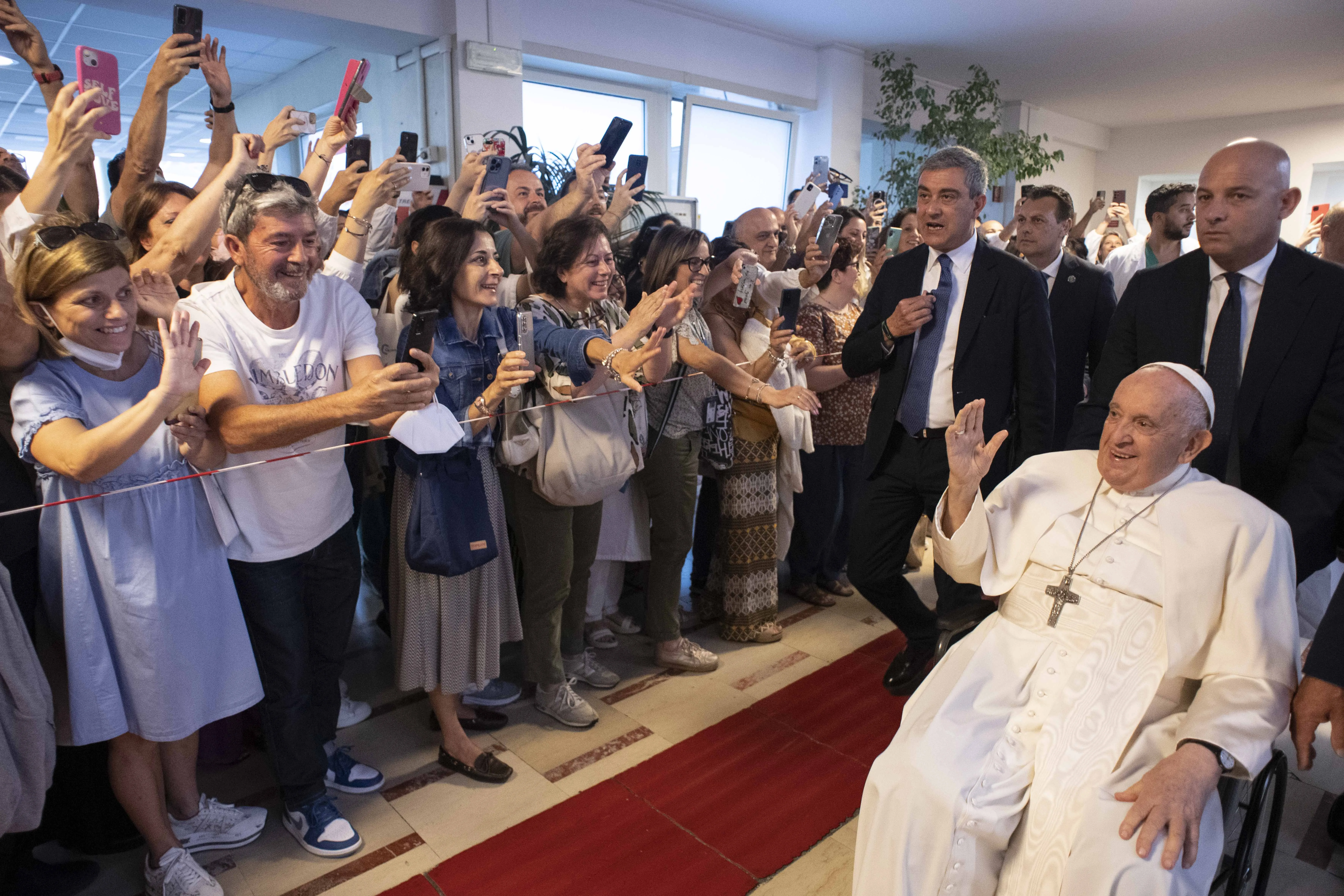
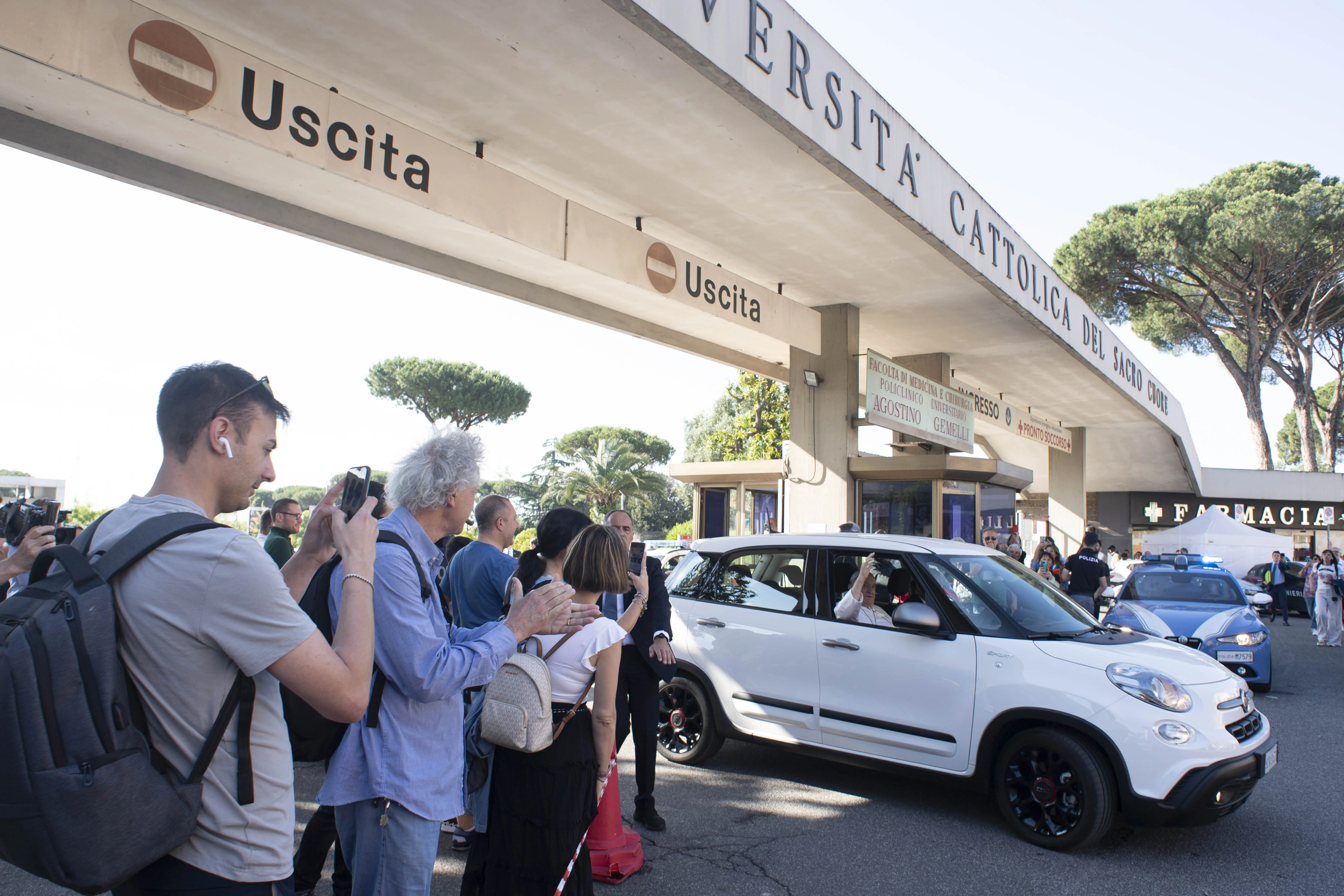
He greeted hospital staff and other patients as he left the hospital in a wheelchair June 16. Outside the building, the pope was asked how he was doing by media, to whom he said, “I’m still alive!”
After Francis left in his white Fiat 500, surgeon Dr. Sergio Alfieri told reporters, “The pope is well. He’s better than before,” according to the Associated Press.
According to the Vatican, Pope Francis will lead the Angelus on Sunday as usual and other audiences for the upcoming days will take place.
The pope’s Wednesday morning audience with the public in St. Peter’s Square on June 21 has been canceled, instead, “to safeguard the Holy Father’s postoperative recovery.”
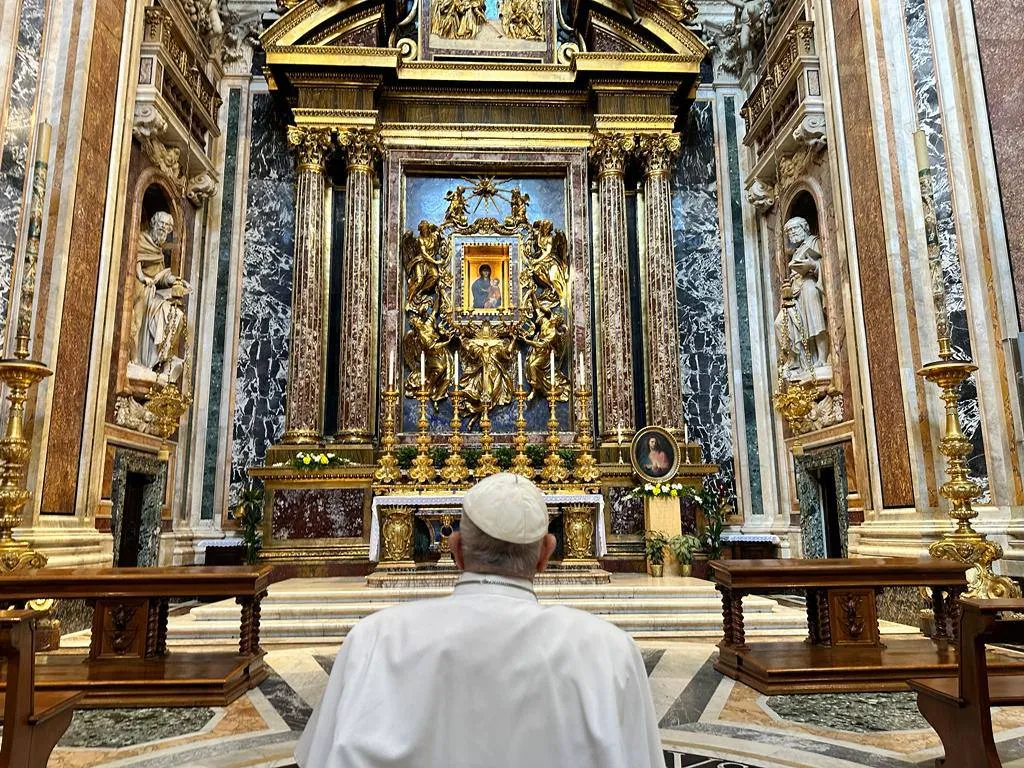
Pope Francis stopped for a moment of prayer before the historic Marian icon of Salus Populi Romani at St. Mary Major Basilica after being discharged from Rome’s Gemelli Hospital on the morning of June 16, 2023. Vatican Media.
Before returning to the Vatican on Friday, Francis stopped to pray in front of the Salus Populi Romani Marian icon.
The historic icon is kept in a chapel in the Basilica of St. Mary Major. Pope Francis has also stopped there after previous hospitalizations and visits the icon before and after every international trip.
Pope Francis waves to other patients as he leaves Rome’s Gemelli Hospital shortly before 9:00 a.m. on June 16, 2023. Before returning to the Vatican, he stopped to pray in front of the historic Marian icon of Salus Populi Romani at St. Mary Major Basilica, and made a quick visit to a group of religious sisters close to St. Peter’s Square. Vatican Media.
On his approach to the Vatican, he made a quick private visit to a group of religious sisters who run a guesthouse next to St. Peter’s Square.
The Italian Istituto Santissima Maria Bambina (“Institute of the Most Holy Child Mary”) is currently holding its general chapter meeting in Rome.
The pope also thanked the law enforcement who guard the entrance to the Vatican.
Pope Francis left Rome’s Gemelli Hospital shortly before 9:00 a.m. on June 16, 2023. Before returning to the Vatican, he stopped to pray in front of the historic Marian icon of Salus Populi Romani at St. Mary Major Basilica, and made a quick visit to a group of religious sisters close to St. Peter’s Square. Vatican Media.
According to daily updates from the Vatican, the 86-year-old Pope Francis has been recovering normally after undergoing a three-hour surgery to repair an incisional hernia on June 7.
A team of surgeons removed scar tissue and operated on a hernia in the pope’s abdominal wall at the site of a previous surgical incision.
The June 7-16 stay was Pope Francis’ third hospitalization in the past two years.
He was hospitalized for four days in March for a lung infection and had part of his large intestine removed in July 2021 due to diverticulitis.
Pope Francis prays at the tomb of Pope Pius XII on Nov. 2, 2021. / Vatican Media.
Vatican City, Feb 10, 2022 / 06:00 am (CNA).
In a video message on Thursday, Pope Francis encouraged Christians to stay committed to making the world a more just … […]
5 Comments
About our “understanding of Christian doctrine in its development”–and freeing ourselves of mutant signaling and insinuations during the past decade–in “The Development of Christian Doctrine” Newman appeals, in part, to a biological analogy whereby growth (“development”) is one thing, while corruption is another.
He writes:
“I venture to set down seven notes of varying cogency, independence, and applicability to discriminate healthy developments of an idea from its state of corruption and decay, as follows: “There is no corruption if it retains:
(1) One and the same TYPE [doctrine/natural law v. a disconnected degree of pastoral “accompaniment” devolving into accommodation],
(2) The same PRINCIPLES [the non-demonstrable first principle of non-contradiction v. neo-Hegelian interpretations of the ambivalent “time is greater than space”],
(3) The same ORGANIZATION [the received Barque of Peter as from a supernatural source v. natural religions more as expressions of unaltered human searching]
(4) If its beginnings ANTICIPATE its subsequent phases [the Incarnation/Creed/ Catechism/Veritatis Splendor v. normalization of “choices” in place of moral judgments, as in the homosexual lifestyle, etc.];
(5) Its later phenomena PROTECT and subserve its earlier [Veritatis Splendor/ Familiarus Consortio v. social science (?) as the source of alternative truths];
(6) If it has a power of assimilation and REVIVAL [Evangelization and inculturation v. incongruous amalgamation as with Amazonia/der Synodal Weg], and
(7) A vigorous ACTION from first to last…” [lively steadfastness v. the mess of constant change as the deepest rut of all].
By definition, we cannot prove “illative” knowledge, but it helps make sense of why we know that another person, even the Divine Persons, love us. We know the truth of this interpersonal love on many mysterious levels.
Try reading the Bible and everywhere there is the word “faith” replace it with “relationship.”
Faith or belief in the love of another person is more than math. Think also of the revealed fact that the Holy Angelic Persons love us. Happy Feast!
Thank you for remembering my Feast Day. Certainly faith, and beyond that, mystical knowledge, can provide men with certitude regarding religious matters. But Henry Neman’s illative knowledge was viewed as a natural human faculty.As such, it’s not faith or mysticism. It could be regarded as another human means of strengthening faith, but it would be fatal to the Faith to confuse it with a supernatural thing in itself. I think such ideas had a lot to do with the romantic atmosphere of the nineteenth century which, by confusing natural faculties with the supernatural, risked emptying the latter of its real, very distinct, reality.






About our “understanding of Christian doctrine in its development”–and freeing ourselves of mutant signaling and insinuations during the past decade–in “The Development of Christian Doctrine” Newman appeals, in part, to a biological analogy whereby growth (“development”) is one thing, while corruption is another.
He writes:
“I venture to set down seven notes of varying cogency, independence, and applicability to discriminate healthy developments of an idea from its state of corruption and decay, as follows: “There is no corruption if it retains:
(1) One and the same TYPE [doctrine/natural law v. a disconnected degree of pastoral “accompaniment” devolving into accommodation],
(2) The same PRINCIPLES [the non-demonstrable first principle of non-contradiction v. neo-Hegelian interpretations of the ambivalent “time is greater than space”],
(3) The same ORGANIZATION [the received Barque of Peter as from a supernatural source v. natural religions more as expressions of unaltered human searching]
(4) If its beginnings ANTICIPATE its subsequent phases [the Incarnation/Creed/ Catechism/Veritatis Splendor v. normalization of “choices” in place of moral judgments, as in the homosexual lifestyle, etc.];
(5) Its later phenomena PROTECT and subserve its earlier [Veritatis Splendor/ Familiarus Consortio v. social science (?) as the source of alternative truths];
(6) If it has a power of assimilation and REVIVAL [Evangelization and inculturation v. incongruous amalgamation as with Amazonia/der Synodal Weg], and
(7) A vigorous ACTION from first to last…” [lively steadfastness v. the mess of constant change as the deepest rut of all].
Let us hope it is Newman’s WRITINGS that will inspire the Church Peter.
A great saint and example for non-catholics. Not so sure about his notions concerning “illative”, intuitive knowledge though.
By definition, we cannot prove “illative” knowledge, but it helps make sense of why we know that another person, even the Divine Persons, love us. We know the truth of this interpersonal love on many mysterious levels.
Try reading the Bible and everywhere there is the word “faith” replace it with “relationship.”
Faith or belief in the love of another person is more than math. Think also of the revealed fact that the Holy Angelic Persons love us. Happy Feast!
Thank you for remembering my Feast Day. Certainly faith, and beyond that, mystical knowledge, can provide men with certitude regarding religious matters. But Henry Neman’s illative knowledge was viewed as a natural human faculty.As such, it’s not faith or mysticism. It could be regarded as another human means of strengthening faith, but it would be fatal to the Faith to confuse it with a supernatural thing in itself. I think such ideas had a lot to do with the romantic atmosphere of the nineteenth century which, by confusing natural faculties with the supernatural, risked emptying the latter of its real, very distinct, reality.