
Vatican City, May 7, 2018 / 10:18 am (CNA/EWTN News).- The ongoing crisis in Venezuela has produced a tremendous flow of emigration, with thousands fleeing the instability and hyperinflation under Nicolas Maduro’s socialist government to seek refuge in neighboring countries.
Venezuelans who choose to leave their country, as with any migrant, face a plethora of obstacles, risks, and unknowns, including an increased number of neighboring nations closing their doors, as well as the danger of falling victim to traffickers.
In a bid to help host countries support the influx of their Venezuelan neighbors and provide migrants the resources they need to integrate into their new countries, the Vatican’s office for migrants and refugees has partnered with eight South American bishops’ conferences in launching a project aimed at providing this support.
Titled “Bridges of Solidarity,” the project was presented May 7 by the two undersecretaries of the Vatican’s migrant office – part of the Dicastery for Promoting Integral Human Development and is overseen by Pope Francis directly – Fr. Michael Czerny, SJ, and Fr. Fabio Baggio, as well as Fr. Arturo Sosa, father general of the Society of Jesus and himself a Venezuelan.
The office is partnering with the bishops of Colombia, Brazil, Ecuador, Peru, Chile, Bolivia, Paraguay, and Argentina.
The project is in line with the 20 actions points drafted by the Vatican’s migrant section as part of Pope Francis’ 4-step plan for assisting migrants and refugees: to welcome, protect, promote and integrate.
Services offered through the project, which is designed to run for 24 months, include the building of centers and shelters for migrants; assistance finding housing and jobs; the facilitation of access to education and healthcare; advocacy and legal assistance; professional training of pastoral workers and awareness campaigns aimed at sensitizing local communities to the needs of migrants and the risks they face.
Funding, according to Fr. Baggio, happens partially at a local level, but the dicastery also helps in seeking support from private donors and partnerships.
Fr. Czerny said the department’s mission is to “assist the Church wherever needed, wherever possible, in accompanying migrants, refugees and victims of human trafficking.”
As a refugee himself, Czerny said one of the biggest areas they want to address helping migrants to have access to good information, thus lowering the risks they face along the way.
The looming questions for any migrant, Czerny said, are “what awaits you? What lies ahead? What do you need to know now that’s going to happen that you can be a bit better prepared? Or are you always arriving shocked, surprised and disappointed?”
“I don’t think there’s a better example of where the Church, throughout [the continent] can cooperate so that as people undertake these difficult journeys and that they are supplied with good information all along the way,” he said, referring to the new project.
Providing the right information, he said, plays a key role in the prevention of trafficking, “because people are trafficked when they lack the necessary information in order to make good decisions.”
In comments to CNA, Czerny said migrants generally lack two key areas information, the first being the practical “what do you do when…” info, as well as answers to questions about what a migrant should do when they arrive to a bus station or shelter, and what to say and not to say.
The other area is a lack of correct information, he said, noting there is often an abundance of false information that reaches migrants, and “false information is the beginning of the trafficking problem…people are oriented in the wrong direction and they end up trapped.”
Compounding the issue is the fact that many see the issue as something chaotic, assuming that it would be difficult to get the right information to migrants in the first place.
However, “when we look at it practically it’s not chaotic, it’s practical. It’s people, and people are coming and if you have good information you can share it,” Czerny said, adding that cell phones and other digital tools make it easy to share information, “but it has to be good information.”
Pope Francis has often been outspoken about the issue of trafficking. He addressed the topic again, speaking specifically about the problem of false information, in a video message to the Second International Forum on Modern Slavery, taking place May 5-8 in Argentina, published May 7.
The pope said slavery is not something of the past, but is a grim reality for many men, women and children throughout the world.
Confronted with this “tragic reality,” the pope said “no one can wash their hands who does not want to be, in some way, complicit in this crime against humanity.”
He spoke of the need to overcome “the veil of indifference” covering this issue, and said it often times appears as if “many don’t want to understand the scope of the problem.”
“There are those who, being directly involved in criminal organizations, don’t want this to be talked about simply because they get high profits thanks to the new forms of slavery,” he said, noting that there are also those who know about the problem, but don’t want to talk about it “because they find themselves at the end of the chain of consumption.”
According to Fr. Czerny, the problem of prostitution, to which the pope was likely referring, is the biggest area of trafficking that migrants fall victim to.
Pope Francis said that enforcing stricter laws are not enough, but the root causes must also be addressed, such as poverty, violence, and corruption.
The response to this issue, he said, must be based on creating opportunities for a true integral human development, beginning with education, which he said is “the key point.”
Francis closed his message noting that the task is a difficult one which requires both patience and perseverance, but which will help in building “a society that is renewed and oriented toward freedom, justice and peace.”
 […]
[…]




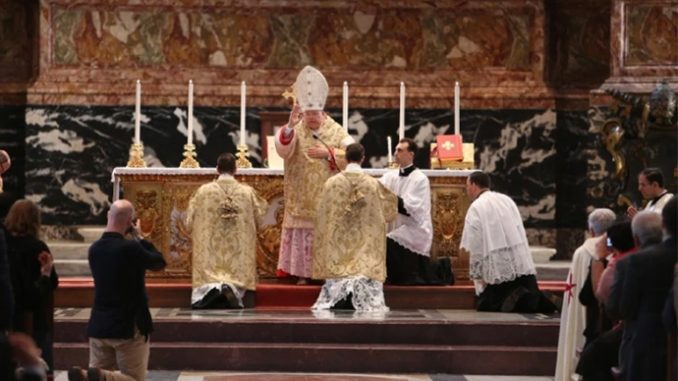


These small blessings bring gratitude for the opportunity to celebrate the Latin Mass once again at St. Peter’s. However, it is disheartening that such a thing should be viewed as an event for which we must feel so grateful — a return to a tradition upheld for nearly 1800 years.
Michael, you forget that tradition now means whatever has been believed and practiced only for the last 50 years.
Michael, you forget that tradition now means whatever has been believed and practiced only for the last 50 years.
This permission should not have been granted. The aim ought to be to completely phase out the use of the preconciliar liturgy, not to prolong its use and certainly not to encourage its growth.
The Roman Church is liturgically and ecclesiologically incoherent in its practice.
Ergo, Seabass, also sprach Zarathustra.
Pronouncing such judgment on the church, you make yourself a heathen and a slave like Onesimus, thinking you know more than the Church by defrauding your Christian master. May you find yourself an apostle like Paul. He can reset your thoughts to True.
The Church is universal & catholic, within which there are many Rites & liturgies.
It’s all good.
This is a good sign.
Habemus Papam
While I do not participate in Mass in Latin, I want it available for those who love this liturgy. As Catholics we have room for all.
As Catholics, we should accept the liturgical reform mandated by the bishops at Vatican II. That entails putting the 1962 Missal behind us and only celebrating the reformed Mass. If the reformed Mass were celebrated more in accord with tradition — including the Latin language and Gregorian chant — I believe well over 90% of the tiny subset of Catholics who say they prefer the TLM would accept that way of celebrating the reformed Mass and attend it. For the vast majority of TLMers, they are seeking a traditional, reverent liturgical aesthetic at Mass, not the 1962 Missal itself. That’s how the reformed Mass ought to be celebrated anyway: in accord with liturgical tradition.
So is the Mass celebrated by most Catholics today actually in conformity with what the conciliar documents (SC, etc) really say? This is a double-edge sword, but the fixation is always on those who prefer the “traditional” form. Once again, I’m quite thankful that I’ve been in an Eastern Catholic parish for most of my Catholic life.
To your question, the way the reformed Mass is celebrated in the typical American parish is inept, in my judgment, and does not conform to the Church’s liturgical norms nor does it accord with liturgical tradition.
I understand why the trads want the TLM: because the celebration of the reformed Mass is so embarrassingly awful in 99% of Catholic parishes. The solution is to correct the liturgical abuses and poor celebrations of the reformed Mass in parishes, not to retreat into the preconciliar form of the Mass in liturgical enclaves of traditionalism.
By maintaining the use of the 1962 Missal alongside the reformed Mass, the Roman Church is liturgically schizophrenic.
Preferring and attending the TLM is not a retreat into a preconciliar form or enclave. The TLM reverently and ritually commemorates the sacrifice of Christ’s passion without room for liturgical novelty or debased experimentation.
The Church is not liturgically schizophrenic in allowing use of both forms. Based as it is upon the TLM, the NO’s precursor, foundation, history, meaning, and rubrical model is the TLM.
Seeing the Church’s use of both forms as schizophrenic reflects a want of wisdom and a rigidity in want of charity.
Sebastian: I have the opportunity to celebrate the Holy Mass in churches frequently in three different states and in no way are they “embarrassing awful “ in any of these churches. How much have you been around, and where do you come up with your 99 %?
Carl, two of my cousins and their families recently started attending the Eastern Orthodox Church. I believe Pope Francis was a step too far for them, so they decided to leave. While I understood their choice, it still made me sad. When they explained their reasons for leaving, I found myself without a response.
Mr Olson, I totally agree with you. I too am grateful to be part of a Byzantine Rite parish. Just pure old-world style liturgical services without wars.
Will that Mass at St. Peter’s by Cardinal Burke be with or without James Martin’s parade of homosexual activists?
The Pope met with BOTH Burke and Martin. A good sign I would think.
Br. Jaques, we have come to expect your foolish sentimentality here. You seem to struggle with discriminating between good and evil.
May the Lord forgive disdain against LGBT. Our Lord died for all of his children. Arrogance, like it’s cousin pride. Does nothing to build the body of Christ. It is a poverty to show contempt to brothers and sisters in Christ. So that you might live as you wish.
Pray for the unity of Christendom.
It’s not a disdain against individuals but about Church teaching regarding acting on disordered attractions.
Joe, you seem to have a perverse notion of the moral good; you confuse/invert evil for the good. Come to your senses, man.
If I thought the TLM would bring peace to our world, I would kneel during the whole Mass. As it is, I settle for making my heart kneel before God.
Love God more than Rubrics; Burke is power hungary;
Please explain, Sister, how celebrating Mass at the Vatican is evidence of being “power hungary”. I await your cogent presentation of the matter.
Doubtful she’ll respond to you Carl if she’s one of those “nuns out of uniform.”
Clearly the holy nun (or is it “none”?) is referring to Hungary’s Cardinal Erdo and the future day when he gains further influence in the perennial Catholic Church, as when he introduced the second session of the Synod on the Family, offering this self-evident insight: “There are absolutely no grounds for considering homosexual unions to be in any way similar or even remotely analogous to God’s plan for marriage and family.” (Section III:3, below).
https://www.catholicnewsagency.com/news/32772/full-text-of-cardinal-erdos-introductory-report-for-the-synod-on-the-family
Respectfully Sister, Cardinal Burke has always struck me as a very humble & lovely man.
Hungry, not Hungary.
Typical ‘Nun on the Bus’ sort of comment.
To James Connor above who wrote: “Sebastian: I have the opportunity to celebrate the Holy Mass in churches frequently in three different states and in no way are they “embarrassing awful “ in any of these churches. How much have you been around, and where do you come up with your 99 %?”
Father O’Connor, when you celebrate Mass, do you ONLY say the Black and DO the Red, with no deviations whatsoever? Let’s hope so.