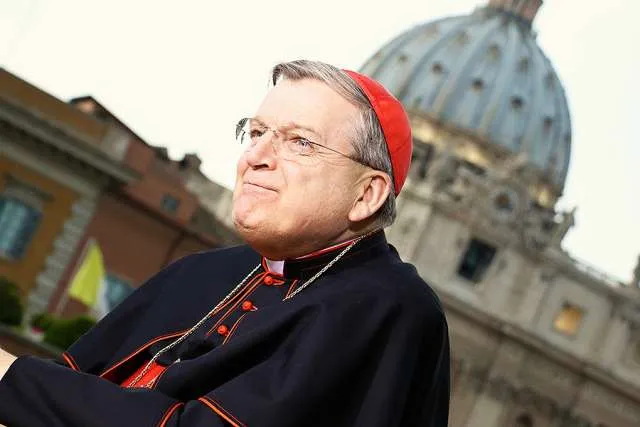
Vatican City, Apr 6, 2018 / 11:05 am (CNA).- Before he died, the late Cardinal Carlo Caffarra, emeritus Archbishop of Bologna, told friends that he wished for a conference that would gather bishops and other Catholics to reflect on the state of the Church.
The conference “Church, where do you go?,” scheduled for April 7 in Rome, can be considered the fulfillment of Cardinal Caffarra’s wish.
Not by chance, the conference is dedicated to his memory. Not by chance, the subtitle of the conference is “only the blind would deny there is confusion in the Church,” a passage of one of his latest interviews.
A number of significant topics that have arisen during Pope Francis’ pontificate will be discussed: the 50th anniversary of the Humanae Vitae; questions about the Church’s doctrine on matters of sexual morality; the issue of conscience, which was crucial during the 2015 synod on family, and the concept of “discernment,” which is sometimes used in arguments justifying more open access to communion for divorced and remarried Catholics.
The topics of discussion will also include the limits of the papal authority and infallibility.
There are all the ingredients of a rich food for thought.
Relators of the conference are Cardinals Raymond Leo Burke, Walter Brandmueller and Joseph Zen Zekiun; Bishop Athanasius Schneider; philosopher Marcello Pera; professors Renzo Puccetti and Valerio Gigliotti; and journalist Francesca Romana Poleggi.
The titles of the lectures touch critical issues, and also explore the possibility of correcting the pope, if his statements seem to contradict Catholic doctrine. This demonstrates the increasing preoccupation in some circles with the protection of the deposit of faith.
Though some presentation titles might seem harsh, the topics are real, and they are intended to be part of an attempt to respond to open issues, such as those put forth by the 2016 dubia of four cardinals, that asked the pope certain questions about the doctrine of the Church, in light of the different ways Amoris Laetitia was being interpreted.
The late Cardinal Caffarra was one of the signatories of those dubia, and his approach to the issue provides a good way to glimpse into the conference, beyond any possible vis polemica.
Cardinal Caffarra always underscored he was not against the Pope, but he was merely seeking clarity on issues of faith. His signature at the end of the dubia, and the following letter he sent to the Pope to solicit a response, was intended as a search for the guidance of Peter on questions on faith and doctrine.
The Apr. 7 conference will be concluded by a short video interview Cardinal Caffarra granted on the issue of Humanae Vitae, one of the increasingly controversial topics of the moment.
Presenting a book on the contribution of Cardinal Karol Wojtytla (then Pope John Paul II) to the preparatory commission of Humanae Vitae, Cardinal Gerhard Ludwig Mueller, emeritus prefect of the Congregation for the Doctrine of the Faith, stressed that overturning the teaching of the Bl. Paul VI encyclical would be “a crime against the Church,” and denounced the work of a “secret commission” to re-write Humanae Vitae.
The commission is a study group led by professor Gilfredo Marengo, that is said to be looking back to the genesis of the encyclical.
The genesis of Humanae Vitae is one of main topics of discussion, and Renzo Puccetti, one of the lecturers, described it very well in the book “I veleni della contraccezione” (“The poisons of contraception”) that explains how the contraceptive pill was invented, developed and spread, describes the work of the lobbies of demographic control and how Catholics responded with natural family planning, and describes the struggle between bishops, theologians, doctors, and association of lay people over contraception.
This struggle poisoned the years before and after the Second Vatican Council, but Paul VI resolved to staying faithful to the doctrine.
The rebellion that followed provides a lot of clues about what is going on now. The encyclical was strongly resisted by a group of theologians that grabbed the headlines, and the pope was subjected to strong pressures.
The first step was to question the authoritativeness of the encyclical, saying that norms of contraception were not mandatory, as the document did not present a solemn declaration of infallibility.
This is the reason why Cardinal Wojtyla, who took part the in the preparatory committee, recommended that Paul VI clearly express the infallibility, not of the encyclical, but of the teaching expressed in the encyclical, a part of deposit of faith that needed to be preserved to stay faithful to the Gospel.
If the story behind Humanae Vitae says a lot about how campaigns against Catholic teaching is carried on even nowadays, the issue of pope’s infallibility is another interesting topic.
Is Amoris Laetitia or any other Papal document beyond the possibility of any mistake? To this extent, it is worthy to note that Cardinal Walter Brandmueller, another of the speakers, wrote in 1992 a book titled “The Church and the right to be wrong” about the Galileo case.
Cardinal Brandmueller took the example of Galileo to stress that the Church does not claim any infallibility except in some, well defined cases. Things can be discussed, in the end. Noting this is also an indirect response to those who blame any critic of Amoris Laetitia as a critic of papal authority itself.
Cardinal Burke is a very well known personality, and on numerous occasions he has addressed the problems of confusion over Catholic teaching. and the need to tackle that issue for the sake of the faithful.
Cardinal Zen has become the loudest voice in the defense of the Church’s freedom in China. While a discussion on the China-Vatican deal on the appointment of bishops is underway, Cardinal Zen has expressed the concern of many Catholics of China, and decried a return to Ostpolitik, the label given to Holy See’s policy with Eastern bloc countries on the other side of the Iron Curtain.
Ostpolitik was a diplomacy of dialogue and concessions, developed in the 60s by Msgr. Agostino Casaroli, later St. John Paul II’s Secretary of State.
Ostpolitik was also strongly criticized from the Cardinals of the Church of Silence, i.e., Cardinal Stefan Wyszynski, Primate of Poland, and above all Cardinal Jozef Mindszenty, Archbishop of Budapest-Esztergom, that both considered the Holy See’s approach as amounting to too much dialoguing with the countries of the Soviet bloc.
Bishop Schneider of Astana, Kazakhstan, has been one of the strongest defenders of Catholic teaching and a promoter of the Kazakhstani profession of truths on marriage.
Is the current approach on issues of doctrine and morality a replica of the Ostpolitik approach? Is the Church dialoguing too much with the world, giving up the primary task of evangelization?
Those are issues that will be explored during the April 7 discussion.
The conference will end with a declaration, which will likely restate the truth of faith regarding doctrine on marriage and sexuality.
According to the veteran Vatican watcher Sandro Magister, “this ‘declaratio’ will be the polar opposite of that ‘Kölner Erklärung’ – the declaration signed in Cologne in 1989 by German theologians now in the good graces of Francis – which concerned the principles later reaffirmed by John Paul II in the 1993 encyclical “Veritatis Splendor.”
It remains to be seen how much the conference will garner attention and make an impact. It is likely it will be labeled as an “anti-Francis” conference, but it is also likely that there will be a poor response to the hard-hitting questions raised during the lectures.

 […]
[…]




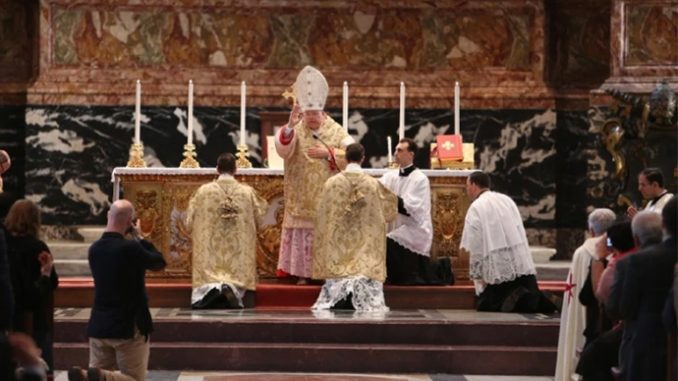


These small blessings bring gratitude for the opportunity to celebrate the Latin Mass once again at St. Peter’s. However, it is disheartening that such a thing should be viewed as an event for which we must feel so grateful — a return to a tradition upheld for nearly 1800 years.
Michael, you forget that tradition now means whatever has been believed and practiced only for the last 50 years.
Michael, you forget that tradition now means whatever has been believed and practiced only for the last 50 years.
This permission should not have been granted. The aim ought to be to completely phase out the use of the preconciliar liturgy, not to prolong its use and certainly not to encourage its growth.
The Roman Church is liturgically and ecclesiologically incoherent in its practice.
Ergo, Seabass, also sprach Zarathustra.
Pronouncing such judgment on the church, you make yourself a heathen and a slave like Onesimus, thinking you know more than the Church by defrauding your Christian master. May you find yourself an apostle like Paul. He can reset your thoughts to True.
The Church is universal & catholic, within which there are many Rites & liturgies.
It’s all good.
This is a good sign.
Habemus Papam
While I do not participate in Mass in Latin, I want it available for those who love this liturgy. As Catholics we have room for all.
As Catholics, we should accept the liturgical reform mandated by the bishops at Vatican II. That entails putting the 1962 Missal behind us and only celebrating the reformed Mass. If the reformed Mass were celebrated more in accord with tradition — including the Latin language and Gregorian chant — I believe well over 90% of the tiny subset of Catholics who say they prefer the TLM would accept that way of celebrating the reformed Mass and attend it. For the vast majority of TLMers, they are seeking a traditional, reverent liturgical aesthetic at Mass, not the 1962 Missal itself. That’s how the reformed Mass ought to be celebrated anyway: in accord with liturgical tradition.
So is the Mass celebrated by most Catholics today actually in conformity with what the conciliar documents (SC, etc) really say? This is a double-edge sword, but the fixation is always on those who prefer the “traditional” form. Once again, I’m quite thankful that I’ve been in an Eastern Catholic parish for most of my Catholic life.
To your question, the way the reformed Mass is celebrated in the typical American parish is inept, in my judgment, and does not conform to the Church’s liturgical norms nor does it accord with liturgical tradition.
I understand why the trads want the TLM: because the celebration of the reformed Mass is so embarrassingly awful in 99% of Catholic parishes. The solution is to correct the liturgical abuses and poor celebrations of the reformed Mass in parishes, not to retreat into the preconciliar form of the Mass in liturgical enclaves of traditionalism.
By maintaining the use of the 1962 Missal alongside the reformed Mass, the Roman Church is liturgically schizophrenic.
Preferring and attending the TLM is not a retreat into a preconciliar form or enclave. The TLM reverently and ritually commemorates the sacrifice of Christ’s passion without room for liturgical novelty or debased experimentation.
The Church is not liturgically schizophrenic in allowing use of both forms. Based as it is upon the TLM, the NO’s precursor, foundation, history, meaning, and rubrical model is the TLM.
Seeing the Church’s use of both forms as schizophrenic reflects a want of wisdom and a rigidity in want of charity.
Sebastian: I have the opportunity to celebrate the Holy Mass in churches frequently in three different states and in no way are they “embarrassing awful “ in any of these churches. How much have you been around, and where do you come up with your 99 %?
Carl, two of my cousins and their families recently started attending the Eastern Orthodox Church. I believe Pope Francis was a step too far for them, so they decided to leave. While I understood their choice, it still made me sad. When they explained their reasons for leaving, I found myself without a response.
Mr Olson, I totally agree with you. I too am grateful to be part of a Byzantine Rite parish. Just pure old-world style liturgical services without wars.
Will that Mass at St. Peter’s by Cardinal Burke be with or without James Martin’s parade of homosexual activists?
The Pope met with BOTH Burke and Martin. A good sign I would think.
Br. Jaques, we have come to expect your foolish sentimentality here. You seem to struggle with discriminating between good and evil.
May the Lord forgive disdain against LGBT. Our Lord died for all of his children. Arrogance, like it’s cousin pride. Does nothing to build the body of Christ. It is a poverty to show contempt to brothers and sisters in Christ. So that you might live as you wish.
Pray for the unity of Christendom.
It’s not a disdain against individuals but about Church teaching regarding acting on disordered attractions.
Joe, you seem to have a perverse notion of the moral good; you confuse/invert evil for the good. Come to your senses, man.
If I thought the TLM would bring peace to our world, I would kneel during the whole Mass. As it is, I settle for making my heart kneel before God.
Love God more than Rubrics; Burke is power hungary;
Please explain, Sister, how celebrating Mass at the Vatican is evidence of being “power hungary”. I await your cogent presentation of the matter.
Doubtful she’ll respond to you Carl if she’s one of those “nuns out of uniform.”
Clearly the holy nun (or is it “none”?) is referring to Hungary’s Cardinal Erdo and the future day when he gains further influence in the perennial Catholic Church, as when he introduced the second session of the Synod on the Family, offering this self-evident insight: “There are absolutely no grounds for considering homosexual unions to be in any way similar or even remotely analogous to God’s plan for marriage and family.” (Section III:3, below).
https://www.catholicnewsagency.com/news/32772/full-text-of-cardinal-erdos-introductory-report-for-the-synod-on-the-family
Respectfully Sister, Cardinal Burke has always struck me as a very humble & lovely man.
Hungry, not Hungary.
Typical ‘Nun on the Bus’ sort of comment.
To James Connor above who wrote: “Sebastian: I have the opportunity to celebrate the Holy Mass in churches frequently in three different states and in no way are they “embarrassing awful “ in any of these churches. How much have you been around, and where do you come up with your 99 %?”
Father O’Connor, when you celebrate Mass, do you ONLY say the Black and DO the Red, with no deviations whatsoever? Let’s hope so.