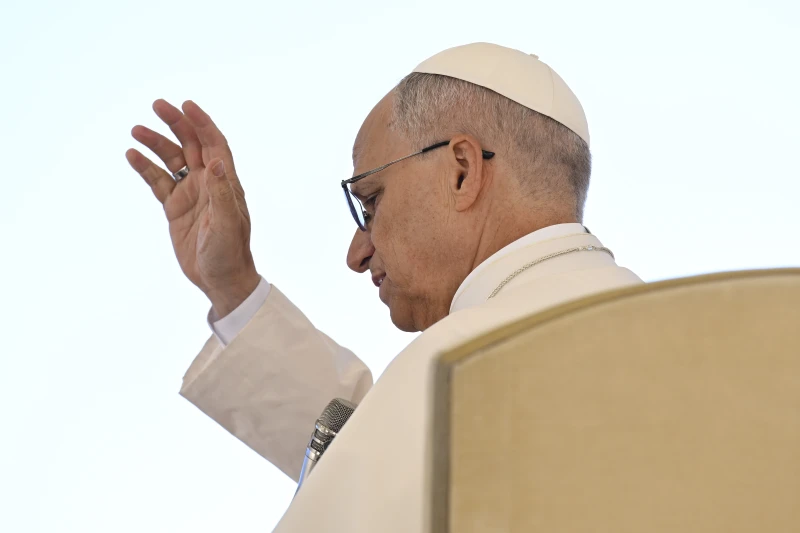
 Pope Leo XIV blesses pilgrims in St. Peter’s Square during an audience for the Jubilee of Hope on Oct. 4, 2025. / Credit: Vatican Media.
Vatican City, Oct 9, 2025 / 06:01 am (CNA).
In the first major document of his pontificate, Pope Leo XIV writes that the poor are not only objects of charity, but evangelists who can prompt us to conversion through their example of weakness and reliance on God.
“The poor can act as silent teachers for us, making us conscious of our presumption and instilling within us a rightful spirit of humility,” Leo writes in Dilexi Te (“I have loved you”), released by the Vatican on Thursday. “The elderly, for example, by their physical frailty, remind us of our own fragility, even as we attempt to conceal it behind our apparent prosperity and outward appearance. The poor … remind us how uncertain and empty our seemingly safe and secure lives may be.”
The pontiff quotes his predecessor throughout the document, which was first drafted during the previous pontificate and draws heavily on Pope Francis’ first apostolic exhortation, Evangelii Gaudium, on the joy of the Gospel. An apostolic exhortation is one of the most authoritative genres of papal teaching, typically focused on the pastoral application of doctrine.
Christ’s whole life is an example of poverty, Leo writes, and the Church, if it wants to belong to Christ, must give the poor a privileged place.
“For Christians, the poor are not a sociological category, but the very ‘flesh’ of Christ,” he writes. “The Lord took on a flesh that hungers and thirsts, and experiences infirmity and imprisonment.”
Inherited from Pope Francis
Leo signed the exhortation on Oct. 4, the feast of St. Francis of Assisi, who is traditionally known as Il Poverello (“the Little Poor Man”).
The pontiff explains at the beginning of the document that he received it as an inheritance from Pope Francis, who was working on it during the final months of his life.
The document traces the Church’s perennial teaching on the poor, drawing on the Old and New Testaments, the practice of the early Christian community, the writings of Church Fathers and Doctors, the lives of the saints, the documents of the Second Vatican Council, and the magisterium of the popes since St. John XXIII.
Leo also commends the example of contemplative and active religious orders throughout history that have helped the poor with healthcare, food, shelter, and education.
“Every movement of renewal within the Church has always been a preferential concern for the poor. In this sense, her work with the poor differs in its inspiration and method from the work carried out by any other humanitarian organization,” he writes.
Technological progress has not eradicated poverty, which only continues to appear in diverse forms, the pope writes. He defines the poor to include the incarcerated, victims of sexual exploitation, those affected by the degradation of the environment, and immigrants.
“The Church, like a mother, accompanies those who are walking. Where the world sees threats, she sees children; where walls are built, she builds bridges,” he says. “And she knows that in every rejected migrant, it is Christ himself who knocks at the door of the community.”
Lack of material and spiritual care
Leo denounces prejudices that he says can lead Christians to neglect their duty to the poor.
“There are those who say: ‘Our task is to pray and teach sound doctrine’ [and argue] that it is the government’s job to care for [the poor], or that it would be better not to lift them out of their poverty but simply to teach them to work,” he writes.
Sometimes “pseudo-scientific data are invoked to support the claim that a free-market economy will automatically solve the problem of poverty,” or that the rich can enact more effective solutions, the pope writes.
Leo condemns such views as worldly and superficial, and “devoid of any supernatural light.”
Dilexi Te also emphasizes the spiritual needs of the poor, arguing that those are more important than the material, yet often ignored by the Church.
It is not a question of “providing for welfare assistance and working to ensure social justice. Christians should also be aware of another form of inconsistency in the way they treat the poor. In reality, “the worst discrimination which the poor suffer is the lack of spiritual care,’” the pope writes, quoting Pope Francis.
Leo ends his exhortation by emphasizing the duty of almsgiving, which he claims has fallen out of fashion, even among believers.
“Almsgiving, however modest, brings a touch of pietas [“piety”] into a society otherwise marked by the frenetic pursuit of personal gain,” he says, adding that, though it will not be the solution to poverty in the world, it will touch our hearts.
“Our love and our deepest convictions need to be continually cultivated, and we do so through our concrete actions,” he continues. “Remaining in the realm of ideas and theories, while failing to give them expression through frequent and practical acts of charity, will eventually cause even our most cherished hopes and aspirations to weaken and fade away. For this very reason, we Christians must not abandon almsgiving. It can be done in different ways, and surely more effectively, but it must continue to be done. It is always better at least to do something rather than nothing.”
[…]




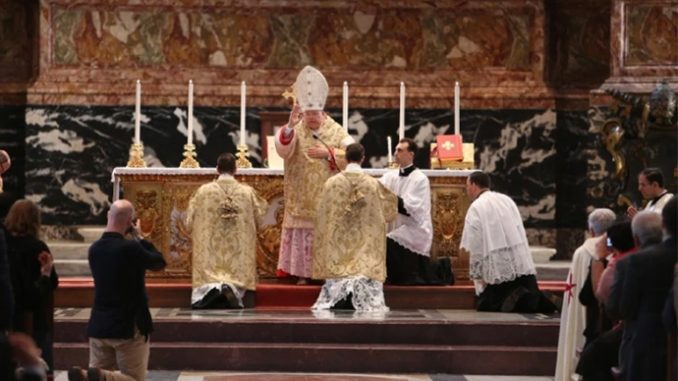


These small blessings bring gratitude for the opportunity to celebrate the Latin Mass once again at St. Peter’s. However, it is disheartening that such a thing should be viewed as an event for which we must feel so grateful — a return to a tradition upheld for nearly 1800 years.
Michael, you forget that tradition now means whatever has been believed and practiced only for the last 50 years.
Michael, you forget that tradition now means whatever has been believed and practiced only for the last 50 years.
This permission should not have been granted. The aim ought to be to completely phase out the use of the preconciliar liturgy, not to prolong its use and certainly not to encourage its growth.
The Roman Church is liturgically and ecclesiologically incoherent in its practice.
Ergo, Seabass, also sprach Zarathustra.
Pronouncing such judgment on the church, you make yourself a heathen and a slave like Onesimus, thinking you know more than the Church by defrauding your Christian master. May you find yourself an apostle like Paul. He can reset your thoughts to True.
The Church is universal & catholic, within which there are many Rites & liturgies.
It’s all good.
This is a good sign.
Habemus Papam
While I do not participate in Mass in Latin, I want it available for those who love this liturgy. As Catholics we have room for all.
As Catholics, we should accept the liturgical reform mandated by the bishops at Vatican II. That entails putting the 1962 Missal behind us and only celebrating the reformed Mass. If the reformed Mass were celebrated more in accord with tradition — including the Latin language and Gregorian chant — I believe well over 90% of the tiny subset of Catholics who say they prefer the TLM would accept that way of celebrating the reformed Mass and attend it. For the vast majority of TLMers, they are seeking a traditional, reverent liturgical aesthetic at Mass, not the 1962 Missal itself. That’s how the reformed Mass ought to be celebrated anyway: in accord with liturgical tradition.
So is the Mass celebrated by most Catholics today actually in conformity with what the conciliar documents (SC, etc) really say? This is a double-edge sword, but the fixation is always on those who prefer the “traditional” form. Once again, I’m quite thankful that I’ve been in an Eastern Catholic parish for most of my Catholic life.
To your question, the way the reformed Mass is celebrated in the typical American parish is inept, in my judgment, and does not conform to the Church’s liturgical norms nor does it accord with liturgical tradition.
I understand why the trads want the TLM: because the celebration of the reformed Mass is so embarrassingly awful in 99% of Catholic parishes. The solution is to correct the liturgical abuses and poor celebrations of the reformed Mass in parishes, not to retreat into the preconciliar form of the Mass in liturgical enclaves of traditionalism.
By maintaining the use of the 1962 Missal alongside the reformed Mass, the Roman Church is liturgically schizophrenic.
Preferring and attending the TLM is not a retreat into a preconciliar form or enclave. The TLM reverently and ritually commemorates the sacrifice of Christ’s passion without room for liturgical novelty or debased experimentation.
The Church is not liturgically schizophrenic in allowing use of both forms. Based as it is upon the TLM, the NO’s precursor, foundation, history, meaning, and rubrical model is the TLM.
Seeing the Church’s use of both forms as schizophrenic reflects a want of wisdom and a rigidity in want of charity.
Sebastian: I have the opportunity to celebrate the Holy Mass in churches frequently in three different states and in no way are they “embarrassing awful “ in any of these churches. How much have you been around, and where do you come up with your 99 %?
Carl, two of my cousins and their families recently started attending the Eastern Orthodox Church. I believe Pope Francis was a step too far for them, so they decided to leave. While I understood their choice, it still made me sad. When they explained their reasons for leaving, I found myself without a response.
Mr Olson, I totally agree with you. I too am grateful to be part of a Byzantine Rite parish. Just pure old-world style liturgical services without wars.
Will that Mass at St. Peter’s by Cardinal Burke be with or without James Martin’s parade of homosexual activists?
The Pope met with BOTH Burke and Martin. A good sign I would think.
Br. Jaques, we have come to expect your foolish sentimentality here. You seem to struggle with discriminating between good and evil.
May the Lord forgive disdain against LGBT. Our Lord died for all of his children. Arrogance, like it’s cousin pride. Does nothing to build the body of Christ. It is a poverty to show contempt to brothers and sisters in Christ. So that you might live as you wish.
Pray for the unity of Christendom.
It’s not a disdain against individuals but about Church teaching regarding acting on disordered attractions.
Joe, you seem to have a perverse notion of the moral good; you confuse/invert evil for the good. Come to your senses, man.
If I thought the TLM would bring peace to our world, I would kneel during the whole Mass. As it is, I settle for making my heart kneel before God.
Love God more than Rubrics; Burke is power hungary;
Please explain, Sister, how celebrating Mass at the Vatican is evidence of being “power hungary”. I await your cogent presentation of the matter.
Doubtful she’ll respond to you Carl if she’s one of those “nuns out of uniform.”
Clearly the holy nun (or is it “none”?) is referring to Hungary’s Cardinal Erdo and the future day when he gains further influence in the perennial Catholic Church, as when he introduced the second session of the Synod on the Family, offering this self-evident insight: “There are absolutely no grounds for considering homosexual unions to be in any way similar or even remotely analogous to God’s plan for marriage and family.” (Section III:3, below).
https://www.catholicnewsagency.com/news/32772/full-text-of-cardinal-erdos-introductory-report-for-the-synod-on-the-family
Respectfully Sister, Cardinal Burke has always struck me as a very humble & lovely man.
Hungry, not Hungary.
Typical ‘Nun on the Bus’ sort of comment.
To James Connor above who wrote: “Sebastian: I have the opportunity to celebrate the Holy Mass in churches frequently in three different states and in no way are they “embarrassing awful “ in any of these churches. How much have you been around, and where do you come up with your 99 %?”
Father O’Connor, when you celebrate Mass, do you ONLY say the Black and DO the Red, with no deviations whatsoever? Let’s hope so.