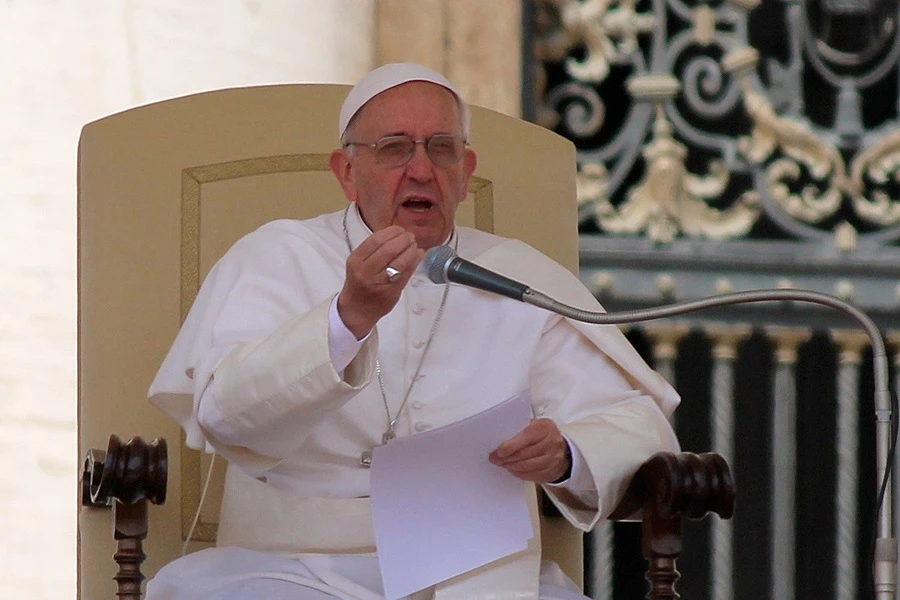
Vatican City, Feb 1, 2018 / 10:26 am (CNA).- Pope Francis in his latest prayer video places a spotlight on the problem of corruption, saying that it is the root of most societal evils and praying that those in power would be able to resist its allure.
The video, released Feb. 1, opens with the dramatic image of a young girl with a dirty face and clothes holding an infant, and who appears to be part of a group of migrants or refugees.
This image is followed by a series of others showing child laborers and buildings destroyed by bombs as the Pope speaks in his native Spanish, asking, “What is at the root of slavery, unemployment and disregard for nature and goods held in common?”
As the music transitions to the sound of shattering glass, the Pope says the answer is “corruption,” which he describes as “a process of death that feeds the culture of death.” This, he says, is “because the thirst for power and possessions knows no limits.”
The screen, showing an image of a prostitute soliciting customers, is dissolved and replaced by an image of a beach filled with waste, which in turn is followed by an image of an Italian monument commemorating the 1992 “Strage di Capaci,” referring to a massacre in which Sicilian mafia branch Cosa Nostra killed anti-mafia judge Giovanni Falconi, his wife and their three bodyguards.
This image is then replaced by someone opening a briefcase of money and passing a handful to another person behind his back.
“Corruption,” Francis says, “is not countered with silence. We must speak about it, denounce its evils and try to understand it so as to show our resolve to make mercy reign over meanness, beauty over nothingness.”
As he speaks, images of nature, the Pieta and the Sistine Chapel are shown. Francis then closes his video asking viewers to join him in praying “that those who have material, political or spiritual power may resist any lure of corruption.”
Corruption is one of the topics Pope Francis has been most outspoken about since the beginning of his papacy almost five years ago, saying in one 2016 general audience that to be corrupt “is to become a follower of the devil, the father of lies.”
He recently returned to the topic during his Jan. 18-21 visit to Peru, which is one of several Latin American countries to be hit with a wide-scale corruption scandal involving several of their former presidents, and accusations against sitting President, Pedro Pablo Kuczynski Godard.
In his address to diplomats and civil authorities, the Pope said Peru is a country that has a lot of hope, but warned that “a shadow is growing” through corruption that could smother the potential to do good.
Corruption “increasingly contaminates the whole system of life,” he said.
In a forward for “Corrosion,” a book-length interview of Cardinal Peter Turkson published in June 2017, Pope Francis said corruption is a “cancer that (burdens) our lives.”
He said phenomena such as exploitation, human trafficking, weapon and drug trafficking, social injustices, slavery, unemployment, and carelessness for nature can all be traced back to corruption, which is “a profound cultural question that needs to be addressed.”
And the Church, he said, “must listen, raise herself and bend herself on the sorrows and hopes of people according to mercy, and must do so without fear of purifying herself, assiduously seeking a way to improve.”
An initiative of the Jesuit-run global prayer network Apostleship of Prayer, the Pope’s prayer videos are filmed in collaboration with Vatican Media and Argentinian marketing association La Machi.
The Apostleship of Prayer, which produces the monthly videos on the Pope’s intentions, was founded by Jesuit seminarians in France in 1884 to encourage Christians to serve God and others through prayer, particularly for the needs of the Church.
Since the late 1800s, the organization has received a monthly, universal intention from the Pope. In 1929, an additional missionary intention was added by the Holy Father, aimed at the faithful in particular.
However, as of last year, rather than including a missionary intention, Pope Francis opted to have only one prepared prayer intention – the universal intention featured in the prayer video – and will add a second intention for an urgent or immediate need should one arise.
In a press release for the new video, Cardinal Turkson, prefect of the Dicastery for Promoting Integral Human Development, said “we shouldn’t speak about resolving the issue of corruption in theory.” Rather, “we should confront corruption in every sector. It is the poor who pay for the parties of the corrupt.”
According to the release, the video is the latest in a series of initiatives from the dicastery aimed at drawing attention to the worldwide problem of corruption.
Among these initiatives was a June 15, 2017 conference on corruption that coincided with the release of Turkson’s book. The dicastery will also be hosting a conference on corruption in Naples Feb. 3, where the Pope’s prayer video will be shown.
 […]
[…]



From the back bleachers, yours truly humbly proposes that “a balanced synthesis between the laws of God and the dynamics of man’s conscience and freedom” respects the immutable and inviolable moral absolutes against intrinsically evil acts, as elaborated in “Veritatis Splendor,” combined with exercise of the moral virtues for matters which are not absolute.
Two points:
FIRST, with regard to such moral absolutes along with God’s infinite mercy, “…the commandment of love of God and neighbor does not have in its dynamic any higher limit, BUT (Caps added) it does have a lower limit, beneath which the commandment is broken” (n. 52).
SECOND, regarding other and more problematic matters, still governed still by the moral virtues (courage, temperance, justice and especially prudential judgment), and mostly the responsibility of those directly accountable for the common good, we can turn to the Catholic Social Teaching as synthesized, already, in “The Compendium” (2004). And, which might be organized to better effect into, first, the always central “transcendent dignity of the human person” and then, second, the following binaries:
(1) Solidarity & Subsidiarity, always together; (2) Dignity of the human Person & Family; (3) Rights & Responsibilities; (4) well-formed Conscience & faithful Citizenship; (5) Option for the Poor & the dignity of Work; (6) Personal Property & intergenerational care for God’s Creation.
SUMMARY: Town hall “synodality” is not enough, and Cardinal Fernandez (Fiducia Supplicans) is too much.
A balanced synthesis . . ? Hopefully an error in translation of the Pope’s words.
Isn’t this universe, world, & our human species (according to The New Testament witness) subject to the Stoikheia – that is the tenant Principalities, Powers, Dominions, Rulers, Authorities, Governments, & Thrones that reject GOD’s authority, self-identifying as “a whole host of evil in high places”.
Aren’t The Church’s many problems caused by melding with these intrinsic evils?
Isn’t the Christ-given work of The Church to confront ‘the ways of the world & its prince’ with our Holy Spirit-anointed radical obedience to & our persevering proclamation of GOD’s holy commandments; whilst not counting the cost . . ?
Now, that’s a challenge young Catholics will respond to – if given half a chance!
“Be calm but vigilant, because your enemy the devil is prowling round like a roaring lion, looking for someone to eat.”
“Think of the love that The FATHER has lavished on us, by letting us be called GOD’s children; and that is what we
A balanced synthesis . . ? Hopefully an error in translation of the Pope’s words.
Isn’t this universe, world, & our human species (according to The New Testament witness) subject to the Stoikheia – that is the tenant Principalities, Powers, Dominions, Rulers, Authorities, Governments, & Thrones that reject GOD’s authority, self-identifying as “a whole host of evil in high places”.
Aren’t The Church’s many problems caused by melding with these intrinsic evils?
Isn’t the Christ-given work of The Church to confront ‘the ways of the world & its prince’ with our Holy Spirit-anointed radical obedience to & our persevering proclamation of GOD’s holy commandments; whilst not counting the cost . . ?
Now, that’s a challenge young Catholics will respond to – if given half a chance!
“Be calm but vigilant, because your enemy the devil is prowling round like a roaring lion, looking for someone to eat.”
“Think of the love that The FATHER has lavished on us, by letting us be called GOD’s children; and that is what we are. Because the world refused to acknowledge Him, therefore it does not acknowledge us.”
“No created thing can hide from Him; everything is uncovered & open to the eyes of The One who to whom we must give an account of ourselves.”
“A balanced synthesis?”
About a year ago a friend thought to balance my bookshelf by unloading seven volumes of the complete works of St. Alphonsus de Liguori (1926!), lifted many years ago from a real pastor who passed away in 1988. I need to spend some time with this…
Thinking about “God’s mercy” and turning almost randomly to Part I of “The Way of Salvation and of Perfection,” we find many dozens of Meditations, including VIII: “The abuse of God’s Mercy”:
The reader is counseled to avoid both despair and presumption [….]. Second, “God is merciful, but he is also just [….]. Then third, “God is not mocked [….] The hope of those who commit sin because God is forgiving, is an abomination in his sight: their hope, says the holy Job, is an abomination [much in italics].”
Any “synthesis” conforming to “the spirit of St. Alphonsus Maria de’ Liguori” will be a daunting and sobering task, given the 3,000 pages of unambiguous fine print such as this.
SUMMARY: Not much here on “time is greater than space.”
A presumption there is a synthesis. If we’re addressing Hegel’s thesis antithesis synthesis it’s argued that Hegel does not give evidence of using the formula in any of his works (see Leonard F Wheat in Undiscovered Thesis-Antithesis-Synthesis Dialectics).
Intelligence in Man is not distinguished by level rather by kind. Among animal species only man can make the following comparative distinctions: 1. universal and particular 2. one and many 3. union and separation 4. essence and existence 5. divine and human 6. inner and outer 7. in itself and for itself 8. potential and actual 9. unconscious and conscious 10. artificial [man-made] and natural 11. God and man. 12. Father and Son Jesus (Wheat).
The proposition of synthesis poses a presumption these appositional parings can be synthesized. Except for the Father and Son Jesus. If we take a moral principle [principle here replaces absolute] can we modify it to satisfy its opposite and retain a morally acceptable compromise? For example communion for divorced and remarried. If using Amoris Laetitia as a guide can we retain the precept Adultery and allow communion – even if based on mitigating circumstances? Is that not accommodation rather than synthesis?
It seems Pope Leo’s premise “balanced synthesis’ between God’s law, human freedom” cannot satisfy both principle/precept and freedom. A solution is found when it’s shown as given the example of Alphonsus Ligouri that a famished man secretly taking fruit from someone’s orchard is not stealing because life or death presents a right. Whereas taking another man’s wife for sensual fulfillment presents an evil. The natural law that undergirds our conscience tells us that.
Leo XIV has made a terrible decision to open up doctrinal moral principles for discussion in reaching a synthesis with human freedom – in a regional Bogotá setting attended by a cadre of Redemptorist lecturers, professors from Columbia, a handful from elsewhere – with immense repercussions [particularly doctrinal fragmentation] for the universal Church.
Leo, a canon lawyer, must be aware that what occurs regionally by a group of unknowns [despite the heady title International Congress of Theologians] with his papal sanction will be taken elsewhere as the rule or at least the option, and for other such regional discussion of doctrine.
Hegel, when addressing thesis antithesis synthesis, theorized these dynamics in reference to the history of nations and cultures. Not to definitive moral principles.
These secular philosophers also know their ruminations including dialectics are taken as rules and options for other things beyond the initial application.
Becoming popularized or well spread it takes on bulk or immenseness sometimes personalized or “authored” and in general through “autonomous” anonymity.
Thanks, dear Fr Dr Peter Morello for illuminating what appears to be yet another crafty scheme to deceive & manipulate The Church towards blatant denial of GOD’s strict but benevolent instructions, that enable us to live a life of Grace.
Ps 118 “How shall we remain sinless? By obeying Your Word.”
“I have sought You with all my heart: let me not stray from Your commands”
“I treasure Your promise in my heart, lest I sin against You.”
“Blessed are You, O LORD, teach me Your statutes.”
Not to dismiss your analysis–which applies especially to the past twelve years–my proposition is that a synthesis of the Hegelian vintage is not possible if attempted within the spirit of St. Alphonsus Maria de Liguori. Which is why I used the terms “daunting and sobering.”
Thomists celebrate Aquinas’ “synthesis” of Faith and Reason, and this direction is clearly not Hegelian. With you, I would prefer if Leo XIV had used the better term “coherence” instead of synthesis, which was preferred by Benedict XVI.
A Hegelian outcome would/will (?) be out of step with Liguori. That’s my point–a not-entirely-subtle invitation for theologians to consider that what the magisterium upholds about God and human freedom is not “rigid, bigoted, fixistic and backwardist.”
Agreed.
Although Peter, Faith and Reason cohesive by nature [as God ordained] are not two opposing premises. God’s Law and human freedom are opposed. Unless we attribute freedom to following God’s Law. Which is not a true synthesis. The phrasing by Leo XIV means freedom from God’s Law.
Although Peter, Faith and Reason cohesive by nature [as God ordained] are not two opposing premises. God’s Law and human freedom are opposed. Unless we attribute freedom to following God’s Law. Which is not a true synthesis. The phrasing by Leo XIV means freedom from God’s Law.
Faith is a gift. Reason a natural faculty. Neither are opposed although differ, both compliment the other.
“God’s Law and human freedom are opposed”?
“It follows that the authority of the Church, when she pronounces on moral questions, in no way undermines the freedom of conscience of Christians. This is so not only because freedom of conscience is never freedom ‘from’ the truth [!] but always and only freedom ‘in’ the truth [!], but also because the Magisterium does not bring to the Christian conscience truths which are extraneous to it; rather it brings to light the truths which it ought already to possess, developing them from the starting point of the primordial act of faith” (St. John Paul II, “Veritatis Splendor,” 1993, n. 64).
“God’s Law and human freedom are opposed. Unless we attribute freedom to following God’s Law”.
By ordained nature the will is not opposed to God’s law. By tendency due to original sin it is opposed.
Jesus Christ is the balance between the laws of God and the dynamics of man’s conscience and freedom.
“It brings to light the truths which it ought already to possess, developing them from the starting point of the primordial act of faith” (St. John Paul II, “Veritatis Splendor,” 1993, n. 64).
John Paul is not precise in this diagram in reference to the natural law within, that prescient knowledge that all men possess realized in the act of apprehension of good from evil. ‘We do not require grace to apprehend this law within’, which law is a reflection of the divine law. That is why all men are subject to judgment if they commit intrinsically evil sin. It is this natural law that undergirds conscience. Insofar as freedom it belongs to the will. Which is why Aquinas holds, evil is in the will.
Faith enlightens the intellect regarding natural law and strengthens the will to observe the law. Whereas revealed knowledge of heroic virtue required for salvation are not found by reason, rather they are gifts of the Holy Spirit, knowledge of which and adherence by grace surpass Man’s natural capacity.
A correction to “John Paul is not precise in this diagram”. John Paul is likely focused on the baptized who are certainly recipients of grace at baptism, and other non baptized to whom God wishes to confer grace – all of whom would be subject “to [the] light [of] truths which it ought already to possess, developing them from the starting point of the primordial act of faith”.
“Balanced synthesis”? The corruptions going on in liturgy said to be according to VATICAN II the pastoral Council, are not pastoral.
At least, this sounds properly Papal –
‘The interview appears in the Spanish-language book “León XIV: ciudadano del mundo, misionero del siglo XXI” (“Leo XIV: Citizen of the World, Missionary of the XXI Century”), a biography by Crux correspondent Elise Ann Allen, published on Sept. 18 in Spanish by Penguin Peru. English and Portuguese editions are expected in 2026.
In the book, Pope Leo, a longtime missionary in Peru before he was pope, underlines that the Church’s primary mission remains spiritual, not political.
“My role is announcing the good news, preaching the Gospel,” he said. “I don’t see my primary role as trying to be the solver of the world’s problems. I don’t see my role as that at all, really, although I think that the Church has a voice, a message that needs to continue to be preached, to be spoken and spoken loudly.”’