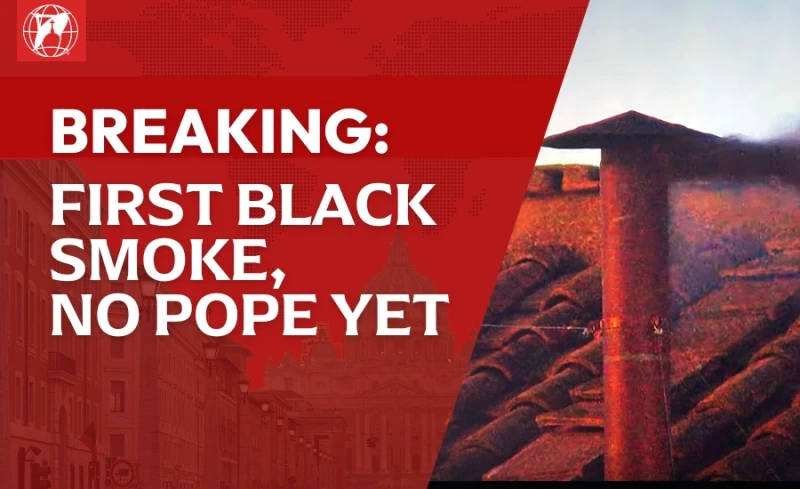
Black smoke billows from the chimney of the Sistine Chapel on May 7, 2025, indicating no pope has been chosen yet. / Credit: EWTN News
Vatican City, May 7, 2025 / 15:09 pm (CNA).
Black smoke billowed from the Sistine Chapel chimney Wednesday evening to the watchful eyes of pilgrims gathered in St. Peter’s Square as the first day of conclave voting concluded without a new pontiff.
The dark plume emerged at approximately 9 p.m. Rome time, confirming the 133 cardinal electors sequestered inside had not reached the required two-thirds majority — at least 89 votes — needed to elect Pope Francis’ successor.
The College of Cardinals began their deliberations earlier Wednesday following the “Pro Eligendo Romano Pontifice” (“For the Election of the Roman Pontiff”) Mass celebrated in St. Peter’s Basilica.
Cardinal Giovanni Battista Re, dean of the College of Cardinals, presided over the liturgy that officially opened the conclave proceedings.
Shortly thereafter, the cardinal electors processed into the Sistine Chapel.
The cardinals will return to the Sistine Chapel Thursday morning for two voting sessions before noon (Rome time) and two more in the afternoon. With each inconclusive ballot, smoke from burnt voting papers will continue to emerge black until the moment a new pope is elected.
When a candidate secures the necessary votes, white smoke will signal to the world that the Catholic Church has a new shepherd.
Cardinal Dominique Mamberti, the senior cardinal deacon, will then appear on the central loggia of St. Peter’s Basilica to make the traditional “Habemus papam” announcement, revealing the identity of the 266th successor to St. Peter.
During the 12 general congregations leading up to the conclave, cardinals identified several key challenges facing the Church, including evangelization, vocations, sexual abuse, Vatican finances, synodality, and global conflicts.
If you value the news and views Catholic World Report provides, please consider donating to support our efforts. Your contribution will help us continue to make CWR available to all readers worldwide for free, without a subscription. Thank you for your generosity!
Click here for more information on donating to CWR. Click here to sign up for our newsletter.
Pope Francis speaking on St. Peter’s Square, Vatican, Oct. 12, 2022 / Daniel Ibáñez / CNA
Rome Newsroom, Oct 12, 2022 / 03:35 am (CNA).
At his public audience on Wednesday, Pope Francis spoke about the role desire plays in spiritual discernment, comparing it to a compass that points one in the right direction.
“Desire is not the craving of the moment. No. The Italian word, desiderio, comes from a very beautiful Latin term, desidus, literally ‘the lack of the star,’” Pope Francis said in St. Peter’s Square on Oct. 12.
“Desire is ‘the lack of the star,’ of the reference point that orients the path of life,” he continued. “It evokes a suffering, a lack, and at the same time a tension to reach the good that is missing.”
Pope Francis greeting pilgrims on St. Peter’s Square, Oct. 12, 2022. Daniel Ibáñez / CNA
On Aug. 31, Francis began a series of weekly catecheses, or messages, on discernment, which he described as “an exercise of intelligence, and also of skill and also of will, to seize the opportune moment” in order to make a good choice about one’s life.
“Desire, then,” he said in the live-streamed address on Wednesday, “is the compass to understand where I am and where I am going. Actually, it is the compass for whether I am standing still or going.”
Pope Francis addressed how someone can recognize desire within themselves in his message. “A sincere desire,” he said, “knows how to touch deeply the chords of our being, which is why it is not extinguished in the face of difficulties or setbacks.”
“Unlike a momentary craving or emotion, desire lasts through time, even a long time,” he explained.
General audience on St. Peter’s Square, Oct. 12, 2022. Daniel Ibáñez / CNA
Pope Francis pointed to some of the pitfalls to knowing the desires of one’s heart; for example, society’s promotion of “the maximum freedom of choice,” while those “choices” are mostly reduced to just what is wanted most in the moment, not what will truly satisfy over the long term.
“We are bombarded by a thousand proposals, projects, possibilities, which risk distracting us and not permitting us to calmly evaluate what we really want,” the pope said, adding that many people go around “with their cell phones in their hands and they are searching, looking,” but never stopping to think or reflect.
“Desire cannot grow like that,” he said. “You live in the moment, satiated in the moment, and desire does not grow.”
Francis said that distraction can cause people a lot of suffering “because they do not know what they want from their lives; they have probably never got in touch with their deepest desire.”
Another pitfall the pope mentioned was the knowledge that one wants to do something but never actually takes action.
“And so certain changes, though desired in theory, when the opportunity arises are never implemented,” he said.
“Often,” he said, “it is indeed desire that makes the difference between a successful, coherent and lasting project, and the thousands of wishes and good intentions with which, as they say, ‘hell is paved with.’”
The moon was visible over St. Peter’s Basilica, Vatican, on the morning of Oct. 12. 2022. Daniel Ibáñez / CNA
He recalled that Jesus, before performing a miracle, often questions a person about his or her desires, like he does with the paralytic at the pool of Bethesda in chapter five of the Gospel of John.
“Jesus asks him: ‘Do you want to be well?’ How come?” the pope said.
He explained that “Jesus’ question was an invitation to bring clarity to his heart, to welcome a possible leap forward: to no longer think of himself and his own life ‘as a paralytic,’ transported by others. … By engaging in dialogue with the Lord, we learn to understand what we truly want from life.”
The paralytic, he continued, is an “example of people [who say,] ‘Yes, yes, I want, I want,’” but in the end, never do anything.
Instead of taking action, we find excuses or complain: “But be careful,” he said, because “complaints are a poison, a poison to the soul, a poison to life because they don’t make you grow the desire to move forward.”
“If the Lord were to ask us, today, the question he asked the blind man in Jericho: ‘What do you want me to do for you?’ how would we answer?” the pope said. “Perhaps we could finally ask him to help us know his deepest desire, that God himself has placed in our heart.”
Washington, D.C. Newsroom, Jul 11, 2022 / 20:18 pm (CNA).
A bogus Twitter account using the name of Georg Bätzing, the head of the German Bishops’ Conference… […]
Pope Francis meets members of the First Nations at the Vatican on March 31, 2022. / Vatican Media
Vatican City, May 13, 2022 / 04:15 am (CNA).
The Vatican confirmed on Friday that Pope Francis will visit three cities in Canada during the last w… […]
Leave a Reply
