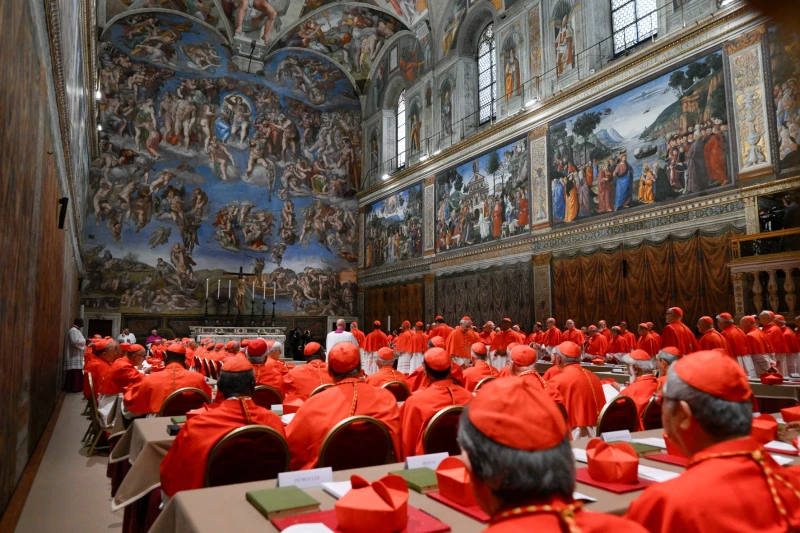
Cardinals prepare to begin the conclave to elect a new pope in the Sistine Chapel on May 7, 2025. / Credit: Vatican Media
Vatican City, May 7, 2025 / 15:44 pm (CNA).
As the conclave gets underway, all eyes turn to the small chimney atop the Sistine Chapel. From this simple metal tube will emerge the long-awaited white smoke that will announce the election of the new pope.
Black smoke billowed from the Sistine Chapel chimney Wednesday evening to the watchful eyes of pilgrims gathered in St. Peter’s Square as the first day of conclave voting concluded without a new pontiff.
Beginning Thursday, the cardinals will hold four votes each day: two in the morning and two in the afternoon. Each round of votes is followed by smoke from the chimney, which will be black if still no agreement has been reached, or white if the new pontiff has been elected.
If the new pope is not elected on the first morning ballot, a second ballot is held immediately. Both ballots are burned together, leading to possible smoke around noon Rome time. If, however, the pope is elected on the first morning ballot, the white smoke will appear shortly after 10:30 a.m.
The same process is repeated in the afternoon. After a brief break, two more votes will be held. If neither is conclusive, the smoke is expected around 7 p.m. Rome time. However, if the pope is elected on the first ballot of the afternoon, white smoke would be seen shortly after 5:30 p.m.
Thus, on both Thursday and Friday, observers should be alert for four possible times when the smoke may appear each day: two around noon and two in the evening.
The smoke is produced by burning the ballot of every cardinal along with chemical compounds that make the smoke black or white. After white smoke appears, the bells of St. Peter’s will ring loudly to confirm the awaited announcement: “Habemus papam!” (“We have a pope!”).
This story was first published by ACI Prensa, CNA’s Spanish-language news partner. It has been translated and adapted by CNA.
If you value the news and views Catholic World Report provides, please consider donating to support our efforts. Your contribution will help us continue to make CWR available to all readers worldwide for free, without a subscription. Thank you for your generosity!
Click here for more information on donating to CWR. Click here to sign up for our newsletter.
Pope Francis meets with Father Federico Lombardi, president of the Ratzinger Foundation and Vatican spokesman during Pope Benedict XVI’s pontificate (left), and the 2023 Ratzinger Prize recipients Father Pablo Blanco Sarto (center) and Professor… […]
Pope Francis waves to crowds gathered in St. Peter’s Square on June 19, 2022, on Corpus Christi Sunday. / Vatican Media
Denver Newsroom, Jun 19, 2022 / 09:56 am (CNA).
The Feast of Corpus Christi is a time for Christians to remember that God will meet their basic needs to eat and to be filled with the joy and amazement of receiving loving nourishment from Jesus Christ, Pope Francis said Sunday.
At the same time, the pope emphasized, the Eucharist must also move Christians to action.
“We can evaluate our Eucharistic Adoration when we take care of our neighbor like Jesus does,” the pope said Sunday before the recitation of the Angelus at St. Peter’s Square in Rome.
“There is hunger for food around us, but also for companionship; there is hunger for consolation, friendship, good humor; there is hunger for attention, there is hunger to be evangelized. We find this in the Eucharistic Bread — the attention of Christ to our needs and the invitation to do the same toward those who are beside us. We need to eat and feed others.”
The pope’s remarks reflected on Sunday’s Gospel reading, the miracle of the multiplication of the loaves and fishes from the Gospel of Luke.
The pope linked the reading to the institution of the Eucharist at the Last Supper. The Eucharist was like “the destination of a journey along which Jesus had prefigured through several signs, above all the multiplication of the loaves narrated in the Gospel of today’s liturgy.”
The pontiff reflected on the manner of the miracle when Jesus fed so many who lacked food.
“The miracle of the loaves and fishes does not happen in a spectacular way, but almost secretly, like the wedding at Cana — the bread increases as it passes from hand to hand. And as the crowd eats, they realize that Jesus is taking care of everything,” said Pope Francis.
“This is the Lord present in the Eucharist. He calls us to be citizens of Heaven, but at the same time he takes into account the journey we have to face here on earth,” he said. “If I have hardly any bread in my sack, he knows and takes care of it himself.”
Thousands gather in St. Peter’s Square in Rome on June 19, 2022, to hear Pope Francis’ Angelus reflections. Vatican Media
The pope connected the tangible needs of food with the intangible needs of humankind.
“Sometimes there is the risk of confining the Eucharist to a vague, distant dimension, perhaps bright and perfumed with incense, but rather distant from the straits of everyday life. In reality, the Lord takes all our needs to heart, beginning with the most basic,” he said.
“In the Eucharist, everyone can experience this loving and concrete attention of the Lord. Those who receive the Body and Blood of Christ with faith not only eat, but are satisfied. To eat and to be satisfied: These are two basic necessities that are satisfied in the Eucharist,” he added. “The crowd is satisfied because of the abundance of food and also because of the joy and amazement of having received it from Jesus!”
Jesus Christ’s self-giving presence is key to understanding the Eucharist, the pope said.
“We certainly need to nourish ourselves, but we also need to be satisfied, to know that the nourishment is given to us out of love. In the Body and Blood of Christ, we find his presence, his life given for each of us. He not only gives us help to go forward, but he gives us himself — he makes himself our traveling companion, he enters into our affairs, he visits us when we are lonely, giving us back a sense of enthusiasm.”
“This satisfies us, when the Lord gives meaning to our life, our obscurities, our doubts; he sees the meaning, and this meaning that the Lord gives satisfies us,” the pope explained. Everyone is looking for the presence of the Lord, because “in the warmth of his presence, our lives change,” the pope added.
“Without him, everything would truly be gray,” he said. “Adoring the Body and Blood of Christ, let us ask him with our heart: ‘Lord, give me that daily bread to go forward, Lord, satisfy me with your presence!’”
The pope also prayed that the Virgin Mary may teach us “how to adore Jesus, living in the Eucharist and to share him with our brothers and sisters.”
Statements on Spanish martyrs, Ukraine war
After the Angelus, the pope discussed the Saturday beatification of Dominican religious who were killed in the Spanish Civil War.
“They were all killed in hatred of the faith in the religious persecution that took place in Spain in the context of the civil war of the last century,” the pope said, calling for applause for them. “Their witness of adherence to Christ and forgiveness for their killers show us the way to holiness and encourage us to make their lives an offering of love to God and their brothers and sisters.”
The conflict of Ukraine after the Russian invasion also was a point for prayer, the pope said: “Let us not forget the suffering of the Ukrainian people in this moment, a people who are suffering.”
“I would like you all to keep in mind a question: What am I doing today for the Ukrainian people? Do I pray? Am I doing something? Am I trying to understand? What am I doing today for the Ukrainian people? Each one of you, answer in your own heart,” he asked.
Prayers for Myanmar, World Meeting of Families
Pope Francis also lamented the violence in Myanmar, which has forced many to flee their homes and blocked them from meeting basic needs.
“I join the appeal of the bishops of that beloved land, that the international community does not forget the Burmese people, that human dignity and the right to life be respected, as well as places of worship, hospitals, and schools. And I bless the Burmese community in Italy, represented here today,” he said.
In early 2021 the Myanmar military seized power in the country. Its crackdown on opponents provoked a violent backlash. The U.N. High Commissioner for Refugees has said the conflict has displaced more than 800,000 people from their homes. Of these, 250,000 are children.
Pope Francis also noted that the 10th World Meeting of Families will begin June 22 in Rome and throughout the world. Around 2,000 Catholic families will gather in Rome this week to meet Pope Francis and hear talks on marriage and the faith.
“I thank the bishops, parish priests, and family pastoral workers who have called families to moments of reflection, celebration and festivity,” he said. “Above all, I thank the married couples and families who will bear witness to family love as a vocation and way to holiness. Have a good meeting!”
Vatican City, Sep 19, 2017 / 07:32 am (CNA/EWTN News).- On Tuesday Pope Francis issued a new motu proprio changing the legal status of the John Paul II Institute for Marriage and Family, making it a theological institute charged with studying marriage and the family from a scientific perspective.
The motu proprio, titled “Summa Familiae Cura,” meaning “Highest Care of Families,” was published Sept. 19 and officially established the John Paul II Theological Institute for the Sciences of Marriage and Family, replacing the former institute founded by John Paul II in 1981.
In the document, Francis noted that John Paul II made great strides in the area of the family, first of all with his 1980 Synod of Bishops on the topic and the subsequent publication of his post-synodal apostolic exhortation on the conclusions of the gathering, “Familiaris Consortio.”
He then established the Pontifical John Paul II Institute for Marriage and the Family in 1981 with the Apostolic Constitution “Magnum Matrimonii Sacramentum” in order develop the themes in his 1960 book “Love and Responsibility,” written when he was still Cardinal Wojtyla, and as well as the theology of the body he developed while Pope.
“Since then it has developed a profitable work of theological and pastoral education both in its central headquarters in Rome and in the territorial sections, present on all continents,” Francis said.
While the institute’s main headquarters remains in Rome, they have campuses all over the world, including Washington DC, Nigeria, Spain, Brazil, Mexico, India and South Korea, among others.
This path of development has continued, Francis said, with the recent 2014 and 2015 Synods of Bishops on the Family, which resulted in Pope Francis’ own apostolic exhortation “Amoris Laetitia,” published in 2015.
In the text, which was signed on the Sept. 8 Feast of the Nativity of Mary, the Pope said that in light of the new challenges families today face and increasing cultural changes, he wanted to establish the new entity so that the work of the John Paul II Institute for Marriage and Family can be “better known and appreciated in its fruitfulness and relevance.”
Francis said this is why he chose to make it a theological institute with a scientific perspective, “expanding the field of interest, both in terms of the new dimensions of the pastoral task and the ecclesial mission, as well as in the development of human sciences and the anthropological culture in such a crucial field for the culture of life.”
Composed of six articles, the motu proprio said the new John Paul II Theological Institute for the Sciences of Marriage and the Family, linked to the Pontifical Lateran University, will officially “substitute” the prior entity, annulling the 1981 constitution that established it.
However, Francis stressed that “the original inspiration” that led to the founding of the original institute will “continue to fertilize the vast field of engagement” of the new entity, “effectively contributing to make it fully correspond to the modern needs of the pastoral mission of the Church.”
The motu proprio stated that the new institute will be a “center of academic reference” on matters of scientific interest regarding marriage and the family, particularly on topics “connected with the fundamental alliance of man and woman for the care of generation and of creation.”
The new institute will be tied to the Congregation for Catholic Education, the Pontifical Academy for Life, and the dicastery for Laity Family and Life. It will also be required to adapt its structures to offer the necessary personnel, professors, programs and administrative staff needed to carry out its new task.
Students who attend the institute will now be able to obtain various degrees, including a Doctorate, Licentiate or diploma in the Sciences of Marriage and Family.
Although the statutes for the new institute still need to be defined, the leadership will remain the same, and will continue to be headed by the Institute’s Grand Chancellor, Archbishop Vincenzo Paglia, Chairman Msgr. Pierangelo Sequeri, and the entity’s Board of Directors.
Until new statutes are in place, the theological institute will temporarily be governed by the norms under which the previous institute operated.
In a Sept. 19 press breifing on the motu proprio, Archbishop Paglia said the decision to establish a completely new entity was due to the importance of the family today.
The two key aspects of the new institute, he said, are that it is now “theological” and “scientific.”
Adding “theological” to the title points to “the ecclesial dimension in its fullness, the moral perspective, the sacramental perspective, but the biblical and dogmatic perspective, the perspective of history, of law,” he said.
By adding “sciences,” Paglia said it gives the institute the ability to study and explore topics in the “entire realm of human studies,” including the sociological, anthropological and psychological view from a more scientific perspective.
He said Pope Francis’ 2015 post-synodal apostolic exhortation Amoris Laetitia will be new “magna carta” of-sorts for the institute, noting that Chapter 2 of the document is dedicated to the social and anthropological aspects of the family, while Chapter 4 is dedicated to scripture.
“The family, for Pope Francis, is not simply an abstract reality,” the archbishop said. “Families for Pope Francis are families who today must be helped and accompanied to rediscover their historical task, both in the Church and in society.”
Because of this, he said, there is a special link between the new motu proprio and the 2014 and 2015 Synod of Bishops on the Family.
In addition, he said faculty will not be cut, but rather expanded, bringing in new professors and experts to discuss themes relevant to the the Sciences of Marriage and Family, including those who aren’t Catholic.
Because it is a scientific entity and due to its link to the Pontifical Academy for Life, the institute “dialogues with everyone who reflects on this theme,” Paglia said, adding that “it clear that the dialogue with those who aren’t Catholic must be done.”
Leave a Reply