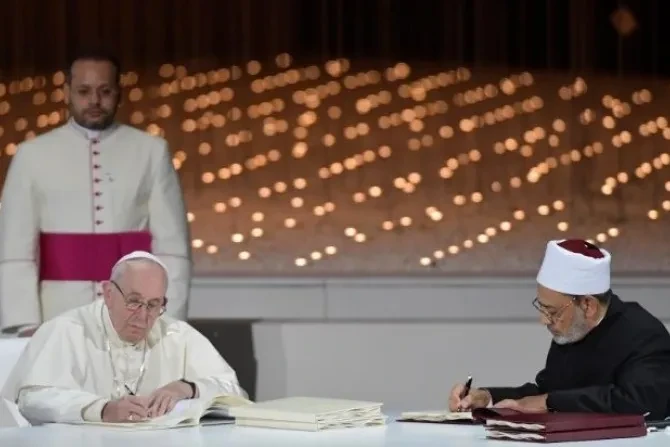
Pope Francis and Grand Imam Ahmed al-Tayeb sign the Document on Human Fraternity for World Peace and Living Together in 2019 . / Credit: Vatican Media
ACI MENA, Apr 26, 2025 / 09:00 am (CNA).
With the passing of Pope Francis, the world is reflecting on a pontificate marked by bold outreaches, including to the Islamic world, which was rooted in fraternity, humility, and a deep commitment to peace. How did the Holy Father view Islam and Muslim peoples during his time as pope? What is the position of the Islamic world toward him?
From the very beginning of his papacy in 2013, Pope Francis sought to build bridges with the Islamic world. This is a distinctly evangelical approach, following the example of Jesus, who, during his earthly life, deeply connected with those who differed from him and with people from outside his own environment.
Pope Francis, by placing great importance on Christian-Islamic communication, took his cues from the saint whose name he chose to bear: Francis of Assisi, who created channels of communication between East and West in times marked by violence and bloodshed — similar to those of our own day.
The pope also aligned himself with the Second Vatican Council, which called for open dialogue with Muslims. One example of this was his signing of the Document on Human Fraternity for World Peace and Living Together with the grand imam of Al-Azhar, Ahmed al-Tayeb, in the United Arab Emirates (UAE).
Over the course of his papacy, Francis visited 13 Muslim-majority countries — despite increasing health challenges and advanced age. These nations included Egypt, Iraq, the UAE, Bahrain, Turkey, Morocco, Bosnia and Herzegovina, Bangladesh, Jordan, Palestine, Azerbaijan, Kazakhstan, and Albania.
He brought to these visits a personality and pastoral style marked by humility, simplicity of life, closeness to people, and a desire to express love and fraternity with those he met. Examples of this include washing the feet of a Muslim woman and his quoting a Quranic verse on another occasion.
All of this has prompted the moderate Islamic world to reciprocate his love and cooperate with him in order to consolidate brotherhood among peoples and to work to achieve a better world characterized by understanding, mutual respect, and peace.
This story was first published by ACI MENA, CNA’s Arabic-language news partner. It has been translated and adapted by CNA.
If you value the news and views Catholic World Report provides, please consider donating to support our efforts. Your contribution will help us continue to make CWR available to all readers worldwide for free, without a subscription. Thank you for your generosity!
Click here for more information on donating to CWR. Click here to sign up for our newsletter.
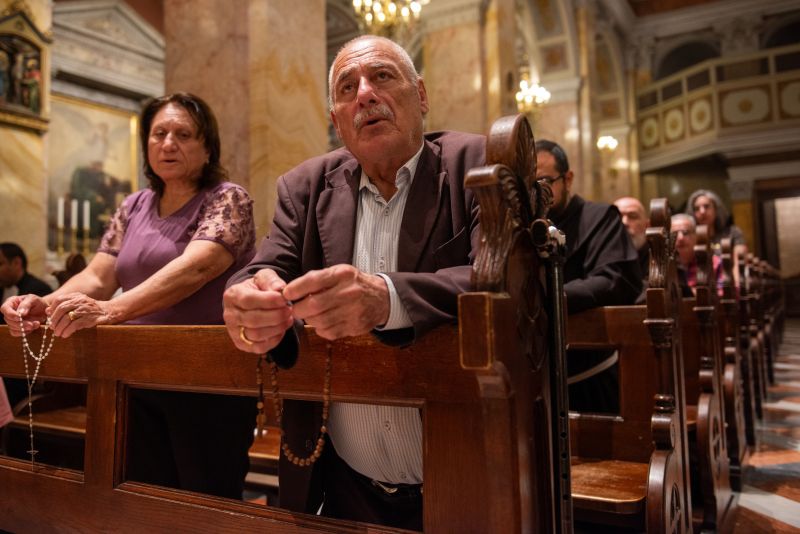
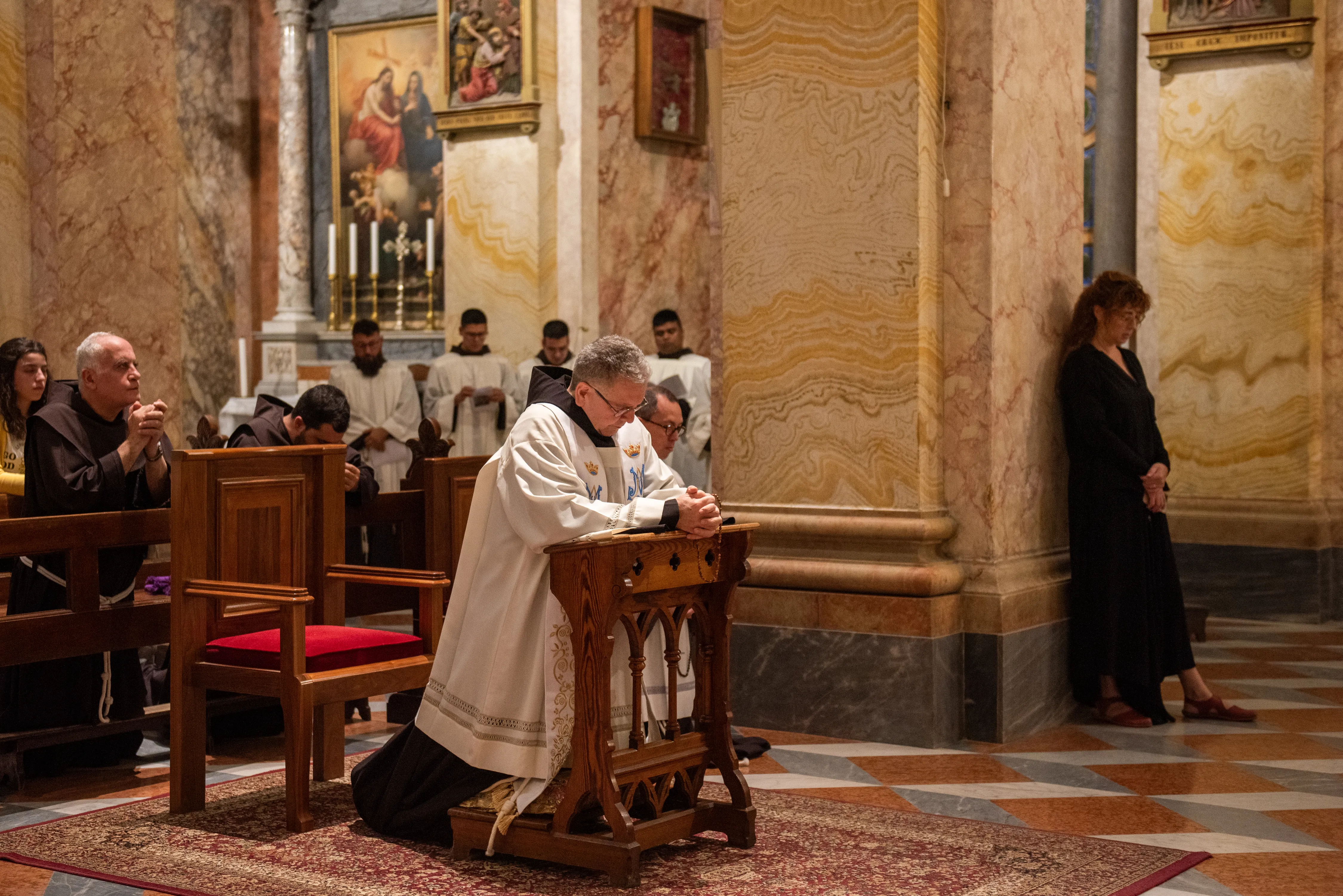
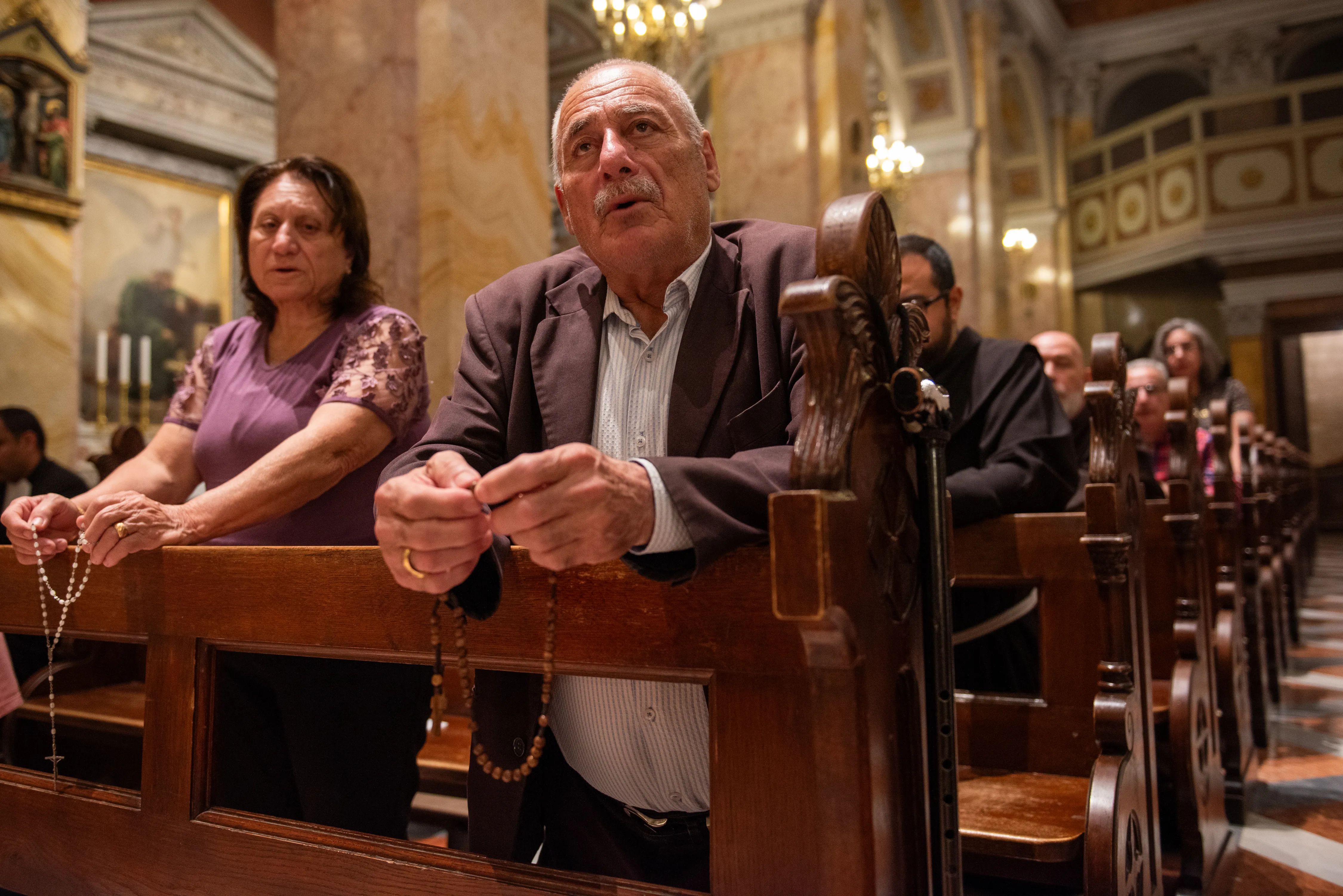
Local Christians pray the rosary during a prayer service hosted by the Franciscan friars of the Custody of the Holy Land on Saturday, Oct. 14, 2023, in St. Saviour’s Church, Jerusalem. / Credit: Marinella Bandini
Jerusalem, Oct 16, 2023 / 14:13 pm (CNA).
This past weekend, Franciscan friars in Jerusalem gathered together with the faithful for two prayer services dedicated especially to peace, marking one week since war erupted between Israel and Hamas.
A moment of silence at the Way of the Cross, held in St. Saviour’s Church, Jerusalem, Friday, Oct. 13, 2023. Credit: Marinella Bandini
The first took place on Friday, Oct. 13 — the Via Crucis. This is a tradition that Franciscans have carried on for centuries, walking through the Old City of Jerusalem on the Via Dolorosa every Friday: from the Sanctuary of the Flagellation (where Jesus’ condemnation to death and flagellation is remembered) to the Holy Sepulchre, which encompasses the sites of Jesus’ death, burial, and resurrection.
This tradition continued even during the COVID-19 pandemic; however, this time the Via Crucis was held inside St. Saviour’s Church for security reasons. This was a rare occurrence and has only happened before during crises of public order.
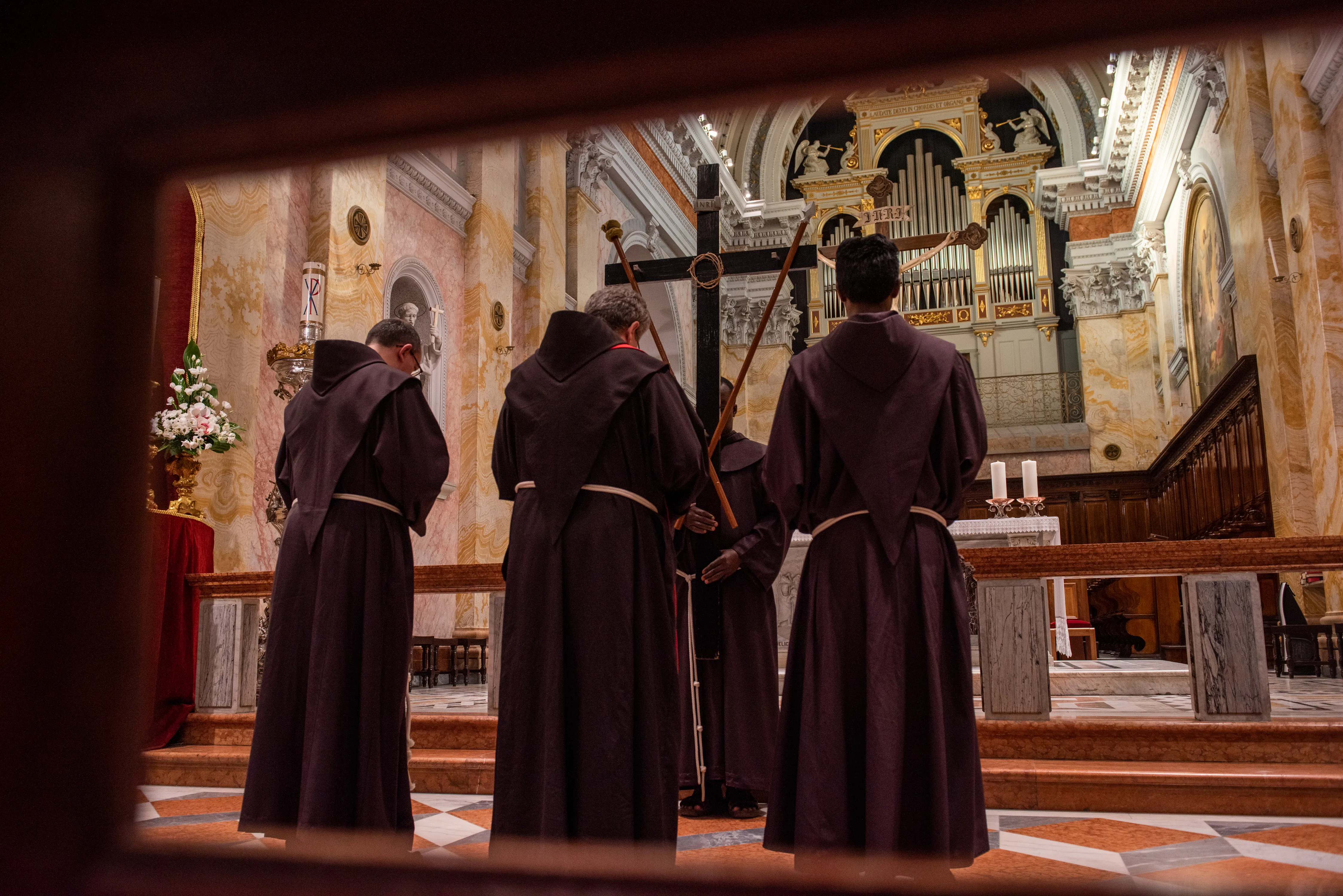
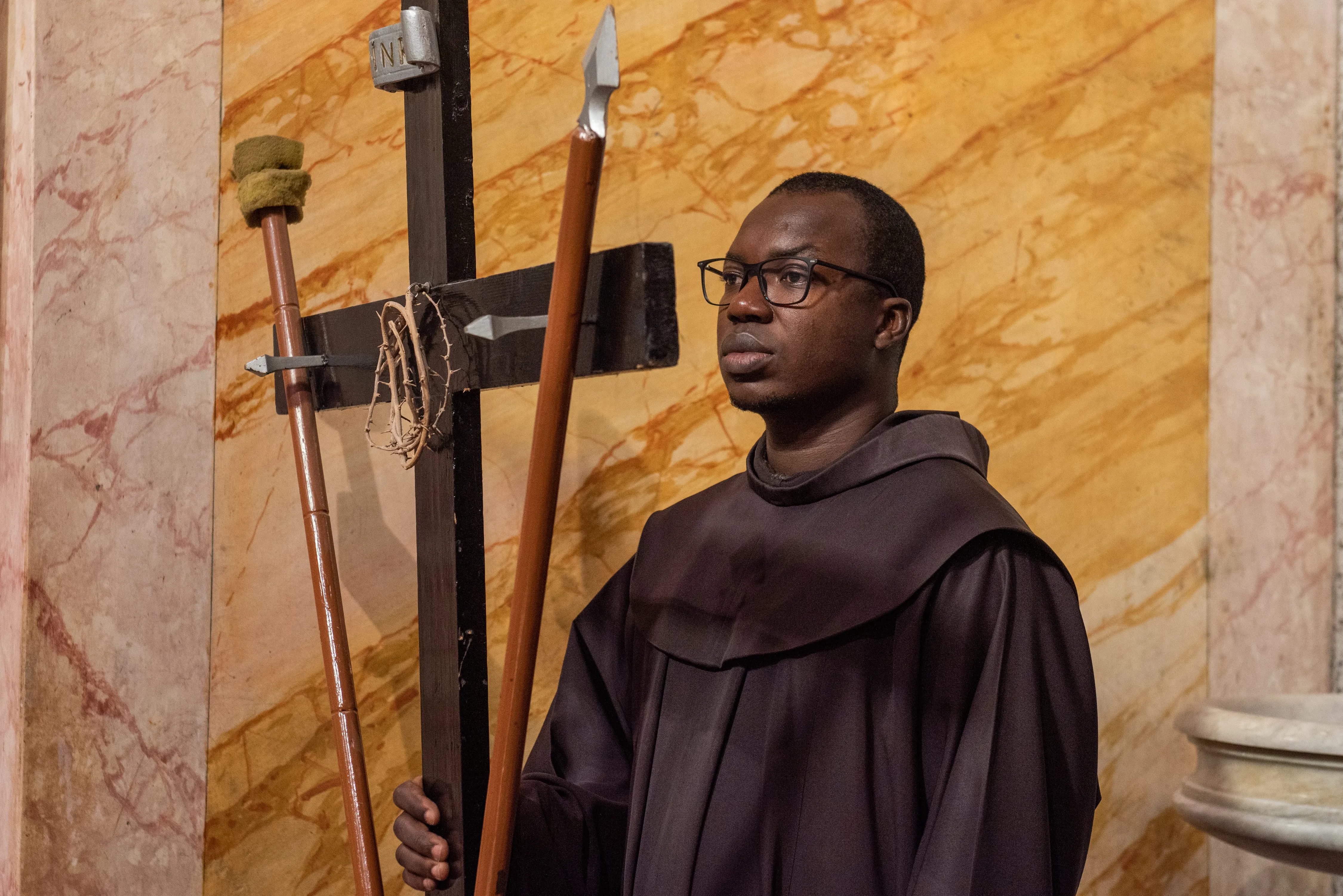
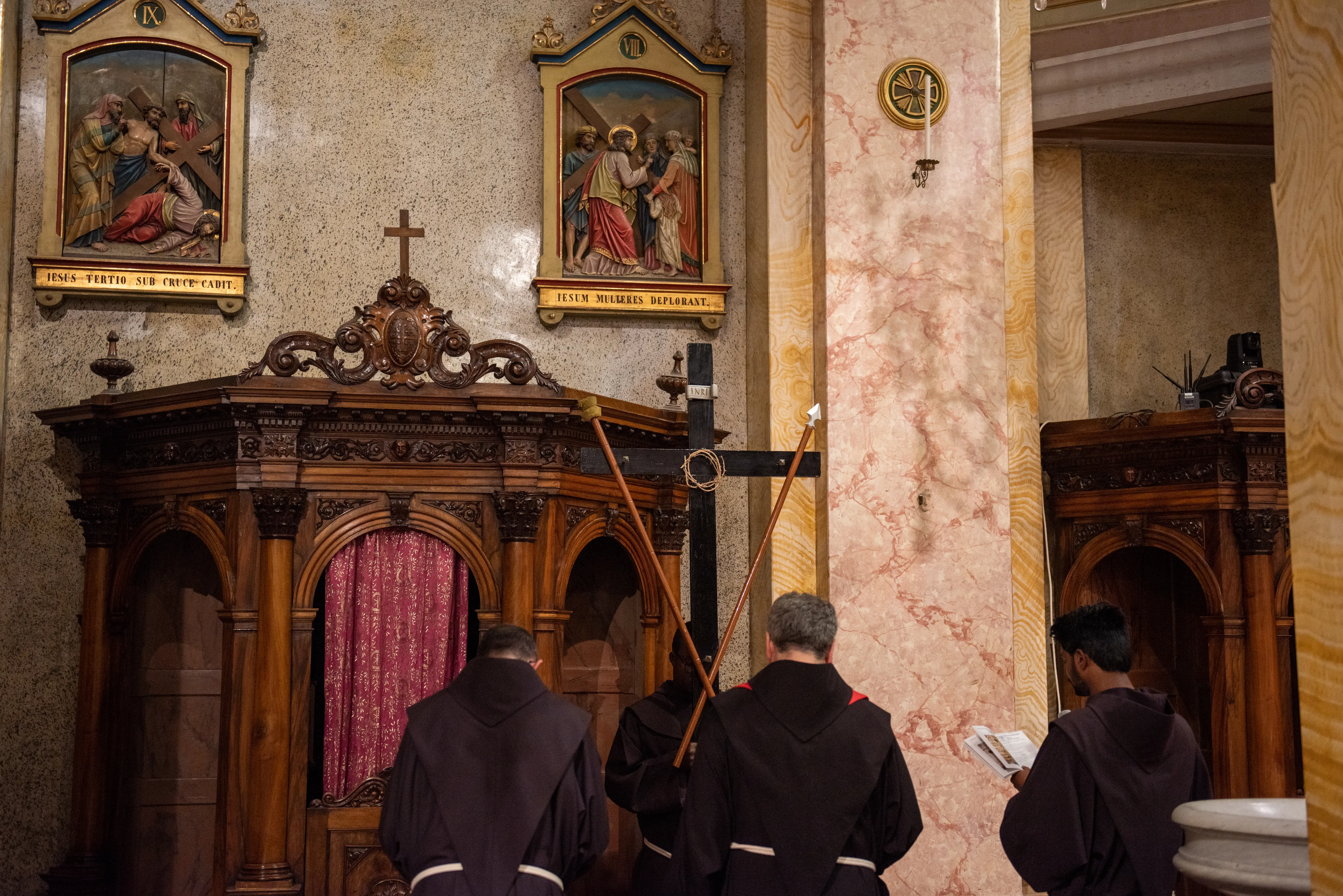
A Franciscan friar who carried the cross during the Way of the Cross held in St. Saviour’s Church in Jerusalem on Friday, Oct. 13. The cross bore symbols of Jesus’ Passion: the sponge that was soaked in vinegar, the crown of thorns, and the spear. Credit: Marinella Bandini
A small procession — formed by the custos of the Holy Land, Father Francesco Patton, the master of ceremonies, and two friars — walked along the perimeter of the church, stopping at each station. The cross at the front of the procession bore symbols of Jesus’ Passion: the sponge, which was soaked in vinegar and brought to Jesus’ lips when he said “I thirst”; the crown of thorns with which Roman soldiers crowned him as king to mock him; and the spear that a Roman centurion used to pierce his side to ensure his death.
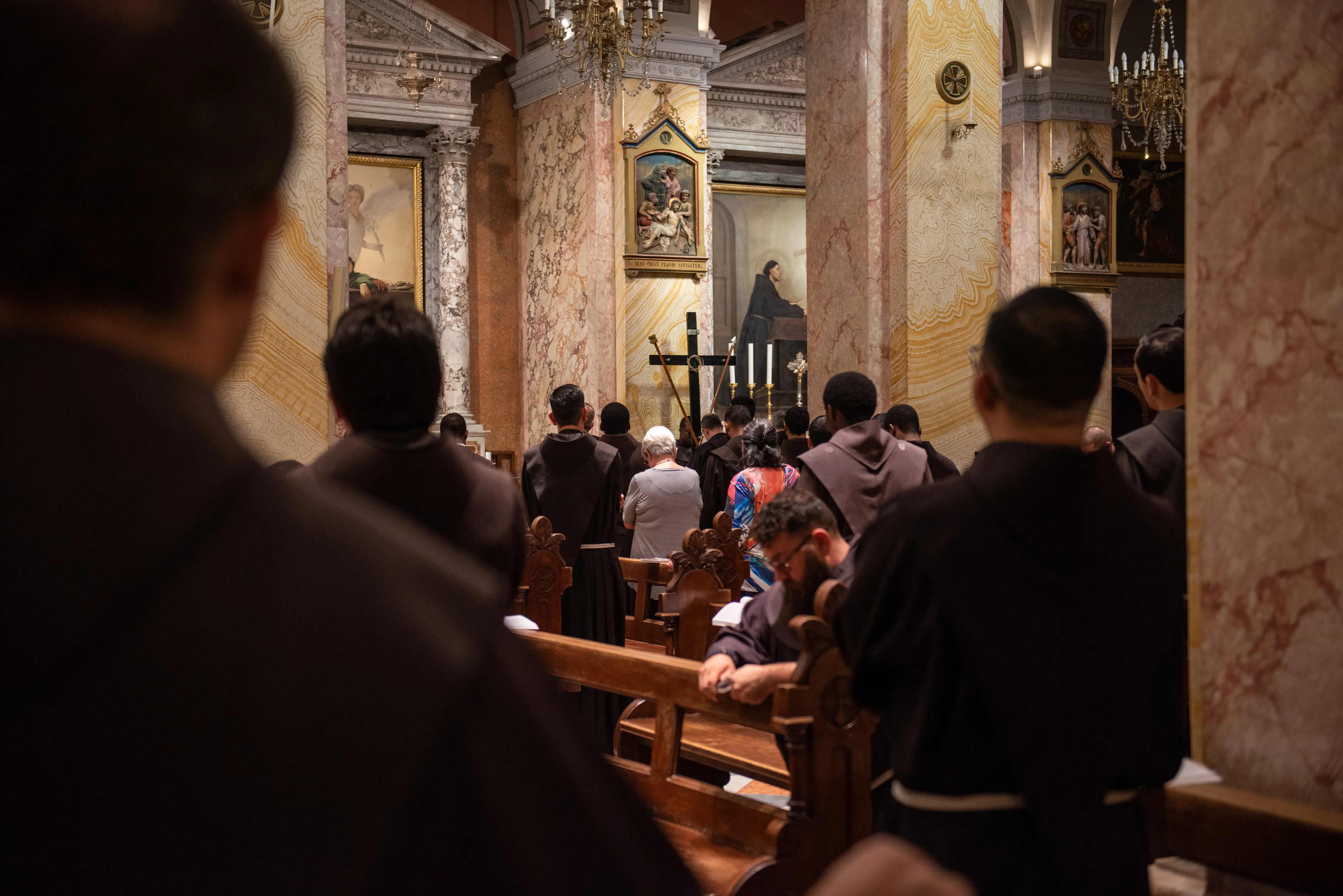
Praying the Way of the Cross, held in St. Saviour’s Church, Jerusalem, Friday, Oct. 13, 2023. Credit: Marinella Bandini
Inside the church, the community of the friars of St. Saviour along with some nuns and a few faithful joined in prayer. Before the final blessing, a moment of silence was observed — as before the tomb of Jesus in the Holy Sepulcher’s edicule — to invoke the gift of peace.
A small procession, formed by the Custos of the Holy Land, Father Francesco Patton, the master of ceremonies, and two friars, walked along the perimeter of the church, stopping at each station of the Way of the Cross. Here, they stop before the 8th station. Oct. 14, 2023. Credit: Marinella Bandini
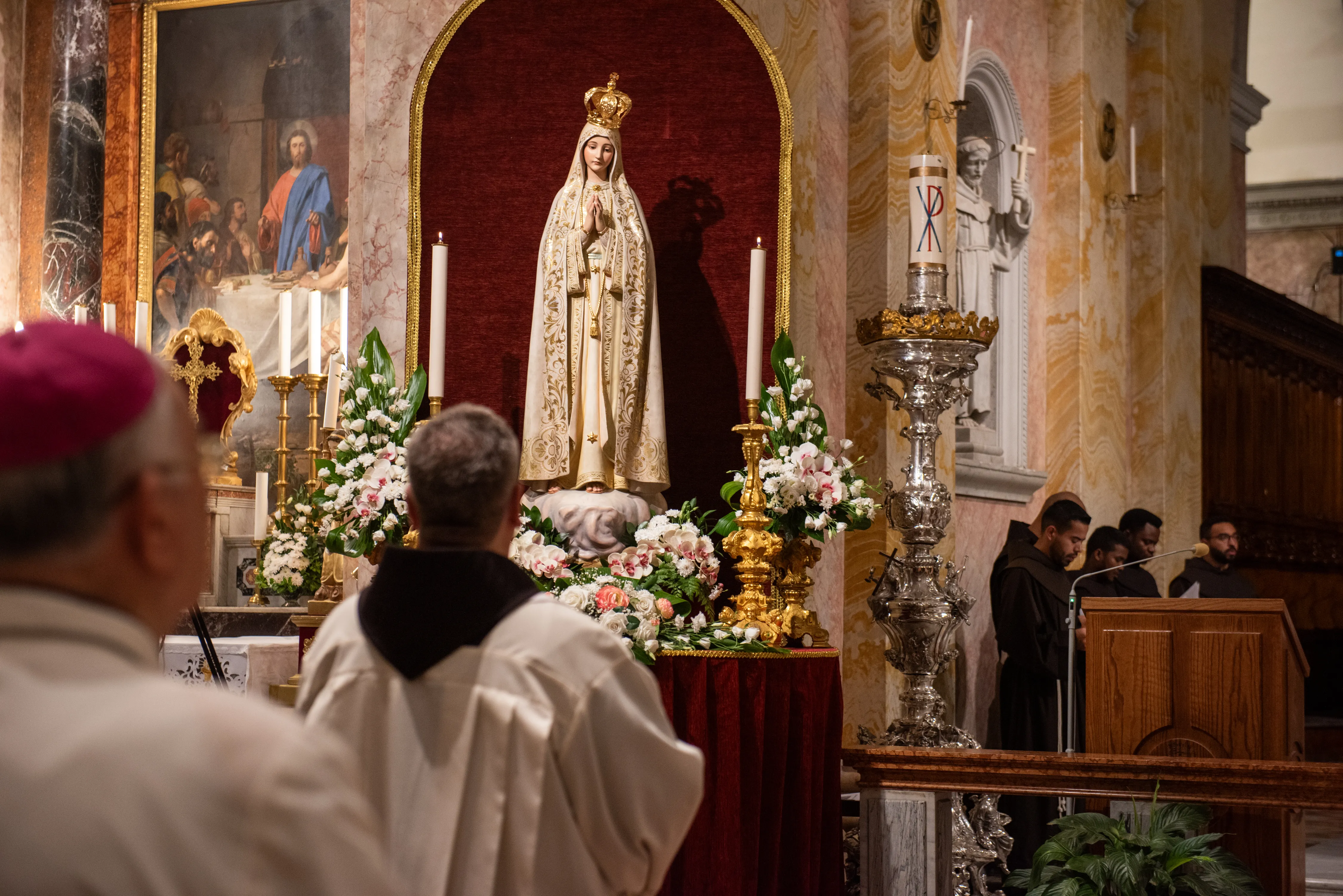
Then on Saturday, Oct. 14, in the Church of St. Saviour a special time of prayer took place with the recitation of the rosary for peace at the feet of the statue of Our Lady of Fatima.
The Custos of the Holy Land, Father Francesco Patton, standing before the statue of Our Lady of Fatima, during the “Rosary for peace” in St. Saviour’s Church, Jerusalem, Oct. 14, 2023. Credit: Marinella Bandini
In addition to the friars and religious men and women, there was significant participation from the local Christian community.
The five mysteries meditated upon were chosen based on an observation by Pope John Paul II in his 2002 apostolic letter Rosarium Virginis Mariae.
The parish priest of St. Saviour’s Latin parish in Jerusalem and the assistant priest pray the rosary at a prayer service organized by the Franciscan friars of the Custody of the Holy Land on Saturday, Oct. 14, 2023. Credit: Marinella Bandini
“The rosary is by its nature a prayer for peace,” the late pope wrote. He explicitly mentioned five rosary mysteries: the birth of Jesus in Bethlehem (joyful mysteries), the proclamation of the kingdom of God (mysteries of light), the death of Jesus on the cross (sorrowful mysteries), the glory of the risen Christ, and the crowning of Mary as Queen of Peace (glorious mysteries).
After the singing of the Salve Regina and the Litany of the Blessed Virgin Mary, the Prayer for Peace by St. John Paul II was recited: “Look with special attention upon the land in which you gave birth to Jesus, a land that you loved together with him, and that is still so sorely tried today. Pray for us, mother of hope!”
The Franciscan friars of the Custody of the Holy Land promoted a special “Rosary for peace” in St. Saviour’s Church in Jerusalem, on Saturday, Oct.14. The prayer was presided over by the Custos of the Holy Land, Father Francesco Patton. Credit: Marinella Bandini
The prayer service concluded with the final blessing and the song “Sub Tuum Praesidium.”
This Tuesday, Oct. 17, the Assembly of Catholic Ordinaries of the Holy Land has called for a day of prayer and fasting for peace. This will be a time of Eucharistic adoration presided over by Cardinal Pierbattista Pizzaballa, the Latin patriarch of Jerusalem, and will be held in the church of the Latin Patriarchate, Jerusalem’s co-cathedral.
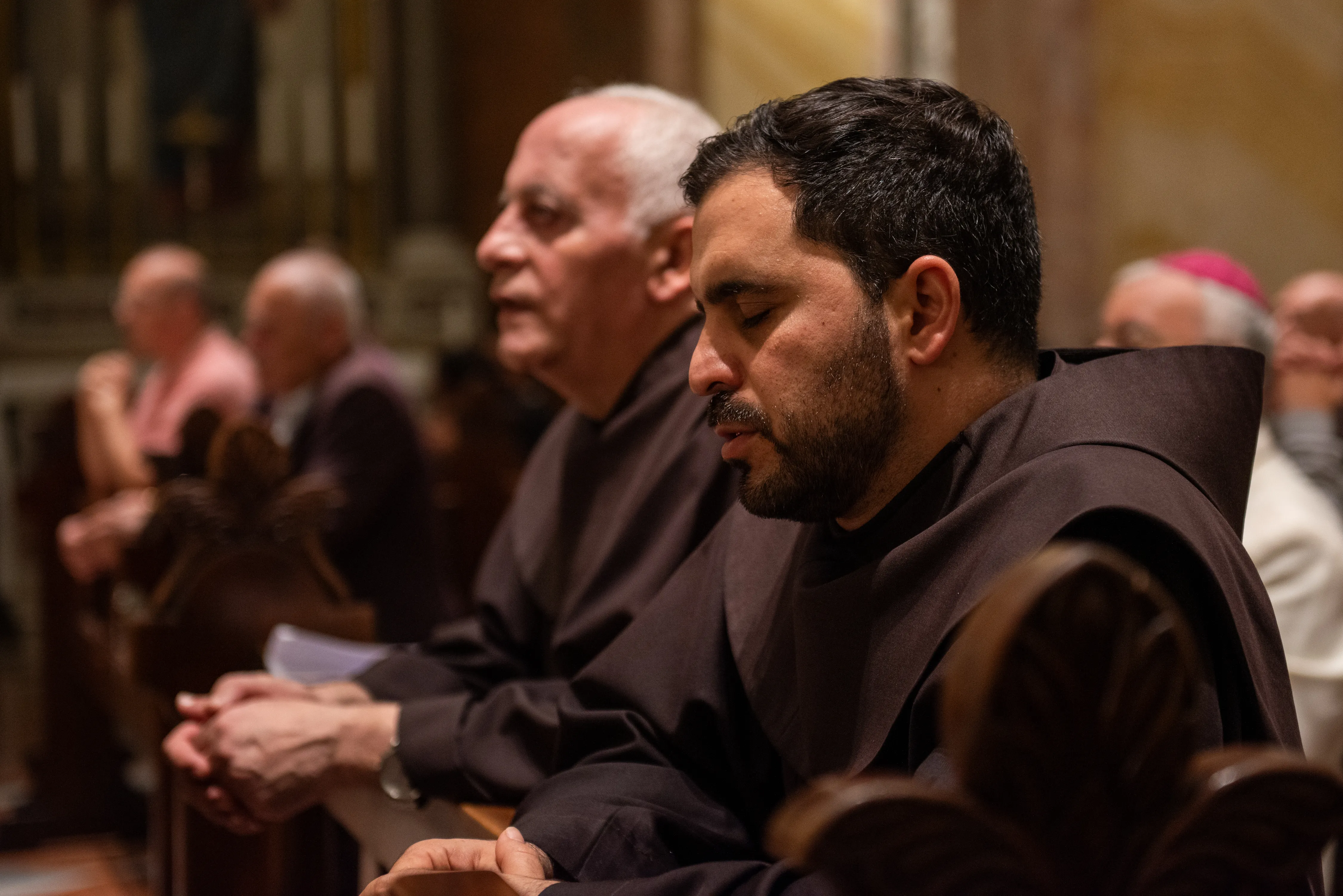
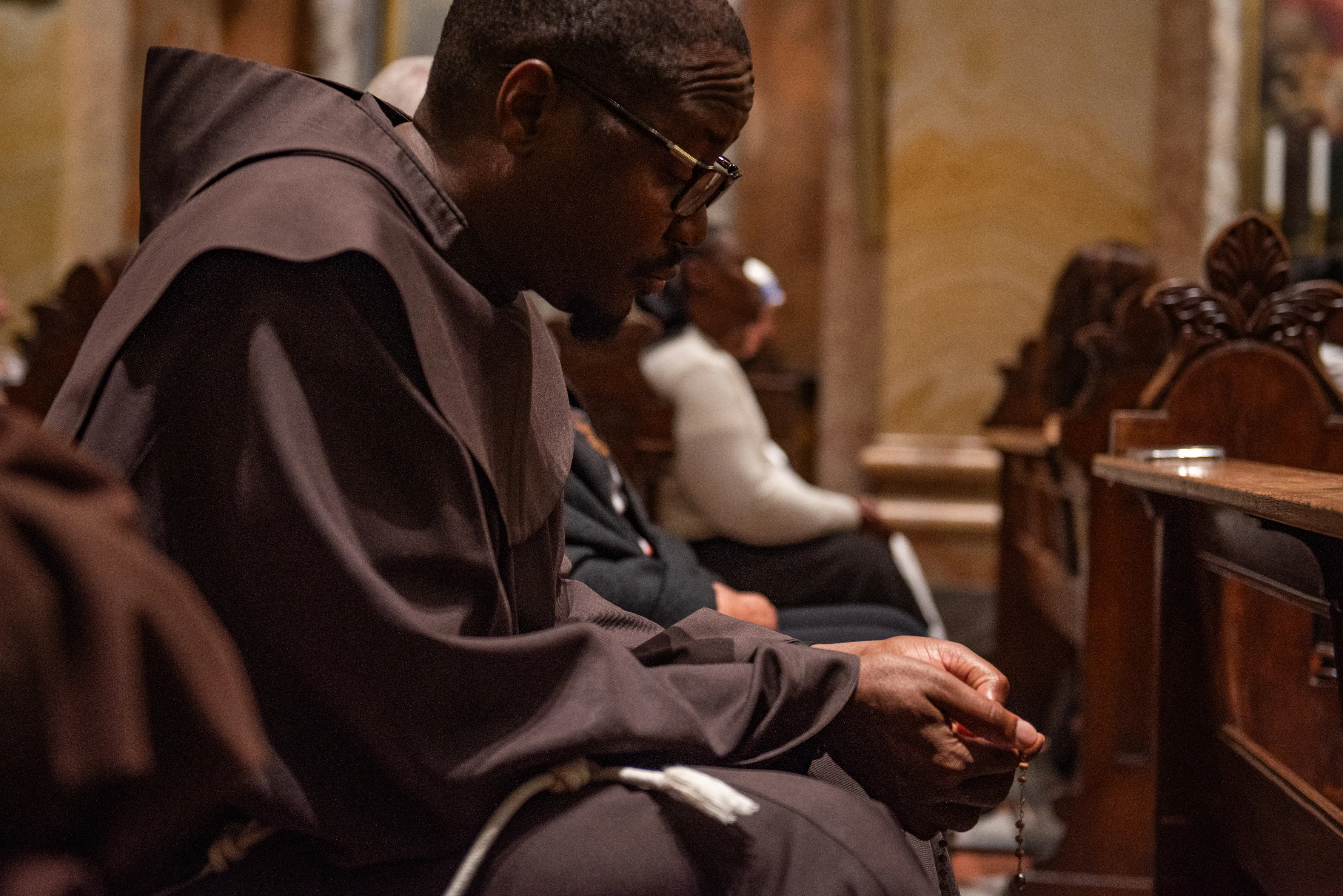
A Franciscan friar prays the rosary during a prayer service promoted by the Franciscan friars of the Custody of the Holy Land on Oct. 14, 2023, in St. Saviour’s Church, Jerusalem.
In the sanctuaries of the Holy Sepulcher (Jerusalem) and the Nativity (Bethlehem), celebrations will also be held according to the Status Quo with a specific intention for peace. (The Status Quo is an understanding among religious communities regarding the holy sites.)
In the Basilica of the Annunciation in Nazareth, the Blessed Sacrament will be exposed throughout the day and a special program of prayer for peace will take place, including Masses, Eucharistic adoration, the recitation of the rosary, and the divine mercy chaplet.
Local Christians pray the rosary, during a prayer service hosted by the Franciscan friars of the Custody of the Holy Land on Saturday, Oct. 14, in St. Saviour’s Church, Jerusalem. Credit: Marinella Bandini
During the Angelus prayer on Oct. 15, Pope Francis invited all believers to join the day of prayer and fasting for peace, stating: “Prayer is the meek and holy force to oppose the diabolical force of hatred, terrorism, and war. I invite all believers to join with the Church in the Holy Land and to dedicate next Tuesday, 17 October, to prayer and fasting.”
Father Deusdedit Ssekabira of the Catholic Diocese of Masaka in Uganda is in police custody for alleged “violent subversive activities against state” following his abducted from his office in Katwe, Masaka city, by men wearing Uganda Army unifor… […]
Kampala, Uganda, Apr 3, 2021 / 01:40 pm (CNA).- Archbishop Cyprian Kizito Lwanga of Kampala was found dead in his room Saturday morning. He was 68, and had preached at an ecumenical Way of the Cross the preceding evening.
Oh, please. I am incredulous at the above story on CWR.
You guys have had multiple stories in recent months about Muslims slaughtering hundreds of non-Muslims in far-flung locations, including Kashmir, Nairobi, Kenya, Nigeria and Bangladesh.
If anything, Bergoglio should be roundly criticized for not speaking out to defend the Christians being martyred by Muslim extremists around the world.
Brineyman made the point I was going to cover. None of the worthless “dialogue” ever includes condemnations of the atrocities committed by Muslims in the places he lists and many others. Few, if any, “moderate” Muslims ever denounce the murderous behavior of the jihadists. Frequently, they cooperate with it. Never did the Francis Vatican ever push mainstream Muslims to do something to stop the violence.
The loving example of humility, patience, tolerance, and forgiveness has to start with us. Jesus exhorted us to “love our enemies”. And the “Our Father” prayer clearly says: “Forgive us our trespasses, AS WE FORGIVE THOSE WHO TRESPASS against us.” Let us reflect as to WHY our Lord asked us to do that. We are all works in progress. Let us TRUST the Lord.




Oh, please. I am incredulous at the above story on CWR.
You guys have had multiple stories in recent months about Muslims slaughtering hundreds of non-Muslims in far-flung locations, including Kashmir, Nairobi, Kenya, Nigeria and Bangladesh.
If anything, Bergoglio should be roundly criticized for not speaking out to defend the Christians being martyred by Muslim extremists around the world.
Brineyman made the point I was going to cover. None of the worthless “dialogue” ever includes condemnations of the atrocities committed by Muslims in the places he lists and many others. Few, if any, “moderate” Muslims ever denounce the murderous behavior of the jihadists. Frequently, they cooperate with it. Never did the Francis Vatican ever push mainstream Muslims to do something to stop the violence.
Why don’t we all just talk to our priests and teachers about Islam?
The loving example of humility, patience, tolerance, and forgiveness has to start with us. Jesus exhorted us to “love our enemies”. And the “Our Father” prayer clearly says: “Forgive us our trespasses, AS WE FORGIVE THOSE WHO TRESPASS against us.” Let us reflect as to WHY our Lord asked us to do that. We are all works in progress. Let us TRUST the Lord.
So Matthew 23:33, John 4:22, Matthew 8, Romans 11, Acts 17
Is there a unique way to love enemies?
In his time, proactive Pope Francis did his best to reduce tensions among fellow pilgrims on a common journey.