Denver Newsroom, Feb 14, 2021 / 02:00 am (CNA).- Mardi Gras in New Orleans has been canceled only a handful of times, including during World War I and II, and the Spanish flu pandemic in 1918. This year will be added to that list, as the mayor of New Orleans has canceled Mardi Gras because of the coronavirus pandemic. But seminarians at Notre Dame Seminary are still planning to celebrate Mardi Gras, in their own way.
“I can’t have everybody go home and then come back again, as we’re trying to keep the virus out of the seminary. Which means everybody has to stay here,” said rector Fr. Jim Wehner. “So we’re going to do our own celebrations.”
Many of the seminarians have pickup trucks, and Wehner said there will be a competition to transform those trucks into Mardi Gras floats. The seminarians will then have their own parade of floats in a space behind the seminary. The seminary invited residents at a nearby Catholic nursing home to sit outside to watch the makeshift parade.
“The whole point of Mardi Gras, one of the points, is to promote community…from the neighborhood, from the city, from the Church,” Wehner said. “This will be a chance for us here to step out of the academic world for a few days and just have some really strong community building.”
“Isn’t that what a pastor does, through the sacramental, spiritual life of the Church, we’re building a parish community and that can involve good social encounters. So we’ll model that here a little bit for those days here.”
Wehner was not always a fan of Mardi Gras. In fact, he remembers being scandalized his first year at Notre Dame Seminary, when he first realized seminarians had several days off for Mardi Gras celebrations.
“Why are seminarians participating in Mardi Gras events? Isn’t this pagan and secular?” Wehner said, recalling his memory of that time. “I was pre-judging what I thought Mardi Gras was, which is debauchery, heavy drinking, drugs. Just, you know, immorality.”
“And that maybe is what a lot of people who aren’t from here, the tourists or outsiders…that would have all of this perception of what Mardi Gras is. And there is an element of that that would be maybe more expressed in the tourist parts of the city, but that was completely not the case.”
“I fell in love with the city and then the culture, the history— and certainly Mardi Gras.”
More than one day
Notre Dame Seminary in New Orleans is closed the Friday before Mardi Gras until Ash Wednesday. But Mardi Gras actually begins much earlier— on the Feast of the Epiphany, traditionally celebrated January 6th.
“When we speak of Mardi Gras, it’s not just of course the day itself, but the whole season and the attitudes surrounding that,” said Earl Higgins, a Catholic author and New Orleans native. “On the traditional day of the Epiphany, which is January 6 … we shift from the Christmas season to the beginning of the Carnival season, Mardi Gras.”
January 6 is also the birthday of Saint Joan of Arc, the Maid of Orléans. One of the first parades of the Mardi Gras season is hosted by a group of women known as the ‘Krewe de Jeanne d’Arc.’ The parade passes through the French Quarter, beginning at the foot of a statue of St. Joan of Arc, gifted to the city by the town of Orléans in north-central France.
“There is actually a procession that is not a liturgical procession, a festival procession that goes from her statue to the cathedral and the rector of the cathedral is waiting,” Wehner said. “The person who’s dressed up on a horse as Saint Joan of Arc reaches out the lance and then…the rector…blesses it. And that’s become the informal unofficial start to Mardi Gras.”
January 6th is also the day New Orleanians traditionally eat their first King Cake of the season.
“We call it La Galette du Roi in French,” said Father Keenan Brown, a priest of the Diocese of Lafayette in southern Louisiana. “That tradition comes from France.”
Lafayette is about a two hour drive north west from New Orleans, but the city has a lot of the same Mardi Gras traditions.
“Traditionally, it’s a brioche batter that’s braided and baked, and it’s topped with this really sweet glaze in the three colors and sometimes sprinkles,” he said, referenced the three colors of Mardi Gras: green, gold and violet. The colors represent the gold, frankincense and myrrh that tradition holds the three kings brought to the baby Jesus.
Originally, a bean or a piece of jewelry was baked into the King Cake. But lately, at least in New Orleans, any tokens have been replaced by small plastic dolls representing the infant Jesus.
From Epiphany to Ash Wednesday, the city of New Orleans and many other cities and towns in southern Louisiana light up with masquerade balls – and, of course, parades.
“These parades always run on the same day, at the same time. So everyone in the city refers to the parade and not the day,” Wehner said.
Notre Dame Seminary sits along the path of Endymion, the largest Mardi Gras parade that runs through the city of New Orleans on the Saturday before Fat Tuesday.
“Leading up to this, the custom here – and everyone respects it – is that several days before each parade, you can reserve your spot,” Wehner said. “If you do it the right way, no one will confiscate it. So it’s a gentleman’s agreement— and it’s spray paint and tape.”
It is also customary for locals to man their spots at least 24 hours before the start of the parade.
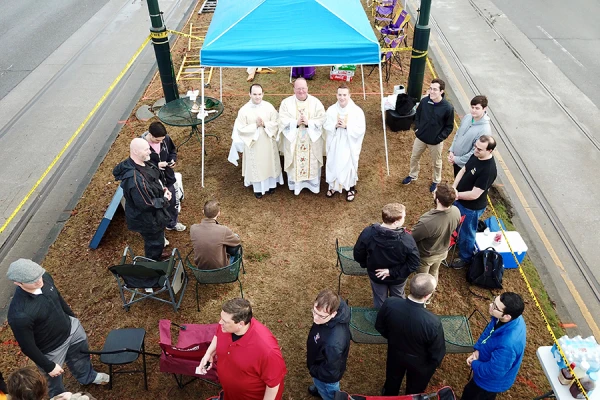
“So for two days before Endymion, the seminarians will sleep out during the night and we will protect our spot that we have spray painted,” Wehner said.
During that time, the seminarians are praying the rosary, playing cards. Wehner will even celebrate a sunrise Mass.
“People are very, very respectful of the fact that we’re doing this,” Wehner said. “Of course, we’re in our collars, and we’re not embarrassed of who we are. For the seminarians… this is the perfect time for evangelization.”
One of the last parades of Mardi Gras traditionally begins first thing Tuesday morning. I’m talking before dawn. A group called the Skull and Bones Gang runs through the Treme neighborhood of New Orleans dressed as skeletons.
“They go around and knock on the doors at five o’clock in the morning,” Higgins said. “And say ‘wake up, wake up!’ You don’t know how much time you have. It’s to remind people, ‘Hey, life is short! Get up and party!’”
As Fat Tuesday progresses, the historic French Quarter gets pretty saturated with tourists. Higgins said those tourists bring their own ways of celebrating Mardi Gras.
“The French Quarter is not a place where you want to bring your Aunt Maude, or any anybody with any, shall we say social sensibility because it’s pretty raunchy,” he said.
The partying continues until midnight, when yet another great New Orleans Mardi Gras ritual takes place: clean up.
“At one end of Bourbon Street, a team of the police lines up,” Higgins said. “The chief of police is usually at the head of the procession. And policemen on horses and dogs, and they have bullhorns. Right behind the police and the horses are the cleanup crews…And that marks midnight. Mardi Gras is over.”
Brown remembers the end of Mardi Gras was very clear to him as a child.
“We were very aware that when midnight hit, party’s over,” he said. “The next day, everybody goes to Ash Wednesday [Mass]…and everyone goes in for the ashes to begin the penitential season and to make the fast.”
“Now, the funny thing about that is, they’re not just Catholics that get ashes,” Brown said. “Everybody goes to get ashes. I’ve heard of Jews going to get ashes at the cathedral in New Orleans, because it’s just cultural. For some people, it’s very cultural.”
Higgins remembers a pastor who visited his church many years ago from out of town.
“He says he was amazed at the piety of the people in New Orleans. And the rest of us were kind of looking around. ‘What’s this guy talking about?’,” Higgins laughed. “The churches packed on Ash Wednesday in New Orleans, and by many, many people who are not only Catholic, probably don’t believe in anything. But part of the ritual of being in New Orleans is to get ashes on Ash Wednesday. That’s what you do.”
Celebrating Mardi Gras like a Catholic
Tradition runs deep in New Orleans, especially when it comes to Mardi Gras. These traditions have a Catholic flavor that is accepted and celebrated by everyone, even non-Catholics.
“In New Orleans, the culture and Catholicism are inextricably intertwined. You cannot imagine New Orleans without the Catholic Church. It’s just part of the history and the culture, and it affects everybody,” Higgins said.
Fr. Patrick Broussard is vocations director in the Diocese of Lafayette, and pastor of a parish in the town of Church Point. Broussard grew up in Lafayette, and he remembers going to parades with his family when he was a child. He never really enjoyed the Mardi Gras traditions who grew up with, until he moved away to study in Rome.
“Being so far removed from home, I realized how special South Louisiana is in a number of ways, particularly with the Catholic culture…Just seeing how ingrained the Catholic life is in people, even if they don’t practice it or don’t appreciate it,” he said.
“Everything that we do has that sort of Catholic flavor to it.
Higgins likened it to popular devotion to Our Lady of Guadalupe in Mexico.
“Mardi Gras has always been a mixture of, you know, secular and religious. In a way it’s like the Virgin de Guadalupe in Mexico. That’s just part of their culture, whether people believe in whatever they believe in. That’s just who they are. That’s Mardi Gras in New Orleans.”
Wehner was scandalized when he first heard that his seminarians got time off to join in Mardi Gras celebrations. But by now, he’s learned Mardi Gras isn’t something to be afraid of.
“You know, it can be if you’re in the wrong places, in the wrong spaces in the wrong times. But that’s really not the practice when you’re with parishes, you know, the different local parishes have their parishioners at different parts of the parade route, and it’s an all day cooking out and these types of things,” he said.
Plus, it can be a great opportunity to evangelize.
“We have to be careful not to throw the baby out with the bath water,” Broussard said. “if you think of Mardi Gras in New Orleans, you think of all the kind of scandal and craziness that goes on with it. But there is a lot of good in it too.”
“I think just to say, ‘we should not do Mardi Gras’…I think that would be a mistake because there is so much good tied up in it that we could draw from. And even, it could be very beneficial to us in our proclaiming the Gospel. So, hey, you love Mardi Gras. You know that’s a time of preparation for Lent, right? It’s intimately tied in with the Catholic faith. People may not realize it anymore, but I think that’s our sort of way to re-evangelize them.”
Wehner said celebrating Mardi Gras can be incredibly Catholic.
“I always preach to the seminarians, the Catholic Church is not counter-cultural,” he said. “We can be counter societal. Culture is an expression of God’s design. So we will critique anything that tears down what God wants. Society is what man produces. Culture is an expression of God’s Providence.”
“So we are not counter-cultural, we’re all about culture. We’re about promoting it. And at the heart of that is life. It’s family, and we know how to celebrate life very well, with festivals and food and family. That’s a part of our tradition, even tied into the saints. You go to various parts of the world where the whole town is celebrating that saint that came from their neighborhood. And it turns into a festival.”
“I think Mardi Gras is the same way. We’ve just come from the Christmas season. And in between, before we move into the Lenten season, we’re celebrating. The Gospel that can evangelize culture. And when that happens, everybody wins. And you could see that here in New Orleans, which has its own – like any culture – it has its issues and problems. But when the Christian faith speaks to it, you see the best of people.”
This story originally aired on Catholic News Agency’s podcast, CNA Newsroom. It has been adapted for print. Listen to the episode below.
CNA Newsroom · Ep. 91: Mardi Gras (and all that jazz)

[…]







If the Catholic Church and its agencies want to help immigrants, that’s fine. Just do it with money that belongs to the Catholic Church. Tax dollars confiscated from taxpayers to do the work of the Church should end…NOW!
Nope. No amnesty for those who entered illegally. Reagan did that with the expectation that the border would be secured. Democrats flooded the country with illegals again. They all go back. All of them.
The Catholic Church applauded and abetted the entry into the United States of people who knowingly broke the law by how they arrived. The Catholic Church even profitted greatly in their act. Now our bishops want to say, “Well, since they’re already here, why not let them stay.” But arriving here as a lawbreaker is not the way to start life in a new country. Rather, I’d propose that anyone here illegally and who has committed no other crimes since arriving, should be asked to voluntarily leave the country. They can be fingerprinted on the way out or use that photo ID system that we citizens are subjected to when we leave or re-enter the USA. They will be repatriated to their country of origin where they can re-apply for residency on an expedited basis. Their entry, then, into the USA can be normalized and they can once again resume life in a country where laws mean something. Acting on emotions is never a way to apply the law.
How about: if you have been deported for illegally and grossly overstaying a Visa or illegally entering, then you do not get to enter legally. If you deport yourself, there’ll be no record of deportation, and you can go through the normal process. (Possibly I’m making incorrect assumptions about illegal immigration processes) Exceptions for those under 18. I don’t see a reason to deport children who’ve been here most of their lives.
If potential immigrants get bonus points for speaking English and knowing the American way of life, self-deported illegals should have a leg up on the rest of the applicants, assuming they tried to integrate while they were here.
Let’s remember some salient facts:
1. There are millions of illegal aliens in this country.
2. They are earning incomes off-the-books
3. They are not paying taxes
4. The rest of the hard-working American citizens are paying more than their fair share for services that taxes provide
5. In effect, this entire Illegal Immigration Industry (that the Catholic Church receives remuneration for) is STEALING FROM THEIR NEIGHBORS. Where’s the charity in that, you bishops?
It seems the Archbishop is saying , while we should secure our borders, at the same time we should normalize those who are here as undocumented IF they are living as productive law abiding people. They would then become contributing taxpayers. Judging the number of “Help Wanted” signs in every town, I would conclude that they are very much needed. If we expelled them who would pick our crops? I’m in no way suggesting that we take advantage of them and keep them permanently in a lower class, but rather that they are welcomed and allowed every opportunity to better themselves and advance their social standing. Over several centuries every wave of immigrants has started at the bottom and worked their way up. Orderly paths to citizenship should be provided. This is the American way. They wouldn’t be here in the first place if we had secure boarders. Since they are here we should allow them to legally integrate.
They entered illegally. They committed a crime. They should return.
The Vatican recently increased penalties on illegals going into Vatican City. What does the Archbishop think of that?
He should have stopped at paragraph seven.
“If President Trump is able to shut down the border successfully, making illegal entry into our country virtually impossible, does it not make more sense to create a pathway for the undocumented to be able to earn legal status?”
Honestly, no. This “pathway to citizenship” narrative is inappropriate and unacceptable. There is already a formal process for immigrants to become citizens. That process must be honored, and it must apply equally to everyone. No amnesty, no work visas, no exceptions.
I voted for J.D. Vance. I never voted for any bishop to weigh in on immigration policy. That is left for laypersons in the Church to deliberate about. Bishops should stay in their own lane.
Bishops are the Church’s official teachers on faith and morals, and government policy is partly applied morality. They have reason to weigh in. But they should be careful not to speak beyond their knowledge, as we all should.
The Church does have “an obligation to care for every person with respect and love, no matter their citizenship status.”
That includes the children of American citizens whose parents are both working, one of them working two jobs, just to be able to provide their children with the basic essentials, and still can’t do that without slowly drowning in credit card debt.
Such children don’t get to spend anywhere near enough time with their parents. They are basically being raised by the secular school system, which in many cases indoctrinates them with values contrary to the Christianity of their parents.
Why are such families in this dire situation? Because massive, out of control, unregulated immigration (open borders) has driven down wages that far.
The Church’s approach to immigration hasn’t been treating such families with “respect and love.” It has instead coldly abandoned them, leaving their vulnerable children in a terrible situation.
The difference between Archbishop Naumann’s pleas for reasonable accommodation marks the spiritual heart of a man of God, a man committed to his brother as well as faith in Christ – from the many who continue to show no compassion whatsoever in their commitment to civil law. Whereas Naumann, a staunch traditional Catholic, is not a legalist when there’s room for charity.
Idiot compassion is not genuine compassion. Render to Ceasar the things that are Ceasar’s. We are a nation of laws. Illegal aliens do not deserve compassion; they are technically criminals, so the appropriate response is deportation.
At judgment do you believe Christ will consider the difference as just or unjust?
I seem to recall a bible passage where Jesus asked His disciples to pay their tax with a coin found in the mouth of a fish. I have no recollection of Him advising civil unrest, which his disciples had initially hoped for. And I recall Him saying “render to Caesar”. Jesus never advocated breaking the civil law ( something his followers believed the Messiah would apparently do.) . I dont recall him making an allowance for illegal aliens either, some of whom commit violent crimes like rape and murder. Breaking into another nation is a crime.
Too many churchmen mistake Christianity for socialism or communism. It is not. Nor is it a sin to be a successful person or nation. Which means no one has a right to TAKE what belongs from you without your consent. The US donates foreign aid in numbers much larger than the next few nations combined. WE dont owe anyone anything. I dont recall Christianity EVER teaching that one has an obligation to stand by and be the punching bag of those with less means.
STEALING what you want is a great deal different than asking for help.
Charity belongs to God.
Illegal immigrants do not deserve compassion??
I’m all for law & order. A secure border protects everyone’s safety but I have a great deal of compassion for people brought here as children through no fault of their own. Even Gov. Rick Perry said we can be law abiding & still have a heart. We’re Catholics. We’re not 100% on one political team or the other. We can consider humane exceptions.
Whew! Good to hear your voice mrscracker. For awhile I thought compassion, even limited to hard cases had died among the faithful.
Amen, well said. I would hope that there is room for courteous and fruitful dialogue between men who are both reasonable and devout, which certainly includes both the Archbishop and the Vice-President. There is room for discussion about nuance and prudential judgements between such men, sorely lacking in, say, the endless simplistic pronouncements of the talking heads of CNN and Fox.
I don’t think disagreement on what is a reasonable way to approach illegal immigrants is necessarily evidence of legalism or a lack of compassion.
Possibly people are aware that there are only so many immigration officials, and the backlog in legal immigration applicants is years-long, sometimes over a decade. Giving illegals amnesty is not without cost to potential legal immigrants.
Fr. Morello, as multiple outlets have now reported, the USCCB has been operating a large contract for immigration-related services valued at over 100 millions dollars, which seems to include transferring federal funds to individual dioceses. Evidence is that they have been filing expenses and being reimbursed on a monthly basus. That is not “charity,” that is a contractual relationship to provide services for the federal government. There are charitable motivations behind it, and no doubt the individuals providing the services truly want to help others. But they are being paid for services, and only a minuscule fraction of their funding comes from charitable donations.
Whatever the relationship between the USCCB and the federal government has been in the past, the organization is now a major federal contractor by any reasonable standard.
So until more bishops, priests and Church employees connected to these contracts & grants are willing to openly discuss the ramifications and possible consequences of their heavy reliance on federal funding to perform essential missions of the Church, the appeals to “charity” will ring hollow. They are talking like people in denial of the basic circumstances in which they’re operating, and expecting others, especially laypeple, to tacitly go along with their delusions. I’m sorry to find that I have yet to find one bishop or priest who is being candid about this. Therefore now, I can’t fully trust what any of them say on the subject of relief for migrants and immigrants. But I will keep looking for one.
The good Archbishop, along with many other bishops, asserts that the church
does not have the authority or responsibility to determine the legal status of
migrants. But there is a profound difference between legal and illegal immigration –
and that is the crux of the problem. Many Americans support legal
immigration, not illegal immigration. Ignoring this difference is naive and irresponsible.
The church should encourage all people to obey the law.The church itself has
rules and laws – canon Law. Lawless behavior does not promote the common good which the church is always preaching.
And the Vatican itself does not permit the uncontrolled influx of migrants
into its territory.
So it’s looking like the Catholic dioceses throughout the United States have gotten themselves into a bad position by tacitly accepting responsibility for taking care of the unprecedented floods of would-be immigrants during the past 3-4 years because of the Biden administration’s lax enforcement of border security and immigration laws. Catholic Charities organizations seem to have unquestionably accepted the additional funding offered by the previous administration, as well as the administration’s approach, and now they are stuck dealing with the aftermath. They must have counted on Joe or Kamala Harris winning the election and continuing to throw more money at the various “refugee” assistance and othe4 programs.
Worst of al, the bishops seem to have fully embraced the Biden-era blurring of distinctions between “refugees” (a limited group) and the much larger group of people seeking to emigrate for economic reasons (who do not qualify as refugees). Now they are stuck trying to care for whatever percentage of the 5-million-plus people they are contractually obligated to assist. And it is Annual Appeal season. No wonder we are seeing multiple bishops coming forth with statements that are basically variations on the same set of messages. They want to keep the Biden-era levels of funding going.
I have a couple of comments.
The USCCB and individual bishops often call for immigration reform for our broken system, without saying what reform they want. Archbishop Naumann at least states what he wants – to make legal the illegals, or at a minimum to give them work permits. He proposes a fine, but they are economic immigrants and have very little money. What has been broken about our immigration system is a failure to enforce our immigration laws.
The bishop states, “It is inconceivable that our previous administration either did not know or care about the location or the circumstances of approximately 300,000 children and youth who entered the United States during the past four years.”
I find it inconceivable that the bishops did not know about the 300,000 children since it had been in the news for a long time.
Alhough it is not in this article, the bishops often say that we should welcome the stranger. We do welcome the stranger about one million times a year with legal immigrants. If the bishops do not think that this is an adequate number, they should tell us why, and what the correct number should be in their opinion.
In general the bishops try to conceal that they want legalization of illegals, by not using that language in their 2025 voting guide, but rather saying that, “We must stand with newcomers, authorized and unauthorized.”
Vatican threatens illegal immigrants who may dare enter the Vatican grounds:
“Vatican Promises Stiff Penalties for Illegal Aliens Crossing its Border”
https://www.breitbart.com/europe/2025/01/16/vatican-promises-stiff-penalties-for-illegal-aliens-crossing-its-border/
I did a quick search on top salaries at Catholic Relief Services. I’m removing the names because I haven’t verified the following:
President: $596,5512
Executive VP of Strategy, Technology & Communications: $356,3882
Executive VP of Overseas Operations: $352,028
Apparently, charity pays very well, especially when using other people’s money.
The average VP salary in the US for a charity is $157,532; in California it’s 203,000. For a CEO, the average is 865,000. However, the average charity is nowhere near as large as CRS is, and one can expect above-average salary for above-average work.
Charitable officials, like government officials, may well be in it more for the spending power than for their personal salary. Motivations are typically impossible to observe, and trying tends toward rash judgement, which is why we judge by the fruits, and by adherence to other Catholic moral teachings (like contraception).
“Sadly, our population is declining in the United States because of abortion, many adults choosing not to marry, and married couples having fewer children. Our birth rate is below replacement level. Without immigrants, our population decline would be even more severe.”
When was the last time the USCCB issued a statement regarding the need for Americans to marry, refrain from contraception, and have children?
There has been success in raising birth rates when Catholic and Orthodox bishops in a few other countries have promised to be godparent to those in their diocese who request it, or for the third child of those in their diocese who request it. This is something a single bishop could have a direct impact on.
When was the last time the USCCB issued a statement regarding the need for Americans to marry, refrain from contraception, and have children?’
************
Good point.
The problem is the more liberal bishops and priests are controlling the issue in the United States.