


CNA Staff, Nov 6, 2024 / 05:45 am (CNA).
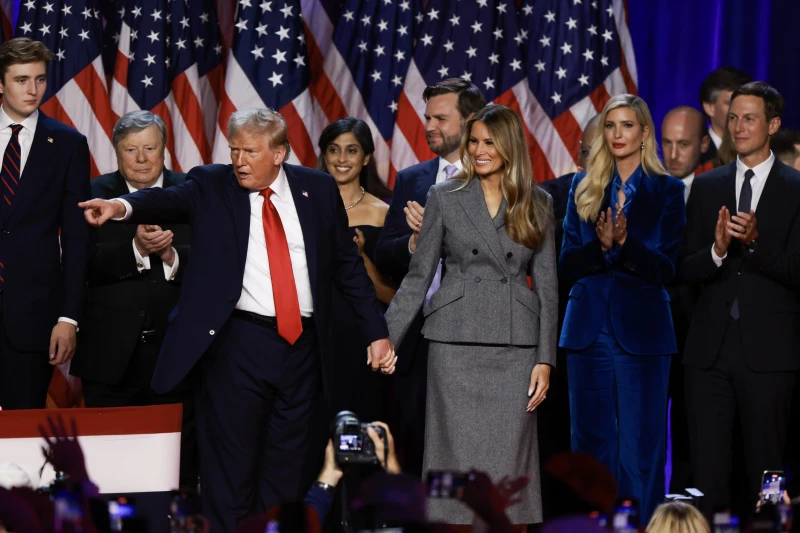
Donald Trump on Wednesday won his reelection bid for president, defeating Democratic opponent Vice President Kamala Harris and becoming the first president in nearly 130 years to secure a nonconsecutive White House victory.
Multiple news networks called the race for the Republican president-elect on Wednesday morning. Fox News had called the race for Trump hours earlier.
Early Wednesday morning Trump had posted a 276-219 lead in the Electoral College over Harris as well as a 5 million lead in the popular vote.
“This was, I believe, the greatest political movement of all time,” Trump said in Florida in the early hours of Wednesday morning. “There’s never been anything like this in this country, and maybe beyond.”
“And now it’s going to reach a new level of importance because we’re going to help our country heal,” he said.
“Every citizen, I will fight for you, for your family and your future,” he continued. “Every single day, I will be fighting for you. And with every breath in my body, I will not rest until we have delivered the strong, safe, and prosperous America that our children deserve and that you deserve.”
The victory caps what has effectively been a four-year effort by Trump to retake the White House after he lost his first reelection bid to President Joe Biden in 2020.
Trump has spent most of Biden’s term shoring up political support among Republicans and conservatives while fending off numerous legal challenges from state and federal prosecutors, one of which ended in a felony conviction.
The GOP president-elect worked to build a broad coalition of allies and supporters, particularly in the final year of the race, when he drew endorsements from public figures as diverse as Elon Musk, Robert F. Kennedy Jr., Buzz Aldrin, and Peter Thiel.
Trump also appealed aggressively for the Catholic vote, arguing that Harris is “very destructive … to the Catholic Church” and slamming Harris for skipping the annual Al Smith dinner in New York City.
In July the now-president-elect picked Ohio Sen. JD Vance as his running mate. Vance, a Catholic, is one of the most overtly religious major politicians in America and made faith a central part of his campaign, warning Catholics of Harris’ alleged “anti-Catholic bias” and arguing that many Catholic voters “feel abandoned” by Harris and Biden.
Vance on Wednesday described Trump’s victory as “the greatest political comeback in the history of the United States of America.”
“We’re never going to stop fighting for you, for your dreams, for the future of your children,” Vance said, vowing also an “economic comeback”under the Trump administration.
Trump himself told “The World Over with Raymond Arroyo” in October that he would continue to back religious liberty in his second term, describing it as “a stance that I’ve taken from the beginning.”
In September, meanwhile, Trump’s campaign launched a “Catholics for Trump” coalition, which emphasized the defense of religious liberty, traditional values, and the sanctity of human life as priorities of his agenda.
If you value the news and views Catholic World Report provides, please consider donating to support our efforts. Your contribution will help us continue to make CWR available to all readers worldwide for free, without a subscription. Thank you for your generosity!
Click here for more information on donating to CWR. Click here to sign up for our newsletter.



I suspect that Trump will not do that much for the working class, but perhaps throw them a few culture war bones. The real winners are the billionaires. They always are. Look for big tax cuts for Elon Musk & his buddies.
Hmmm. Well, perhaps. But my real spending power dropped around 25% during the Biden years. Go figure.
I notice absolutely no proof has been offered to back this hyperbolic statement up. You are a liar through and through.
Keep licking those billionaire boots with your crusty and diseased tongue. We all see what you are, Carl.
Between all of 2020 and not all of 2024 the average inflation rate is 4.94% per year, with a cumulative inflation of 21.20%. So, at least a 20 percent erosion on average, absent offsetting pay increases, if any.
Let me offer a few platitudinous condolences:
*Trash talk doesn’t have much staying power.
*Your cross fits you perfectly.
*You’ll be all right.
*Carl’s loss of spending power likely benefitted someone just like you, someone bereft of grace, without any idea of gratitude.
Dave R. I see you. You’ve unmasked yourself. I know Carl, and he is nothing like you, as your post reveals you.
There’s a special place prepared for the hateful. Make a change before you find yourself there.
“Keep licking those billionaire boots with your crusty and diseased tongue. We all see what you are, Carl.”
Oh, I’m sure you do, Davie. Meanwhile:
“Prices are still 21.4% more expensive since the pandemic-induced recession began in February 2020, with only about 6% of the nearly 400 items the Bureau of Labor Statistics tracks cheaper today.”
Your need to make personal attacks is interesting. And sad. You’re a sad guy, Davie boy.
William and Dave R.!
You want facts? During Trump’s first term, real wages — i.e., wages adjusted for inflation — rose by 7 percent, the largest increase for any four-year period since the 1970’s.
That’s according to Wisconsin Watch and Gigafact.
By the way, the largest increases occurred in the wages paid to those workers earning the least.
You need to question your assumptions, sirs. Otherwise you will end up engaging in cartoon thinking like so many on the left.
Dave R
Gas and food is through the roof. Any president, Dem or GOP, should be given at least 2 or 2½ years into their first term in order for their policies to start taking effect. Inflation has been dragging even before Biden took office, and it’s still hanging around almost 4 years later. Whatever he and Harris were doing obviously didn’t work or impress the vast majority of the working class voters who have now found a home in the new Trump Republican party. What we saw two days ago was a pissed off America that fired Kamala Harris for not doing her job.
The working class is now in charge of the ruling class.
“The rich get richer and the poor get poorer.” Spoken like a true progressive. Working people voted for Trump. The progressives you support are all funded by billionaires.
Without expressing an election preference, and about the mentioned “numerous legal challenges from state and federal prosecutors,” here’s one fanciful path to be manicured into the White House lawn…
About the FEDERAL CASES in Florida and DC on the unconstitutional disruption of governance on January 6, 2020, and on the on mishandling of classified documents…in the first instance, why not acknowledge that disruptive court appearances for a president now constitute (!) a repeat, and just call it even?
And, regarding CLASSIFIED MATERIALS, why not just let stand the finding that prosecutor Smith was improperly appointed—an unconstitutional assault on the entire judicial system? Likewise, about the RICO charge in Georgia, as with the now past-tense Harris campaign, why not just let the disqualified prosecutor Fani Willis stay in the rearview mirror?
About the CIVIL LAWSUITS—about which even a sitting president is not exempt (sitting, or whatever), why not link the penalty amount for inflated property values (up to $454 Billion redefined as damages) to an inquiry into funny-money budgeting and the inflated national debt incurred by all members of Congress, some $34 Trillion (not billion) and counting…
And, about the coincidental 34 (!) counts on falsified BUSINESS RECORDS, if the conviction stands why not simply impose the least awkward sentence of “community service”? And, assign the next four years of community service (!) in the White House as sufficing, with the corresponding salary donated to some relevant cause?
Oh, wait, like Presidents Washington, Hoover and Kennedy, Trump didn’t accept a presidential salary, for his first four years in the White House. He donated it to the National Park Service, the Department of Education, the Department of Veterans Affairs, the Small Business Administration, the Surgeon General’s office and the Department of Agriculture. Maybe this counts, something remotely like jail time already served?
Just sayin’ about these real but dangling-chads, why not just declare victory as smoothly and as unified as possible?
Oops, I slipped a decimal three places! Should read “$454 million,” not billion.
But, still, as the late Senator Everett Dirksen, Majority Leader of the Senate 1959-1969, elucidated: ” “A billion here, a billion there, and pretty soon you’re talking real money.”
“And it’s a great day to be alive
I know the sun’s still shining
When I close my eyes
There’s some hard times in the neighborhood
But why can’t every day be just this good…”
Travis Tritt
I voted for a write-in candidate, Thomas Massie, because I could not abide Trump’s greenlighting the ongoing genocide in Gaza and the re-emergence of neo-con Mike Pompeo as probable secretary of state. Our only hope is that the good forces within the Trump campaign–Tucker Carlson, RFK Jr., and Tulsi Gabbard will have his ear. These–and the Holy Ghost!
Fellow Catholics, keep praying that Trump will pursue peace, especially with Russia, and that he will cease to fund and arm the murderous state of Israel.
The “genocide in Gaza” is like unicorns and leprechauns. These are all things that exist only in people’s imagination. The terrorists in Gaza are getting exactly what they deserve.
One of the reasons I voted for Donald Trump was because he has been a true friend of Israel and is not antisemitic. That’s not always the case with populist type politicians.
From what I saw in his first administration I’m hoping he will keep us out of war, especially a global one. Israel’s neighbors, with the exception of iran, want peace.
And the markets spoke the day after the election: the Dow rose 1500 points – the largest increase in many years. The market has a collective intelligence unmatched by any one individual.