

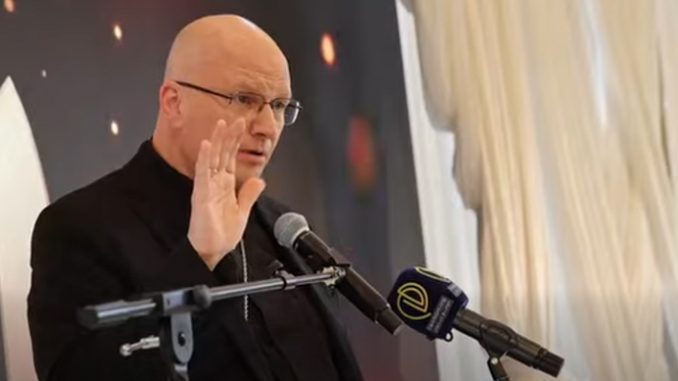
On the evening of June 6th—the Vigil of the Solemnity of the Most Holy Body and Blood of Christ—Detroit Archbishop Edward Weisenburger joined Rep. Rashida Tlaib, Imam Fadhel Al-Sahlani (representative of the Shia Grand Ayatollah Sayyid Ali al-Sistani in North America), and other Muslim dignitaries at the opening ceremony of the new headquarters of the Islamic Institute of America (IIOA) and the inauguration of the Imam Al-Hasanain Mosque.
According to the Arab American News, it is a “$16 million project that community leaders describe as one of the largest and most significant Islamic developments in Michigan in recent years.” It is a sprawling complex built on seven acres, which “features striking golden domes that have already made it a prominent landmark in Metro Detroit’s religious landscape.”
And the Archbishop of Detroit was there to celebrate it.
“There is no place where I feel more respect, fraternity and kindness,” Weisenburger declared. “From the moment I entered this beautiful site, I felt a profound divine presence. We are members of the same human family. All churches, all mosques, all synagogues, all places where God reaches out and touches with his finger are sacred. This is a truly wonderful and sacred place, a place that will bring all of humanity, I believe, into a deeper communion with our one god.”
Huh?
It should be obvious—even to those given to this kind of One God, Many Paths nonsense—that the Roman Catholic Archbishop of Detroit, whose seat is in the Cathedral of the Most Blessed Sacrament, should not exclusively find “more respect, fraternity, and kindness” in a mosque. Nor should the archbishop publicly proclaim the presence of the divine in such a place. For unless he equivocates on the nature of the One he calls divine, it is obvious that the Triune God is not present in a mosque. On this point, all Muslims would agree with me.
And with all respect to the infinitely long Finger of God, it does not—it cannot—rest upon a mosque (for the purpose of sacralizing). That is, if you are a faithful Catholic, such a thing is not possible, nor is such a statement true. Weisenburger knows that sacralization of matter inheres in the sacramental ministry of the priest in persona Christi capitis. But he apparently thinks sacralized matter pops up elsewhere—like a mosque.
Which, incidentally, isn’t even how Muslims view it. At least not entirely. The sacral character of a mosque is not in the walls or the carpets. It is in the prayers that are said. Therefore, for the Muslim, all the earth is a mosque. This is in keeping with the teaching of Muhammad. So while some holy places—Mecca, Medina, Najaf, and Karbala (in the case of Shia Muslims)—are revered, all the earth is sacred because all belongs to Allah.
A mosque (from the Arabic masjid) is first and foremost a place of prostration. To whom? To Allah. It has many other roles and functions in Islam, but one function it absolutely does not have is, as Weisenburger claims, “a place that will bring all of humanity…into a deeper communion with our one god.” Unless, of course, Muslims and Catholics and Hindus and Jews and all other believers equivocate on the nature of their God or gods.
Muslims—particularly those present at the opening ceremony—may agree with the archbishop’s statement in form. But in substance, it cannot be so. They hear “deeper communion with our one god” as tantamount to submission to Allah, the heart of Islam. No Muslim hears “deeper communion with our Triune God.” For the Muslim, this is shirk, a form of idolatry, partnering, or polytheism. It is the gravest of sins because it violates the foundational Islamic dogma of tawhid, the oneness of Allah. It is, rather predictably, punishable by Hellfire.
Did Archbishop Weisenburger cause scandal with his remarks? Absolutely, as he did not witness to Christ Crucified, and he concealed the true nature of the Triune God either to avoid offense or encourage Muslims in their faith.
But looking at it in the light most favorable to him, the archbishop probably saw this as an opportunity to witness the Catholic Faith (there is no evidence for this beyond his mere presence), engage in “religious dialogue” with Muslims (there is no evidence of this taking place at the mosque opening ceremony, whatever it might mean), and offer support to other members of our “human family” in their religious journeys.
Weisenburger entered priestly formation after the Second Vatican Council and was apparently formed by the muddled messiness too often found in seminaries in the immediate post-conciliar years. His comments are the logical and theological consequences. It simply shocks one to think that the archbishop preached on Trinity Sunday only to equivocate on the nature of that Trinity days later.
Beyond Weisenburger’s scandalous comments, the irony of the archbishop celebrating the opening of a mosque while initiating the reorganization of an archdiocese in decline will not be lost on his flock. As reported recently, the restructuring and renewal initiative, scheduled to take effect next year, will likely see the suspension or stoppage of weekend Masses at 90 parishes across Metro Detroit and surrounding counties. The archbishop believes that “God is inviting us to reimagine parish life.” It is clear that the faithful are going to need strong imagination because the reality of parish life will shrink or be nonexistent in many places.
The Mass is the source and the summit of our faith. How, one might ask, does a parish have life if the very source of that life is diminished?
In fairness to Archbishop Weisenburger, the decline of Catholic life in Detroit long preceded his coming. There are many reasons: ethnic, demographic, cultural, and religious. It is not surprising that the Archdiocese of Detroit—facing $94 million in unfunded maintenance and $18 million in budget deficits—must plan and act with firm discipline and prudence. Nor is it surprising that some of the pain will be felt on the parish level.
What surprises is how managerial it all is. The website dedicated to the restructuring employs all the usual suspects: listening, phases, implementation, parish workbooks. There is the obligatory nod to “confidence in Christ” and so forth, but the charts and graphics and middle-management-speak reek of a corporate bankruptcy plan. It is both buzzy and banal. The Barque of Peter is a business, and business isn’t good in Detroit.
In announcing the initiative last November, Weisenburger spoke of “new creativity and deep faith, to build something that will last—something vibrant, sustainable, and full of hope.” Perhaps this is what he found so attractive at the grand opening of the Imam Al-Hasanain Mosque.
If you value the news and views Catholic World Report provides, please consider donating to support our efforts. Your contribution will help us continue to make CWR available to all readers worldwide for free, without a subscription. Thank you for your generosity!
Click here for more information on donating to CWR. Click here to sign up for our newsletter.

It’s just a matter of time before Muslims are considered one with us in partial communion while the SSPX are demonised for “staring a new heretic church “.
The Magisterium seems to be following the the fall of the Israelites in the Old Testament by worshiping false gods.
Or it’s a rogue Bishop in the tunic of Judas… We’ve had heretical Bishops before – and in the majority (the century of the Arian Controversy). It can happen again. But just because several Bishops fail to follow Christ doesn’t mean the magisterium is also manifestly heretical. That is both unscriptural and illogical.
Right? It’s like we’re living in an alternate universe. You can’t make this stuff up.
Now that The Veil Is Lifted; no Faithful Catholic can plead invincible ignorance.
https://bigmodernism.substack.com/p/mcelroy-says-leo-deepens-francis
“If the reported decree comes, it will not merely punish the SSPX.”
Let the reported decree come, for in this case, it will illuminate the fact that any Faithful Catholic can know through both Faith and reason, that, in essence, it will be the false spirit of Vatican II, and it’s counterfeit magisterium, that is attempting to subsist within The True Magisterium of Christ’s Church, that will be, In essence, anathema, and thus officially separated from Christ’s One, Holy, Catholic, And Apostolic Church, In The Unity Of The Holy Ghost, The Spirit Of Perfect Divine Eternal Infinite Love Between The Father And His Only Begotten Son, Jesus The Christ, Who Proceeds From Both The Father And His Only Begotten Son, Jesus The Christ, for one cannot, in essence, be worshipping The One True God, if one denies The Divinity Of The Ordered Communion Of Perfect Divine Eternal Infinite Complementary Love, The Most Holy Blessed Trinity, In The Unity Of The Holy Ghost, which is, in essence, apostasy.
Thus, in essence, the decree , by anathema the false spirit of Vatican ll, will affirm the fact that God, The Most Holy Blessed Trinity, In The Unity Of The Holy Ghost, Is The Author Of Love, Of Life, And Of Marriage, and restore Peace and Unity in Christ’s One, Holy, Catholic, And Apostolic Church , In The Unity Of The Holy Ghost, by affirming The Filioque.
If you want to end a schism you must begin at The Beginning.
In the earliest days, syncretic Islam sought a wide and absorbent appeal….
First, about polyglot Islam:
Three of the five pillars of Islam are borrowed from the Judeo-Christian faiths (fasting, almsgiving, prayer); the timing and the length of Ramadan coincide with a Jewish holyday and the Christian forty days of Lent; polygamy and the annual pilgrimage to the (now monotheistic) Ka’ba carry over from pagan times, as does the warrior code of jihad (something like wartime Japan’s samurai/Bushido code). Some more liberal voices within Islam would marginally recognize Hinduism and Buddhism because these religions, too, have written scriptures and are “peoples of the book.” We might even notice some similarities between the historical Islamic practices of consensus building (ijma and ijtihad within a very sectarian “congregational theocracy”) and der Synodal Weg’s redefined and doormat version of “synod-ality”….(progressivist backwardism?).
But unlike equally fractious Protestant sectarianism, the sacramental Catholic Church (a “hierarchical communion,” Lumen Gentium) is Eucharistic (CCC 1374)—rather than sola Scriptura (not merely a “people of the Book”).
And, now, about dialogue:
There is much to be said about genuine dialogue, but of course without confusion, remembering this elementary caution from even an atheist (the “pope of secularism”), Marcello Pera, in intelligently robust dialogue with Benedict XVI:
“I am urging people to realize that a war has indeed been declared on the West. I am not pushing for a rejection of dialogue, which we need more than ever with those Islamic countries that wish to live in peaceful coexistence with the West, to our mutual benefit. I am asking for something more fundamental: I am asking for people to realize that dialogue will be a waste of time if one of the two partners to the dialogue states beforehand that one idea is as good as the other” (Marcello Pera with Pope Benedict XVI, “Without Roots: The West, Relativism, Christianity, Islam,” New York: Basic Books, 2006, p.45).
The voice of god in their holy book:
Fight against those who believe not in Allah, nor in the Last Day, nor forbid that which has been forbidden by Allah and His Messenger and those who acknowledge not the religion of truth [i.e. Islam] among the people of the Book [Jews and Christians], until they pay the jizya with willing submission, and feel themselves subdued. (Sura 9:29)
Kill the mushrikun [unbelievers] wherever you find them, and capture them and besiege them, and prepare for them each and every ambush. (Sura 9:5)
I will cast terror into the hearts of those who have disbelieved, so strike them over the necks, and smite over all their fingers and toes. (Sura 8:12)
Precisely!
In the name of GOD, there is nothing sacred in the Quran! He has not read the Quran.
Get enlightened.
1984 and Islam
https://www.youtube.com/watch?v=-Mzf7-NtWKI&t=2313s
Beloved Siddhi Nasranni – this song will show you what we will all face on Judgment Day; is anyone so bold to face it without faith in Jesus.
CeCe Winans – Is He Worthy? – YouTube
What a wonderful gift African American musicians are. They can touch Heaven, even here on Earth. Praise GOD forever.
And some criticize Thomas Merton for having dreamed of being a Buddhist monk! Was it St. Augustine who thanked God for not holding him responsible for what he dreamed?
Brave browser search terms: Was it St. Augustine who thanked God for not holding him responsible for what he dreamed?
AI-generated answer (bold style omitted):
Yes, St. Augustine is credited with thanking God for not holding him responsible for his dreams, a sentiment notably cited by Carl Jung to illustrate the autonomous nature of the unconscious mind. In his Confessions (Book X), Augustine expressed relief that while he could control his waking actions, dreams were involuntary happenings rather than deliberate choices, meaning he lacked moral culpability for the sins committed within them. This distinction between active waking responsibility and passive dreaming experience allowed Augustine to seek divine grace to heal the lingering desires that surfaced during sleep, without attributing personal sin to the dreams themselves.
I saw his presentation on Youtube. This picture does not show it, but he appeared to cover his pectoral cross with is hand nearly all the time while speaking. Here, it looks like it has been tucked away until his jacket
Is this guy for real?
Weisenburger has no particular affection for Islam or Muslims. The LGBTQ movement is much more to his liking. As a leftist, he celebrates Islam simply because it is one of the main historical enemies of the Christian West that he despises. All of the actions of characters like him— from the promotion of mass immigration to the suppression of the Latin Mass— can be understood accurately through that lens.
In 2018, Weisenburger linked the prevalence of sexual abuse to the cultural shifts of the 1960s so-called “sexual revolution,” a perspective criticized by some as deflecting responsibility from the Church’s institutional failures.
In August 2021, Weisenburger issued a statement to his clergy, directing them not to be involved in supporting applications for religious exemptions from COVID-19 vaccine or mask mandates.
In March 2024, Weisenburger publicly thanked Pope Francis for his critique of “irresponsible” American lifestyles contributing to anthropogenic climate change.
In July 2025, Weisenburger banned the celebration of the Tridentine Mass in parishes.
In 2025, Weisenburger terminated three professors of theology and canon law, Dr. Ralph Martin, Dr. Eduardo Echeverria, and Dr. Edward N. Peters, from Sacred Heart Major Seminary in Detroit, without explanation.
This is the latest in a long line of actions that are contemptuous, imperious and abusive subversions. He’s a star in a pantheon of political subversives masquerading as bishops.
When Archbishop Sheen stated the Church would be rehabilitated from the pews, he didn’t specify how. Let the this “Archbishop” get his donations from Muslims, and aggrieved Catholics should direct their offerings to private investigators who can determine whether or not there is scandalous behavior that the people he rules with an iron fist have every right to know about, beyond his abuse of office.
The worst part is he’s only 65.5 (tomorrow), which means he’s got 9 and half years of being a comic book villain and tyrant. Still he’s a bit young to have been a hippie. What an utter embarrassment.
Now he’s in a diocese where a Catholic did get support from her priest for a religious exemption, got fired from blue cross, but ended up winning in court to the tune of millions. Lisa Domski
Plus he almost immediately canned those professors from the seminary who questioned some of Francis’ dictims.
He’s a “typical” Bishop today in the aftermath of the wreckage of Vatican II; a council designed by inimical forces both within and by secular pressures without to advance every OTHER creed than the Catholic. Decomposition, decay, rot, corruption, compromise – the REAL “Spirit” of Vatican’t II.
With all the comments on this article (164 as of this morning in the U.S.) hard to add anything meaningful. But I nonetheless wish to endorse your comment, Pitchfork Rebel, for pointing out that one of the first things this guy did upon becoming the head of the Detroit Archdiocese was to dismiss from Sacred Heart Seminary three wonderful Spirit-filled teachers.
Christ in the Gospels and Paul, John, Peter and Jude in the Epistles warned of the continual problem of false teachers in the Church. When you have a prelate who took the disgraceful aforementioned action and also claims divine presence, not in the Eucharistic Tabernacle but rather in a Muslim mosque, we are again reminded of this warning
Yes, the gesture of “Islamo-filia” is simply an ornament of his cult, which is Marxist intersectional ideology,
Well discerned, dear ‘Chris in Maryland’: “his (Weisenburger’s) cult . . . is Marxist intersectional ideology”.
Among Aussie Catholics that comes with freemason, luciferian polytheism.
Let’s pray for bishops who boldly proclaim the One True Catholic and Apostolic faith. They are thin on the ground.
Here in the UK we’ve had to suffer the sight of the fake Archbishopess of Canterbury being honoured and treated as an equal both by our local hierarchy and the Pope in Rome.
In Australia not much better!
We need a Crusade but instead, become a doormat.
Instead of wasting both his Church and his opportunity, the well-meaning but content-challenged Detroit Archbishop Edward Weisenburger might have said something wiser…
Four comments and an overview:
FIRST, as human beings (not the religions, per se) the individual “witnesses to Christ” and the individual “followers of Islam” are challenged to live at least in natural (!) fraternity, while also being conscious enough as to acknowledge, equally (!), the difference between all natural religions and the supernatural faith of incorporation into the divine life of the self-disclosing Triune One. The real Catholic Church and some guy named Benedict XVI put it this way:
“Equality, which is a presupposition of interreligious dialogue, refers to the equal personal dignity of the parties in dialogue, not to doctrinal content, nor even less to the position of Jesus Christ–who is God himself made man–in relation to the founders of the other religions” (Congregation for the Doctrine of the Faith, “Dominus Iesus” [The Lord Jesus], 2000, n. 22).
SECOND, on this clarity, Weisenburger might have even celebrated a former Muslim scholar who, immediately before the Second Vatican Council, also remarked:
“It all comes down to knowing whether one should hold strictly to the fundamental religious values which were those of Abraham and Moses, on pain of falling into blasphemy—as the Muslims believe; or whether God has called men to approach him more closely, revealing to them little by little their fundamental condition as sinful men, and the forgiveness that transforms them and prepares them for the beatific vision—as Christian dogma teaches.” (el Akkad in 1956, as cited by Jean Guitton, “The Great Heresies and Church Councils,” 1965).
THIRD, before sleepwalking into the current moment, Weisenburger might have paused at Benedict XVI who, in his balanced Regensburg Lecture (2006), critiquing both the excessive rationalism of the post-Christian West and the irrational fideism of pre-Christian (not chronologically, but in content) Islam. Even earlier, Benedict had explained about the flaccid and post-Christian West:
“We must acknowledge, however, that faith is seriously weakened and threatened within the Church. Even we in the Church have lost courage. We feel it to be arrogance or triumphalism to assume that the Christian faith tells the truth. We have picked up the idea that all religions are the product of history, some developing this way and others that, and that every person is as he is because of the accident of birth. Such a view reduces religion from the level of truth to the level of habit [….] There is a great temptation to say, ‘But there is so much suffering in the world!—let’s suspend the question of truth for a while. First let’s get on with the great social tasks of liberation; then, one day, we will indulge in the luxury question of truth’” (Ratzinger, “Behold the Pierced One,” Ignatius, 1986).
FOURTH, Archbishop Weisenburg totally misses what a cardinal noted about a Vatican synod in late 1999…The study topic was how to improve rapport between Christians and Muslims. The cardinal recalled this from an attending Muslim: “By means of your democracy we will invade you, by means of our religion we shall dominate you” (His Eminence monsignor Guiseppe Bernardini, archbishop of the Turkish Diocese of Smyrna, in Oriana Fallaci, “The Rage and the Pride,” New York: Rizzoli, 2001, 98).
Very synodal, that!
OVERVIEW: Constantinople in Turkey is where the secular museum of the Cathedral of Sancta Sophia (built by the Christian Justinian I in A.D. 532-537) has been converted/reverted, again, back into a mosque. And, the rest of the world is where 90 percent of fashionable new mosques are funded with fashionable Wahhabi petro-dollars.
Apparently, “Excellency” Weisenburger and the Imam of the new Mosque can simply trade places every weekend, and no one would know the difference.
Accurate discernment, dear Chris in Maryland.
That, ideed, is satan’s plan.
Thank you Martin, I appreciate your support.
Quite a comment!
I thought of the beautiful Sancta Sophia the moment I heard of this event. Does no one remember that the now Muslim East was the heart of early Christianity. From this article, and your thoughtful analysis, Mr. Beaulieu, it appears to be where the West is now headed.
Thank you Rebecca for reminding us of what happened to the Church in the East, which was once the center of Christianity while the West was still mostly pagan. That may be our future. Yes, Hagia Sophia is now a mosque. May God protect Saint Peter’s Basilica. Actually it was sacked by Arab followers of the religion of peace, in 846. The Pope fled behind the Aurelian walls. His successors built the Vatican walls as a defense against the religion of peace (which CC authorities and professors say worship the same god as the Christians they persecute). Muslim Turks sacked Otranto in Italy in 1480 and beheaded over 800 Christians who refused to worship the Muslims’ god (“The Martyrs of Otranto”).
For all this See
https://www.raymondibrahim.com/06/15/2016/published-scholar-talks-islam-at-mtra
and this
https://www.catholic.com/magazine/print-edition/how-the-800-martyrs-of-otranto-saved-rome
With the waves of illegals invading Italy, they have no need for force to conquer the land. Of course the Pope does not want them in his own domain. See this:
Vatican Promises Stiff Penalties for Illegal Aliens Crossing its Border
https://www.breitbart.com/europe/2025/01/16/vatican-promises-stiff-penalties-for-illegal-aliens-crossing-its-border/
Peter:
I couldn’t agree more regarding the observation that Pope Benedict made about the falsification of God in Islam, and the astonishing convergence of contemporary post-Christian political ideology in the West, which distills into an autonomy of absolute willfulness, and how that arrives at the same destination as the Islamic falsification of God as the absolute tyrant of willfullness.
It is too easy to recall his unjust dismissal of 3 deeply Catholic professors from Sacred Heart Seminary quick upon the heels of his installation. Men like this being elevated to positions this high is evidence of God’s respect for human freedom and intellect regardless of how poorly it is exercised. I feel for the Archdiocese.
Well noted: thanks dear Chris Chapman.
Am sure the three faithful professors are rejoicing to have been persecuted for The Name Above All Names. What a privilege!
A privilege that may be graciously afforded to every faithful Catholic in the days ahead.
Thank you, Mr. Chapman. I wasn’t aware of the actions you describe. How very sad that this prelate has been elevated to such a position within our church, or should I say troubling?
Although, Timothy Lusch isn’t this Bahai [Baháʼí] religious vision of Archbishop Weisenburger inherent in the new paradigmatic Church indicated in the Synodality in general and specifically in Study Group 9? Apparent in the Archbishop Paglia confessional interview.
Blame has been cast on Vat II, which the documentation never advanced. That red herring the rationale of those unwilling to comply with the good contained in those documents. Adding to the ease for progressives to implement the spirit of Vatican II.
That deleterious spirit found its epoch in Pope Francis and unfortunately remains with the current pontificate of Leo XIV. He appointed Weisenburger whose record was known. As were other appointments. That mixed in with orthodox statements, demeanor leave many of us anesthetized.
For the faithful essays like yours highlight the problem affecting our Church. Certainly, our faith is being tested in this. God is permitting it due to our own laxity. Whereas Judith teaches us that God tests those who are close to him with trial.
I was received into the Church Easter 2022 at the tender age of 69. I appreciate Vatican II for many reasons, many related to my lack of understanding Latin. More to its reach to the nations. Fr., what you have said addresses a primary concern I had during my heart searching. Pope Francis was so popularly different; he espoused ideas I didn’t find in the CCC I was reading and certainly not as I understood the gospels. But I have never, not for one day, regretted my conversion to the Church Christ founded. Your comment helps me remember why, along with the wonderful Bishop and priests of my parish.
Rebecca, God has blessed you with a true, living faith.
This article is nonsense on stilts. One fears the author would get the vapors if he read Pope St. Gregory VII’s letter to the king of Mauritania:
“For almighty God, who wills that all men be saved and that none should perish, approves nothing more in us than that, after loving Him, a person should love his fellow man and should not do to another what he would not wish done to himself. Therefore, we and you owe one another this charity in a special way, more than to other peoples, since we believe in and confess one God, though in different ways, and daily we praise and venerate Him as the Creator of the ages and the ruler of this world. For, as the Apostle says: ‘He himself is our peace, who has made both one.’”
Amazing that Gregory, who was far more familiar with militant Islam than anyone on the comment board, could speak so kindly and so judiciously of Islam. The author should take note.
“Islam has not wanted to choose between Heaven and Earth. It proposed instead a blending of heaven and earth, sex and mysticism, war and proselytism, conquest and apostolate. In more general terms, Islam proposed a blending of the spiritual and the temporal worlds which neither in Islam nor among the pagans have ever been divided” (Jean Guitton, “Great Heresies and Church Councils,” 1965, p. 116).
Well done. Thank you for sanity.
A sane Catholic and Gerard,
While not having a lock on sanity, you do hint toward a real complexity about dialogue between persons versus dialogue between their incompatible religions.
Among members of all religions and of no religion at all, we can see evidence of natural virtue (not the same, though, as the supernatural and gratuitous virtues of Faith, Hope, and Charity). The perplexity is in the mysterious workings in individuals, of the Holy Spirit. Some say that we can detect the working of the Holy Spirit—Who blows where He will—by the “fruits of the Holy Spirit”— including kindness, goodness, and gentleness, if exercised at the graced level…
What are we to think, for example, about the individual members of both sides of the Crusades? Western armies often cared for and returned Muslim children captured in battle, and of the Muslims, Oliverius Scholasticus, a member of a defeated Frankish army, offers this striking report:
“Who could doubt that such goodness, friendship and charity came from God. Men whose parents, sons and daughters, brothers and sisters had died in agony at our hands, whose lands we took, whom we drove naked from their homes, revived us with their own food when we were dying of hunger, and showered us with kindness even while we were in their power” (Friedrich Heer, “The Medieval World,” Mentor Books, 1963, p. 144).
Again (as explained in unread remarks above), there’s the not-so-insane (!) distinction between many individual Muslims on the street vs Islam as a package-deal religion. For example, the borrowed “Law of Moses” (Pentateuch) is a refrain found throughout the Qur’an, but not explicitly listed is the balancing and prohibitive Commandments 5 through 10. This vacuum of “thou-shalt-not” is too easily filled by early Arabian and always expansive jihad as the method of choice for proselytizing.
Wow, did you even read it?
What an uncharitable comment. Why is this article “nonsense”? Why do you think the author “would get the vapors” reading what you posted here from St. Gregory VII?
As any diplomat knows, we affirm what is right and true in any person. You clearly left out the context in which St. Gregory VII’s letter was written. He was working for peace and trying to free Christian people who were captured. You left this part out:
“[O]ut of love for us, you freed some Christians who were being held captive by your people. You also promised to free the other (Christian) captives. It is certainly God, creator of all things, God without whom we can do nothing or even think of anything good, who inspired your heart to do this good deed, for he enlightens every man who comes into this world, and he enlightened your mind on this occasion.”
You also left out the part where St. Gregory VII calls for the conversion of the King and his people:
“We exhort you to offer him [Servandus, the priest who the king one year prior asked Gregory to make bishop of all Christians in his province] all your humble obedience according to the divine law, so that the non-Christian peoples around you, seeing the sincerity of your faith and also the purity of the divine charity that reigns in you and of your brotherly love, may be led by your examples to imitate you and not to despise the Christian faith; indeed, by looking at you they must glorify your Father who is in heaven. Act, then, beloved sons, according to the precept of Our Lord Jesus Christ, who said to his disciples: “Love one another as I have loved you. There is no greater love than to lay down one’s life for one’s friends. ”
This is qualitatively different from what happened in Detroit with the archbishop there. There’s nothing wrong with Gregory speaking kindly when he was trying to free Christian captives and maintain peace. But there is something wrong when an archbishop makes comments that call into question the salvific necessity of Jesus Christ and His Catholic Church.
Your comment drips with a haughtiness that does not befit a Catholic Christian. Perhaps you could take a lesson from Pope St. Gregory VII and speak more kindly to your Catholic brethren in future, and actually point out what makes his article “nonsense on stilts”. God bless you.
For the record, this was a fantastic article which should prompt a lot of reflection. Thank you for your contribution, Mr. Lusch. Praying for our shepherds to bring all the sheep into the one fold of Christ by word and example.
Bob – I repeat, nonsense on stilts. Absolutely nothing you posted had anything to do with my charge against the author’s ridiculous view of Islamic theology. And it is frankly ridiculous to suggest that the archbishop, an invited guest at an interreligious ceremony, should have called for his interlocutors to convert. That’s a great way to end a dialogue. I’m sure you’d take it just fine if an imam present at the dedication of a Catholic church said the same.
Am I being haughty? Rather, sane. I’m tired of the nonsense in these comment sections. Ninety percent of what is posted is beneath the quality of the articles. The combox is increasingly an echo chamber.
Dear anonymous ‘catholic’ – speak for yourself . . !
It’s no wonder you don’t like most of the comments here, they’re more humble, informed, & genuinely communicative than the stentorian but largely erroneous and vacuous contributions you have offered so far.
Maybe this is why you shield behind annonymity . . ?
Please try again; taking your lead from our learned, gentle majority of committed (not communist!) Catholics.
Ever in the love of King Jesus Christ; blessings from marty
Double talk…insane word salads where what is said does not reflect simple reality. “Love one another as I have loved you”. Pretty simple. No salad dressing needed. OK Have at it…
So nice to know that I am not completely alone here. 🙂 Who knew that insane fear and walls built of words meant to isolate and distance and condemn – even to the point of denying the Omnipresence of the Divine – could masquerade as religion despite the absence of real Heart. Looks like Terror in place of Faith.
Dear ‘yoteech’: in the context of this great CWR article by the learned & faithful Timothy D. Lusch, and the very numerous comments by mostly educated Catholics, do you think these 2 comments of yours add anything; or indeed achieve any degree of coherent meaning?
As previously recommended to you: “Ask our LORD Jesus Christ for help; read The New Testament; find a good priest willing to mentor your life progress.
Your soul is precious to Jesus; do your best to look after it.
Always in the merciful love of Jesus; blessings from marty
“There is an obvious objection, which is that non-Christian Jews also reject the Trinity, but Catholic Tradition has never held that Jews don’t worship God. The doctrine of the Trinity had not been clearly revealed in Old Testament times, and Jews prior to the time of Christ did not believe in it. Jesus even acknowledges this. As he says in John 14:1, “You believe in God, believe also in me.”
The Trinity was new revelation with the Christian age, but that didn’t stop previous Jews—or those who maintained the previous, non-trinitarian understanding of God—from genuinely directing their prayers to the Creator of the universe.
This is a reflection of the fact that you don’t have to know everything about someone in order to talk to him or give him honor and worship.
But if non-Christian Jews disbelieve in the Trinity and nevertheless worship God, then the same will be true of Muslims, who do the same thing. They may not understand God with the full Christian understanding of him—just as contemporary Jews don’t—but they do recognize that there is a Creator who appeared to Abraham and to whom they direct their worship.
What may come as a surprise is that this has been the traditional Catholic understanding. If you read traditional authors interacting with Islam—like St. Thomas Aquinas or St. John Damascene—they criticize it, but you don’t find them saying things like, “Muslims worship a different God from the God we Christians worship.”
The more one delves into the Tradition, the more clear it is that Catholics have accepted the basic premise that Muslims—despite what is flawed and incomplete in their understanding of him—do worship God.
This comes out more clearly the deeper one goes into the Tradition, as we can see by examining the footnotes of Vatican II’s discussion of the subject.
There are two passages where the council discusses Muslims, as mentioned above. One is in Lumen Gentium 16, and the other is in Nostra Aetate 3. The latter says,
The Church regards with esteem also the Muslims. They adore the one God, living and subsisting in himself; merciful and all-powerful, the Creator of heaven and earth, who has spoken to men; they take pains to submit wholeheartedly to even his inscrutable decrees, just as Abraham, with whom the faith of Islam takes pleasure in linking itself, submitted to God. Though they do not acknowledge Jesus as God, they revere him as a prophet. They also honor Mary, his virgin Mother; at times they even call on her with devotion. In addition, they await the day of judgment when God will render their deserts to all those who have been raised up from the dead. Finally, they value the moral life and worship God especially through prayer, almsgiving, and fasting.
Since in the course of centuries not a few quarrels and hostilities have arisen between Christians and Muslims, this sacred synod urges all to forget the past and to work sincerely for mutual understanding and to preserve as well as to promote together for the benefit of all mankind social justice and moral welfare, as well as peace and freedom.”
Catholic Answers 1/24/2025
“Let US Make man in OUR Image.”
Dear MrsCracker, thanks for presenting the arguments for unitariansism or semi-unitarianism.
Let’s remember that both John the Baptist and our LORD Himself referred to the Jewish ‘pope & cardinals’ of their day as: “seed of satan doomed to hell” and similar descriptives. Like Moslems today, those Jewish leaders mistakenly insisted that they worshipped the one true god.
Freemasons are also unitarian heretics, making the identical, eternally fatal error in thinking ‘G’ is the one true god.
If we’re Catholic or any sort of Christian (free of masonry!), we’d surely recognize the precedence of GOD Himself in our LORD Jesus Christ instructing us that religious persons’ claims to worship GOD may be vacuous or worse. So, then, how to get free . . ?
Reading the Quaran opens the eyes to who Moslems worship & it’s the sovereign prescription for curing unitarian diseases & returning one to the pure Trinitarian Faith of our loyal Catholic mothers & fathers.
Well stated. Thank you.
We’re more familiar with the cognitively deficient.
Dear annonymous, Weisenburgerophile, calling yourself ‘A Sane Catholic’: it’s probably a waste of time to remind you that salvation is found in King Jesus Christ, and in Him alone; for your ‘sanity = hubris’ has blinded you to the Truth.
Among clinically demented, it’s the worst who insist they alone are sane.
Not everyone who says they are a Catholic is a Catholic.
Forgive me, a relatively new Catholic (Easter 2022), but yours seems a harsh and almost un-Christian reply. I try to remember Matthew 5:1, along the lines of Judge not lest ye be judged. And Jesus goes on to talk about removing the log from our own eyes rather than worrying about the mote in our brother’s eye. Just a thought you might ponder, Dr. Rice.
Dear Rebecca Watson Kahn; thank you for the reproof.
Re-reading my response to the upitty comments of the ‘sane, anonymous person’ who claims to be a Catholic: agreed I was shorter & sharper than the ideal.
In ammelioration: please don’t judge that harshly as many of us find it hard to take when we have no idea who this annonymous commenter is and thus no way of knowing if they’re a regular church member.
As some suggested, the stentorian-comments of the so-called ‘Sane Catholic’ could be from anyone, maybe an echo-mate of Weisenburger; or even the errant Arch. himself?
Hoping you can appreciate that ALL ASC’s comments have implied the insightful article by Timothy D. Lusch, plus the learned comments & thoughtful reflections on it have been contributed by Insane persons who are ignorant of the Catholic faith; unlike ASC.
ASC’s wild, uninformed bragging such as: “I’ve read Dominus Iesus more than you.” adds to a perception of ASC’s lack of respect for others.
ASC’s ad hominems speak volumes!
ASC says: “90% of what is posted is beneath the quality of the article”; the article that he has aleady condemned as rubbish!
ASC seems to have no intent to make a genuine contribution. Rather, the aim seems to be to cause anarchy & mischief; clearly motivated by the aim of destroying the vitally relevant information that is of importance to all Catholics, everywhere.
ASC seems to be a professional at this game (maybe on salary).
So thanks again and with blessings in the Name of Jesus our LORD.
Dr Rice, There seems so little Christ – like demeanor in so many of your posts here that I wonder how I let myself get drawn in to such hypocritical conversation. I need to keep my own heart more open so must again withdraw from conversations here. You are free to have at it again. Good bye. I’m out once again.
Indeed.
“Doctor” Rice – I wonder where you got your degree, since you clearly never learned the logical fallacies – before I laugh at your petty accusations, I’ll wager that I’ve read Dominus Iesus more than you.
BSc Hons from The University of London, UK
PhD (Science) from The University of Birmingham, UK
Graduate Diploma in Ministry from Christian Heritage College, Brisbane
PhD (Arts & Social Science) from Griffith University, Brisbane
Your turn now, beloved annonymous ‘ASC’ . . . we’re waiting . . .
as the song goes, “Who is the King of Glory, how shall we call Him? He is Emmanuel the promised of Ages. The King of Glory comes the nation rejoices, open the gates before Him lift up your voices!”
Well said, dear ‘knowall’.
You’d like this creedal account of our lovely One True GOD –
The God We Love CityAlight YouTube
CityAlight joins with Matt Redman to create Nicene Creed song
When were you appointed by God to be the judge of other people’s faith?
Dear ‘yoteech’: as we keep exhorting you:
“Find a good Catholic priest, repent, receive Jesus Christ as your one & only LORD, get catechised, and live your life as a faithful servant among all of us Catholics who are servants of The One & Only.”
You will then understand what it means to be in The Body of Christ.
“Christ, high priest and unique mediator, has made of the Church: ‘a kingdom, priests for his God and Father’ (Revelation 1:6, see 5:9–10; 1 Peter 2:5,9). … The faithful exercise their baptismal priesthood through their participation, each according to his own vocation, in Christ’s mission as priest, prophet, and king (CCC, 1546).”
Thus equipped we are gifted to make accurate discernments concerning what is orthodox faith in GOD and what is aberrant or even heretical.
Hope this helps and my prayers are with you, beloved yoteech.
The job of the church is to save souls, is my understanding.
“…a place that will bring all of humanity, I believe, into a deeper communion with our one god.”
*****
Who decided to not capitalize “God”?
I assume the author, perhaps because he refuses to admit that both Catholics and Muslims worship the one God?
I don’t know, Sane Catholic but I assumed it wasn’t the Archbishop.
http://www.catholicapologetics.info/apologetics/islam/worship.htm
Our God is a Trinity – Father, Son and Holy Spirit. “God has no son” is a fundamental and absolute tenet of Islam. It is a core pillar of Tawhid—the indivisible, absolute oneness of God—which forms the foundation of the entire Islamic faith. This belief is most famously encapsulated in Surah Al-Ikhlas (Chapter 112) of the Quran: “He begets not, nor is He begotten”.
Have you ever picked up a copy of the Quran? Have you ever lived in a Muslim-majority country? If you think Allah is the same God as is found in the Bible, you have a significant comprehension problem.
Perhaps and innocent typo?
Excellent article! Something else that has not really been addressed as the fact that many parishioners have decreased their financial offerings because they have lost confidence in many of the church leaders. Perhaps the restructuring needs to begin in the Vatican. Satan loves confusion, and that is what we have been given by some priests, bishops, cardinals, and even recent popes. I’d like to begin with removal of father James Martin which is a whole other conversation.
Thank you, dear Maria Eby for expressing your heartfelt distress with: “confusion, and that is what we have been given by some priests, bishops, cardinals, and even recent popes.” That same heart distress is felt right across the Catholic world by hundreds of millions of sincere believers.
Your discernemnt of the satanic spiritual origins of this is (Praise GOD!) gradually being realised by more and more among our prayerful Catholics.
Even our LORD had that problem with His little flock, as in John 6:70 –
“One of you is a devil.”
Saint Paul identified this sort of treacherous sabotage among the first Catholic bishops; as recounted by Saint Luke in Acts 20:30 –
“Even from your own ranks there will be men coming forward with a travesty of the truth on their lips to induce the disciples to follow them.”
The basic cause? Lack or loss of The Holy Spirit of GOD, who we all need to protect us from infiltration by the counterfeit father of lies.
There’s not enough time to list the many reasons why bishops or other Catholics lack or lose The Holy Spirit. Maybe we need a CWR article focussed on that. I humbly suggest the esteemed lay Church elder, Professor Ralph Martin, would be a very well-qualified author.
Actually, this is so critically important that a confernce is needed.
Ever seeking to hear & lovingly follow King Jesus Christ; blessings to all from marty
One more spineless bishop, scared to death of islam. The Muslims read him as weak and cowardly and easily moved to their positions. The Muslims clearly see that Catholics have no true strong shepherds. And they are correct.
Our bishops deplore Catholic tradition and those that respect it and will punish those that reverence the Tridentine Mass.
But the Muslim maniacs who slaughter Christians in Africa, their name will not be spoken.
Is he spineless? Or is he subversive?
Some day, when the Muslims reach critical mass demographically, they will drag Bishops from their beds. Only a fool thinks that things such as mayors telling aggrieved citizens, you aren’t welcome here (in Dearborn) is the end of the conquest.
There will be nobody to help the Bishop. (I’d like to take credit for this prediction, but it’s a more detailed projection of the late former Cardinal Archbishop of Chicago’s prediction that he would die in his bed, but a successor would die in the street).
I’m figuring that occurs in 20 years. By that time, Wiesenberger will be retired, disabled or dead and unable to reap the crop he is sewing. Bummer.
Do not fear, Rebel friend. God judges weasels at the story’s end.
I don’t give a hoot what Archbishop Weisenburger says. Muslims worship a FALSE god. Our Christian God is the TRUE GOD whose divine essence is Three Persons.
And, besides, I am sick and tired of homosexual clergy and clergy who support homosexuality.
Deacon, it’s time you read both the Catechism and Vatican II. Both cite none other than SAINT Gregory VII declaring that both Muslims and Christians worship the one true God. It is rank balderdash to suggest otherwise.
Hey Ed, get back to running the Detroit Diocese (into the ground, the way the car industry did). Nobody’s buying your cover or your shilling.
I don’t care to argue who the Muslims worship, its irrelevant-what is relevant is how they worship.
Marrying nine year old girls, and in some cases injuring or killing them from penetration their immature bodies cannot yet accommodate, suicide bombings, using airliners as missiles.
“Pitchfork Rebel” – don’t know why you think I’m named “Ed”; not even close. And by the way, St. Thomas Aquinas thought it was relevant to argue whom the Muslims worshipped, and he lived during a period of, shall we say, great violence.
No, actually. It represents an impoverished theology. No one with a biblical understanding of the true God would equate Him with the false God of Islam.
Well, “Athanasius”, Thomas Aquinas did (Summa contra Gentiles I, chapter 6). Did he lack a “biblical understanding”?
No, you sadly mistake their intention because you fail to think contextually. Your’s, dear ASC, is eisegesis not exegesis. Fatal!
Certainly it’s true that people – Catholics, Orthodox, Protestants, and Abrahmics like Jews & Moslems SAY they are worshipping the one true GOD. We all can say that!
As our LORD Jesus Christ taught (e.g. see John 7:28) our claim of worship is fallacious if we do not KNOW the ONE we say we worship.
Informed Catholics (and other genuine Christians) know that there’s only one Person, Jesus, who reveals THE ONE GOD & FATHER, so that we can truly know who it is we’re worshipping.
Jesus Christ is called: ‘The Light of The World’ for good reason.
In simple terms: it’s the differerence between people kicking a football in a darkened room, hoping to get a goal versus people kicking goal after goal with the Light on!
Is it not sacriligious for an Archbishop of The Catholic Church to affirm those who kick in darkness, when he’s been commissioned by the LORD and The Church to show them how to turn on The Light?
Dear ASC – for the sake of your soul – please think about it.
“Doctor” – I do not know why I indulge your academic pretensions when clearly they are undeserved. The unanimous tradition of the Catholic Church is that Muslims worship the one God same as Christians. I could not possibly care less for your denials.
The Catechism itself is not an infallible document, e.g., paragraph 2267 on capital punishment before and after Pope Francis’d change in 2018. And was St Gregory VII speaking Ex cathedra when he wrote what he wrote? I think not. Sometimes popes (and saints) get it wrong. I submit Galatians 2:11-14 where St Paul corrects St Peter to his face regarding not eating with gentiles.
Ron – then tell me why St. John of Damascus, St. Thomas Aquinas, and Nicholas of Cusa also believed that Christians and Muslims confessed the one God.
See above – anyone can confess anything.
It only counts if you know and thus love the ONE you confess.
“Doctor” – since you manifestly do not actually care for the teaching of the Church, I don’t know why you bother posting here.
Sane Catholic,
Your posts are confusing and possibly duplicitous. For one, it is noted that you don’t always use the same terms- you mostly omit the word “same,” but say “the one god,” which are distinct concepts. To say muslims acknowledge “the one God”/one God, which has truth to it, and which is also what Gregory VII and VII said, is not synonymous with the same God. If you mean to say the latter, and that it has been the continuous tradition that Catholics and Muslims worship the same God, that claim is wrong, as up until shortly before VII, the recognition of Islam was mostly negative, including from the figures you mention- that it’s a heresy(John Damascene), diabolically-inspired, a political movement, a militant movement- in Aquinas’ take. Even Gregory vii’s statement is an outlier and hardly a pattern, while VII does not say “same.” (The latin word used in N. Aetate is unicum, which can mean simply one, as in monotheistic, vs. the one.) It is interesting to note that under Pope BXVI, even the concept/phrase that muslims worship the one god was not included in a joint declaration with Muslims in 2008. If I’m not mistaken, that was also the first declaration of its kind following VII.
Dear Sane Catholic: Here’s the acid test: Ask 100 devout Muslims if they worship the same God as do Christians. Then get back to me.
Deacon: I’ll get back to you as soon as you ask a hundred Catholics if women can be ordained and if homosexuals can get married. Polling’s the way to religious truth, no?
What nonsense!
Perhaps they should be asked if they worship the God of Abraham? We could all say “Yes” to that I think. Jews, Christians, & Muslims alike.
We can have very different understandings of Him it’s true, but He is the same notwithstanding.
Beloved MrsCracker – Maybe we could add a few Scriptural facts; facts that don’t always submit to our earnest desire to be tolerant of all.
The Moslem’s Quaranic ‘Allah’ is the Miasma that blinds minds and the Vortex that is sucking millions into hell for all eternity.
Its spirit is well-known: obsessively proslytizing by using any & every means ranging from murderous genocides to massive bribery and even gentle kindnesses. All with one aim: DOMINANCE.
The Moslem Allah is rediculously ‘super masculine’, promising men a ‘paradise’ of unlimited sex with each man awarded more that seventy
maiden houris, to serve him day & night.
This Quaranic paradisical instrumentation of women is ridiculus BUT it’s reflected in degradation of millions of women & vicious torture of women who show the slightest independence in this life.
That doesn’t apply to Indonesian & other Christians who sometimes use ‘Allah’ as a generic name for The GOD & Father of Jesus Christ, among whom women have authority & are greatly honoured.
Same name, DRASTICALLY different spirit.
The Holy Spirit of GOD inspired our LORD Jesus Christ in this rebuke of those who claimed to worship His God (John 8:44) –
“THE DEVIL IS YOUR FATHER & YOU PREFER TO DO WHAT YOUR FATHER WANTS.”
Observed behaviours of Moslems suggest this cap fits them well.
Ever in the grace & mercy of King Jesus Christ; love & blessings from marty
Dear ‘MrsCracker’: “We can have very different understandings of Him it’s true, but He is the same notwithstanding.”
The whole point of The New & Better Covenant” (Hebrews 12:18-29) is that we humans are AT LAST AND FOREVER shown how to worship GOD in the only Way that He has made acceptable (v. 28).
That unique Way is exclusively through the one & only Priest of The New & Better Covenant, The Lion of Judah, The Lamb of GOD, The Only One Found Worthy, Jesus Christ, the only begotten Son of God.
Catholics & other true Christians would be taken directly to Heaven upon our cleansing baptism, except that we are expected to bravely announce this one pure truth to all creatures in this Earth, so that at least some can be saved. A sacred, life-long duty.
Maybe try this song on your Moslem friends –
CeCe Winans – Is He Worthy? – YouTube
What a great gift to us are African American musicians who bring us closer to Heaven than any others.
Thank you Dr. Marty. We share the same feelings about about music. That’s a good thing.
🙂
Islam misunderstands God, but it simply is wrong to say that Islam’s Allah is a different God. Mohammed himself asserted that Allah was the God of the Old Testament. And no doubt people will decry the authority of the Catechism post-Vatican II error, but it clearly says that Muslims worship the same God.
Thank you steveb.
True Catholics & other true Christians worship GOD who promises to be our peace & our joy & our light & our glory in Heaven eternal.
Moslems worship a god who promises them endless, unlimited sex with personal hareems of 72 women.
Dear anonymous ‘steveb’ and dear anonymous ‘MrsCracker’ if you wont tell the difference and if you wont stop proslytizing that lie, then may Heaven help you!
Think carefully: you’ll not be anonymous on Judgment Day.
This truth may sound harsh, but for your soul’s sake must be said.
The Islamic rudimentary understanding of the basic qualities of God compared to the fuller Trinitarian understanding is like comparing a grade school student’s general level of intellectual development to a graduate student’s general level of intellectual development, and it’s not even close. When it comes to God and all that humans can know about Him, Muslims are a bunch of galactic dunderheads. Of course some people given to syncretism and various forms of universalism have no problem with letting Muslims remain childishly and absurdly ignorant on this matter (‘aren’t they just cute staying in grade school forever?’), and so their enhanced ignorance continues without any pushback in defense of the truth.
Also, Christians accurately portray what Islam ‘teaches’ about God, ridiculous contradictions and all, by showing greater theological integrity in honestly engaging what Islam actually proclaims. On the other hand, and despite thousands of years of explaining the basics of the Trinity, Islam and the Muslims who preach their super ‘heresy’ (broadly speaking) will simply disrespect Christians by mocking the notion of the Trinity by claiming it pertains to Mary being physically united to God and producing Jesus.
How ignorant and arrogant do you have to be to not even honestly engage what is actually being taught, and it amounts to this from Muslims: “I don’t care what Christianity has said about the so-called trinity for thousands of years. We do not accept Christian statements (finding a token Muslim that does accept Christian notions of the Trinity changes nothing), and we also insist that what you really believe (we can essentially read your minds) is that Mary and God had sexual relations to produce Jesus, and that dishonors Allah. How dare you?”
Totally disrespectful of Christians en masse (for all you apologists loving on Islam to the point that you refuse to face objective truth), and yet some people are also so obtuse in their own right to insist that Islam’s understanding of God is ‘just a little bit different than ours, so we should all sing cumbaya. And to top it off, these Muslim apologists will use the highly problematic and NON-DOGMATIC Nostra Aetate as a malevolent cudgel against anyone presenting the actual teaching of Islam and Muslim attitudes toward the One True God.
A nice analysis of the truth. Thank you, dear Michael Angelicus.
Both Dr. Taylor Marshall and St. Thomas Aquinas seem to be of the opinion that Muslims worship the One God. Not that they couldn’t have erred in that (it’s not like the Church has the authority to declare what false religions believe). But, they are talking more about Islam being in the right general direction (unlike pantheism or atheism or paganism), rather then claiming they have correct theology about who God is.
It is rather hard to require correct theology in order to achieve any sort of worship of God at all. Jews do not have the Trinity, yet it is undeniable that they worshiped the One True God throughout the Old Testament.
Any creed rooted in crimes against humanity is not worshiping God. They are worshipping Satan.
Dear Edward J Baker – you are so right.
Some of us witnessed to a fervent Moslem – a very intelligent guy called Abdul Ramen – after nearly 3 hours of very energetic interchange he asked if we would pray for him to receive Jesus Christ.
It was spectacular – his whole appearance, especially his eyes changed from oppositional and fearful to so much softer and joyful.
As The Holy Spirit entered, something unholy left. Unforgettable.
The glory belongs to Jesus and to the women who so faithfully prayed for Abdul’s salvation during the long time we men were talking to him.
Evangelization works best when a team of Catholic men & women are in harmony.
Correction: that Moslem convert to Christianity was Abdul Rahim; not Ramen.
No, they are not. They deeply misunderstand God, but they are not worshipping Satan.
Ridiculous, and directly contrary to fourteen centuries of tradition.
“Ridiculous and directly contrary to fourteen centuries of tradition.”
Off topic, I know, but Traditionis Custodes immediately comes to mind.
“Both Dr. Taylor Marshall and St. Thomas Aquinas seem to be of the opinion that Muslims worship the One God. ”
In spite of the fact that I think HOW they worship is more than WHO they worship to the rest of the world-because Islam has a 13 plus century history of martial imperialism, I don’t find the “same God” argument convincing.
Just because I say I worship the one true God and another person makes the same claim, it doesn’t necessarily follow that we worship the same entity. Christianity recognizes the Triune God, Muslims say “Allah has no need a son”. I have no idea whether they are mistaken about the nature of God or the identity-and as a practical matter, it doesn’t matter.
Well, there are quite a few who would say that Christianity has a history of violent imperialism. And again, those Christians who actually lived during the time of Islamic expansion believed that Muslims worshipped the one God. Who are you to deny them?
“Well, there are quite a few who would say that Christianity has a history of violent imperialism.”
Argumentum ad populum. Fallacy much?
Beloved ‘ASC’: if you have a dictionary please scrutinize it over the difference between GENERIC and SPECIFIC.
Then apply it to your confusion of the generality of worshipping god and the specificity of worshipping The Holy Trinity.
This was taught to me by wonderful Marist sister catechists about 80 years ago.
I’m sad that you and the rest of the Weisenburger-fan-club have missed out on this same saving catechesis.
Reflecting on SteveB’s comment: “they (Islamists) are not worshipping Satan.”
Let’s remember that both John the Baptist and our LORD Himself referred to the Jewish ‘Pope & cardinals’ of their day as “seed of satan doomed to hell” and similar descriptives. Like Moslems today, those Jewish leaders mistakenly insisted that they worshipped the one true god.
Freemasons all make the identical fatal error in thinking ‘G’ is the one true god.
If we’re Catholic or any sort of Christian, we’d surely recognize the precedence of GOD Himself in Jesus Christ instructing us that religious persons’ claims to worship GOD may be vacuous or worse.
Hoping that helps you both to ‘put this matter to bed’, at last.
Ever in the amazing love of King Jesus Christ; blessings from marty
From Wikipedia, the free encyclopedia
Whataboutism
Tactic Manipulation and propaganda strategy
Type Tu quoque (appeal to hypocrisy, ad hominem) and red herring (distraction from relevant topic of discussion)
Logic Informal fallacy
“Whataboutism” or “whataboutery” (as in, “but what about X?”) refers to the propaganda strategy of responding to an accusation with a counter-accusation instead of offering an explanation or defense against the original accusation.
Christians alive at the time of Muslim expansion believed that Muslims worshiped the One God because Muslims claimed they did. Today you may not, but others have caught a glimpse behind the wizard’s curtain. See FT April 2026 article by UND Prof. of Islamic Studies and Theology.
Dear Amanda, some good points here; except regarding: “Jews do not have the Trinity, yet it is undeniable that they worshiped the One True God throughout the Old Testament.”
Perhaps we need to concede that SOME Jews knew and worshipped the One True GOD of Abraham & Moses & Esther and other faithful exemplars. The Old Testament does not seem to say ALL did; often suggesting a majority, including men & women leaders, did not!
In the First Century, both John the Baptist and our LORD Jesus Christ had a very dim view of Jewish faith in the One True GOD.
Jewish leaders were told that their god was the devil and that, on Judgment Day, Moses would condemn them.
More generally, our LORD said The Kingdom of GOD would be taken away & given to others who produced its fruits. Obviously meaning Jews, at large, were not judged to be worshipping The One True GOD at that time.
In regard to the current CWR article about a shamefull Moslem sycophant ‘catholic’: it’s obvious that denial of Christ’s Divinity obliterates anyone’s claim to be worshipping The One True GOD; and that means all or most Moslems.
The teaching of Islaam’s highly venerated Quaran are unarguably oppositional to The New Testament. Even ridiculusly so in some places, such as the teaching that every jihadist martyr is to be rewarded in paradise by having eternal sex with his own hareem of 72 women.
If god’s paradise is a bordello, what are they actually worshipping? Not surprising, then, that so much Islamic architecture features the turgid male appendage.
That crazy Quaranic teaching, with others, has debased millions of Moslem girls & women, not just 600 years ago, but even today, in many countries.
“By their fruits you will know them.”
A grace by way of serendipity visited today. The weather inched its way to 90. I searched for something to read at poolside. Because it was there, unread since April, and its color cover matched my swimsuit~…I declared myself childish and maybe vain. I grabbed the First Things April 2026 edition because of its color.
“The Qu’ran’s Christians” arrested my vision as one of four feature headlines. The Prof. of Islamic Studies and Theology at the University of Notre Dame authored the thing.
His point? The Qu’ran and Muslims entered a world predominantly Christian. Islam “…clearly has a negative assessment of Christian theology. It offers a different view of God and of his relationship with the world, centered on its claims about Muhammad. The qu’ranic author was aware of Christians in his audience and was intent on making the case to them that a new prophet, with a new message, had been sent by God. Nevertheless, the world in which Islam emerged was not pagan. It was a Christian world.”
Professor Said Reynolds reports that Surah 29:46 tells new [Muslim] believers how to debate with Christians: “Dispute now with the People of the Book [Christians]…and say, ‘We believe…our God and your God is One….'”
The temperature inched toward 90 today in Seattle, but I began to feel a chill.
Freedom religion is one of the main reasons for our creation 250 yes ago. They have to abide by that. In this country at least
Until they edit the Declaration & Constitution in accord with Sharia.
Here is what I see as a huge problem. The Vatican II documents, Nostra Aetate, section 3, says “[Muslims] adore the one God” and Lumen Gentium , section 16, says together with us “they [Muslims] adore the one , merciful God.”
The key word in these statements is THE. Pagans in Roman times adored one god – Mars, Zeus, etc. But these gods did not have the characteristics of our God. However, neither does Allah, the Muslim god. Their god provides 72 virgins for Muslim martyrs, heaven for suicide bombers who kill innocent civilians, and many other attributes that our Catholic God does not have. These are statements from a valid Church council, but I do not see how these statements can be correct.
Those statements are from POPE SAINT GREGORY VII, writing a THOUSAND YEARS AGO. There are MANY, MANY OTHERS from the whole medieval period to the same effect. Muslims and Christians both adore the one true God. It’s as simple as that.
Dear self-authenticating ‘Sane Catholic’. Time to cease speaking of what you know not, my friend!
If you had ever had the honor of leading a sincere Moslem to faith in Christ you would have observed what an enormous change takes place.
It doesn’t matter what god they say they worship (that applies to us, too). What DOES matter is they don’t have the Holy Spirit of GOD in them.
Sincerely accepting Jesus Christ as LORD fills them with the Holy Spirit, who promtly expels the ungodly spirit that had been deceiving them. Their changed physical appearance & joy in their heart witnesses to the Truth. They are indeed born again; and they can feel it!
The tragedy in today’s Church, dear friend, is that Weisenburger, you, & a multitude of other heretical indifferentists are in need of conversion, just as much as any Moslem or other non-Christian. Your words & actions show you are depauperate of King Jesus Christ and His Holy Spirit.
None of us should think we are not in need of constant conversion and of more & more of the Holy Spirit of GOD; the Spirit of Truth; Who is the very adhesive of our proper Catholic unity in Christ.
Even simple Catholic children know we can’t worship GOD properly without the mediation of the Holy Spirit of Christ. Sadly so many of our supposed Catholic leaders are desperately in need of that childlikeness.
Always in the grace & mercy of King Jesus Christ; love & blessings from marty
“Doctor” Rice – I, frankly, mock your ignorance of me, just as I mock your patronizing tone. It is *you* who speak of what you do not know. I unhesitatingly put my orthodox credentials up against yours, and good luck to you, because you’ll need it.
I choose to stand with the Church on reason and faith. The tradition says that Muslims and Christians together adore the one God, although the former have a deficient understanding of God. That is the doctrine of St. Gregory. That is the doctrine of St. Thomas. That is orthodoxy. Anything besides is not Catholic.
This has been well & truly dealt with already by several learned commentators. Please read & try to comprehend dear friend ‘ASC’.
It’s futile & effete to try to intimidate by boasting of how high we are in Catholic Church Hierarchy; as if that were an argument any adult, sensible, mature Catholic (or any other reasonable person) would find persuasive.
Your ad hominems, ‘ASC’, are another sign of your weak position.
Those who have The Holy Spirit never depend on such inapt logic & bullying. We daily converse with The Spirit of Truth, a Sword that finely divides falsehoods that are at odds with The Word of GOD, Who we adore above all things.
Without that, as Saint Paul teaches us in Romans 8:9, we have nothing of Christ. What then are we worshipping? This, of course, comes with eternal consequences.
Serious stuff beloved, highly-credentialed ‘ASC’. With blessings from marty
Oh “Doctor”, you’re a peach. I claimed no position in the Church hierarchy. Apparently you are unable to read. I claim no academic credentials, although I do possess them. I do claim orthodoxy.
Take your patronizing tone and get out. You argue against what you do not know. You defy fourteen centuries of Church tradition. Your position is as valueless as your comments. It’s been put to bed.
In both the Documents cited, LG 16 and NA 3, Paul VI is merely repeating/encapsulating what Moslems say about themselves, as they would have it said. As for example a Catholic father elucidating in a matter-of-fact dialogue with his child, what another believes who is not Catholic and what to expect them to say.
I might be saying this in CWR for the first time, here, now; but I have said it many times over decades with fellow Catholics hearing it and not recognizing what is said.
Nostra Aetate is directly referring in that passage to a letter of Pope St. Gregory VII. Check the footnote.
It’s both see Beaulieu below; also it is going to depend on the Muslim or Muslim group that you meet as there will be Muslims denying that Christians and Muslims worship “God Who Is One”.
I mentioned this “God Most High” at CWR some years ago, “Rahman”, embedded in the cultural milieu in the Levant, Middle East, Northeast Africa, Sinai and what is now Saudi and among the nomadic tribes, before the appearance of Mohammed. Recognized as “triconsonant” – “R-H-M”.
The Jews know about that and it would interesting research to find out what their Rabbis would have to say about it or if they have been remaining silent.
This area needs to be studied properly. It remains in a poor state. All the Islamic “appreciation” of God with the various Islamic divine appellations is drawn from Rahman, I think.
RAHMAN
https://en.wikipedia.org/wiki/Rahman_(name)
AMUN-RA
https://en.wikipedia.org/wiki/Amun#Identification_with_Min_and_Ra
AMARNA
https://en.wikipedia.org/wiki/Atenism
There are a bunch of Christians here denying that Muslims worship the one God as do Christians; I do not think it is material that there are some Muslims who would ignorantly do the same.
It has to be material as it affects what will go on – will be going on – in any given apostolate.
You could be as sane as you wish but I think you need to be brighter on this. If the Pope appointed me to run a study commission for “Rahman”, I would make its terms of reference capture that very issue and insist its members pre-qualify as being open on that score.
DiogenesRedux below, rejects “Allah” but “Allah is in the arabic language long before Mohammed appears in history, “Al-Ilah”. Arabic speaking Christians ?Christian Arabs use this word just like “God” and “Trinity”, I would say interchangeably.
Some Catholics can be like real hicks totally out of touch with everything beyond the 100 square miles of their world of existence. And it’s not Thomist.
https://en.wikipedia.org/wiki/Allah
On Beaulieu’s ‘note that “belief” can entail both convictions and actions’, below, Peter D. Beaulieu, July 1, 2026 at 1:24 pm -: we might bring in attraction and confidence rather can immediately concluding upon conviction and action as needing to be utterly demonstrable at once.
Consider how the Jews’ exile in Babylon was instrumental in drawing the Achaemenid Persians to concentrate their beliefs in Ahura Mazda, playing down other “deity forms” and in particular legally banishing worship of diavas. This would be covered in the eras from Daniel to Queen Esther.
In our time we have the witness of mass conversion in the intervention of the BVM at Guadalupe.
Edit E. Galy July 3, 2026 at 6:52 am, 1st para. – rather than not “rather can”
The Abbott (1966) edition of Nostra Aetate (and much less so the curiously reworded Flannery edition, 1996), section 3, is here fatally misquoted. What the Abbott edition actually says is: “Muslims] adore one [not ‘THE one’] God.” Whatever it is, Islam is monotheistic. (With G. K. Chesterton, there’s a big difference between lightning and a lightning bug.)
As for Lumen Gentium, section 16, the complete and, yes, weakly nuanced and layered wording is “But the plan of salvation also includes those who acknowledge the Creator. In the first place among these there are the Moslems, who, professing to hold [not actually holding?] the faith of Abraham, along with us adore the one and merciful God.”
Well, the Triune God is “one,” and all 114 chapters (all but one) in the Qur’an begin with mercy: “In the name of Allah, Most Gracious and Merciful.” A really long stretch from this to recognizing the Triune One and the doctrinal and historical (!) fact and that the incarnate Jesus Christ is divine “mercy” in person! Islam rejects this and remains a natural religion.
But, then, about “those who acknowledge the Creator,” is Islam a mutation still connected to one of its roots, in Judaism, in which case it Islam keeps a fingerhold on the Judeo-Christian God of Abraham? Von Balthasar gives us this somewhat related meditation about what’s what—and why:
“The responses of the Old Testament and a fortiori of Islam (which remains essentially in the enclosure of the religion of Israel) are incapable of giving a satisfactory answer to the question of why Yahweh, why Allah, created a world of which he did not have need in order to be God. Only the fact is affirmed in the two religions, not the why. The Christian response is contained in these two fundamental dogmas: that of the Trinity and that of the Incarnation” (posthumous, “My Work in Retrospect,” Ignatius, 1993).
A good rebuke for all those who insist there are no false propositions whatsoever in the documents of VII.
Rebuke? My dear Edward, in rebuking that passage you rebuke Pope St. Gregory VII.
And Pope Saint Gregory VII is laughing at your latest bung comment.
This great saint assuredly yields to our LORD Jesus Christ as He condemned His eminent persecutors (who claimed to worship the one true god of Abraham & Moses). Jesus said they did not know GOD and that their god was satan. Can’t get any plainer than in John 15:20-25 dear vociferous ‘ASC’.
Hoping this helps you sleep peacefully at last. Blessings from marty
It is true that Muslims deny the Trinity, but that does not mean they worship a different God. The Trinity can only be known by divine revelation, The Church, though, teaches that the “the one true God, our Creator and Lord, can be known with certainty with the natural light of human reason through the things that are created” (Vatican I, Dei Filius, Denz.-H 3026). It should also be acknowledged that Islam was influenced by Jewish and Christian sources. The Qur’an, however, understands the Trinity in a distorted way as God, Jesus, and Mary (Surah 5:116). Muslims, therefore, deny the Trinity because of a false understanding. This does not mean, though, that they believe in a different God. Instead, they believe in the one true God but with an inadequate comprehension.
In addition to Gregory VII, there are other Catholic authorities who recognize Muslims as believers in the one God. St. Thomas Aquinas (c. 1225–1274) in chapter eight of his opusculum, De Rationibus Fidei Contra Saracenos …, Reasons for the Faith against Muslims …, argues for the Eucharist as the true substance of Christ’s Body and Blood. He realizes, though, that such an argument will have no force for those who deny the omnipotence of God. He then says: “We are here arguing against Muslims and others who confess the omnipotence of God” [sed contra Saracenos, et alios qui Dei omnipotentiam confitentur].” Aquinas, therefore, recognized Muslims as monotheists who confess the omnipotence of God.
St. Robert Bellarmine (1542–1621) believed that Jews and Muslims worship the one God. In Book III, chapter 10 of his Controversy on the Word of God (de Verbo Dei), he writes: “Jeremiah foretold the future: that in the time of the New Testament all men will know the one God, which is certainly now fulfilled: for the Gentiles have been converted to the Faith, and also the Jews and the Turks, who, although they are impious, nevertheless worship the one God” (tamen unum Deum collunt).
St. Pius X, in question 226 of his Catechismo Maggiore (Major Catechism) raises the question, “Who are the infidels?” when discussing the “communion of the saints.” Here he distinguishes between the infidels “who believe and adore false gods like the idolators” and those who, “while admitting the one true God (pure ammettendo l’unico vero Dio), do not believe in the Messiah Christ, neither as already come in the Person of Jesus Christ, nor to come in the future, such as the followers of Muhammad and the like” (tali sono I maomettani ed altri somiglianti). St. Pius X, therefore, saw the Muslims as those who admit the existence of the one true God.
In light of Vatican II’s Lumen Gentium 16 and Nostra Aetate, 3, all post-conciliar popes acknowledge Muslims as authentic monotheists who adore the one true God (even though they deny the Trinity). Perhaps the most explicit expression of this was by John Paul II in his address to young Muslims in Morocco on August 19, 1985. In this French language address John Paul II explicitly states that Christians and Muslims believe in the same God:
“Christians and Muslims, we have many things in common, as believers and as human beings. We live in the same world, marked by many signs of hope, but also by multiple signs of anguish. For us, Abraham is a very model of faith in God, of submission to his will and of confidence in his goodness. We believe in the same God, the one God, the living God, the God who created the world and brings his creatures to their perfection.” (In the French original: Nous croyons au même Dieu, le Dieu unique, le Dieu vivant, le Dieu qui crée les mondes et porte ses créatures à leur perfection).
St. Thomas Aquinas, St. Robert Bellarmine, St. Pius X, and St. John Paul II all recognized Muslims as authentic monotheists who adore the one God—in spite of the Islamic denial of the Trinity. None of these saints, of course, believed Islam provides a path to salvation apart from Christ and the Catholic faith. They all, however, regarded Muslims as believers in the almighty Creator, who is the one and only God.
Thank you for your response listing a great number of saints and popes who refer to the one god.
However, I did not even mention the trinity as an issue, but rather very different attributes and characteristics of the Muslim god and the Christian God, and many more could be listed.
I guess my question is how many different attributes and what kind different characteristics would be required to indicate that the Muslim god is not the Christian God, if the current differences are not adequate to show a different god.
The Muslims do not claim attributes of God but see that his monotheism is such that nothing humans can say of him would be true.
This essay is informative: https://anothercity.org/not-merely-islam-c-s-lewis-assesses-the-religion-of-mohammed/
Thank you for your cogent and well sourced contribution.
Thank you! I will retain your documentation. All true enough. But then the side question lingers about the depth of this divergent “misunderstanding” of the “same God”.
At what inflection point still in the future does the Qur’anic misunderstanding totally redefine the very nature of this “one God” or even of Man? An ideology something like the Western courtroom fatwa redefining “marriage”? And the Fiducia Supplicans doublespeak for “blessings.”
About the Muslim understanding of the one God, Pope St. John Paul II also wrote this:
“Whoever knows the Old and New Testaments, and then reads the Koran, clearly sees the process by which it completely reduces Divine Revelation. It is impossible not to note the movement away from what God said about Himself, first in the Old Testament through the Prophets, and then finally in the New Testament through His Son. In Islam all the richness of God’s self-revelation, which constitutes the heritage of the Old and New Testaments, has definitely been set aside . . . . Some of the most beautiful names in the human language are given to the God of the Koran, but He is ultimately a God outside of the world, a God who in only Majesty, never Emmanuel, God-with-us. Islam is not a religion of redemption. There is no room for the Cross and the Resurrection. Jesus is mentioned, but only as a prophet who prepares for the last prophet, Mohammed. There is also mention of Mary, His Virgin Mother, but the tragedy of redemption is completely absent. For this reason not only the theology but also the anthropology of Islam is very distant from Christianity” (John Paul II, “Crossing the Threshold of Hope.” Alfred Knopf, 1994, pp. 92-3).
And, then, there’s the flipside question whether jihad-tolerant Muslims think that Christians worship the same God as they. Benedict summarizes what he finds in the Muslim self-understanding:
“We (Muslims) are somebody too; we know who we are; our religion is holding its ground; you don’t have one any longer. This is actually the feeling today of the Muslim world: The Western countries are no longer capable of preaching a message of morality but have only know-how to offer the world. The Christian religion has abdicated; it really no longer exists as a religion; the Christians no longer have a morality or a faith; all that’s left are a few remains of some modern ideas of enlightenment; we (Muslims) have the religion that stands the test” (Ratzinger/Benedict XVI, “Salt of the Earth,” Ignatius Press, 1997, p. 246).
Maybe “expert” Synod Study Group #9 has an attitude…all genuflect!
Thank God for your work, Dr. Fastiggi. Looks like you’ve put this issue to bed.
Dear ‘ASC’ please explain exactly what god you’re thanking.
The same God Pope St. Pius X said.
Ladies and gentleman, we have a new troll.
ASC, EW or an EW fanboy has emerged ex nihilo in one thread to argue ad nauseum, with pretentiousness, a contraindicated pseudonym and profound intellectual conceit buttressed with ad hominem, argumentum ad verecundiam and Tu quoque arguments.
The only question, new troll or sock puppet account?
So you say!
One might doubt that Saint Pius X is nodding in agreement with you.
Preposterous, “Doctor,” since Dr. Fastiggi just quoted his catechism.
I would assume the God of Abraham Whom we all should thank. And Who our catechism & Church documents teach is thanked by Jews, Christians, & Muslims alike.
I’m really quite saddened how conversations on an orthodox Catholic website end up in these kind of weeds & why we can’t present a more more charitable witness within the Body of Christ. Which non-Christian believer in the God of Abraham would be attracted to our Faith by reading these comment boxes?
The character of Felix Unger, portrayed by the late Tony Randall has a rather amusing play on the word to illustrate the dangers of assumption.
When you assume, you make an ASS out of U and ME.
Muslims should all be accorded the utmost respect and accommodation, except for the ones in the Middle East who threaten or inconvenience the Israelis. Do I have it right? Thanks.
Everyone should be accorded respect Mr Tony.
Agreed! So much bluster. So little Christian Charity toward one another.
Not quite. You and Fastiggi may be asleep, but others aren’t.
Fastiggi fails to mention what Aquinas implies: The Saracens [Muslims] confess the omnipotence of God, but they fail to grasp what omnipotence implies. If Muslims confess God as Omnipotent Creator, they should logically also confess that He can Reveal Himself in ways they do not accept or fail to understand.
Fastiggi quotes a part of a sentence from Chap. 8 of Aquinas’ “Rationes Fidei.” The complete sentence in Latin original and in English translation is below. The sentence is conditional although Fastiggi fails to include that clause. His off-kilter quotation marks and failure to ellipse missing words suggest carelessness. He writes: “We are here arguing against Muslims and others who confess the omnipotence of God” [sed contra Saracenos, et alios qui Dei omnipotentiam confitentur].”
Complete Sentence, Latin: “Si quis vero Dei omnipotentiam non confitetur, contra talem in praesenti opere disputationem non assumpsimus, sed contra Saracenos et alios qui Dei omnipotentiam confitentur.” (www.documentacatholicaomnia.eu/03d/1225-1274,_Thomas_Aquinas,_De_Rationibus_Fidei,_LT.pdf)
“But if anyone does not acknowledge the omnipotence of God, we have not undertaken in the present work a disputation against such a person, but rather against the Saracens and others who do acknowledge the omnipotence of God.” (trans. Joseph Kenny, O.P. at isidore.com)
The nuance of Aquinas’ rhetoric is lost in Fastiggi’s scholarship.
Questions: Is the Muslim confession true and complete? Does it represent the same and equal fullness of truth that Catholics confess? If not true and/or not complete, is it possible that Catholics and Muslims worship the same (exact, true) God? I say no. Rather, we both worship what we conceive to be God. Catholics worship the Revelation of One Omnipotent God WHO CAN DO ALL THINGS–He can and has assumed a human nature and has changed wine into His blood. He can continue to perform miracles at any time by Himself alone or through and with His ordained and sacramental priesthood through and with His Holy Spirit in the Church which He founded. Muslims worship a God they believe is one and omnipotent (in a limited way.)
Time to get up! The alarm is ringing.
Truth conveyed so clearly & charitably.
Thank you, Dr. Rice.
Meiron,
Starting under Francis, Fastiggi did his share of over the top popesplaining, which is even objectively demonstrable. (Remember when he and Dawn Eden tied themselves in knots with “scholarly” explanations to claim that Francis was not advocating communion for the divorce and remarried, only to be proven wrong by Francis himself?) It is hard to trust his “scholarship” now, and for whatever reasons, his use of sources is sometimes questionable. (Note, this is not to question his orthodoxy, though I note Fastiggi can regularly question the orthodoxy of those he disagrees with, such as Ed Feser.) He, as well as others here also fail to make a distinction between “the one God” and the “same,” which are distinct concepts, but they treat them basically as synonyms. To say muslims acknowledge “the one God” has truth to it, but is not synonymous with the same God. Even Vatican II does not say “same” and the latin word used in N. Aetate, unicum, is not a word that would be used to indicate identical concepts, but which can mean simply one, as in monotheistic. Up until shortly before VII, the recognition of Islam was almost entirely negative, in ways that strongly indicated it does not have the same God, and one God, in a monotheistic sense. Thus, Fastiggi, as others do, leans heavily on the post-VII period; this brings in a question of rupture and what exactly changed- our understanding of Islam, Islam itself; how could various popes and saints describe it as a heresy and even diabolical and others in very positive fashion? It seems the use of the word same occurs only once, in one papal talk, to a specific group, and thus of very weak magisterial weight. We also now have post-VII folks, like the current folks in Rome including Leo, inferring that Hindus worship a similar God, and that the distinction between true and false religions is a false dichtomy; so one has to take the developing trajectory with a grain of salt! It is interesting to note that under Pope BXVI, even the concept/phrase that muslims worship the one god was not included in a joint declaration with Muslims in 2008. If I’m not mistaken, that was also the first declaration of its kind following VII.
Another thing often completely omitted in such discussions, but which is perhaps the most important, is the failure to account for the view of Islam itself. How can Catholics claim to speak for Muslims as to what God they worship? That perogative arguably belongs to Muslims. And there is a big problem therein, of course, for you will find no shortage of muslims, including clerics and scholars, who will say most certainly it is not the same God and even doubt if God falls under the idea of “the one God” as Christians conceive. It thus depends on exactly who one talks to. You would think that with this problem alone people would refrain from making such declarations.
Thanks, David. I appreciate your perspective. You’ve articulated well the crux of the issues.
I regret that I lumped support for Weisenberger and Islam into nonsupport of Jesus’ divinity. It is good that you reiterate not questioning another’s orthodoxy. I failed and am ashamed that I did that.
Although past performance does not predict future results, a popesplaining past does beg one’s current scholarship be put under scrutiny. One’s current scholarship warrants ‘scare quotes’ when said scholarship is demonstrably incomplete and misleading, using Aquinas’ words while missing the meaning and purpose of Aquinas’ argument in Rationes.
Most importantly, you’ve explained the distinction our theologians and Church leaders should note between “unicum” as one while not the same and not equal. God may be one but all worship of him is not.
Etc. You’ve pointed out, surely, the mess of pre and post VCII understandings. As time allows, I hope to check BVXI’s 2008 words in the joint declaration.
Elsewhere I posted re Gabriel Said Reynolds, UND Prof. of Islamic Studies and Theology, who indicates the Qu’ran as the first to argue one god with Christians. He also points out Islam’s VERY unique idea that Abraham was not (Hebrew) Jewish, this from Islam’s earliest days.
I can only speak from personal experience but I’ve been told by a Muslim that yes, they worship the same God as we do but they see Jesus as a prophet. They also hold His mother Mary in high esteem.
I’ve had a group of Muslims praying for my little grandchild who’s been ill. His mother, a TLM attendee, was very grateful & touched when I shared that with her.
To mrscracker,
Discussions about Islamic beliefs, practices, and theology differ from individual people who profess the Islamic faith. There are sinners of every stripe and type in every religion. There are good and kind people of many shades in any and every group.
I have many friends who practice many faiths–Jewish, Muslim, polytheists, nones. I have friends or know people who are gay, married, divorced, widowed, those who are fornicating heterosexual singles, etc. I have friends of many races and blends of race. I have friends from many countries and many levels of education and class. I have friends rich and poor, healthy, disabled, elderly, youthful, unwell, and those with varying levels of bodily health and athletic ability. I bet that you do too.
Talking of a theology not our own implies NOTHING about personal traits of people who profess a different persuasion, belief, race, class, educational level, SES, etc. I can be an obese slob who doesn’t care what sugar-and-fat laden foods I shovel, and I can still discuss the habits and acts of a healthy well-sourced food fanatic friend.
Could you worship at a Muslim service? Why or why not?
ASC or Dr. Fastiggi,
The God of Abraham forbade adultery and murder. The god of Muhammad authorized serial pedophilia and terrorism.
How can one logically conclude that these two religions worship the same God?
Both might claim to worship the God of Abraham, but the one true God cannot contradict himself.
We cannot create God in our own image without blaspheming His Holy Name. While Moslems might believe in the oneness of the Father, they deny some of His other attributes, thus concocting a god so divergent from the true Godhead that it is unrecognizable.
I think this is the point of other posters. I do not think they deny Islam‘s monotheism.
Praise be to Jesus Christ crucified!
Dear Joseph De Lisle: “Praise be to Jesus Christ” who through His Holy Spirit in you has provided an unanswerable rebuttal of Fastiggi & his sidekicks’ heterodox, one-sided apologetics. John 14:6 stands:
“NO ONE CAN COME TO THE FATHER EXCEPT THROUGH ME.”
Excellent post JD.
“It is true that Muslims deny the Trinity, but that does not mean they worship a different God.”
This is a ridiculous statement, as if rejecting the Trinity is a minor issue. God has revealed Himself as Triune. If you reject God’s own revelation of Himself, you are not worshipping the same God.
Neither Jews or Muslims understand God as a Trinity. And honestly it’s something difficult to wrap your mind around. But we still worship God the Father together.
The term and the meaning of Father appears nowhere in the Qur’an.
Whether we call Him Father or Allah, He is the same Creator and we are His children.
Dearly beloved Maam, maybe we could say:
No one can worship GOD The Father except by GOD The Father’s express provision of GOD The Son, who’s been amply revealed to us in the life, teachings, & commandments of Jesus Christ of Nazareth. By whom every Catholic & every other true Christian has been commissioned to convey this saving truth to every creature on Earth, no matter what it costs us.
All the Gospel writers, especially John, emphasize this because it’s the foundation of our Faith, of our salvation, & of our promise of eternal life. Nicely summarized where John 14:6 reports Jesus’ words:
“NO ONE CAN COME TO THE FATHER EXCEPT THROUGH ME.”
Blessings to the author, the editor, and all commenters; from marty
Aquinas’ Rationes Fidei (which Fastiggi notes) explains EXACTLY, philosophically, how God the Father’s WORD is the Son. Aquinas also explains the Trinity as the Love of the Father for the Son and the Love of the Son for the Father.
Aquinas applies philosophical principles to Revelation. As basic logic and reason, as philosophy they are common sense. Yet some religions choose not to see. And some Christian leaders do not recognize the rotten fruits of false teaching.
Aquinas’ Sermon on False Prophets (Podcast at CatholicCulture.com) is INSTRUCTIVE. Mohammed considered Himself the final prophet AFTER the mere prophet Jesus. Only one of the two prophets shows signs of being false.
Yet some claim our God is the same and equal to the Muslim God. Sure, Muslims of God as ONE. We know our God as the ONE who is LOVE, WORD, and FATHER. All those words imply much which Muslims deny. We claim Jesus is, who He said he was (also John 14:6), “…the Way, the Truth, and the Life.”
They don’t believe that, I am quite sure
Dear ‘MrsCracker’: regarding your earlier report of a group of Moslems praying for the healing of your sick grandaughter.
Am hoping your grandaughter, you, & all your family are well.
I’ve found this GOD-honoring song, by a group of un-paid Aussie volunteers, to be very healing; a gift of The Holy Spirit of GOD:
CityAlight He Will Be YouTube
https://www.youtube.com/watch?v=wRf25AoMxvY&list=RDkHLUvUtbp2I&index=5
Am wondering what your Moslem friends might think of it . . ?
Our LORD Jesus Christ as reported in John 10:30 says that He and The Father are ONE.
One GOD in 3 Persons inseparable: that always was and still is a basic tenet of our Catholic Faith.
With Moslem friends, we owe it to GOD & them to tell them the Truth.
That’s where faith the size of a mustard seed comes into the picture.
On another topic, thanks to Him for the precipitation keeping the pastures green and getting the crops off to a decent start. Heat on the way to the mitten. Prayers for those areas in desperate need of rain!
The exact wording of Aquinas in your quote is:
Si Dei omnipotentiam confitetur.
Si translates to IF.
The fact that JPII made many fatuous remarks about Islam does not make his opinions binding on anyone, nor does it excuse his disgraceful act of kissing a copy of the Quran, a book that labels Christians as idolaters. Next, you will tell us that Pachamama is actually an indigenous representation of the BVM endorsed by Bergoglio, and we will laugh at that statement as well.
Exactly! Let the Light in and let reality strike home!
Thank you, Mr. Fastiggi for sharing that.
I think in the zeal for orthodoxy we can end up overcorrecting.
Our Church teaches clearly that we are all children of Abraham & worship the same God, though clearly with different understandings of Him.
Our church teaches something and the Muslim qu’ran teaches something else.
“In Surah 3 the author insists that Abraham was submissive (‘muslim,’ in Arabic), and neither a Jew nor a Christian….Surah 3:67 puts things more plainly: “No; Abraham in truth was not a Jew, neither a Christian; but he was a Muslim and one pure of faith; certainly he was never of the idolaters.” (FT 4/26 writing of Prof. Reynolds, UND, Islamic Studies and Theology, p. 33).
The qu’ran claims that Abraham was Muslim. Is that your understanding of Abraham’s faith? If Jews, Muslims, and Christians worship the same god, what is the reason we distinguish between liturgies and places of worship?
Muslim understanding of God or Abraham doesn’t change our Church’s teaching on the children of Abraham.
Abraham’s family had it’s own dysfunctions and that carries forth to the present day.
Huh!
We read: “The Qu’ran claims that Abraham was Muslim.” You ask an excellent question…
My proposition is that Muslims conflate their polyglot “religion” with some elements of the intuitive and included natural law—which in the more differentiated way of thinking of Christianity comes from outside of time and before any historical event of divine revelation (real or imagined). And, which is fulfilled and confirmed by Christian revelation—the Incarnation.
That is, to say that Abraham was Muslim is to say that he adhered to the Muslim (mis)understanding of the universal and baked-in natural law. This is why the hadith identifies “fitra” as “the germ of Islam,” and why followers of Islam (and jihadists) are sure that every infidel apostate really is a Muslim at heart, even if we no longer know it.
As is explained thusly: “There is not a child that he or she is born upon this fitrah, this original state of the knowledge of God. And his parents make him a Jew, a Christian, or a Zoroastrian . . . and if they are Muslims, Muslim.”
Non-start “interreligious” dialogue at all levels is as ships passing in the night….Muslims conflate their pre-conceptual and inarticulate misunderstanding of natural law with the cultic and sweeping package-deal of the “dictated” and “uncreated” Qur’an (including jihad, etc.). While Christian thinkers too quickly presume that this Islamic mindset respects the clarifying categories of coherent faith & reason. For Islam, there are no categories but one; there is only “Allah who alone is great.” And the Qur’an alone, which is the essence of God, is the sum-total of coherence. To propose a distinct (but not totally separate) autonomy for man with God, is already a blasphemy. There is no such freedom.
If one were to begin to unpack my simple proposition in all of its fascinating details, it might take a book of a quarter-million words with 100 pages of wide-ranging fine-print footnotes!
Wait, what! There is just such an overpriced and unmarketable book, but here’s the link to CWR author interview: https://www.catholicworldreport.com/2017/04/29/the-mosque-the-manger-and-modernity/
Only Christians worship the same Creator. Jesus said the only way to the Father is through Him. Appears quite clear cut.
In this country we have freedom to worship whomever we choose but that doesn’t change the catechism.
For Saint John Bosco’s critical perspective on islam, please watch this YouTube video:
https://youtu.be/tLJJBg-SEBY?is=HXlJa_Dcy6Jh9H1p
It is said that the antichrist will come from islam.
With this current set of cardinals, it becomes easy to see how they will welcome him with open arms, like a kindred brother.
People who say that are deeply unserious and superstitious.
Dear anonymous ‘Gerard’ – be careful that what you call ‘unserious and superstitious’ is not, when properly understood, actually Apostolic truth and hence mandatory for belief by Catholics & other faithful Christians.
Gerard has been trolling for a couple weeks now. His assertions are mostly ipso factos, non sequiturs and a large helping of cheerleading like minded posters.
Based on an evaluation of his body of work here, the use of the phrase ‘unserious and superstitious’ appears to be classic projection. I refer you to the patently tedious and trivial claim that “female” is demeaning.
How sweet to know my comments are still living rent free in your head!
You have lived only in my prayers, and I’ve sent those on to God. I have lots of neighbors, and they are nothing like you. You don’t live anywhere near me!
I reject the Evangelical Eschatology. As a Catholic, you should as well.
How sweet to know my comments are still living rent free in your head!
Graffiti often does. But thanks for confirming your disingenuousness.
And you’ve been “serious” in your contentions that Jesus authorized popes to do whatever they desire, even if it means a willful desire to destroy the Church?
If you disagree with how Jesus set up His Church yiu can take it up with Him.
On the contrary, I am both unstitious and superserious.
Archbishop Weisenburger (and Pope Leo, too, for that matter) ought to ask Muslims themselves if they worship the same God as do Christians. My guess is that they would reply with a resounding “NO”!
But that wouldn’t deter our woke Arian bishops for whom cheap sentimentality and indifferentism are also gods at whose altar they worship. My guess is that our Arian bishops also worship the god of sodomy.
Islam had some fine intellectuals who had esteem for Aristotle.
Averroes was one who advocated the principle of twofold truth, that of religion, the other for philosophy.
Religion was considered for the vulgar many, philosophy for the enlightened few.
Now which of the two was being addressed by his sycophantness Archbishop Edward Weisenburger?
“There is no place where I feel more respect, fraternity and kindness,” Weisenburger declared. “From the moment I entered this beautiful site, I felt a profound divine presence. We are members of the same human family. All churches, all mosques, all synagogues, all places where God reaches out and touches with his finger are sacred. This is a truly wonderful and sacred place, a place that will bring all of humanity, I believe, into a deeper communion with our one god.” Archbishop Edward Weisenburger of Detroit at the opening of the new headquarters of the Islamic Institute of America and the inauguration of the Imam Al-Hasanain Mosque.
“St. Thomas Aquinas, St. Robert Bellarmine, St. Pius X, and St. John Paul II all recognized Muslims as authentic monotheists who adore the one God—in spite of the Islamic denial of the Trinity. None of these saints, of course, believed Islam provides a path to salvation apart from Christ and the Catholic faith. They all, however, regarded Muslims as believers in the almighty Creator, who is the one and only God.” Robert Fastiggi Bishop Kevin M. Britt Chair of Dogmatic Theology and Christology at Sacred Heart Major Seminary, Detroit.
VOICE OF THE ONE GOD OF MUSLIMS, CHRISTIANS AND JEWS IN THE QUR’AN:
Fight against those who believe not in Allah, nor in the Last Day, nor forbid that which has been forbidden by Allah and His Messenger and those who acknowledge not the religion of truth [i.e. Islam] among the people of the Book [Jews and Christians], until they pay the jizya with willing submission, and feel themselves subdued. (Sura 9:29)
Kill the mushrikun [unbelievers] wherever you find them, and capture them and besiege them, and prepare for them each and every ambush. (Sura 9:5)
I will cast terror into the hearts of those who have disbelieved, so strike them over the necks, and smite over all their fingers and toes. (Sura 8:12)
“We [Thomas Jefferson and John Adams] took the liberty to make some inquiries concerning the grounds of their [Barbary Islamic states in N. Africa] pretentions to make war upon nations who had done them no injury, and observed that we considered all mankind as our friends who had done us no wrong, nor had given us any provocation. The ambassador [of Tripoli] answered us that it was founded on the laws of their Prophet, THAT IT WAS WRITTEN IN THEIR KORAN [emphasis added], that all nations who should not have acknowledged their authority were sinners, that it was their right and duty to make war upon them wherever they could be found, and to make slaves of all they could take as prisoners, and that every Musselman who should be slain in battle was sure to go to Paradise.” [Letter of American Commissioners to John Jay, 28 March 1786].
https://meforum.org/1786-america-first-brush-with-islamic-jihad
The time is coming that whoever kills you will think that he offers God service. (Gospel According to John 16:2)
https://www.raymondibrahim.com/03/19/2015/the-madness-of-our-age
Thanks dear Oscar for the useful research.
You are welcome Dr. Rice. One charitable explanation for the fact that the CC authorities cited by the defenders of the “the one god of Muslims, Christians and Jews” (including the 1995 post Vatican II catechism authors and many professors of theology) is that they have not read the Qur’an.
a. It is illogical to say that the god, Allah, that in the Qur’an says Christians should if necessary be beheaded (“strike their necks”), or turned into dhimmis if they do not worship him is the same god that the Christians already worship. This makes no sense. If it is the same god the Christians worship, why would this god insist on Christians worshipping him OR ELSE?
b. These words of this god, what they say, their tone, etc. is incompatible with what the Christians believe is and would be God’s word.
c. There may be other less charitable explanations for some of these authorities’ views, but better not go there.
Archbishop Weisenburger is by definition an infidel in Dar al Harb. There are consequences.
Now that he is made aware of this predicament, he will no doubt be wary of his emotions in future dealings with the religion of peace.
The very best of our comments! What joy! Brilliant!
And this, regarding Islam, within the context of the missionary work of Saint Francis Xavier –
https://youtu.be/DfztnuSnTcg?is=SpU-vl1dSNJv-xkj
The Quran explicitly warns Christians against asserting the concept of a Trinity, stating that God is only One.Surah An-Nisa 4:171: “O People of the Scripture, do not commit excess in your religion or say about Allah except the truth. The Messiah, Jesus, the son of Mary, was but a messenger of Allah… And do not say, ‘Three’; desist – it is better for you. Indeed, Allah is but one God”.
Surah Al-Ma’idah 5:73: “Those who say, ‘Allah is one in a Trinity,’ have certainly fallen into disbelief. There is only One God”.
Anyone who denies the Trinity does not worship the same God as Christians.
Spot-on, dear Nick.
Just that it’s too easy to interest the highly-credentialled!
So Jews don’t worship the same God as Christians because they deny the Trinity?
Be careful what you ask for in these times…
🙂
You mean be careful what you notice.
The noticing will continue.
Obviously. That’s why they need to be saved! Maybe you, too?
JESUS SAID . . “NO ONE CAN COME TO THE FATHER EXCEPT THROUGH ME” John 14:6b
Jesus also said in answer to Nicodemus: The Kingdom of Heaven is Within.
Think about that …
Dear annonymous ‘yoteech’: many have thought carefully and exegetically contextually about that verse.
The top New Testament exegeticists say our LORD was referring to His little flock of 12 Apostles and associated believers.
Consequentially: all true Christians in the Catholic Church and in other true Christian churches are able to apply that to themselves.
With the previso that ‘true’ means obedient to GOD’s commandments as perfected by Jesus Christ. The Holy Trinity then dwells in us.
Sounds complicated but isn’t. A good Catholic priest can help you.
Hope this enlightens; my prayers are with you, beloved ‘yoteech’.
Great so all that Ot bunk can be junked right, Deacon?
Huh!
Not junked but understood to be FAR inferior to The New & Better Covenant we have under The Precious Blood of our LORD Jesus Christ.
Spend time, dear Gerard, prayerfully reading the New Testament book of ‘Hebrews’.
As reflected in the ‘Catechism of the Catholic Church’ being built on over 3,500 citations from the ‘New Testament’ and far fewer from the very much larger ‘Old Testament’. Catholics are indelibly a New Covenant People.
Remember Jesus teaching us that those who are born again of The Holy Spirit are greater than John the Baptist who is greatest of all OT holy women & men.
It is a different, errant, understand of God’s nature, but it is the same God. Check the Catechism and virtually every major theologian that has discussed the matter.
Cracked – retract that vicious and disgusting statement about Islam. It is a lie. Muslims offer no such sacrifice. As for “same God” – Dr. Fastiggi has ended that discussion.
Oh! Give it a miss ‘ASC’.
So it’s not actually blood flowing out of the thousands of decapitated brother and sister martyr Catholics of ours . . .
How embarassing for us all that one who publicly claims to be a senior Catholic is so dreadfully unaware of (or obdurately defying) reality.
U might excuse it in today’s parlance: “Your Truth is not my truth!”
May GOD have mercy on us. Amen
I pity this archbishop. He talks of nothing more than his feelings.
I pity Fastiggi. He was not a member of the archbishop’s purge of orthodox Catholic teachers.
The problem with these muslim sympathizers is that they do not appreciate the Lord Incarnate (and with Him, the Gift of His Holy Spirit). They acknowledge God the Creator (as did Mohammed) and see Jesus as man only, a prophet, but only a man. Seeing God as Creator is a good start, but seeing Jesus as nothing more than a man is a poor end.
The Muslim faith is a heresy of Christianity. The Muslim aim===implied, unconscious, or express===is that of any other heresy: Christianity’s demise.
Lord, have mercy on us who are not lukewarm and syncretistic in our belief and love of You.
Dear Merion,
I would kindly ask you not to question my orthodoxy. I believe in the Holy Trinity and in Jesus Christ as true God and true man. I also believe Jesus is the one Savior of the human race. In no way am I a syncretist. It is very wrong of you to insinuate otherwise. It is Catholic dogma that the one true God, our Creator and Lord, can be known with certainty by the natural light of human reason (Vatican I, Dei Filius, Denz.-H 3026). The Holy Trinity cannot be known by natural reason but the one true God can be known by natural reason. The Church, therefore, recognizes that people who do not believe in the Holy Trinity can still know the one true God. I should also note in your comment above that you misread my citation of Aquinas in the Latin. The quote from Aquinas uses “sed” not “si” (sed contra Saracenos, et alios qui Dei omnipotentiam confitentur). I don’t question your sincerity or your orthodoxy. I hope you can manifest the same courtesy to me and others
See my later remark to Sane Catholic. I stand by that remark and apologize if you have taken offense at my orthodox belief and the manner in which I have expressed it.
I stand by your standing by of your comment to Robert. It is appropriate to question orthodoxy. Christians and Muslims do not worship the same God. Anyone familiar with basic Islamic theology sees this.
Thank you, Athanasius. The only thing I would make more clear with is lumping disbelief in Jesus’ divinity with support for Islam’s doing the same.
Dear Dr Robert Fastiggi, the huge effort you’ve put in trying to justify the treachery of a hierarch is impressive. Maybe sets a record.
Sadly, for some reason, you turn-a-blind-eye to the obvious. Every true Catholic & especialluy our wonderful apostles, saints, martyrs, doctors of The Church, and authors of the CCC bow before their LORD & our LORD Jesus Christ, and none other.
No Catholic teacher should require reminding that whatever has been written was, is, & eternally will be subject to King Jesus Christ.
To argue against that, no matter how learnedly, is un-Christian and un-Catholic; fatal!
It’s our LORD Jesus Christ who condemned His eminent persecutors (who claimed to worship the one true god of Abraham & Moses). Jesus said they did not know GOD and that their god was satan. Can’t get any plainer than in John 15:20-25.
So, in that divine conditioning context, what could have been the motive of our venerated saints & doctors in writing that non-Christian religions were worshipping the One True GOD & Father of our LORD Jesus Christ, as we Catholics do? It could simply be a lapse or maybe a strategy.
Anyone who has been involved with witnessing to and evangelizing moslems could tell you, how we always start with bridge-building, reminding them that their Koran includes so much from our Bible, honoring Abraham etc. Raising the idea of us worshipping the same god is one strategy of gently easing them towards the greater Truth; just like Saint Paul with the Athenians, as recorded by Saint Luke in Acts 17.
It’s wrong to major on a misunderstanding of that as an apology for Arch. Weisenburger’s recent pathetic submission to the false god of Islam.
Hope this helps to straighten-out things for you.
Ever seeking to hear & lovingly follow King Jesus Christ; blessings to all from marty
Meiron,
You summarize the dominant lens: “The Muslim faith is a heresy of Christianity.” Here’s a compatible but possible added perspective (cultural anthropology). Please bear with me:
FIRST, what if Islam is neither a “faith” nor literally a Christian “heresy”?
Is Islam more of a natural “belief,” while the only real “faith” is in the incarnate Person of Jesus Christ? And what if it’s already a deception to sometimes use the term religion and faith interchangeably, just as it’s a deception to use interchangeably the terms ecumenical and interreligious?
SECOND, what if Belloc (even John of Damascene) was too quick to brand Islam as a heresy, together with the internal Arianism, Nestorianism, Albigensianism and Protestantism?
What if Islam, instead, is pre-Christian (logically, but not chronologically), and then cobbles s redefined Christ into narrative to assimilate as many followers in Arabia as possible? Is Islam more Velcro than an internal heresy?
THIRD, how, then, does one dialogue with at least some “followers of Islam”?
Is the dialogue more on the distinct level of universal and inborn Natural Law, than it is on the level of real and alleged revelations and heresies? In place of the eternal Jesus Christ, Muslims believe the dictated Qur’an to be “uncreated” and as the very essence of God. But, Muslim leaders also identify “fitrah” as the very “germ of Islam”—prior to all the biographical, historical, circumstantial and visionary folk-hero accretions.
“There is not a child that he or she is born upon this [ahisrorical] ‘fitrah,’ this original state of the knowledge of God [!]. And his parents make him a Jew, a Christian, or a Zoroastrian . . . and if they are Muslims, Muslim” (From the hadith as reported by Bukhari; Sahih, I :34).
FOURTH, not so much an internal heresy, as an external congeries with Christian trappings tossed in?
A bit like the ideology of the Taiping Rebellion in 19th-century China (T’ai-p’ing t’ien-kuo: the Heavenly Kingdom of Peace) which sought to topple the Manchu regime in Beijing (rather than the pagan establishment in Arabian Mecca?). Hung’s jihad-like quest for reform failed, but not before it brought death to between twelve and twenty million souls.
FIFTH, rather than the prophet Muhammad replacing the incarnate Jesus Christ with the “uncreated” Qur’an, the also theocratic and polygamous Hung Hsui-ch’uan found himself to be more than a prophet—the younger brother of Jesus Christ! He also had been only briefly evangelized about Christianity (under Protestant missionary Issachar Roberts), and even had a Mt. Hira-type vision of his new identity. (Later, a dissident general then found himself to be the Holy Spirit.)
QUESTION: Is hypothetical dialogue with the followers of Islam more precisely between ‘fitrah’ as the “germ” of Islam, and what in the West is the distinct and undistorted Natural Law? Rather than about Islamic belief in the package-deal Qur’an—and as found in other undifferentiated/pre-Christian cultures? The “kernel” of Christianity—faith in the Triune One and the Incarnation—might come later.
Why do Christian apologists reduce external (!) Islam to a “heresy” while not the also external and similar Taiping Rebellion? Instead, should the dialogue be as much about pre-Christian cultural anthropology as it is about Christian theology?
Of course, anti-Christian/anti-Western and syncretic(Velcro!) Muslim apologists would not be pleased, just as the undifferentiated/fused mosque-state remains beyond question.
FIRST, what if Islam is neither a “faith” nor literally a Christian “heresy”?“
Perhaps a fabricated religious ideology for a carnal desert man eager to wield the sword, easily seduced by false doctrines and fables.
An Abrahamic religion?
With no verifiable link in the 2500 intervening years between Abraham and Mohammed.
Rejected by wise men, however.
But aided and abetted by the Washington Irvings of this world and in the liberal reaches of the Catholic Church.
Peter, you ask: ” Why do Christian apologists reduce external (!) Islam to a “heresy” while not the also external and similar Taiping Rebellion? Instead, should the dialogue be as much about pre-Christian cultural anthropology as it is about Christian theology?’
I don’t know. Of course we could frame your question and the faith of Islam in many different frames. The reason it makes sense to me label it a heresy (deviation from the Christian/Catholic faith) is that Mohammed, through his writings, appears to have known both the Old and New Testaments. There is speculation that he also knew an Arian monk.
Belloc was not the first to label Islam a heresy. Father and Doctor of the Church, St. John Damascene (c. 675/676-749) lived under caliphate rule. He is a generation or two contemporary of Mohammed (c. 570-630). He was the first to define heresy, naming and describing many, including “The Ishmaelite Heresy” in his theological opus, “The Fount of Knowledge” whose second part was “On Heresies.” In the sample below, we clearly see how he refutes, ridicules, and ‘cancels’ Christ simply because he knows better.
“There is also the superstition of the Ishmaelites which to this day prevails and keeps people in error, being a forerunner of the Antichrist. They are descended from Ishmael, [who] was born to Abraham of Agar, and for this reason they are called both Agarenes and Ishmaelites. They are also called Saracens, which is derived from Sarras kenoi, or destitute of Sara, because of what Agar said to the angel: ‘Sara hath sent me away destitute.’ These used to be idolaters and worshiped the morning star and Aphrodite, whom in their own language they called Khabár, which means great. And so down to the time of Heraclius they were very great idolaters. From that time to the present a false prophet named Mohammed has appeared in their midst. This man, after having chanced upon the Old and New Testaments and likewise, it seems, having conversed with an Arian monk, devised his own heresy. Then, having insinuated himself into the good graces of the people by a show of seeming piety, he gave out that a certain book had been sent down to him from heaven. He had set down some ridiculous compositions in this book of his and he gave it to them as an object of veneration.
“He says that there is one God, creator of all things, who has neither been begotten nor has begotten. He says that the Christ is the Word of God and His Spirit, but a creature and a servant, and that He was begotten, without seed, of Mary the sister of Moses and Aaron. For, he says, the Word and God and the Spirit entered into Mary and she brought forth Jesus, who was a prophet and servant of God. And he says that the Jews wanted to crucify Him in violation of the law, and that they seized His shadow and crucified this. But the Christ Himself was not crucified, he says, nor did He die, for God out of His love for Him took Him to Himself into heaven. And he says this, that when the Christ had ascended into heaven God asked Him: ‘O Jesus, didst thou say: “I am the Son of God and God”?’ And Jesus, he says, answered: ‘Be merciful to me, Lord. Thou knowest that I did not say this and that I did not scorn to be thy servant. But sinful men have written that I made this statement, and they have lied about me and have fallen into error.’ And God answered and said to Him: ‘I know that thou didst not say this word.” There are many other extraordinary and quite ridiculous things in this book which he boasts was sent down to him from God. But when we ask: ‘And who is there to testify that God gave him the book? And which of the prophets foretold that such a prophet would rise up?’—they are at a loss. And we remark that Moses received the Law on Mount Sinai, with God appearing in the sight of all the people in cloud, and fire, and darkness, and storm. And we say that all the Prophets from Moses on down foretold the coming of Christ and how Christ God (and incarnate Son of God) was to come and to be crucified and die and rise again, and how He was to be the judge of the living and dead. Then, when we say: ‘How is it that this prophet of yours did not come in the same way, with others bearing witness to him? And how is it that God did not in your presence present this man with the book to which you refer, even as He gave the Law to Moses, with the people looking on and the mountain smoking, so that you, too, might have certainty?’—they answer that God does as He pleases. ‘This,’ we say, ‘We know, but we are asking how the book came down to your prophet.’ Then they reply that the book came down to him while he was asleep. Then we jokingly say to them that, as long as he received the book in his sleep and did not actually sense the operation, then the popular adage applies to him (which runs: You’re spinning me dreams.)”
To be clear: The last sentence of paragraph three in my above post, “…he refutes, ridicules, and ‘cancels’ Christ…” The “he” is Mohammed. NOT St. John the Damascene.
Thanks be to GOD for Saint John of Damascus; & for you, dear Meiron.
Peter, I’ve contemplated your question. I know that you’ve written about Islam in some comments over the years as well as an OP for CWR about some aspect of it. You likely know more than I about it.
I have never been interested in learning about Islam. I have Hindu, Buddhist, Jewish, and LDS neighbors who typically gather for a Fourth of July street fest. I had one good Pakistani Muslim friend who cared for my son in his public school; over a few years, we visited each other in one another’s homes. At one point we invited her to live with us because she had serious family problems and retaliatory discriminatory gestures against her at her workplace after 9/11. She needed respite and a safe space at times. I know her faith through her and her family.
The First Things, Prof. Reynolds (UND) article, makes sense of the evidence (admittedly not thick) and persuasively clinched my thinking. Reynolds admits his perspective will encounter resistance because it is not the traditional one of Jewish, Islam, and Christianity as sharers in ‘the faith of Abraham.’ Reynolds argues that Mecca was a marketplace for religion, and Christianity competed against Islam. Paganism may have been dominant, but Christians were likely numerous enough to hinder the spread of the Muslim message.
1) Diverging from Christianity in recognizable ways, the qu’ran also argues against Christianity, advising what apologetic messages should be used (one is the Oneness of their God) against Christians in favor of Islam.
2) Catholic church synod records of late antiquity contain many attendees with Christian Arabic names.
3) The qu’ran exclusively appropriates Abraham as Muslim alone (Abraham could be neither Jewish nor Christians since he preceded both Moses and Jesus, with a particular qu’aranic question posed: “Is that reasonable?” DUH!
4) Apostolic zeal of Eastern Christians was great in late antiquity, spreading far beyond the Middle East, so it seems reasonable Eastern Christians would have evangelized near as well.
I have reflected upon your idea and appreciate the ‘external’ adjective as totally fitting. I think the heresy label applies despite a Muslim heresy having elements which differ from most other heresies arising by/from baptized Christians.
The qu’ran picked and chose from the OT and NT what appeared good (“The Common Word”)-although here too the professor notes a caveat. The good “Holy Light” accurately describes monastery practices. The qu’ran appropriates this Holy Light and offerings of morning and evening prayer. (The Holy Light verses are popular ornamental adornments in many Muslim homes.) At the same time, the qu’ran denigrates, denies and argues against those aspects of Christianity which would not accept a new, improved, most wise, most holy prophet the world had never known until he appeared mid 600 AD.
In brief, the religion arose in purposeful Meccan-marketplace opposition to or in competition with prophets of the Old and the One True God of the New Testament.
‘Heresy’ fits as does ‘external.’
With
Edit, please: Third paragraph from the end: “mid 600 AD” should be “early 600 AD”
Thanks.
meiron, in all respect, you give too much credit for islam being a bastardization of Christianity. Their god is a faux god, capricious and simply a projection of the whacky imagination of a rather crude people..
In my opinion, allah is a fake and a fraud. Allah does not exist.
Allah is like a unicorn or a leprechaun. Things that exist only in people’s imaginations.
Ridiculous.
Not ridiculous at all! Dear Athanasius is speaking truth, as usual.
He could be a good Catholic role model for you, dear friend ‘ASC’.
The Moslem’s Quaranic ‘Allah’ is the miasma that blinds minds and the vortex that is sucking millions into hell for all eternity.
Obviously this does not apply to Indonesian & other Christians who sometimes use ‘Allah’ as a generic name for The GOD & Father of Jesus Christ.
Same name, drastically different spirit.
‘ASC’ – this is *the real world* It’s past time for you to join up!
Recommended reading – http://WWW.MEMRI.ORG
Weisenberger to Fr. James Martin: ‘Hold my beer.’
Lol
Please, dear brothers and sisters, do not make the mistake of quoting the Quran as if it was on par with Sacred Scripture.
Though it may coincidently contain elements of truth, the book itself is altogether evil.
Mohammed had epilepsy. He described his seizures as supernatural events during which he communicated directly with the Archangel Gabriel.
Though being unable to read or write, he was intelligent enough, with diabolical assistance, to assemble a set of writings from his imagination combined with Old Testament and Christian excerpts. These were compiled together by a Jew and an apostate Christian monk into the Quran.
Mohammed fulfilled no prophecies, performed no miracles and tacitly rejected Christ claiming that He was never crucified.
Mohammed had not a single witness to corroborate what he claimed took place or was divinely dictated to him during his “visions”.
His book carefully lays out the hierarchy of where Jesus and all of the prophets are in relation to Almighty God.
Mohammed places himself above Christ and just below God the Father (Allah – the Arabic word for God). Christ Hinself is but a minor prophet.
However, unlike our Lord Jesus Christ who, with many witnesses, rose from the dead and ascended into Heaven where He is seated in glory at the right hand of God the Father, Mohammed died, and his bones, to this day, lie in a little-tended box in Mecca.
How many Muslim leaders walk in their local cathedral and make a similar claim?
Oh, they do. Indeed, in their belief and perception of creation. they most certainly do.
To a moslem, the rejection of Christ by muhammed and his Quran is all they need to know. They don’t go to the effort of studying Christ and the Church He founded in order to debate and defend the superiority of Islam.
They don’t need to, since muhammed already did.
Blessed ‘Knowall’, you got it. Awesome!
I’m somewhat of a simple rube, but would prefer the archbishop visit the sick Muslims in the hospital or rest home and offer them a rosary. His gushing over a non Christian building is disturbing.
I assume this one God that Muslims worship is supposed to equate to God the Father of Christianity. How closely does Allah, who can change his mind at any time with his arbitrary will, resemble the God of the Logos? Can one religion’s conception of God differ so fundamentally from another’s as to make it a different deity entirely?
In the eyes of St. John of Damascus, Pope St. Gregory VII, St. Thomas Aquinas, and Pope St. Pius X, Muslims worshipped the one God, like Christians.
How sad that a serial commenter on this great CWR site should twist the context & likely motivation of some highly esteemed Catholic authorities.
And that, despite numerous learned commenters repeatedly making clear the larger context of Church opinion & the rational impossibility of Quaranic teaching & Islamic practice according with even a vague similarity between the Allah of most Moslems and The GOD & Father of Jesus Christ.
To stubbornly refuse these charitable corrections is not Christian & not Catholic IMHO.
As Jesus proclaimed: “The reason you do not recognize Me is because you do not know GOD.”
Refusal to know The Son of GOD is the infallible sign of not knowing GOD.
It’s fatuous for those who do not know GOD to claim they believe in GOD.
And there’s the whole reason for Catholic Christianity: that every true Catholic, cleric & lay, should selflessly work to help those who do not know GOD to know GOD through knowing Christ. No alternative provided.
In the Great Shalom of The LORD Jesus Christ; blessings to all from marty
And one for the first things the Archbishop did was to fire Ralph Martin from teaching at Sacred Heart Major Seminary:
https://www.ncregister.com/news/firing-shock-for-theologian-ralph-martin
Thanks, dear Therese: that was an early indication of demonic oppression.
Whoever approved Weisenburger’s appointment is totally ignorant of spiritual realities.
Talk about wolves disguised as sheep! Robbers disguised as shepherds!
Has the gift of spiritual discernment totally vacated Rome . . ?
Islam is an evil and dangerous ideology that has no place in the West, but that does not mean that we should be in a state of perpetual war with Muslims. A sensible policy would be to keep them out of (and remove them from) our lands, and for us to let them live in peace in theirs. We need to discard the false liberal fantasies to accomplish the former. The latter would require us to seriously adjust our relationship with the only non-Muslim majority country in the Middle East.
Don’t rile them up, but that mild Protestant minister got yelled at by the mich mayor – we don’t want you here!
BTW, the Muslim majority in Dearborn has made it quite clear who is in charge now. The call to prayer is blasted throughout the town daily. The mayor has stated that he wants Christian who complains to leave. Dearborn today, the rest of the country tomorrow.
Yes, dear ‘Tony’: “the rest of the country tomorrow.”
Resonates with a huge meeting in London, with similar concerns expressed.
An alarming warning from author Ayaan Hirsi Ali has galvanised conservatives at a London gathering that is seeking to revive traditional values – and build support for the political right.
Ali, who fled Somalia for Europe to escape a forced marriage, warned that Western civilisation was being weakened by Islamists and that the danger could turn their societies into the country of her birth.
Her message dominated the opening sessions of a conference that has drawn 4000 delegates to talk about restoring Western society by tackling challenges such as a crisis of masculinity, falling birth rates and the impact of social media on the young.
Ali, who gained asylum in the Netherlands in 1992, said she had seen Western societies being “deconstructed” over the past three decades by those who sought to introduce Islamist values or advocate communism.
“The Islamists among us, the communists among us, are saying let’s shift all these institutions away from this focus on the individual towards the collective,” she said.
“And the result, to be quite clear, is just going to be where I came from.”
Ali said she was amazed at the personal freedoms in the West when she moved to the Netherlands, including the liberty to walk safely at night regardless of what she chose to wear.
Now, she said, women were not safe in parts of the West when they were alone at night – and, as proof, she pointed to a long scandal in Britain over migrant rape gangs that preyed on girls.
The answer, she told delegates to the Alliance for Responsible Citizenship event, was to assert Western values.
“We can explain the deconstruction that’s been happening in the last few decades – and now it’s time to reconstruct all of these institutions back to focusing on the individual well-being,” she said.
“And, brick by brick, piece by piece, prevail. I would say to all of these institutions: do not give in to the demands of the Islamists. Confront them with the question: Why are you here if Sharia law is so fantastic? Why are so many people in Muslim countries moving to the ‘inferior’ West?”
Now in its third year, the ARC event is giving voice to opinions that might be discouraged in parts of the mainstream media but are strongly felt by members of the public who fear the erosion of traditional values such as personal responsibility, individual liberty, Western democracy and Christian teaching.
This meant the summit engaged in humour that might not raise a laugh in other forums. When Ali aired her fears about risks from other cultures, moderator Konstantin Kisin joked that she was his favourite white supremacist.
“If accountability is white supremacy, and if individual responsibility is white supremacy, then I want to be a white supremacist,” Ali replied. She added that superficial accusations were often used to silence debate.
The gathering comes at a time of crisis in British politics as the Labour government prepares to replace Prime Minister Keir Starmer, while right-wing party Reform UK and its leader Nigel Farage rise in the opinion polls with their pledge to halt migration and cut welfare.
But the conference also addresses global issues and has a strong Australian connection, based on support from former Nationals leader John Anderson, the deputy prime minister from 1999 to 2005.
Australians at the ARC event this week include former prime ministers Tony Abbott and Scott Morrison as well as One Nation MP Barnaby Joyce. Those moderating some of the sessions include Sky News host Peta Credlin, journalist Greg Sheridan of The Australian and former ABC and Nine Network political editor Chris Uhlmann.
One of the founders of ARC, Paul Marshall, a wealthy investor, said the event sought to be “upstream from politics”, but his speech highlighted how philosophy and politics are chained together. He targeted progressive beliefs, including net zero climate targets and the use of “diversity, equity and inclusion” in employment and education. Another founder, Conservative Party peer Philippa Stroud, hosted the session.
Young men ‘emasculated’ by the Left
American politician Nick Freitas, a Republican from Virginia, issued a rallying cry against left-wing ideas that he said “emasculated” young men.
“We’re not going to convince the young men of the West to fight for a civilisation that is complicit in their own destruction,” he said.
In a sign that the gathering was as much about culture and religion as politics, the sessions were interspersed with classical music and a defence of Christian faith.
Sculptor Sabin Howard, who created the First World War memorial for the US government in Washington, issued a passionate defence of faith and Renaissance values in art, contrasting this with sterile modern art.
“I refuse to be represented by a cold pile of bricks on a cement gallery floor,” he said.
While there was at least one Labour politician on the podium – political theorist and life peer Maurice Glasman – the audience appeared to be a mix of Conservative Party and Reform supporters.
Migration was a key topic that merged the cultural and political threads of the event. Conservative Party leader Kemi Badenoch told the gathering she wanted Britain to change course and impose border controls that ensured higher economic growth and lower migration.
“People in this country were very welcoming of immigration – I mean, I’m a testament to that,” she said. (Badenoch was born in London to parents from Nigeria). “But the scale and the pace of immigration in recent years, dare I say in recent decades, has meant that the social fabric has been frayed.”
The political impact of the ARC is uncertain when its supporters appear divided between the Conservatives and Reform, in a dynamic that would split the bloc at a general election and might help Labour hold power.
‘We’ve never been as fractured … we’ve never been as deeply in debt. We’ve never flailed around so much looking for leadership, and we can’t possibly know where to go if we don’t know where we are, and we can’t know where we are if we don’t know where we’ve come from.’ John Anderson, former Nationals leader.
But the arguments on the ARC podium also figure strongly in the political messages from the Liberals and Nationals as well as One Nation leader Pauline Hanson.
“The goal is not to be a political movement or a religious movement or whatever,” Anderson told this masthead. “The goal is to defend the classic liberalism that gave rise to our freedoms and our prosperity. “No one argues that Western society has not changed massively. No one can argue, either, that we are in a good place now. “We’ve never been as fractured, as atomised, and as distrustful as we are. We’ve never been as deeply in debt. We’ve never flailed around so much looking for leadership, and we can’t possibly know where to go if we don’t know where we are, and we can’t know where we are if we don’t know where we’ve come from. Not understanding that kills civilisations.”
Anderson said it was wrong to regard the gathering as a meeting of the “far right” when people at the event came from across the spectrum of the centre right, including some from Labour. He declared, however, that left-wing leadership had eroded traditional values in Australia and led to some of the country’s problems today.
“I’m sorry, Mr Progressive, you’ve had 20 years at least of dominating the debate,” he said. “And Australia is a weaker and more divided nation for it.”
Let’s remember who hand-picked Weisenburger for Detroit: Cupich – the homosexual sympathizer.
I believe that the declarations in Nostra Aetate regarding Islam, while I am sure made with all good intention at outreach, are of themselves quite limited, and in the case of the particular phrase “together we worship,” this is a very impoverished construction, and an enormous overreach, going from a minor admission about monotheism, to a delusion about the person of God himself.
As Peter B above has noted, Islam dies not know or wirship
God as Our Father. And as Pope Benedict XVI noted in his Regensburg Address, Islam does not believe God is loving nor reasonable, but instead insists God is willful and capricious.
So as to the Archbishop Weisenburger of Detroit, and perhaps some interpretations of Nosta Aetate and the Catechism, they appear to be overreaching and over-effusive.
Nostra Aetate said nothing more than the unanimous theological tradition of popes, saints, and doctors stretching back to the very origins of Islam.
All indifferentism, unitarianism, and universalism is rendered null & void (even when it seems to be present in some church documents) by John 14:6 –
“JESUS SAID: ‘I AM THE WAY THE TRUTH AND THE LIFE; *NO ONE* CAN COME TO THE FATHER EXCEPT THROUGH ME.'”
This is the solid Rock where all faithful Catholics stand and the position from which we lovingly attempt to evangelize Jews, Moslems, Buddhists, Hindus, Marxists, and all others who are on the way to hell.
Wake up, dear ASC; before it’s too late.
Blessings in THE NAME ABOVE ALL NAMES, from marty
As I noted, it says very little about Islam, which your reply does not refute.
The fact that Islam is monotheistic is not in dispute. The fact that Moslem people worship God in his oneness is not in dispute. The fact that the great St. Thomas Aquinas and others teach that is not in dispute.
My wife and I have a good friend who is a Moslem man, husband of a Catholic woman, and a very fine person, and I believe that by his own virtues, he possessed what the Church calls “the baptism of desire.” In fact, I believe this is true for many people who are not of Christian faith. Because, unlike men, God is merciful.
Nevertheless, it is true that Islam does not claim to conceive of God as Our Father, nor does Islam claim that God is love, or loving, or reasonable in his person. Islam does claim that God is omnipotent, and that He is merciful. And any claims beyond what Islam claims, or that contradict what the Koran teaches, voicing Christian or Catholic assertions about “authentic Islam,” are unfounded and imprudent projections, no matter how well intended they might be.
I believe it is true to say, as Islam claims, and saints and popes have testified, that Moslem people worship God in his oneness and power and mercy. But that is a very limited claim.
I believe that those Moslem people of good will who submit themselves to the divine will of peace and justice, in the same sense that a Christian or Jew of good will submits to the will of God, are in the eyes of God, worshipping in spirit and truth. I believe that those Moslem people who believe that it is God’s will for them to abuse their own Moslem brethren under violent Sharia, and subjugate and steal from and kill “the infidels” in Jihad, and claim they do God’s will, do not worship God, they believe in and worship a false God, who is opposed to God.
While much more can be said, on and on and on, I think this is sufficient, and that St. Thomas Aquinas and the popes affirming the monotheism of Islam would find my point of view very sensible.
Dear anonymous ‘Chris in Maryland’: so many of your previous comments in CWR have been sensible; even very sensible sometimes.
Yet: I think the majority of faithful & learned commenters in this great CWR article by dear Timothy D Lusch would not: “find my point of view very sensible” (as you boasted June 25, 2026 at 11:39 am).
Both beloved ‘MrsCracker’, and your dear self, are perfectly Catholic Christian in being friendly to friendly Moslems. We are all human.
Sadly: you are perfectly un-Catholic un-Christian’s if you fail to tirelessly work to persuade such friendly Islamists of our Christian certainty that without Christ they will never make it to Heaven.
“JESUS SAID: ‘I AM THE WAY THE TRUTH AND THE LIFE; *NO ONE* CAN COME TO THE FATHER EXCEPT THROUGH ME.’”
John 6:53-58 should be well-known & deeply venerated by every Catholic
“So Jesus said to them [those who thought their belief in the God of Abraham & Moses would save them]: ‘Very truly, I tell you, unless you eat the flesh of The Son of Man and drink His blood, you have no Life in you.'”
YES! Friendship is good but Jesus taught us that even the friendship of our closest family is suspect if they refuse to acknowledge Him as the Father’s appointed Teacher of humanity and unique provider of our salvation.
John 10:27-30 explains this superbly and succinctly.
We are a gift from the One & Only Father GOD to His Only Begotten Son: the only one who can lead us to imperishable eternal life.
Moslems need to hear that & observe your unswerving allegiance to it; in season and out of season, as Saint Paul firmly instructs us.
Love to all in Christ Jesus’ Holy Name; blessings from marty
Martin:
I certainly agree that we, including myself, have a duty to proclaim Christ and the Holy Trinity to all, including Moslem people.
He closed 13 thriving TLM communities in his diocese just last year. Now, he’s closing another 90 parishes. This is not what “winning” looks like. The Masons said over 100 years ago (talking of our times) that Catholics would think they are walking in procession under the banner of the keys of St. Peter but in reality, they will be walking under the banner of our upside-down triangle. We’re there. Isn’t it obvious?
Watering down Roman Catholicism continues to be a mistake.
“This is why there must be constancy among Christians who keep the commandments of GOD and have faith in Jesus Christ.” Revelation 14:12
“Enter by the narrow gate, since the road that leads to perdition is wide & spacious, and many take it; but it is a narrow gate & a hard road that leads to Life, AND ONLY A FEW FIND IT.” Matthew 7:13-14
Do lemmings think they’re going well, until smashed at the foot of a cliff?
This is the truth, from the very mouth of The Son of The Most High.
So much of the material and concerns expressed here, critical parts included, meant to be in the engagement with Islamists/Muslims.
What is going to happen is that Islam will be engaged in separate archdioceses in diverse ways, where some of it is left “in dialogue” and some of it is taken up for definitive action. The Francis Papacy offered no provision for the definiton section and brought in a confused approach to the open dialogue section.
Engagement with Islam will happen in different levels, from personal all the way up to the Pope. Pope Francis, however, seems to have intended to universally impact Catholic relations with Islam via the “fraternal” Abu Dhabi Document he joined with Grand Imam of Al-Azhar, Ahmed el-Tayeb “covenanted” somehow with the Abraham House of that city. Al Tayeb can not hold other Muslims to it as a Pope can do impliedly with Christians; and we still can not tell how else the engagement with Islam might unfold.
Peaceful mutual coexistence already being in the secular law, nothing new seems to have been added except to bring Al Tayeb to the front to some extent. And so on.
VATICAN II sets up impetus for apostolate and identifies the areas in vie – not positions groundwork for arguing doctrine among ourselves.
Like Patrick to Ireland or Boniface among the Germanic tribes.
Look at, the set-up of the situation would be the same without VATICAN II.
So that maybe the issue at hand is Weisenberger just getting through his personal introduction not necessarily of the highest quality but an “okay try”?
Don’t make it complicated.
I agree; it’s not complicated dear Elias Galy:
Inspired by the great deceiver of humankind, and aided by his hordes of fallen angels, Islam (in most of its manifestations) is muscular, fit, healthy, prolific, focussed, & hungry to capture souls & nations, using violence, flattery, finance, or any other & every means, foul or fair.
Islam is both majorly wrong and majorly effective! One reason is that it has stolen & developed the communal living & sharing that Christians originated & that we have now traded for Darwinian competitive rivalry.
With our sophisticated minds more on the world than on GOD, we’ve grieved & quenched The Holy Spirit of GOD & largely denied The LORD Jesus Christ and His glorious perfection of Father GOD’s 10 Commandments.
Discipline & obedience (cornerstones of past Catholic communities) are now spurned by both our clergy & lay. The horrendous scandals of child & vulnerable adult criminal molestations, clerical sodomy-culture, and expensive cover-ups sap the loyalty of even the most devoted Catholic.
Spiritually: we are flacid, unfit, sick, barren, & lacking in evangelical zeal because we’ve swallowed the lie that everyone will be saved holus-bolus.
The Holy Angels of GOD are very rarely found among Catholics these days for they hate lies & spiritual disobedience. Occultists like freemasons & witches have rushed to fill their place in our congregations.
Estranged from The Holy Trinity, scandalizing the Holy Angels, and invaded by occultists, is it a surprise many places that used to be mighty strongholds of Catholicism are now in progressive decay?
A return to deep study of The New Testament, to whole-hearted praise & worship, to regular prayer meetings where the gifts of The Holy Spirit are welcomed, to rebukings of occultism (& expulsions if necessary), to communal caring & sharing; these are able to fund a passionate renewal of understanding and exercising of the wonders of the Holy Mass and the sacremental life among all true Catholics, both clerics & lay.
Truly: the choice is not complicated – “Sink or Swim”.
God bless the good Dr.! Thank you for welcome tips.
Of course in my first sentence I meant VIEW not “vie”. I had touched the key on the keyboard too lightly.
Al Tayeb has 150 million followers but, as you note, this does not account for the other 92% of sectarian Islam (1,800 million). But, a faint signal toward some sense of undefined (!) personal “fraternity” here and there, under the universal natural law (distinct from divine revelation or Arabian voices).
A journey of future millennia, awaiting intervention by the Holy Spirit in a profoundly fallen world. As with radical secular-ism, the estrangement of Islam from the Logos is, in itself, a consequence and further evidence of a sin “original” to ourselves rather than to an inscrutably arbitrary and fatalistic Allah.
Dear Peter D. Beaulieu: “a consequence and further evidence of a sin “original” to ourselves rather than to an inscrutably arbitrary and fatalistic Allah.”
Alternatively: a consequence of gross spiritual ignorance in ‘leaders’ of our One True Church; ignorance of Israel’s historic divine judgments:
If you don’t obediently and wholeheartedly occupy the spiritual part of reality, things far less attractive will move in.
“Hold firmly to what you already have, and let nobody take your prize away from you.” Revelation 3:11b
Also see Revelation 2:4-5; 16.
“There is no place where I feel more respect, fraternity and kindness,” declared Archbishop Edward Weisenburger of Detroit at the opening of the new headquarters of the Islamic Institute of America and the inauguration of the Imam Al-Hasanain Mosque.”
Clearly, he has rejected Christ’s Call that we become Temples Of The Holy Ghost and even makes the claim that residing In The Word of God, in The Unity Of The Holy Ghost, is not sufficient for him and thus we can know through both Faith and reason, he supports the counterfeit magisterium that is attempting to subsist within The One Body Of Christ, which is impossible due to The Unity Of The Holy Ghost.
Why continue to spend our time in a stalemate, when The King Of Kings is on the line?
IMHO, saying Muslims worship the same God makes about as much sense as saying Protestants worship the same Jesus.
Well, that does make sense actually.
I think only one Pope and only one time, St Gregory VII, ever said anything about Muslims worshipping the same God before VII, and it wasn’t infallible or even an encyclical, just a personal letter he wrote. That’s hardly unanimous when you think there were over 150 popes before him and plenty more after him.
I know this tactic of yours because commenters, some maybe even on here now, have in the past used that same exact letter and quote of St. Gregory to defend Pope John Paul II’s and his teachings about Muslims so it’s ironic to see you using it against them now as they used to use it against me and anyone who questioned many of the things JPII said or did in reference to Muslims.
“Whoever does not embrace the Catholic Christian faith will be damned, AS WAS MOHAMMED.” ~ St. Peter Mavimenus
“Mohammad was a disciple of the devil, and his followers are in a state of perdition.” ~ St. George of San Saba
“But if you do believe there is a God you must also believe there’s a true religion. And if not the Roman Catholic, which is?Perhaps that of the pagans who admit many gods, and thus deny them all. PERHAPS THAT OF MOHAMMED, A RELIGION INVENTED BY AN IMPOSTER AND FRAMED FOR BEASTS RATHER THAN HUMANS.” ~ St. Alphonsus Maria Liquori
Why are there so many Muslims in Michigan? Is there a reason for this? I would appreciate an explanation. Thanks.
Only 1% of Michiganders identify as Muslim.
https://www.pewresearch.org/religious-landscape-study/state/michigan/
Perhaps it’s only 1% Muslim, but they do seem to have a lot of influence. I live near many Indians, who are mostly Hindu. They don’t seem to be as assertive as the Muslims.
Gandhi overthrew the Brits with non violence
Not exactly. If you read history carefully, you’ll notice that mob violence broke out every time Ghandi scheduled a non-violent protest. Hardly a coincidence. Ghandi realized he could use violence to accomplish his goals without getting his hands dirty by actually being violent. Very crafty, in a manipulative sort of way.
Ghandi, absent the fawning hagiographies surrounding him was no laudable figure.
Perhaps because they don’t face the same hate from the majority for now at least.
The population of Michigan in 10,155,806. The Muslim component is 270,000.
So, 2.75% of the Michigan population is Muslim.
Henry Ford recruited them to work in his factories, I believe. Many Blacks moved up from down south to work in the auto factories as well.
People moved there from Appalachia, too.
Right, it was a mini melting pot from various parts of the country and world.
If you want a glimpse of what happened when the mines closed type “Christmas in Appalachia” on your internet access and watch Charles Kuralt back in 1964.
Feel congratulated, they see it as a good beach-head . . .
Their method of conquest is both simple and effective.
They gain a foothold by starting a community of just a few families. Then, more families are brought in, slowly at first.
Their stated intention is increase the Moslem population until it becomes a political presence, with their ultimate goal of gaining a popular majority.
Then, they establish sharia law within the boundary of their community, intentionally usurping and replacing the existing laws of the state in which they live.
Historically, this tactic has met with little opposition, until it’s too late. New York City is just the first of many American cities simultaneously being taken over in this passive yet insidious attack.
Aside from infiltration into the West, and between the Muslim-country bookends of officially secular Turkey and jihadist Iran, we find a range of Muslim national adjustments to the West.
Much in the press, Nigeria is roughly half Muslim and half Christian. In tribally divided Nigeria (mostly Hausa in the north, Yoruba in the West, and Christian Ibo in the east) interreligious clashes in the Muslim north were formally addressed in 1999 in the so-called Kaduna Compromise.
Under this agreement, the Shari’a criminal code was put in place only at the state level and not at the federal level. And, further, it is said to apply only to Muslims. Twenty years ago, one observer was guardedly optimistic about this federated democratic compromise in Nigeria (Darren Kew, “Why Nigeria Matters,” First Things [New York: Institute on Religion and Public Life, Nov. 2007], 17-19), whereas the descent into Islamic terrorism in the northern states is now conspicuously obvious. At the federal level the secular democratic constitution remains intact but federal protection of religious minorities in north Nigeria fails miserably.
We are also reminded of another totalitarian devolution, in China, where Chairman Mao accepted the compromise of a coalition government, but only as a steppingstone toward total dominance (Mao Tse-Tung, “On Coalition Government,” April 24, 1945/ Peking: Foreign Language Press, 1955).
At the “cultural” level within the West, conservative “backwardist bigots” are almost reminded of transitional homosexual “civil unions” as a steppingstone toward gay marriage (the U.S. Supreme Court fatwa Obergefell v. Hodges, 2015).
Local minarets and footbaths, anyone? How about a prayer rug in the Vatican library?
Yes, a prayer rug was placed in the Vatican library late last year, if I recall.
Tom Sullivan’s on his podcast said the latest New York turnout was 7% of registered voters, if I heard him correctly. That was how AOC got in her district.
There is truly one God! He sent His son to die on the cross for us. No one comes to the Father (God) except through Jesus Christ, Whom Muslims reject. God is NOT Allah and he is not sacred, nor is the Mosque. This Bishop is not in unison with Catholic teaching.
Went to Saturday night mass and as soon as we started the creed I thought to myself, there is no wiggle room; “one holy CATHOLIC and apostolic faith…”
Growing up, there was a saying, “if you can’t beat ’em, join em.”
If you’re too silly, disorganized, & miserly to occupy, they’ll beat you.
The Vatican has abundently more than enough finances to put this very special Chicago property to good Catholic use:
“The ‘Islamic Community Center of Illinois’ (ICCI) is raising funds to purchase the former ‘Our Lady of Victory Catholic Church’ and its convent in the Jefferson Park neighbourhood of Chicago, with plans to convert the 1.6-acre property into the first Islamic college-preparatory high school on the city’s North Side.” {in today’s Catholic Herald}
So sad…so ironic, the name of the Church…
Indeed! Our Lady of Victory refers to the Virgin Mary and her Rosary, which helped Christians win a crucial battle. Before the battle of Lepanto (Oct 7 1571), Saint Pius V asked all Christian warriors to pray the Rosary asking her for help to beat the enemy. They did and they beat the Turkish followers of the religion of peace in one of the greatest battles in history. Since then, October 7 was called the day of Our Lady of Victory. But then, with the growing wimpiness and wokeness that has entered the CC, the CC authorities feared the name Lady of Victory was too aggressive, so they changed it to Our Lady of the Rosary. So now the once upon a time losers at Lepanto will change the church of the Our Lady of Victory into a mosque. The religion of peace scores another victory over the CC.
See the great poem LEPANTO, by G.K. Chesterton:
https://www.poetryfoundation.org/poems/47917/lepanto
Thank you for that link to Chesterton’s poem.
“And the Pope has cast his arms abroad for agony and loss,
And called the kings of Christendom for swords about the Cross,”
These lines recall Genesis 3:24. Throwing Adam and Eve out of Eden, God then “placed at the east of the garden of Eden cherubim, and a flaming sword which turned every way, to guard the way to the Tree of Life.”
Cherubim holding a flaming Sword turning in every direction to protect the Tree of Life.
I just started to read a theological whopper on the Church of the Incarnate Word, vol. 1 of 3 by the Swiss theologian Charles Journet. The book includes a couple chapters on the TWO swords of the Church….Journet was a Thomist, living 1891-1975, attending VCII, so his perspective and wisdom is unparalleled.
My comment was tongue in cheek but is there truth in jumping ship and join the enemy? Who is slitting Christian throats in Africa?
Aren’t we supposed to convert to Catholicism not apologize? Unless you eat His flesh and drink His blood you shall not have life within you.
Beloved ‘knowall’: “Aren’t we supposed to convert to Catholicism not apologize? Unless you eat His Flesh and drink His Blood you shall not have Life within you.”
We can hear the Holy Angels, Martyrs, & Saints together in loud chorus: shouting: “AMEN and AMEN!!!”
In short: the sinless Good Shepherd Jesus, like His Father who is LOVE, Loves us with His whole Being, Body & Blood.
Have we ever heard any Moslem say that sin-wracked, murderous Mohammed or his god loves us?
If one can’t tell the difference between GOD who is Love and a ‘god’ who is not love, we really are in trouble!
You are right, wise ‘knowall’: the Flesh & Blood settle the argument.
I am grateful to Merion, David, and others for taking interest in my postings. There might be times for raising questions about someone’s orthodoxy, but we must careful not to accuse others of denying truths of the faith unless there is clear evidence that they do so. We also need to keep in mind different levels of magisterial teaching. I don’t believe I ever accused Prof. Edward Feser of denying any infallible truths of the faith (which would be unorthodoxy in the strict sense). I simply noted that he does not give assent to the current magisterial teaching on the death penalty (which is an authoritative teaching but not definitive and infallible).
Speaking of Professor Feser, he wrote an excellent article explaining how it is possible to affirm Christians and Muslims as worshiping the same God even though there are differences in understanding God: https://www.wordonfire.org/articles/christians-muslims-and-the-worship-of-god/ This article might be helpful to David and others.
Finally, I should note that my original posting citing Aquinas, Bellarmine, St. Pius X, and St. John Paul II was hardly meant to be comprehensive. I just wanted to provide some examples of Catholic saints who believed Catholics and Muslims worship the one true God (though with different understandings).
Aquinas, to be sure, did not believe Muhammad was a prophet, and he did not believe the Qur’an was a divine revelation (See Book One, chapter 6 of his Summa Contra Gentiles). In chapters seven and eight of his De Rationibus Fidei Contra Saracenos, Graecos et Armenos, however, he does affirm Muslims as worshipers of God who affirm Divine Providence and Divine Omnipotence.
In chapter seven he argues for the fittingness of the Word of God suffering and dying. He makes it clear, though, that his argument will only have force for those who accept Divine Providence. He then states:
“I say this supposing our belief that the whole disposition of nature and all human acts are subject to Divine Providence. Take this belief away and all worship of the Divinity is excluded. Yet we argue presently against those who say they are worshipers of God, whether Muslims, or Christians or Jews.”
Here is the Latin: “Dico autem hoc secundum quod credimus totam naturae dispositionem et humanos actus divinae providentiae esse subiectam. Hac enim credulitate sublata, omnis divinitatis cultus excluditur. Suscepimus autem praesentem disputationem ad eos qui se Dei cultores dicunt, sive sint Christiani, sive Saraceni, sive Iudaei.”
In chapter eight, as I noted in my prior comment, Aquinas is arguing for the truth of the Eucharist as the true substance of Christ’s Body and Blood. He notes, however, that his argument can only make sense to those who believe in Divine Omnipotence. He then offers this comment:
“But if someone does not admit the omnipotence of God, we do not attempt to argue with him in this work, but against the Muslims and others who confess the omnipotence of God.”
Here is the Latin: “Si quis vero Dei omnipotentiam non confitetur, contra talem in praesenti opere disputationem non assumpsimus, sed contra Saracenos, et alios qui Dei omnipotentiam confitentur.
I’ve adjusted the translation of the last clause to correspond more exactly with the Latin. In chapter seven, Aquinas places Muslims, Christians, and Jews together as “those who say they are worshipers of God.” In chapter eight he does not say “against the Muslims and others who confess the omnipotence of what they believe is God.” He simply says “against the Muslims and others who confess the omnipotence of God.”
As I read these texts, it’s quite clear that Aquinas regarded Muslims as those who confess belief in the one God along with his providence and omnipotence. He never says that Muslims believe in a different God. I agree with St. Thomas Aquinas on these points.
Here is a more direct link to Prof. Edward Feser’s article on Christians and Muslims referring to the same God:https://edwardfeser.blogspot.com/2015/12/christians-muslims-and-reference-of-god.html?_gl=1*1jculkr*_gcl_au*MTkzNjkxODA0MS4xNzgyNTg1NjYy
Dear Dr Fastiggi: as one academic to another, am wondering if you ever learned the difference between eisegesis (most of what you have written here is non-contextual slanting of recognized authorities) and exegesis (faithfully representing texts in the context of all of an authors works).
To correct all you’ve spun so eisegetically would take much time. So, for now, just one salutary contextual rebuttal from Matthew Hanley’s work –
“It is no secret that secularists generally react to Christianity with hostility, but to Islam with obsequiousness – or silence in the face of belligerence and even of atrocities such as the Ft. Hood massacre. The most elementary explanation for this curious phenomenon, aside from cowardice, might simply come from that old adage: the enemy of my enemy is my friend. But is there more to it?
Scholar Ibn Warraq notes that diverse figures, including Czeslaw Milosz, Carl Jung, and Karl Barth have spotted striking similarities between Islam and Communism or National Socialism; atheist Bertrand Russell felt, for example, that “Bolshevism is to be reckoned with Mohammedanism rather than with Christianity and Buddhism.” The estimable Theodore Dalrymple has also referred to Islam as the Marxism of our times, though he feels its totalitarian tendencies are borne of an inherent weakness: its inability to withstand philosophical scrutiny.
For all their obvious differences, Benedict XVI also posits (as in his Regensburg Address) that Islam and the secular West do have something important in common: they have each given Reason the Heisman. By that I mean that they have each stiff-armed Reason because it stands in their way.
Which bring us to St. Thomas Aquinas – the “Angelic Doctor,” known for efforts to harmonize faith and reason. He had some memorable things to say about Islam, though he only addressed it explicitly a couple of times. In one treatise, he offers reasons for Christianity against many typical Muslim objections and, at the beginning of ‘Summa contra Gentiles’, he concisely presents objections to the claims of Islam: its founder produced no miracles, and Islam – unlike Christianity, which emerged amidst waves of persecution – spread by the sword.
Aquinas’ own words from the 1260s are worth a look today:
“He (Mohammed) did not bring forth any signs produced in a supernatural way, which alone fittingly gives witness to divine inspiration; for a visible action that can be only divine reveals an invisibly inspired teacher of truth. On the contrary, Mohammed said that he was sent in the power of his arms – which are signs not lacking even to robbers and tyrants.”
He goes on to note that Mohammed shrewdly forbade his followers to read the Old and New Testaments, which he twisted into “fabrications of his own,” before concluding: “it is thus clear that those who place any faith in his words believe foolishly.”
One can prize universal religious freedom, acknowledge the piety and sincerity of a good many Muslims, and value genuine dialogue, yet still find these medieval observations, stripped of politically correct evasiveness, engaging in ways that modern, informed, judgment-free observations tend not to be.
Aquinas also observes that the founder of Islam, much like our own secularist vanguard “seduced the people by promises of carnal pleasure to which the concupiscence of the flesh goads us. His teachings also contain precepts that were in conformity with his promises, and he gave free rein to carnal pleasure. In all this, as is not unexpected, he was obeyed by carnal men. (See Chapter 6 of Book 1 for these passages).”
Dear Dr. Rice,
Thank you for your comments. I am well aware of the difference between eisegesis and exegesis. I’ve referred to these terms many times in class lectures. I am also aware of Aquinas’s negative view of Muhammad and the Qu’ran as presented in Book One, chapter 6 of his Summa Contra Gentiles. In fact, I refer to this text in my comment above. I don’t believe I am reading into the texts from the De Rationibus Fidei Contra Saracenos, Graecos et Armenos. Rather than argue with you about this, I would simply invite others to read the texts of Aquinas that I cite and decide for themselves. As a Catholic, I can’t speak for Muslims and those of other faiths. I remember having a Jewish professor in college who insisted that the Christian God is different than the Jewish God because of the Christian belief in the Trinity. I’ve met other Jewish scholars, however, who believe Jews and Christians share a common belief in the one God. The same is true in my encounters with Muslim scholars. Most of them believe we Christians are fellow monotheists who are just mistaken about the Trinity and the divinity of Christ.The Qur’an seems to speak in different ways about Jews and Christians. Surahs 2:262 and 5:69 give assurance of God’s reward to Jews, Christians, and others who believe in God, the Last Day, and do what is right. Surah 42:15 also suggests that the God of the Muslims is the same God as that of Abraham, Moses, and Jesus (cf. Surah 42:13). On the other hand, Surah 4:171 warns Christians not to say “Three” about God. Surah 9:30 invokes a divine curse against Christians for saying the Messiah [Jesus] is the Son of God. Surah 5:116 has Jesus say that He never claimed to take Himself and his Mother “as gods apart from God.” All these passages would take a great deal of time to examine and discuss. I would simply let the passages I cited from Aquinas, Bellarmine, St. Pius X, and John Paul II speak for themselves. I’ve made my points, and people can decide for themselves what to think.
Oremus pro invicem. Pax Christi,
Robert
To Fastiggi and Marty,
I would have hoped we’d be done with this. But I find I have a page-more words to say.
First, the words of saints are not infallible.
Second, Aquinas REPORTED what the qu’ran’s people confessed. The qu’ran says that Muslims should refute “People of the Book” (Christians) by claiming that they (Muslims) confess one god.
Aquinas nowhere reports that Aquinas himself inferred, deduced, or reasoned that he (Aquinas) concluded that Muslims worshiped one God.
Aquinas REPORTED that Saracens (Muslims) confessed belief in one god. Aquinas REPORTED that Saracens confessed belief in an omnipotent god. Aquinas reported, as a truthful and good journalist would, what he OBSERVED or discerned to be true.
Aquinas OBVIOUSLY disagreed with Muhammed. Modern-day Muslim sympathizers may not see that Aquinas rhetorically posited beliefs of Muslims as unreasonable, using adjectives such as these to describe their teaching: Brutal. Fables. Falsity. Fabrications. Carnal. Forceful. Utterly ignorant. Aquinas used those words.
Martin points out what Aquinas believed in paragraph 4 of Book I of Chapter 6 of “Summa contra Gentiles:”
“Muhammed[‘s]…doctrine,…brought forward only such as could be grasped by the natural ability of anyone with a very modest wisdom. Indeed, the truths that he taught he mingled with many fables and with doctrines of the greatest falsity…. What is more, no wise men, men trained in things divine and human, believed in him from the beginning. Those who believed in him were brutal men and desert wanderers, utterly ignorant of all divine teaching, through whose numbers Muhammad forced others to become his followers by the violence of his arms. Nor do divine pronouncements on the part of preceding prophets offer him any witness. On the contrary, he perverts almost all the testimonies of the Old and New Testaments by making them into fabrications of his own,…these books convict him of falsity. It is thus clear that those who place any faith in his words believe foolishly.”
I reiterate: “…those who place any faith in his [Muhammed’s] words believe foolishly.”
What Catholic among us believes it good and true to think that Muslims claim their god is one as our God is?
If Fastiggi is reading this, I apologize and regret offending you by lumping a questionable orthodoxy with Muslim sympathy. If you feel the need to continue to invoke my error made in haste, please do. It is recorded in the book of my life, and God surely knows. If you feel the need to continually remind me and others here, c’est la vie. Add a little splinter in my cross, and may God bless you.
Dear Merion,
Thank you for your apology. Your error is forgiven and forgotten. We all make mistakes. Jesus atoned for our sins and those of the whole world (1 Jn 2:2).
God bless you,
Robert
A not- unrelated question: “Do Mormons worship the same God as do we Catholics?”
Dear Deacon,
You raise a good question. Prof. Edward Feser does a fine job explaining why the Mormon understanding of God/gods is not authentic monotheism: https://edwardfeser.blogspot.com/2015/12/christians-muslims-and-reference-of-god.html?_gl=1*1jculkr*_gcl_au*MTkzNjkxODA0MS4xNzgyNTg1NjYy
A pertinent query, dear Deacon Edward Peitler.
Being founded by a smart freemason fraudster; initially as a prank (viz. ‘the angel Moron I’), yet taken up with gusto by a few, then many, then very many more, it has no authority from GOD. Not because Mormons are bad people – on the contrary they are often good citizens & human beings. Rather, because it blocks the path of millions from finding & serving GOD through the eternal revelation of GOD by the LORD Jesus Christ & His Holy Apostles.
Like all who purloin parts of the Apostolic revelation of GOD – made available by & taught & preached by the Catholic Church & all true Christians for the last 1990 years – twisting it and adding their own fables, the fearful ban issued in Revelation 21:18-19 surely applies?
GOD will add to them every plague & wiil cut them off from The Tree of Life and The Eternal New Jerusalem.
We hope & pray for a better outcome for Mormons and other heretics, both outside & inside our Catholic Church. Yet, are sobered by the LORD Jesus Christ’s words, that only a few will obey The Way, The Truth, & The LIFE.
Among the varied attempts by some Catholics to equate the Quranic ‘Allah’ with the Biblical GOD & Father of our LORD Jesus Christ we find little or no interest in the fact that the majority of learned Islamic scholars deny that connection.
In fact, the Quran itself utterly rejects the central claim of Christianity: that Jesus Christ of Nazareth (both GOD & man) was crucified, dead & entombed, and was resurrected to life in accordance with the Scriptures. Further, Islam denies this act of GOD was sin-cleansing for all who believe and salvific for eternal Life. For example:
Quran 4:157 “That they (The Jews) said (in boast), ‘We killed Christ Jesus the son of Mary, the Messenger of God (Allah)’; but they killed him not, nor crucified him, but so it was made to appear to them, and those who differ therein are full of doubts, with no (certain) knowledge, but only conjecture to follow, for of a surety they killed him not.”
The logical impossibility of GOD & Allah being the same person was glossed-over (maybe still is) for political reasons. For example, Rome and Islam have had many historical alliances against, for example, the eastern Christian Church.
It was too easy to say: “They believe in Abraham like us!” Ignoring the drastic differences between the Abraham story in the Bible & the Quran.
There have been other motives, too, such as a philosophical drift towards unitarianism; against the plain Biblical facts. Scandalously, even blasphemously, such attempts inevitably impugn the oneness of Father, Son & Holy Spirit.
Today there are not a few Catholics who say they worship The Father and relegate The Son & The Holy Spirit. As ‘MrsCracker’ says: “I can’t get my head around The Holy Trinity”. A common difficulty among those with freemason influence.
It’s good for Catholics & Moslems to be friends but that should never involve sacrificing core New Testament Christian truth, as is still happening today.
Agree wholeheartedly.
If, in fact, there is only ONE GOD how can so much argument be spent on different kinds of gods…? Different ideas about the Divine. Different customs and cultures used to describe this One God…all the rest, it seems to me, is sound and fury signifying nothing. People who must be right and by criticizing make others wrong. So many egotistical battles … so typical of male animals where the head butting has been raised to verbal levels. Just crazy.
Beloved anonymous ‘yoteech’, PLEASE read this excellent CWR article and the many learned comments that abundently explain for you there is only ONE TRUE GOD, revealed by our LORD Jesus Christ and taught by The Catholic Church & other genuinely Christian churches. Always was, is now, always will be.
Yet there are many who follow other divinities, impervious to the claims of GOD in Christ. Human hunger for religion is manifest yet frequently unenlightened and highly prone to manipulation by demon wannabe ‘gods’.
Saint Paul says that the Jewish People will eventually accept the Christian revelation. Today there is, in fact, a thriving body of Messianic Jews united with us by joyous faith in Jesus. Equally wonderfully, there’s an ever-growing body of Moslem women & men who have found Christ as LORD.
Beloved ‘yoteech’ maybe its your turn to turn to The One and Only. Any good priest will be delighteed to assist you. Love from marty
ps If you like music, this song might help – Taya – One and Only – YouTube
Beloved annonymous ‘yoteech’:
(1) please read the learned article & comments; these will answer your puzzlement perfectly.
(2) please watch this music video and you’ll get a wonderful insight on the unique offer that the One True GOD is offering you and all others who are confused about Catholic Christian faith in the one true GOD.
TAYA – Come Into The Light (Lyric Video)
Blessings in King Jesus’ Name; from marty
Re redundant churches. becoming mosques, Christianity in Europe is, if surveys are to be believed, a threatened species. Tens of thousands of churches are now surplus to requirements. They are being re-ordered as night clubs, bars, climbing centres, apartments etc. many still retaining the Christian symbols and even furniture such as altars, confessionals etc. The appearance they give is that of the owner in a desperate hurry to quit the scene of the crime.
Islam would at least retain the religious purpose of the building and Christian symbols would be removed.
In Algiers there is a large Ottoman mosque which during the French occupation became the cathedral church when the French quite it returned to being a mosque and of course there is Ayia Sofia in Istanbul controversially «restored» to Islamic use.
This re religioning is historically common in Europe & the Arabophone world.
At least the Muslims are unlikely to make strip clubs and bars out the buildings.
Furthermore, might there actually have been a superfluity of church buildings in the first place based on a demographic model of continuing growth?
Dear ‘Turabdin’, it is unarguably true that no decent neighbourhood wants sleasy bars, night clubs, brothels, gambling joints, etc., etc. to replace churches.
However, its a false dichotomy to propose the only alternative to them taking over Catholic premises is to welcome in Moslem organisations (& all that often comes with them).
There are many excellent alternatives – such as social housing, adult education facilities, youth centres, medical centres, health and exercise facilities, community libraries, arts workshops, recycling workshops, men’s sheds, legal advice offices, community kitchens, caring centres for handicapped peopel,. . . the list of possibilities is enormous.
Always in the grace & mercy of King Jesus Christ; love & blessings from marty
A church where the Body and Blood of Christ was confected is desecrated if sold to those who deny Christ’s Divinity.
In secular terms, this is the same as selling unique equipment to a competitor and lowering their “market penetration” costs. Islam has enough of a triumphalist streak, no need to feed it. We should have some respect for the people that sacrificed to build those buildings-do you think they gave their talent, time and treasure so some pollyannish fools could give away the product-at a discount?
There is another option. Demolition. Enough with the trying to squeeze a few final coins out of the corpse.
As Catholics, we worship a God who sent His Only Son into the world to die for our sins. With that truth in mind, do we worship the sme God as do Muslims?
That’s it, beloved faithful Deacon.
Only God knows what’s going on in our hearts. At least in my case it’s deep experiential knowledge that my worship is: *BY* the grace & mercy of our Lord Jesus Christ; *OF* His God & Father, the One & Only God; *EMPOWERED BY* The Holy Spirit of God given us by the Father & the Son.
My worship is the beating heart of my life & has now become experientially TRINITARIAN through and through.
Jesus Christ teaches us: John the Baptist was the greatest of all previous believers, yet the least one of us born of the Holy Spirit is greater.
It just occurred to me: maybe Catholics & other Christians WHO DO NOT HAVE or HAVE LOST the Holy Spirit of God indeed worship the same non-deity as Moslems and Jews, etc. . . ? Something to think & pray about.
We Catholics repeatedly sign ourselves with a Trinitarian form of the Cross of Christ. Surely indicating the need to know, believe in, & worship GOD as Trinity, if our knowledge, belief, & worhip are to be at all apposite.
We are stamped with the HOLY TRINITY as the only way to believe in, know, worship, & serve the One True GOD.
A bit elderly now, but I’d love to help all Catholics to find this deep, experiential Trinitarian worship & thus learn how unique we are!
They’d never ever dream of telling Moslems their god is the same as ours.
Jews worship a non-deity? This thread is becoming rather concerning…
Only for the IDF JV team.
Dear Mrs Cracker: the alternative is called TRITHEISM & it’s a pernicious heresy. Your comments seem to show you are among those who split the One True GOD into separately worshippable bits. Fatal!
Our LORD Jesus Christ emphasises that He and The Father are ONE (e.g John 10:30). True Catholics, like most authentic Christians believe that and we’re TRINITARIAN MONOTHEISTS. We believe GOD is 3 Persons in an inseparable unity that always was & still is & always will be. That’s a basic tenet of our Catholic Faith. When we sign ourselves with the Trinitarisn Cross we affirm that.
In some Brisbane Catholic congregations there’re men & women who do not sign themselves with the Trinitarian Cross. Some of those I know to be heavily into freemasonry. Are you one of those, too?
With our blessed, lovely Jewish friends, we owe it to GOD & to their eternal souls to tell them the Truth. GOD is The Holy Trinity or is only a non-god! No third possibility!
Jesus, our LORD, insists (John 4:23-24) that the only worship acceptable to GOD has to be in spirit & in truth. That is: the truth that He is One with The Father, both in union with The Holy Spirit.
In the First Century: John the Baptist and our LORD Jesus Christ had a very dim view of Jewish faith in the One True GOD. Jewish leaders were told that their god was the devil and that, on Judgment Day, Moses would condemn them.
Crystal clear where He tells them that if they knew GOD they would know Him!
Not knowing Jesus Christ is not knowing GOD. Not knowing GOD means it is impossible for you to be worshipping GOD.
More generally: our LORD said The Kingdom of GOD would be taken away & given to others who produced its fruits. Obviously meaning Jews, at large, were not judged to be worshipping The One True GOD at that time.
Is it not obvious that DENIAL of Christ’s Divinity in the Eternal Trinitarian One & Only GOD obliterates anyone’s claim to be worshipping The One True GOD; and that means all of the Jewish faith apart from the ever-growing community of Christian Jews who worship the Holy Trinity as we do. Paul prophesied that the whole Jewish nation would one day attain that glorious salvific state.
Am surprised by yr comment. Seems a bit uncharacteristically wokish.
Non-the-less: love & Trinitarian blessings from marty
Only at the most rudimentary level do Muslims worship the same God as do Christians, Deacon, and their whole approach is monstrously obtuse. For more on some very important distinctions that overly pro-Islam apologists either ignore or downplay in useful idiot fashion while claiming (kinda like Neville Chamberlain in his early naive praising of Hitler) much more goodness and intelligence in Islam than is even close to existing in reality, see my previous post dated June 30, 2026 at 7:52 PM. No need repeating it all here. God Bless.
Dear annonymous ‘yoteech’: many have thought carefully and exegetically contextually about that verse.
The top New Testament exegeticists say our LORD was referring to His little flock of 12 Apostles and associated believers.
Consequentially: all true Christians in the Catholic Church and in other true Christian churches are able to apply that to themselves.
With the previso that ‘true’ means obedient to GOD’s commandments as perfected by Jesus Christ. The Holy Trinity then dwells in us.
Sounds complicated but isn’t. A good Catholic priest can help you.
Hope this enlightens; my prayers are with you, beloved ‘yoteech’.
Dear annonymous ‘yoteech’: many have thought carefully and exegetically contextually about that verse.
The top New Testament exegeticists say our LORD was referring to His little flock of 12 Apostles and associated believers.
Consequentially: all true Christians in the Catholic Church and in other true Christian churches are able to apply that to themselves.
With the previso that ‘true’ means obedient to GOD’s commandments as perfected by Jesus Christ. The Holy Trinity then dwells in us.
Sounds complicated but isn’t. A good Catholic priest can help you.
Hope this enlightens; my prayers are with you, beloved ‘yoteech’.
I felt I made some good comments.
The voice of what some CC authorities and theologians say is “the same god of Muslims, Christians and Jews”:
–Fight against those who believe not in Allah, nor in the Last Day, nor forbid that which has been forbidden by Allah and His Messenger and those who acknowledge not the religion of truth [i.e. Islam] among the people of the Book [Jews and Christians], until they pay the jizya with willing submission, and feel themselves subdued. (Sura 9:29)
–Kill the mushrikun [unbelievers] wherever you find them, and capture them and besiege them, and prepare for them each and every ambush. (Sura 9:5).
–I will cast terror into the hearts of those who have disbelieved, so strike them over the necks, and smite over all their fingers and toes. (Sura 8:12)
These words seem to contradict earlier peaceful words in the Qur’an. But Allah does not contradict himself. In earlier suras he told his Prophet what should be done while he was still weak at Mecca, surrounded by hostile religions like paganism, Christianity and Judaism. He and his followers should be nice and conciliatory. But once he became strong at Medina, then he and his followers should carry out the forceful struggle to make unbelievers submit. This is what the religious authorities of the religion of peace call Abrogation: in case of apparent contradiction, the later or Median suras abrogate the earlier ones dictated in Mecca. BTW, when the Prophet was strong, he ended Christianity and Judaislm (which, again, some CC authorities and theologians tell us worship the same god that the Prophet worshipped) in Arabia. See a good explanation here:
ISLAMIC JIHAD AND THE DOCTRINE OF ABROGATION
https://www.raymondibrahim.com/03/05/2014/islamic-jihad-and-the-doctrine-of-abrogation
At a record 320 comments, this thread is not nearly complete. In response to Fastiggi and Rice above, two academics, on whether Muslims and Christians worship the same God, we might note that “belief” can entail both convictions and actions. (or more than a belief, is this the unique “faith” in the incarnate person of Jesus Christ?).
A Comment and a Quote:
FIRST, on the debate between different beliefs and whether it’s possible to square the circle, from an architectural perspective (not ivory tower) the solution to reconciling the top of a square foundation and the circular base of a supported dome does exist!
It’s the “pendentive”: a curve triangular element, four of which transmit the circular base of the dome to the four corners of the square base. As in Sancta Sophia in Constantinople, which began as a 6th-century cathedral, then after the conquest of A.D. 1453 was transgendered into a Mosque, then in the early 20th Century was neutered into a museum, and most recently has been reverted back to a mosque.
So, about pendentive institutional architecture, so to speak, can we harmonize Islam and Christianity in terms of both convictions to actions?
How about this pendentive proselytism:
“Islam has not wanted to choose between Heaven and Earth. It proposed instead a blending of heaven and earth, sex and mysticism [!], war and proselytism, conquest and apostolate. In more general terms, Islam proposed a blending of the spiritual and the temporal worlds which neither in Islam nor among the pagans have ever been divided” (Jean Guitton, “Great Heresies and Church Councils,” 1965, p. 116).
In terms of such blending of convictions and actions, do the “followers of Islam” witness to the same God as the “witnesses to Christ”?
Muslims are bound to admit that “Salvation is from the Jews” as they know Jesus is the one coming to judge at the end. Which controverts Mohammed’s “tenets” / Islamic insight.
Yes there is a lot of obtuseness with them when you speak with them; however they are if you notice always on a footing keeping the dialogue on their terms, some oblivious.
Dear Peter D. Beaulieu, as part of your extended, insightful, patient, polite, & persevering contributions to our Catholic World Report’s genuine synodality, it’s right that you should have the last word in this epochal string of comments that so powerfully contrast Catholic & Moslem beliefs, a topical topic of immense worldwide significance.
My question is this:
Is ‘trinity’ an ESSENTIAL attribute of the God whom we worship as Christians?
Dear DeaconEdwardPeitler: “is Holy Trinity an essential”.
Saint Augustine wrote a book on this. More recently, Brisbane Archdiocese in Australia explained Catholic essential belief in The Holy Trinity of GOD.
THE HOLY TRINITY – by Brisbane Archdiocese – 1 Jun 2023
“The Holy Trinity is a fundamental truth that is very important to our faith as Christians. The Trinity is an important doctrine that helps to affirm the triune nature of God and helps to explain that there is one God who exists in three Persons as the Father, Son, and Holy Spirit.
Each Person of the Trinity is distinct and yet fully God, this could be appreciated and likened to water existing in three forms whether it’s a liquid, frozen, or steam. The three persons of the Trinity are one in essence and united in purpose, vision, and mission .
After the fall of man as detailed in the book of Genesis chapter 3, man was separated from God but the three persons of the Trinity worked together in planning and executing the project of reconciling us back to God.
The doctrine of the Trinity is accomplished by the coming of God Himself into the world. God the Father, our creator and source, is the planner of redeeming humanity, He sent His Son into the world. The Son implements the plan by dying for us on the cross. Jesus the Son and the Father sent the Holy Spirit (Comforter, Advocate, Counsellor, Helper) to teach and guide us, to testify and administer the plan in order to bear witness to our world and make more disciples for God.
The message of the Trinity is unity, love, and most importantly multiplying the number of disciples through the gospel of salvation. The Lord wants us to be united and advance this as an individual, family, and as an organization. No family or organization or nation will stand if they are divided .
As we have one God in three persons functioning uniquely and perfectly, our families, organization, and the nation, in general, can achieve this regardless of our diversity by believing and embracing the doctrine and concept of the Trinity to produce an environment where different people can work cohesively as one towards achieving a common goal and making our homes, work places and the environment a better place to live.”
EWTN 08.06.2026
French authorities on July 27 ordered the closure of a mosque in the Paris region for six months, citing sermons and social media posts by its imams that officials say glorified terrorism, legitimized jihad, and incited violence, hatred, and discrimination.
The closure occurred in the context of growing political debates around the challenges posed by the expansion of Islam in the country.
Bishop needs to be removed and sent out to reflect and remove from leaading a Catholic Flock. He will be punished severely in purgatory for idolizing a false representation of God, and leading his flock astary by confusion of his comments. Schsim comes to mind. Removal by the Vatican council is a must.