


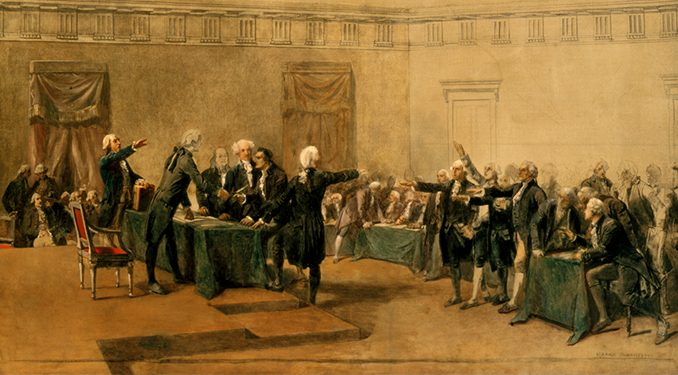
As we mark the national semiquincentennial on July 4, we might well reflect on Benjamin Franklin’s answer to Elizabeth Willing Powel, when the elderly sage left the Constitutional Convention in 1787, and the Philadelphia matron demanded, “Well, Dr. Franklin, what have we got, a republic, or a monarchy?”
To which Franklin famously responded, “A republic, if you can keep it.”
That brief riposte underscores a basic fact about these United States: that we are a democratic experiment in republican self-governance, the testing of which is ongoing. And within that fact is embedded a truth that is implied, if not explicitly stated, by the Declaration of Independence: it takes a critical mass of people, living certain virtues, to keep the experiment on track—to make the political machinery of a democratic republic facilitate individual human flourishing and social solidarity.
Taking our republic for granted is a sure prescription for losing it to some species of authoritarianism. If we want to keep it, we must work at it. And that requires sacrifice. Thus, the brief motto at the Korean War Veterans Memorial on the National Mall—“Freedom Is Not Free”—speaks not only to the debt we owe those who made the ultimate sacrifice, from Lexington to the Normandy beaches and the Chosin Reservoir to the present. That “Freedom Is Not Free” reminds us that every citizen is challenged to live freedom nobly, for the common good, if the American experiment is to prosper, indeed survive.
Sixty-six years after its publication, John Courtney Murray’s book, We Hold These Truths: Catholic Reflections on the American Proposition, remains a profound analysis, based on classic Catholic political theory, of what made the United States possible. In that meaty volume, Father Murray did a deep dive into the subsoil of the American Founding, the tilling of which he did not ascribe solely to 17th-century Enlightenment philosopher John Locke (unlike Patrick Deneen and others). In doing so, Murray excavated the deepest conceptual roots, the foundational ideas, that would eventually undergird the Declaration of Independence.
The first of those ideas is that God’s rule extends over nations as well as individuals. When the Lord Jesus distinguished the things of God from the things of Caesar, he was teaching that Caesar’s writ is limited. The deepest, sturdiest taproot of American convictions about limited government and religious freedom, then, is Matthew 22:21, not Locke’s Two Treatises of Civil Government. Catholic integralists, post-liberals, and progressive secularists, please take note.
The second foundational idea crucial to the Declaration whose quincentenary we celebrate is that we are creations—neither congealed stardust nor walking algorithms—whose creator endowed us with the intellectual, spiritual, and moral capacities to govern ourselves. Listen to the stirring first movement of Randall Thompson’s “Testament of Freedom,” ponder its Jeffersonian text (“The God who gave us life gave us liberty at the same time; the hand of force may destroy them but cannot disjoin them.”), and spend a few moments on the Glorious Fourth reflecting on whether other “hands of force” are at work within our nation today, threatening destruction. (I, for one, think of the vulgar falsehoods of social media blatherskites and antisemitic podcasters in precisely those terms).
Because we have the God-given capacity to be self-governing, just governance is by the consent of the governed: “we the people” have a right to be heard by the governors in matters touching the common good. Moreover, “the people” have within them an instinct for justice that must be nurtured by a vibrant public moral culture: the cultural air we breathe should reflect the built-in truths about the human person we can know by reason (and, Catholics would insist, by revelation). Those are the third and fourth foundational ideas that form the roots of the American liberty tree.
Taken together, the truths explicitly claimed or implied by the Declaration of Independence are summed up in this master truth: only a virtuous people can live freedom so that individuals flourish in a society of solidarity. Only a virtuous people can live freedom such that liberty, decayed into license, does not corrupt the institutions of freedom so that those institutions collapse into tyranny.
The claim the American Founders made two hundred fifty years ago was not that free government was inevitable. The claim was that free government was possible. And as Dr. Franklin reminded Mrs. Powel, that possibility would be tested, time and again. It is surely being tested today. So, as we thank God for the gift of the United States, let us remind ourselves and each other that freedom is not license and that freedom is never free.
If you value the news and views Catholic World Report provides, please consider donating to support our efforts. Your contribution will help us continue to make CWR available to all readers worldwide for free, without a subscription. Thank you for your generosity!
Click here for more information on donating to CWR. Click here to sign up for our newsletter.

I am struck by the simple but profound statement “we are creations—neither congealed stardust nor walking algorithms—whose creator endowed us with the intellectual, spiritual, and moral capacities to govern ourselves.” Our free will allows us to choose to accept or reject this truth, but that choice makes all the difference.
As was I also struck by the comment that for a moment let us recollect the full spectrum of beliefs/world views with the Catholic Church from tradition to modernism as a subset of the full spectrum of world views within Christianity as a subset of the full spectrum of the modern world to include non-Cristian religions and atheistic variants. The total summation of all the choices results in a small number that may comprise the Faithful Remnant for the 2nd Coming.
St Thomas Aquinas that the seekers of the objective Truth find their way to God, from Scripture we know that to love God is to be obedient to God in thought word and deed to hear the his words “welcome, my good and faithful servant”. What the comment above does not clarify is that choices have consequences intended & unintended in the here and now as well as the then and forever.
Common virtue or morality is the glue that makes shared or free government possible, and this is the element that is so lacking and needed today. When the Soviet Empire was breaking up and Poland was in turmoil, Gorbachev, president, Reagan and Pope John Paul II were working together behind the scenes to try to keep a semblance of peace. One of the things that Gorbachev realized that was lacking in the Soviet system was Religion, He realized that atheism didn’t work and that the people needed the church and its moral teachings. He saught advice from Reagon and the Pope on how to go about it, and he ended up giving the Russian Orthodox Church more freedom.
Today the world is in dire need of a common morality and the Catholic Church is in a unique position to fill this need with its teachings. No other institution is so well known or is in a.position to do this. We must preserve, retain and share our over Two thousand year old moral teachings which were built on the over two thousand year old teachings of the Jews.
The rather recent phenomenon of the younger generations returning to the Traditional Latin Mass is only one indication of a new awakening taking place toward restoring our moral heritage.
The world is lost and hungry and we have the food that it needs for survival and we must share it- evangelism. This is what Pope Leo has been talking about and we must listen and act. It’s time to drop our labels (liberal, conservative etc. etc. etc.) and work together-shoulder to shoulder-as Catholics.
Our duty as Catholic citizens of the United States of America is to conserve and contribute to the ongoing founding of our beloved country. We were told this by a man we revere, on a solemn day in November of 1863.
“It is for us the living, rather, to be dedicated here to the unfinished work which they who fought here have thus far so nobly advanced. It is rather for us to be here dedicated to the great task remaining before us—that from these honored dead we take increased devotion to that cause for which they gave the last full measure of devotion—that we here highly resolve that these dead shall not have died in vain—that this nation, under God, shall have a new birth of freedom—and that government of the people, by the people, for the people, shall not perish from the earth.”
My God give us the grace to do only what He wills, and to preserve and defend our “One Nation, Under God, with Liberty and Justice for All.”
CiM: I would add to Lincoln’s words that unless our government can ensure honest, fraud-free elections, those men WILL INDEED HAVE DIED IN VAIN.
I share your concern about that Ed.
The election process means nothing if there is not one standard of control that is completely auditable by any 3rd party.
We read that “we are creations—neither congealed stardust nor walking algorithms…”
With the advent of algorithmic AI, we’re tempted by the ancient heresy of monism and stargazer Einstein’s god who in not quite the ex-nihilo creator of the universe:
“…teachers of religion must have the stature to give up the doctrine of a personal God, that is, give up that source of fear and hope which in the past placed such vast power in the hands of priests [….] In their labors they will have to avail themselves of those forces which are capable of cultivating the Good, the True, and the Beautiful in humanity itself”(“Out of My Later Years,” The Philosophical Library, 1950).
A great new book on the American revolution is Eric Metaxas, Revolution. Impressively documented with new materials, including hitherto unnoticed statements by the Founders. For instance, when Washington was named to lead the American forces, he told officers to instruct their soldiers not to swear, not to behave improperly, and even to go to church every Sunday whenever possible. See
https://www.amazon.com/Revolution-Birth-Greatest-Nation-History/dp/1631440888/ref=sr_1_1?adgrpid=1346904318831615&dib=eyJ2IjoiMSJ9.r2NLxtFjvi44gB2MyES_1J-dOmwcTiS3DviIS2_ODadIiw9UDWxlkS8VP6cxnwbI-K9hEj0GWGjK7Y1uZEjB4kzCfWhFlYdGW_zGd2q3Rs49VPuhXkhi6_QY2vN4G5a86YKOF1CfkdJIDvw2dVY9oltt558WVOX8UXyWq9hQAnBX-HjTNrVRW67Ot-ZNQNwugkx_lMdG4HiAd3JPA14S7Ll8F2jKL1gesJGRXEAJHVs.nbuZu6EmXpLoOalTfZh0I-WmP1RWPQG-uHRnwWVPmyA&dib_tag=se&gb=2&hvadid=84181806943472&hvbmt=be&hvdev=c&hvexpln=0&hvlocphy=101647&hvnetw=o&hvocijid=10258060257192853463–&hvqmt=e&hvtargid=kwd-84182746398298%3Aloc-190&hydadcr=2498_13723992&keywords=metaxas+revolution&mcid=2d85395aa72c3e5db92aa47135b078bd&qid=1782915985&sr=8-1
“That brief riposte underscores a basic fact about these United States: that we are a democratic experiment in republican self-governance, the testing of which is ongoing.”
As a failed engineering student, I learned there are two types of tests: destructive and non-destructive. Guess which one we’ve done.
Whatever is left of the “United States” has metamorphosized into a kleptocratic administrative superstate, increasingly devoted to erecting a digital panopticon.
Keeping a Republic: questions- is it necessary? Is it possible? Is it desirable?
Without elections free from fraudulent voting, there is no future for the republic known as the UNITED STATES OF AMERICA.
Fortunately, there is no evidence of fraud in our elections. Thanks be to God!
I beg to differ. There’s plenty of evidence, even some videotape footage. Especially back in 2020.
Nonsense. Virtually all of those court cases indicated little or no fraud in 2020. Why do you believe this? Because Trump said so? The man lies so much how can you believe him?
That’s why Wikipedia has a page devoted to it.
“Fortunately, there is no evidence of fraud in our elections. Thanks be to God!”
Reply: The mumblings of an insane person!
Yes, delusional folks often cannot provide evidence of their claims yet still persist in false beliefs of some widespread election fraud. If proof exists, show it, otherwise I will continue to thank God for our free and fair elections in the U.S.
What fraudulent election? They seemed pretty straight to me.
Every election has fraud, if for no other reason there are people voting who are not and have never been net taxpayers. When people can vote themselves benefits without any “skin in the game” that’s inherently fraudulent. These recipients might be in the ‘Hood, on Main Street, corporate board rooms, Wall Street, or one of those nice Northern Virginia gated communities filled with GS-12+ employees, you know the type of gestapo goons that showed up on Mark Houck’s doorstep.
There’s three million federal employees and millions more who are substantially dependent on federal awards, contracts, expenditures and grants. They are the standing army we were warned about.
But back to your statement: define straight, your professional qualifications to determine the existence, extent and nature of fraud, plus what sort of analytical procedures, tests of controls or ballot reviews you conducted to form that an opinion.
Standard comment from a proabortion Dem. Anyone supporting abortion has no problems with stealing elections, destroying this country.
Like Trump?
Preamble:
To answer the question, assuming it’s about the Republic of the United States, the discussion must define what the Republic of the USA is. The USA has democratic republic. It was chosen and designed to protect the God-given rights of citizens (some of which are declared and enumerated in the Declaration of Independence and the Constitution) and minority factions of these citizens, against any form of tyrannical tresspass on those rights, including a tyrannical parliament or congress, and a tyrannical majority of other citizens represented by such parliament or congress.
As elaborated here:
https://whatweneednow.substack.com/p/if-we-can-keep-it
Replies to the 3 questions you pose.
Q1. Is our US republic necessary?
A1. As compared to which, if any, alternative? Yes, as compared to any apparent or implied alternatives, which by implication do not protect against political tyranny, including a tyrannical democratic majority and their political representatives.
Q2. Is it possible?
A2. Yes, it has proven possible here in the USA for 250 years.
Q3. Is it desirable?
A3. As compared to what alternative? If the answer is to live in liberty and justice under God, yes. That is
most desirable, and preferable to any apparent or implied alternatives.
How might you answer your 3 questions?