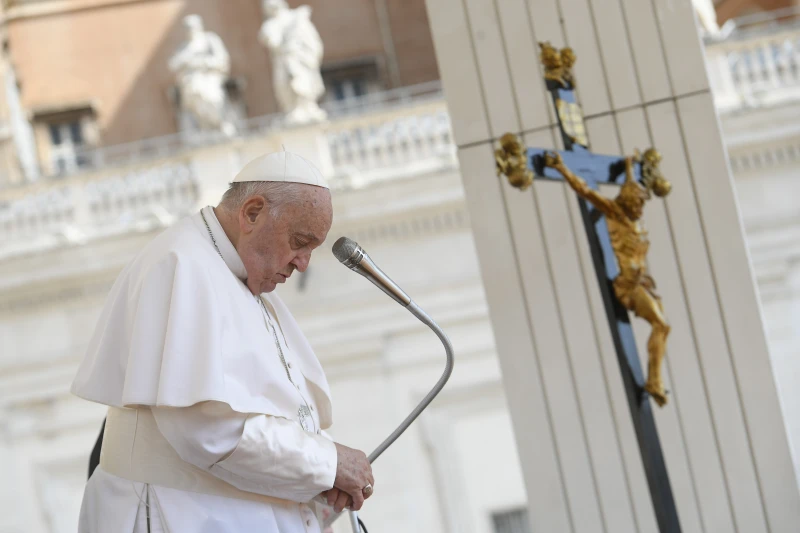
Pope Francis prays during his general audience on Wednesday, May 29, 2024, in St. Peter’s Square at the Vatican. / Credit: Vatican Media
CNA Staff, Jul 2, 2024 / 14:15 pm (CNA).
Pope Francis’ prayer intention for the month of July is for the pastoral care of the sick.
“The anointing of the sick is not a sacrament only for those who are at the point of death. No. It is important that this is clear,” the Holy Father said in a video message released July 2.
Let us #PrayTogether that the Sacrament of the Anointing of the Sick may grant the Lord’s strength to those who receive it and to their loved ones. May it become for everyone an ever more visible sign of compassion and hope. #PrayerIntention#ClickToPraypic.twitter.com/d9JE8Zodux
“When the priest draws near a person to perform the anointing of the sick, it is not necessarily to help them say goodbye to life. Thinking this way means giving up every hope,” he said, adding: “It means taking for granted that after the priest the undertaker will arrive.”
The pope urged the faithful to “remember that the anointing of the sick is one of the ‘sacraments of healing,’ of ‘restoration,’ that heals the spirit.”
“And when a person is very ill, it’s advisable to give them the anointing of the sick. And when someone is elderly, it’s good that they receive the anointing of the sick,” he said.
He concluded with a prayer: “Let us pray that the sacrament of the anointing of the sick grant the Lord’s strength to those who receive it and to their loved ones, and that it may become for everyone an ever more visible sign of compassion and hope.”
Pope Francis’ prayer video is promoted by the Pope’s Worldwide Prayer Network, which raises awareness of monthly papal prayer intentions.
If you value the news and views Catholic World Report provides, please consider donating to support our efforts. Your contribution will help us continue to make CWR available to all readers worldwide for free, without a subscription. Thank you for your generosity!
Click here for more information on donating to CWR. Click here to sign up for our newsletter.
Vatican City, Mar 29, 2017 / 04:56 am (CNA/EWTN News).- With the battle for major ISIS strongholds heating up in Iraq, Pope Francis has voiced his closeness to the country, praying for the safety of people on the ground, particularly civilians caught in the crosshairs of the fighting.
“My thoughts go out to civilians trapped in the western districts of Mosul and displaced because of the war, to whom I feel united in suffering, through prayer and spiritual closeness,” he said during his March 29 general audience.
“While expressing deep sorrow for the victims of the bloody conflict, I renew to all the call to engage with every effort in the protection of civilians as an imperative and urgent requirement.”
During the audience, which took place in St. Peter’s Square, the Pope greeted a delegation of Iraqi Superintendents representing various religious groups accompanied by the President of the Pontifical Council for Interreligious Dialogue, Cardinal Jean-Louis Tauran.
“The richness of the beloved Iraqi nation lies in this mosaic which is unity in diversity, strength in union, prosperity in harmony,” he said, encouraging them to go forward on this same path.
Francis also asked for prayers for Iraq that they might find reconciliation and harmony and “peace, unity and prosperity” among their different ethnic and religious groups.
His appeal followed a sharp rise this week in the number of reported civilian deaths in U.S.-led airstrikes in Iraq and Syria as ground forces backed by the strikes are closing in on two of the Islamic State’s main urban strongholds: Mosul in Iraq and Raqqa in Syria.
According to the Washington Post, the reports have fueled accusations that the U.S. and its partners may not be acting with sufficient regard for the safety of civilians.
During his main address to pilgrims, Pope Francis continued his catechesis on the theme of hope, drawing attention to the close connection that exists between the virtue of hope and the virtue of faith.
“Great hope is rooted in faith, and as such is able to go beyond all hope,” he said, “because it is not based on our word, but the Word of God…When God promises, he accomplishes what he promises.”
“I’d like to ask you a question,” the Pope said. “We, all of us, are we convinced of this? Do we believe that God loves us and that everything he has promised us will be brought to fruition?”
All we have to do is have an open heart, and God will teach us how to hope and will do “miraculous things.” The only price, he said, is to “open our hearts to faith and he will do the rest.”
To illustrate the point, Pope Francis drew on the Old Testament story of Abraham and his wife Sarah, quoting the words of St. Paul in the Letter to Romans, that Abraham “believed, hoping against hope.”
Despite the advanced age of he and his wife Sarah, Abraham, “did not weaken in faith when he considered his own body as dead (he was almost a hundred years old) and the dead womb of Sarah,” who was barren.
We are also called to live this experience and example of faith, Francis said, adding that Abraham, “who, even before the evidence of a reality that seems destined for death, trusts in God, ‘fully convinced that what he had promised he was also able to bring to completion.’”
Francis said this is a “paradox,” yet at the same time is the strongest element of our hope. A hope, he said, which is “founded on a promise which from the human point of view seems uncertain and unpredictable, but which does not fail even in the face of death.”
“The God who reveals himself to Abraham is the God who saves, the God who has come out of desperation and death, a God who calls to life,” he said. “In the story of Abraham all becomes a hymn to God who frees and regenerates.”
And we recognize and celebrate the fulfillment of God’s promises in the mystery of Christ’s Resurrection at Easter, he explained.
Hope, then, is not something we can possess based on “human reassurance,” but “it occurs where there is no hope, where there’s nothing left to hope for, just as it did for Abraham, in front of his imminent death and sterility of his wife Sarah.”
“Dear brothers and sisters, today we ask the Lord for the grace to remain founded not so much on our safety, on our own strength, but on the hope drawn by the promise of God, like true children of Abraham,” he concluded.
A memorial Mass for the late Los Angeles Auxiliary Bishop David O’Connell was held at St. John Vianney Catholic Church in Hacienda Heights, California, on March 1, 2023. / Credit: YouTube/St. John Vianney Hacienda Heights
Boston, Mass., Mar 2, 2023 / 13:27 pm (CNA).
As three days of memorial services began Wednesday for the late Los Angeles Auxiliary Bishop David O’Connell, who was murdered in his Hacienda Heights home on Feb. 18, Pope Francis and President Joe Biden commended the man known as a “peacemaker.”
News of O’Connell’s murder and the subsequent arrest of his housekeeper’s husband in connection with the killing came as a shock to Catholics across the nation. Among those mourning the late bishop was Pope Francis, whose message was read at Wednesday’s memorial Mass at St. John Vianney Catholic Church in Hacienda Heights, California.
Los Angeles Archbishop José Gomez was the main celebrant of a 7 p.m. memorial Mass in which O’Connell’s younger brother attended and shared memories of growing up together in Ireland.
Pope Francis: O’Connell had ‘profound concern for the poor’
In a message from Pope Francis read aloud at the beginning of Mass by Gomez, the Holy Father commended O’Connell, 69, for his efforts to uphold the sanctity of life and his profound concern for the poor.
The pope sent his “heartfelt condolences and the assurance of his spiritual closeness” to all the clergy, religious, and lay faithful of the Archdiocese of Los Angeles after the bishop’s “untimely and tragic death.”
Pope Francis remembered the bishop for his “profound concern for the poor, immigrants, and those in need; his efforts to uphold the sanctity and dignity of God’s gift of life; and his zeal for fostering solidarity, cooperation, and peace within the local community.”
“In commending the late bishop’s soul to the love and mercy of Christ the Good Shepherd, His Holiness prays that all who honor his memory will be confirmed in the resolve to reject the ways of violence and overcome evil with good,” said the message, which was signed by Vatican secretary of state Cardinal Pietro Parolin.
“To those gathered for the Mass of Christian burial and to all who mourn Bishop O’Connell’s loss in the sure hope of the resurrection, the Holy Father cordially imparts his blessing as a pledge of peace and consolation in the Lord.”
‘Dave got us through tough times’
O’Connell’s younger brother, Kieran O’Connell, thanked the local Catholic community for the outpouring of support and said that his brother had a strong belief in the power of prayer.
“I know he has been a source of solace for myself and my family as well,” he said.
“As my older brother, he was an immense support to me during the passing of our parents and also my brothers and sister. Dave got us through these tough times. He always said it was God’s plan and thanked God for their wonderful lives,” O’Connell said.
Reflecting on his brother’s ordination, O’Connell said: “It was the proudest moment for our family and for the whole community when he said his first Mass in our local parish church.”
O’Connell noted the many “great memories” he had of visiting his brother in Los Angeles and the active role that the bishop played in the raising of his children.
“He was present at every milestone in our lives, baptism, holy Communion, graduation, weddings,” he said. “We forever cherish those memories.”
“Just thank you most sincerely for taking care of Dave for these 45 years and know that he was happiest here among his people,” he said, fighting back tears.
Los Angeles Auxiliary Bishop David O’Connell’s brother, Kieran O’Connell, speaks at the bishop’s memorial Mass on March 1, 2023. Credit: YouTube/St. John Vianney Hacienda Heights
‘Christ was looking Dave right in the eyes’
Monsignor Timothy Dyer, pastor of St. Patrick Catholic Church in Los Angeles, gave the homily and opened his remarks by recalling Archbishop Gomez’s presence at the Los Angeles Sheriff’s Department Feb. 22 press conference following the arrest of O’Connell’s alleged murderer, Carlos Medina.
The archbishop had fought back tears as he struggled to get through his brief comments during that press conference.
“Before we begin to reflect on the Scripture readings I would like think that I represent each of you when I say to the archbishop that on the day he spoke in the news conference with the officials from the city and the state and the county around him, his inability to put into words his feelings, was the best way to speak for all of us,” Dyer said.
Dyer said that the Catholic community has been “overwhelmed” at the “pouring out of praise and gratitude” and sympathy from both the Catholic community and the secular community for O’Connell.
“If ever there was a man of prayer that I’ve known it was Dave,” he said. O’Connell would often begin meetings with the prayer method of lectio divina, he said, joking that “and he didn’t worry about how much time it took.”
O’Connell was passionate about standing up for immigrants, standing against racism, and standing up for the unborn and women, Dyer said.
“You could not pigeonhole him. If you wanted to put him up on your banner and let him be your patron for your particular cause, you could only do it if you embraced all of the things that he embraced, and all of the places he fished because it was an ethic of life from beginning to end,” he said.
Dyer’s recommendation that “it would be wise” for the seminary to hold an annual seminar to study O’Connell’s spirituality and ministry, was received with applause from those gathered at the church.
Dyer said that O’Connell had a “great devotion to Mary” that was “reflected in his respect and his admiration for women in religious life.”
Speaking briefly abuse the clergy sex abuse crisis, Dyer said that O’Connell would say to his fellow priests: “Wear it like a hairshirt. Let it irritate you so that it will never happen again.”
For O’Connell, becoming a bishop was a cross rather than a promotion, Dyer said, adding that “it almost broke his heart.”
O’Connell did not want to leave the flock that he pastored, Dyer said. “We need to take care of our bishops. It is not an easy life,” he said.
Fighting back tears, Dyer reflected on the last moments of O’Connell’s life.
“When the bullets were being fired, Christ was looking Dave right in the eyes, and he said to him, ‘Well done, good and faithful servant. You may lay down the nets now Dave. I’ve prepared a place for you in the Father’s house,’” he said.
Dyer continued: “And there’s someone there who’s waiting too, the one you’ve always called the Blessed Mother, as well as your own mother, waiting to fold you in her arms. And Dave, you don’t have to be a bishop anymore. But in front of your dwelling place, there’s a great big lake. And we have a lot of fishing to do on behalf of the Archdiocese of Los Angeles still,” he said.
Biden White House statement
In response to a question from EWTN White House Correspondent Owen Jensen, White House Press Secretary Karine Jean-Pierre said March 1 that “the president and the first lady join Archbishop Gomez, the Archdiocese of Los Angeles, and the entire Catholic community in the mourning of Bishop David O’Connell.”
“We also express our sympathy and prayers for the family and friends of the bishop, who will certainly remember his legacy of service to those on the margins of society. And so, again, we offer up our condolences to the community.”
The White House responds to the murder of Bishop David O’Connell from Los Angeles and to the leaked FBI document comparing Catholics to violent extremists.
— EWTN News Nightly (@EWTNNewsNightly) March 1, 2023
There will be a public viewing on Thursday at the Cathedral of Our Lady of the Angels in Los Angeles. The viewing will take place from 10 a.m. to noon and 1 p.m. to 6 p.m.
A vigil Mass will be held following the public viewing at 7 p.m. and will be livestreamed both here and here.
O’Connell’s funeral Mass will be held on Friday, March 3, at the same Cathedral of Our Lady of the Angels at 11 a.m. local time. The funeral Mass will be livestreamed both here and here.
If you think you’re a priest, and you really aren’t, you have a problem. So do a lot of other people. The baptisms you performed are valid baptisms. But the confirmations? No. The Masses you celebrated were not valid. Nor the absolutions or anointings. And the marriages? Well…it’s complicated. Some yes, some no. It depends on the paperwork, believe it or not.
Father Matthew Hood of the Archdiocese of Detroit learned all this the hard way.
And then this summer, he learned he wasn’t a priest at all. In fact, he learned he wasn’t even baptized.
If you want to become a priest, you must first become a deacon. If you want to become a deacon, you must first be baptized. If you’re not baptized, you can’t become a deacon, and you can’t become a priest.
Of course, Fr. Hood thought he had been baptized as a baby. But this month, he read a note issued by the Vatican’s Congregation for the Doctrine of the Faith. The note said that changing the words of baptism in certain ways make it invalid. That if the person doing the baptizing says “We baptize you in the name of the Father and of the Son and of the Holy Spirit,” instead of “I baptize you…” the baptism is not valid.
He remembered a video he’d watched of his own baptism ceremony. And he remembered that the deacon said “We baptize you….”
His baptism wasn’t valid.
Father Hood called his archdiocese. He needed to be ordained. But first, after three years of acting like a priest, living like a priest, and feeling like a priest, he needed to become a Catholic. He needed to be baptized.
In short order, he was baptized, confirmed, and received the Eucharist. He made a retreat. He was ordained a deacon. And on Aug. 17, Matthew Hood finally became a priest. For real.
The letter explained that after he realized what had happened, Fr. Hood “was recently validly baptized. Furthermore, since other sacraments cannot be validly received in the soul without valid baptism, Father Hood also was recently validly confirmed and validly ordained a transitional deacon and then a priest.”
“Let us give thanks and praise to God for blessing us with Father Hood’s ministry.”
The archdiocese released a guide, explaining that people whose marriages were celebrated by Fr. Hood should contact their parish, and that the archdiocese was making its own efforts to contact those people.
The archdiocese also said it was making efforts to contact other people who had been baptized by Deacon Mark Springer, the deacon who invalidly baptized Hood, and is believed to have invalidly baptized others, during 14 years at St. Anastasia Parish in Troy, Michigan, using the same invalid formula, a deviation from the rite clerics are required to use when performing baptisms.
The guide clarified that while absolutions performed by Fr. Hood before his valid ordination were not themselves valid, “we can be assured that all those who approached Father Hood, in good faith, to make a confession did not walk away without some measure of grace and forgiveness from God.”
“That said, if you recall any grave (mortal) sins that you would have confessed to Father Hood before he was validly ordained and you have not yet been to a subsequent confession, you must bring them to your next confession explaining to any priest what has happened. If you cannot remember if you confessed any grave sins, you should bring that fact to your next confession as well. A subsequent absolution will include those sins and will give you peace of mind,” the guide said.
The archdiocese also answered a question it expects many Catholics will be asking: “Isn’t it legalistic to say that, even though there was an intention to confer a sacrament, there was no sacrament because different words were used? Won’t God just take care of it?”
“Theology is a science that studies what God has told us and, when it comes to sacraments, there must not only be the right intention by the minister but also the right ‘matter’ (material) and the right ‘form’ (words/gestures – such as a triple pouring or immersion of water by the one saying the words). If one of those elements is missing, the sacrament is not valid,” the archdiocese explained.
“As far as God ‘taking care of it,’ we can trust that God will assist those whose hearts are open to Him. However, we can have a much greater degree of confidence by strengthening ourselves with the sacraments He has entrusted to us.”
“According to the ordinary plan God has established, the Sacraments are necessary for salvation: baptism brings about adoption into the family of God and places sanctifying grace in the soul, since we are not born with it, and the soul needs to have sanctifying grace when it departs from the body in order to spend eternity in heaven,” the archdiocese added.
The archdiocese said it first became aware that Deacon Springer was using an unauthorized formula for baptism in 1999. The deacon was instructed to stop deviating from liturgical texts at that time. The archdiocese said that, though illicit, it had believed the baptisms Spring had performed to be valid until the Vatican’s clarification this summer.
The deacon is now retired “and no longer in active ministry,” the archdiocese added.
No other Detroit priests are believed to be invalidly baptized, the archdiocese said.
And Fr. Hood, newly baptized and newly ordained? After an ordeal that began with a deacon’s liturgical “innovation,” Fr. Hood is now serving at a parish named for a deacon saint. He’s the new pastor at St. Lawrence Parish in Utica, Michigan.
The sick and the healthy are two sides of the same coin. Anointing can heal the sick and empower the healthy. May all pilgrims be blessed with joy and happiness.
