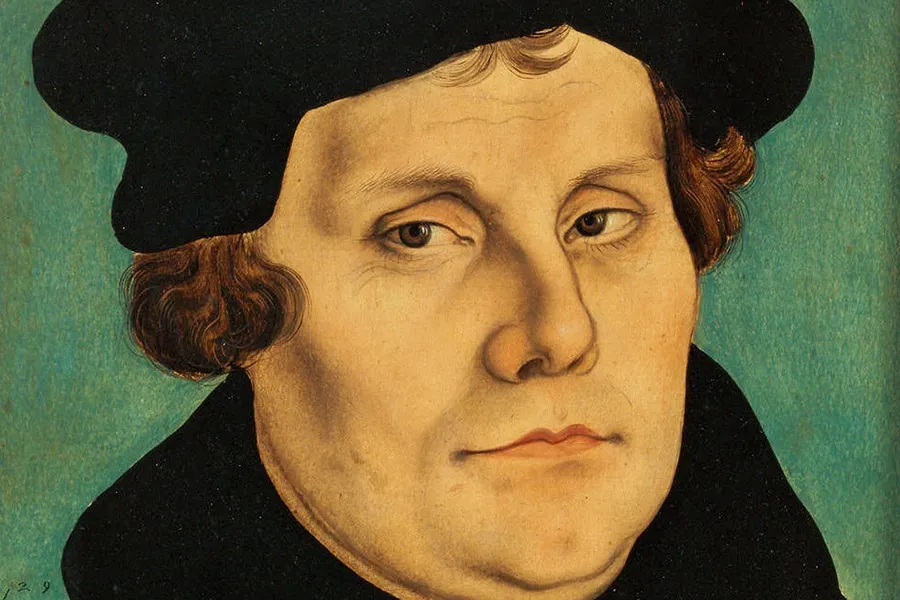
Washington D.C., Oct 30, 2017 / 04:36 pm (CNA/EWTN News).- One fated Halloween, 500 years ago, Martin Luther nailed his 95 theses to the door of Wittenberg Castle in a dramatic act of defiance against the Catholic Church.
Or, he may have just hung it on the doorknob. Or mailed out copies.
Or, if he did nail it, the act of the nailing itself would not have been all that significant, because the door may have been used as a bulletin board where everyone was nailing announcements.
And he probably wasn’t all that defiant; he likely had the attitude of a scholar trying to raise questions and concerns. At that point, Luther didn’t know how defiant he would eventually become, or that his act, and his subsequent theological work, would lead to one of the greatest disruptions of unity in the Church’s history.
“This was not a declaration of war against the Catholic Church, nor was it a break,” Dr. Alan Schreck with Franciscan University of Steubenville told CNA.
“It was a concerned, Augustinian monk and biblical scholar correcting an abuse, and it was really a call for a dialogue.”
However, it took fewer than five years for this call for dialogue to transform into schism, rejection of the authority of the Church’s tradition and bishops and most of the sacraments, and a growing number of Protestant communities, united only by their rejection of the Catholic Church.
While historians debate just how dramatic was the actual posting of the 95 theses, its anniversary is an occasion to look back at what the role of the most popular Protestant was in the movement that ultimately split Western Christendom in two.
Who was Martin Luther?
Martin Luther was born on November 10, 1483, the oldest son of Hans and Margarethe Luther. His father, a successful business and civic leader, had grand visions for his eldest son’s life and sent him to school with the hopes he would become a lawyer.
While Luther completed his bachelor’s and master’s degree according to his father’s plan, he dropped out of law school, finding himself increasingly drawn to the subjects of philosophy and theology.
Soon after leaving law school, Luther entered an Augustinian monastery, a decision he would later attribute to a vow he made during a precarious horseback ride, when he was nearly struck by lightning in the midst of a storm. Terrified that he was about to die, the 21-year-old Luther cried out to St. Anne, promising that he would become a monk if he survived. He felt it was a vow he could not break; his father felt it was a waste of his education.
By all accounts, Luther was a Catholic success story before he became the leading figure of the Reformation. He joined the monastery in 1505, and by 1507 he was ordained a priest. He became a renowned theologian and biblical scholar within the order, as well as a powerful and popular preacher and lecturer at the University of Wittenberg in Germany.
During his years of study and growing popularity, Luther began developing the groundwork of his theology on salvation and scripture that would ultimately become deal-breakers in his relationship with the Catholic Church.
The offense of selling indulgences
But it wasn’t strictly theological ideas that first drove Luther to the ranks of reformation ringleader – it was his critique of the practice of selling indulgences, the central subject of his 95 theses, that catapulted him into the limelight.
According to Catholic teaching, an indulgence is the remission of all or part of the temporal punishment due to sins which have already been forgiven, and can be applied either to the person performing the prescribed act or to a soul in Purgatory.
To obtain an indulgence, one must complete certain spiritual requirements, such as going to the sacraments of Confession and Communion, in addition to some other act or good work, such as making a pilgrimage or doing a work of mercy.
But even years before Martin Luther, abuses of indulgences were rampant in the Church.
Instead of prescribing an act of prayer or a work of mercy as a way to obtain an indulgence, clerics began also authorizing a “donation” to the Church as a good work needed to remit the temporal punishment due to sin.
Increasingly, people grew critical of the sale of indulgences, as they watched money gleaned from people’s afterlife anxiety go to fund the extravagant lives of some of the clergy. The money was also often used to buy clerical offices, the sin of simony.
During Martin Luther’s time, in northern Germany, the young and ambitious prince-Archbishop Albrecht of Brandenburg was offered the position of the Archbishop of Mainz, but was unwilling to relinquish any of his previously-held power.
Meanwhile in Rome, Pope Leo X was demanding a considerable fee from Albrecht for his new position, as well as from the people of his dioceses for the fund to build St. Peter’s Basilica. Albrecht took out a loan and promised Rome 50 percent of the funds extracted from – as critics would describe it – preying on people’s fear of Purgatory.
For the St. Peter’s fund, the Pope had employed Dominican friar Johann Tetzel to be the Grand Commissioner for Indulgences for the country of Germany.
According to historians, Tetzel liberally preached the indulgence, over-promising remission of sins, extending it to include even future sins one might commit, rather than sins that had already been repented of and confessed. He even allegedly coined the gimmicky indulgence phrase: “As soon as a coin in the coffer rings / the soul from Purgatory springs.”
It was Tetzel’s activities that ultimately pushed Luther to protest by publishing his 95 theses.
The 95 theses and the seeds of reform
“When he posted the 95 theses, he wasn’t a Lutheran yet,” said Michael Root, professor of systematic theology at The Catholic University of America.
“In some ways they get things rolling, but what’s important is what happens after the 95 theses when Luther gets pushed into a more radical position.”
Regardless of how dramatically they were posted to the door of Wittenberg Castle on October 31, 1517, Luther nailed not only his theses but the feelings of many faithful at the time who were also frustrated with the corruption and abuse they saw in the Church.
Christian humanists such as Erasmus and St. Thomas More were contemporaries of Luther who also objected to abuses within Church while not breaking from it.
Meanwhile, Luther’s already-established reputation as a respected professor, as well as access to the printing press, allowed his theses and ideas to spread at a rate previously unmatched by previous reformers who had similar critiques of the Church.
“Clearly there was a kind of symbiosis between Luther and the development of the printing press,” Root said. “What he was writing was able to engage lots of people. Many of them were short pamphlets that could be printed up quickly, they sold well…so he was on the cutting edge of technology and he fit what the technology needed – short, energetic things people wanted to read.”
Most historians agree that Luther’s original intent was not to start a new ecclesial community – that idea would have been “unthinkable at the time,” Root noted. ??“So that’s too much to say; however, it’s too little to say all he want to do was reform abuses.”
By 1518, his theses spread throughout Germany and intellectual Europe. Luther also continued writing prolifically, engaging in disputes with Tetzel and other Catholic critics and further developing his own ideas.
For its part, the Church did not issue an official response for several years, while attempts at discussions dissolved into defensive disputations rather than constructive dialogue. As a result, early opportunities to engage Luther’s criticisms on indulgences instead turned into arguments about Church authority as a whole.
Swatting flies with a sledgehammer – Luther becomes a Lutheran
One of Luther’s most well-known critics was Catholic theologian Johann Eck, who declared Luther’s theses heretical and ordered them to be burned in public.
In 1519, the two sparred in a disputation that pushed Luther to his more extreme view that scripture was the only valid Christian authority, rather than tradition and the bishops.
“The Catholic critics quickly changed the subject from indulgences to the question of the Church’s authority in relation to indulgences, which was a more dangerous issue,” Root said. “Now you’re getting onto a touchy subject. But there was also an internal dynamic of Luther’s own thought,” that can be seen in his subsequent writings.
In 1520, Luther published three of his most renowned treatises: The Babylonian Captivity of the Church, On the Freedom of a Christian Man, and To the Christian Nobility of the German Nation.
By that time, it was clear that what Luther thought was wrong in the Church was not just the abuse of indulgences, but the understanding of the message of Christianity on some basic levels. Besides denouncing the Pope as a legitimate authority, Luther also declared that faith alone, sola fide, was all that was necessary for salvation, rather than faith and good works.
“Luther was definitely trying to fix what was a legitimate problem, which was pelagian tendencies, or people trying to work their way into heaven,” said Dr. Paul Hilliard, Assistant Professor and Chair of Church History at Mundelein Seminary. It had created a “mercantile attitude” in some people at the time of Luther – “if I do this, God will do this.”
“So Luther was trying to correct these things, but the phrase I sometimes say is that Luther swatted the fly of pelagianism with a sledgehammer. In order to keep any trace of humans earning salvation out of the system, he changed the system.”
Luther’s distrust of human beings did not particularly spring from his criticisms of indulgences and the subsequent pushback from the Church – it was in line with most anthropological thought at the time, which tended toward a very negative view of human nature. Therefore, in his Protestant views, he sought to get rid of any human involvement wherever possible – particularly when it came to interpreting scripture and salvation.
“On the scale of beasts to angels, most people (at the time) would have us a lot closer to beasts,” Hilliard noted.
The Catholic Church officially condemned Luther’s theses in a papal bull, Exsurge Domine, promulgated in June 1520, and in part authored by Eck. The declaration afforded Luther a 60-day window to recant his positions, lest he be excommunicated.
But by the time the papal bull was issued, Luther had not only denounced the authority of the Pope, but had declared him an anti-Christ. The window for reconciling views was all but closed.
The popular and political reforms
Despite Luther’s increasingly radical claims against the Pope and the Church, his popularity spread, due to his compelling and prolific writings and, to Luther’s dismay, his populist appeal.
Luther popularized the idea of a “priesthood of all believers” to the exclusion of an ordained, ministerial priesthood. Rather than bearing an indelible mark on their soul, in Luther’s view ministerial priests did not differ from the “priesthood of believers” except in office and work. This, along with his personality and background, appealed to the poor and working class of the time who were frustrated with the lavish lives of Church hierarchy, which typically came at the expense of the poor in rural areas.
“Luther was very much a populist, he was a man of the people, he was scruff, he came from sort of peasant stock, he spoke the language of the people, so I think a lot of the common people identified with him,” Shreck said.
“He was one of them, he wasn’t far away in Rome or a seemingly wealthy bishop or archbishop…so he appealed particularly to Germans because he wanted a German liturgy and a German bible, and the people said, ‘we want a faith that is close to us and accessible’.”
But Luther balked when his religious ideals spurred the Peasant’s War of 1525, as peasants in rural areas of German revolted, motivated by Luther’s religious language of equality. The year or so of subsequent bloody war seemed to justify those who dismissed Luther as nothing more than a social movement rather than a serious religious reformer.
In order to maintain the esteem of those higher up, Luther disavowed the unruly peasants as not part of the official reform movement, laying the groundwork for the Anabaptists to fill in the religious gaps for the peasants in the future.
However, the Peasant’s War wasn’t the only time the Reformation got political – or lethal. Because of the vacuum of authority that now existed in Luther’s pope-less, emerging ecclesial community, authority was handed over to the local princes, who took advantage of the reformation to break from the fee-demanding Pope.
Much of Germany had embraced Lutheranism by the mid 1500s, though some parts, such as Bavaria, retained their Catholic faith.
For his part, Holy Roman Emperor Charles V officially condemned Luther’s theology at the 1521 Diet of Worms, a meeting of German princes, during which Luther famously refused to recant his position with the words: “Here I stand. God help me. I can do no other.”
Despite Charles V’s opposition to Luther’s views, he allowed for Luther’s safe passage from the diet, rather than enforcing the customary execution of heretics, and thus forfeited his best chance for stomping out the Reformation at its roots.
Historians speculate that while Charles V personally opposed Luther’s views, he let him live because he also saw the decentralizing of power from the Vatican as something of which he could take political advantage.
Reformation fever was also catching throughout Europe, and soon Norway, Denmark, Sweden, Switzerland and England were all following Germany’s example of breaking from the Catholic Church and establishing state-run, Protestant ecclesial communities.
“I like to think of the story with the little Dutch boy with his the finger in the dyke,” Shreck said. “Once the breach was made, others follows his example. Once Luther did it, it was like the domino effect.”
“In a book by Owen Chadwick, he said the Reformation came not because Europe was irreligious, but because it was fervently religious,” Shreck added. “This was after the black death and a lot of social turmoil – people really wanted to turn to God and seek solace in faith.”
But the reformers were not all agreed on their beliefs, which led to the rise of numerous sects of Protestantism, including Calvinism, Anglicanism, and Anabaptism.
“Protestantism became very divided, though they all claimed to be doing the right thing because they believed they were maintaining the purity of the faith,” Schreck said.
Root noted that once the Protestant-Catholic divide “got embedded in political differences, between southern Europe and northern Europe, between Spain and England, and so the religious differences also became national differences, that just made matters far worse.”
“Once you have the wars of religion in 1546, then attitudes become very harsh. Once you start killing each other, it’s hard to sit down and talk,” he added.
The wars over religion would become especially pronounced in the 30 Years War of the 1600s, though at that point, religion had become more of a political tool for the state, Hilliard said.
“The 30 Years War is a really good indication that while religion was important, it was not the most important thing – it was a war between different competing princes to gain greater control of territories, during which religion was thrown into the mix,” Hilliard noted.
Could the Reformation have been avoided?
The million-dollar question at the center of Reformation history is whether the Reformation and the splitting of Western Christendom could have been avoided.
“Some would say by two years into the Reformation, the theological differences already ran very deep and there was no way you were going to get reconciliation,” Root said.
“But there are others who would argue that as late as the 1540s it was still possible that perhaps the right set of historical circumstances could have brought people together, and there’s no way of knowing, because you can’t run history again and change the variables.”
“Whether one could have settled it all then short of war, there were missed opportunities for reconciliation, that’s clear,” he added.
Luther’s fiery and rebellious personality, matched with the defiant and defensive stance that the Catholic Church took in response to his ideas, created a perfect storm that cemented the Protestant-Catholic divide.
Much of Luther’s thinking remained Catholic throughout his life, Schreck noted, including his devotion to the Blessed Virgin Mary.
“I think if there had been a sincere effort on the part of the Catholic hierarchy that his concerns were legitimate, history might have gone in a different direction.”
It wasn’t until Pope Paul III (1534–1549), 17 years after the fated theses first made their rounds, that the Catholic Church as a whole took a serious and official look at its own need for reform, and its need to respond to the Protestant Reformation.
This is Part 1 in a three-part series on the Reformation. Part 2 will discuss the Council of Trent and the Counter-Reformation. Part 3 will discuss ecumenism today.
 […]
[…]







Lord Jesus Christ preserve us for Your clemency.
My loyalty is with Vigano.
“For it has been reported to me by Chloe’s people that there are quarrels among you, my brothers and sisters. What I mean is that each of you says, “I belong to Paul,” or “I belong to Apollos,” or “I belong to Cephas,” or “I belong to Christ.” Has Christ been divided? Was Paul crucified for you? Or were you baptized in the name of Paul?”
1 Corinthians 1:11-13
Paul wasn’t crucified, he was beheaded since he was a Roman Citizen.
Correct! And it is said that St. Paul ‘s head bounced three times on the ground before stopping. Nonetheless, there is never an excuse for schism.
Dear GF – that was a totally different situation.
Really?
Then maybe you and he should start your own church, like Luther.
As long as Francis is allowed by true Catholics, clergy and laity, to exercise the OFFICE of Pope, something he has clearly rejected by his words and actions, he will continue to make use of that Office to the detriment of the Church. As he has surrounded himself with modernists like himself, there is little hope that the present Vatican will do the right thing and remove him. That means that the Church Herself, outside of Her present “government” must do what is necessary. All through history, it has been the priests, good bishops and faithful laity that has served to keep The Church holy and in keeping with Christ’s commands.
You are SO right, dear Valerie.
As Jesus taught us, the littlest ones are greatest in His eyes.
“For those who defend authority against rebellion must not themselves rebel.” Tolkien, The Silmarillion
Totally depends on how we define ‘rebellion’.
The fuse has been lit. At the very least, ecclesiastical history will now forever record that Jorge Mario Bergoglio has been publicly charged in detail with heresy and apostasy by one of the most eminent prelates in the Vatican Curia.
Yeah, I think if anyone is to be on trial for schism, it isn’t AB Vigano.
FSSPX News website had said, unlike Archbishop Viganò, Archbishop Lefebvre never denied the legitimacy of the Church. Although the following position published by Lefebvre 1974 is similar to what Archbishop Viganò has said:
“We adhere
with all our heart and all our soul to Catholic Rome, guardian of the Catholic Faith and the traditions necessary to maintain it, and to Eternal Rome, mistress of wisdom and truth. On the other hand we refuse and have always refused to follow the Rome of the neo-Modernist and the new Protestant trend which was clearly evident in the Second Vatican Council and, after the Council in all the reforms which flowed from it” (Declaration Archbishop Lefebvre 1974).
Compare that with:
“I have no reason to consider myself separate from communion with the holy Church and with the papacy, which I have always served with filial devotion and fidelity. I maintain that the errors and heresies to which [Francis] adhered before, during, and after his election, along with the intention he held in his apparent acceptance of the papacy, render his elevation to the throne null and void” (Statement Archbishop Viganò 2024).
Difference may be seen in Viganò’s direct refutation of Pope Francis from Lefebvre’s indirect reference to Pope Paul VI as part of the Modernist Church. What they have in common is the allegation of a faithful Church to which they claim allegiance and a false Church which they repudiate. This identifies a problematic dynamic within the Church, the distancing of one, Left or Right from the other among its members, the Right frequently questioning the legitimacy of the pope. It would be beneficial for those who disagree with specious policies, non binding doctrines like Fiducia Supplicans to resist the errors but refrain from accusations of the illegitimacy of this pontificate.
Otherwise from a justice standpoint, it could be added in defense of Archbishop Viganò, that as an insider, is his access to first hand information that we don’t possess. For example in the recent defense of Pope Francis, “Report on the Holy See’s Institutional Knowledge and Decision Making Related to Former Cardinal Theodore Edgar McCarrick”, that report argued the Pontiff’s lack of knowledge of the McCarrick dossier, that report also confirmed several personal meetings [prior to the Archbishop’s allegation that Francis lied when he claimed no knowledge of the dossier] between Francis and Viganò of which Pope Francis says he remembers the meetings but nothing about the content.
Furthermore, there was the silence, a refusal to respond to the allegation that he lied in having no knowledge – but responded only when an accusation was made public of a prosecution case on Viganò’s family financial matters – the Pope remarking, “See! See!, That’s why I kept silent”. Anyone with intelligence can see through that response.
From Viganò’s conscientious perspective considering what he may have gleaned from personal contact he may possess what he honestly believes substantiates his accusations. We, lacking that presumed knowledge cannot place ourselves in his position nor can we say he lacks justification. Although it’s prudent to add that he may have had a greater influence in benefit of the Church on the allegations of errors and mismanagement if he followed the examples of Cardinals Raymond Burke and Joseph Zen.
Excellent points, Fr. Morello.
I think I remember reading an argument that Pope Francis is both the head of the true Church and a valid Pope, and also the leader of the false church. I can see that theory fitting what Archbishop Vigano has said, but he does not clearly state it.
As beloved Jesus Christ instructs us: “No one can serve two masters!”
Excellent comment.
Archbishop Vigano’s move ties the Church into proving one or more of the following, right at this time, or, as from this time:
1. heresy
2, apostasy
3. schismatic leadership
4. non-election
5. non-election by non-intent
6. non-election by non-eligibility.
Maybe there is more he has in mind and we can not surmise about it for the present.
It helps understanding to read universi Dominici gregis which are regulations regarding a Conclave and the biography of Godfried Danneels in which he openly states how he and his group violated them
Thus, we suffer illegitimate pronouncements & actions from an illegitimate pope.
Very helpful thank you. I’m bound to accept the election of Bergoglio since I personally do not know of any voiding defect.
In such a case if it should arise, that something arouses suspicion for me about that, still I must reserve judgment on it, or, finality of decision, or disservice of faith or prudence or impartiality or sound reasoning on my part, until it should be substantiated.
Bergoglio’s majority was well in excess of the required two-thirds margin. It suggests that if there were collusion but the number of individual electors involved does not reduce the voted majority below that margin, the election was not compromised. It would, however, then be up to the new Pope to deal correctly with the “now proven” problem, so uncovered. And also be for us to assess if the new Pope is being true resolving the issue in faith, rationality and prudence.
Right now it could possibly be a mere case that Archbishop has over-shot the issues. I would take no glee from it.
God bless.
‘ Benedict issued De aliquibus mutationibus in normis de electione Romani Pontificis on 11 June 2007 after two years as pope. In this five-paragraph document, Benedict denied the cardinal electors the options John Paul had allowed them and retained only John Paul’s determination that a change was required after many ballots had failed to produce a result. He restored the two-thirds majority rule. ….. Benedict resigned the papacy on 11 February 2013, effective 28 February. On 22 February he issued his second set of instructions on the papal election process, Normas nonnullas. Following his resignation, cardinals had questioned the rule that they delay starting the conclave until 15 days after the papacy fell vacant. Benedict allowed them to begin earlier “if all the Cardinal electors are present” while keeping their ability to delay the start until 20 days pass “for serious reasons”.He modified the oath of secrecy to be taken by all support personnel, making excommunication the automatic punishment (latae sententiae) for violations of the oath, which had previously been punished at the discretion of the new pope. ‘
https://en.wikipedia.org/wiki/Papal_election_reforms_of_Pope_Benedict_XVI
During the 4th century, St. Athanasius found himself in a similar position as Archbishop Vigano. Athanasius was almost the lone voice against the Arian heresy held by the overwhelming majority of bishops. Pope Liberius excommunicated Athanasius who refused to accept the validity of the excommunication, as Vigano likely will do if he is excommunicated.
It was Athanasius against the world, and in the end, the almost lone voice of the excommunicated Athanasius was right.
Is the Church in that same position today?
Excellent reminder of another courageous bishop who spoke truth to power in defense of the Church; history has vindicated St A
No. Vigano is in open opposition to discipline and refuses to even submit himself before his superiors as is his duty. If he is to be excommunicated, he may only be vindicated by the Church, whom he has chosen in this event to cut his last ties with.
Dear ‘EENS’ that’s not the key issue.
In the opinion of many Catholic experts, Archbishop Carlo Maria Viganò is far more obedient to our KING, Jersus Christ than the revisionist PF administration.
Also, the PF administration has amply demonstrated that it has no interest in proper jurisprudence but is openly biased against everyone who offers logical and factual criticisms. They use a loaded dice.
In PF’s Rome, Archbishop Carlo Maria Viganò would not get a fair go.
In fact, his life could be endangered if he ventured into the dragon’s den.
Maybe Archbishop Vigano needs hip surgery. Certainly Rome has soom excellent medical doctors.
Dear Patrick – you must be thinking of how convenient it was for the PF lot when Pope Benedict and then Cardinal Pell (were) exited.
Agreed. St. Athanasius never hid. And Pope Liberius was never free, having an imperial sword on his neck. It cannot be said for sure that he freely acted to do anything.
Archbishop Vigano is paranoid, secluded and deluded. Cardinals Burke, Zen, Müller, et al., have not been disobedient or fomented schism. They are acting like St. Athanasius.
Dear GF, surely that is a very eccentric view of the actual circumstances?
Submission to superiors is never absolute. Any duty to submit is forfeited when superiors are spiritually and morally bankrupt. The faithful owe no duty to submit to a renegade pope.
Great point! When it comes to pope Francis, I’ve been suspicious about him for several years because he’s always given ambiguous answers to many subjects which, in the end, he ended up supporting!
It will be interesting how this works out. Will the Archbishop be excommunicated? Stripped of Episcopal and Priestly powers? Or basically just ignored? We shall see.
Here’s Archbishop Vigano on the verge of being excommunicated.
While Rupnik is free to indiscriminately desecrate the most sacred places and forcibly defile the most vulnerable of holy women.
It’s very clear. Bergoglio is the one who deserves to be booted.
Amen.
Two camps debating how many angels can dance on the head of a pin.
“I maintain that the errors and heresies to which [Francis] adhered before, during, and after his election, along with the intention he held in his apparent acceptance of the papacy, render his elevation to the throne null and void,” Viganò wrote. Bravo. There is hope for the Chruch with men like Vigano.
God bless Archbishop Viganò. He has been in hiding for good reason. If he showed up in Rome, he would probably be poisoned.
These Bishops need to remember they must obey the Pope because he is head of the Roman Catholic Church,
If a Latin Mass means so much to a Bishop, especially in the United States where Religious Practices are free, Let them start their own American Catholic Church, where all Mass are in Latin and they could even make Donald Trump a Bishop like evangelicals (60% of American Catholics support him more than fellow Catholic Joe Biden)
As for me, I’m a Roman Catholic and I stand by Pope Frances.
Pardon my laughter.
A devout and faithful Catholic can smell the rot of CINO-Biden’s hypocritical shell of Catholicism which would kill any baby the mother didn’t want though she enjoyed the conceiving of same.
No, the Latin Mass does not mean much to the American Catholic Bishops, witnessing the decreased numbers they’ve permitted under the rule of Francis.
Lastly, Trump is a married and divorced man. He has never attended seminary, has never received the sacrament of Ordination to Holy Orders, and he is not even a Catholic, so your imagination needs a bit of reigning in.
Francis is not a woman, so perhaps you may reconsider how you spell his name. Just remember this little mnemonic: Francis, egotist, narcissist–his “I” is greater than any other letter.
Brilliant!
As with any debate or disagreement, if certain of your position, recoiling or hiding should not be an option to strengthen your argument. If Viganò is right, he should have the courage to face the Curia, win or lose. This the vow he took.
Dear Henry,
If you’d had the horror experience I’ve had of going into a judicial process, with trust that the truth would prevail and then discovering that all those involved had coluded to use any means whatever to destroy me, you would not be urging Archbishop Carlo Maria Viganò to submit to PF’s ‘Star Chamber’, pseudo-legal process.
It would be the height of naivette to think justice is of any interest to PF & Co.
Sorry to say this; but still trusting in the grace & mercy of King Jesus Christ; love & blessings from marty
Even Jesus walked through the crowd of his townspeople ready to throw him over the cliff. There is a time for every reason. Jesus’ time had not yet come, and Vigano’s may never come.
Staying away from the hands of Francis’ hench-hit-men is a justifiably reasonable and smart move.
May St. Michael the Archangel, through the power of God, protect and defend the good Archbishop if it be God’s will.
I’m not Catholic but this pope is the least Christian pope I’ve ever seen.
If Catholics really & truly knew what was going on behind closed doors of the Vatican, they would be dumbfounded. I understand Archbishop Viganò I find it sad that there are not more couragous bishops like him. I fully stand with Archbishop Viganò.There is much I could say, but I will leave it at that. God bless Carlo Maria Viganò.🙏🏼
Sedevacantism is courageous? Hardly.
If he doesn’t accept the authority of Vatican 2 and also Pope Francis as Pope, why has he been in the Church all these years? And if he doesn’t accept Vatican 2, then what about the Pope’s who came after Vatican 2? Paul 6th, Pope John Paul1st, Pope John Paul 2nd, Pope Benedict and now Pope Francis? Who does Vigano think he is to decide who is a legitimate Pope? And to decide on the authority of Vatican 2? Vigano is guilty of schism!!
Sorry, dear Joseph, that is not the actual situation at all.
“I maintain that the errors and heresies to which [Francis] adhered before, during, and after his election, along with the intention he held in his apparent acceptance of the papacy, render his elevation to the throne null and void,” Viganò wrote.
“He also said he has “no reason to consider myself separate from communion with the holy Church and with the papacy, which I have always served with filial devotion and fidelity.”
We can know through both Faith and Reason, that by denouncing a schismatic who could not possibly be a Vicar of Christ, because prior to his election to The Papacy, he denied Sacred Tradition, Sacred Scripture, and The Teaching of The Magisterium, The Deposit Of Faith that Christ Himself Has Entrusted To His Church, Archbishop Vigano maintains communion with The Body Of Christ, which exists “Through Him, With Him, And In Him, In The Unity Of The Holy Ghost(Filioque).
To denounce the election of Jorge Bergoglio to The Papacy, is to affirm The Unity Of The Holy Ghost, and thus the fact that “it is not possible to have Sacramental Communion without Ecclesial Communion”, due to The Unity Of The Holy Ghost (Filioque). To affirm The Unity Of The Holy Ghost, is to affirm the Papacy, and thus affirm every validly elected Vicar of Christ, and Magisterial Teaching grounded in Sacred Tradition and Sacred Scripture.
Jorge Bergoglio, unlike every validly elected Pope, rejects The Office Of The MUNUS, grounded in Sacred Tradition, Sacred Scripture, And The Teaching Of The Magisterium, The Deposit Of Faith That Christ Has Entrusted To His One, Holy, Catholic, And Apostolic Church, Is “Forever”, thus Pope Benedict could not have resigned The Office Of The MUNUS because for a validly elected Pope it remains “Forever”. Even if Pope Benedict was in error when he abdicated The Ministerial Office, who can deny, that by stepping aside, Pope Benedict XVI illuminated the fact that Jorge Bergoglio was not in communion with Christ and The Magisterium Of His Church and could not have possibly hold The MUNUS because he rejected The Deposit Of Faith, and thus Ecclesial Communion, and thus Sacramental Communion. For this is our Sacred Heritage: The Sacred Heritage of all human persons, from the moment of conception, Salvation Is Of The Jews, From The Father, Through The Son, In The Unity Of The Holy Ghost (Filioque).
https://biblehub.com/drbc/john/4.htm
The pope should resign in order to preserve the RC church from to much liberal ideas .
To keep the traditions as they should be and start a new conclave in order to elect
a more traditional pope .
I humbly ask Pope Francis to consider all that he has done and said and resign for the goodness of the whole RC Church .
Praise be God .
I’m saddened that vigano does not support pope Francis ,at this point in time everybody should be on pope Francis side, with the world gone mad he needs all the support he can get 😇
Francis needs all the support he can get. Right. Would that be help covering for sexual predators, help meeting with homosexualist priests, help undermining the traditional Latin mass,and help dismissing conservative prelates? If that’s the case, the less help and support Francis gets, the better.
Archbishop Vigano would have done better to stick with his early and discrediting revelation that the McCarrick phenomenon was not new news in the Vatican…
A BRIDGE TOO FAR, now, to explicitly pronounce that the pope is not a pope, and to seem to reject Vatican II (but what he seems to say latest is only that the apostasy started there, not that the “real” (Benedict’s distinction) Council, by its very nature and Documents, was the definitive cause).
Archbishop Vigano should have posed his accusations as questions, about the Church cohabiting with the One World Order. The rhyming GNOSTICISM of inventing a script and then prohibiting all contrarian views as inadmissible or even “backwardist”.
Then, instead of surrendering the possible high ground to legal proceedings against a schism, the full spectrum within the Church could be asking, where is the real DIALOGUE? Still a remote possibility…and a remotely possible substitute for what is seen by many as a self-gratifying and self-ratifying “Synod-on-Synodality”. Say what??? A “couple” of synods…
In graduate school even at a secular university, TRUTH can still happen. Why am I reminded, here, of a penetrating professor who denounced research papers that engaged in wool-gathering without demonstrable conclusions worthy of readers outside the echo chamber? Papers larded up with self-referential purple prose and very selectively read references—”a tale Told by an idiot, full of sound and fury signifying nothing” (Macbeth, Act 5, Scene 5).
WHEN is a synod a crypto-synod?…Accountable only to itself rather than, say, to the relevant particulars of the Council Documents (e.g., Lumen Gentium, Ch. 3 with the Prefatory Note), or to the irreducible Apostolic Succession, or to the Magisterium and the explicitly incorporated Natural Law with its moral absolutes (the Catechism, Veritatis Splendor), or to the real Holy Spirit in union with the Son—“Jesus Christ, yesterday, today and forever” (Heb 13:8)? Or, instead, in step with the 5,000-word Fiducia Supplicans and even cohabiting with the irregular “couples,” as such?
QUESTION: For the fatally overreaching Archbishop Vigano and the fatally self-ratifying synod-on-synodality, both (!), to what extent might the professor’s meme equally apply: “intellectual masturbation”?
Vigano for Pope! Strickland for Cardinal!