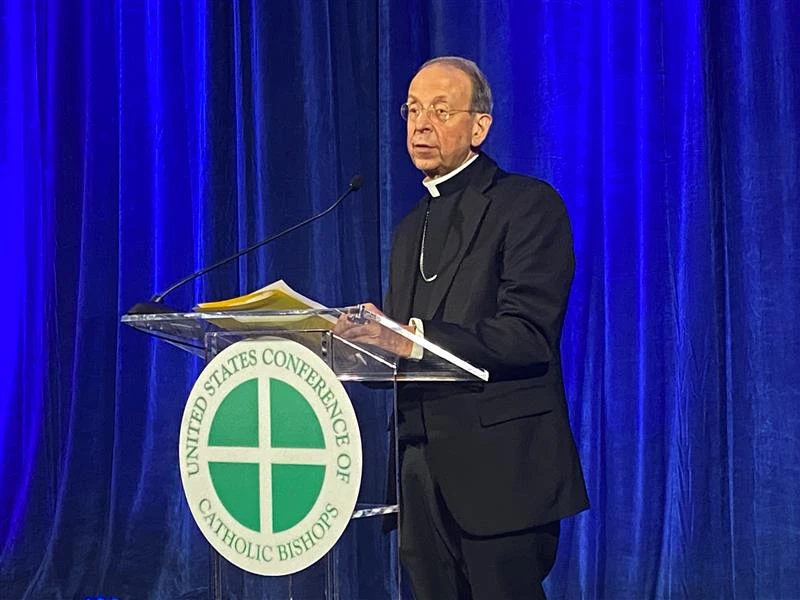
 Archbishop William Lori of Baltimore, vice president of the United States Conference of Catholic Bishops, at the USCCB’s fall meeting Nov. 15, 2023. / Credit: Joe Bukuras/CNA
CNA Staff, Jan 31, 2024 / 13:25 pm (CNA).
The bishops of Maryland have written an open letter denouncing state legislators’ decision to consider an assisted-suicide bill and calling for “a better path forward.”
“We are deeply disappointed to learn that once again the Maryland General Assembly will debate whether to legalize physician-assisted suicide,” the Jan. 30 letter from the Maryland Catholic Conference said.
Assisted-suicide bills have been considered in Maryland since the 1990s — and most recently in 2023 — but have never passed.
Signed by Baltimore Archbishop William Lori, Washington archbishop Cardinal Wilton Gregory, and Wilmington Bishop William Koenig, the letter said that the bill “puts our most vulnerable brothers and sisters at risk of making decisions for themselves that are manipulated by factors such as disability, mental instability, poverty, and isolation.”
“Maryland has accurately recognized that suicide is a serious public health concern in the general population and has offered substantial resources to address the concern,” the letter said.
“At a time when our nation is grappling with how to address a frighteningly high suicide rate it is deeply illogical for the state of Maryland to be seeking ways to facilitate suicide for those with a terminal illness, all the while claiming such preventable and unnecessary deaths are somehow dignified,” the bishops continued.
The bill, titled the End-of-Life Option Act, was introduced in both the House and Senate in mid-January.
The legislation would allow individuals with a terminal illness to request assisted suicide from a physician.
Terminal illness is defined in the bill as “a medical condition that, within reasonable medical judgment, involves a prognosis for an individual that likely will result in the individual’s death within six months.”
The process for requesting “aid in dying” consists of making an oral request to one’s physician and then submitting a written request. The individual must then make another oral request to the physician at least 15 days after the first oral request and 48 hours after the written request. No one can request assisted suicide on behalf of the patient.
According to Death with Dignity, 11 states have legalized the practice: California; Maine; Oregon; Colorado; Montana; Vermont; Washington, D.C.; New Jersey; Washington; Hawaii; and New Mexico.
“For all legal rights and obligations, record-keeping purposes, and other purposes governed by the laws of the state, whether contractual, civil, criminal, or otherwise, the death of a qualified individual by reason of the self-administration of medication prescribed under this subtitle shall be deemed to be a death from natural causes, specifically as a result of the terminal illness from which the qualified individual suffered,” the legislation says.
In their letter, the bishops said: “The central tenet guiding our opposition to this deadly proposal is that all human life is created in the image and likeness of God and therefore sacred.”
They cited modern “medical advancements” that can be used to help individuals with terminal illnesses to be “comfortable and improve the quality of the remainder of their lives without them feeling the need to reluctantly choose a ‘dignified death.’”
The bishops called on Marylanders to improve end-of-life care, writing that “it is incumbent upon each of us to ensure that those at the end of their lives can experience a death that doesn’t include offering a form of suicide prescribed by a doctor.”
“We believe our elected officials should work to improve access to the network of care available to Maryland families by increasing access to palliative and hospice care, enhancing end-of-life education and training opportunities for physicians, and ensuring that there is appropriate diagnosis and treatment for depression and other mental and behavioral health issues,” the letter said.
They also pointed to the lack of “safeguards” in the bill.
“The proponents of this legislation claim that this policy offers an ‘option’ to a very small set of individuals who are suffering from a terminal illness with less than six months to live, claiming this option will help them maintain control and dignity during their final days on earth,” the letter said.
“This legislation ignores the reality facing many in such conditions and is woefully lacking in the types of meaningful safeguards that would prevent this unnecessary and drastic option,” the letter said. “Such safeguards include mandated mental health assessments, reporting requirements, safe disposal of unused medication, or prohibitions against expansion of this program.”
The letter said that in every state where assisted suicide has been legalized, “grave abuses and expansion have occurred,” which makes the lethal practice “available to far more people and not just those facing imminent death.”
“There is a better path forward for the people of Maryland, and it does not involve suicide,” the letter said.
“We urge all people of goodwill to demand that our lawmakers reject suicide as an end-of-life option and to choose the better, safer path that involves radical solidarity with those facing the end of their earthly journey,” the letter said.
In recent weeks, residents of Massachusetts and New York were also urged by bishops and pro-life advocates to oppose assisted-suicide bills upcoming in their states.
In Massachusetts, the “End of Life Options Act” says that “a terminally ill patient may voluntarily make an oral request for medical aid in dying and a prescription for medication” if the patient is a “mentally capable adult,” a resident of Massachusetts, and has been determined by a physician to be terminally ill.
In New York, the “Medical Aid in Dying Act” would also allow a terminally ill patient to request medication that would put an end to his life.
“Lawmakers need to hear from their constituents if we hope to avoid yet another assault on human life here. Assisted suicide is dangerous for patients, caregivers, and vulnerable populations such as the elderly and people with disabilities,” the New York State Catholic Conference said.
In Massachusetts, the pro-life group Massachusetts Citizens for Life told supporters that “the bill clashes with cultural, religious, and philosophical beliefs against intentionally ending human life.”
According to Death with Dignity, 16 other states are considering assisted suicide legislation in 2024.
[…]






What’s the point?
Bergoglio regularly issues high-handed edicts that reshape the Church and her teachings.
As far as he’s concerned, it’s synod schnynod. He’s going to do what he wants, regardless.
It’s a shame but I trust nothing that comes out if the Vatican during these dark days in Rome.
The Pontiff Francis and his fellow-ideologues are subverted and subversive people, who live as parasites feeding on The Body of Christ.
They are fit to be prayed for and opposed…because they are enemies of Our Lord.
As coda, I pray for the intercession of St. Charles Lwanga against the “Synod-of-the-Subverted.”
God’s will be done.
Ah, witness the real Synodaling…
Admittedly, I am a bit miffed to be excluded. Closed door theology – it’s as if they are trying to hide from the Holy Spirit!
And I remain astounded that no invitation has arrived for the all-inclusive Roman boondoggle called the Synod on Synodaling II. Who wants to bet that bad boy Bishop Stowe gets a golden ticket? It’s not fair…
About the “secret” meeting of the “expert” study groups, recalling the ten themes disclosed earlier, now from the back bleachers: what about these not-so “rigid, bigoted, and fixistic” questions:
1.About the East, how to restore credibility with the now estranged Eastern Orthodox Churches, kicked out of bed (so to speak) by Fiducia Supplicans—like all of the Church in Africa et al as just another culturally defective “special case”?
2. About the “cry of the poor,” how to excluding those who are impoverished spiritually and culturally (Centesimus Annus, n. 57)? “The Church’s Pastors have the duty to act in conformity with their apostolic mission, insisting that the right of the faithful [italics] to receive Catholic doctrine in its purity and integrity must always be respected” (Veritatis Splendor, n. 113).
3. About the digital environment, how to preserve analogue reality—like the Reality of the incarnate Jesus Christ—over a Nominalist digital cosmos and even amoral/immoral AI (the looming threat of lab-guided human evolution)?
4. About a “missionary perspective,” how to not displace the received/missionary Deposit of Faith with plebiscite sociology?
5. About “ministerial forms,” how to respect the “hierarchical communion” (Lumen Gentium) and not split apart sacramental ordination (as already signaled by ministerial/informal half-blessings under Fiducia Supplicans)? Teeing up the ball for non-ordained female diaconate as a stepping stone toward an Anglican-style (c)hurch—just as civil unions were really a stepping stone toward the oxymoron “gay marriage”…
6. About “ecclesial organizations,” how to not dilute the institutional and personal accountability (both) of each Successor of the Apostles, within/versus multilevel townhall meetings—diocesan, national, continental, and expertly synodal!—a relationship already clarified in Apostolos Suos (May 21, 1998)?
7. On the selection, judicial role and meaning of ad limina visits for bishops, how to transcend zeitgeist intrusions into the particular Churches—not lapsing into an elitist and polyhedral Church devoid of its catholic unity and center?
8. On papal representatives in a missionary synodal perspective, how to conform a missionary “style” (now a “perspective”?) of “listening” to the inborn natural law about which the Church is neither the “author” nor the “arbiter,” (Veritatis Splendor, n. 95)? And specifically, how to avoid a domineering class structure of papal representatives as under Cupich, McElroy, Tobin, Gregory, et al?
9. About theological criteria (etc.), how to outlive the obvious criterion (!) of self-anointed theologians, themselves, apparently intent on severing an actively deadly (c)hurch from the living Magisterium?
10.About the ecumenical journey/ecclesial practices, how to not undefine/mutilate the Mystical Body of Christ, or the “hierarchical communion” gifted in the Holy Spirit (Lumen Gentium)?
SUMMARY, if the “backwardists” turned the lights on, would they discover a “forwardist” cult with a secret handshake? …or real Dialogue?
Okay, let us look at how the popes use commissions (1) to give people hope that meaningful changes will be made to end the church’s behindedness, and (2) to maintain the church’s behindedness.
It is well known that popes stack study commissions in order to obtain a result they desire. A famous example happened with Pope Paul VI and the birth control commission (not its official name). Well along in the commission’s work, commission members were overwhelmingly in favor of removing the church’s prohibition on artificial contraception. At one point, the nineteen theologians on the commission took a separate vote and were 12 to 7 in favor of changing the church’s stance. That caused Paul VI to demote the members of the commission to “advisors,” and he brought in sixteen bishops who would then constitute the commission and issue a final report.
Before the final vote of the new bishops, a decision was made to only issue one report, i.e., to not send any minority report. Of the sixteen people brought in to issue the final report, they voted 9 to 3 to change the church’s stance. There were three abstentions, and one of the sixteen bishops didn’t vote. After the vote, a report which had been prepared in advance by Cardinal Ottaviani and Father Ford was sent along and misrepresented as a minority report from the Commission. However, it was NOT an official minority report; the commission sent only ONE official report. Paul VI later said he could not accept the vote of the commission because it had come to him with a minority report. (Votes on Vatican II’s decrees were not unanimous either, but he did not invalidate those.) In all, Paul VI ignored the recommendations (by their final votes) of nine of twelve bishops, fifteen of nineteen theologians, and thirty of thirty-five nonepiscopal members of the Commission. (Information from Papal Sins: Structures of Deceit, by Garry Wills)
Now, we have a sad chronology on the subject of women deacons that covers more than eight years:
• May 12, 2016 – Francis promises a Women Deacons Commission to some women religious during questioning at an audience. (https://www.ncronline.org/news/vatican/francis-create-commission-study-female-deacons-catholic-church)
• August 2, 2016 – Francis appoints his first Women Deacons Commission (not its official name). It is of course headed by a male priest. Articles about it emphasize that it has six women members and six men members, suggesting, though it is a non-sequitur, that the even gender split guarantees fairness. The commission has its first meeting in November 2016. A long period of silence follows.
• June 2018 – Nearly two years after appointment and after meeting in Rome four times, the commission sends its report to the pope. No statement is made and the public is left hanging. Eventually people are told that the commission had been unable to come to a consensus and therefore could not make a recommendation. Nearly a year after receiving the report, the pope gave a portion of the report to the UISG leadership at their May 2019 assembly. The report itself still (as of Nov. 29, 2023) has not been published despite many requests for it and despite church officials’ repeated claims to desire more “openness.”
• April 8, 2020 – One year and ten months after receiving the report of the first commission, Francis appoints his second Women Deacons Commission (not its official name). It is of course headed by a male, Cardinal Giuseppe Petrocchi. It appears stacked with members who are known to oppose having women deacons (https://www.ncronline.org/news/vatican/several-members-new-vatican-commission-appear-opposed-women-deacons).
• November 29, 2023 – Inquiring people are being told the second Women Deacons Commission has been meeting regularly, and that a report to the pope is expected sometime in 2024. They are given the boilerplate that the commission’s work is proceeding in a spirit of openness and transparency. Yet, as of today, the second commission hasn’t issued any statements. Vatican officials tell us that the commission’s findings will be important in helping to inform the pope’s decision on whether or not to ordain women as deacons.
• Pope Francis says in a CBS interview aired on May 20, 2024, that he is opposed to ordained women deacons and that a little girl growing up Catholic today will never have the opportunity to be a deacon and participate as a clergy member in the church.
We all had been encouraged to believe that Pope Francis was open to the possibility of ordaining women as deacons. Of course, we were also told that he wants to make a decision based on a careful study of the issue. In its efforts to be thorough, as the pope desires, the second women deacons commission, and now also one of the ten commissions from the synod work, are still said to be gathering information and insights from around the world and consulting with experts in theology, church history, and canon law. Why the continued work on it? He has already announced his decision; it is “No” to ordained women deacons.
My Opinion:
I strongly doubt that Pope Francis ever serious about considering a possibility of having women deacons despite his saying otherwise multiple times. I have reasons for thinking this, chief among them being these: (1) his incredibly slow pace on the issue, and (2) his stacking of the second women deacons commission with people known or thought to oppose having women deacons.
In my opinion, here are the only two questions needing to be answered in order to correctly decide whether women should be permitted to become deacons:
1. Are men who feel called permitted to become deacons?
2. Are the men’s exclusively male parts used to perform the functions of a deacon?
I think the answers to those two questions are already well known to most folks. All of the above chronology, covering more than eight years, only to “help inform” the pope regarding a question that perhaps a hundred million Catholics, and hundreds of millions of non-Catholics who are not misogynistic, could have decided correctly, i.e., in favor of having women deacons, in about one-tenth of a second.
Two opinions and some big picture stuff:
FIRST, men do not become deacons because they feel called, but only when they are then actually called by the bishop, or not. This clarity has something to do with the apostolic succession tracing back the incarnate Second Person of the Triune One. A unique situation, and a bit of a challenge for a more-or-less democratic mindset IN the world. Clearly not OF this world.
SECOND, about artificial birth control, in Pope Paul VI’s mind and the mind of the Church, the misfit is between the opinions of consulted commissions versus the universal and inborn natural law—that is, whether the intrinsic nature of the nuptial act can be mechanically or chemically divided into its unitive purpose versus its equally obvious procreative purpose. Morally, can an anti-conceptive act be averaged-in with others remaining intact (identified as “proportionalism” in Veritatis Splendor). Natural Family Planning is not contraceptive.
The CURRENT big picture?
In terms of the Fundamental Option and “consequentialism” (both also addressed in Veritatis Splendor), some observers connect the dots and propose that a contraceptive culture is inseparable from our abortion culture, and the surge in illegitimate births and cohabitation and divorce, and the ubiquitous porn culture, and the scourge of sex trafficking of even children, and even the anti-binary indifference of “gender theory”.
The PAST big picture?
About this trendline (a seamless garment?) and the Anglican Lambeth Conference which first crossed the Rubicon, the defeated minority, as late as 1948, had this to say:
“It is, to say the least, suspicious that the age in which contraception has won its way is not one which has been conspicuously successful in managing its sexual life. Is it possible that, by claiming the right to manipulate his physical processes in this manner, man may, without knowing it, be stepping over the boundary between the world of Christian marriage and what one might call the world of Aphrodite, the world of sterile eroticism?” (Cited in Wright, “Reflections on the Third Anniversary of a Controverted Encyclical,” St. Louis: Central Bureau Press, 1971).
The FUTURE big picture?
Not sure, here, that the “non-synod” der Synodal Weg, or synodality’s Cardinal Hollerich, have this civilizational Rubicon figured out any better than any other transitory commission or whatever—by now endorsing anti-binary homosexuality, and by now proposing that sexual morality in general should be rejected—based on, what, sociological and cultural criteria!
As for Veritatis Splendor, it’s really not a Church imposition; instead, it’s the defense of our inborn and universal natural law: “The Church is no way the author or the arbiter of this norm” (n. 95). Perhaps we can at least agree that blessing the full range of “irregular” couples, as camouflage for blessing the LGBTQ religion one “couple” at a time, probably isn’t so bright a step in maturing the flock past the moral collapse of the past half century.
Based on what’s been produced so far, at the end of the SoS, the weakest possible tea would be the best possible outcome.
A secret meeting of 20 handpicked theologians at the Jesuit general curia almost sounds like a kids game we played on the Brooklyn streets. Suddenly the 20 rush out of the Jesuit curia shouting, Bet you can’t guess where we hid the Blessed Sacrament? Or perhaps, the deposit of faith. Only then it was a fun adventure of ingenuity. Now it’s a dreadful game of deceit.
A commentator wrote a very studied analysis of the latest Vatican outrage calmly asserting nothing to be found here as it stands, then at the end paused leaving the question of motivation open. Double entendres evoke feelings of intrigue. More Jesuitry, Fr Costa SJ is the special general secretary for the Synod. If this were the Jesuits of old one could be confident. Although I doubt that there will be any direct annulment of Catholic doctrine. Perhaps a reassurance to the faithful that Francis’ leadership is really benign. Although as has been the pattern we should expect double entendres that suggest the opposite direction and greater anguish.
Faith is now required of us, that trust in Christ that is confident of his love for us during this dark trial. I pray for him not simply because it’s my duty, rather that personally I perceive in him the qualities of what could have been most beneficial for the Body of Christ. A warm hearted, caring old man who has opened his heart to all leading us to greater compassion for the bereft. Instead his pattern has revealed someone whose voice is foreign to what we know interiorly is Christ.
Are these theologians and other experts been named?
About my #5, above, this isn’t rocket science. Let’s try a thought experiment…Synod 2024 proposes non-ordained deaconesses. Is this the Hegelian thesis-antithesis-synthesis?
Thesis: Fiducia Supplicans invents “non-ecclesial, informal, spontaneous” non-blessings of irregular “couples,” as couples.
Antithesis: a divided Church with corrective dissent from continental Africa, Ukraine, Poland, Hungary,
Kazakhstan, Peru, parts of Argentina, France, and Spain, and a distancing by other conferences of bishops.
Synthesis!: the non-blessing of “couples” is off-loaded from the ordained priesthood to non-ordained deaconesses…
…and private-meeting/photo-op Jeannine Gramick becomes de facto archdeaconess in a parallel church-within-a-Church! Ordination comes later….Maybe not yet a “polyhedral” church, but at least a transitional parallelogram! Ecclesial transgenderism.
This scenario is only hypothetical, of course. Just a non-theologian un-thought experiment, or whatever.
World-building is a meaningful challenge. Theologians are yet to do justice to their enormous potential in world-building.
Awesome page with genuinely good material for readers wanting to gain some useful insights on that topic! But if you want to learn more, check out webemail24 about Crowdfunding. Keep up the great work!