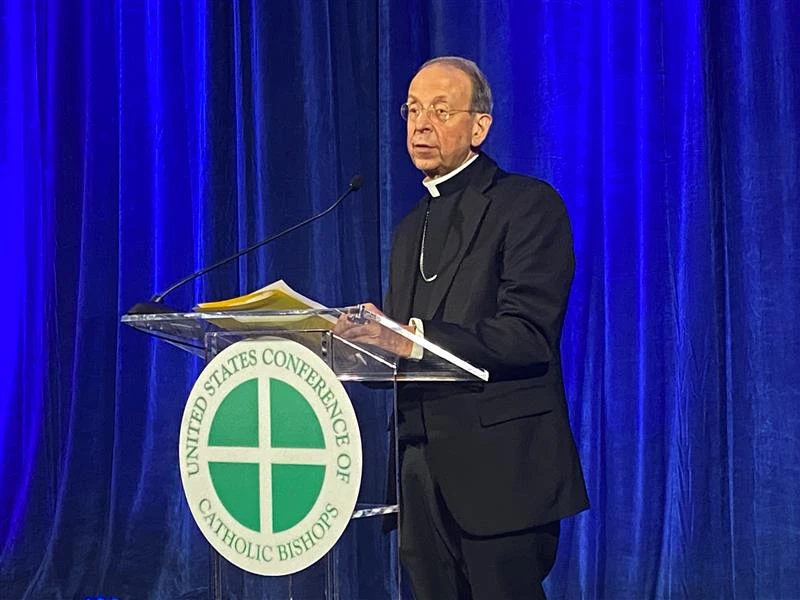
Archbishop William Lori of Baltimore, vice-president of the United States Conference of Catholic Bishops, at the USCCB’s fall meeting Nov. 15, 2023. / Credit: Joe Bukuras/CNA
CNA Staff, Apr 4, 2024 / 12:15 pm (CNA).
The Archdiocese of Baltimore is suing numerous insurers over their alleged failure to pay for abuse claims stretching back several decades.
The archdiocese filed for bankruptcy in September of last year ahead of a state law that ended the statute of limitations for civil lawsuits for negligence concerning child sexual abuse. The law opened the archdiocese up to abuse allegations stretching back decades.
With the Chapter 11 filing, “the archdiocese will be reorganized, victim-survivors will be equitably compensated, and the Church will continue its mission and ministries,” Archbishop William Lori said at the time.
In a new court filing last week, meanwhile, the archdiocese alleged that nearly two dozen insurers “have failed to acknowledge, or will fail to acknowledge” their obligations to “pay for the defense of the archdiocese” and its parishes.
The insurers have also allegedly failed to acknowledge their obligation to “indemnify the archdiocese and/or parishes, including the funding of any settlements or judgments.”
The 22 named insurers have contracted with the archdiocese at various times since 1956, the filing said. The archdiocese itself “timely paid all premiums” related to the policies.
The alleged refusal of the insurers to pay out the insurance claims “constitutes a breach” of the policy agreements, the archdiocese said.
The filing asks the court to declare that the insurers are “obligated to pay in full” the “expenditures made by the archdiocese and parishes” pursuant to the claims.
The archdiocese said it was requesting a trial by jury on the matter if the court deemed it necessary.
Lori said last year that the bankruptcy filing was “the best path forward to compensate equitably all victim-survivors, given the archdiocese’s limited financial resources, which would have otherwise been exhausted on litigation.”
“Staggering legal fees and large settlements or jury awards for a few victim-survivors would have depleted our financial resources,” the prelate said at the time, ”leaving the vast majority of victim-survivors without compensation while ending ministries that families across Maryland rely on for material and spiritual support.”
The archdiocese joined more than two dozen other U.S. dioceses that have filed for bankruptcy in recent years.
Most recently, the Diocese of Sacramento filed for bankruptcy after more than 250 lawsuits alleging abuse by Church officials.
If you value the news and views Catholic World Report provides, please consider donating to support our efforts. Your contribution will help us continue to make CWR available to all readers worldwide for free, without a subscription. Thank you for your generosity!
Click here for more information on donating to CWR. Click here to sign up for our newsletter.
ACI Prensa Staff, Jun 28, 2021 / 14:30 pm (CNA).
The bishops of the Pacific and the southwestern regions of Colombia spoke out about the current situation in the country last week, encouraging reconciliation, justice,… […]
The Adoration Chapel at St. Peter’s Catholic Church in Beaufort, South Carolina. / Photo Credit: Aaron Miller, Miller Design & Marketing
Washington, D.C. Newsroom, Aug 20, 2023 / 05:00 am (CNA).
“Awesome. Awesome.”
That’s how Anna Sudomerski, the communications coordinator at St. Peter’s Catholic Church in Beaufort, South Carolina, describes the parish’s eucharistic adoration program.
St. Peter’s is among the parishes in the United States that are hosting perpetual eucharistic adoration with the Blessed Sacrament exposed 24 hours a day.
Since Church law dictates that exposition of the Blessed Sacrament requires at least one adorer present at all times, this means the parishes that opt for this extraordinary form of worship must coordinate a major year-round effort to ensure at least one volunteer is present before the Eucharist every hour of the day.
Eucharistic adoration, whether exposed or reserved in the tabernacle, is an ancient custom of the Church dating back to its earliest centuries. Yet its practice today occurs among flagging faith in the real presence of Christ in the Eucharist, with U.S. Catholics signaling a growing reluctance to believe that Jesus is truly present in the Blessed Sacrament.
Yet multiple parishes around the country in recent years have maintained vibrant adoration initiatives, including St. Peter’s, which began its perpetual adoration in the early 1990s.
Sudomerski said the St. Peter’s adoration program started at the parish’s original historic church in downtown Beaufort. With the construction of a new church building in 2006, adoration moved to a purpose-built chapel there.
For years, Sudomerski said, the adoration program was run by team captains who each supervised a specific stretch of hours within a given 24-hour period.
“They were in charge of certain times, like from midnight to 6 a.m., in case the adorer could not make it, so the captain would have to find a substitute or cover the hour themselves,” she told CNA. “We had four team captains covering midnight to 6, 6 to noon, noon to 6, and 6 to midnight.”
She said the church’s adoption of the sign-up software Adoration Pro “made it a lot easier for people to sign up.”
“From there, ever since, we’ve done several campaigns,” she said. “One to pass out interest forms to see who would be interested in what hour. We just finished another campaign because Father thought the Eucharist is the most important thing that we have. We’ve done callouts, mailings.”
Light of the World Catholic Church in Littleton, Colorado
Kathryn Nygaard, the communications director at Light of the World Catholic Church in Littleton, Colorado, outside of Denver, said the parish has maintained an adoration program since 2007.
“There are two parishioners who are the main adoration chapel coordinators and they do an incredible job,” she said. “In addition, there are 24 ‘hourly coordinators’ to assist with making sure substitutes fill in during open hours and communicating with the adorers in their specific hour.”
“There are approximately 270 people involved in adoration, as either regularly scheduled adorers or as substitutes,” she said. The church hosts two “renewal weekends” in February for adorers to re-up for the coming year; regular announcements are also made at weekend Masses to attract more interest.
Adorers at Light of the World use the church software Flocknote to communicate with one another, Nygaard said. “Most requests for substitutes are filled within 1-2 days,” she noted.
Bishops aim to ‘start a fire’ of eucharistic renewal
The U.S. bishops last year launched the National Eucharistic Revival, meant to “start a fire” of eucharistic devotion among Catholics in the United States. The initiative was first conceived following the 2019 Pew poll showing low numbers of Catholics with a belief in the Real Presence.
As part of the three-year program, parishes around the country have been encouraged to launch Eucharist-focused programs and events to draw parishioners into a deeper relationship with Jesus through the Blessed Sacrament.
Next year, the bishops will host a National Eucharistic Congress featuring multiple high-profile Catholic speakers along with what is expected to be a crowd of about 80,000 Catholics. Pope Francis in June called next year’s national congress “a significant moment in the life of the Church in the United States.”
St. Bonaventure Catholic Church in Columbus, Nebraska
At St. Bonaventure Catholic Church in Columbus, Nebraska, worshippers have been keeping perpetual adoration there for more than 62 years — since Feb. 14, 1961, according to a live clock on the parish’s website.
The exposed Blessed Sacrament at St. Bonaventure Catholic Church in Columbus, Nebraska. Credit: Tim Cumberland
The parish on its website says the roots of its adoration program go back to 1949 and expanded thereafter. The program now includes worshippers from other nearby parishes who come to participate in adoration.
Parishioner Tim Cumberland told CNA the church is “blessed to have about 550 people in the program.”
“A few years ago, we went to an automated process of managing our perpetual adoration program, using the Adoration Pro software,” Cumberland said. “This has greatly improved our ability for our adorers to find subs online when necessary. A request for a substitute is usually filled within minutes.”
Kim Waller said the 25-year-old adoration program at Holy Infant Catholic Church in Ballwin, Missouri, still uses a coordinator-led sign-up program instead of an online sign-up. Like many programs, Holy Infant breaks down management of the adoration schedule into hourly segments.
“The 24 hourly coordinators form the backbone of perpetual adoration,” she said. “They ensure that there is at least one adorer present in the chapel at all times. The hourly coordinator reviews the sign-up list weekly to ensure that their committed hourly adorer fulfills his/her commitment and contacts the adorer if she/he has not been to adoration as committed for two consecutive weeks.”
A new team of coordinators just took over in January, Waller said. “The last several years, the ministry was administered by a couple who since have passed within six months of each other,” she said.
St. Mary Help of Christians in Aiken, South Carolina
Donna Pierce told CNA she helped launch the 24/7 adoration program at St. Mary Help of Christians in Aiken, South Carolina, roughly 30 years ago.
“I think we have about 10-15 people who have maintained their Holy Hour since it began, and currently we have 318 weekly adorers and about 60 substitutes, not counting the many people that pop in the chapel when they can,” she said.
Pierce said a priest from a perpetual adoration apostolate helped the parish launch the program. “He told us that having perpetual adoration is actually much easier to run than a 40-hours or other time frame,” she said. “Adorers incorporate their hour into their schedule, so you don’t have to keep signing up from scratch.”
The exposed Blessed Sacrament in the St. Claire Chapel at St. Mary Help of Christians in Aiken, South Carolina. Credit: Lori Rainchuso
She said the parish maintains participation in the program by way of biannual talks at Masses (which Pierce described as “our fall and Lent blitzes”). These efforts usually result in upwards of a few dozen sign-ups.
On the website for the National Eucharistic Revival, the bishops say that the current year of the program is focused on “fostering eucharistic devotion at the parish level, strengthening our liturgical life through the faithful celebration of the Mass, eucharistic adoration, missions, resources, preaching, and organic movements of the Holy Spirit.”
Catholic evangelist Tim Glemkowski in a video for the revival urged parish leaders to “prioritize personal encounters with Jesus in the Eucharist” over the course of the year.
“The heart of this invitation … is to create space in our parish calendar this year for people to come and encounter Jesus in the Eucharist personally,” he said. “This could mean parishes that don’t have perpetual adoration start that opportunity, or opportunities for eucharistic processions, or different devotional experiences.”
Pierce said that starting the St. Mary program decades ago was a daunting prospect, but she went ahead with it by putting her trust in God.
“It was terrifying when Msgr. [Thomas] Evatt asked me to be head coordinator to start it so long ago — I was 30 years old with a toddler and working part time,” Pierce said. “So I made a deal with God. He would have to be responsible for sustaining it, and we would just be his instruments.”
“How many, many times he made it obvious he was running it!” she said.
Graces for eternity
St. Bonaventure’s website, meanwhile, predicts that the graces of perpetual adoration will redound not just in the present but for eternity.
“Someday far, far from now, there will be a magnificent heavenly banquet where all of the adorers in the St. Bonaventure adoration program will be reunited,” the parish’s website says.
“Won’t it be wonderful,” the website continues, “for all of us who have been in the program to share stories of how many of our lives, and the lives of those we touched as a result, were radically changed by this personal and enduring encounter with Our Lord!”
New Cardinal Ruben Salazar Gomez, archbishop of Bogotá, Colombia, receives the biretta cap from Pope Benedict XVI in St. Peter’s Basilica on Nov. 24, 2012, in Vatican City, Vatican. / Photo by Franco Origlia/Getty Images
Vatican City, Jan 3, 2023 / 08:00 am (CNA).
Cardinal Joseph Ratzinger demonstrated faithfulness, said Pope Paul VI in his address during the consistory of June 27, 1977, in which Ratzinger, then archbishop metropolitan of Munich and Freising, was created a cardinal of the Holy Roman Church.
Paul VI pointed to Ratzinger’s “theological teaching in prestigious university seats in his Germany and in numerous and worthy publications.”
Ratzinger, Paul VI continued, “has made apparent how theological research — in the main way of the ‘fides quaerens intellectum’ — cannot and should not be ever disconnected from the profound, free, creative adherence to the Magisterium, which authentically interprets and proclaims the Word of God; and that now, from the archiepiscopal seat of Munich and Freising he, with so much of our confidence, leads an elect flock on the paths of truth and peace.”
The future Pope Benedict XVI wore the red cassock for almost 28 years and always carried out, with the utmost dedication, the functions of a cardinal called for by canons 349 and 353 of the Code of Canon Law: “The cardinals of the Holy Roman Church constitute a special college which provides for the election of the Roman Pontiff according to the norm of special law. The cardinals assist the Roman Pontiff either collegially when they are convoked to deal with questions of major importance, or individually when they help the Roman Pontiff through the various offices they perform, especially in the daily care of the universal Church,” and “The cardinals especially assist the supreme pastor of the Church through collegial action in consistories in which they are gathered by order of the Roman Pontiff who presides. Consistories are either ordinary or extraordinary.”
Paul VI assigned Ratzinger the titular church of Santa Maria Consolatrice in Casal Bertone. In 1993, Pope John Paul II established his promotion to the order of bishops with the assignment of the title of the Diocese of Velletri-Segni, a suffragan diocese of Rome. In 1998, Ratzinger became vice deacon of the Sacred College, and after the resignation of Cardinal Deacon Bernardin Gantin in 2002, he was elected deacon of the College of Cardinals and assigned the titular Diocese of Ostia, also a suffragan diocese of Rome.
As cardinal deacon, in April 2005 Ratzinger presided over the funeral of John Paul II, the general congregations, and the conclave that then saw his election to the pontificate.
But what did being a cardinal mean to Ratzinger? Pope Benedict XVI himself responded several times to the question.
The red cap, the pope said during his first consistory in March 2006, was above all a responsibility. To the new cardinals he said: “More closely linked to the Successor of Peter, you will be called to work together with him in accomplishing his particular ecclesial service, and this will mean for you a more intense participation in the mystery of the cross as you share in the sufferings of Christ. All of us are truly witnesses of his sufferings today, in the world and also in the Church, and hence we also have a share in his glory. And so you will be able to draw more abundantly upon the sources of grace and to disseminate their life-giving fruits more effectively to those around you.”
At the November 2010 consistory, Benedict added that “the special communion and affection that bonds these new cardinals to the pope makes them his unique and precious cooperators in the lofty mandate to tend his sheep, which Christ entrusted to Peter in order to unite peoples with the solicitude of Christ’s love. From this same love the Church was born, called to live and to journey on in accordance with the Lord’s commandment, which sums up the whole of the law and the prophets. Being united with Christ in faith and in communion with him means being ‘rooted and grounded in love,’ the fabric that unites all the members of Christ’s Body.”
At his last consistory to create cardinals, in November 2012, Benedict repeated that “situated within the context and the perspective of the Church’s unity and universality is the College of Cardinals: it presents a variety of faces, because it expresses the face of the universal Church. In this consistory, I want to highlight in particular the fact that the Church is the Church of all peoples, and so she speaks in the various cultures of the different continents. She is the Church of Pentecost: amid the polyphony of the various voices, she raises a single harmonious song to the living God.”
He reminded the new cardinals that, “from now on, you will be even more closely and intimately linked to the See of Peter: the titles and deaconries of the churches of Rome will remind you of the bond that joins you, as members by a very special title, to this Church of Rome, which presides in universal charity. Particularly through the work you do for the Dicasteries of the Roman Curia, you will be my valued co-workers, first and foremost in my apostolic ministry for the fullness of catholicity, as pastor of the whole flock of Christ and prime guarantor of its doctrine, discipline, and morals.”
In the course of his pontificate, Benedict presided over five consistories in which he created 90 cardinals originating from 37 countries.
This article was originally published in ACI Stampa. It has been translated and adapted by CNA.
The Archdiocese paid the premiums but I wonder if their attempts to conceal and protect rogue Priests somehow voided the insurance. I am not a lawyer, but perhaps someone who is can answer this question.