


 By
By 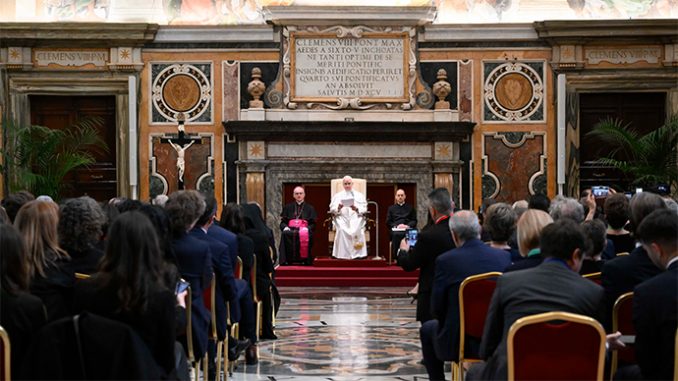
Pope Leo XIV called for respect for human dignity in the fight against organized crime and drug trafficking and reiterated his rejection of the death penalty, torture, and any degrading punishment in the face of a scourge that, he warned, “imperils the very future of our societies.”
In a May 15 audience with participants in the Second International Conference on the Fight against Drugs and Organized Crime in the OSCE region — dedicated to the “grave and urgent struggle against the scourge of illicit drugs” — the pope expressed his concern about criminal and drug enterprises.
The Organization for Security and Co-operation in Europe (OSCE) works to promote security, political cooperation, conflict prevention, and the protection of human rights in Europe, Central Asia, and North America. The May 14-15 conference was hosted by the Italian Parliament.
Leo stated firmly that the Holy See maintains that “the rule of law, crime prevention and criminal justice must advance together in unity.”
Citing the Churchʼs social doctrine, the pope emphasized that “no truly just society can endure unless the law — and not the arbitrary will of individuals — remains sovereign.”
Prevention as respect for human dignity
The Holy Father underscored that no one, regardless of power or status, “may ever claim the right to violate the dignity and rights of others or of their communities.”
Therefore, he insisted that preventing and responding to criminal activities “is closely interrelated with the respect for and protection of universal human rights.”
The pontiff appealed to the responsibility of society as a whole and reiterated that efforts must not fall solely on public authorities.
For this reason, he stressed that the Holy See supports every initiative that seeks “to establish an effective, just, humane and credible criminal justice system capable of preventing and countering the production and the trafficking of illicit drugs.”
He also emphasized that punishment cannot be the only response of the justice system, but that efforts must “embrace approaches marked by perseverance and mercy, aimed at the re-education and full reintegration of offenders into the fabric of society.”
He affirmed that respect for the dignity of every person “precludes the use of the death penalty, torture, and every form of cruel or degrading punishment.”
Education must begin in the family
Pope Leo also urged the development of comprehensive programs so that those “enslaved by addiction” may “rediscover and live anew the fullness of their God-given dignity.”
He highlighted that education “is key to prevention,” especially today in light of misinformation circulated on social media, where the risks of drugs are often trivialized. He indicated that education must begin in the family and be strengthened in schools.
The pope insisted that “preventing and countering organized crime is essential to building safe, just and stable societies.” He also recalled the members of law enforcement who have “sacrificed their lives or suffered injury in the courageous performance of their duties.”
At the conclusion of his address, Leo urged conference participants “to promote policies that truly serve the common good and the inalienable dignity of every human being.”
This story was originally published by ACI Prensa, EWTN News’ Spanish-language news partner. It has been translated and adapted by EWTN News English.
If you value the news and views Catholic World Report provides, please consider donating to support our efforts. Your contribution will help us continue to make CWR available to all readers worldwide for free, without a subscription. Thank you for your generosity!
Click here for more information on donating to CWR. Click here to sign up for our newsletter.

We read: “He affirmed that respect for the dignity of every person ‘precludes the use of the death penalty, torture, and every form of cruel or degrading punishment’.”
The “use” of the death penalty, as distinguished from its possibly intact morality, and as such maybe as distinguished from the added list of abuses? Responding to The Gospel of Life (1995), which marginalized the use of the death penalty in terms of protecting the public, Cardinals Ratzinger and Dulles early offered their interpretations:
Cardinal Ratzinger: “Clearly the Holy Father has not altered the doctrinal principles…but has simply deepened (their) application…in the context of present-day historical circumstances” (National Review, July 10, 1995, p. 14; First Things, Oct. 1995, 83). In a July 2004 letter to (former-cardinal) McCarrick—a letter intended for all of the bishops but which came to light only when later leaked to the press—he wrote: “Not all moral issues have the same moral weight as abortion and euthanasia….There may be a legitimate diversity of opinion even among Catholics about waging war and applying the death penalty, but not however with regard to abortion and euthanasia.”
Cardinal Avery Dulles concluded that traditional teachings on “retributive justice” and “vindication of the moral order” are not reversed by John Paul II’s strong “prudential judgment” regarding the use of capital punishment. The pope simply remained silent on these teachings. (“Seven Reasons America Shouldn’t Execute”, National Catholic Register, 3-24-02).
“According to Saint Thomas Aquinas:
Therefore if a man be dangerous and infectious to the community, on account of some sin, it is praiseworthy and advantageous that he be killed in order to safeguard the common good . . . . ST IIa-IIae, q. 64, a. 2.
It is permissible to kill a criminal if this is necessary for the welfare of the whole community. However, this right belongs only to the one entrusted with the care of the whole community — just as a doctor may cut off an infected limb, since he has been entrusted with the care of the health of the whole body. ST IIa-IIae, q. 64, a. 3.
(See also his treatment of capital punishment in the Summa contra Gentiles III, c. 146 which is essentially the same (though less nuanced).)”
See Thomistic Philosophy at
https://aquinasonline.com/capital-punishment/
But the Pope and his Vatican etc. want to innovate in this, too, against the greatest philosopher, and a saint to boot, of the Catholic Church and tradition.
I wish John Paul never weighed in with his prudential judgement. It has caused such confusion. Although the Cardinals were right, most people cannot understand the nuance between doctrine and prudential judgement. It just appears the Church has reversed the teaching. Francis and now Leo too claim the death penalty is ‘inadmissibile’, an assault on human dignity and contrary to the Gospel. What other moral teachings can be preserved in theory but reversed in current practice? We already see the synodalists are trying to do so with same sex marriage.
“precludes the use of the death penalty”
” full reintegration of offenders into the fabric of society.”
I guess we’ll have to wait for a future Pope to correct these terrible prudential judgements by the current pontificate. Just what we need the Pope to pronounce in 2026– that drug traffickers, child rapists, serial killers should be reintegrated into society. Absent in his analysis of criminal justice is the actual implementation of justice for the victims–one of the classical pillars of traditional law enforcement.
” full reintegration of offenders into the fabric of society”
Well that’s divorced from reality.
Sociopaths, probably not.
Other types of offenders, hopefully one day. It’s going to vary case by case. But life sentences really should be for life.
I’ve heard of sociopaths integrating into the fabric of society, (most of them without going to prison, but some after prison). I can’t say I’ve ever heard of a convicted pedophile doing that.
But really the question comes down to: Are you willing to live with them yourself? Are you willing to let your kids/grandkids/great-grandkids be around them, unwatched? If not, why are you willing for them to be around other people, and other peoples’ kids? Particularly given they will most likely be around the poor or vulnerable.
It’s so much easier for a judge to be merciful when he isn’t the one who will suffer for being wrong.
It’s more often clueless parole boards that turn sociopaths and violent criminals loose to prey again on society
But yes, judges too.
RE: “I’ve heard of sociopaths integrating into the fabric of society, (most of them without going to prison”
The fabric of society is run and controlled by high level sociopaths or psychopaths — https://www.rolf-hefti.com/covid-19-coronavirus.html. And lower level psychopaths or sociopaths are routinely integrated and let out into the fabric of society because a psychopath-run society NEEDS other lower level sociopaths/psychopaths to “function” and this explains why “parole boards” and judges are not “clueless” but deliberately let these criminals run free again.
“Growing up means realizing that none of the worst villains are in prison.” — Caitlin Johnstone, Independent Journalist (https://archive.ph/zDqoh)
“Ignorance is the root cause of all Evil. Since only Knowledge eradicates ignorance, it is our duty and moral obligation to educate ourselves, as well as the masses around us.” — Anonymous
“He [Pope Leo] affirmed that respect for the dignity of every person “precludes the use of the death penalty…”
I guess that Aquinas, Pope Pius V and Pope Pius XII, to name a few, did not get the word. I find it extremely unfortunate that Popes and bishops, with all of the advanced education that they have, seem to have no historical knowledge of the Church on the death penalty. It appears that it is more likely they do not want to know.
It puts me in mind of pro-abortion women who yell, My Body My Choice! You can explain why scientifically, biologically, that it is not their body, but they still respond by yelling My Body My Choice! You cannot reason with people who do not arrive at their position through reason. Which makes me wonder why I respond to these less than factual, unhistorical statements on the death penalty.
If only the Pope would preface his comments with “In my humble opinion” rather than project his opinion as a dogma would be objectively Truthful but that is not the way, life or truth of modernism.
The deliberate, willful, and intentional killing of a human person, albeit a criminal, cannot be justified at all according to Natural Law. CP is not a double effect scenario. What we have in Aquinas is a rationalization that is dangerously close to totalitarian thinking (the human being is a part of the state as a foot is a part of the body). Pius XII’s arguments are also defective in many ways. John Paul II was on the right track, but it was a track, and things move on a track. Francis was right to take it further, and Leo is still on that track, which is good. Yes, it makes things a bit more difficult for the Catholic fundamentalist, who believes he or she can have “all the answers” in a nice little package, but life is characterized by change and growth. The Church is in continual reform. You can study Church history with filters that give the appearance of harmony and consistency, or you can face the fact that it is just not so simple.
Newman is often misquoted about what some refer to as “constant change and reform.” Might it be that the bogus doctrine of constant change is the deepest rut of all, the “neat[est] little package,” and the most “fundamentalist” error of all?
Four reflections:
FIRST REFLECTION: Newman about permanence: “In a higher world it is otherwise, but here below to live is to change, and to be perfect is to have changed often.” But, the context for this remark is the preceding remark: “[‘a philosophy or belief’] enters upon a strange territory; points of controversy alter their bearing; parties rise and fall around its dangers and hopes appear in new relations; and old principles reappear under new forms. It changes [!] with them in order to remain the same [!!]” (“Essay on the Development of Christian Doctrine,” Ch. II, Secs I-II).
SECOND REFLECTION: And, broadly about the “development of doctrine,” the track is one of deepening rather than contradiction (in continuity with the 5th-century St. Vincent of Lerins):
“I venture to set down seven notes of varying cogency, independence, and applicability to discriminate healthy developments of an idea from its state of corruption and decay, as follows: There is no corruption if it retains”: One and the same TYPE; the same PRINCIPLES; and the same ORGANIZATION. And if its beginnings ANTICIPATE its subsequent phases; its later phenomena PROTECT and subserve its earlier; if it has a power of assimilation and REVIVAL; and with vigorous ACTION from first to last…”.
THIRD REFLECTION: About the difference between doctrine and prudential judgment (or even imprudent judgment!), this:
“Was St. Peter infallible on that occasion at Antioch when St. Paul withstood him? Was St. Victor infallible when he separated from his communion the Asiatic Churches? Or Liberius when in like manner he excommunicated Athanasius? And, to come to later times, was Gregory XIII, when he had a medal struck in honour of the Bartholomew massacre? Or Paul IV in his conduct towards Elizabeth? Or Sixtus V when he blessed the Armada? Or Urban VIII when he persecuted Galileo? No Catholic ever pretends that these Popes were infallible in these acts” (a comment on a Letter to the Duke of Norfolk [1876], by editor Vincent Blehl, “The Development of Christian Doctrine” in “The Essential Newman,” 1963).
FOURTH REFLECTION: Newman also explained: The effect of the definition (of papal infallibility) is “not to enfeeble the freedom or vigour of human thought in religious speculation, but to resist and control its extravagance [!]” (Apologia Pro Vita Sua).
Reply Peter D. Beaulieu on Change
To the first reflection: Yes indeed. When a living organism changes, it becomes more fully what it is. For every change, there is an underlying substrate that does not change. Change is unintelligible without this substrate. There are great changes in evidence between a fetus and the full grown adult, and one can barely recognize that they are the same entity. But they are the same entity. The adult has become fully what it was from the beginning.
To the second reflection: It is certainly a track of deepening, but once again, that deepening often involves discarding what is inconsistent with the deepest nature of the organism (you oppose what in reality are not opposed). In this case (death penalty), the change involves a discarding, and what we are left with is a Church that is the same TYPE, and this change renders it more truly the kind (TYPE) of thing it is than it was before the change, and the same PRINCIPLES, for before the change, this teaching on the death penalty was not properly grounded in Catholic principles on respect for life, but finally it is becoming so, and it is the same ORGANIZATION, and of course the rest of those UPPER CASE factors are not a problem. Observe the changes in any institution: things, habits, behaviour, practices, ways of seeing things, etc., often accrue to it that do not properly belong to its deepest nature, but it takes time to see this. Gradually, these are discarded so that the institution, organism, living entity, can be more fully what it is and what it is intended to be.
To the third reflection: Hopefully not, but these acts are rooted in a certain understanding, a certain way of seeing and interpreting the world, and these ways were deficient and in need of perfection (which involves change, which in turn involves a discarding, which results in a renewed way of seeing things that is inconsistent with the old way). We can’t see our own current deficiencies, but only in retrospect, after significant development, that is, after we have discarded what is finally discovered, through experience and deeper reflection and the insights of others, to be inconsistent with our deepest identity. And that takes time.
To the Fourth Reflection: Which is precisely why “creeping infallibility” enfeebles the freedom or vigour of human thought in religious speculation. Leo XIV is certainly not being extravagant.
I think I will adhere to the teachings of Popes John Paul II, Pius V, Pius XII, Innocent I, Innocent III; Thomas Aquinas; Cardinal Ratzinger; The Catechism of the Council of Trent, and Leo XIII (the current pope’s namesake) to name but a few.
They more accurately reflect what the Church has taught always and everywhere for 2,000 years up until the last 2 papacies which have given us some novel interpretations as evidenced by such anomalies as Amoris Laetitia and Fiducia Supplicans.
I agree.
I have never understood why anyone should want the death penalty as if it is a good in itself, like marriage. I can understand why people believe it is necessary, but that is rarely the argument that its proponents put forward.
I don’t understand either Anne Marie, but I do appreciate that people take criminal acts seriously and seek justice.
Mrscracker and Amanda, The word “justice” appears some 170 times in the Bible, depending on what translation you use. It can mean either legal justice (Hebrew:mishpat) or righteousness (Hebrew: tzedek). We Americans tend to be very legal-minded, and when we think of justice, it is rarely in the sense of righteousness. Mrscracker, you appreciate that people take criminal acts seriously and seek justice. I appreciate that people like Pope Leo take criminal acts seriously and seek righteousness.
I think I first take public safety seriously.
Justice is very important but it’s more God’s department than ours. I heard a Muslim say we can do more harm carrying out justice than the original crime committed. Human beings can get justice terribly wrong. Especially vigilante justice.
This is the first mention of vigilante justice in this discussion unless I missed something. Are you thinking of Dutuerte’s Death Squads? No, they don’t qualify as vigilantes since they were government authorized.
Are you thinking of the Guardian Angels organization? I virtually never take the New York subway, but I don’t think I would ever take it if it weren’t for the Guardian Angels!
Hello Anne Marie, I was just thinking out loud. We’re imperfect human beings & we can make terrible mistakes meting out justice. Vigilante justice can be the worst sort of example of that.
I don’t support the death penalty for a number of reasons but I do think there can be exceptions where there’s no other way to protect the innocent.
Why not both? Scripture certainly seems to advise both, and they are not mutually exclusive. A person who refuses to do justice cannot be considered to be doing righteousness any more than a person who tries to overachieve on justice and moves into cruelty, severity, or harshness.
It would be a very odd thing to advise Christians to reject one virtue in order to acquire another. Virtues always come together, and rejecting one can only lead to the loss of all the others, and the falsification of whatever looks like them.
Some possible reasons they might have:
Justice is objectively good. Certain people have done things deserving of death, therefore it is good that they get it. It’s similar to the way hell can be looked at as a good thing – not good in itself, but good that people who choose it, get it. While mercy is superior to justice, true mercy works toward the person’s reform, and false mercy is far inferior to justice (seeing as false mercy is evil).
The law is a teacher, and not just a means of determining who deserves what. So it isn’t just meting out the death penalty, it is explaining to society at large that the corresponding acts are evil, and seriously so, to the extent that execution is a just response. This education is a good thing, particularly for those members of society who don’t get particularly good moral teaching from their parents (or from their culture).
It is scriptural, in the New Testament as well as the Old. You could say that going along with Scripture is an objective good.
There are certainly a number of other principles that come into play that restrict when the death penalty is the right decision and when it isn’t, and there’s a lot to be said for leaving a very healthy margin for error, and for exercising true mercy as much as the offender will allow, and for questioning whether our justice system is functioning as it should.
Justice is one of four cardinal virtues in classical Catholic teaching and has been defined as “to give everyone his due.” Four basic kinds:
1) Commutative (one man or group give and receive something from another man or group, based on equality between them). EX: A merchant sells something at a fair price; the buyer considers the price to be ‘just.’
2) Distributive (The larger community or its designated authorities): The common good or goods of the community are considered and distributed to members of the community according to what is fair and just for the group members individually with each receiving a proportionate amount of the total common good/s. EX: A mayor and town council determine what neighborhood gets a new paved street this year and what neighborhood waits a year for their street paving.
3) Legal or Social justice: The individual members of the group contribute or take from the common good of the community, either in a fair and just, or unfair and unjust manner. EX: Most community members pay taxes. The death penalty can be considered here. The community (or the judicial/political entity) determines whether the common good of the community can withstand the ill effects or injustice which one community member has dealt to the larger common good.
The death penalty is not a GOOD in and of itself. It may be considered necessary for the good of the larger society–it may serve the common good. It may be necessary to protect the larger community. It can serve to deter others who may consider similar types of crime. One man does not murder or put to death another man. Rather, the entire society, community or political entity sentences and enacts the death penalty.
It puzzles me that the outcry among us against the death penalty is so great while so many of us easily accept abortion.
Genesis 9
5 And for your lifeblood I will require a reckoning: from every beast I will require it and from man. From his fellow man I will require a reckoning for the life of man.
6 “Whoever sheds the blood of man,
by man shall his blood be shed,
for God made man in his own image.
No one argues that the death penalty is a “good in itself.” It is a terrible but appropriate necessity.
Please see my reply to Mrscracker and Amanda. I do not agree with your use of the word necessity. Look up Alessandro Serranelli. https://mariagoretti.com/the-murderer/
Miss Anne Marie, I’m not a fan of capital punishment. It really isn’t a necessity in a society with modern correctional facilities. But it certainly is in places like Haiti where there is no way to keep killers and gang leaders locked up.
Otherwise, I think life sentences are appropriate *if* they are actually for life. No early release.
“It really isn’t a necessity in a society with modern correctional facilities.”
Can you define “modern correctional facilities”?
If we stipulate, for the sake of argument that contemporary institutions are largely inescapable -they aren’t, the Wikipedia page on List of prison escapes has a rather lengthy list of events 2022-26-then inescapability only accounts for one aspect of the protective objective of the criminal justice system.
Penal/Correctional institutions are designed to protect three separate groups:
The public
The Staff
The Incarcerated
According to
National Law Enforcement Officers Memorial Fund:
There are roughly 8,000 assaults on correctional officers and security staff each year. In the past 30 years alone, more than 200 correctional officers have died in the line of duty. About one-quarter of them were stabbed to death.
According to the DOJ’s Mortality in State and Federal Prisons,
2001-2018 – Statistical Tables (Table 1)
Inmate homicides rose from 39 in 2001 to 120 in 2018.
So let’s not assume that “modern” facilities are magic. They aren’t. They are incredibly expensive. SCI Phoenix in Pennsylvania, which replaced the notorious SCI Graterford cost $400 MILLION to construct.
Modern correctional facilities aren’t 100 percent inescapable and correctional staff and other inmates lives are valuable, too.
I like Pope John Paul II’S perspective that capital punishment should be “virtually ” eliminated. There are always rare exceptions.
Yes, very true. But you failed to mention the difficulty in getting the offender into the correctional facility in the first place and then keeping them there. First one must run the gambit of incompetant and defeatist prosecutors, progressive and Marxist judges, uninterested and intellectually feeble juries, defence solicitors not held to any form of professional accountabilty and parole boards obsessed with alleviating alleged prison ever crowding. “Life imprisonment” rarely means “life” today. “Mercy to the guilty is cruelty to the innocent.” Adam Smith.
ELIAS among the pseudonyms (except maybe Anne Marie) speaking in a planning sort of way.
A system that is focused on apprehending the criminal and systematic defeating of criminal enterprise, would tend to avoid deadly confrontation so as to build out effective interventions and construct the patterns in evidence and witness. Also, the penal “stakes” would tend to middle out so that the prosecuting authority and the defense would eschew taking triumphalist stark positions and eschew being too easy and tendentious. Killing suspects removes witnesses -not a good thing. A policeman in an obviously open position against a suspect lining up a weapon against the policeman, needs to take appropriate action there and then and not everyone can disable a shooter on the first fire without killing him; however, there are myriad circumstances when an armed criminal or armed criminals can be enjoined and left to waste their ammunition, where the police forces pressing on them can let them do just that and then move in for the arrests.
Yes it would mean enforcement officers accepting the risks in those kinds of plans.
True.
Here’s the acid test about integrity of thinking regarding capital punishment: Let all those convicted of heinous capital crimes and sentenced to death be sent to the Vatican where they can administer justice as they see fit. It would be no different from the reaction of those who favor unregulated illegal invasion when all the illegals from one State were shipped to a “sanctuary” State. The residents of Martha’s Vineyard wouldn’t have any of it!
Oh come now, next you’ll be telling us the illegals that are the darlings of limousine liberals should be sent to the gated communities and exclusive neighborhoods where so much sanctimonious activism resides.
When Leo talked about “reintegration into society”, I wonder what he would do about somebody like Mark Mangelsdorf?
Look him up. He was the “heir apparent” at a company I worked about 25 years ago and looked every bit the part of a Harvard man aspiring to the top of the corporate ladder. The company, part of “Omni Services” was ironically located on “Lover’s Lane” in Culpeper, Virginia. It was sold to Cintas post 9-11.
In 1982, he smashed his paramour’s husband’s skull in with a crowbar (the victim was helping him through school in Ohio by opening his home to him). Absent the re-opening of a “cold case”, he would have escaped justice completely. He is not known to have killed anybody else and only served about ten years and was released about ten years ago at the age of 56.
This was not justice.
Here’s a suggestion, the best of both worlds!
Keep capital criminals alive until they have a complete conversion, THEN execute them. That way they go straight to heaven, like many people believe that Jacques Fesch did, AND justice is fulfilled because they have been executed.
Righteousness is an all-encompassing word not in a singular relation with legal justice.
The word justice means, literally, to give what is due; and applies in all spheres.
It is true that justice is not merely penal enforcement but also positive facilitation.
Things the Redemption brings into “what is due” are, inter alia, mercy and clemency.
The Church has always taught that Redemption did not abolish penal justice.