

 By
By The 2026 Eucharistic pilgrimage will launch in St. Augustine, Florida, where the first recorded Catholic Mass within the future continental United States was celebrated.

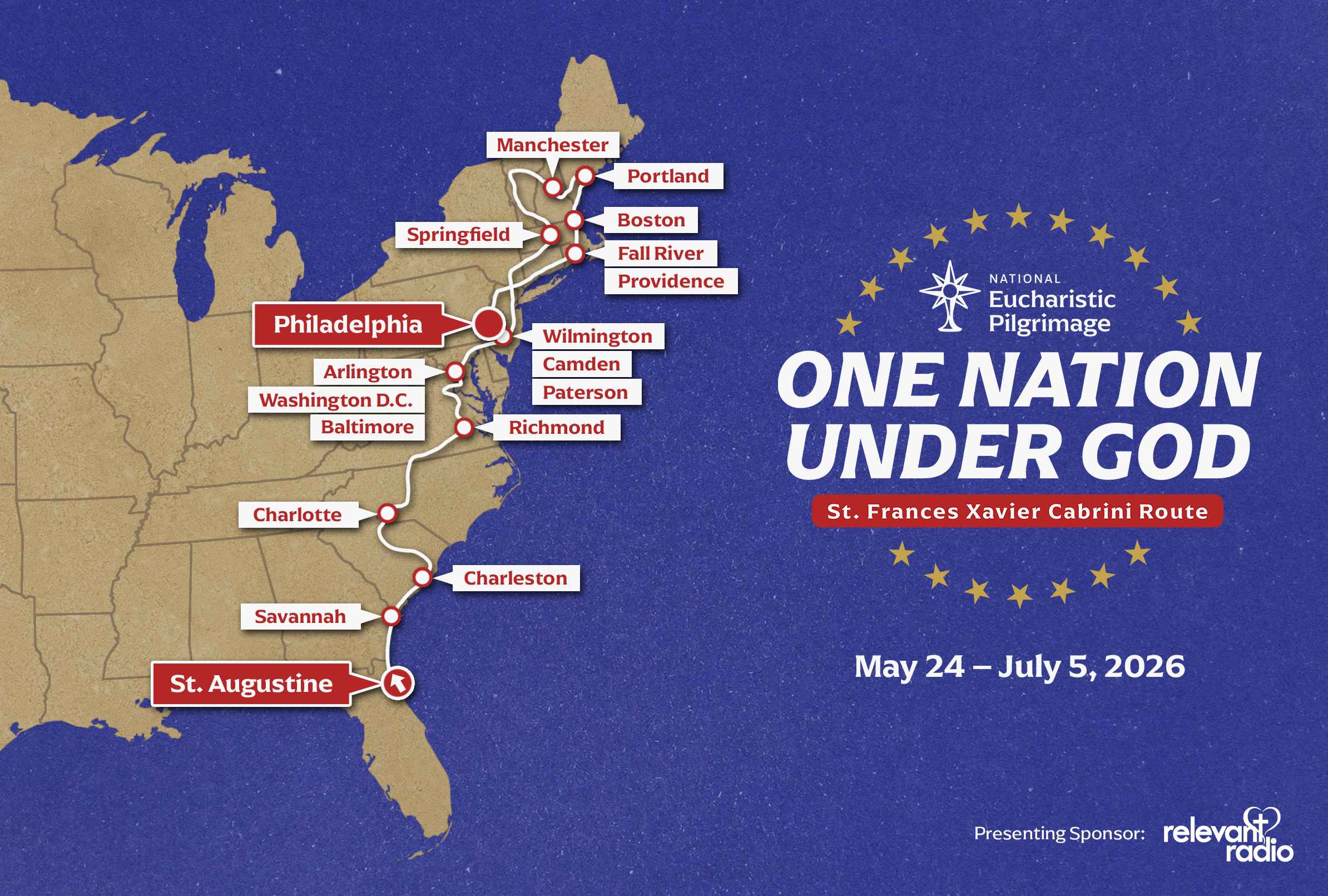
The 2026 National Eucharistic Pilgrimage, “One Nation Under God,” will kick off on May 24 in St. Augustine, Florida.
In honor of the nation’s 250th anniversary, the pilgrimage will begin in Florida, where the first recorded Catholic Mass within the future continental United States was celebrated, highlighting the country’s Catholic roots.
“We have to return to one nation under God, and I think that by beginning this pilgrimage at St. Augustine, weʼre returning to one of the major start points for Catholicism,” Jeffrey Bruno, a photojournalist and contributor to the National Catholic Register, the sister partner of EWTN News, said in an interview with Register Radio.
“If we do return to that as a nation, we really will be a nation filled with hope and with promise,” he said.
The launch of the pilgrimage will include remarks from Jason Shanks, president of the National Eucharistic Congress. He will also be joined by Bishop Erik Pohlmeier of St. Augustine and the nine perpetual pilgrims who will travel the entirety of the pilgrimage, which spans more than 2,000 miles.
The 250th anniversary coinciding with the pilgrimage is “perfect,” said Bruno, who has photographed past Eucharistic pilgrimages and the Eucharistic congress. “Hopefully itʼs going to be a new start, a fresh start“ and ”the next 250 will be really happy and holy, I pray.”
The pilgrimage will pass through most of the original 13 colonies. Pilgrims will travel the Eastern Seaboard along the Cabrini Route in honor of St. Frances Xavier Cabrini, the first U.S. citizen to be canonized.
The group will stop in Baltimore, which is the U.S. Catholic Church’s “foundation,” as it houses “the first cathedral” and “was the first diocese” in the nation, Bruno said.
Pilgrims also will travel through Colonial Williamsburg, the immersive restoration of Virginia’s 18th‑century capital, where “American culture … meets Catholic culture,” he said.
“American Catholic culture has had such an incredible impact on this country,” he said. “Catholicism is so interwoven into the fabric of the United States. Mother Cabrini is the perfect example of that too, with all the accomplishments, all the hospitals and institutions that she founded over all the years.”
“Healthcare, education, all these different things, itʼs like they can all find their roots back in … Catholicism” and its “contributions to this country,” he said.
“I just hope [and] I pray that the contributions moving forward will be even more intense,” Bruno said.
The pilgrimage will conclude on July 5 in Philadelphia.
Graces of the Blessed Sacrament
As the Eucharist travels from state to state, it will offer needed “grace” to believers and nonbelievers alike, Bruno said.
In his past experience on the pilgrimages, he said “seeing the impact of the Blessed Sacrament” and “passing through the highways and the byways has been the privilege of a lifetime.”
“The grace that comes from these pilgrimages, from these processions, from the processions with the Blessed Sacrament, and the witness of the pilgrims and the people that turn out to join in the local parishes … itʼs breathtaking. Itʼs incredible,” he said.
Bruno said “the efficacy of grace” is just like a quotation attributed to the inspiration of St. Carlo Acutis: “People who put themselves before the sun get a tan; people who place themselves before the Eucharist become saints.”
“I think that bringing the Blessed Sacrament” and “crossing all these different towns and places and exposing people — believers, nonbelievers, people that are hurt, people that are broken — to his grace … [has] an efficacy that can’t be understated,” he said.
“Itʼs something that I think the country has missed for a long period of time. And Iʼm super glad that this is happening now,” Bruno said. “You see the hunger is out there.”
“Everybody needs him” and “heʼs present, heʼs available,” Bruno said. “The grace is there.”
If you value the news and views Catholic World Report provides, please consider donating to support our efforts. Your contribution will help us continue to make CWR available to all readers worldwide for free, without a subscription. Thank you for your generosity!
Click here for more information on donating to CWR. Click here to sign up for our newsletter.

Leave a Reply