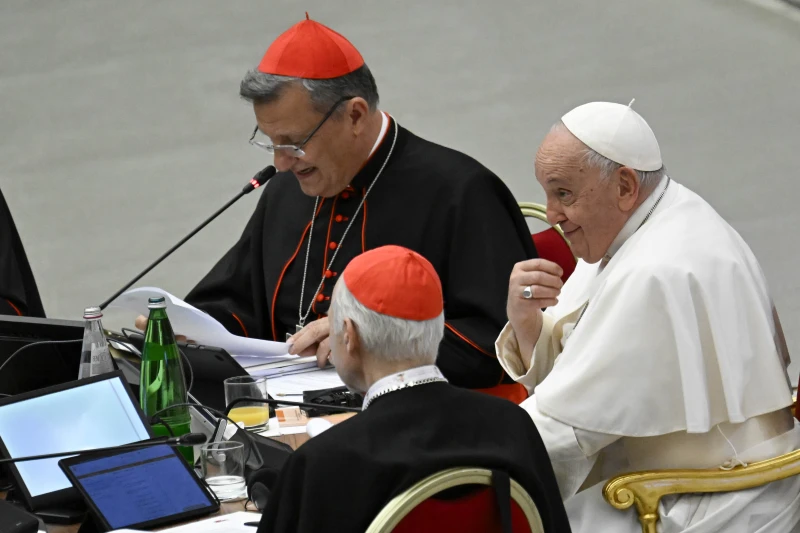
Cardinal Mario Grech and Pope Francis at the conclusion of the Synod on Synodality on Oct. 28, 2023. / Credit: Vatican Media
Rome Newsroom, Mar 14, 2024 / 17:40 pm (CNA).
Church experts will meet in study groups to examine the question of women deacons and other key topics through June 2025 — well beyond the Oct. 27 conclusion of the final assembly of the Synod on Synodality, Pope Francis revealed in a new letter to the synod’s general secretary released Thursday.
Writing to Cardinal Mario Grech, secretary general of the General Secretariat of the Synod, the pope noted that the 42-page Synthesis Report produced after the first session of the synod assembly held last October “enumerates many important theological issues,” which “by their very nature, require in-depth study.”
Because it won’t be possible to complete this study before the start of the next synod assembly on Oct. 2, the pope explained, “I am arranging for them to be assigned to specific study groups, so that they may be properly examined.”
In his letter Pope Francis listed 10 themes he wants the study groups to examine. They are:
1. Some aspects of the relationship between the Eastern Catholic Churches and the Latin Church.
2. Listening to the cry of the poor.
3. The mission in the digital environment.
4. The revision of the Ratio Fundamentalis Institutionis Sacerdotalis in a missionary synodal perspective.
5. Some theological and canonical matters regarding specific ministerial forms.
6. The revision, in a synodal missionary perspective, of the documents touching on the relationship between bishops, consecrated life, and ecclesial associations.
7. Some aspects of the person and ministry of the bishop (criteria for selecting candidates to episcopacy, judicial function of the bishops, nature and course of ad limina apostolorum visits) from a missionary synodal perspective.
8. The role of papal representatives in a missionary synodal perspective.
9. Theological criteria and synodal methodologies for shared discernment of controversial doctrinal, pastoral, and ethical issues.
10. The reception of the fruits of the ecumenical journey in ecclesial practices.
These selected themes were among a more extensive list of topics deemed “matters of great relevance” that came up during the synod’s first session in October 2023 that required consideration “at the level of the whole Church and in collaboration with the dicasteries of the Roman Curia,” according to the Dec. 12, 2023, document from the synod’s general secretariat titled “Towards October 2024.”
Observing that these issues require extensive review, Pope Francis noted that there is inadequate time to fully address them ahead of the synod in October. Therefore, he said, “the study groups will offer an initial account of their activity on the occasion of the second session and, if possible, will conclude their mandate by the month of June 2025.”
The pope said “it is the task of the General Secretariat of the Synod, by joint agreement with the competent dicasteries of the Roman Curia, to constitute these groups, calling pastors and experts from all continents to take part in them, and taking into consideration not only existing studies but also the most relevant current experiences in the people of God gathered in the local Churches.”
“It is important that the aforementioned study groups work according to an authentically synodal method, of which I ask you to be the guarantor,” the pope continued in his letter to Grech.
At a press briefing at the Vatican on Thursday, officials of the Secretariat of the Synod discussed the pope’s letter as well as two new documents the secretariat released in conjunction with the letter.
The first document, titled “Five Perspectives for Theological Exploration in View of the Second Session of the XVI Ordinary General Assembly of the Synod of Bishops,” reflects on the guiding theme of the synod: “How to Be a Synodal Church on Mission?”
It highlights that the next session will serve to deepen “the dynamic connection between the participation of all and the authority of some, in the horizon of communion and mission … in its theological meaning, in the practical ways of setting it in motion, and in the reality of canonical structures.”
The document also outlined the intermediary steps that are to be taken in the upcoming months in preparation for the synod, noting that this process will be built upon a “new consultation process,” articulating this will unfold on three distinct levels: the local Church, the groupings of Churches (i.e. national, regional, continental), and on the universal level.
The second document is titled “Study Groups on Questions Arising in the First Session of the 16th Ordinary General Assembly of the Synod of Bishops to Deepen in Collaboration with the Dicasteries of the Roman Curia.”
It is the second document that specifies that theme No. 5 — regarding matters related to ministerial forms — “is the context in which the question on the possible access of women to the diaconate can be appropriately posed.”
The study group formed to examine this question will be under the direction of the Dicastery for the Doctrine of the Faith, the document notes. This group “is entrusted with the task of continuing “theological and pastoral research on the access of women to the diaconate, taking advantage of the results of the commissions specially established by the Holy Father.”
The group’s work “will also aim to respond to the desire expressed by the Synodal Assembly for ‘a greater recognition and appreciation of the contribution of women and a growth in the pastoral responsibilities entrusted to them in all areas of the life and mission of the Church.”
If you value the news and views Catholic World Report provides, please consider donating to support our efforts. Your contribution will help us continue to make CWR available to all readers worldwide for free, without a subscription. Thank you for your generosity!
Click here for more information on donating to CWR. Click here to sign up for our newsletter.
Pope Francis at the general audience in St. Peter’s Square, Oct. 5, 2016. / Credit: Daniel Ibanez/CNA
CNA Staff, Mar 13, 2025 / 04:00 am (CNA).
March 13 marks the 12th anniversary of the election of Pope Francis as the 265th successor of St. Peter. Here is a timeline of key events during his papacy:
2013
March 13 — About two weeks after Pope Benedict XVI steps down from the papacy, Cardinal Jorge Bergoglio is elected pope. He takes the papal name Francis in honor of St. Francis of Assisi and proclaims from the central balcony of St. Peter’s Basilica: “Let us begin this journey, the bishop and people, this journey of the Church of Rome, which presides in charity over all the Churches, a journey of brotherhood in love, of mutual trust. Let us always pray for one another.”
March 14 — The day after he begins his pontificate, Pope Francis returns to his hotel to personally pay his hotel bill and collect his luggage.
July 8 — Pope Francis visits Italy’s island of Lampedusa and meets with a group of 50 migrants, most of whom are young men from Somalia and Eritrea. The island, which is about 200 miles off the coast of Tunisia, is a common entry point for migrants who flee parts of Africa and the Middle East to enter Europe. This is the pope’s first pastoral visit outside of Rome and sets the stage for making reaching out to the peripheries a significant focus.
Pope Francis gives the Wednesday general audience in St. Peter’s Square on Oct. 2, 2013. Elise Harris/CNA.
July 23-28 — Pope Francis visits Rio de Janeiro, Brazil, to participate in World Youth Day 2013. More than 3 million people from around the world attend the event.
July 29 — On the return flight from Brazil, Pope Francis gives his first papal news conference and sparks controversy by saying “if a person is gay and seeks God and has goodwill, who am I to judge?” The phrase is prompted by a reporter asking the pope a question about priests who have homosexual attraction.
Nov. 24 — Pope Francis publishes his first apostolic exhortation Evangelii Gaudium (The Joy of the Gospel). The document illustrates the pope’s vision for how to approach evangelization in the modern world.
2014
Feb. 22 — Pope Francis holds his first papal consistory to appoint 19 new cardinals, including ones from countries in the developing world that have never previously been represented in the College of Cardinals, such as Haiti.
March 22 — Pope Francis creates the Pontifical Commission for the Protection of Minors. The commission works to protect the dignity of minors and vulnerable adults, such as the victims of sexual abuse.
Pope Francis greets pilgrims during his general audience on Nov. 29, 2014. Bohumil Petrik/CNA.
Oct. 5 — The Synod on the Family begins. The bishops discuss a variety of concerns, including single-parent homes, cohabitation, homosexual adoption of children, and interreligious marriages.
Dec. 6 — After facing some pushback for his efforts to reform the Roman Curia, Pope Francis discusses his opinion in an interview with La Nacion, an Argentine news outlet: “Resistance is now evident. And that is a good sign for me, getting the resistance out into the open, no stealthy mumbling when there is disagreement. It’s healthy to get things out into the open, it’s very healthy.”
2015
Jan. 18 — To conclude a trip to Asia, Pope Francis celebrates Mass in Manila, Philippines. Approximately 6 million to 7 million people attend the record-setting Mass, despite heavy rain.
March 23 — Pope Francis visits Naples, Italy, to show the Church’s commitment to helping the fight against corruption and organized crime in the city.
May 24 — To emphasize the Church’s mission to combat global warming and care for the environment, Pope Francis publishes the encyclical Laudato Si’, which urges people to take care of the environment and encourages political action to address climate problems.
Pope Francis at a Wednesday general audience in St. Peter’s Square on June 17, 2015. Bohumil Petrik.
Sept. 19-22 — Pope Francis visits Cuba and meets with Fidel Castro in the first papal visit to the country since Pope John Paul II in 1998. During his homily, Francis discusses the dignity of the human person: “Being a Christian entails promoting the dignity of our brothers and sisters, fighting for it, living for it.”
Sept. 22-27 — After departing from Cuba, Pope Francis makes his first papal visit to the United States. In Washington, D.C., he speaks to a joint session of Congress, in which he urges lawmakers to work toward promoting the common good, and canonizes the Franciscan missionary St. Junípero Serra. He also attends the World Meeting of Families in Philadelphia, which focuses on celebrating the gift of the family.
Pope Francis speaks to the U.S. Congress in Washington, D.C. on Sept. 24, 2015. . L’Osservatore Romano.
Oct. 4 — Pope Francis begins the second Synod on the Family to address issues within the modern family, such as single-parent homes, cohabitation, poverty, and abuse.
Oct. 18 — The pope canonizes St. Louis Martin and St. Marie-Azélie “Zelie” Guérin. The married couple were parents to five nuns, including St. Therese of Lisieux. They are the first married couple to be canonized together.
Dec. 8 — Pope Francis’ Jubilee Year of Mercy begins. The year focuses on God’s mercy and forgiveness and people’s redemption from sin. The pope delegates certain priests in each diocese to be Missionaries of Mercy who have the authority to forgive sins that are usually reserved for the Holy See.
2016
March 19 — Pope Francis publishes the apostolic exhortation Amoris Laetitia, which discusses a wide variety of issues facing the modern family based on discussions from the two synods on the family. The pope garners significant controversy from within the Church for comments he makes in Chapter 8 about Communion for the divorced and remarried.
April 16 — After visiting refugees on the Greek island of Lesbos, Pope Francis allows three Muslim refugee families to join him on his flight back to Rome. He says the move was not a political statement.
Pope Francis at the General Audience in St. Peter’s Square, Feb. 24, 2016. Daniel Ibanez/CNA.
July 26-31 — Pope Francis visits Krakow, Poland, as part of the World Youth Day festivities. About 3 million young Catholic pilgrims from around the world attend.
Sept. 4 — The pope canonizes St. Teresa of Calcutta, who is also known as Mother Teresa. The saint, a nun from Albania, dedicated her life to missionary and charity work, primarily in India.
Sept. 30-Oct. 2 — Pope Francis visits Georgia and Azerbaijan on his 16th trip outside of Rome since the start of his papacy. His trip focuses on Catholic relations with Orthodox Christians and Muslims.
Oct. 4 — Pope Francis makes a surprise visit to Amatrice, Italy, to pray for the victims of an earthquake in central Italy that killed nearly 300 people.
2017
May 12-13 — In another papal trip, Francis travels to Fatima, Portugal, to visit the Shrine of Our Lady of Fatima. May 13 marks the 100th anniversary of the first Marian apparition to three children in the city.
July 11 — Pope Francis adds another category of Christian life suitable for the consideration of sainthood: “offering of life.” The category is distinct from martyrdom, which only applies to someone who is killed for his or her faith. The new category applies to those who died prematurely through an offering of their life to God and neighbor.
Pope Francis greets a participant in the World Day of the Poor in Rome, Nov. 16, 2017. L’Osservatore Romano.
Nov. 19 — On the first-ever World Day of the Poor, Pope Francis eats lunch with 4,000 poor and people in need in Rome.
Nov. 27-Dec. 2 — In another trip to Asia, Pope Francis travels to Myanmar and Bangladesh. He visits landmarks and meets with government officials, Catholic clergy, and Buddhist monks. He also preaches the Gospel and promotes peace in the region.
2018
Jan. 15-21 — The pope takes another trip to Latin America, this time visiting Chile and Peru. The pontiff meets with government officials and members of the clergy while urging the faithful to remain close to the clergy and reject secularism. The Chilean visit leads to controversy over Chilean clergy sex abuse scandals.
Aug. 2 — The Vatican formally revises No. 2267 of the Catechism of the Catholic Church, which concerns the death penalty. The previous text suggested the death penalty could be permissible in certain circumstances, but the revision states that the death penalty is “inadmissible.”
Aug. 25 — Archbishop Carlo Viganò, former papal nuncio to the United States, publishes an 11-page letter calling for the resignation of Pope Francis and accusing him and other Vatican officials of covering up sexual abuse including allegations against former Cardinal Theodore McCarrick. The pope initially does not directly respond to the letter, but nine months after its publication he denies having prior knowledge about McCarrick’s conduct.
Aug. 25-26 — Pope Francis visits Dublin, Ireland, to attend the World Meeting of Families. The theme is “the Gospel of family, joy for the world.”
Pope Francis at the 2018 World Meeting of Families in Ireland. Daniel Ibanez/CNA.
Oct. 3-28 — The Synod on Young People, the Faith, and Vocational Discernment takes place. The synod focuses on best practices to teach the faith to young people and to help them discern God’s will.
2019
Jan. 22-27 — The third World Youth Day during Pope Francis’ pontificate takes place during these six days in Panama City, Panama. Young Catholics from around the world gather for the event, with approximately 3 million people in attendance.
Feb. 4 — Pope Francis signs a joint document in with Sheikh Ahmed el-Tayeb, the grand imam of Al-Azhar, in Abu Dhabi, United Arab Emirates, titled the “Document on Human Fraternity for World Peace and Living Together.” The document focuses on people of different faiths uniting together to live peacefully and advance a culture of mutual respect.
Pope Francis and Ahmed el-Tayeb, grand imam of al-Azhar, signed a joint declaration on human fraternity during an interreligious meeting in Abu Dhabi, UAE, Feb. 4, 2019. Vatican Media.
Feb. 21-24 — The Meeting on the Protection of Minors in the Church, which is labeled the Vatican Sexual Abuse Summit, takes place. The meeting focuses on sexual abuse scandals in the Church and emphasizes responsibility, accountability, and transparency.
Oct. 6-27 — The Church holds the Synod of Bishops for the Pan-Amazon region, which is also known as the Amazon Synod. The synod is meant to present ways in which the Church can better evangelize the Amazon region but leads to controversy when carved images of a pregnant Amazonian woman, referred to by the pope as Pachamama, are used in several events and displayed in a basilica near the Vatican.
Oct. 13 — St. John Henry Newman, an Anglican convert to Catholicism and a cardinal, is canonized by Pope Francis. Newman’s writings inspired Catholic student associations at nonreligious colleges and universities in the United States and other countries.
2020
March 15 — Pope Francis takes a walking pilgrimage in Rome to the chapel of the crucifix and prays for an end to the COVID-19 pandemic. The crucifix was carried through Rome during the plague of 1522.
March 27 — Pope Francis gives an extraordinary “urbi et orbi” blessing in an empty and rain-covered St. Peter’s Square, praying for the world during the coronavirus pandemic.
Pope Francis venerates the miraculous crucifix of San Marcello al Corso in St. Peter’s Square during his Urbi et Orbi blessing, March 27, 2020. Vatican Media.
2021
March 5-8 — In his first papal trip since the start of the COVID-19 pandemic, Pope Francis becomes the first pope to visit Iraq. On his trip, he signs a joint statement with Grand Ayatollah Ali al-Sistani condemning extremism and promoting peace.
July 3 — Cardinal Giovanni Angelo Becciu, who was elevated to the College of Cardinals by Pope Francis, is indicted in a Vatican court for embezzlement, money laundering, and other crimes. The pope gives approval for the indictment.
July 4 — Pope Francis undergoes colon surgery for diverticulitis, a common condition in older people. The Vatican releases a statement that assures the pope “reacted well” to the surgery. Francis is released from the hospital after 10 days.
July 16 — Pope Francis issues a motu proprio titled Traditionis Custodes. The document imposes heavy restrictions on the celebration of the Traditional Latin Mass.
Dec. 2-6 — The pope travels to Cyprus and Greece. The trip includes another visit to the Greek island of Lesbos to meet with migrants.
Pope Francis greets His Beatitude Ieronymos II in Athens, Greece on Dec. 5, 2021. Vatican Media
2022
Jan. 11 — Pope Francis makes a surprise visit to a record store in Rome called StereoSound. The pope, who has an affinity for classical music, blesses the newly renovated store.
March 19 — The pope promulgates Praedicate Evangelium, which reforms the Roman Curia. The reforms emphasize evangelization and establish more opportunities for the laity to be in leadership positions.
May 5 — Pope Francis is seen in a wheelchair for the first time in public and begins to use one more frequently. The pope has been suffering from knee problems for months.
Pope Francis greeted the crowd in a wheelchair at the end of his general audience on Aug. 3, 2022. Daniel Ibanez/CNA
July 24-30 — In his first papal visit to Canada, Pope Francis apologizes for the harsh treatment of the indigenous Canadians, saying many Christians and members of the Catholic Church were complicit.
2023
Jan. 31-Feb. 5 — Pope Francis travels to the Democratic Republic of Congo and South Sudan. During his visit, the pope condemns political violence in the countries and promotes peace. He also participates in an ecumenical prayer service with Anglican Archbishop of Canterbury Justin Welby and Moderator of the Church of Scotland Iain Greenshields.
Pope Francis greets a young boy a Mass in Juba, South Sudan on Feb. 5, 2023. Vatican Media
March 29-April 1 — Pope Francis is hospitalized for a respiratory infection. During his stay at Rome’s Gemelli Hospital, he visits the pediatric cancer ward and baptizes a newborn baby.
April 5 — The pope appears in the Disney documentary “The Pope: Answers,” which is in Spanish, answering six “hot-button” issues from members of Gen Z from various backgrounds. The group discusses immigration, depression, abortion, clergy sexual and psychological abuse, transgenderism, pornography, and loss of faith.
April 28-30 — Pope Francis visits Hungary to meet with government officials, civil society members, bishops, priests, seminarians, Jesuits, consecrated men and women, and pastoral workers. He celebrates Mass on the final day of the trip in Kossuth Lajos Square.
Pope Francis stands on an altar erected outside the Parliament Building in Budapest’s Kossuth Lajos’ Square during a public outdoor Mass on April 30, 2023. Vatican Media
June 7 — The Vatican announces that Pope Francis will undergo abdominal surgery that afternoon under general anesthesia due to a hernia that is causing painful, recurring, and worsening symptoms. In his general audience that morning before the surgery, Francis says he intends to publish an apostolic letter on St. Thérèse of Lisieux, “patroness of the missions,” to mark the 150th anniversary of her birth.
June 15 — After successful surgery and a week of recovery, Pope Francis is released from Gemelli Hospital.
Aug. 2-6 — Pope Francis travels to Lisbon, Portugal, for World Youth Day 2023, taking place from Aug. 1-6. He meets with Church and civil leaders ahead of presiding at the welcoming Mass and Stations of the Cross. He also hears the confessions of several pilgrims. On Aug. 5, he visits the Shrine of Our Lady of Fátima, where he prays the rosary with young people with disabilities. That evening he presides over the vigil and on Sunday, Aug. 6, he celebrates the closing Mass, where he urges the 1.5 million young people present to “be not afraid,” echoing the words of the founder of World Youth Days, St. John Paul II.
Pope Francis waves at the crowd of 1.5 million people who attended the closing Mass of World Youth Day 2023 in Lisbon, Portugal on Aug. 6, 2023. Vatican Media.
Aug. 31-Sept. 4 — Pope Francis travels to Mongolia, the world’s most sparsely populated sovereign country. The trip makes Francis the first pope to visit the Asian country that shares a 2,880-mile border with China, its most significant economic partner. Mongolia has a population of about 1,300 Catholics in a country of more than 3 million people.
Pope Francis meets with local priests and religious of Mongolia, which includes only 25 priests (19 religious and six diocesan), 33 women religious, and one bishop — Cardinal Giorgio Marengo — in Ulaanbaatar’s Cathedral of Sts. Peter and Paul on Sept. 2, 2023. Credit: Vatican Media
Sept. 22-23 — On a two-day trip to Marseille, France, Pope Francis meets with local civil and religious leaders and participates in the Mediterranean Encounter, a gathering of some 120 young people of various creeds with bishops from 30 countries.
Pope Francis asks for a moment of silence at a memorial dedicated to sailors and migrants lost at sea on the first of a two-day visit to Marseille, France, Sept. 22, 2023. A Camargue cross, which comes from the Camargue area of France, represents the three theological virtues of faith, hope, and charity. The three tridents represent faith, the anchor represents hope, and the heart represents charity. Credit: Daniel Ibañez/CNA
Oct. 4-29 — The Vatican hosts the first of two monthlong global assemblies of the Synod on Synodality, initiated by Pope Francis in 2021 to enhance the communion, participation, and mission of the Church. Pope Francis celebrates the closing Mass of the synod at St. Peter’s Basilica on Oct. 29. The second and final global assembly will take place at the Vatican in October 2024.
Pope Francis at the Synod on Synodality’s closing Mass in St. Peter’s Basilica on Oct. 29, 2023. Vatican Media
Nov. 25 — Pope Francis visits the hospital briefly for precautionary testing after coming down with the flu earlier in the day. Although he still participates in scheduled activities, other officials read his prepared remarks. The Vatican on Nov. 28 cancels the pope’s planned Dec. 1–3 trip to Dubai for the COP28 climate conference, where he was scheduled to deliver a speech, due to his illness.
Dec. 18 — The Dicastery for the Doctrine of the Faith issues the declaration Fiducia Supplicans, which authorizes nonliturgical blessings for same-sex couples and couples in “irregular situations.” Various bishops from around the world voice both support for and criticism of the document.
2024
Jan. 14 — Pope Francis for the first time responds publicly to questions about Fiducia Supplicans in an interview on an Italian television show. The pope underlines that “the Lord blesses everyone” and that a blessing is an invitation to enter into a conversation “to see what the road is that the Lord proposes to them.”
Feb. 11 — In a ceremony attended by Argentine president Javier Milei, Pope Francis canonizes María Antonia of St. Joseph — known affectionately in the pope’s home country as “Mama Antula” — in a Mass at St. Peter’s Basilica. The president and the former archbishop of Buenos Aires embrace after the ceremony. Pope Francis, who has not returned to his homeland since becoming pope in 2013, has said he wants to visit Argentina in the second half of this year.
Pope Francis meets with Argentina President Javier Milei in a private audience on Feb. 12, 2024, at the Vatican. Credit: Vatican Media
March 13 — Pope Francis celebrates 11 years as supreme pontiff of the Roman Catholic Church.
April 8 — The Dicastery for the Doctrine of the Faith releases Dignitas Infinita (“Infinite Dignity”), a document that reaffirms the Church’s perennial opposition to abortion, euthanasia, and gender ideology.
May 19 — Pope Francis appears on CBS’ “60 Minutes” in an interview with Norah O’Donnell, where he states categorically that women’s ordination to the priesthood and the diaconate is off the table.
In an interview with 60 Minutes’ Norah O’Donnell, Pope Francis took aim at his “conservative critics” in the United States. Credit: CBS News/Adam Verdugo
June 14 — Pope Francis becomes the first pope to address the G7 Summit in the southern Italian region of Puglia. In his remarks, he stresses that human dignity requires that the decisions of artificial intelligence (AI) be under the control of human beings. During the three-day event, the pope also meets with U.S. President Joe Biden.
Sept. 2-13 — Pope Francis embarks on a 12-day trip of more than 20,000 miles over seven flights through Asia and Oceania. The trip to Indonesia, Papua New Guinea, East Timor, and Singapore is his most ambitious international trip yet and the longest of his 11-year pontificate. In East Timor, 600,000 Catholics attend Mass with the Holy Father.
Pope Francis celebrates Mass at the Esplanade of Taci Tolu in Dili, Timor-Leste, Tuesday, Sept. 10, 2024. Credit: Daniel Ibáñez/CNA
Oct. 2-27 — The three-year Synod on Synodality concludes with the final session in Rome and the adoption of the final report, which in a surprise move Pope Francis signs immediately, stating he will not issue a separate postsynodal document.
Dec. 7 — Pope Francis holds a consistory at the Vatican in which he creates 21 new cardinals, including Archbishop Frank Leo of Toronto; Archbishop Dominique Joseph Mathieu of Tehran-Isfahan, Iran; and Archbishop Tarcisio Isao Kikuchi of Tokyo, reflecting the pope’s emphasis on the Church’s global mission.
Pope Francis places the red biretta on Cardinal Domenico Battaglia, archbishop of Naples, during the consistory for the creation of 21 new cardinals in St. Peter’s Basilica, Dec. 7, 2024. Credit: Daniel Ibáñez/CNA
Dec. 24 — On Christmas Eve, Pope Francis opens the Holy Door at St. Peter’s Basilica to officially launch the 2025 Jubilee Year of Hope.
Pope Francis opens the Holy Door of St. Peter’s Basilica before Mass on Christmas Eve, Dec. 24, 2024, officially launching the Jubilee Year 2025. Credit: Vatican Media
2025
Jan. 14 — “Hope,” Pope Francis’ autobiography, is released. The book marks the first time a pope has provided a first-person narration of the episodes that have marked his entire life, in this case from his childhood in Argentina in a family of Italian immigrants to becoming the successor of St. Peter.
Feb. 14 — Pope Francis is hospitalized with bronchitis and later develops double pneumonia.
March 13 — While still in Gemelli Hosptial in Rome for treatment for respiratory illnesses, Pope Francis celebrates the 12th anniversay of his election to the papacy.
Cardinal Joseph Zen, former bishop of Hong Hong, attends the funeral Mass for Pope Emeritus Benedict XVI on Jan. 5, 2023, in St. Peter’s Square. / Credit: Diane Montagna
Rome Newsroom, Feb 1, 2023 / 09:02 am (CNA).
Cardinal Joseph Zen has been hospitalized in Hong Kong after his health deteriorated upon returning from Benedict XVI’s funeral in Rome.
The 91-year-old cardinal wrote on his blog on Jan. 31 that he is receiving treatment in the hospital after experiencing difficulty breathing.
Zen said that the doctors have already conducted many examinations and ruled out that he does not have a bacterial infection in his lungs as he experienced in 2016 when he was hospitalized for three weeks.
“You have not heard from me as I have been staying in the hospital. Please rest assured, Hong Kong’s most senior doctors are taking care of me,” he wrote.
The former bishop of Hong Kong revealed that he had already been experiencing some health difficulties before he received permission from a Hong Kong court to travel to Rome for the Jan. 5 funeral of Benedict XVI.
Despite having inflammation in his shoulders, an aching back, and numbness in his hands, Zen said that he felt that he “could not give up the opportunity” to be present at the funeral.
“The funeral of Pope Benedict was very important to me; and like a miracle, God allowed me to go to Rome to attend: The court approved, the police let me get back my passport; the airline just had a flight so that I could catch the funeral in time, therefore, I felt that I couldn’t give up this opportunity and decided to go,” he said.
“When I went to Rome, I felt that I represented the whole of Hong Kong and the whole of China, expressing our respect and love to Pope Benedict XVI.”
After his four-day trip to Rome, the cardinal spent 10 days resting in Hong Kong, but his health unexpectedly continued to deteriorate, worsening on the first day of Lunar New Year, Jan. 22.
Zen shared the update on his health in a blog post titled “Letter to Inmates.” The retired cardinal has dedicated his time over the past 10 years to prison ministry in Hong Kong and has baptized several prisoners.
“Do not forget that we will never be separated in prayer,” he wrote to the inmates. “I will continue to pray for you, and please remember me in your prayers.”
Fr. Stan Swamy, S.J. / Jharkhand Janadhikar Mahasabha/YouTube
Manila, Philippines, Jul 6, 2021 / 16:01 pm (CNA).
The Federation of Asian Bishops’ Conferences (FABC) on Tuesday mourned the death of Jesuit priest Stanislaus Lourduswamy, and called… […]
24 Comments
Well, we know he’s already managed to destroy the relationship with the Eastern Churches as they have cut off discussions over his gay blessings essay.If he wants to continue to damage the church, keep pushing the female deacon thing, which nobody wants but the most radical feminists. Its more than clear the action of female deacons and “priests” didn’t help the Protestant churches, whose attendance is far worse than ours.
At this early date, might we respectfully propose ten questions on the ten listed themes? Especially since time pressures have forced the partial replacement of the synod itself by study groups. So, some early questions:
1. About the East, how to avoid quarantining of the recently estranged Eastern Orthodox Church, like all of the Church in Africa, as just another culturally defective “special case;”
2. About the “cry of the poor” as not excluding those who are impoverished spiritually and culturally (as noted in the less exclusionary teaching of Centesimus Annus, n. 57);
3. In the digital environment, yes!, the preservation of analogue reality over a Nominalist digital cosmos, and even AI; and affirmation in season and out of season of the “transcendent dignity of [each] human person,” and of the “real” Vatican Council in its Documents over the “virtual” council as is still peddled by clones of Hans Kung;
4. A “missionary perspective” which, however, clearly does not marginalize (a new “periphery”!) the received and missionary Deposit of Faith with digital sociology;
5. Attention to “ministerial forms” in a way that now does not mutilate the unity of sacramental ordination, as has been pioneered with redefined ministerial “blessings” (Fiducia Supplicans) and such that the diaconate is not rendered as both a sacrament and not-a-sacrament and as a stepping stone (“walking together”) toward an Anglicanized female priestesshoody;
6. About “ecclesial organizations,” wording that does not dilute the individual and personal accountability of each Successor of the Apostles, versus the leveling administrative convenience of conferences of bishops, even if synodally “continental”—a matter already settled and clarified scripturally and in Apostolos Suos (May 21, 1998);
7. On the selection, judicial role and meaning of ad limina visits for bishops, perhaps guidance on how better to transcend the progressive intrusion of the zeitgeist into the particular Churches—as less polyhedral than equally rooted in the incarnate Jesus Christ, “the same yesterday, today, and forever;”
8. On papal representatives in a missionary synodal perspective, surely a functional role, still, for the Dicastery on the Doctrine of the Faith—as the Magisterium now preserves both faith and explicitly (!) morals (the natural law about which the Church is neither the “author” nor the “arbiter,” Veritatis Splendor, n. 95).
9. Theological criteria (etc.) for first distinguishing what is only controverted (!) from what else might be actually controversial,” and certainly without schizophrenic separation of the pastoral from the doctrinal—as earlier Nestorianism, likewise, tried to split the unity of Jesus Christ in twain;
10.Handling of ecumenical journey and ecclesial practices which, nevertheless, does not in practice redefine the Eucharistic and Mystical Body of Christ as a contour-free, congregational mosaic—”walking together” out of step with the “hierarchical communion” of the perennial Church and Second Vatican Council (Lumen Gentium); and where, in the forwardist future, wide-screen congregational “synods” might even pretend to replace (“backwardist”?) internally coherenet ecumenical councils.
From the back bleachers, just some self-evident questions…
Nine appears the key affecting the remainder, “Theological criteria and synodal methodologies for shared discernment of controversial doctrinal, pastoral, and ethical issues”. For example, what are synodal methodologies for shared discernment? Is it to proofread moral doctrine?
Discernment in so wide a context would pertain to common sense perception of ethical issues. Although it’s not required to call a universal Synod to address what’s practical knowledge that’s usually evaluated in the field. The intent on this scale of inquiry would more likely be a consensus on changes of doctrine. Whether such changes were to be formally pronounced by the Magisterium is troublesome and unlikely. Intent of change to doctrine would occur by less dramatic means, media proliferation of suggestions. Innovations wrapped in semi authentic gloss.
By the age of four, a child learns that wrongdoing necessitates finding ways to lie to Mommy and Daddy and to his very own self. It is amazing that after two thousand years of moral reflection by scholars and saints, dedicated to the Gospels, a gathering of those who currently represent this heritage can’t figure out that morality becomes complicated only when you’re trying to avoid it.
Wow, a whole lot of new entries for the Catholic Dictionary I’ve been working on for eleven years. Well, its a dictionary with a sub-title for Sorta-Catholic Catholics.
Honestly, I am restraining from contributing as ultimately, some bishops will accept the worked-through conclusions at the end and some will not. Even at this time Pope Francis is hailing these groupings as “one of the fruits of the Synod process launched on 9 October 2021.” I suppose he is breaking it into study groups in order to meet the October deadline – is what he means? This so-called process is attempting to produce itself into a work of the Holy Spirit; while yet already demonstrating unnatural forcing of acceptance and planting synthetic circularity.
It is impossible for the groups to correct this!
‘ In the spirit of the Chirograph signed by me on 16 February, it is the task of the General Secretariat of the Synod, by joint agreement with the competent Dicasteries of the Roman Curia, to constitute these Groups, calling Pastors and Experts from all Continents to take part in them, and taking into consideration not only existing studies, but also the most relevant current experiences in the People of God gathered in the local Churches. It is important that the aforementioned Study Groups work according to an authentically synodal method, of which I ask you to be the guarantor.
This will enable the Assembly, in its Second Session, to focus more easily on the general theme that I assigned to it at the time, and which can now be summarized in the question: “How to be a synodal Church in mission?”. ‘
I wrote synthetic circularity above, without knowing that Cardinal Grech had already been confessing “circularity” and not imagining anyone would even use that language.
Subsequently to my writing I found out about this aspect of Grech and the so-called Synod, from Beaulieu’s post MARCH 27, 2024 AT 3:07 PM, CWR’s Extra! Extra! March 27.
It shows to me that they have “no shame” about what they’re doing (Grech et al). Passing it off and passing it on as a sincerity -not like our faith!
In the VATICAN.VA link Grech is calling on the monachists to be the “deep breath of prayer”. Timothy Radcliffe and Gregory Polan in the videos select other cues.
Polan’s views reflect Sr. Gabriela’s perspective or angle on “synod”. This brings us right back to various discussions at CWR the past 3 years or so.
I note again, the “synod” commentators are saying different things. I note also, my Archbishop attended and you don’t know a) what he said there and b) what he is saying here, after his return. Myself, I don’t know a) either, like you.
See Sr.’s comments in the CWR links. And mine in tandems.
What safeguards and precautions are there to stop the place being turned into a “bargain basement” and to catch out or spot the miscreants?
‘ In the latest twist to a mounting privacy scandal in Italy, a Vatican prosecutor has announced opening an investigation to determine whether confidential information was used illicitly to influence the recent “trial of the century” on financial crime, which ended with the first-ever conviction of a cardinal by a Vatican civil court.
“As soon as I discovered, from articles in the press, the existence of electronic stalking regarding the Holy See, I opened a file, because I believe that someone followed our investigations from the outside,” said Alessandro Diddi, a veteran Italian lawyer who serves as the Vatican’s Promoter of Justice.
…..
Investigators say they’ve identified at least 800 suspicious searches undertaken by Striano related to 165 different individuals, although in recent comments to the Italian press Striano claimed the actual number of database searches he performed could reach as high as 40,000.
Among other things, investigators are seeking to understand if Striano and anti-mafia prosecutor Antonio Laudati, who’s also been named in the investigation, conducted these searches on behalf of other parties who were seeking to influence the outcome of political or legal procedures through the use of well-timed leaks. ‘
Proprietor owners of surveillance equipment co-operate with whomsoever they choose not merely with those with whom they enter into contract.
They are many proprietor owners and also proprietor co-owners. Equipment may be jointly developed or it may be leased out to an operator to hide the developer.
The Hong Kong invasion of privacy and invasion of confession laws, will mean that you may not interfere with wiretapping or obstruct the results.
This Hong Kong situation infuses a terrible flaw into the Holy See-China Provisional Agreement placing the secular authority inside the so-called internal forum.
Holy See will be unable to tell where things really are or what is or is not upheld.
The assertion of “no risk” from the new Hong Kong law is both foolhardy and deceitful. Even without a law there can be problems and you are supposed to take measures to deflect and disarm them. With the law, down to ad hoc eavesdroppers will be protected but also be duly employable officially; and the people in charge of them won’t necessarily divulge the state of affairs. You won’t even be able to tell if the patriotic bishop is less trustworthy from another bishop -or more.
You can’t prepare your flock to defend what is coming at them by misrepresenting it. Neither can you undress unjust law by saying “Oh it’s all good.”
These “Catholic idealists” helping deface the sacraments and sacramentals are helping deface everything else as well including a) clarity and right order (mercy and justice) in the secular and b) legitimate private initiative. Pope Francis seems unable to identify them as being under the spell of ideology. As the stakes go higher and things escalate he seems to become more and more UNWILLING TO ADMIT THAT, i.e., they fit with his own vision of things presented in little steps meant to demonstrate non-exclusion and other formulae in the “mission”.
A progression and a psychology that are not unfamiliar.
So far I’ve contributed 5 points on this and I am aiming to achieve a full slate of 10 of them to match with the Papal output and keep a pace with Mr. Beaulieu. To be frank I am praying that Pope Francis can handle the effectsas well as some others!
So this is the 6th. Cardinal Ambongo and my Archbishop present dualistic enigmas!
Ambongo is saying there could have been a way to “accept” FS. He was surprised at how it jumped out of the woodwork when he would have expected it to happen differently given the way things were going through October 2023. He has resisted it on the basis that it couldn’t fit with the culture; and the Pope endorses this.
He also insists it is a western imperialism.
I suspect a level of consultation was already made -at least shortly after the publication. But it is possible they conferred immediately prior! How shall we ever discover it?
Ambongo’s rationale and collaboration square with Evangelii Gaudium, unity prevails over conflict. But not with EG’s the whole is greater than the part.
But if he is against homosexualism in principle as he should be, where he shrewdly is relying on the papal politics to his advantage – how are we to know now?
Having publicly admitted it’s a culture business, what is he really preaching?
On the other hand my Archbishop, whom I believe to be a papal darling and a favourite for the succession, has been pushing homosexualism here at home WHERE IT IS AGAINST THE CULTURE AND THE RELIGIONS! In such wise defying all of EG’s 4 maxims! Ambongo insists he doesn’t want to cause confusion in the culture but that is exactly what my Archbishop has imposed, forcing something just not there.
He is doing this in a circle of priests that never complain about anything as would be when people are swearing by the subsisting peace. The very same blank about Bergoglio that Rome had before his election (Benedict XVI – “My authority ends at the door”), covers him as well; except now Rome is Bergoglio and the C9 etc. including Ambongo.
My Archbishop runs like a dark horse in a dark race with those who know him.
There is no DIRECT mention of the 300 priests in the 10 points or as one of the study groups or as a theological consideration. Presumably it has something to do with “the participation of all and the authority of some”?
The 10 points do seem to be focusing in on bishops.
From my own “subsidiary” experience, could it be that there is a vision “from the Holy Spirit” for intensifying “local tradition” over “universal” while at the same time defining “universal” more upon the terms of “synodal”?
So “the Holy Spirit will be guiding” these priests in “trained harmony”?
Or, Bishops will receive some “Holy Spirit formation in guiding priests”?
And in the meantime ahead of these developments the German malformation has been allocated some stable ground on which they can legitimately encounter the Holy Spirit through the rest of the proceedings?
“This encounter will have the aim of listening to and valuing the experience parish priests live in their respective local Churches, and to offer them an opportunity to experience the dynamism of synodal work at a universal level,” the Vatican announcement states.
CRUX says the 300 priests are “boots on the ground” and the Germans got “reigned in” by “the Vatican in keeping with Canon Law”.
The period of the Arian Crisis was a confluence a number of temptations to digression, anathema and dissipation: Paganists, Donatists, Pelagius, Origen and Arius and a little later Nestorius. In the Arian Crisis the secular authority would level exile sentences from bishops and impose exiles and decisions themselves.
Eusebius of Samosata, opponent of Arianism, refused to yield up records to the Arian Emperor Constantius II. When Eusebius offered instead both hands for amputation the Emperor withdrew.
Eusebius of Vercelli refused to join in the condemnation of Athanasius at the Milan council and was exiled by the same Constantius. This council was convoked at the request of the Pope with the aim of restoring Athanasius’ status. In one place of exile, Thebald, Upper Egypt, Eusebius was persecuted, harrassed and dragged through the streets.
The Milan Bishop’s name was Lucifer of Cagliari who also got exiled! Following the death of Constantius, Julian the Apostate gained the throne and he was responsible for restoring both men.
Bishop Meletius of Antioch opposed the Arians but suffered revolt within his See through intrigues from the Arian Eusebius of Caesarea; leading to Melitus being deposed and banished. This See was then thrown into turmoil.
That Eusebius of Caesarea started out with the Arians; turned out not to be truly Arian; supported pro-Arian factions; then formulated is own creed avoiding condemnation for Arianism but expressing his difficulty with homoousios. His faithsul disciple was Eusebius of Emesa whom St. Jerome describes as “standard bearer of the Arian faction” and a “rhetorical exhibionist”.
Eusebius of Nicomedia was the contemporary of Eusebius of Caesarea and close associate. He was very forceful in the expulsion of Athanasius. Later his behaviours matched that of Eusebius of Caesarea, in parallel denying the homoousios then later siging on with it but holding that Arius never held the views imputed to him. He led the resurgence in post-Nicene aggressive Arianism.
Of Constantine the Great’s sons and successors, Constantine II was Arian, Constantius II was Airan/semi-Arian and Constans I was Nicene. Julian of course was paganized.
Ambrose came to his bishopric in the midst of all of this.
I want to highlight the example of Hilary of Poitiers on his return from exile. That in the midst of the extremes of heretical disputation, scandal and luxury of heretic do-nothings, the possibilities for active ministry can not be missed.
‘ Hilary also attended several synods during his time in exile, including the council at Seleucia (359) which saw the triumph of the homoion party and the forbidding of all discussion of the divine substance. In 360, Hilary tried unsuccessfully to secure a personal audience with Constantius, as well as to address the council which met at Constantinople in 360. When this council ratified the decisions of Ariminum and Seleucia, Hilary responded with the bitter In Constantium, which attacked the Emperor Constantius as Antichrist and persecutor of orthodox Christians. Hilary’s urgent and repeated requests for public debates with his opponents, especially with Ursacius and Valens, proved at last so inconvenient that he was sent back to his diocese, which he appears to have reached about 361, within a very short time of the accession of Emperor Julian.
On returning to his diocese in 361, Hilary spent most of the first two or three years trying to persuade the local clergy that the homoion confession was merely a cover for traditional Arian subordinationism. Thus, a number of synods in Gaul condemned the creed promulgated at the Council of Ariminum (359).
In about 360 or 361, with Hilary’s encouragement, Martin, the future bishop of Tours, founded a monastery at Ligugé in his diocese.
In 364, Hilary extended his efforts once more beyond Gaul. He impeached Auxentius, bishop of Milan, a man high in the imperial favour, as heterodox. Emperor Valentinian I accordingly summoned Hilary to Milan to there maintain his charges. However, the supposed heretic gave satisfactory answers to all the questions proposed. Hilary denounced Auxentius as a hypocrite as he had been ignominiously expelled from Milan. Upon returning home, Hilary in 365, published the Contra Arianos vel Auxentium Mediolanensem liber, describing his unsuccessful efforts against Auxentius. He also, perhaps at a somewhat earlier date, published the Contra Constantium Augustum liber, accusing the deceased emperor as having been the Antichrist, a rebel against God, “a tyrant whose sole object had been to make a gift to the devil of that world for which Christ had suffered.” ‘
Pope Francis is re-proposing Aquinas for the age. The assumption would therefore seem to be that the 4 “principles” in Evangelii are seamlessly compatible or otherwise reconcilable with Aquinas -whether through Thomism or something else; or that they will stand on their own merits outside Aquinas.
He has demarcated (below) four areas of focus. One would have supposed that a correct approach would have been an offering on the right teaching for each one, in as much as the trend to date has been to avoid -keep avoiding- the perennial magisterium. What has been developing is a tremendous babble of “personal insights”.
‘ He added that the Dominican theologian also demonstrated how grace elevates wounded human nature, with “rich implications for an understanding of the dynamics of a sound social order grounded in reconciliation, solidarity, justice, and mutual concern.” ‘
From what I have seen already unfold in my Archdiocese, there is a movement to redefine everything in terms of “ecclesial community” and in particular the “ecclesial communities” peculiar to the locale; and locate the Christian identity and mission from these. If you read the ten points as a unit they seem to have in view how to flesh out further this movement and facilitate its expression, legality and progress. They mean to colonize, take over and rule everything.
Including schools.
By implication, “conversion” will necessarily “include” an “attestation” to those things and what they must yield; submitting to hierarchy who will guide it as a proof of true converting and the Holy Spirit. On these new premises it wouldn’t be right to say, “in line with that thinking” just so.
Further, apparently the Holy Spirit already intimated to certain souls that this is what the Holy Spirit wants “because its time has come”: the Holy Spirit was bringing about this very “kairos” in “the fullness of time”. My Archbishop gets very hot when he has to expound the kairos.
“It’s a kairos moment.”
The kairos is the widget that nuances, adapts, reorients or overturns the paradigm. Multi-taskish. This is underlying Traditionis Custodes, among all the others. The series -journey- that it travels through is marked by intermediate conclusion, suggestion, notionalizing and emotional baiting.
Compare to the 4 “principles” in Evangelii.
It seems someone wants the Opus Dei situation to be more ineluctable still.
Opus Dei is slowly throwing aside the founder’s original inspiration and the foundation laid by JPII for something else they have gone in search of with a certitude it will be found; so that when they find it, it help them avoid “being exceptional” but confirm their new certainty. They have singled out ONE Opus Dei norm to achieve this, unity with the Pope.
Had Ocariz said this during the time of Don Alvaro he would have been expelled. He knows it very well. Even more excruciating for them, Ocariz understands perfectly that the relatively recent legalism of “ecclesial community” was 1. not meant to express a spiritual revolution and 2. not meant to replace the true formatting already established for Opus Dei in the Holy Spirit.
See Fr. Morello’s comments on Fr. Matthew Fox O.P., in the CWR link on Fr. Aidan Nichols. (I just discovered this [i.e. for the first time] after my post on kairos! Same thing with synthetic circularity -Beaulieu’s post about Grech in Extra! Extra!)
There are different “theologies” and “spiritualities” to do with paradigm shift and “kairos” and whatever other new terminologies are inducted. The right perspective on these is that they were up for judgment by the Church -like gay spiritulaity also; not for haphazard and piecemeal inclusion coerced by the Pontiff.
If you research the topic online you will see many different interpretations coming with these topics from Catholics as well as non-Catholics.
What my Archbishop’s background reading and socializing has been I simply do not know. It’s not possible for me to be attending his homilies and lectures consistently where he name-drops on occasion. His inter-religious circles have been very varied too.
Here is a perspective-analysis about a position set up by Paul Tillich. As you can see, this traces a long history. It probably goes back to Teilhard de Chardin and others.
‘ In succession, the three “Kairos” texts show how Tillich employs the idea of a different temporality and a temporality of difference in order to rethink the relation of religion and politics and to reassess a situation of crisis. As Weber’s reading of the Hebrew prophets and Barth’s interpretation of the New Testament reveal, diverse and complex discourses echo in the idea of kairos, allowing for the formulation of new ideas of intellectual politics. The three different versions of Tillich’s texts reflect the idea’s capacity to adapt to different circumstances: kairos can connote both idealism and realism; it can highlight spiritual as well as very material needs; it can be connected to the prophetic as well as the priestly. The sequence of the texts also allows us to explore the strong rhetorical and performative dimension of the idea, which is fundamental to its relevance in the context of the Weimar Republic. More than simply a descriptive category, kairos constitutes a strong appellative moment that is essential for the politics it engenders. Even though its rhetoric of urgency runs the risk of lapsing into disappointment, its gesture is complex enough to integrate an awareness of that risk, as Tillich’s later texts show.
At least potentially, the rhetoric of kairos can thus lead to a self-critique that does not spiral into abstraction, sustaining vehemence without forgetting its own limitations. ‘
Well, we know he’s already managed to destroy the relationship with the Eastern Churches as they have cut off discussions over his gay blessings essay.If he wants to continue to damage the church, keep pushing the female deacon thing, which nobody wants but the most radical feminists. Its more than clear the action of female deacons and “priests” didn’t help the Protestant churches, whose attendance is far worse than ours.
So sick and tired of this Synodal garbage. The next Pope needs to issue a bull declaring there will be no more Synods ever again. Period.
The next Pope will be a Modernist far worse than Francis. He has already packed the Curia with Modernists and all the Cardinals are Modernists.
At this early date, might we respectfully propose ten questions on the ten listed themes? Especially since time pressures have forced the partial replacement of the synod itself by study groups. So, some early questions:
1. About the East, how to avoid quarantining of the recently estranged Eastern Orthodox Church, like all of the Church in Africa, as just another culturally defective “special case;”
2. About the “cry of the poor” as not excluding those who are impoverished spiritually and culturally (as noted in the less exclusionary teaching of Centesimus Annus, n. 57);
3. In the digital environment, yes!, the preservation of analogue reality over a Nominalist digital cosmos, and even AI; and affirmation in season and out of season of the “transcendent dignity of [each] human person,” and of the “real” Vatican Council in its Documents over the “virtual” council as is still peddled by clones of Hans Kung;
4. A “missionary perspective” which, however, clearly does not marginalize (a new “periphery”!) the received and missionary Deposit of Faith with digital sociology;
5. Attention to “ministerial forms” in a way that now does not mutilate the unity of sacramental ordination, as has been pioneered with redefined ministerial “blessings” (Fiducia Supplicans) and such that the diaconate is not rendered as both a sacrament and not-a-sacrament and as a stepping stone (“walking together”) toward an Anglicanized female priestesshoody;
6. About “ecclesial organizations,” wording that does not dilute the individual and personal accountability of each Successor of the Apostles, versus the leveling administrative convenience of conferences of bishops, even if synodally “continental”—a matter already settled and clarified scripturally and in Apostolos Suos (May 21, 1998);
7. On the selection, judicial role and meaning of ad limina visits for bishops, perhaps guidance on how better to transcend the progressive intrusion of the zeitgeist into the particular Churches—as less polyhedral than equally rooted in the incarnate Jesus Christ, “the same yesterday, today, and forever;”
8. On papal representatives in a missionary synodal perspective, surely a functional role, still, for the Dicastery on the Doctrine of the Faith—as the Magisterium now preserves both faith and explicitly (!) morals (the natural law about which the Church is neither the “author” nor the “arbiter,” Veritatis Splendor, n. 95).
9. Theological criteria (etc.) for first distinguishing what is only controverted (!) from what else might be actually controversial,” and certainly without schizophrenic separation of the pastoral from the doctrinal—as earlier Nestorianism, likewise, tried to split the unity of Jesus Christ in twain;
10.Handling of ecumenical journey and ecclesial practices which, nevertheless, does not in practice redefine the Eucharistic and Mystical Body of Christ as a contour-free, congregational mosaic—”walking together” out of step with the “hierarchical communion” of the perennial Church and Second Vatican Council (Lumen Gentium); and where, in the forwardist future, wide-screen congregational “synods” might even pretend to replace (“backwardist”?) internally coherenet ecumenical councils.
From the back bleachers, just some self-evident questions…
Nine appears the key affecting the remainder, “Theological criteria and synodal methodologies for shared discernment of controversial doctrinal, pastoral, and ethical issues”. For example, what are synodal methodologies for shared discernment? Is it to proofread moral doctrine?
Discernment in so wide a context would pertain to common sense perception of ethical issues. Although it’s not required to call a universal Synod to address what’s practical knowledge that’s usually evaluated in the field. The intent on this scale of inquiry would more likely be a consensus on changes of doctrine. Whether such changes were to be formally pronounced by the Magisterium is troublesome and unlikely. Intent of change to doctrine would occur by less dramatic means, media proliferation of suggestions. Innovations wrapped in semi authentic gloss.
By the age of four, a child learns that wrongdoing necessitates finding ways to lie to Mommy and Daddy and to his very own self. It is amazing that after two thousand years of moral reflection by scholars and saints, dedicated to the Gospels, a gathering of those who currently represent this heritage can’t figure out that morality becomes complicated only when you’re trying to avoid it.
Wow, a whole lot of new entries for the Catholic Dictionary I’ve been working on for eleven years. Well, its a dictionary with a sub-title for Sorta-Catholic Catholics.
A classic nailing it Edward. Naughty children who’ve grown up to be naughty men.
How difficult for man to become more Christlike. Yet, how easy for man to become earthly and irreverent!
Thank you for proclaiming Jesus Christ and remaining steadfast.
How difficult for man to become more Christlike. Yet, how easy for man to become earthly and irreverent! This applies especially to Pope Francis.
Honestly, I am restraining from contributing as ultimately, some bishops will accept the worked-through conclusions at the end and some will not. Even at this time Pope Francis is hailing these groupings as “one of the fruits of the Synod process launched on 9 October 2021.” I suppose he is breaking it into study groups in order to meet the October deadline – is what he means? This so-called process is attempting to produce itself into a work of the Holy Spirit; while yet already demonstrating unnatural forcing of acceptance and planting synthetic circularity.
It is impossible for the groups to correct this!
‘ In the spirit of the Chirograph signed by me on 16 February, it is the task of the General Secretariat of the Synod, by joint agreement with the competent Dicasteries of the Roman Curia, to constitute these Groups, calling Pastors and Experts from all Continents to take part in them, and taking into consideration not only existing studies, but also the most relevant current experiences in the People of God gathered in the local Churches. It is important that the aforementioned Study Groups work according to an authentically synodal method, of which I ask you to be the guarantor.
This will enable the Assembly, in its Second Session, to focus more easily on the general theme that I assigned to it at the time, and which can now be summarized in the question: “How to be a synodal Church in mission?”. ‘
https://press.vatican.va/content/salastampa/en/bollettino/pubblico/2024/03/14/240314f.html
I wrote synthetic circularity above, without knowing that Cardinal Grech had already been confessing “circularity” and not imagining anyone would even use that language.
Subsequently to my writing I found out about this aspect of Grech and the so-called Synod, from Beaulieu’s post MARCH 27, 2024 AT 3:07 PM, CWR’s Extra! Extra! March 27.
It shows to me that they have “no shame” about what they’re doing (Grech et al). Passing it off and passing it on as a sincerity -not like our faith!
In the VATICAN.VA link Grech is calling on the monachists to be the “deep breath of prayer”. Timothy Radcliffe and Gregory Polan in the videos select other cues.
https://www.vaticannews.va/en/vatican-city/news/2021-08/grech-monastic-contemplative-listening-conversion-communion.html
https://www.catholicworldreport.com/2024/03/27/extra-extra-news-and-views-for-wednesday-march-27-2024/
Polan’s views reflect Sr. Gabriela’s perspective or angle on “synod”. This brings us right back to various discussions at CWR the past 3 years or so.
I note again, the “synod” commentators are saying different things. I note also, my Archbishop attended and you don’t know a) what he said there and b) what he is saying here, after his return. Myself, I don’t know a) either, like you.
See Sr.’s comments in the CWR links. And mine in tandems.
https://www.catholicworldreport.com/2023/09/22/the-sacramental-nature-of-authority-and-the-limits-of-synodality/
https://www.catholicworldreport.com/2022/05/09/synodality-bureaucratic-malaise-and-the-problem-of-power/
https://www.catholicworldreport.com/2022/07/04/embracing-the-spirit-of-charity-in-a-post-dobbs-culture/
What safeguards and precautions are there to stop the place being turned into a “bargain basement” and to catch out or spot the miscreants?
‘ In the latest twist to a mounting privacy scandal in Italy, a Vatican prosecutor has announced opening an investigation to determine whether confidential information was used illicitly to influence the recent “trial of the century” on financial crime, which ended with the first-ever conviction of a cardinal by a Vatican civil court.
“As soon as I discovered, from articles in the press, the existence of electronic stalking regarding the Holy See, I opened a file, because I believe that someone followed our investigations from the outside,” said Alessandro Diddi, a veteran Italian lawyer who serves as the Vatican’s Promoter of Justice.
…..
Investigators say they’ve identified at least 800 suspicious searches undertaken by Striano related to 165 different individuals, although in recent comments to the Italian press Striano claimed the actual number of database searches he performed could reach as high as 40,000.
Among other things, investigators are seeking to understand if Striano and anti-mafia prosecutor Antonio Laudati, who’s also been named in the investigation, conducted these searches on behalf of other parties who were seeking to influence the outcome of political or legal procedures through the use of well-timed leaks. ‘
https://cruxnow.com/vatican/2024/03/vatican-opens-probe-on-trial-of-the-century-amid-widening-italian-privacy-scandal
Proprietor owners of surveillance equipment co-operate with whomsoever they choose not merely with those with whom they enter into contract.
They are many proprietor owners and also proprietor co-owners. Equipment may be jointly developed or it may be leased out to an operator to hide the developer.
The Hong Kong invasion of privacy and invasion of confession laws, will mean that you may not interfere with wiretapping or obstruct the results.
This Hong Kong situation infuses a terrible flaw into the Holy See-China Provisional Agreement placing the secular authority inside the so-called internal forum.
Holy See will be unable to tell where things really are or what is or is not upheld.
https://www.lifesitenews.com/news/hong-kong-passes-national-security-law-forcing-priests-to-break-seal-of-confession/
https://www.thecatholicthing.org/2024/03/14/pope-tells-priests-dont-ask-too-much-during-confession/
https://www.thecatholicthing.org/2024/03/20/synodal-news-and-a-papal-saga/
The assertion of “no risk” from the new Hong Kong law is both foolhardy and deceitful. Even without a law there can be problems and you are supposed to take measures to deflect and disarm them. With the law, down to ad hoc eavesdroppers will be protected but also be duly employable officially; and the people in charge of them won’t necessarily divulge the state of affairs. You won’t even be able to tell if the patriotic bishop is less trustworthy from another bishop -or more.
You can’t prepare your flock to defend what is coming at them by misrepresenting it. Neither can you undress unjust law by saying “Oh it’s all good.”
https://cruxnow.com/church-in-asia/2024/03/hong-kong-diocese-says-no-risk-to-confession-with-security-law
Some advices about wisdom from 2013 –
‘ “The Kingdom of God is among us: do not seek strange things, do not seek novelties with this worldly curiosity. …” ‘
https://www.catholicworldreport.com/2013/11/14/pope-francis-do-not-seek-novelties-with-this-worldly-curiosity/
These “Catholic idealists” helping deface the sacraments and sacramentals are helping deface everything else as well including a) clarity and right order (mercy and justice) in the secular and b) legitimate private initiative. Pope Francis seems unable to identify them as being under the spell of ideology. As the stakes go higher and things escalate he seems to become more and more UNWILLING TO ADMIT THAT, i.e., they fit with his own vision of things presented in little steps meant to demonstrate non-exclusion and other formulae in the “mission”.
A progression and a psychology that are not unfamiliar.
So far I’ve contributed 5 points on this and I am aiming to achieve a full slate of 10 of them to match with the Papal output and keep a pace with Mr. Beaulieu. To be frank I am praying that Pope Francis can handle the effectsas well as some others!
So this is the 6th. Cardinal Ambongo and my Archbishop present dualistic enigmas!
Ambongo is saying there could have been a way to “accept” FS. He was surprised at how it jumped out of the woodwork when he would have expected it to happen differently given the way things were going through October 2023. He has resisted it on the basis that it couldn’t fit with the culture; and the Pope endorses this.
He also insists it is a western imperialism.
I suspect a level of consultation was already made -at least shortly after the publication. But it is possible they conferred immediately prior! How shall we ever discover it?
Ambongo’s rationale and collaboration square with Evangelii Gaudium, unity prevails over conflict. But not with EG’s the whole is greater than the part.
But if he is against homosexualism in principle as he should be, where he shrewdly is relying on the papal politics to his advantage – how are we to know now?
Having publicly admitted it’s a culture business, what is he really preaching?
On the other hand my Archbishop, whom I believe to be a papal darling and a favourite for the succession, has been pushing homosexualism here at home WHERE IT IS AGAINST THE CULTURE AND THE RELIGIONS! In such wise defying all of EG’s 4 maxims! Ambongo insists he doesn’t want to cause confusion in the culture but that is exactly what my Archbishop has imposed, forcing something just not there.
He is doing this in a circle of priests that never complain about anything as would be when people are swearing by the subsisting peace. The very same blank about Bergoglio that Rome had before his election (Benedict XVI – “My authority ends at the door”), covers him as well; except now Rome is Bergoglio and the C9 etc. including Ambongo.
My Archbishop runs like a dark horse in a dark race with those who know him.
There is no DIRECT mention of the 300 priests in the 10 points or as one of the study groups or as a theological consideration. Presumably it has something to do with “the participation of all and the authority of some”?
The 10 points do seem to be focusing in on bishops.
From my own “subsidiary” experience, could it be that there is a vision “from the Holy Spirit” for intensifying “local tradition” over “universal” while at the same time defining “universal” more upon the terms of “synodal”?
So “the Holy Spirit will be guiding” these priests in “trained harmony”?
Or, Bishops will receive some “Holy Spirit formation in guiding priests”?
And in the meantime ahead of these developments the German malformation has been allocated some stable ground on which they can legitimately encounter the Holy Spirit through the rest of the proceedings?
“This encounter will have the aim of listening to and valuing the experience parish priests live in their respective local Churches, and to offer them an opportunity to experience the dynamism of synodal work at a universal level,” the Vatican announcement states.
CRUX says the 300 priests are “boots on the ground” and the Germans got “reigned in” by “the Vatican in keeping with Canon Law”.
https://cruxnow.com/church-in-the-usa/2024/03/ahead-of-synod-meeting-priests-have-boots-on-the-ground-of-church
https://cruxnow.com/vatican/2024/03/vatican-reigns-in-german-bishops-amid-dispute-over-national-reforms
The period of the Arian Crisis was a confluence a number of temptations to digression, anathema and dissipation: Paganists, Donatists, Pelagius, Origen and Arius and a little later Nestorius. In the Arian Crisis the secular authority would level exile sentences from bishops and impose exiles and decisions themselves.
Eusebius of Samosata, opponent of Arianism, refused to yield up records to the Arian Emperor Constantius II. When Eusebius offered instead both hands for amputation the Emperor withdrew.
Eusebius of Vercelli refused to join in the condemnation of Athanasius at the Milan council and was exiled by the same Constantius. This council was convoked at the request of the Pope with the aim of restoring Athanasius’ status. In one place of exile, Thebald, Upper Egypt, Eusebius was persecuted, harrassed and dragged through the streets.
The Milan Bishop’s name was Lucifer of Cagliari who also got exiled! Following the death of Constantius, Julian the Apostate gained the throne and he was responsible for restoring both men.
Bishop Meletius of Antioch opposed the Arians but suffered revolt within his See through intrigues from the Arian Eusebius of Caesarea; leading to Melitus being deposed and banished. This See was then thrown into turmoil.
That Eusebius of Caesarea started out with the Arians; turned out not to be truly Arian; supported pro-Arian factions; then formulated is own creed avoiding condemnation for Arianism but expressing his difficulty with homoousios. His faithsul disciple was Eusebius of Emesa whom St. Jerome describes as “standard bearer of the Arian faction” and a “rhetorical exhibionist”.
Eusebius of Nicomedia was the contemporary of Eusebius of Caesarea and close associate. He was very forceful in the expulsion of Athanasius. Later his behaviours matched that of Eusebius of Caesarea, in parallel denying the homoousios then later siging on with it but holding that Arius never held the views imputed to him. He led the resurgence in post-Nicene aggressive Arianism.
Of Constantine the Great’s sons and successors, Constantine II was Arian, Constantius II was Airan/semi-Arian and Constans I was Nicene. Julian of course was paganized.
Ambrose came to his bishopric in the midst of all of this.
I want to highlight the example of Hilary of Poitiers on his return from exile. That in the midst of the extremes of heretical disputation, scandal and luxury of heretic do-nothings, the possibilities for active ministry can not be missed.
‘ Hilary also attended several synods during his time in exile, including the council at Seleucia (359) which saw the triumph of the homoion party and the forbidding of all discussion of the divine substance. In 360, Hilary tried unsuccessfully to secure a personal audience with Constantius, as well as to address the council which met at Constantinople in 360. When this council ratified the decisions of Ariminum and Seleucia, Hilary responded with the bitter In Constantium, which attacked the Emperor Constantius as Antichrist and persecutor of orthodox Christians. Hilary’s urgent and repeated requests for public debates with his opponents, especially with Ursacius and Valens, proved at last so inconvenient that he was sent back to his diocese, which he appears to have reached about 361, within a very short time of the accession of Emperor Julian.
On returning to his diocese in 361, Hilary spent most of the first two or three years trying to persuade the local clergy that the homoion confession was merely a cover for traditional Arian subordinationism. Thus, a number of synods in Gaul condemned the creed promulgated at the Council of Ariminum (359).
In about 360 or 361, with Hilary’s encouragement, Martin, the future bishop of Tours, founded a monastery at Ligugé in his diocese.
In 364, Hilary extended his efforts once more beyond Gaul. He impeached Auxentius, bishop of Milan, a man high in the imperial favour, as heterodox. Emperor Valentinian I accordingly summoned Hilary to Milan to there maintain his charges. However, the supposed heretic gave satisfactory answers to all the questions proposed. Hilary denounced Auxentius as a hypocrite as he had been ignominiously expelled from Milan. Upon returning home, Hilary in 365, published the Contra Arianos vel Auxentium Mediolanensem liber, describing his unsuccessful efforts against Auxentius. He also, perhaps at a somewhat earlier date, published the Contra Constantium Augustum liber, accusing the deceased emperor as having been the Antichrist, a rebel against God, “a tyrant whose sole object had been to make a gift to the devil of that world for which Christ had suffered.” ‘
https://en.wikipedia.org/wiki/Hilary_of_Poitiers
Pope Francis is re-proposing Aquinas for the age. The assumption would therefore seem to be that the 4 “principles” in Evangelii are seamlessly compatible or otherwise reconcilable with Aquinas -whether through Thomism or something else; or that they will stand on their own merits outside Aquinas.
He has demarcated (below) four areas of focus. One would have supposed that a correct approach would have been an offering on the right teaching for each one, in as much as the trend to date has been to avoid -keep avoiding- the perennial magisterium. What has been developing is a tremendous babble of “personal insights”.
‘ He added that the Dominican theologian also demonstrated how grace elevates wounded human nature, with “rich implications for an understanding of the dynamics of a sound social order grounded in reconciliation, solidarity, justice, and mutual concern.” ‘
https://www.catholicworldreport.com/2024/03/07/pope-francis-st-thomas-aquinas-is-needed-to-answer-todays-social-challenges/
From what I have seen already unfold in my Archdiocese, there is a movement to redefine everything in terms of “ecclesial community” and in particular the “ecclesial communities” peculiar to the locale; and locate the Christian identity and mission from these. If you read the ten points as a unit they seem to have in view how to flesh out further this movement and facilitate its expression, legality and progress. They mean to colonize, take over and rule everything.
Including schools.
By implication, “conversion” will necessarily “include” an “attestation” to those things and what they must yield; submitting to hierarchy who will guide it as a proof of true converting and the Holy Spirit. On these new premises it wouldn’t be right to say, “in line with that thinking” just so.
Further, apparently the Holy Spirit already intimated to certain souls that this is what the Holy Spirit wants “because its time has come”: the Holy Spirit was bringing about this very “kairos” in “the fullness of time”. My Archbishop gets very hot when he has to expound the kairos.
“It’s a kairos moment.”
The kairos is the widget that nuances, adapts, reorients or overturns the paradigm. Multi-taskish. This is underlying Traditionis Custodes, among all the others. The series -journey- that it travels through is marked by intermediate conclusion, suggestion, notionalizing and emotional baiting.
Compare to the 4 “principles” in Evangelii.
It seems someone wants the Opus Dei situation to be more ineluctable still.
Opus Dei is slowly throwing aside the founder’s original inspiration and the foundation laid by JPII for something else they have gone in search of with a certitude it will be found; so that when they find it, it help them avoid “being exceptional” but confirm their new certainty. They have singled out ONE Opus Dei norm to achieve this, unity with the Pope.
Had Ocariz said this during the time of Don Alvaro he would have been expelled. He knows it very well. Even more excruciating for them, Ocariz understands perfectly that the relatively recent legalism of “ecclesial community” was 1. not meant to express a spiritual revolution and 2. not meant to replace the true formatting already established for Opus Dei in the Holy Spirit.
My tenth installment, TEN ALL.
https://www.catholicworldreport.com/2017/08/24/for-pope-francis-the-liturgical-reform-is-irreversible/?unapproved=288758&moderation-hash=36a7160ad640b3089d858cb649eddea3#comment-288758
See Fr. Morello’s comments on Fr. Matthew Fox O.P., in the CWR link on Fr. Aidan Nichols. (I just discovered this [i.e. for the first time] after my post on kairos! Same thing with synthetic circularity -Beaulieu’s post about Grech in Extra! Extra!)
There are different “theologies” and “spiritualities” to do with paradigm shift and “kairos” and whatever other new terminologies are inducted. The right perspective on these is that they were up for judgment by the Church -like gay spiritulaity also; not for haphazard and piecemeal inclusion coerced by the Pontiff.
If you research the topic online you will see many different interpretations coming with these topics from Catholics as well as non-Catholics.
What my Archbishop’s background reading and socializing has been I simply do not know. It’s not possible for me to be attending his homilies and lectures consistently where he name-drops on occasion. His inter-religious circles have been very varied too.
Here is a perspective-analysis about a position set up by Paul Tillich. As you can see, this traces a long history. It probably goes back to Teilhard de Chardin and others.
‘ In succession, the three “Kairos” texts show how Tillich employs the idea of a different temporality and a temporality of difference in order to rethink the relation of religion and politics and to reassess a situation of crisis. As Weber’s reading of the Hebrew prophets and Barth’s interpretation of the New Testament reveal, diverse and complex discourses echo in the idea of kairos, allowing for the formulation of new ideas of intellectual politics. The three different versions of Tillich’s texts reflect the idea’s capacity to adapt to different circumstances: kairos can connote both idealism and realism; it can highlight spiritual as well as very material needs; it can be connected to the prophetic as well as the priestly. The sequence of the texts also allows us to explore the strong rhetorical and performative dimension of the idea, which is fundamental to its relevance in the context of the Weimar Republic. More than simply a descriptive category, kairos constitutes a strong appellative moment that is essential for the politics it engenders. Even though its rhetoric of urgency runs the risk of lapsing into disappointment, its gesture is complex enough to integrate an awareness of that risk, as Tillich’s later texts show.
At least potentially, the rhetoric of kairos can thus lead to a self-critique that does not spiral into abstraction, sustaining vehemence without forgetting its own limitations. ‘
Prophetic Criticism and the Rhetoric of Temporality: Paul Tillich’s Kairos Texts and Weimar Intellectual Politics – by Daniel Weidner
https://www.tandfonline.com/doi/full/10.1080/1462317X.2020.1730558
https://www.catholicworldreport.com/2024/03/31/keeping-the-faith-with-fr-aidan-nichols/