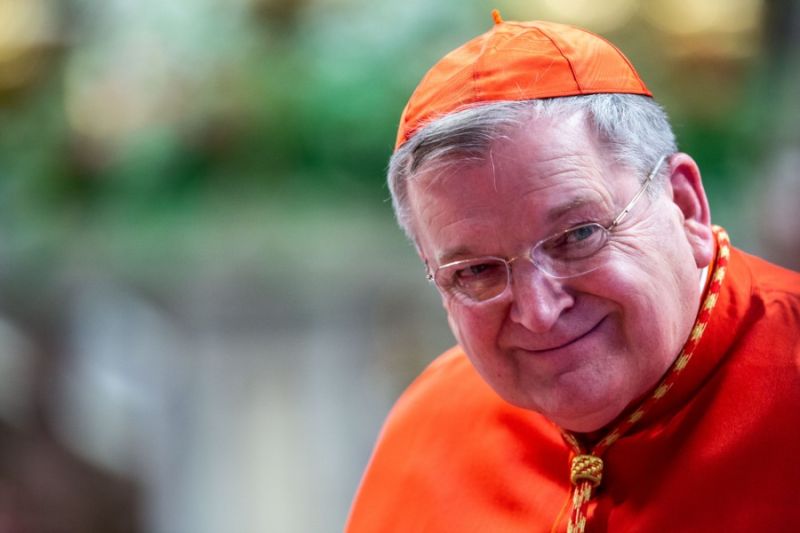
Raymond Leo Cardinal Burke during the Solemnity of Sts. Peter and Paul in St. Peter’s Basilica in Vatican City, June 29, 2019. / Credit: Daniel Ibáñez/CNA
The American cardinal, who founded the Shrine of Our Lady of Guadalupe in Wisconsin, announced the prayer initiative in a video address posted over the weekend.
“Our Lord has not called us to fear. No matter the darkness of our age, men and women of faith are not without the truth and love of Christ, nor the faithful care of his mother,” Burke wrote in an accompanying letter posed to the Guadalupe shrine website.
“The darkness of sin seems so great. But Our Lord has not called us to fear! Evil cannot approach the power of God’s grace. Sin cannot prevent Our Lord’s healing mercy from reaching those who repent and seek it. And nothing can diminish the care and protection of Our Lady for us, which remain as strong today as they were 500 years ago.”
A novena, a traditional Catholic practice usually consisting of a nine-day series of petitionary prayers, can also be much longer. Those who sign up to join Burke’s novena will receive, via email, short video reflections from the cardinal each month in addition to regular written reflections and prayers.
Recalling St. Juan Diego, to whom Christ’s mother appeared under the name of Our Lady of Guadalupe in present-day Mexico in 1531, Burke invited “all Catholics, especially those in the Americas” to ask for the intercession of Our Lady of Guadalupe for “maternal care and protection.”
“The world wrestled with famine and disease, and war in the Holy Land threatened to reduce that beautiful and tortured region to chaos. Then, too, poisonous confusion from within the Church corroded the faith of Christians the world over,” Burke wrote.
“And then, too, we saw the forces of sin retreat before the presence of Our Lady. Through St. Juan Diego’s humble and courageous cooperation with grace, Our Lady claimed the New World for Christ, drawing nearly 9 million new souls into the Church by the time of St. Juan Diego’s death in 1548. It is this same maternal care and protection that we seek today — a care and protection that she will grant us, should we earnestly ask for it.”
A native of Wisconsin, Burke previously shepherded the Diocese of La Crosse and the Archdiocese of St. Louis before being appointed in 2008 as head of the Church’s highest court, the Apostolic Signatura, until 2014.
If you value the news and views Catholic World Report provides, please consider donating to support our efforts. Your contribution will help us continue to make CWR available to all readers worldwide for free, without a subscription. Thank you for your generosity!
Click here for more information on donating to CWR. Click here to sign up for our newsletter.
Dallas, Texas, Sep 21, 2018 / 09:22 pm (CNA/EWTN News).- Most, if not every, diocese in the United States has some sort of prison ministry. Most do not have a detention center ministry to tend to the spiritual needs of minors detained by the the U.S. Border Patrol.
The Diocese of Brownsville, located in southern Texas along the U.S./Mexico border, isn’t like most dioceses.
While the diocese had been providing services to the detention centers for a long time, Bishop Daniel Flores told CNA that things started to change about four years ago when the number of unaccompanied minors detained at the border started to swell.
“We’ve always had numbers,” Flores said, but 2014 saw a major influx in the number of unaccompanied minors from Central America attempting to cross the U.S. border. This increase in the number of people sparked a realization that something had to be done to care for the unusually high number of people in detention.
“So our prison ministry, you know, kind of morphed into more of a detention center ministry,” Flores told CNA during a closed session with the media at the National V Encuentro conference in Grapevine, Texas on Sept. 21.
This “detention center ministry” would consist of teams who would go into the centers, determine who was there, and then create some sort of spiritual offering.
These teams would “develop opportunities to go in and either offer catechesis or say Mass or hear confessions” as part of an ongoing process to minister to those in the center. This process is “ongoing,” Flores told CNA.
While the diocese tries to have some sort of presence at the centers, this can be challenging due to changes in policy over time.
“The circumstances changes, because, I’ll be honest, the government sometimes changes the rules,” said Flores, “and we try to respect that but we also kind of ask questions” as to why the changes are being made.
Despite this, Flores said the diocese has “very good cooperation” with the centers and is able to address the needs of those who are detained.
“I think the people who work at the detention centers, for the most part, that I know, recognize that it’s important that these young people have access to somebody who can help them have hope and can follow up on their cases,” explained Flores.
This ministry, while important, is “really serious commitment of time,” and is carried out by priests, religious, and laypeople. Flores credited the laypeople who volunteer their time as those “who really make the effort.”
Flores also praised the Latin American apostolic movements that have taken root in the United States for assisting with this effort.
Each minor’s experience in the detention center is different. Some may be there for weeks, and others for months, depending on the circumstances of their case.
The Diocese attempts to extend this ministry even after the minors are released from custody. Flores said that after a minor leaves the center, they will attempt to contact a group or charity (such as Catholic Charities) in their destination that will keep tabs on the minor once they arrive.
“It’s good to get a phone call that’s not asking ‘where are your documents?’,” said Flores. “It’s a phone call (asking) ‘how are you doing, and can we help you with something?”
Pontifical Missions Society USA National Director Monsignor Roger Landry speaks during a panel at the 2025 EWTN Family Celebration. / Credit: EWTN/Screenshot
Washington, D.C. Newsroom, Sep 2, 2025 / 19:30 pm (CNA).
The team that led the Eternal… […]
Pope Francis speaks to religious leaders on the grounds of Indonesia’s national mosque in Jakarta, Indonesia, Sept 5, 2024. / Daniel Ibáñez/CNA
Jakarta, Indonesia, Sep 5, 2024 / 00:13 am (CNA).
Pope Francis visited the grounds of Southeast Asia’s largest mosque on Wednesday for an interfaith meeting in Indonesia, where he signed a joint declaration condemning religious-based violence with Muslim leader Grand Imam Nasaruddin Umar.
The Istiqlal Joint Declaration 2024 is titled “Fostering Religious Harmony for the Sake of Humanity.”
Named for Indonesia’s national Istiqlal Mosque, the document calls for religious leaders to work together to promote human dignity, interreligious dialogue, and environmental protection.
“The values shared by our religious traditions should be effectively promoted in order to defeat the culture of violence,” the declaration says.
“Our religious beliefs and rituals have a particular capacity to speak to the human heart and thus foster a deeper respect for human dignity.”
Pope Francis arrives at Istiqlal Mosque in Jakarta, Indonesia for an interreligious meeting on Sep. 5, 2024. Daniel Ibáñez / CNA
Pope Francis became the first pope to visit the grounds of Jakarta’s Istiqlal Mosque on Sept. 5. The massive mosque is among the largest in the world, accommodating up to 250,000 people at a time. John Paul II, who visited Indonesia in 1989, was the first pope to ever visit a mosque during his visit to Damascus in 2001.
According to the mosque’s grand imam, Istiqlal is second only in size to Mecca and Medina, and its influence extends to Indonesia’s roughly 242 million Muslims.
The interfaith meeting sought to promote religious tolerance and moderation in Indonesia, which faces challenges with the rise of hardline Islamist groups and instances of violence against Christians.
Speaking to representatives of Indonesia’s six officially recognized religions — Islam, Buddhism, Hinduism, Confucianism, Catholicism, and Protestantism — Pope Francis articulated his vision for interreligious dialogue.
“Sometimes we think that a meeting between religions is a matter of seeking common ground between different religious doctrines and beliefs no matter the cost. Such an approach, however, may end up dividing us, because the doctrines and dogmas of each religious experience are different,” the pope said.
“What really brings us closer is creating a connection in the midst of diversity, cultivating bonds of friendship, care and reciprocity.”
Pope Francis added that when religious leaders cultivate bonds, it enables them “to move forward together in pursuit of the same goals: defense of human dignity, the fight against poverty and the promotion of peace.”
Pope Francis arrived at the mosque through the Alfattah Gate, where Grand Imam Nasaruddin Umar warmly greeted him. The two leaders then proceeded to the newly constructed “Tunnel of Friendship,” an underground passage connecting the mosque to Jakarta’s Catholic Cathedral of Our Lady of the Assumption, built by the Indonesian government to foster dialogue and unity.
Before entering the “Tunnel of Friendship,” Pope Francis expressed his hope that it would become “a place of dialogue and encounter.”
Pope Francis told the grand imam, “I hope that our communities may increasingly be open to interreligious dialogue and be symbols of the peaceful coexistence that characterizes Indonesia.”
Representatives of Indonesia’s six officially recognized religions — Islam, Buddhism, Hinduism, Confucianism, Catholicism, and Protestantism — attend the interfaith meeting with Pope Francis and Grand Imam Nasaruddin Umar on Sept. 5, 2024, in Jakarta, Indonesia. Daniel Ibáñez/CNA
´The interfaith event took place in a red and white tent on the mosque grounds. It unfolded with a traditional Muslim welcome dance known as Marawis, followed by a brief chanting of a passage from the Quran by an Indonesian woman and a reading from the Gospel of Luke.
Representatives of the other four recognized religions stood in solidarity as the declaration was read aloud to participants in the tent.
The Istiqlal document identifies dehumanization and climate change as two serious crises facing the world today, emphasizing the shared responsibility of religious communities in tackling global challenges. It also affirms the need for interreligious dialogue to resolve “local, regional and international conflicts, especially those incited by the abuse of religion.”
The joint declaration at the Indonesian mosque was reminiscent of the Abu Dhabi declaration on “Human Fraternity” that Pope Francis signed with Ahmed el-Tayeb, Grand Imam of al-Azhar in the United Arab Emirates, when he became the first pope to visit the Arabian Peninsula in 2019.
On Thursday, the Indonesian grand imam underlined the significance of the meeting, pointing to Istiqlal Mosque’s influence across Indonesia, the world’s most populous Muslim country.
As Indonesia’s only state mosque, the Istiqlal Mosque is “expected to provide guidance to more than one million mosques and prayer rooms scattered throughout the islands of the Republic of Indonesia,” he explained.
“This mosque also seeks to promote religious tolerance and moderation in Indonesia,” the Muslim leader underlined.
Pope Francis kisses the hand of Grand Imam Nasaruddin Umar after the signing of the Istiqlal Joint Declaration on Sept. 5, 2024, in Jakarta, Indonesia. Daniel Ibáñez / CNA
In a moving gesture of solidarity and friendship at the closing of the event, the imam kissed Pope Francis on the head, while the pope kissed the grand imam’s hand and then touched it to his cheek.
Pope Francis will conclude the third day of his apostolic journey to Southeast Asia and Oceania by celebrating Holy Mass in Gelora Bung Karno Stadium in Jakarta. On Friday he is expected to depart Indonesia for Papua New Guinea.
Keenly aware of the darkness by nature of his expertise, former Apostolic Signatura Card Ray Burke perceives the wrought danger of executive clergy malfeasance. What most may perceive as run of the mill badness, when evil reaches the higher levels of ecclesial authority it indicates subversion of its instituted mission. As if the gates of hell were succeeding to prohibit the Word. That won’t happen Christ assures us. Burke is proof.
