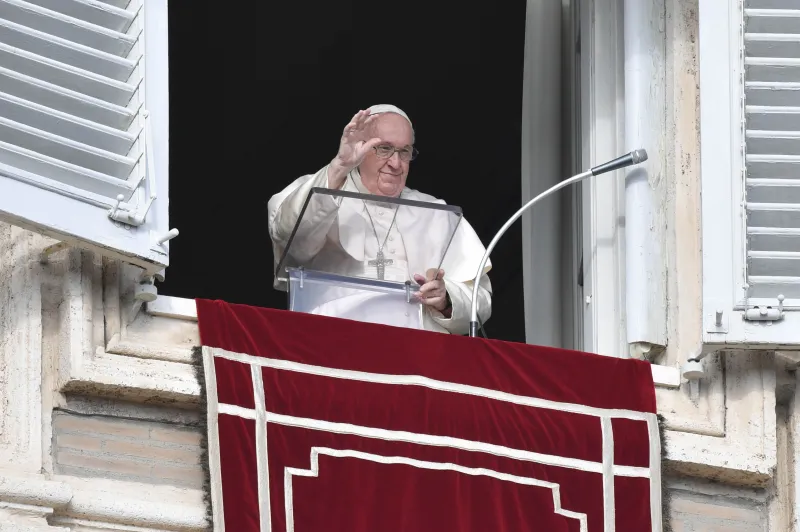
Pope Francis meets on April 29, 2023, with children and adults who are visually impaired and have other disabilities at a Catholic institute in Budapest, Hungary, dedicated to Blessed László Batthyány-Strattmann. / Credit: Vatican Media
Denver Newsroom, Dec 1, 2023 / 07:00 am (CNA).
Pope Francis’ prayer intention for the month of December is for people with disabilities.
“People with disabilities are among the most fragile among us,” Pope Francis said in a video released Nov. 28.
“Some of them suffer rejection, rooted in either ignorance or prejudice, which then
marginalizes them,” he added.
The Holy Father urged civil institutions to “support their projects through access to education, employment, and places where they can express their creativity.”
“Programs and initiatives are needed that promote their inclusion. Above all else, big hearts are needed who want to accompany.”
The pope encouraged individuals to change “our mentality a little” and open “ourselves to the abilities and talents of these people who are differently abled, both in society as well as in the life of the Church.”
“And so, creating a completely accessible parish does not only mean eliminating physical barriers,” he said. “It also assumes that we stop talking about ‘them’ and start talking about ‘us.’”
He concluded with a prayer: “Let us pray that people with disabilities may be at the center of attention in society, and that institutions offer inclusion programs that enhance their active participation.”
Pope Francis’ prayer video is promoted by the Pope’s Worldwide Prayer Network, which raises awareness of monthly papal prayer intentions.
If you value the news and views Catholic World Report provides, please consider donating to support our efforts. Your contribution will help us continue to make CWR available to all readers worldwide for free, without a subscription. Thank you for your generosity!
Click here for more information on donating to CWR. Click here to sign up for our newsletter.
Prince Harry and Meghan Markle / EWTN Pro-Life Weekly
Washington D.C., Jul 20, 2021 / 19:01 pm (CNA).
An environmental charity recently awarded Prince Harry and Meghan Markle for limiting their family to two children. In honor of World Popu… […]
Standing 100 feet tall, the Christmas Star overlooks the little town of Bethlehem, Pennsylvania (aka “Christmas City, USA”). / Credit: A. Strakey/Flickr
CNA Staff, Dec 25, 2023 / 07:00 am (CNA).
There are at least 18 cities and towns in the United States named Bethlehem, but one of the first and perhaps the most famous is Bethlehem, Pennsylvania, a town of 75,000 in the eastern state’s Lehigh Valley, a short drive from Allentown.
Bethlehem was founded in 1741 — prior to the establishment of the United States itself — when Protestant Christians, members of the Moravian Church, purchased land along the confluence of Monocacy Creek and the Lehigh River and cleared it of trees to begin building hewn-log structures.
According to the city’s official website, the town of Bethlehem was christened on Christmas Eve of that year. It’s not the only town in the area to be named after a biblical location — the valley also is home to towns named Egypt, Emmaus, and Nazareth.
In the intervening years since its founding, the town has sought to lean into its name by branding itself “Christmas City USA.” The town even claims to have put up the first documented Christmas tree in the (future) United States, in 1747.
The town has seen a lot throughout its lengthy history, including the deaths of about 500 of its soldiers in the Revolutionary War. One of the original buildings in the town is thought to be the largest 18th-century log structure in continuous use in the United States, the town’s website says.
The town’s status as a nexus of industry is long as well. Just six years after its founding, the town website says, some 35 crafts, trades, and industries had been established, including a butchery, clockmakers, and numerous mills of different kinds. Bethlehem’s Colonial Industrial Quarter had, the town says, the largest concentration of pre-Industrial Revolution crafts, trades, and industries in America and “can be considered America’s earliest industrial park.”
A steel plant in Bethlehem, Pennsylvania. Credit: Peter Miller/Flickr
Bethlehem Steel was once one of the most important manufacturers in the entire country, as it provided the steel for such iconic structures as the Golden Gate Bridge, the Empire State Building, and the Hoover Dam.
And according to at least one historian, the United States may not have succeeded in the two World Wars if Bethlehem Steel, with its wartime peak of some 300,000 workers, had not been able to turn out the necessary materials for the country’s military. Bethlehem Steel alone produced 1,127 ships during World War II.
The massive plant in the corporation’s hometown finally closed down for good in 2003 after the company declared bankruptcy two years earlier. Still a prominent landmark on the city’s riverfront, the rusted, dystopian steel mill towers have been preserved and incorporated into a trendy new public park and music venue.
Inside Holy Infancy Catholic Church in Bethlehem, Pennsylvania, which is located on Bethlehem’s south side and founded in 1861, attracting Catholic immigrants from all over the world who came to work in the steel industry. Credit: Courtesy of Holy Infancy Catholic Church
Catholics in Bethlehem
Father Andrew Gehringer, pastor of Holy Infancy Catholic Church, told CNA that his parish, which is located on Bethlehem’s south side, was founded back in 1861 and attracted Catholic immigrants from all over the world who moved to Bethlehem to work in the steel industry. In the town’s heyday, there were six Catholic churches within 10 blocks, he said, with Holy Infancy being the first. Germans, Irish, Hungarians, Polish, Portuguese, and Brazilian people have all made Bethlehem home over the years.
Today, Mass is offered at Holy Infant in English, Spanish, and Portuguese. Gehringer said the multicultural nature of his parish lends itself to numerous fascinating Christmas traditions. For example, Portuguese-speaking parishioners participate in the “Novena de Natal” (Christmas novena), a nine-day prayerful meditation on the birth of Christ.
Spanish-speaking Catholics celebrate “Las Posadas” at Holy Infancy Catholic Church in Bethlehem, Pennsylvania, which is located on Bethlehem’s south side and founded in 1861. Credit: Courtesy of Holy Infancy Catholic Church
A similar devotion, “Las Posadas,” is practiced by the parish’s Spanish-speaking Catholics. The Spanish word “posada” means “inn,” and this devotion commemorates Mary and Joseph’s journey from Nazareth to Bethlehem, where they sought shelter for the birth of Jesus. Like the Portuguese Christmas novena, Las Posadas begins on Dec. 16 and involves the recitation of the rosary followed by a procession, Mass, and a celebration with a piñata on the nights leading up to Christmas.
“We really do push the multicultural flair of our parish. So we have multicultural dinners, and we have a multicultural summer festival,” Gehringer continued.
The priest said the town, as you can imagine, goes all out decorating for Christmas. Many of the decorations are religious, such as a Nativity scene in the center of the city, as well as innumerable Christmas trees. Gehringer said some of the parish’s Spanish-speakers have been asked in years past to decorate Christmas trees for the city in the manner of their culture.
The town has had a massive Christmas star set up on a nearby mountain since the late 1930s, a five-pointed star with eight rays. The structure is located at Bethlehem’s highest point — 890 feet above sea level — and the star’s LED lighting array, installed in 2010, can be seen 20 miles away. The star has become a symbol of the city, with signs throughout Bethlehem bearing an image of the star and proclaiming “Follow the Star to Bethlehem Attractions.”
Gehringer said it is special to live in a city where the religious aspects of Christmas are so widely celebrated with symbols — which, of course, include the name of the town itself.
“There’s some very Christian symbolism that’s very prominent in our city, that our city puts up,” Gehringer said. “In some towns, they don’t even allow the Nativity set.”
Talitha Kum members hold a sculpture of St. Josephine Bakhita in St. Peter’s Square on Feb. 6, 2022. / Credit: Vatican Media
Rome Newsroom, Feb 8, 2024 / 12:15 pm (CNA).
On the 10th International Day of Prayer and Awareness against Human Trafficking, Pope Francis urged people to take concrete actions to “combat this global scourge.”
“Let us help one another to be more responsive, to open our lives and hearts to our sisters and brothers who even now are being bought and sold as slaves. It is never too late to take action,” Pope Francis said in a message published Feb. 8.
“Let us pray fervently and work proactively for this cause, the defense of human dignity, whether by prayer and action as individuals and families, or as parish and religious communities, as ecclesial associations and movements, and also in the various spheres of social and political life.”
The pope’s comments came as Catholics from more than 50 countries across the world rallied together virtually as part of an online prayer marathon for the International Day of Prayer and Awareness against Human Trafficking.
Human trafficking is estimated to be a $150 billion industry that profits off of an estimated 49.6 million victims worldwide, according to the International Labor Organization. The U.N. agency documented a 25% increase in the number of people experiencing modern slavery between 2016 and 2021.
Pope Francis established the International Day of Prayer and Awareness against Human Trafficking 10 years ago to coincide with the Feb. 8 feast of St. Josephine Bakhita, the patron saint of human trafficking victims.
“Together let us walk in the footsteps of St. Bakhita, the religious sister from Sudan who as a child was sold into slavery and was a victim of traffickers. Let us remember the wrong she endured, her suffering, but at the same time her strength and her journey of liberation and rebirth to a new life,” Pope Francis said.
“St. Bakhita encourages us to open our eyes and ears to see those who go unseen and to hear those who have no voice, to acknowledge the dignity of each person and to fight trafficking and all forms of exploitation.”
St. Josephine Bakhita was born in 1869 in Sudan. Around 1877, she was kidnapped and sold into slavery by Arab slave traders. During her time as a slave, she was beaten, tortured, and scarred.
Eventually, in 1883, she was sold to the Italian vice-consul Callisto Legani, who took her with him back to Italy. While in Italy, she was given to a family and became their nanny, and that family eventually left her with the Canossian Sisters in Venice when they traveled to Sudan for business.
Once with the sisters, she learned about Christianity and decided to become Catholic. She refused to go back to the family that enslaved her once they returned to Italy, and an Italian court ruled that since slavery had been outlawed in Sudan before her birth, she was not legally a slave. She was then freed from slavery.
With her newfound freedom, Bakhita remained with the Canossians. She took the names Josephine Margaret and Fortunata, the Latin translation of her Arabic name, Bakhita. Three years later, she became a novice with the Canossian Daughters of Charity and professed her final vows on Dec. 8, 1896.
She then lived out the remainder of her life in a convent in Schio, Vicenza, working as a cook and a doorkeeper. She died on Feb. 8, 1947, and was canonized on Oct. 1, 2000, by Pope John Paul II.
Pope Francis urged people to respond to his appeal to fight human trafficking in honor of St. Josephine Bakhita, who he said “stands for all those men and women who, despite their enslavement, can still attain freedom.”
“It is a call to take action, to mobilize all our resources in combatting trafficking and restoring full dignity to those who have been its victims.”
Religious sisters affiliated with Talitha Kum are present in 77 countries. Members of the network have served 10,000 trafficking survivors by accompanying them to shelters and other residential communities, engaging in international collaboration, and helping them to return home.
“From my heart, I express my gratitude to everyone engaged in the celebration of this day, and I bless all those who are committed to combatting trafficking and all forms of exploitation in order to build a world of fraternity and peace,” Pope Francis said.
Able-bodied people and people with disabilities are equal and important partners in our world shaping responsibilities.