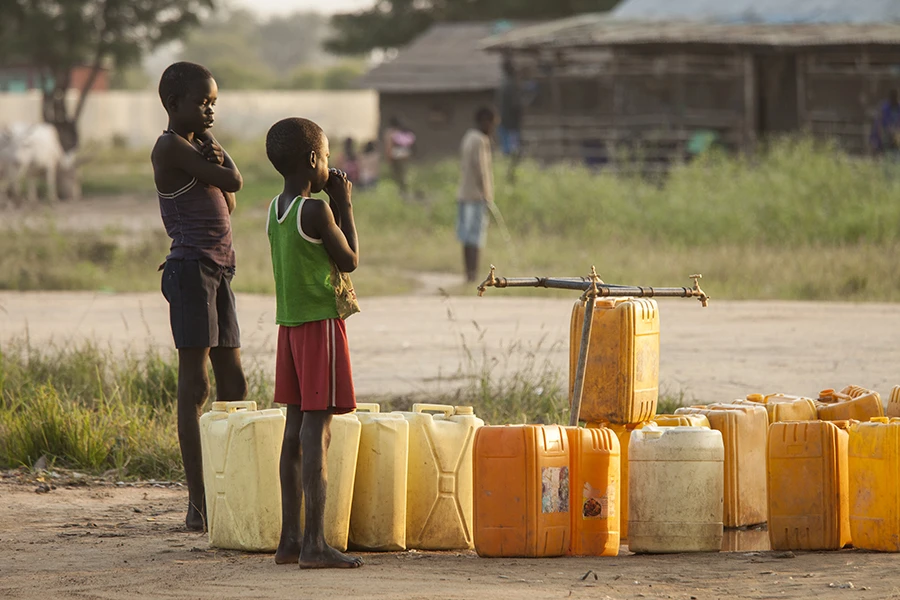
Vatican City, Jun 21, 2017 / 11:34 am (CNA/EWTN News).- After the Vatican stated last month the postponement of Pope Francis’ proposed trip to South Sudan, they announced Wednesday that the Pope will instead send aid to the people suffering from worsening conditions.
The Vatican announced June 21 that Pope Francis will be aiding projects in the areas of education, healthcare, and agriculture, called the “Pope for South Sudan” Initiative.
The program will be coordinated through the Dicastery for the Promotion of Integral Human Development, headed by Cardinal Peter Turkson, and by Caritas International.
Because he is unable to travel to South Sudan in person, Pope Francis “wanted to express the tangible presence and closeness of the Church with the afflicted people,” Cardinal Turkson told journalists.
“It is an initiative that is to foster, support and encourage the work of the various religious congregations and international aid organizations that are present on the territory and tirelessly work to help the population and to promote the process of development and peace,” he said.
The projects of the Pope’s aid includes support for two hospitals: Wau Hospital in the Western Bahr el-Ghazal state, and Nzara Hospital in the Diocese of Tombura-Yambio.
Both hospitals have fewer than 130 beds between all of the departments, though the Wau Hospital treats around 300 patients a day on average, hospitalizing around 40,000 per year.
The aid will go toward support for medical and nursing staff, medicine and its transportation from Uganda to the hospital and management costs of the facilities.
Among the priorities of the Nzara hospital are the prevention and treatment of diseases such as tuberculosis, leprosy, and AIDS, as well as healthcare for children under the age of five.
Under education, the Pope’s initiative will help support an association of religious congregations called “Solidarity with South Sudan” which is working to train teachers, nurses, midwives, local farmers, and community leaders.
Since 2010 they have offered a two-year full-time program for obtaining a primary school teacher diploma at their center in Yambio, recognized by the Ministry of Education of South Sudan. Since opening, they have welcomed 3,500 students.
Francis also sends 200,000 euros ($223,000) to support agriculture in the country. The aid will be directed toward giving families the tools and seeds to grow their own crops where it is possible, thus feeding themselves and their families and providing a sustainable source of food.
In comments to CNA, Cardinal Turkson emphasized that this initiative should not be presented in any way as the only and first time the Holy Father is showing interest in the situation in South Sudan.
Cardinal Turkson himself has already made two visits there on behalf of the Pope, and this is just “the latest gesture,” he said.
“The Holy Father stays very close to the situation in South Sudan to try to a help, to be paternal to the situation over there and to try to afford the help that he can.”
Since December 2013 there has been ongoing civil war in South Sudan, interrupted by tenuous peace.
Parts of South Sudan were declared to be under conditions of famine in February. The classification was lifted Wednesday following an increase in aid, according to a UN-backed report. It warns, however, that the situation remains desperate as the number of people at risk for starvation continues to increase.
Michel Roy, Secretary General of Caritas International, told CNA that in February they said 100,000 people were going to die of hunger, but now they think that number might be 1 million.
“The situation is worsening day-by-day and we tend to forget what the situation is because it’s not new,” he said. “Now, the people of South Sudan are dying of hunger, of famine. Because there is no food and we cannot bring food to them because of security. So it’s the worst thing that can happen.”
The Pope’s aid is not just important for the concrete help it gives, he said, but because it also again raises the attention of the international community to the plight in South Sudan.
“To save lives needs money,” he continued. “The UN have launched an appeal which is only half funded, so the other half has to be found. It’s a lot of money, but we cannot just sit and look at people dying, so there’s a real need for increasing humanitarian aid.”
The Vatican’s aid to South Sudan was also welcomed by Catholic Relief Services, the US bishops’ international charity agency.
Sean Callahan, the president of CRS, stated that “what is most important, is Pope Francis telling world not to give up on South Sudan, that we all must step up our commitment to help.”
Callahan recently visited South Sudan, and said, “I can tell you from my visit that there is hope. I saw that when people had peace, they got to work, planting their crops, building homes and roads, building the new nation.”
CRS has led a US government-funded program in the country which focuses on supporting infrastructure development by providing food rations to villagers building roads, schools, dykes, and waterways. The aid agency is urging Congress to continue funding such aid programs, as the Trump administration has proposed cutting or eliminating such programs.
“We’ve seen those programs work and make a huge difference in the lives of people in South Sudan,” Callahan stated. “Now is not the time to turn our backs. There’s still hope and we can still get things done.”
Cardinal Turkson added that South Sudan needs the intervention of the international community to help end the conflict and bring about peace, the only thing which will truly end the humanitarian crisis.
“Pope Francis is a universal shepherd who crosses borders,” Cardinal Turkson said in the press conference. “He feels the pressing need to raise awareness of the international community about this silent drama, calling for greater and renewed efforts to reach a peaceful solution to the conflict.”
“The Holy Father does not forget the unheard and silent victims of this bloody and inhuman conflict, he does not forget all those people who are forced to flee their native country because of the abuse of power, injustice and war – he brings them all in his prayers and in his heart,” he said.
 […]
[…]






Like Keanu Reeves in the Matrix [inspiration by Francis X Maier article] Card Arborelius has taken the red pill rather than remain in the anesthetized state of his down South compatriots.
Nordic bishops are outspoken in criticizing the trend toward heterodoxy within our Church. Perhaps it’s similar to a newer Church similar to Nigeria’s heroic witness amid murderous Islamists. Although the Lutherans aren’t murderous, at least not in comparison. Liberally aggressive perhaps. Intellectually adrift. Ingmar Bergman’s films reflect the search for meaning. At any rate it’s complex. At least their bishops have something to offer. Would that their spirit enlivens
their compatriots.
The Nordic bishops…sort of peripheral?
Might we hope that all of the new bishops and cardinals of the “periphery” in Africa and Asia will see with non-secularist eyes, unlike much of the West, and exert their evangelical and institutional influence at the Synods and at the next conclave?
As if, rather than “primarily as [yes] facilitators,” they are “sent” (apostello), firstly and truly primarily as successors of the apostles. Sent by the historical and incarnate Jesus Christ–the incongruous, “concrete,” and leavening fact (!) at the center of all ambulatory human history, and more than one pluralist idea among many.
Nordic bishops are reactive to a Lutheran culture, whereas bishops in the West, specifically Europe are products of a dying religious culture influenced by secularist intellectual trends. Our US bishops are in a gradual trend toward the European model nevertheless more reactionary to secularism. Bishops Strickland, Cordileone examples of that reaction.
All bishops are first of all defenders of the faith as successors of the Apostles. This is the battle line perpetrated by this pontificate and challenged by a very few Strickland the standout. Fr Gerald Murray articulated this dynamic on World Over and the apparent rationale for which he’s being prosecuted if not persecuted. This is spiritual life and death matter to be taken with due appreciation. Analogously, we’re, that is, those of us prepared to defend the faith at whatever cost are the thin black line of clergy who stand to fight in the shadow of the Cross [wording inspired by Therese of Lisieux]. Strickland deserves our full support. In terms of honor he requires our support.
You’re correct, there is no periphery at play here, there are men prepared to give the glory of their loyalty to Christ.
As a woman myself, I have no interest in attending a “Mass” conducted by a woman. I have seen such conducted at protestant churches and I find them lacking. Nor could I envision going to confession to one. Why don’t these women stick to the many ministries already open to women? I am tired of hearing about this topic, as are many Catholics. Its also a certainty I would not support it financially.
Well, I left the Catholic Church for many years when I felt a call as a woman toward becoming a deacon, and realized I was denied this on the basis of my genetics. Somehow I missed that entire part of my upbringing as a Catholic, and even into my adulthood when I was struck by, basically, a “born again” episode at age 27 and plunged into study and prayer. Well, my journey from there took me to 2 other female-led churches within the Episcopal Church, in the pain of rejection by my own Church. At first, it was balm, but after 10 years, I realized that the Episcopal Church in general, and our Churches in particular, had been led astray by the emotion of our society instead of sticking with the reality of our Christian faith. I returned to Catholic with much unresolved feelings of betrayal still, but the Body of Christ is what keeps my in the Church and keeps me going. I believe that women have a place as Deacons, and would deeply like to see that emerge for all the roles Deacons can play, but also, because of the way that the other women-led churches have been led astray by emotion and strayed so far as to actively support even abortion, I have to agree, women as priests, therefore with growing power to change our Church, should not happen.
Pauline, for you, the sex of a person seems to figure most prominently in how you practice your religion. So I have a few questions for you.
#1. Does it matter to you at all that the Savior – God incarnate – came among us as a man and not as a woman?
#2. Does it matter to you at all that Jesus Christ did not have a human Father, but a Divine Father and was born of a human mother?
#3. Does it matter to you that the only human person graced by God to be born free of original sin was a woman?
How do these three sexual anomalies/disparities/distinctions figure into your faith as a Catholic? I’d be curious to know what you make of these.
Ordaining women is part of a sure path to shrinking congregations & irrelevance. I returned recently from a trip to the UK & this was the case in each CE church we visited. One cathedral c. 670 AD had exactly three elderly couples attending evening prayer led by a woman clergy member. The church events calendar advertised upcoming Elvis & Abba themed music performances inside the cathedral. Using what should be sacred space for Elvis impersonations might garner a higher attendance than evening prayer but does little for a dwindling church membership.
LJ, I agree completely with all of your points.
To your question of why women don’t stick to ministries open to them, the answer is that the question is not, nor has it ever been, about ministry. It’s all about power, whether perceived or actual. One simply has to listen to any of the arguments in favor of priestesses. All of them involve repetitive use of terms such as “patriarchy”, “hierarchy”, “sexism”, “exclusion” and the like. These are expressions of grievance that refer to power or its lack. These are not the words of those who seek first the salvation of souls or expanded understanding of the splendor of truth (both capitalized and lower case).
What’s critically important to understand is that when the the Church says “no”, She always points at the same time to an exalted “yes”. The key is to find, and to live, the yes. Therein lies the path to eternal life.
I too believe I would be uncomfortable with woman in the role of priests. Mostly, I think because Jesus and the apostles were male. Some would say that was the times, the culture. But yet, the Bible clearly states the role of the husband and a wife in marriage. Priscilla along with her husband Aquila are mentioned as helpers to Paul. She seemed to be an important source of spreading the gospel but she was not a priest. I do get tired of women who insist they are being demeaned, disrespected, etc. if not allowed to be a priest. There are so many ways to participate in the faith.
Well, thanks I guess.
Maybe Cardinal Müller will have one friend. If I recall, that was crucial in middle school
Welcome common sense from Sweden and not for the first time. Who would’ve thought?
Sweden apparently exercised some commonsense during Covid also. At least it seems that way so far.
I never in my right mind thought I’d live to see the day when a bishop from Scandinavia came out as a Defender of the Faith.
(Just in case anyone should be inclined to accuse me of not being aligned with the Catholic Church : “Francis truly IS the Pope.” There, I’ve repeated the required mantra.)
It certainly shouldn’t be a focal point of the discussion. It shouldn’t be any part of the discussion, truth be told.
As a Discalced Carmelite, I am grateful to my Swedish Brother for his clear and charitable presentation of the faith!
I recently posted my own statement on the ordination of women in reply to an article in The Tablet: https://flemingtoncarmel.org/posts/the-place-of-women-in-the-church