


Rome Newsroom, Mar 27, 2023 / 10:30 am (CNA).
Pope Francis on Wednesday will bless a satellite that will launch his words into space on June 10.
The “Spes Satelles,” Latin for “Satellites of Hope,” will be launched on a rocket taking off from the Vandenberg Space Force Base in California.
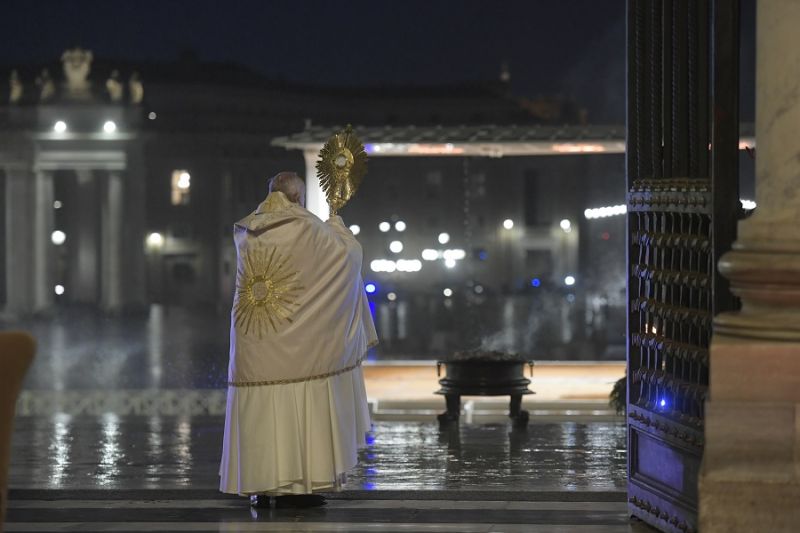
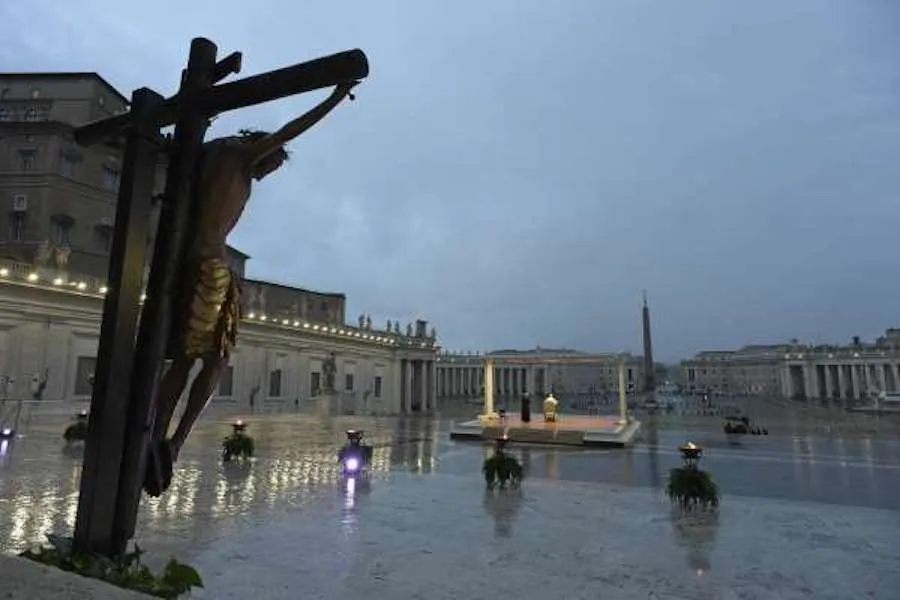
According to the Vatican, the miniaturized satellite will hold a copy of a book documenting the pope’s urbi et orbi blessing of March 27, 2020, when, in the midst of the COVID-19 pandemic, he blessed the world from St. Peter’s Square with the words “Lord, may you bless the world, give health to our bodies, and comfort our hearts.”
“You ask us not to be afraid,” the pope prayed. “Yet our faith is weak and we are fearful. But you, Lord, will not leave us at the mercy of the storm.”
The book, “Why Are You Afraid? Have You No Faith? The World Facing the Pandemic,” has been converted into a nanobook, a 2-millimeter by 2-millimeter by 0.2-millimeter silicon plate, for transport to space.
Pope Francis will bless the satellite and the nanobook after his weekly public audience in St. Peter’s Square on March 29.
The Vatican said March 27 the CubeSat, the name for miniature satellites, will travel aboard a Falcon 9 rocket, SpaceX’s partially reusable two-stage launch platform. It will be hosted on the ION SCV-011ION platform, a satellite carrier developed and built by the Italian company D-Orbit.
The Italian Space Agency will operate the satellite, which was built by the Polytechnic University of Turin.
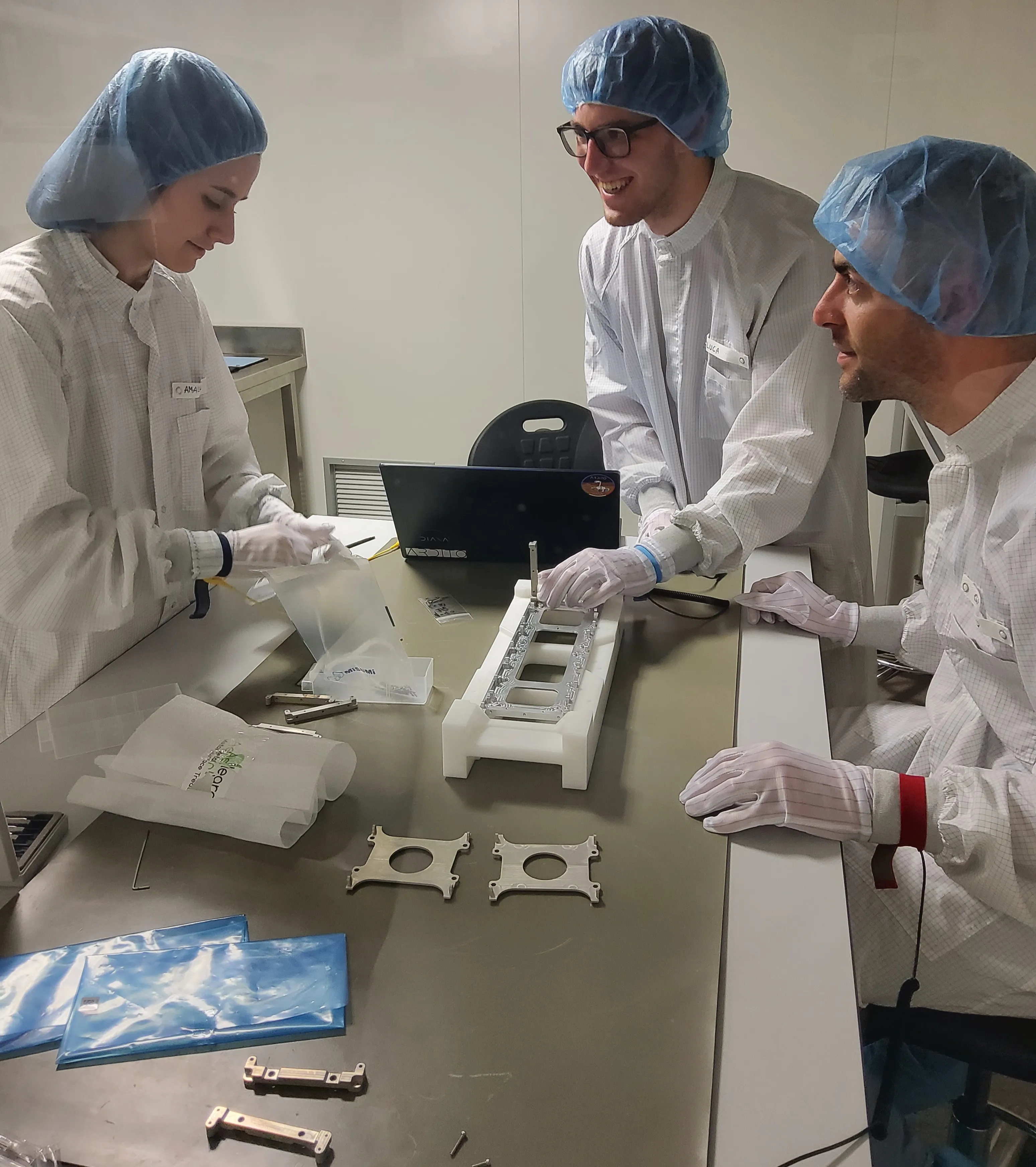
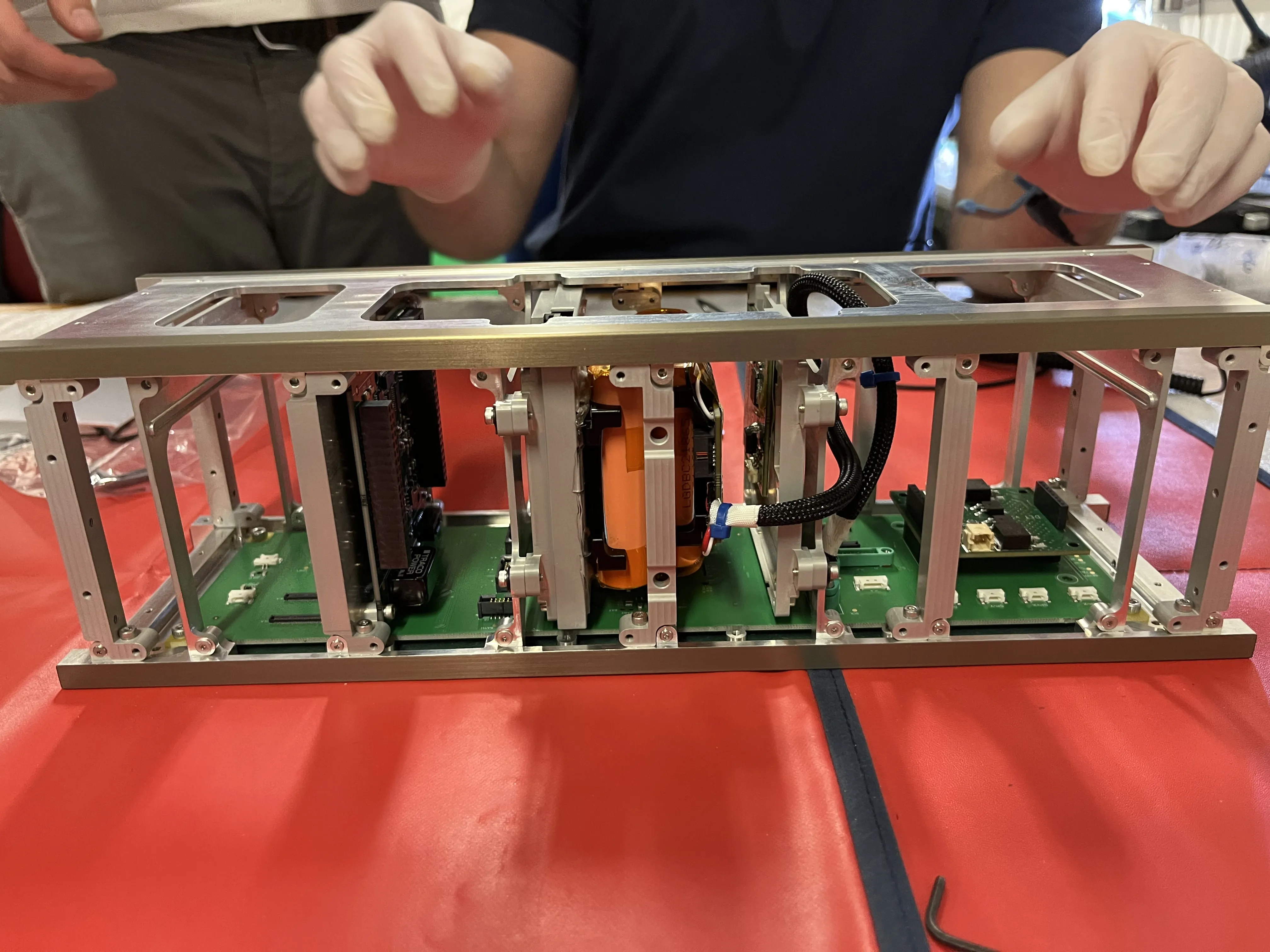
“The satellite is equipped with a radio transmitter as well as onboard instruments to be maneuvered from the ground,” a press release stated.
While in orbit, the satellite will broadcast decipherable statements from Pope Francis on the theme of hope and peace in English, Italian, and Spanish.
The president of the Italian Space Agency, Giorgio Saccoccia, said the Holy See asked the agency to identify a way for Pope Francis’ words of hope “to cross the earth’s borders and reach from space the greatest possible number of women and men on our troubled planet.”
“For those of us who are used to seeing space as the privileged place from which to observe the world and communicate with it without borders, it was easy to imagine a quick, humble and effective solution to offer wings to the Holy Father’s message,” he added.
The secretary of the Dicastery for Communication, Father Lucio Adrian Ruiz, said “space has a fascination for everyone, especially for young people. Space has that mystery of the universal, the deep, the magnificent, and it makes us all dream.”
By launching Pope Francis’ words of the March 27, 2020, blessing into space, the Vatican hopes to signify that the pope’s prayer, blessing, and universal call to hope continue to be relevant for men and women of goodwill today, he said.
You can follow the launch and learn more at the Spei Satelles website.
If you value the news and views Catholic World Report provides, please consider donating to support our efforts. Your contribution will help us continue to make CWR available to all readers worldwide for free, without a subscription. Thank you for your generosity!
Click here for more information on donating to CWR. Click here to sign up for our newsletter.


Francis likely offended space when he claimed time was greater than space. Now he wants to use space to spread his word? Vindictiveness rarely forgets a slight.
Will his words be true, good, and beautiful? Or will the ‘good’ news be spun into pastoral incoherence? Will no words be spoken to clarify sin and perennial Church teaching? If past performance is any indication of future work, the dissonating words won’t be worth the satellite sending them.
I will watch how the stars react. I have privileges at multiple observatories. How would an exasperated star appear?
A starry response to Francis’ assertion that time is greater than space. “Where were you when I laid the foundations of the earth? Declare, if you have understanding. Who laid its cornerstone; when the morning stars sang together, and all the sons of God shouted for joy?” Job 38:4-7
Oh come now, Meiron, why so intolerant!…Francis “offended space while he claimed time was greater than space [?]” Like light waves and light particles, under the higher-math “Theory of Relativity” space and time are interchangeable!
In the physical universe, it all depends upon one’s random point of view (the selected Inertial Frame of Reference)! So, likewise (?) in the non-physical universe and under the higher math of Sin-nod-ism—the bigoted and backwards (!) “tyranny of relativism” disappears altogether!
That is, absorbing the homosexual agenda, Cardinal Hollerich opines “that the sociological-scientific foundation of [Catholic moral] teaching is no longer correct.” Thusly doth Hollerich signal from on high, that today the biblical “good” and “evil” are interchangeable, that morality and immorality are interchangeable—that light and dark disappear as only imaginary aspects of the big-tent and anti-binary grayness of LGBTQ-ism!
Not even in physics, a particle and a wave—at the same time! Einstein rolls over in his grave…But, not the Alchemist Hollerich!…Instead, this:
“In Japan, I got to know a different way of thinking. The Japanese don’t think in terms of the European logic [only European?] of opposites. We say: It is black, therefore it is not white. The Japanese say: It is white, but maybe it is also black. You can combine opposites in Japan without changing your point of view.” https://www.pillarcatholic.com/p/who-is-cardinal-hollerich
So, under the post-logic and anti-binary “point of view” of combinational synodal harmonizing, why not conjure post-morality gray? Why not kowtow to the inclusive political “correct”-ness of the random and aggregated LGBTQ points of view?
And maybe the murder victims of Graham Greene’s Harry Lime are better off dead anyway!
When your quantum knowledge discovers that new phenomena, please be sure to publish the results and let us know. Much obliged!
Seriously. Bergoglio only knew a smattering of chemistry. Now I am expected to believe he learned of Einstein or relativity, let alone its special effects?
Fearless minds and confidence must rest in our wrists is a time tested mantra. Hope encourages us to move on fearlessly. “Spes Satelles” is a fine initiative.
Has the Holy Father considered the carbon footprint that everything involved with this rocket launch will leave? For that matter, how about all the CO2 emissions that result from his foreign travels or the conferences held at the Vatican regularly? Surely, Jeffrey Sachs isn’t getting to Rome by a sailboat.
Aside from hypocrisy, another underappreciated trait of this pope is his staggering egotism. He doesn’t even blush at the idea of a satellite spreading his (note, not the Gospel’s) words into space. It bears a striking similarity to his tendency to refer to his own previous works as support for the novelties he introduces in his endless stream of letters.