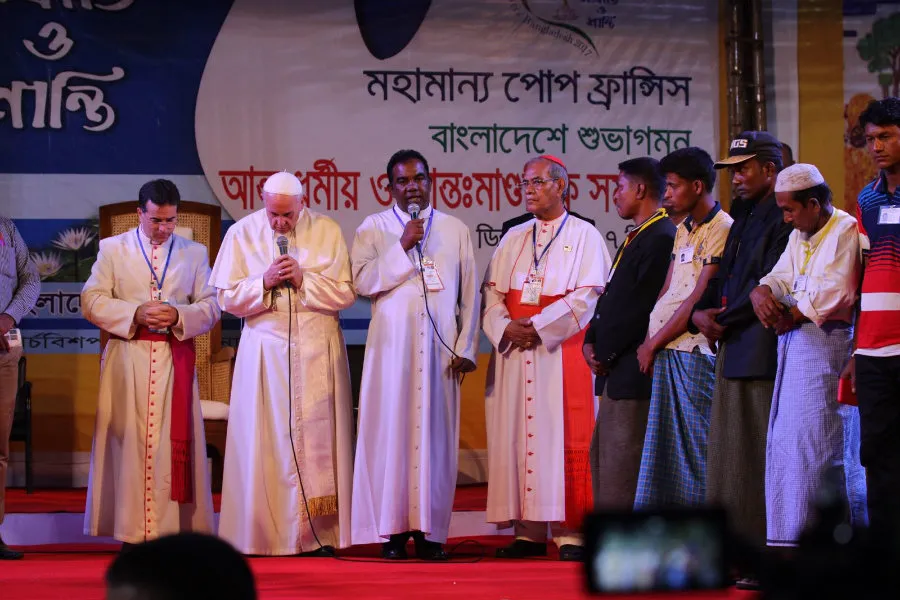
Vatican City, Dec 1, 2017 / 05:34 am (CNA/EWTN News).- In an encounter with interfaith leaders in Bangladesh, Pope Francis stressed the need to join together in promoting mutual respect and combating religiously-justified violence, saying this can’t achieved through mere tolerance, but requires real knowledge and trust of the other.
In a Dec. 1 meeting with interreligious leaders in Bangladesh, Pope Francis praised them for their commitment to live together in “mutual respect and goodwill” in the country, “where the right to religious freedom is a founding principle.”
The fact that they are all meeting together, he said, “stands as a subtle yet firm rebuke to those who would seek to foment division, hatred and violence in the name of religion.”
Pointing to the commitment of interfaith leaders in Bangladesh to building a culture of encounter, Francis said this goal “entails more than mere tolerance.”
“It challenges us to reach out to others in mutual trust and understanding, and so to build a unity that sees diversity not as a threat, but as a potential source of enrichment and growth,” he said, adding that it also serves as a challenge to “cultivate an openness of heart that views others as an avenue, not a barrier.”
Pope Francis with the interreligious leaders on his second day in Dhaka, Bangladesh, which is the second phase of his Nov. 27-Dec. 2 tour of Asia. He was in Burma Nov. 27-30, and will stay in Bangladesh until Dec. 2.
So far, the Pope has been outspoken on the need for peace and healing, specifically in Burma, and has stressed the importance of interfaith dialogue, praising the strides Bangladesh has made in this area.
The theme of interreligious unity has been a major talking point of the Pope’s visit to both countries, as Burma is a majority Buddhist nation and Bangladesh is majority Muslim. In Bangladesh, 86 percent of the population practices Islam. The 375,000 Catholics there represent less than 0.2 percent of the total population.
Pope Francis arrived to the interreligious encounter in a rickshaw, where he listened to testimonies from five leaders representing different religious communities in Bangladesh, including Muslims, Hindus, Buddhists, Anglicans and Catholics. Among the Catholics who spoke were a layman and Cardinal Patrick D’Rozario CSC, Archbishop of Dhaka, who is the first Bangladeshi cardinal, appointed by Francis in 2016.
Around 18 members of the Rohingya Muslim community were also present, including 5-year-old child. The Pope greeted them individually at the end of the event, listening as they each briefly explained their stories through an interpreter.
A largely Muslim ethnic group who reside in Burma’s Rakhine State, the Rohingya have recently faced a sharp increase in state-sponsored violence in their homeland, leading the United Nations to declare the crisis “a textbook example of ethnic cleansing.”
With an increase in persecution in their home country of Burma more than 600,000 Rohingya have fled across the border to Bangladesh, where millions are in refugee camps. The crisis, which boiled over ahead of the Pope’s trip, has been a focal point of the visit.
In his speech to the interfaith leaders, Francis said there are three essential elements of the “openness of heart” that allow us to really encounter others: a door, a ladder and a path.
The door, he said, “is not an abstract theory but a lived experience” which enables one to have real dialogue, “not a mere exchange of ideas.” And going through this door requires “good will and acceptance,” he said, but stressed that this attitude is “not to be confused with indifference or reticence in expressing our most deeply held convictions.”
Pope Francis then turned to the image of the ladder, saying it is one “that reaches up to the Absolute.” By looking to this transcendent aspect of interreligious activity, he said, “we realize the need for our hearts to be purified, so that we can see all things in their truest perspective.”
Finally, he said the path they must take is one that leads “to the pursuit of goodness, justice and solidarity.”
“It leads to seeking the good of our neighbors,” he said, explaining that when religious concern for the good of others comes from an open heart, it “flows outward like a vast river, to quench the dry and parched wastelands of hatred, corruption, poverty and violence that so damage human lives, tear families apart, and disfigure the gift of creation.”
This spirit of openness, acceptance and cooperation among believers doesn’t just contribute to a culture of harmony and peace, but is “its beating heart.”
The world desperately needs this heart to beat strongly, he said, in order “to counter the virus of political corruption, destructive religious ideologies, and the temptation to turn a blind eye to the needs of the poor, refugees, persecuted minorities, and those who are most vulnerable.”
“How much, too, is such openness needed in order to reach out to the many people in our world, especially the young, who at times feel alone and bewildered as they search for meaning in life!”
Pope Francis closed his speech thanking the leaders for their efforts to promote a culture of encounter among the different religions in Bangladesh, and prayed that they would help all believers “to grow in wisdom and holiness, and to cooperate in building an ever more humane, united and peaceful world.”
In his greeting to the Pope, Cardinal D’Rozario said the religious harmony that exists in Bangladesh “is rooted in our cultural identity.” The fact that they live peacefully in a multi-religious and multi-ethnic context, he said, is a heritage “we proudly enshrine in our hearts and we feel so much pain when this sacrosanct heritage is attacked and harmony is disturbed.”
He said Bangladesh continues to “march forward” with the hope of building up humanity through integral development and care of the planet, and voiced the Church’s commitment to “cherish harmony and love peace” in the nation.
Francis was also greeted by five leaders of the different religious communities in Bangladesh, including Grand Imam and Mufti of Bangladesh, Farid Uddin Masud, on behalf of the country’s Muslim community; Swami Dhruveshananda Adhyaksha on behalf of the Hindu community, and Sanghanayaka Suddhananda Mahathero on behalf of the Buddhist community, among others.
In his greeting, Imam Masud said the world today needs compassion and love more than anything else.
“The only remedy and solution to the problem of malice, envy and fighting among nations, races and creeds lies in the compassionate love preached and practiced by the great men and women of the world,” he said, and praised Pope Francis for his “tireless efforts” on behalf of the oppressed, regardless of religion, cast or nationality.
“This is a great inspiration for all of us,” he said, and pointed specifically to the Pope’s support of the Rohingya Muslims from Burma, saying the Pope’s concern for them “will bring a positive result in regard to the attempts to ensure their human rights.”
The Muslim community in Bangladesh, he said, “pay our tribute and show respect” to Pope Francis for his attention not only to the Rohingya, but to people of all faiths, adding that the Pope’s role in promoting world peace “deserves our wholehearted respect.”
On his part, Swami Dhruveshananda Adhyaksha, representing the Hindu community, said that while the religions of those gathered may be different, “the objective is the same.”
“Just as all the rivers which originate from different sources blend into the same ocean, so all religions, though different, lead to the same beatitude,” he said, adding that “we have the duty to remain firm in the ideals we believe in, showing due respect for others.”
Likewise, Sanghanayaka Suddhananda Mahathero, Chief Patriarch of the Buddhists of Bangladesh and President of Bangladesh Bouddha Kristi Prachar Sangha, said the Pope’s visit has “ushered a new horizon of interreligious harmony among all faiths” in Bangladesh.
He said he has been moved by Francis’ “deep sense of kindness and compassion” toward the marginalized, and that the image of Pope Francis washing the feet of young African refugees is something that constantly stays in his mind.
“The Holy Father has achieved greatness,” he said, explaining that Bangladesh is committed to religious cooperation.
Affirming the sentiments of Bangladeshi resident Abdul Harmid, who in yesterday’s speech to the Pope said the country has a “zero tolerance” policy on violent interreligious conflict, the Buddhist leader said “we gather here to invoke with one voice the blessings of peace and fraternity in our country.”
After the testimonies, the encounter closed with a prayer recited by Anglican Bishop Philip Sarkar, who asked for strength to fight together against the evils of discrimination, division and corruption in Bangladesh.
“There are many people today in our world who are the victims of terrorism, conflicts, oppression and exploitation,” he said, noting that religious and ethnic minorities all over the world are suffering hatred and discrimination, and pointing to the Rohingya crisis in neighboring Burma as an example.
He prayed that world leaders and those who have authority would be guided by “wisdom and kindness” so as to wield their power in service to their people with love and attentive care.
Sarkar then pointed to the “hypocrisy and pride” each of the religions present at times display, saying “we misunderstand and hate people of other faiths and create suspicion with each other. We don’t know how to respect other religions and people of other faiths.”
He asked forgiveness for this, and prayed that God would help them to realize the depth of his love in order to “love others and live in service for others, but not judge others because of their faith or creed.”
The bishop closes his prayer asking that the interfaith leaders would be led by a spirit “of love and wisdom” in order to “show the path of true light and true life in this confused and dark world.”
 […]
[…]





Francis likely offended space when he claimed time was greater than space. Now he wants to use space to spread his word? Vindictiveness rarely forgets a slight.
Will his words be true, good, and beautiful? Or will the ‘good’ news be spun into pastoral incoherence? Will no words be spoken to clarify sin and perennial Church teaching? If past performance is any indication of future work, the dissonating words won’t be worth the satellite sending them.
I will watch how the stars react. I have privileges at multiple observatories. How would an exasperated star appear?
A starry response to Francis’ assertion that time is greater than space. “Where were you when I laid the foundations of the earth? Declare, if you have understanding. Who laid its cornerstone; when the morning stars sang together, and all the sons of God shouted for joy?” Job 38:4-7
Oh come now, Meiron, why so intolerant!…Francis “offended space while he claimed time was greater than space [?]” Like light waves and light particles, under the higher-math “Theory of Relativity” space and time are interchangeable!
In the physical universe, it all depends upon one’s random point of view (the selected Inertial Frame of Reference)! So, likewise (?) in the non-physical universe and under the higher math of Sin-nod-ism—the bigoted and backwards (!) “tyranny of relativism” disappears altogether!
That is, absorbing the homosexual agenda, Cardinal Hollerich opines “that the sociological-scientific foundation of [Catholic moral] teaching is no longer correct.” Thusly doth Hollerich signal from on high, that today the biblical “good” and “evil” are interchangeable, that morality and immorality are interchangeable—that light and dark disappear as only imaginary aspects of the big-tent and anti-binary grayness of LGBTQ-ism!
Not even in physics, a particle and a wave—at the same time! Einstein rolls over in his grave…But, not the Alchemist Hollerich!…Instead, this:
“In Japan, I got to know a different way of thinking. The Japanese don’t think in terms of the European logic [only European?] of opposites. We say: It is black, therefore it is not white. The Japanese say: It is white, but maybe it is also black. You can combine opposites in Japan without changing your point of view.” https://www.pillarcatholic.com/p/who-is-cardinal-hollerich
So, under the post-logic and anti-binary “point of view” of combinational synodal harmonizing, why not conjure post-morality gray? Why not kowtow to the inclusive political “correct”-ness of the random and aggregated LGBTQ points of view?
And maybe the murder victims of Graham Greene’s Harry Lime are better off dead anyway!
When your quantum knowledge discovers that new phenomena, please be sure to publish the results and let us know. Much obliged!
Seriously. Bergoglio only knew a smattering of chemistry. Now I am expected to believe he learned of Einstein or relativity, let alone its special effects?
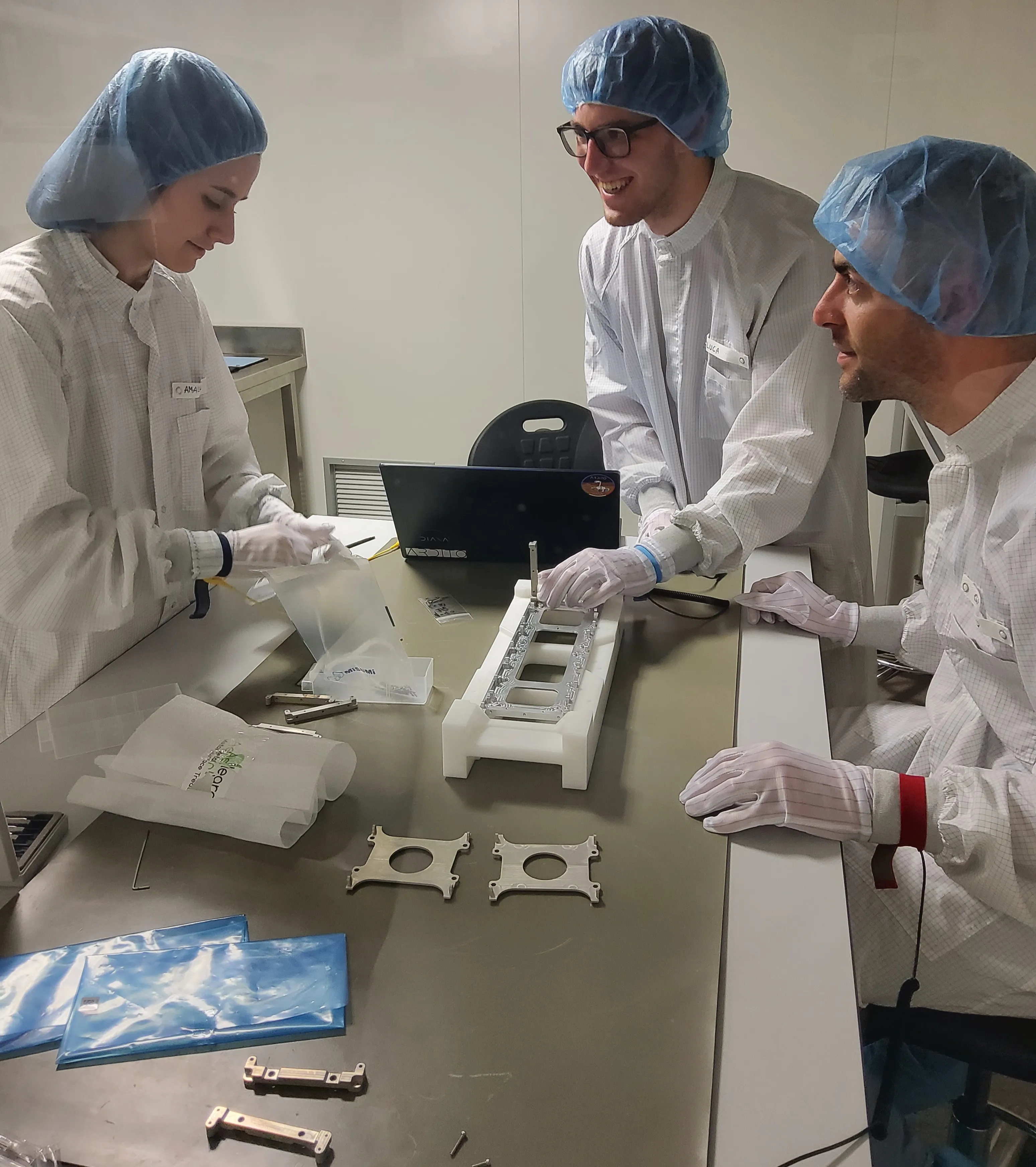
Fearless minds and confidence must rest in our wrists is a time tested mantra. Hope encourages us to move on fearlessly. “Spes Satelles” is a fine initiative.
Has the Holy Father considered the carbon footprint that everything involved with this rocket launch will leave? For that matter, how about all the CO2 emissions that result from his foreign travels or the conferences held at the Vatican regularly? Surely, Jeffrey Sachs isn’t getting to Rome by a sailboat.
Aside from hypocrisy, another underappreciated trait of this pope is his staggering egotism. He doesn’t even blush at the idea of a satellite spreading his (note, not the Gospel’s) words into space. It bears a striking similarity to his tendency to refer to his own previous works as support for the novelties he introduces in his endless stream of letters.