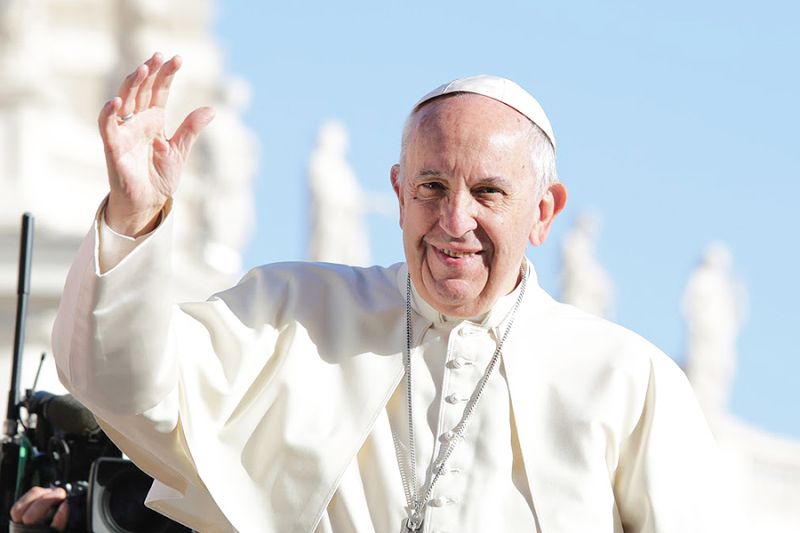
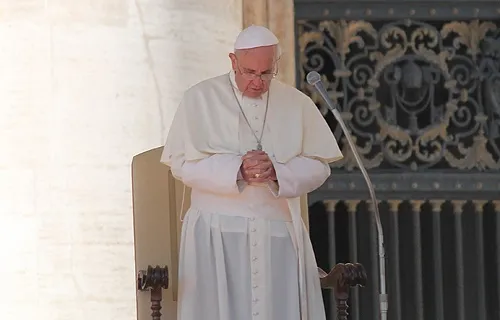
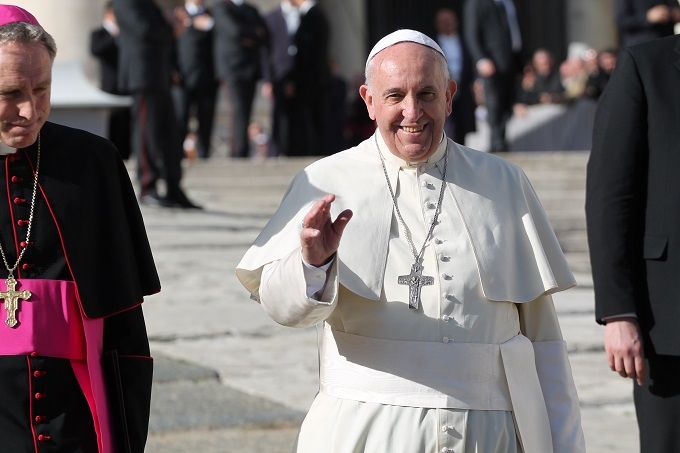
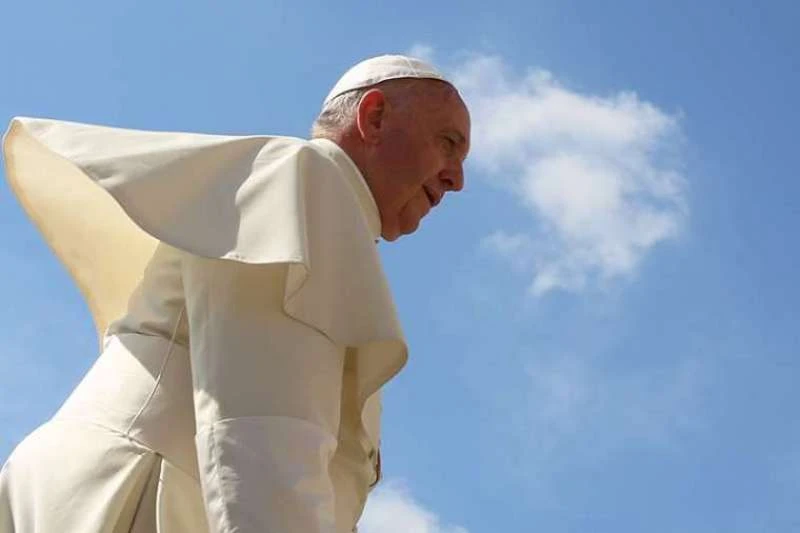
Fr. James Martin, SJ. Credit: Kerry Weber via Wikipedia cc 4.0 | Pope Francis. Credit: Daniel Ibáñez/CNA.
Rome Newsroom, Jan 28, 2023 / 05:00 am (CNA).
Pope Francis has written a letter to clarify his comments on sin and homosexuality from a recent interview with the Associated Press.
“When I said it is a sin, I was simply referring to Catholic moral teaching, which says that every sexual act outside of marriage is a sin,” the pope wrote to Jesuit Father James Martin, in response to a request for clarification.
Francis said he was trying to say in the interview that criminalization of homosexuality “is neither good nor just.”
“As you can see, I was repeating something in general,” he wrote. “I should have said ‘It is a sin, as is any sexual act outside of marriage.’ This is to speak of ‘the matter’ of sin, but we know well that Catholic morality not only takes into consideration the matter, but also evaluates freedom and intention; and this, for every kind of sin.”
Martin published the pope’s Spanish-language letter and an English translation on the website of Outreach on Jan. 27. Martin is the editor of Outreach, which describes itself as “an LGBT Catholic resource” operating under the auspices of America Media.
In an interview published Jan. 25 by AP, Pope Francis said, “Being homosexual is not a crime. It’s not a crime. Yes, but it’s a sin. Fine, but first let’s distinguish between a sin and a crime.”
The Outreach article posited that the pope’s comment that, “yes, but it’s a sin,” was intended to be from a hypothetical interlocutor to whom Pope Francis was responding.
In his Jan. 27 letter, Pope Francis ascribed the confusing statement to the conversational tone of the interview.
“It is understandable that there would not be such precise definitions,” he said.
The pope also noted that the AP interview was “not the first time that I speak of homosexuality and of homosexual persons.”
When speaking about the sin of sexual activity outside of marriage, he added that, “of course, one must also consider the circumstances, which may decrease or eliminate fault.”
The Catholic Church does not teach that homosexuality, that is having same-sex attraction, is a sin.
According to the Catechism of the Catholic Church, people with homosexual tendencies should be treated with respect, and unjust discrimination against them should be avoided, while “homosexual acts are intrinsically disordered” and “under no circumstances can they be approved.”
The Catechism also teaches that for a sin to be mortal, three conditions must be met: it must be grave matter, which is also committed with full knowledge and deliberate consent.
If you value the news and views Catholic World Report provides, please consider donating to support our efforts. Your contribution will help us continue to make CWR available to all readers worldwide for free, without a subscription. Thank you for your generosity!
Click here for more information on donating to CWR. Click here to sign up for our newsletter.
Pope Francis at the general audience in St. Peter’s Square, Oct. 5, 2016. / Credit: Daniel Ibanez/CNA
CNA Staff, Mar 13, 2025 / 04:00 am (CNA).
March 13 marks the 12th anniversary of the election of Pope Francis as the 265th successor of St. Peter. Here is a timeline of key events during his papacy:
2013
March 13 — About two weeks after Pope Benedict XVI steps down from the papacy, Cardinal Jorge Bergoglio is elected pope. He takes the papal name Francis in honor of St. Francis of Assisi and proclaims from the central balcony of St. Peter’s Basilica: “Let us begin this journey, the bishop and people, this journey of the Church of Rome, which presides in charity over all the Churches, a journey of brotherhood in love, of mutual trust. Let us always pray for one another.”
March 14 — The day after he begins his pontificate, Pope Francis returns to his hotel to personally pay his hotel bill and collect his luggage.
July 8 — Pope Francis visits Italy’s island of Lampedusa and meets with a group of 50 migrants, most of whom are young men from Somalia and Eritrea. The island, which is about 200 miles off the coast of Tunisia, is a common entry point for migrants who flee parts of Africa and the Middle East to enter Europe. This is the pope’s first pastoral visit outside of Rome and sets the stage for making reaching out to the peripheries a significant focus.
Pope Francis gives the Wednesday general audience in St. Peter’s Square on Oct. 2, 2013. Elise Harris/CNA.
July 23-28 — Pope Francis visits Rio de Janeiro, Brazil, to participate in World Youth Day 2013. More than 3 million people from around the world attend the event.
July 29 — On the return flight from Brazil, Pope Francis gives his first papal news conference and sparks controversy by saying “if a person is gay and seeks God and has goodwill, who am I to judge?” The phrase is prompted by a reporter asking the pope a question about priests who have homosexual attraction.
Nov. 24 — Pope Francis publishes his first apostolic exhortation Evangelii Gaudium (The Joy of the Gospel). The document illustrates the pope’s vision for how to approach evangelization in the modern world.
2014
Feb. 22 — Pope Francis holds his first papal consistory to appoint 19 new cardinals, including ones from countries in the developing world that have never previously been represented in the College of Cardinals, such as Haiti.
March 22 — Pope Francis creates the Pontifical Commission for the Protection of Minors. The commission works to protect the dignity of minors and vulnerable adults, such as the victims of sexual abuse.
Pope Francis greets pilgrims during his general audience on Nov. 29, 2014. Bohumil Petrik/CNA.
Oct. 5 — The Synod on the Family begins. The bishops discuss a variety of concerns, including single-parent homes, cohabitation, homosexual adoption of children, and interreligious marriages.
Dec. 6 — After facing some pushback for his efforts to reform the Roman Curia, Pope Francis discusses his opinion in an interview with La Nacion, an Argentine news outlet: “Resistance is now evident. And that is a good sign for me, getting the resistance out into the open, no stealthy mumbling when there is disagreement. It’s healthy to get things out into the open, it’s very healthy.”
2015
Jan. 18 — To conclude a trip to Asia, Pope Francis celebrates Mass in Manila, Philippines. Approximately 6 million to 7 million people attend the record-setting Mass, despite heavy rain.
March 23 — Pope Francis visits Naples, Italy, to show the Church’s commitment to helping the fight against corruption and organized crime in the city.
May 24 — To emphasize the Church’s mission to combat global warming and care for the environment, Pope Francis publishes the encyclical Laudato Si’, which urges people to take care of the environment and encourages political action to address climate problems.
Pope Francis at a Wednesday general audience in St. Peter’s Square on June 17, 2015. Bohumil Petrik.
Sept. 19-22 — Pope Francis visits Cuba and meets with Fidel Castro in the first papal visit to the country since Pope John Paul II in 1998. During his homily, Francis discusses the dignity of the human person: “Being a Christian entails promoting the dignity of our brothers and sisters, fighting for it, living for it.”
Sept. 22-27 — After departing from Cuba, Pope Francis makes his first papal visit to the United States. In Washington, D.C., he speaks to a joint session of Congress, in which he urges lawmakers to work toward promoting the common good, and canonizes the Franciscan missionary St. Junípero Serra. He also attends the World Meeting of Families in Philadelphia, which focuses on celebrating the gift of the family.
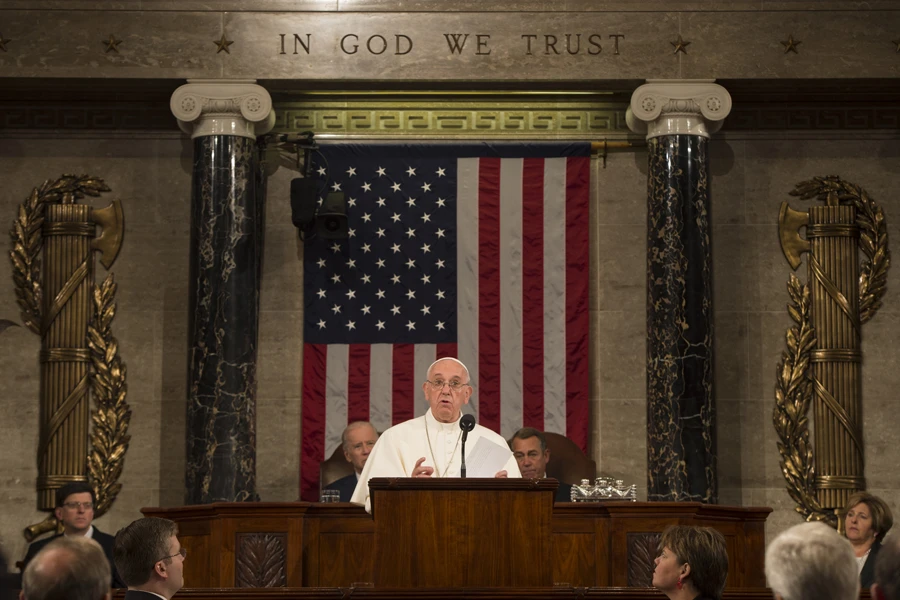
Pope Francis speaks to the U.S. Congress in Washington, D.C. on Sept. 24, 2015. . L’Osservatore Romano.
Oct. 4 — Pope Francis begins the second Synod on the Family to address issues within the modern family, such as single-parent homes, cohabitation, poverty, and abuse.
Oct. 18 — The pope canonizes St. Louis Martin and St. Marie-Azélie “Zelie” Guérin. The married couple were parents to five nuns, including St. Therese of Lisieux. They are the first married couple to be canonized together.
Dec. 8 — Pope Francis’ Jubilee Year of Mercy begins. The year focuses on God’s mercy and forgiveness and people’s redemption from sin. The pope delegates certain priests in each diocese to be Missionaries of Mercy who have the authority to forgive sins that are usually reserved for the Holy See.
2016
March 19 — Pope Francis publishes the apostolic exhortation Amoris Laetitia, which discusses a wide variety of issues facing the modern family based on discussions from the two synods on the family. The pope garners significant controversy from within the Church for comments he makes in Chapter 8 about Communion for the divorced and remarried.
April 16 — After visiting refugees on the Greek island of Lesbos, Pope Francis allows three Muslim refugee families to join him on his flight back to Rome. He says the move was not a political statement.
Pope Francis at the General Audience in St. Peter’s Square, Feb. 24, 2016. Daniel Ibanez/CNA.
July 26-31 — Pope Francis visits Krakow, Poland, as part of the World Youth Day festivities. About 3 million young Catholic pilgrims from around the world attend.
Sept. 4 — The pope canonizes St. Teresa of Calcutta, who is also known as Mother Teresa. The saint, a nun from Albania, dedicated her life to missionary and charity work, primarily in India.
Sept. 30-Oct. 2 — Pope Francis visits Georgia and Azerbaijan on his 16th trip outside of Rome since the start of his papacy. His trip focuses on Catholic relations with Orthodox Christians and Muslims.
Oct. 4 — Pope Francis makes a surprise visit to Amatrice, Italy, to pray for the victims of an earthquake in central Italy that killed nearly 300 people.
2017
May 12-13 — In another papal trip, Francis travels to Fatima, Portugal, to visit the Shrine of Our Lady of Fatima. May 13 marks the 100th anniversary of the first Marian apparition to three children in the city.
July 11 — Pope Francis adds another category of Christian life suitable for the consideration of sainthood: “offering of life.” The category is distinct from martyrdom, which only applies to someone who is killed for his or her faith. The new category applies to those who died prematurely through an offering of their life to God and neighbor.
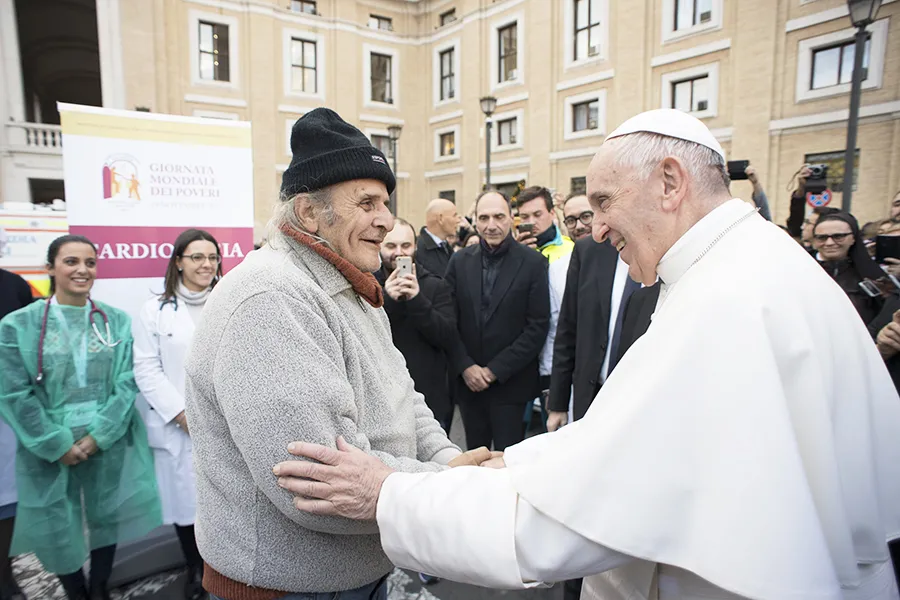
Pope Francis greets a participant in the World Day of the Poor in Rome, Nov. 16, 2017. L’Osservatore Romano.
Nov. 19 — On the first-ever World Day of the Poor, Pope Francis eats lunch with 4,000 poor and people in need in Rome.
Nov. 27-Dec. 2 — In another trip to Asia, Pope Francis travels to Myanmar and Bangladesh. He visits landmarks and meets with government officials, Catholic clergy, and Buddhist monks. He also preaches the Gospel and promotes peace in the region.
2018
Jan. 15-21 — The pope takes another trip to Latin America, this time visiting Chile and Peru. The pontiff meets with government officials and members of the clergy while urging the faithful to remain close to the clergy and reject secularism. The Chilean visit leads to controversy over Chilean clergy sex abuse scandals.
Aug. 2 — The Vatican formally revises No. 2267 of the Catechism of the Catholic Church, which concerns the death penalty. The previous text suggested the death penalty could be permissible in certain circumstances, but the revision states that the death penalty is “inadmissible.”
Aug. 25 — Archbishop Carlo Viganò, former papal nuncio to the United States, publishes an 11-page letter calling for the resignation of Pope Francis and accusing him and other Vatican officials of covering up sexual abuse including allegations against former Cardinal Theodore McCarrick. The pope initially does not directly respond to the letter, but nine months after its publication he denies having prior knowledge about McCarrick’s conduct.
Aug. 25-26 — Pope Francis visits Dublin, Ireland, to attend the World Meeting of Families. The theme is “the Gospel of family, joy for the world.”
Pope Francis at the 2018 World Meeting of Families in Ireland. Daniel Ibanez/CNA.
Oct. 3-28 — The Synod on Young People, the Faith, and Vocational Discernment takes place. The synod focuses on best practices to teach the faith to young people and to help them discern God’s will.
2019
Jan. 22-27 — The third World Youth Day during Pope Francis’ pontificate takes place during these six days in Panama City, Panama. Young Catholics from around the world gather for the event, with approximately 3 million people in attendance.
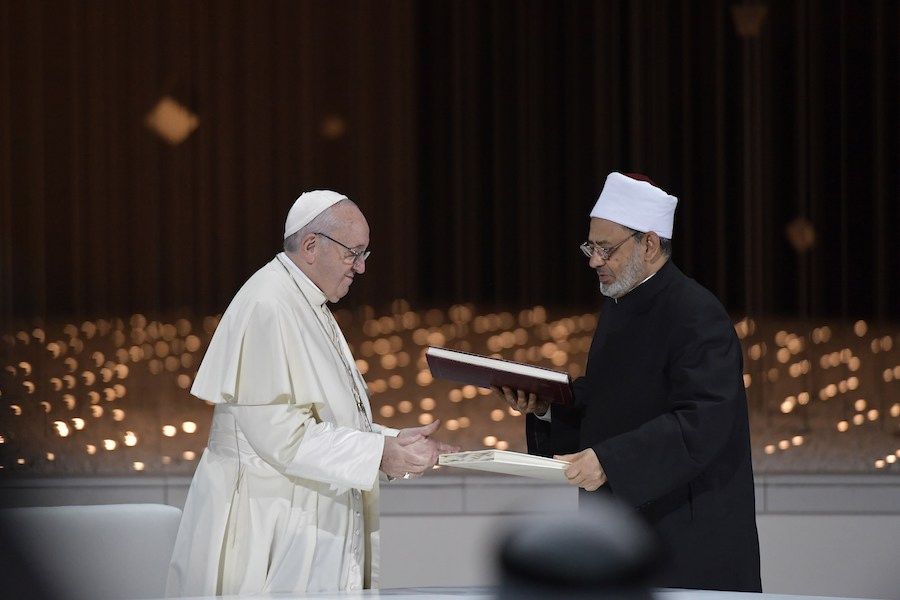
Feb. 4 — Pope Francis signs a joint document in with Sheikh Ahmed el-Tayeb, the grand imam of Al-Azhar, in Abu Dhabi, United Arab Emirates, titled the “Document on Human Fraternity for World Peace and Living Together.” The document focuses on people of different faiths uniting together to live peacefully and advance a culture of mutual respect.
Pope Francis and Ahmed el-Tayeb, grand imam of al-Azhar, signed a joint declaration on human fraternity during an interreligious meeting in Abu Dhabi, UAE, Feb. 4, 2019. Vatican Media.
Feb. 21-24 — The Meeting on the Protection of Minors in the Church, which is labeled the Vatican Sexual Abuse Summit, takes place. The meeting focuses on sexual abuse scandals in the Church and emphasizes responsibility, accountability, and transparency.
Oct. 6-27 — The Church holds the Synod of Bishops for the Pan-Amazon region, which is also known as the Amazon Synod. The synod is meant to present ways in which the Church can better evangelize the Amazon region but leads to controversy when carved images of a pregnant Amazonian woman, referred to by the pope as Pachamama, are used in several events and displayed in a basilica near the Vatican.
Oct. 13 — St. John Henry Newman, an Anglican convert to Catholicism and a cardinal, is canonized by Pope Francis. Newman’s writings inspired Catholic student associations at nonreligious colleges and universities in the United States and other countries.
2020
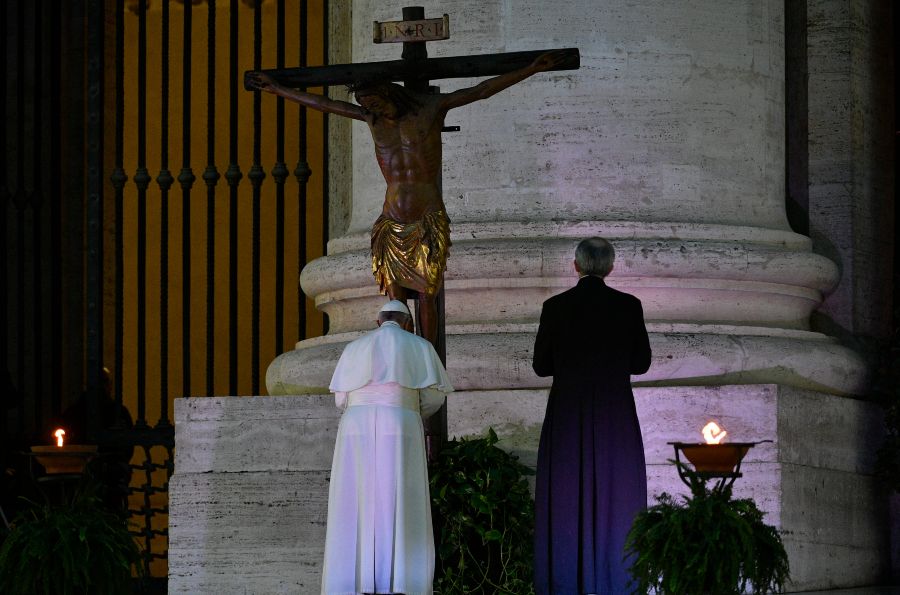
March 15 — Pope Francis takes a walking pilgrimage in Rome to the chapel of the crucifix and prays for an end to the COVID-19 pandemic. The crucifix was carried through Rome during the plague of 1522.
March 27 — Pope Francis gives an extraordinary “urbi et orbi” blessing in an empty and rain-covered St. Peter’s Square, praying for the world during the coronavirus pandemic.
Pope Francis venerates the miraculous crucifix of San Marcello al Corso in St. Peter’s Square during his Urbi et Orbi blessing, March 27, 2020. Vatican Media.
2021
March 5-8 — In his first papal trip since the start of the COVID-19 pandemic, Pope Francis becomes the first pope to visit Iraq. On his trip, he signs a joint statement with Grand Ayatollah Ali al-Sistani condemning extremism and promoting peace.
July 3 — Cardinal Giovanni Angelo Becciu, who was elevated to the College of Cardinals by Pope Francis, is indicted in a Vatican court for embezzlement, money laundering, and other crimes. The pope gives approval for the indictment.
July 4 — Pope Francis undergoes colon surgery for diverticulitis, a common condition in older people. The Vatican releases a statement that assures the pope “reacted well” to the surgery. Francis is released from the hospital after 10 days.
July 16 — Pope Francis issues a motu proprio titled Traditionis Custodes. The document imposes heavy restrictions on the celebration of the Traditional Latin Mass.
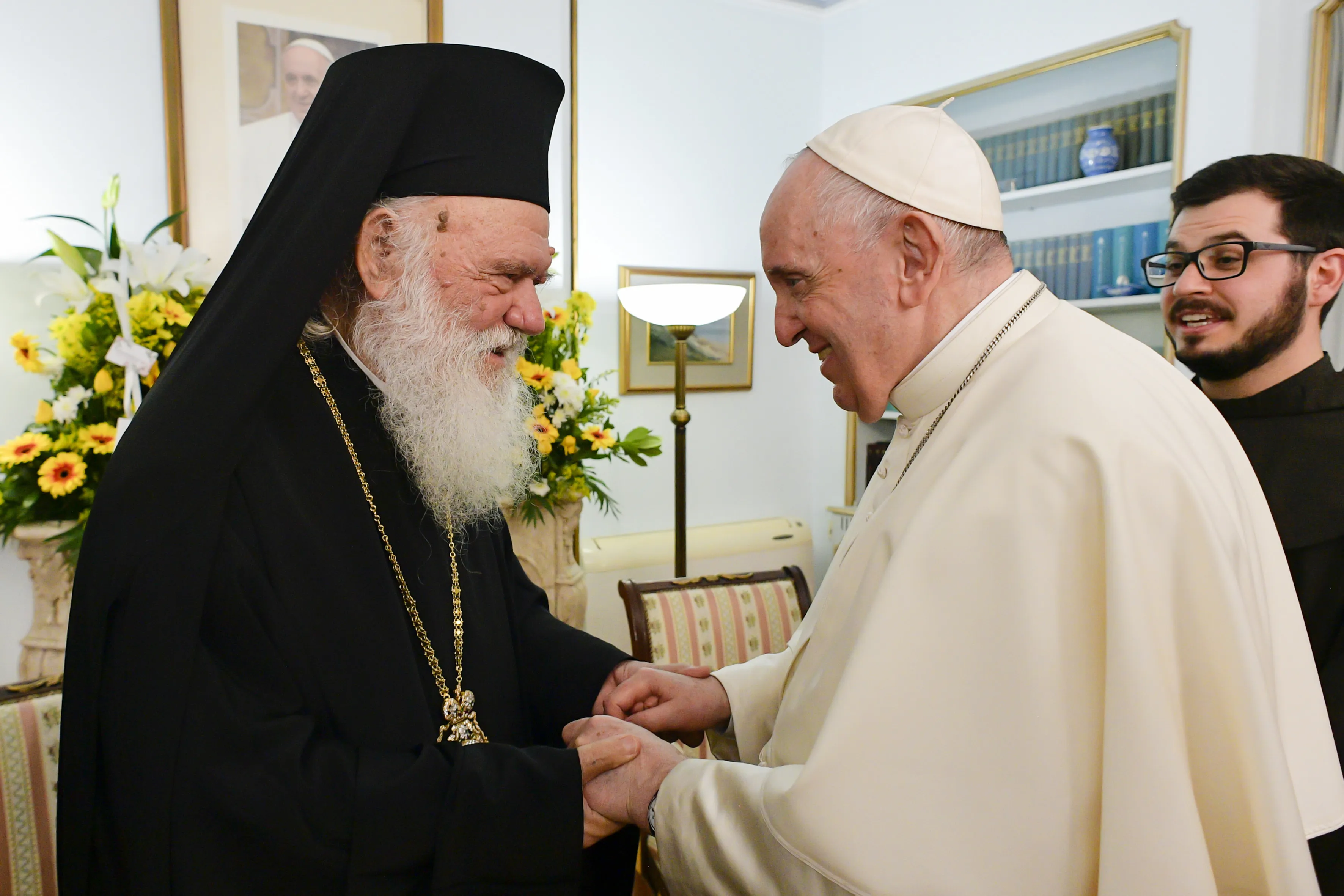
Dec. 2-6 — The pope travels to Cyprus and Greece. The trip includes another visit to the Greek island of Lesbos to meet with migrants.
Pope Francis greets His Beatitude Ieronymos II in Athens, Greece on Dec. 5, 2021. Vatican Media
2022
Jan. 11 — Pope Francis makes a surprise visit to a record store in Rome called StereoSound. The pope, who has an affinity for classical music, blesses the newly renovated store.
March 19 — The pope promulgates Praedicate Evangelium, which reforms the Roman Curia. The reforms emphasize evangelization and establish more opportunities for the laity to be in leadership positions.
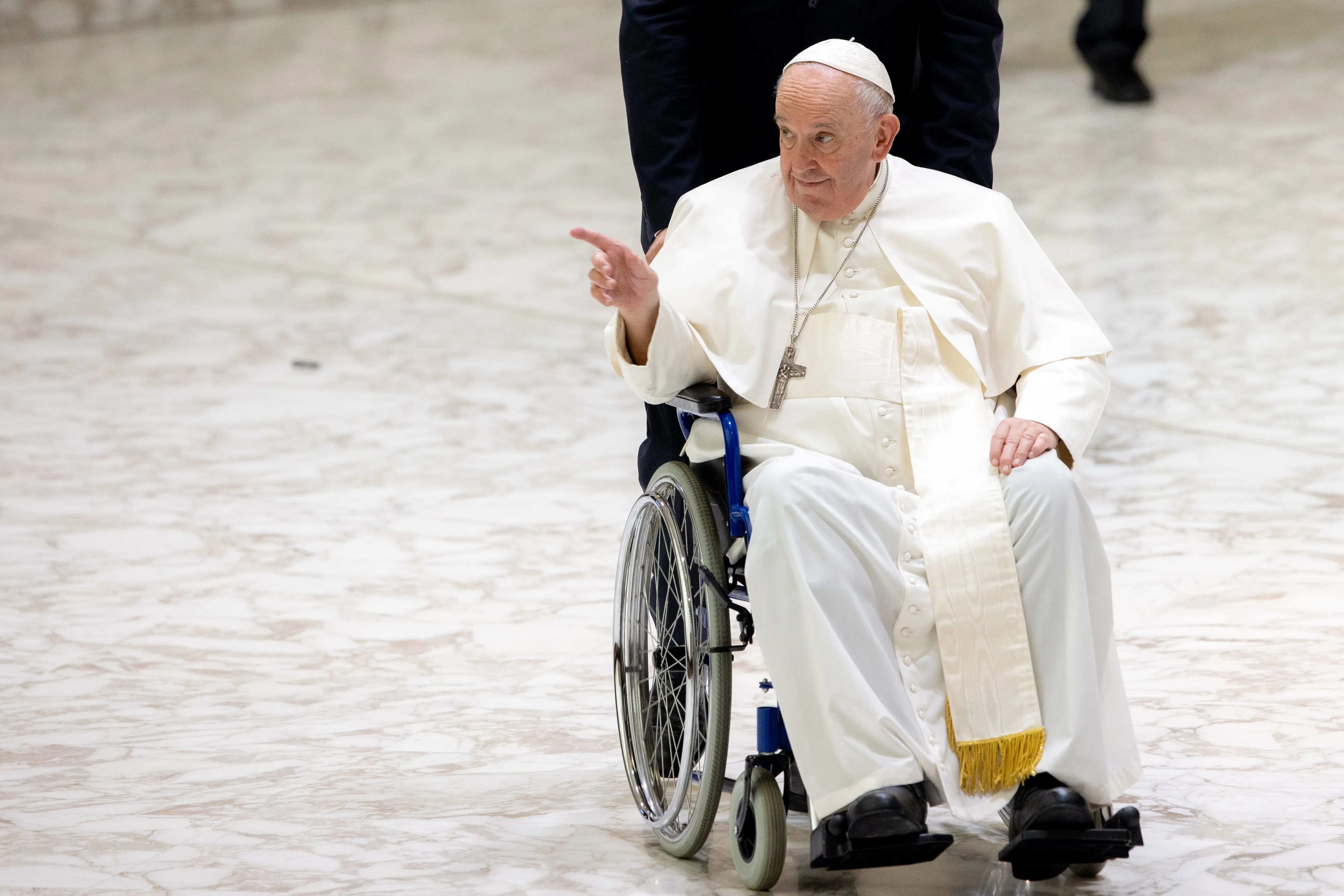
May 5 — Pope Francis is seen in a wheelchair for the first time in public and begins to use one more frequently. The pope has been suffering from knee problems for months.
Pope Francis greeted the crowd in a wheelchair at the end of his general audience on Aug. 3, 2022. Daniel Ibanez/CNA
July 24-30 — In his first papal visit to Canada, Pope Francis apologizes for the harsh treatment of the indigenous Canadians, saying many Christians and members of the Catholic Church were complicit.
2023
Jan. 31-Feb. 5 — Pope Francis travels to the Democratic Republic of Congo and South Sudan. During his visit, the pope condemns political violence in the countries and promotes peace. He also participates in an ecumenical prayer service with Anglican Archbishop of Canterbury Justin Welby and Moderator of the Church of Scotland Iain Greenshields.
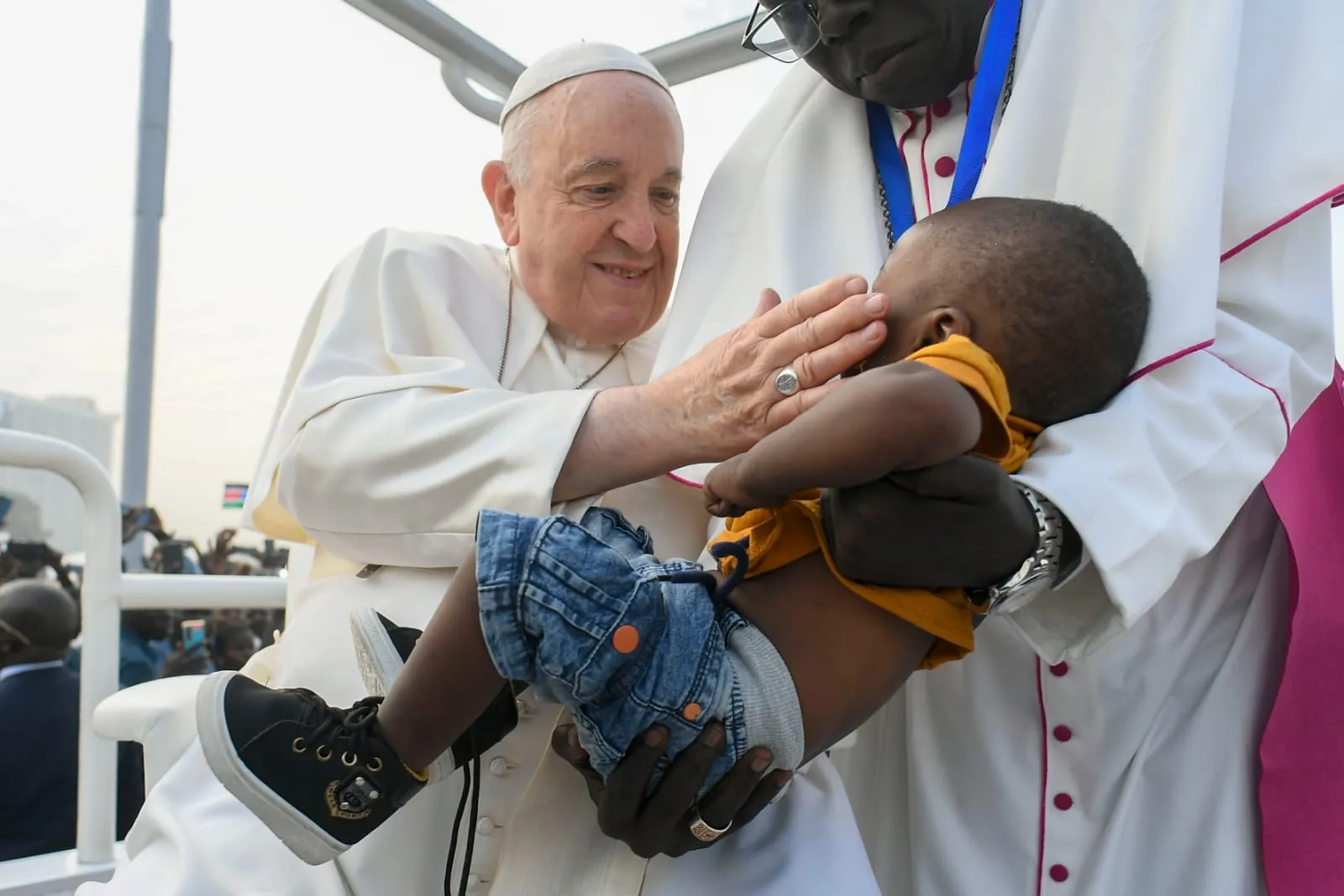
Pope Francis greets a young boy a Mass in Juba, South Sudan on Feb. 5, 2023. Vatican Media
March 29-April 1 — Pope Francis is hospitalized for a respiratory infection. During his stay at Rome’s Gemelli Hospital, he visits the pediatric cancer ward and baptizes a newborn baby.
April 5 — The pope appears in the Disney documentary “The Pope: Answers,” which is in Spanish, answering six “hot-button” issues from members of Gen Z from various backgrounds. The group discusses immigration, depression, abortion, clergy sexual and psychological abuse, transgenderism, pornography, and loss of faith.
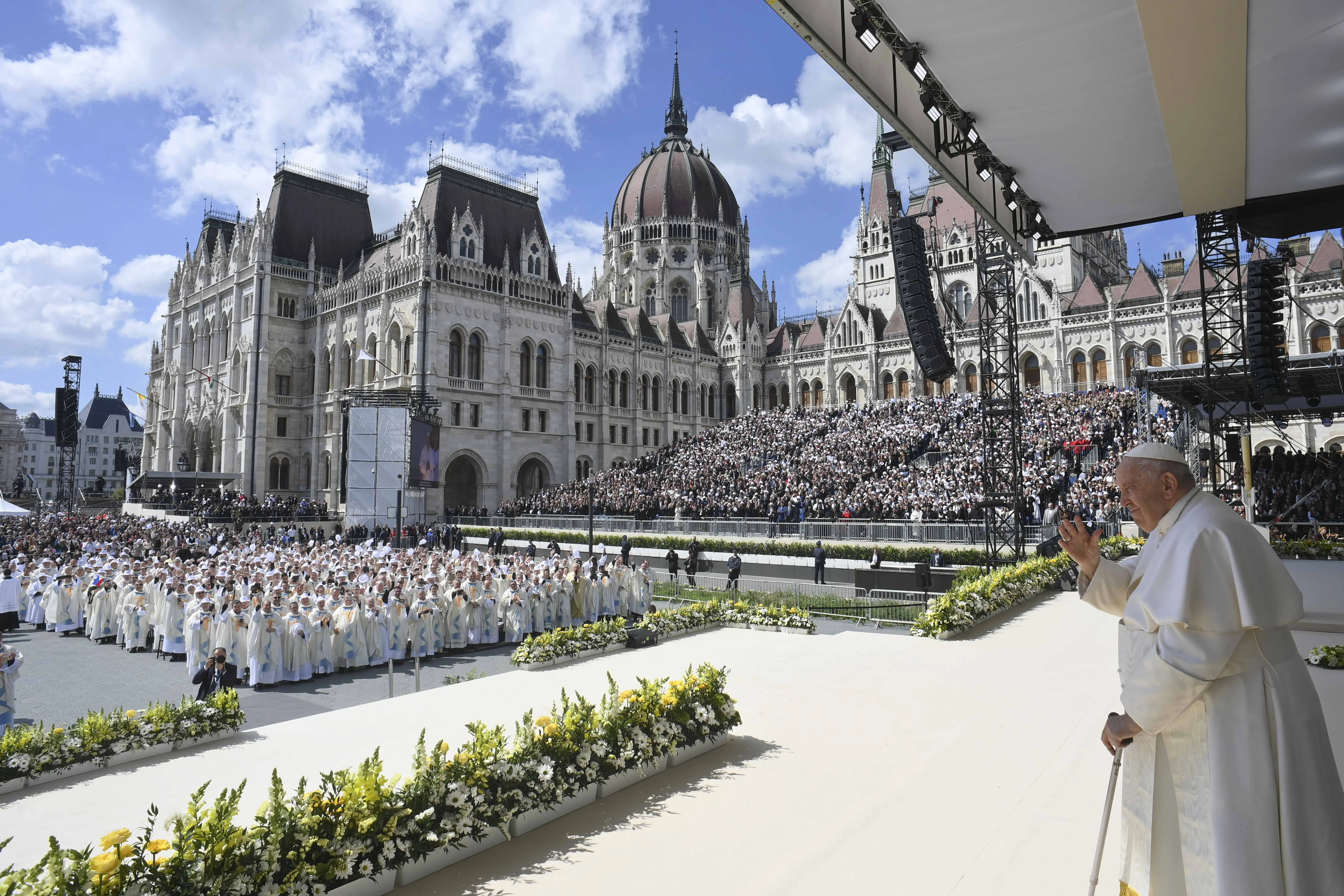
April 28-30 — Pope Francis visits Hungary to meet with government officials, civil society members, bishops, priests, seminarians, Jesuits, consecrated men and women, and pastoral workers. He celebrates Mass on the final day of the trip in Kossuth Lajos Square.
Pope Francis stands on an altar erected outside the Parliament Building in Budapest’s Kossuth Lajos’ Square during a public outdoor Mass on April 30, 2023. Vatican Media
June 7 — The Vatican announces that Pope Francis will undergo abdominal surgery that afternoon under general anesthesia due to a hernia that is causing painful, recurring, and worsening symptoms. In his general audience that morning before the surgery, Francis says he intends to publish an apostolic letter on St. Thérèse of Lisieux, “patroness of the missions,” to mark the 150th anniversary of her birth.
June 15 — After successful surgery and a week of recovery, Pope Francis is released from Gemelli Hospital.
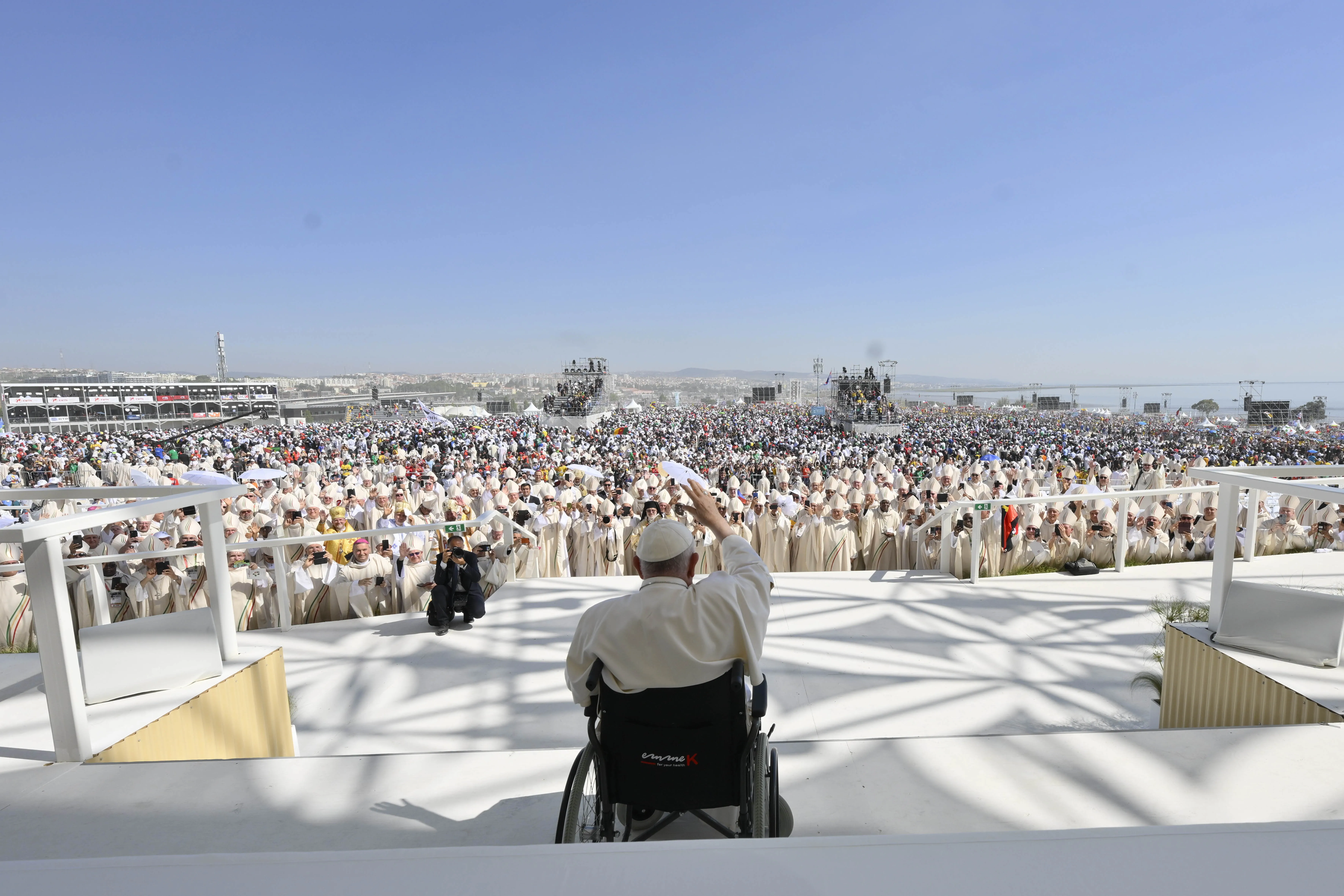
Aug. 2-6 — Pope Francis travels to Lisbon, Portugal, for World Youth Day 2023, taking place from Aug. 1-6. He meets with Church and civil leaders ahead of presiding at the welcoming Mass and Stations of the Cross. He also hears the confessions of several pilgrims. On Aug. 5, he visits the Shrine of Our Lady of Fátima, where he prays the rosary with young people with disabilities. That evening he presides over the vigil and on Sunday, Aug. 6, he celebrates the closing Mass, where he urges the 1.5 million young people present to “be not afraid,” echoing the words of the founder of World Youth Days, St. John Paul II.
Pope Francis waves at the crowd of 1.5 million people who attended the closing Mass of World Youth Day 2023 in Lisbon, Portugal on Aug. 6, 2023. Vatican Media.
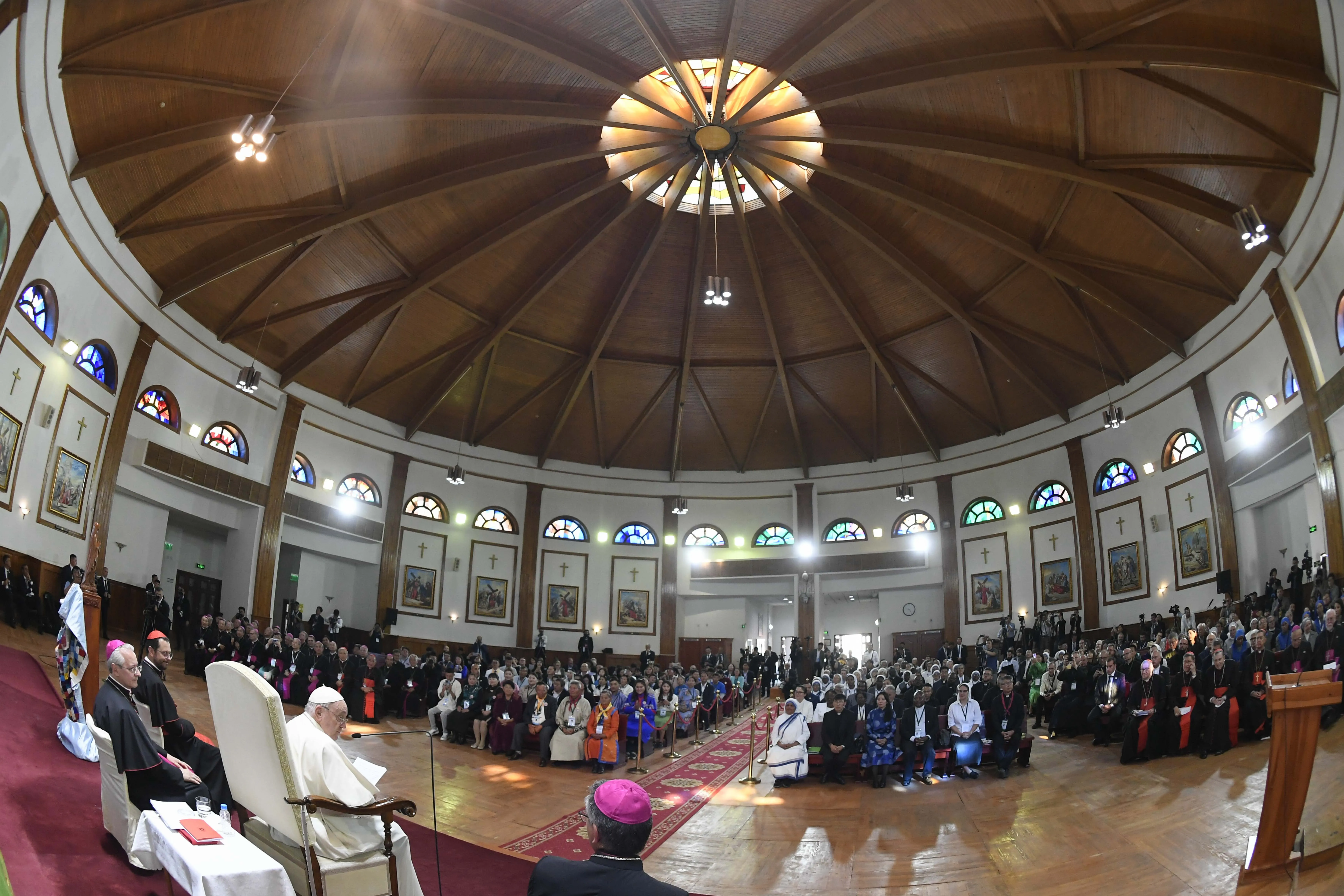
Aug. 31-Sept. 4 — Pope Francis travels to Mongolia, the world’s most sparsely populated sovereign country. The trip makes Francis the first pope to visit the Asian country that shares a 2,880-mile border with China, its most significant economic partner. Mongolia has a population of about 1,300 Catholics in a country of more than 3 million people.
Pope Francis meets with local priests and religious of Mongolia, which includes only 25 priests (19 religious and six diocesan), 33 women religious, and one bishop — Cardinal Giorgio Marengo — in Ulaanbaatar’s Cathedral of Sts. Peter and Paul on Sept. 2, 2023. Credit: Vatican Media
Sept. 22-23 — On a two-day trip to Marseille, France, Pope Francis meets with local civil and religious leaders and participates in the Mediterranean Encounter, a gathering of some 120 young people of various creeds with bishops from 30 countries.
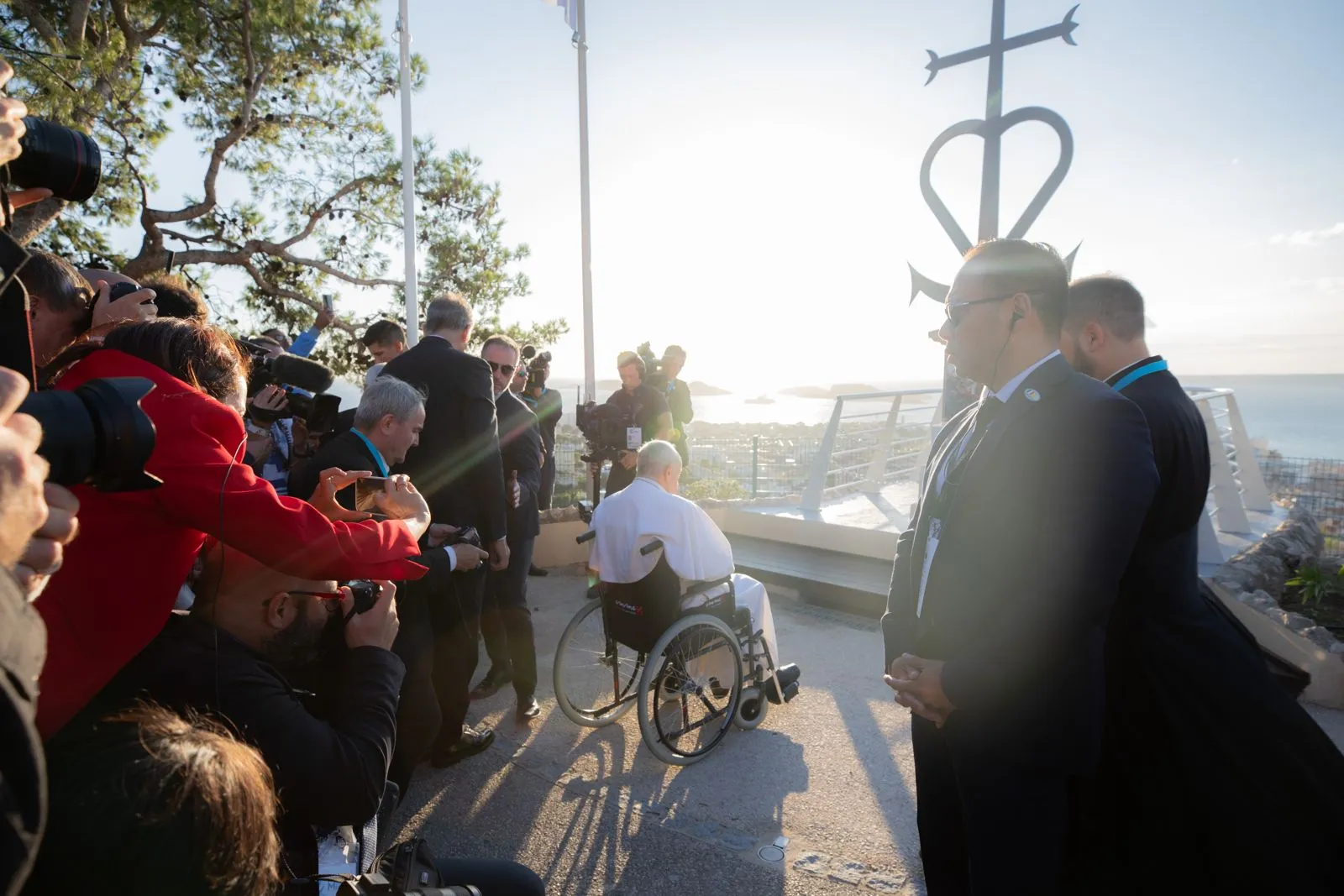
Pope Francis asks for a moment of silence at a memorial dedicated to sailors and migrants lost at sea on the first of a two-day visit to Marseille, France, Sept. 22, 2023. A Camargue cross, which comes from the Camargue area of France, represents the three theological virtues of faith, hope, and charity. The three tridents represent faith, the anchor represents hope, and the heart represents charity. Credit: Daniel Ibañez/CNA
Oct. 4-29 — The Vatican hosts the first of two monthlong global assemblies of the Synod on Synodality, initiated by Pope Francis in 2021 to enhance the communion, participation, and mission of the Church. Pope Francis celebrates the closing Mass of the synod at St. Peter’s Basilica on Oct. 29. The second and final global assembly will take place at the Vatican in October 2024.
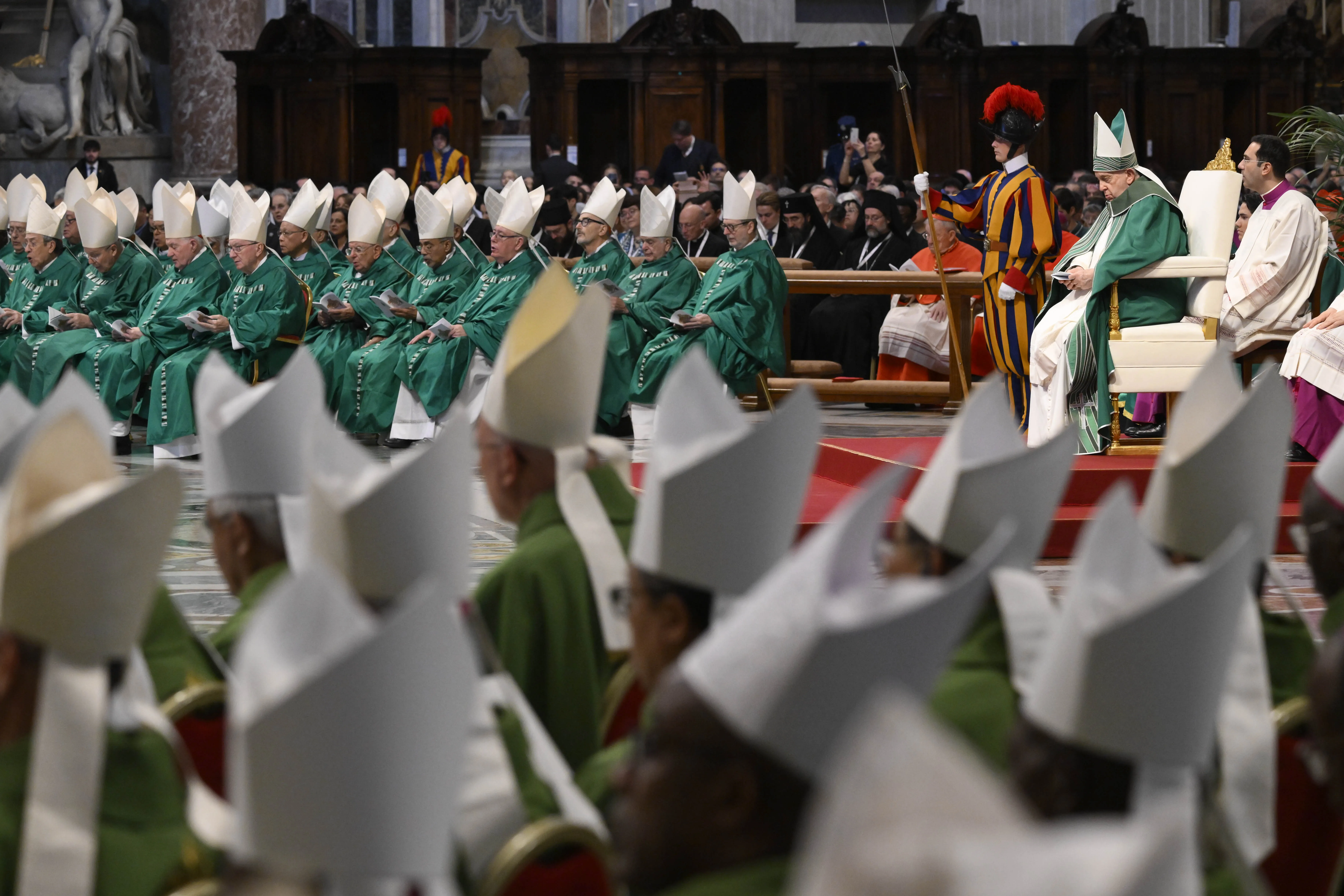
Pope Francis at the Synod on Synodality’s closing Mass in St. Peter’s Basilica on Oct. 29, 2023. Vatican Media
Nov. 25 — Pope Francis visits the hospital briefly for precautionary testing after coming down with the flu earlier in the day. Although he still participates in scheduled activities, other officials read his prepared remarks. The Vatican on Nov. 28 cancels the pope’s planned Dec. 1–3 trip to Dubai for the COP28 climate conference, where he was scheduled to deliver a speech, due to his illness.
Dec. 18 — The Dicastery for the Doctrine of the Faith issues the declaration Fiducia Supplicans, which authorizes nonliturgical blessings for same-sex couples and couples in “irregular situations.” Various bishops from around the world voice both support for and criticism of the document.
2024
Jan. 14 — Pope Francis for the first time responds publicly to questions about Fiducia Supplicans in an interview on an Italian television show. The pope underlines that “the Lord blesses everyone” and that a blessing is an invitation to enter into a conversation “to see what the road is that the Lord proposes to them.”
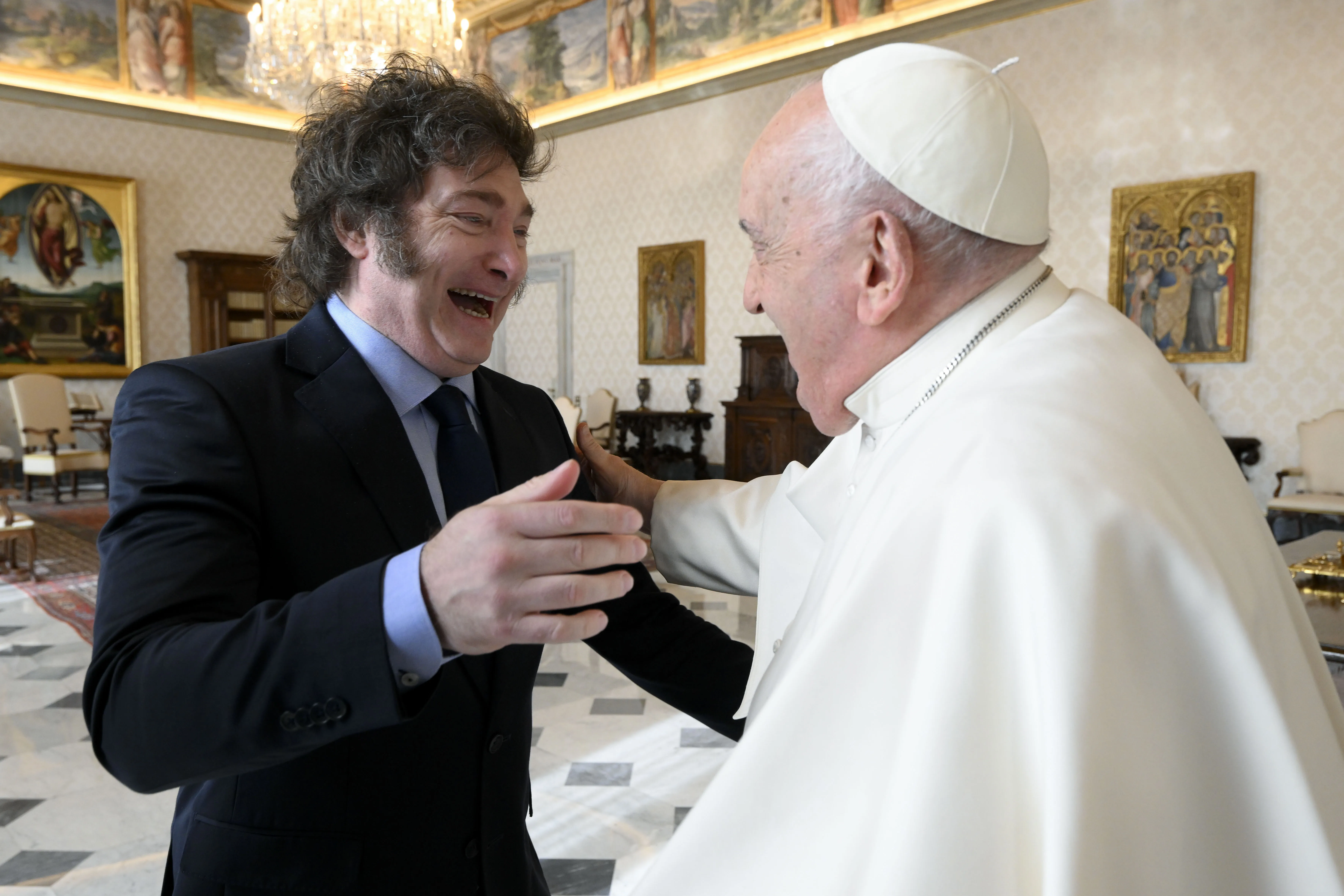
Feb. 11 — In a ceremony attended by Argentine president Javier Milei, Pope Francis canonizes María Antonia of St. Joseph — known affectionately in the pope’s home country as “Mama Antula” — in a Mass at St. Peter’s Basilica. The president and the former archbishop of Buenos Aires embrace after the ceremony. Pope Francis, who has not returned to his homeland since becoming pope in 2013, has said he wants to visit Argentina in the second half of this year.
Pope Francis meets with Argentina President Javier Milei in a private audience on Feb. 12, 2024, at the Vatican. Credit: Vatican Media
March 13 — Pope Francis celebrates 11 years as supreme pontiff of the Roman Catholic Church.
April 8 — The Dicastery for the Doctrine of the Faith releases Dignitas Infinita (“Infinite Dignity”), a document that reaffirms the Church’s perennial opposition to abortion, euthanasia, and gender ideology.
May 19 — Pope Francis appears on CBS’ “60 Minutes” in an interview with Norah O’Donnell, where he states categorically that women’s ordination to the priesthood and the diaconate is off the table.
In an interview with 60 Minutes’ Norah O’Donnell, Pope Francis took aim at his “conservative critics” in the United States. Credit: CBS News/Adam Verdugo
June 14 — Pope Francis becomes the first pope to address the G7 Summit in the southern Italian region of Puglia. In his remarks, he stresses that human dignity requires that the decisions of artificial intelligence (AI) be under the control of human beings. During the three-day event, the pope also meets with U.S. President Joe Biden.
Sept. 2-13 — Pope Francis embarks on a 12-day trip of more than 20,000 miles over seven flights through Asia and Oceania. The trip to Indonesia, Papua New Guinea, East Timor, and Singapore is his most ambitious international trip yet and the longest of his 11-year pontificate. In East Timor, 600,000 Catholics attend Mass with the Holy Father.
Pope Francis celebrates Mass at the Esplanade of Taci Tolu in Dili, Timor-Leste, Tuesday, Sept. 10, 2024. Credit: Daniel Ibáñez/CNA
Oct. 2-27 — The three-year Synod on Synodality concludes with the final session in Rome and the adoption of the final report, which in a surprise move Pope Francis signs immediately, stating he will not issue a separate postsynodal document.
Dec. 7 — Pope Francis holds a consistory at the Vatican in which he creates 21 new cardinals, including Archbishop Frank Leo of Toronto; Archbishop Dominique Joseph Mathieu of Tehran-Isfahan, Iran; and Archbishop Tarcisio Isao Kikuchi of Tokyo, reflecting the pope’s emphasis on the Church’s global mission.
Pope Francis places the red biretta on Cardinal Domenico Battaglia, archbishop of Naples, during the consistory for the creation of 21 new cardinals in St. Peter’s Basilica, Dec. 7, 2024. Credit: Daniel Ibáñez/CNA
Dec. 24 — On Christmas Eve, Pope Francis opens the Holy Door at St. Peter’s Basilica to officially launch the 2025 Jubilee Year of Hope.
Pope Francis opens the Holy Door of St. Peter’s Basilica before Mass on Christmas Eve, Dec. 24, 2024, officially launching the Jubilee Year 2025. Credit: Vatican Media
2025
Jan. 14 — “Hope,” Pope Francis’ autobiography, is released. The book marks the first time a pope has provided a first-person narration of the episodes that have marked his entire life, in this case from his childhood in Argentina in a family of Italian immigrants to becoming the successor of St. Peter.
Feb. 14 — Pope Francis is hospitalized with bronchitis and later develops double pneumonia.
March 13 — While still in Gemelli Hosptial in Rome for treatment for respiratory illnesses, Pope Francis celebrates the 12th anniversay of his election to the papacy.
Washington, D.C. Newsroom, Nov 29, 2022 / 15:30 pm (CNA).
A new ad campaign from a Canadian fashion retailer features a terminally ill woman who ended her life by assisted suicide.“Dying in a hospital is not what’s… […]
I think there’s an abiding ambiguity in the Pope’s thinking on the relationship between sin and culpability. According to the Church, my lack of full knowledge or deliberate consent may mitigate or nullify my culpability for an objectively disordered act, but this does not mean that the act is permissible for me even in a qualified or provisional sense, even for the sake of avoiding a greater evil.
Pope Francis suggests just the opposite in his response to the Argentine Bishops’ Letter, which argues I could discern that it is not presently possible for me to avoid sex outside marriage if to do so would lead to a greater sin, though it may become possible in the future with the help of grace. The issue here is not really a lack of full knowledge or deliberate consent. On the contrary, I have deliberated on my options, and have decided that it is necessary for me to consent to sex outside marriage in order to avoid some consequence that I judge to be a greater evil (e.g., subjecting my children to divorce, etc).
This is not the Church’s teaching. It is consequentialism with a smiling face. No matter how difficult my present circumstances may be, I can keep God’s law with the help of His grace. To say otherwise is not Christian mercy, but moral determinism. It is to strip us of agency and dignity, to deny the share Christ gives us in the victory of the Cross.
All this, of course, is old news, but it makes it difficult for me to take the Pope’s much-welcome correction of James Martin at face value. Francis tends to stretch the Church’s teaching on mitigated culpability from something like a distinction between degrees of murder to a distinction between murder and self-defense. If it is sometimes impossible for divorced and remarried couples to avoid sex outside marriage, and if we must treat all sexual sins alike, could it sometimes be impossible for gay couples too? If so, what is the point of re-affirming that homosexual acts are always sins?
“…of course, one must also consider the circumstances, which may decrease or eliminate fault.”
Yes, in individual cases, but from this will James Martin now manufacture the endorsement he needs to proclaim that LGBTQ as a category (!) is exempt from the natural law, the dubia and the Magisterium’s Veritatis Splendor?
What would such an endorsement mean when, instead, the homosexual tendency is triggered or locked in by early sexual abuse, by random sexual experimentation, by the trauma of absentee or abusive fathers, by cultural victimization? Ought the Church to truly affirm the victim persons and call for confronting and healing the entire package of such background abuses–at, say, the “aggregated, compiled and synthesized” Synod on Synodality? Fat chance. But perhaps James Martin will supply Cardinals Hollerich and Radcliffe with the needed wording!
But then there’s also the science–a literature review, plus the lab finding of a few genome “markers” of little explanatory value, and no gay gene:
One recent STUDY in the mix is a review of two hundred peer-reviewed studies on sexual orientation and gender identity. The conclusion: gender identity is not an innate, fixed property of human beings independent of biological sex (Mayer/McHugh, The New Atlantis: A Journal of Technology and Society, Ethics and Public Policy Center, No. 50, Fall 2016).
Well to have clarified his remarks, although Pope Francis apparently doesn’t distinguish between sexual sins in the natural order, and those moral injustices that are a form of hostility to the natural order. Such are homosexual sins. Why the difference?
God ordained human sexual behavior exclusive to a man and woman. The sin then offends God as a sin outside marriage, and a sin against natural law. Also, the common opinion of late is that the predilection toward same sex is not sinful described as such ‘attraction’. The error in this while it’s apparently true that some have a deep seated same sex attraction that of itself may not be sinful -similarly, the historical evidence shows homosexuality behavior can be an acquired sexual dysfunction.
Francis clouds this distinction. That leads many to assume a form of liceity in that sodomy is no less grievous than natural sexual activity between a man and woman, adding to the willingness to engage in unnatural sex. As well as the Pontiff’s frequent admonition, this is how God made you, he loves you as you are. Hearing this from a pontiff weakens resistance to homosexuality, often for some encourages it.
Well said! The pope’s comment was rather shocking. As we read in scripture God condemns homosexuality which is an abomination to Him and for the pope to suggest that those who choose to disobey God should be given any consideration is wrong and speaks volume for a person in his position.
I could just imagine all the heads exploding in “America” offices all over the land as they hear Pope Francis saying that homosexuality is a SIN.
“He can’t say that!” they all cried out at once. James Martin swooned and had to be helped to the nearest fainting couch.
“We need to get him to issue a clarification right away” all the world’s Jesuits screamed in unison. “No one can know that homosexuality is sinful in any respect! We must have full papal approval of homosexuality, at least in the public mind!”
Pope Francis says “of course, one must also consider the circumstances which may decrease or eliminate fault.” The catechism, however, clearly states that homosexual acts “under no circumstances can they be approved.” The catechism makes things clear, the pope’s statement does not. Some could claim that love for a same sex partner eliminates the moral fault of homosexual acts,
Rene, this conflated concept of mitigation is the lever used in Amoris Laetitia to neutralize intrinsically evil acts. John Paul II warned not to make mitigation [in Amoris as you correctly note mitigating circumstances] a category, as a classification of moral acts. Grace is what’s absent in Ch 8 Amoris Laetitia, a surreptitious omission. When the Apostle Paul complained of Satan’s thorn in his side [Aquinas considered Paul’s affliction a moral temptation] Our Lord answered him, ‘My grace is sufficient. My power is perfected in weakness’.
Dear, dear Francis,
I stopped listening to anything you say or write a long, long time ago. Issue an encyclical or make pronouncements ex cathedra on a matter of faith and moral and then I’ll listen and obey. But your day to day remarks are not only confusing but you’re forever contradicting yourself.
I am deeply concerned over this pontiff and his comments.
I wish there was a way, outside of prayer, that we can address our concerns in a spirit of filial love and correction to this Holy Father, similar to St Paul’s rebuke of St Peter, or that of an adult son to his elderly father.
An interesting, albeit sad,turn of events. James Martin left his two audiences with Francis feeling encouraged and supported, probably due to his sense that the pontiff was on his side. But this is just another example of Francis doublespeak. Homosexual acts are sin. The church has taught this for centuries. There really is no need for clarification. Martin needs to either repent or be laicized.
Last time I checked (okay, I never did, but still) mixing ammonia and bleach is not a crime, or even a sin as far as I know, but it is still an incredibly stupid thing to do, and carries with it the possibility of very, very scary breathing difficulties, if not death.
.
Maybe sodomy should be looked at that way. Not a crime, but incredibly stupid and harmful on many, many levels. Not something that can ever be approved of and should always and everywhere be discouraged–including in marriage–an institution that is exclusively between and man and woman.
These are not equal comparisons as mixing bleach & ammonia are not known from research or millenia of human experience to be a “dysfunctional behavior against Natural Law” – as IS sodomy and all homosexual sexual behaviors. The ramifications of homosexual sexual behaviors are immediately harmful both naturally & eternally to the people involved, and the consequences of harm and destruction from even one encounter can expand like an algae bloom in summer, and from the common on-going behavior (“gay culture”) explode with far-reaching and forever consequences like the radiation from nuclear explosion/melt-down.
A very good analogy there, the mixing of ammonia and bleach. Unfortunately, with sodomy some have apparently to learn the hard way or, worse yet, never do.
I get your point and agree in part. However, I’m not sure it’s ever safe. He is rather like the old uncle or grandpa who keeps coming to family reunions and embarrasses (almost) everyone with his inappropriate comments and behavior. It’s egregious stuff, but nobody seems to be able to stop him. So he keeps roiling things up and fouling the air until, finally, he falls asleep in a rocking chair. Then, then we have a moment of peace and sanity.
God said homosexuality is a sin both in the old and new testament LONG before any pope meekly mentioned it. It’s really sad that you all rely on a catechism made up by sinful men that doesn’t correspond exactly to God’s word. The world is watching as the Catholic church crumbles before their very eyes.
The Pope is implying the realities of voluntary and involuntary homosexuality. The former are sinful and the latter possibly not, as especially when in youth under non-cognitive exploration, a person discovers sexual response though no one taught him nor did one learn it from a source (i.e. ‘it just happened’). If one does not know, then culpability is indeed mitigated. But the one who has already gained full knowledge of disorder (has taken the eternal curriculum of heterosexuality and chastity) and acts out still, ‘will be severely beaten’, in consequence.
Dr/Fr Ripperger has covered this area called ‘involuntary vice’. But someone should write an entire book on this topic, because the tendency of the creature who has already voluntarily or involuntarily wired or configured his body to same-sex attraction (or any other disordered intoxication) preference, searches for every cognitive instance that will legitimize his configuration, to make licit the acting out in the preference. Addicts and compulsives do the same gymnastic of malaprop ‘understanding’ of commentary.
The pope is plying mercy to these vast grey areas, but unawake sinners/the misconfigured accept only what conforms to intoxication preference. Scripture often gets misinterpreted in the same way, in a twilight before facing the fact of disorder.
It is a very complicated area, arriving at actual moral culpability, because inner physical/psychological adolescent maturation often lacks guidance and occurs in total secrecy, and gets ‘locked’ into disordered patterns before cognition, reason or knowledge can undo them.
Conversion is a slow awakening to what got misconfigured, how it should have been configured, and where to get the desire to desist the old and find a home in the new: to change, to be reconfigured: redemption. For many it will take a lifetime of struggle to overcome the Beast who wants to gain the interior permanent upper hand. Which many do not want to make since the misconfiguration is not their fault and because there is deep unfortunate attachment to the intoxication preference.
These are some things the Pope could share with the press, which would have the impossible(!) effect of awakening, remorse, shock, release, amazement, understanding. That’s my prayer. Speak actual truth from the inner world of the sufferer, so he can come to freedom.
Very sad and disappointing that the Holy Father was so quick to clarify his comments in response to the inquiry of Fr. Martin; yet… 4 Cardinals of the Church asked for clarification of the Holy Fathers writings over 6 years ago (the dubia) and these have still not been addressed.
The lackadaisical “clarification” only compounded confusion about what constitutes a sin by persons experiencing same sex attraction. Sexual misbehavior is often a mortal sin, particularly such acts between persons of the same sex. While there are always mitigating circumstances, and only God can judge any particular soul, the Church should always strive to emphasize the “narrow gate” and that obstinate ignorance is not an excuse. Moreover, this would have been a most opportune occasion to strengthen the understanding of what is a God recognized marriage and Holy Matrimony. Instead we received a nuanced response from the Pope that “sex outside marriage” is a sin without soul saving instruction on either. Is there any wonder that Biden and Co Catholics may really believe that same sex “marriage” and funded abortion is supported by the Church?








Pope Francis says “homosexuality is a sin” but is pushing its legalization?
Pope Francis keeps allowing one James Martin to seduce him into these ideas?
Pope Francis and James Martin have a merit to hide who else is involved?
Pope Francis equates buggery with “sexual intercourse outside marriage”?
Pope Francis wants to make this into a “Magisterium” and into acts of piety?
The “conversational tone” of an interview makes up for what really should be taught but isn’t?
Pope Francis says if you do not join in you are Pelagian and/or Jansenist?
Pope Francis calls this clarification? …. when …. James Martin asked for it?
James Martin merits this welcome and specific clarification, but not the four cardinals who authored the dubia?
I think there’s an abiding ambiguity in the Pope’s thinking on the relationship between sin and culpability. According to the Church, my lack of full knowledge or deliberate consent may mitigate or nullify my culpability for an objectively disordered act, but this does not mean that the act is permissible for me even in a qualified or provisional sense, even for the sake of avoiding a greater evil.
Pope Francis suggests just the opposite in his response to the Argentine Bishops’ Letter, which argues I could discern that it is not presently possible for me to avoid sex outside marriage if to do so would lead to a greater sin, though it may become possible in the future with the help of grace. The issue here is not really a lack of full knowledge or deliberate consent. On the contrary, I have deliberated on my options, and have decided that it is necessary for me to consent to sex outside marriage in order to avoid some consequence that I judge to be a greater evil (e.g., subjecting my children to divorce, etc).
This is not the Church’s teaching. It is consequentialism with a smiling face. No matter how difficult my present circumstances may be, I can keep God’s law with the help of His grace. To say otherwise is not Christian mercy, but moral determinism. It is to strip us of agency and dignity, to deny the share Christ gives us in the victory of the Cross.
All this, of course, is old news, but it makes it difficult for me to take the Pope’s much-welcome correction of James Martin at face value. Francis tends to stretch the Church’s teaching on mitigated culpability from something like a distinction between degrees of murder to a distinction between murder and self-defense. If it is sometimes impossible for divorced and remarried couples to avoid sex outside marriage, and if we must treat all sexual sins alike, could it sometimes be impossible for gay couples too? If so, what is the point of re-affirming that homosexual acts are always sins?
“…of course, one must also consider the circumstances, which may decrease or eliminate fault.”
Yes, in individual cases, but from this will James Martin now manufacture the endorsement he needs to proclaim that LGBTQ as a category (!) is exempt from the natural law, the dubia and the Magisterium’s Veritatis Splendor?
What would such an endorsement mean when, instead, the homosexual tendency is triggered or locked in by early sexual abuse, by random sexual experimentation, by the trauma of absentee or abusive fathers, by cultural victimization? Ought the Church to truly affirm the victim persons and call for confronting and healing the entire package of such background abuses–at, say, the “aggregated, compiled and synthesized” Synod on Synodality? Fat chance. But perhaps James Martin will supply Cardinals Hollerich and Radcliffe with the needed wording!
But then there’s also the science–a literature review, plus the lab finding of a few genome “markers” of little explanatory value, and no gay gene:
One recent STUDY in the mix is a review of two hundred peer-reviewed studies on sexual orientation and gender identity. The conclusion: gender identity is not an innate, fixed property of human beings independent of biological sex (Mayer/McHugh, The New Atlantis: A Journal of Technology and Society, Ethics and Public Policy Center, No. 50, Fall 2016).
Other GENOME RESEARCH points to some genetic markers—it does not find a gay gene— and concludes that these markers do not account for same-sex behavior. https://news.yahoo.com/no-gay-gene-study-finds-180220669.html
Well to have clarified his remarks, although Pope Francis apparently doesn’t distinguish between sexual sins in the natural order, and those moral injustices that are a form of hostility to the natural order. Such are homosexual sins. Why the difference?
God ordained human sexual behavior exclusive to a man and woman. The sin then offends God as a sin outside marriage, and a sin against natural law. Also, the common opinion of late is that the predilection toward same sex is not sinful described as such ‘attraction’. The error in this while it’s apparently true that some have a deep seated same sex attraction that of itself may not be sinful -similarly, the historical evidence shows homosexuality behavior can be an acquired sexual dysfunction.
Francis clouds this distinction. That leads many to assume a form of liceity in that sodomy is no less grievous than natural sexual activity between a man and woman, adding to the willingness to engage in unnatural sex. As well as the Pontiff’s frequent admonition, this is how God made you, he loves you as you are. Hearing this from a pontiff weakens resistance to homosexuality, often for some encourages it.
Well said! The pope’s comment was rather shocking. As we read in scripture God condemns homosexuality which is an abomination to Him and for the pope to suggest that those who choose to disobey God should be given any consideration is wrong and speaks volume for a person in his position.
I could just imagine all the heads exploding in “America” offices all over the land as they hear Pope Francis saying that homosexuality is a SIN.
“He can’t say that!” they all cried out at once. James Martin swooned and had to be helped to the nearest fainting couch.
“We need to get him to issue a clarification right away” all the world’s Jesuits screamed in unison. “No one can know that homosexuality is sinful in any respect! We must have full papal approval of homosexuality, at least in the public mind!”
And so, Pope Francis did what he was told.
Pope Francis says “of course, one must also consider the circumstances which may decrease or eliminate fault.” The catechism, however, clearly states that homosexual acts “under no circumstances can they be approved.” The catechism makes things clear, the pope’s statement does not. Some could claim that love for a same sex partner eliminates the moral fault of homosexual acts,
Agreed. I posted a rather over-longish comment about this above.
Pax
Rene, this conflated concept of mitigation is the lever used in Amoris Laetitia to neutralize intrinsically evil acts. John Paul II warned not to make mitigation [in Amoris as you correctly note mitigating circumstances] a category, as a classification of moral acts. Grace is what’s absent in Ch 8 Amoris Laetitia, a surreptitious omission. When the Apostle Paul complained of Satan’s thorn in his side [Aquinas considered Paul’s affliction a moral temptation] Our Lord answered him, ‘My grace is sufficient. My power is perfected in weakness’.
Dear, dear Francis,
I stopped listening to anything you say or write a long, long time ago. Issue an encyclical or make pronouncements ex cathedra on a matter of faith and moral and then I’ll listen and obey. But your day to day remarks are not only confusing but you’re forever contradicting yourself.
Absolutely! Thank God that Francis hasn’t made any doctrinal ex cathedra edicts and pray that he doesn’t.
Up against the abyss, Pope Francis?
The Holy Spirit protects the Deposit of Faith.
I am deeply concerned over this pontiff and his comments.
I wish there was a way, outside of prayer, that we can address our concerns in a spirit of filial love and correction to this Holy Father, similar to St Paul’s rebuke of St Peter, or that of an adult son to his elderly father.
An interesting, albeit sad,turn of events. James Martin left his two audiences with Francis feeling encouraged and supported, probably due to his sense that the pontiff was on his side. But this is just another example of Francis doublespeak. Homosexual acts are sin. The church has taught this for centuries. There really is no need for clarification. Martin needs to either repent or be laicized.
I vote for laicization, as repentance seems to be off the table.
Last time I checked (okay, I never did, but still) mixing ammonia and bleach is not a crime, or even a sin as far as I know, but it is still an incredibly stupid thing to do, and carries with it the possibility of very, very scary breathing difficulties, if not death.
.
Maybe sodomy should be looked at that way. Not a crime, but incredibly stupid and harmful on many, many levels. Not something that can ever be approved of and should always and everywhere be discouraged–including in marriage–an institution that is exclusively between and man and woman.
A sound and sensible take on the issue.
These are not equal comparisons as mixing bleach & ammonia are not known from research or millenia of human experience to be a “dysfunctional behavior against Natural Law” – as IS sodomy and all homosexual sexual behaviors. The ramifications of homosexual sexual behaviors are immediately harmful both naturally & eternally to the people involved, and the consequences of harm and destruction from even one encounter can expand like an algae bloom in summer, and from the common on-going behavior (“gay culture”) explode with far-reaching and forever consequences like the radiation from nuclear explosion/melt-down.
A very good analogy there, the mixing of ammonia and bleach. Unfortunately, with sodomy some have apparently to learn the hard way or, worse yet, never do.
As soon as you read “Pope Francis clarifies comments” you know it is safe to stop reading.
You got it!
I get your point and agree in part. However, I’m not sure it’s ever safe. He is rather like the old uncle or grandpa who keeps coming to family reunions and embarrasses (almost) everyone with his inappropriate comments and behavior. It’s egregious stuff, but nobody seems to be able to stop him. So he keeps roiling things up and fouling the air until, finally, he falls asleep in a rocking chair. Then, then we have a moment of peace and sanity.
God said homosexuality is a sin both in the old and new testament LONG before any pope meekly mentioned it. It’s really sad that you all rely on a catechism made up by sinful men that doesn’t correspond exactly to God’s word. The world is watching as the Catholic church crumbles before their very eyes.
The Old and New Testaments were written by sinful men.
Inspired by the Holy Spirit
Still sinful (the men, that is).
Sinful men under the inspiration of the Holy Spirit so God’s word that the Catholic Church took liberty with and altered it to suit their purpose.
The Pope is implying the realities of voluntary and involuntary homosexuality. The former are sinful and the latter possibly not, as especially when in youth under non-cognitive exploration, a person discovers sexual response though no one taught him nor did one learn it from a source (i.e. ‘it just happened’). If one does not know, then culpability is indeed mitigated. But the one who has already gained full knowledge of disorder (has taken the eternal curriculum of heterosexuality and chastity) and acts out still, ‘will be severely beaten’, in consequence.
Dr/Fr Ripperger has covered this area called ‘involuntary vice’. But someone should write an entire book on this topic, because the tendency of the creature who has already voluntarily or involuntarily wired or configured his body to same-sex attraction (or any other disordered intoxication) preference, searches for every cognitive instance that will legitimize his configuration, to make licit the acting out in the preference. Addicts and compulsives do the same gymnastic of malaprop ‘understanding’ of commentary.
The pope is plying mercy to these vast grey areas, but unawake sinners/the misconfigured accept only what conforms to intoxication preference. Scripture often gets misinterpreted in the same way, in a twilight before facing the fact of disorder.
It is a very complicated area, arriving at actual moral culpability, because inner physical/psychological adolescent maturation often lacks guidance and occurs in total secrecy, and gets ‘locked’ into disordered patterns before cognition, reason or knowledge can undo them.
Conversion is a slow awakening to what got misconfigured, how it should have been configured, and where to get the desire to desist the old and find a home in the new: to change, to be reconfigured: redemption. For many it will take a lifetime of struggle to overcome the Beast who wants to gain the interior permanent upper hand. Which many do not want to make since the misconfiguration is not their fault and because there is deep unfortunate attachment to the intoxication preference.
These are some things the Pope could share with the press, which would have the impossible(!) effect of awakening, remorse, shock, release, amazement, understanding. That’s my prayer. Speak actual truth from the inner world of the sufferer, so he can come to freedom.
Very sad and disappointing that the Holy Father was so quick to clarify his comments in response to the inquiry of Fr. Martin; yet… 4 Cardinals of the Church asked for clarification of the Holy Fathers writings over 6 years ago (the dubia) and these have still not been addressed.
The lackadaisical “clarification” only compounded confusion about what constitutes a sin by persons experiencing same sex attraction. Sexual misbehavior is often a mortal sin, particularly such acts between persons of the same sex. While there are always mitigating circumstances, and only God can judge any particular soul, the Church should always strive to emphasize the “narrow gate” and that obstinate ignorance is not an excuse. Moreover, this would have been a most opportune occasion to strengthen the understanding of what is a God recognized marriage and Holy Matrimony. Instead we received a nuanced response from the Pope that “sex outside marriage” is a sin without soul saving instruction on either. Is there any wonder that Biden and Co Catholics may really believe that same sex “marriage” and funded abortion is supported by the Church?
Pope Francis said the homosexual act is not a crime. Well in some Muslim countries it is a crime.