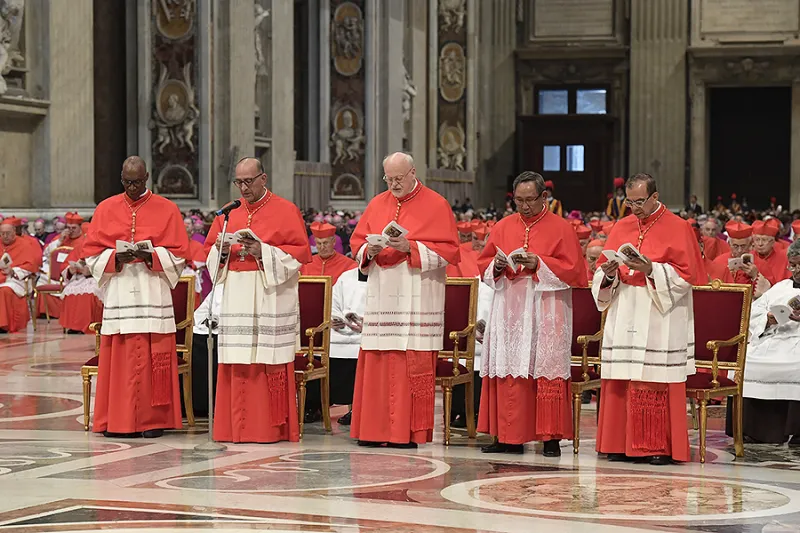
 Pope Francis creates five new cardinals during a consistory in St. Peter’s Basilica on June 28, 2017. / L’Osservatore Romano.
Vatican City, May 27, 2022 / 11:10 am (CNA).
Pope Francis could soon convene a consistory for the creation of new cardinals, taking the number of cardinals eligible to take part in a future conclave over the 120 limit established by Paul VI.
Rumors of a new consistory have multiplied in recent weeks because the new Vatican constitution Praedicate evangelium will come into force on June 5, the feast of Pentecost. Several new Vatican dicasteries will come into being that day and there is an expectation that their leaders will be named cardinals, though the constitution emphasizes that laypeople can lead certain departments.
Pope Francis has two options. He can wait until the end of the year, when the number of cardinal electors will drop to 110 and he will therefore have 10 slots available. Or he can convene a consistory on June 29, the feast of Sts. Peter and Paul. A consistory that day would, in all likelihood, take the number of cardinal electors over 120. But then their number is expected to drop in the following months.
The College of Cardinals currently has 117 cardinal electors. Of these, 12 were created by John Paul II, 38 by Benedict XVI, and 67 by Pope Francis. Cardinals created by Pope Francis account for 57% of the cardinal electors.
The last consistory creating new cardinals was on Nov. 28, 2020. Up to that point, Pope Francis had convened a consistory every year since 2014. But 2021 passed without the creation of new cardinals.
So far this year, four cardinal electors have already turned 80, and another six will do so before 2022 ends. The last will be Cardinal Oscar Andrés Rodriguez Maradiaga on Dec. 29.
Of these 10 cardinals, only four were created by Pope Francis. Therefore, if Pope Francis decided to name 10 new cardinal electors and return to the maximum limit of 120 electors established by Paul VI and confirmed by John Paul II, there would be 76 cardinals created by him in a possible conclave. That is to say, only four fewer than the 80 cardinals who represent the two-thirds of votes needed to elect a new pope.
Pope Francis has generally chosen candidates who are little known in the wider Church, with more pastoral than theological profiles, and with great attention to local churches that are considered marginalized, such as those in Tonga, Cape Verde, and the Central African Republic.
Any discussion of conclaves is, of course, speculative. It is not known who the cardinals will vote for. When they enter the Sistine Chapel, they are isolated, without the possibility of contact with the outside world. There, they ponder the choice of the next pontiff based more on pragmatic considerations than geopolitical ones.
But studying the composition of the College of Cardinals is still worthwhile. If nothing else, it allows us to understand what direction Pope Francis wants to give to the Church and bishops around the world.
Reviewing Pope Francis’ seven consistories creating new cardinals, three fundamental criteria can be distinguished.
The first is unpredictability. The second is a desire to expand the representation of the Church to the most remote and least Christian regions. The third is that at least one new cardinal should represent a connection to the past.
On the first point, Pope Francis has shown that he can choose anyone as a cardinal. But there are some figures who are more likely to receive red hats due to their positions at the Vatican. They include Archbishop Lazarus You Heung-sik, prefect of the Congregation for the Clergy, Archbishop Arthur Roche, prefect of the Congregation for Divine Worship, and Archbishop Fernando Vérgez Alzaga, president of the Governatorate of Vatican City State.
Then there are the less obvious possibilities. The number of Italian cardinals has consistently decreased under Pope Francis. Traditionally cardinalatial sees such as Naples, Palermo, Venice, Milan, and Turin are currently without a red hat. But the pope may opt for Archbishop Marco Tasca of Genoa, even though his predecessor, Cardinal Angelo Bagnasco, is still among the cardinal electors.
He might also reward Archbishop Gintaras Grušas of Vilnius, Lithuania, the president of the Council of European Bishops’ Conferences (CCEE).
Among the surprises, there could also be another Italian: Monsignor Pierangelo Sequeri, president of the John Paul II Pontifical Theological Institute for Marriage and Family Sciences. Sequeri is 77 years old and would therefore be a cardinal elector.
With the red hat, would Pope Francis somehow wish to bless the new direction of the institute named after the Polish pope but profoundly reshaped in recent years?
It is a hypothesis, as is a red hat for Archbishop Piero Marini, Master of Pontifical Liturgical Celebrations from 1987 to 2007 and, until this year, president of the Pontifical Committee for International Eucharistic Congresses.
Both Sequeri and Marini would arguably fit into the category of cardinals who represent a connection with the past. One would underline the new theological course under Pope Francis and the other the new liturgical line expressed most recently through the motu proprio Traditionis custodes.
A red hat for Marini, who was known for his progressive liturgical ideas during the pontificate of John Paul II, would say more than a thousand words about the direction that Pope Francis wants to give to the Church.
France could also gain a red hat. Apart from Cardinal Dominique Mamberti, prefect of the Supreme Tribunal of the Apostolic Signatura, Pope Francis has not placed a red hat on a French head since his election in 2013. With former Paris archbishop Cardinal André Vingt-Trois turning 80 on Nov. 7, and losing his right to vote in a conclave, there is a possible opening.
Spain currently has four cardinals: the archbishops of Madrid, Valencia, Barcelona, and Valladolid. Archbishop Francisco Cherro Chaves of Toledo, the Primate of Spain, is not a cardinal. But insiders think that is unlikely to change.
Looking at Europe, the absence of red hats in influential archdioceses such as Kraków, Poland, and Armagh, Northern Ireland, is striking.
Neither the United States nor Canada seems a likely destination for a new red hat. The U.S. already has six resident cardinal electors: Cardinal Blase Cupich of Chicago, Cardinal Daniel DiNardo of Galveston-Houston, Cardinal Timothy Dolan of New York, Cardinal Wilton Gregory of Washington, Cardinal Seán O’Malley of Boston, and Cardinal Joseph Tobin of Newark. There are three others in Rome: Cardinal Raymond Burke, Cardinal Kevin Farrell, and Cardinal James Harvey.
Canada, meanwhile, has two residential archbishops — Cardinal Thomas Collins of Toronto and Cardinal Gérald Lacroix of Quebec — and two curial cardinals, Cardinal Michael Czerny and Cardinal Marc Ouellet.
In Latin America, the pope is thought to be able to give the red hat to Archbishop Carlos Mattasoglio of Lima, Peru, and Archbishop Walmor Oliveira de Azevedo of Belo Horizonte, the president of Brazil’s bishops’ conference.
Africa is currently under-represented in the College of Cardinals (as well as among the heads of Vatican dicasteries) and three African cardinals turned 80 in 2021. Pope Francis could look to South Sudan, where he intends to visit in July. A possible candidate would be Archbishop Stephen Ameyu Martin Mulla of Juba.
But the pope might also gravitate toward Archbishop Benjamin Ndiaye of Dakar, Senegal, or Archbishop Siegfried Mandla Jwara of Durban, South Africa.
Australia does not currently have a cardinal elector, and the two most prominent names would be Archbishop Anthony Fisher of Sydney and Archbishop Peter Comensoli of Melbourne. But the possibility of a red hat for Archbishop Mark Coleridge of Brisbane should not be underestimated. Coleridge was until recently the president of the Australian bishops’ conference and was seemingly highly esteemed by Pope Francis during the 2015 family synod.
Oceania could also be rewarded with a cardinal, perhaps from Papua New Guinea, where the pope has indicated that he wants to travel.
Asia now has 15 cardinal electors and is probably unlikely to gain many more at a new consistory.
Yet geographical considerations could become irrelevant if Pope Francis decided to expand the number of cardinal electors. There is a precedent: With the consistory of Nov. 28, 2020, he exceeded the threshold of 120, reaching 128 cardinal electors.
When choosing new cardinals, the pope has tended to opt for candidates whom he trusts. But he has also sent signals about the direction of his governance. It is notable that since the beginning of his pontificate, the general secretary of the Synod of Bishops has been a cardinal (first Cardinal Lorenzo Baldisseri and now Cardinal Mario Grech.) This is a sign of how important the pope considers the Synod of Bishops to be.
When Czerny received the red hat, he was under-secretary of the Dicastery for Promoting Integral Human Development and responsible for Vatican policy on migrants and refugees. The gesture was a clear indication of the pope’s strong interest in the themes promoted by the dicastery.
And when it comes to Pope Francis’ choices, no signal should be underestimated.
[…]






Pope Francis says “homosexuality is a sin” but is pushing its legalization?
Pope Francis keeps allowing one James Martin to seduce him into these ideas?
Pope Francis and James Martin have a merit to hide who else is involved?
Pope Francis equates buggery with “sexual intercourse outside marriage”?
Pope Francis wants to make this into a “Magisterium” and into acts of piety?
The “conversational tone” of an interview makes up for what really should be taught but isn’t?
Pope Francis says if you do not join in you are Pelagian and/or Jansenist?
Pope Francis calls this clarification? …. when …. James Martin asked for it?
James Martin merits this welcome and specific clarification, but not the four cardinals who authored the dubia?
I think there’s an abiding ambiguity in the Pope’s thinking on the relationship between sin and culpability. According to the Church, my lack of full knowledge or deliberate consent may mitigate or nullify my culpability for an objectively disordered act, but this does not mean that the act is permissible for me even in a qualified or provisional sense, even for the sake of avoiding a greater evil.
Pope Francis suggests just the opposite in his response to the Argentine Bishops’ Letter, which argues I could discern that it is not presently possible for me to avoid sex outside marriage if to do so would lead to a greater sin, though it may become possible in the future with the help of grace. The issue here is not really a lack of full knowledge or deliberate consent. On the contrary, I have deliberated on my options, and have decided that it is necessary for me to consent to sex outside marriage in order to avoid some consequence that I judge to be a greater evil (e.g., subjecting my children to divorce, etc).
This is not the Church’s teaching. It is consequentialism with a smiling face. No matter how difficult my present circumstances may be, I can keep God’s law with the help of His grace. To say otherwise is not Christian mercy, but moral determinism. It is to strip us of agency and dignity, to deny the share Christ gives us in the victory of the Cross.
All this, of course, is old news, but it makes it difficult for me to take the Pope’s much-welcome correction of James Martin at face value. Francis tends to stretch the Church’s teaching on mitigated culpability from something like a distinction between degrees of murder to a distinction between murder and self-defense. If it is sometimes impossible for divorced and remarried couples to avoid sex outside marriage, and if we must treat all sexual sins alike, could it sometimes be impossible for gay couples too? If so, what is the point of re-affirming that homosexual acts are always sins?
“…of course, one must also consider the circumstances, which may decrease or eliminate fault.”
Yes, in individual cases, but from this will James Martin now manufacture the endorsement he needs to proclaim that LGBTQ as a category (!) is exempt from the natural law, the dubia and the Magisterium’s Veritatis Splendor?
What would such an endorsement mean when, instead, the homosexual tendency is triggered or locked in by early sexual abuse, by random sexual experimentation, by the trauma of absentee or abusive fathers, by cultural victimization? Ought the Church to truly affirm the victim persons and call for confronting and healing the entire package of such background abuses–at, say, the “aggregated, compiled and synthesized” Synod on Synodality? Fat chance. But perhaps James Martin will supply Cardinals Hollerich and Radcliffe with the needed wording!
But then there’s also the science–a literature review, plus the lab finding of a few genome “markers” of little explanatory value, and no gay gene:
One recent STUDY in the mix is a review of two hundred peer-reviewed studies on sexual orientation and gender identity. The conclusion: gender identity is not an innate, fixed property of human beings independent of biological sex (Mayer/McHugh, The New Atlantis: A Journal of Technology and Society, Ethics and Public Policy Center, No. 50, Fall 2016).
Other GENOME RESEARCH points to some genetic markers—it does not find a gay gene— and concludes that these markers do not account for same-sex behavior. https://news.yahoo.com/no-gay-gene-study-finds-180220669.html
Well to have clarified his remarks, although Pope Francis apparently doesn’t distinguish between sexual sins in the natural order, and those moral injustices that are a form of hostility to the natural order. Such are homosexual sins. Why the difference?
God ordained human sexual behavior exclusive to a man and woman. The sin then offends God as a sin outside marriage, and a sin against natural law. Also, the common opinion of late is that the predilection toward same sex is not sinful described as such ‘attraction’. The error in this while it’s apparently true that some have a deep seated same sex attraction that of itself may not be sinful -similarly, the historical evidence shows homosexuality behavior can be an acquired sexual dysfunction.
Francis clouds this distinction. That leads many to assume a form of liceity in that sodomy is no less grievous than natural sexual activity between a man and woman, adding to the willingness to engage in unnatural sex. As well as the Pontiff’s frequent admonition, this is how God made you, he loves you as you are. Hearing this from a pontiff weakens resistance to homosexuality, often for some encourages it.
Well said! The pope’s comment was rather shocking. As we read in scripture God condemns homosexuality which is an abomination to Him and for the pope to suggest that those who choose to disobey God should be given any consideration is wrong and speaks volume for a person in his position.
I could just imagine all the heads exploding in “America” offices all over the land as they hear Pope Francis saying that homosexuality is a SIN.
“He can’t say that!” they all cried out at once. James Martin swooned and had to be helped to the nearest fainting couch.
“We need to get him to issue a clarification right away” all the world’s Jesuits screamed in unison. “No one can know that homosexuality is sinful in any respect! We must have full papal approval of homosexuality, at least in the public mind!”
And so, Pope Francis did what he was told.
Pope Francis says “of course, one must also consider the circumstances which may decrease or eliminate fault.” The catechism, however, clearly states that homosexual acts “under no circumstances can they be approved.” The catechism makes things clear, the pope’s statement does not. Some could claim that love for a same sex partner eliminates the moral fault of homosexual acts,
Agreed. I posted a rather over-longish comment about this above.
Pax
Rene, this conflated concept of mitigation is the lever used in Amoris Laetitia to neutralize intrinsically evil acts. John Paul II warned not to make mitigation [in Amoris as you correctly note mitigating circumstances] a category, as a classification of moral acts. Grace is what’s absent in Ch 8 Amoris Laetitia, a surreptitious omission. When the Apostle Paul complained of Satan’s thorn in his side [Aquinas considered Paul’s affliction a moral temptation] Our Lord answered him, ‘My grace is sufficient. My power is perfected in weakness’.
Dear, dear Francis,
I stopped listening to anything you say or write a long, long time ago. Issue an encyclical or make pronouncements ex cathedra on a matter of faith and moral and then I’ll listen and obey. But your day to day remarks are not only confusing but you’re forever contradicting yourself.
Absolutely! Thank God that Francis hasn’t made any doctrinal ex cathedra edicts and pray that he doesn’t.
Up against the abyss, Pope Francis?
The Holy Spirit protects the Deposit of Faith.
I am deeply concerned over this pontiff and his comments.
I wish there was a way, outside of prayer, that we can address our concerns in a spirit of filial love and correction to this Holy Father, similar to St Paul’s rebuke of St Peter, or that of an adult son to his elderly father.
An interesting, albeit sad,turn of events. James Martin left his two audiences with Francis feeling encouraged and supported, probably due to his sense that the pontiff was on his side. But this is just another example of Francis doublespeak. Homosexual acts are sin. The church has taught this for centuries. There really is no need for clarification. Martin needs to either repent or be laicized.
I vote for laicization, as repentance seems to be off the table.
Last time I checked (okay, I never did, but still) mixing ammonia and bleach is not a crime, or even a sin as far as I know, but it is still an incredibly stupid thing to do, and carries with it the possibility of very, very scary breathing difficulties, if not death.
.
Maybe sodomy should be looked at that way. Not a crime, but incredibly stupid and harmful on many, many levels. Not something that can ever be approved of and should always and everywhere be discouraged–including in marriage–an institution that is exclusively between and man and woman.
A sound and sensible take on the issue.
These are not equal comparisons as mixing bleach & ammonia are not known from research or millenia of human experience to be a “dysfunctional behavior against Natural Law” – as IS sodomy and all homosexual sexual behaviors. The ramifications of homosexual sexual behaviors are immediately harmful both naturally & eternally to the people involved, and the consequences of harm and destruction from even one encounter can expand like an algae bloom in summer, and from the common on-going behavior (“gay culture”) explode with far-reaching and forever consequences like the radiation from nuclear explosion/melt-down.
A very good analogy there, the mixing of ammonia and bleach. Unfortunately, with sodomy some have apparently to learn the hard way or, worse yet, never do.
As soon as you read “Pope Francis clarifies comments” you know it is safe to stop reading.
You got it!
I get your point and agree in part. However, I’m not sure it’s ever safe. He is rather like the old uncle or grandpa who keeps coming to family reunions and embarrasses (almost) everyone with his inappropriate comments and behavior. It’s egregious stuff, but nobody seems to be able to stop him. So he keeps roiling things up and fouling the air until, finally, he falls asleep in a rocking chair. Then, then we have a moment of peace and sanity.
God said homosexuality is a sin both in the old and new testament LONG before any pope meekly mentioned it. It’s really sad that you all rely on a catechism made up by sinful men that doesn’t correspond exactly to God’s word. The world is watching as the Catholic church crumbles before their very eyes.
The Old and New Testaments were written by sinful men.
Inspired by the Holy Spirit
Still sinful (the men, that is).
Sinful men under the inspiration of the Holy Spirit so God’s word that the Catholic Church took liberty with and altered it to suit their purpose.
The Pope is implying the realities of voluntary and involuntary homosexuality. The former are sinful and the latter possibly not, as especially when in youth under non-cognitive exploration, a person discovers sexual response though no one taught him nor did one learn it from a source (i.e. ‘it just happened’). If one does not know, then culpability is indeed mitigated. But the one who has already gained full knowledge of disorder (has taken the eternal curriculum of heterosexuality and chastity) and acts out still, ‘will be severely beaten’, in consequence.
Dr/Fr Ripperger has covered this area called ‘involuntary vice’. But someone should write an entire book on this topic, because the tendency of the creature who has already voluntarily or involuntarily wired or configured his body to same-sex attraction (or any other disordered intoxication) preference, searches for every cognitive instance that will legitimize his configuration, to make licit the acting out in the preference. Addicts and compulsives do the same gymnastic of malaprop ‘understanding’ of commentary.
The pope is plying mercy to these vast grey areas, but unawake sinners/the misconfigured accept only what conforms to intoxication preference. Scripture often gets misinterpreted in the same way, in a twilight before facing the fact of disorder.
It is a very complicated area, arriving at actual moral culpability, because inner physical/psychological adolescent maturation often lacks guidance and occurs in total secrecy, and gets ‘locked’ into disordered patterns before cognition, reason or knowledge can undo them.
Conversion is a slow awakening to what got misconfigured, how it should have been configured, and where to get the desire to desist the old and find a home in the new: to change, to be reconfigured: redemption. For many it will take a lifetime of struggle to overcome the Beast who wants to gain the interior permanent upper hand. Which many do not want to make since the misconfiguration is not their fault and because there is deep unfortunate attachment to the intoxication preference.
These are some things the Pope could share with the press, which would have the impossible(!) effect of awakening, remorse, shock, release, amazement, understanding. That’s my prayer. Speak actual truth from the inner world of the sufferer, so he can come to freedom.
Very sad and disappointing that the Holy Father was so quick to clarify his comments in response to the inquiry of Fr. Martin; yet… 4 Cardinals of the Church asked for clarification of the Holy Fathers writings over 6 years ago (the dubia) and these have still not been addressed.
The lackadaisical “clarification” only compounded confusion about what constitutes a sin by persons experiencing same sex attraction. Sexual misbehavior is often a mortal sin, particularly such acts between persons of the same sex. While there are always mitigating circumstances, and only God can judge any particular soul, the Church should always strive to emphasize the “narrow gate” and that obstinate ignorance is not an excuse. Moreover, this would have been a most opportune occasion to strengthen the understanding of what is a God recognized marriage and Holy Matrimony. Instead we received a nuanced response from the Pope that “sex outside marriage” is a sin without soul saving instruction on either. Is there any wonder that Biden and Co Catholics may really believe that same sex “marriage” and funded abortion is supported by the Church?
Pope Francis said the homosexual act is not a crime. Well in some Muslim countries it is a crime.