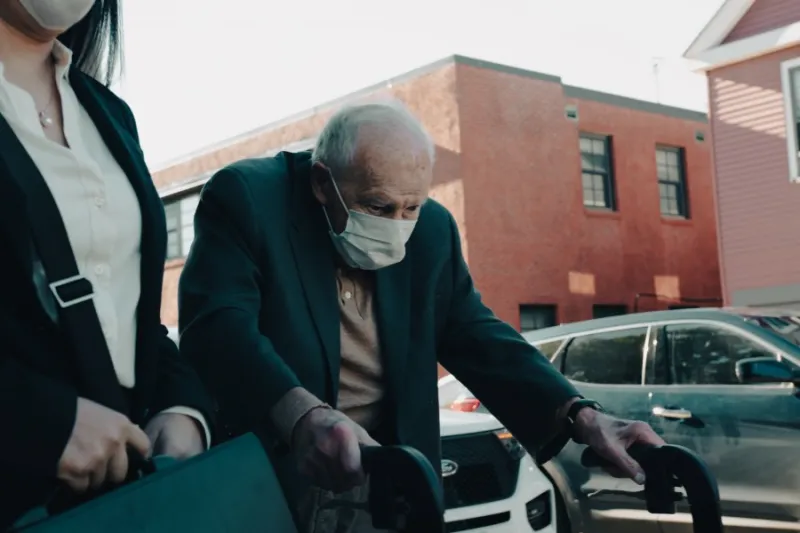
Theodore McCarrick outside Dedham District Court, Friday, Sept. 4, 2021. / Joe Bukuras/CNA
Dedham, Mass., Jan 17, 2023 / 16:43 pm (CNA).
Former cardinal Theodore McCarrick is in “significant” mental decline and may not be fit to stand trial for allegedly sexually abusing a 16-year-old boy, his attorneys say in a new court filing.
The legal team for the 92-year-old ex-prelate said it plans to file a motion to dismiss the case, citing a neurological exam conducted by Dr. David Schretlen, a professor of psychiatry and behavioral sciences at Johns Hopkins University School of Medicine. The exam took place on Dec. 5, 2022, at a facility in Missouri where McCarrick is living.
The results show McCarrick to be suffering from “significant neuropsychological deficits” that “appear to have started relatively recently, to be worsening rapidly, and to impair both Mr. McCarrick’s cognition and his memory,” according to the court document filed Jan. 13 in Dedham District Court in Massachusetts. A final report is expected within 30 days.
“Based on preliminary discussions with Dr. Schretlen, counsel have developed serious concerns that Mr. McCarrick may no longer be legally competent to stand trial, because he would be unable to assist meaningfully in the preparation of his own defense or to consult effectively with counsel during trial with a reasonable degree of rational understanding,” the court document states.
McCarrick hasn’t been seen publicly since his arraignment in Dedham on Sept. 3, 2021, when he pleaded not guilty to three counts of indecent assault and battery on a person over the age of 14. He appeared in frail condition that day, arriving at the courthouse wearing a mask and hunched over a walker. He made no comment either inside or outside the courthouse, where a demonstrator yelled, “Shame on you!” as McCarrick slowly walked past reporters and photographers alongside one of his attorneys.
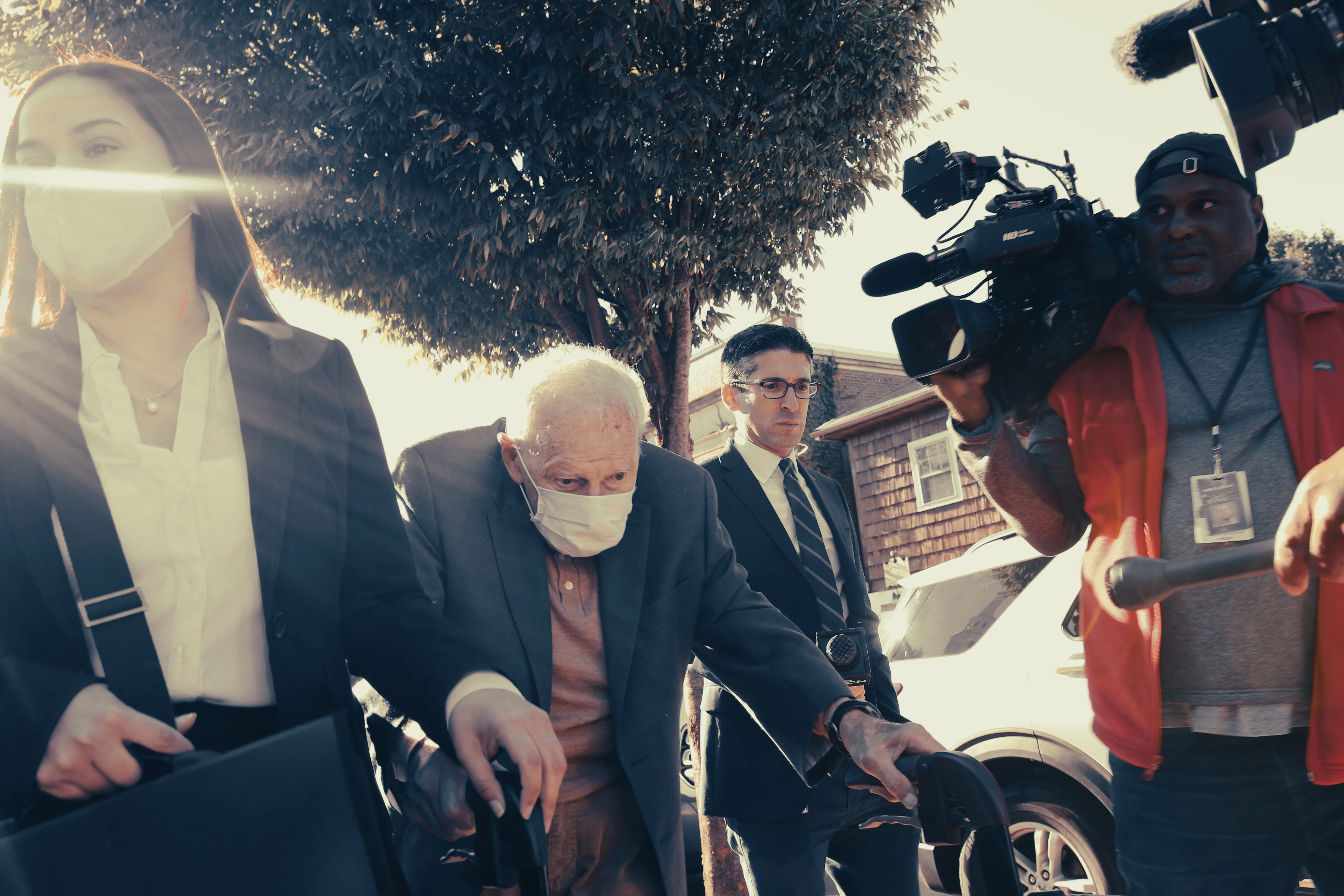
Theodore McCarrick arrives at Dedham District Court on Friday morning, Sept. 3 for his 9 a.m. arraignment. Joe Bukuras/CNA
In their court filing, McCarrick’s legal team also said it plans to argue that the charges should be dismissed “on the grounds that, in the unusual circumstances of this case, due process forbids his prosecution for misconduct that allegedly occurred 50 years ago.”
“Because the Commonwealth bears the burden to establish that Mr. McCarrick is, in fact, competent to stand trial … it will need adequate time to review the report from Dr. Schretlen and, if necessary, to engage its own expert to evaluate Mr. McCarrick,” the court document states.
McCarrick’s attorney Barry Coburn declined comment when reached by CNA Tuesday. McCarrick’s other attorney, Daniel Marx, was not immediately available for comment prior to publication.
If you value the news and views Catholic World Report provides, please consider donating to support our efforts. Your contribution will help us continue to make CWR available to all readers worldwide for free, without a subscription. Thank you for your generosity!
Click here for more information on donating to CWR. Click here to sign up for our newsletter.
Denver Newsroom, Nov 25, 2020 / 04:49 am (CNA).- A Philadelphia bishop last month blessed Saint Philomena Cottage, a new archdiocesan home for young adults with disabilities.
Auxiliary Bishop John McIntyre, who oversees the Secretariat for Catholic Human Services of the Archdiocese of Philadelphia, led the blessing Oct. 23 at the facility in Delaware County.
The event occurred a few months after new renovations permitted residence to three new clients who had difficulty finding a home that matched their complex needs.
Present at the event were James Amato, secretary for Catholic Human Services; members of The Women’s Auxiliary of St. Edmond’s Home for Children; and Denise Clofine, administrator for Saint Edmond’s Home for Children.
During the ceremony, Clofine expressed gratitude for the completion of the project and for the support of the Women’s Auxiliary, who helped fund the project.
“Today is the beginning of a long held dream to have a home like Saint Philomena Cottage where those we serve can continue to be with friends and staff who have become family. There is true love and compassion shared between the two,” she said, according to a Nov. 10 statement from the archdiocese.
“I am deeply grateful to the Women’s Auxiliary who exemplify a deep commitment to our mission. Sometimes in life we are fortunate to meet someone who makes a difference in the lives of others. I have been truly blessed to have met an entire group of women who exemplify dedication, care, and love. Their legacy is so very admirable.”
St. Edmond’s Home for Children purchased the house in November 2017. The house was renovated to include wheelchair accessible bathrooms, doorways, ramps, and elevator lifts.
The renovations were completed over the summer and three ladies from St. Edmond’s Home moved into their house at the end of July. The facility includes a 24-hour nurse and activities such as arts, crafts, cooking, and baking.
Clofine told CNA that it has been more difficult for clients with complex disabilities to find permanent homes after they turned 21. She said the facility was established at the request of parents, and added that families have formed meaningful bonds with the staff of St. Edmond’s Home for Children.
“They have trusted us with their children and their children have been placed [with us] for 10, 15, sometimes 20 years. To have to then take their child to another placement, it’s very, very difficult,” she said.
“We took our best staff – very committed, dedicated. We did not hire from the outside for this hall, [but moved] staff over to the hall who already knew those three young adults really well.”
Saint Edmond’s Home for Children was founded in 1916 by Archbishop Edmond Prendergast to help children with polio. It operates under Philadelphia’s Catholic Social Service and provides intermediate care for children and young adults with intellectual and physical disabilities.
Clofine expressed the importance of providing services to vulnerable individuals in the community. She said the Archdiocese of Philadelphia has a history of charitable service and further added that it was a blessing to open the facility during the pandemic.
“This really has made my whole year, especially in the midst of COVID, we were able to open. It was wonderful,” she said.
“It is our responsibility to do God’s work. It is extremely important to help the most vulnerable in our community … We’re just so thrilled to be able to do this not only for the three young ladies that are in the hall, but for their families,” she said.
Pope Francis opens the Holy Door in L’Aquila, Italy on Aug. 28, 2022. / Daniel Ibanez/CNA
Rome Newsroom, Aug 28, 2022 / 04:15 am (CNA).
Pope Francis became the first pope in 728 years to open the Holy Door of a 13th-century basilica in L’Aquila, Italy on Sunday.
During a visit to the Italian city located about 70 miles northeast of Rome on Aug. 28, the pope participated in a centuries-old tradition, the Celestinian Forgiveness, known in Italian as the Perdonanza Celestiniana.
The opening of the Holy Door marked a key moment in the annual celebration established by Pope Celestine V in 1294.
“For centuries L’Aquila has kept alive the gift that Pope Celestine V left it. It is the privilege of reminding everyone that with mercy, and only with it, the life of every man and woman can be lived with joy,” Pope Francis said in his homily during Mass at L’Aquila’s Basilica of Santa Maria di Collemaggio.
“To be forgiven is to experience here and now what comes closest to the resurrection. Forgiveness is passing from death to life, from the experience of anguish and guilt to that of freedom and joy. May this church always be a place where we can be reconciled, and experience that grace that puts us back on our feet and gives us another chance,” he said.
Pope Francis began the day trip at 7:50 a.m. traveling by helicopter from the Vatican to L’Aquila. He visited the city’s cathedral, which is still being rebuilt after it was badly damaged during a 2019 earthquake in which more than 300 people died.
The pope wore a hard hat while touring the reconstruction area of the damaged church. He spoke to family members of earthquake victims in the town square in front of the cathedral, where local prisoners were also present in the crowd. People cheered and waved Vatican flags as Pope Francis greeted them from a wheelchair.
Pope Francis wore a hard hat while visiting the L’Aquila cathedral, which was damaged by a 2019 earthquake. Vatican Media
Pope Francis said: “First of all I thank you for your witness of faith: despite the pain and loss, which belong to our faith as pilgrims, you have fixed your gaze on Christ, crucified and risen, who with his love redeemed the nonsense of pain and death.”
“And Jesus has placed you back in the arms of the Father, who does not let a tear fall in vain, not even one, but gathers them all in his merciful heart,” he added.
After speaking to the families of the victims, Pope Francis traveled in the popemobile to L’Aquila’s Basilica of Santa Maria di Collemaggio, where he celebrated an outdoor Mass, recited the Angelus, and opened the Holy Door.
In his brief Angelus message, the pope offered a prayer for the people of Pakistan, where flash floods have killed more than 1,000 people and displaced thousands more.
Pope Francis also asked for the intercession of the Virgin Mary to obtain “forgiveness and peace for the whole world,” mentioning Ukraine and all other places suffering from war.
Pope Francis prayed for peace in his Angelus address following Mass in L’Aquila, Italy. Pope Francis prayed for peace in his Angelus address following Mass in L’Aquila, Italy.
During his visit to L’Aquila, the pope said that he wanted the central Italian city to become a “capital of forgiveness, peace, and reconciliation.”
“This is how peace is built through forgiveness received and given,” he said.
L’Aquila is the burial place of Pope Celestine V, who led the Catholic Church for just five months before his resignation on Dec. 13, 1294. The pope, who was canonized in 1313, is buried in L’Aquila’s Basilica of Santa Maria di Collemaggio.
In the spring, the Vatican’s announcement that Pope Francis would visit L’Aquila prompted unsourced speculation that the trip could be the prelude to the 85-year-old pope’s resignation.
When Benedict XVI became the first pope to resign in almost 600 years in 2013, Vatican-watchers recalled that he had visited the tomb of Celestine V years earlier. During his trip on April 28, 2009, he left his pallium — the white wool vestment given to metropolitan archbishops — on the tomb. In hindsight, commentators suggested that Benedict was indicating his intention to resign.
In his homily in L’Aquila, Pope Francis praised Pope Celestine V for his humility and courage.
Mentioning Dante Alighieri’s description of Celestine as the man of “the great refusal,” Pope Francis underlined that Celestine should not be remembered as a man of “no” — for resigning the papacy — but as a man of “yes.”
Pope Francis said: “Indeed, there is no other way to accomplish God’s will than by assuming the strength of the humble, there is no other way. Precisely because they are so, the humble appear weak and losers in the eyes of men, but in reality they are the true winners, for they are the only ones who trust completely in the Lord and know his will.”
At the end of the Mass, the crowd prayed the Litany of Saints and watched as Pope Francis made history when he opened the basilica’s Holy Door. According to Cardinal Giuseppe Petrocchi of L’Aquila, Pope Francis is the first pope to open the Holy Door in 728 years.
Visiting cardinals have opened the Holy Door for the Celestinian Forgiveness in past years, after a reading of the bull of forgiveness by the local mayor. Celestine donated the papal bull to L’Aquila, where it is kept in an armored chapel in the tower of the town hall.
The bull of forgiveness drawn up by Celestine V offered a plenary indulgence to all who, having confessed and repented of their sins, go to the Basilica of Santa Maria di Collemaggio from Vespers on Aug. 28 to sunset on Aug. 29. A plenary indulgence is a grace granted by the Catholic Church through the merits of Jesus Christ, Mary, and all the saints to remove the temporal punishment due to sin.
Celestine’s indulgence was exceptional at the time, given it was available to anyone, regardless of status or wealth, and cost nothing except personal repentance at a time when indulgences were often tied to almsgiving.
Pope Francis prays at the tomb of Pope Celestine V in L’Aquila, Italy. Vatican Media
After opening the Holy Door, Pope Francis was wheeled through the basilica to the tomb of Pope Celestine V, where he spent a moment in silent prayer before the relics of his papal predecessor who was declared a saint in 1313.
“In the spirit of the world, which is dominated by pride, today’s Word of God invites us to be humble and meek. Humility does not consist in the devaluation of self, but rather in that healthy realism that makes us recognize our potential and also our miseries,” Pope Francis said.
“Starting precisely from our miseries, humility causes us to look away from ourselves and turn our gaze to God, the One who can do everything and also obtains for us what we cannot have on our own. ‘Everything is possible for those who believe (Mark 9:23).'”
Denver, Colo., Jun 22, 2023 / 11:55 am (CNA).
Sister Lucia dos Santos, one of the Fatima visionaries, just had her cause for sainthood advanced by Pope Francis on June 22. Jacinta and Francisco Marto, th… […]
Leave a Reply
