The pontiff’s Aug. 12 general audience focused on the importance of the liturgical year.
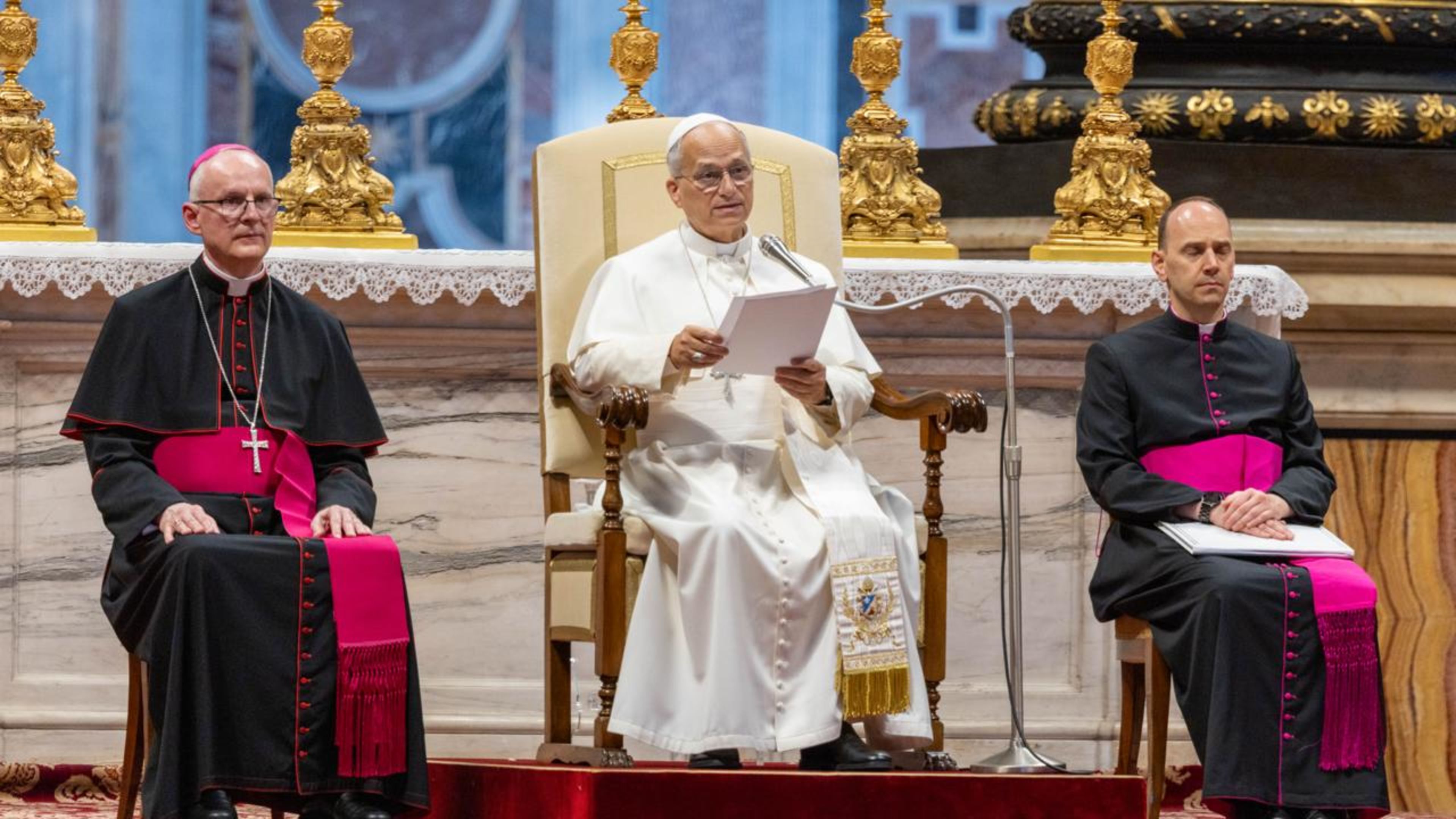
VATICAN CITY — Pope Leo XIV has urged Catholics to prioritize attending Sunday Mass, warning that active participation in the Eucharist cannot be replaced by virtual gatherings.
“I urge everyone to seek the best possible conditions so that even those who are unable to take time off work on Sundays may take part in Holy Mass,” Leo said.
In his address during his general audience at the Vatican on Aug. 12, the pontiff continued his catechesis on the Second Vatican Council’s constitution on the liturgy, Sacrosanctum Concilium.
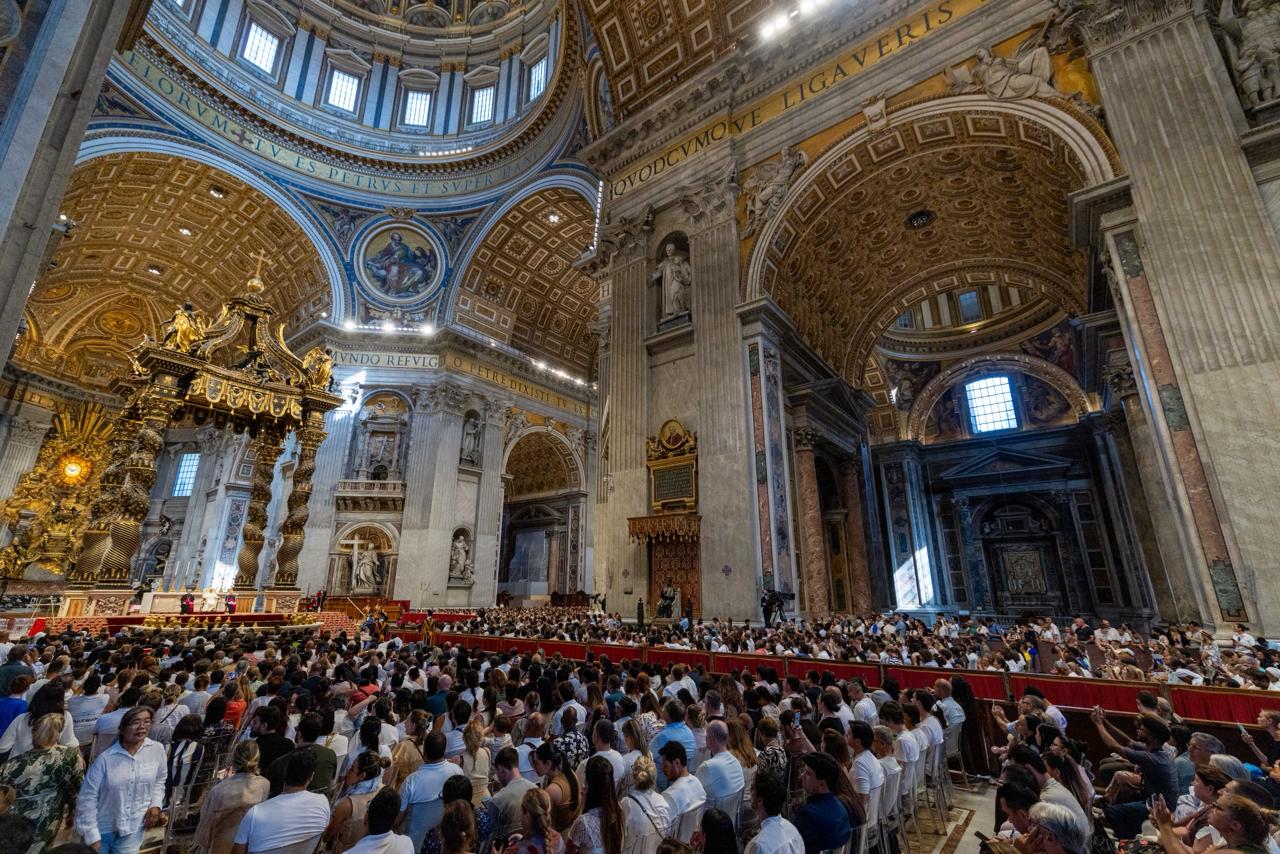
As on Aug. 5, his general audience was held inside St. Peter’s Basilica due to Rome’s high summer temperatures.
The liturgical year according to Pius XII and Prosper Guéranger
Leo explained the importance of the liturgical year, referencing his predecessor Venerable Pope Pius XII as well as Servant of God Abbot Prosper Guéranger, OSB, the first abbot of Solesmes Abbey in France and a key figure in the liturgical movement.
It is “important to note that this way of referring to the cycle of Christian feasts as the ‘liturgical year’ became widespread in ecclesiastical language thanks to the work of the Servant of God, Abbot Prosper Guéranger,” Leo said in his remarks.
The pope also stressed that the liturgical year is not merely a remembrance of past events but, as Pius XII wrote in his encyclical Mediator Dei, “Christ himself, who is ever living in his Church.”
“The liturgical year should thus be understood as a constant renewal of the work of salvation which Christ accomplishes in history,” the pope said. “As she journeys through this temporal cycle, the Church remains in contact with the Lord’s redemptive action, so that all the faithful may be filled with his grace.”
The importance of Sunday Mass
Leo also explained that the Church has always regarded Sunday as a weekly celebration of Christ’s Resurrection: the “dies Domini” (“the Lord’s Day”).
He urged Catholics to attend Sunday Mass and warned against using virtual gatherings to substitute for in-person attendance.
“To sanctify Sunday, it is essential to celebrate the Eucharist,” Leo said. “This
assembly cannot be substituted by a solely virtual presence, nor can it be reduced to a merely passive gathering.”
“The liturgical assembly is in fact fulfilled through the active participation of brothers and sisters,” Leo added.
Leo’s continued closeness to Colombia amid earthquake
The pope again expressed his spiritual closeness to the victims of a 7.4-magnitude earthquake that struck western Colombia on Aug. 10, which has killed at least 250 people, according to reports.
“As I pray to the Lord for the eternal rest of those who have died, I assure their families and those affected by this tragedy of my prayers. I express my gratitude to all those working in rescue and assistance efforts for those affected,” Leo said in Spanish.
The previous day, Aug. 11, the pope sent a telegram through Vatican Secretary of State Cardinal Pietro Parolin expressing his sorrow upon learning of the earthquake.
If you value the news and views Catholic World Report provides, please consider donating to support our efforts. Your contribution will help us continue to make CWR available to all readers worldwide for free, without a subscription. Thank you for your generosity!
Click here for more information on donating to CWR. Click here to sign up for our newsletter.


We read: “He urged Catholics to attend Sunday Mass and warned against using virtual gatherings to substitute for in-person attendance.”
That is, virtual gatherings are to the Eucharistic Church as AI algorithms are to reality.
Many in our parish are old.
Pope Leo XIV – Attendance at Sunday Mass cannot be replaced by virtual participation.
Who’s listening? VII taught us that Sunday Mass was optional.
“VII taught us that Sunday Mass was optional.”
Hmmm. Kind of similar to how VII taught Latin was bad and Gregorian chant had to go?
Cleo, kindly show me where and how Vatican II taught us that attending Sunday Mass was optional. Otherwise, your comment is a meaningless slander against an already valid council.
The Sunday Mass is a beautiful opportunity to commemorate together the life, death, and Resurrection of Jesus, the Prince of Peace and Nonviolence.
“Commemorate”?
The Catholic Mass cannot quite be fitted within the Hindu cosmos. Instead, “we all join in offering this Holy Sacrifice of the Mass, this unbloody renewal [!] and extension [!] of Christ’s [singular and ever present] Sacrifice on the Cross…”
This from Pope St. John Paul II’s PRAYER BEFORE MASS:
Eternal Father, we members of your blessed son Jesus Christ’s Mystical Body (His Church), in prayerful union with other members of His Church throughout the world, especially those who are suffering or living under oppression, and those who desire to go to Mass but are unable to do so; in spiritual communion with the intentions and affections of the Immaculate Heart of Our Lady of Sorrows on Calvary, the Angels and Saints in Heaven, our patron saints, our Guardian Angels—we all join in offering this Holy Sacrifice of the Mass, this unbloody renewal and extension of Christ’s Sacrifice on the Cross for the following intentions:
1) To adore and worship God the Father, God the Son, and God the Holy Spirit and to pledge our love and loyalty forever to the God who made us to Know, Love and Serve Him in this world and to be happy with Him forever in Heaven.
2) To thank Our Lord and Savior Jesus Christ for opening the gates of Heaven by His sacrificial death on Calvary and to thank God for all the blessings and graces He has bestowed upon us throughout our lives especially for the supernatural gifts of Faith, Hope, and Charity; those gifts of Truth, Love and Peace which Christ promised to leave with us.
3) We express our sorrow for having offended God in any way throughout our lives and offer our prayers, works, sufferings, joys and even ourselves, to the Eternal Father with this sacrifice of the Body, Blood, Soul and Divinity of His Dearly Beloved Son in atonement for our sins and those of the whole world.
4) Finally, we petition the Triune God for the Grace from this Eucharist to conform every conscious endeavor of our lives to the will of the Father in all things as did Christ. We also pray for all persons, places and things—absent, present, living and dead—for which we are bound in conscience or have expressed a desire to pray for, especially for an increase in vocations, for peace among nations, for the conversion of Russia and for the end of the unspeakable crime of abortion.
AMEN
Then the bishops should not have normalized it during Covid
Carl (8:54 a.m.)
The average Catholic learned very well the three lessons mentioned here that VII (never) taught.
I thank the Holy Father for his clear teaching on the Sunday obligation. Now I’m back to weeping for those poor German Catholics who are literally having their Mass taken by their own shepherds.
The Holy Father is clearly reinforcing the post-Vatican II party line.
V2 was all about “active” involvement in the liturgy by lay people. Quiet, attentive, prayerful participation, whether in person or online, is condemned as “passive”: a WORTHY celebration must be “active”. Mass is for extraverts, in other words.
But today’s world is overloaded with noise and activity, and a bit of quiet prayerfulness is just what it needs. We as Christians are supposed to be IN the world but not OF the world.
The Church lost obligatory Sunday Mass attendance for good when they stopped people from worship by closing churches during COVID. The Church does not do well when its decisions are knee-jerk reactions to apparent crises. Now try getting the toothpaste back in the tube.
I read about some people turned away without a vaccine card.
To be fair, in some places (like here in the UK) the government ordered churches to close during covid. In response, a young priest in my parish who was tech-savvy got a live stream set up on YouTube by the following Sunday while he said Mass in an empty church.
By doing so, he and others like him have started something truly wonderful with far-reaching implications. For now, the Church authorities are trying to resist. St Clare, patron saint of television, pray for us!