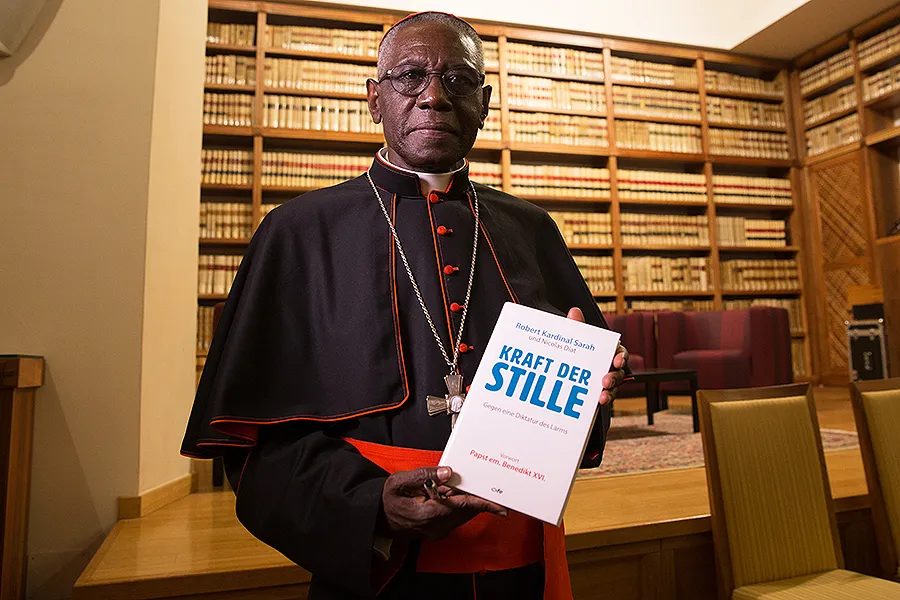
Vatican City, Mar 7, 2018 / 03:05 pm (CNA/EWTN News).- Cardinal Robert Sarah has authored a preface for a newly published book detailing the ascendancy, in the last 50 years, of the reception of Communion in the hand. He has been thanked for his efforts with at least one call for his removal from office. The flare-up offers an opportunity to look in greater detail at the history of the means of receiving Holy Communion.
Sarah, the prefect of the Congregation for Divine Worship and the Discipline of the Sacraments, wrote a preface to La distribuzione della Comunione sulla mano: Profili storici, giuridici e pastorali (The distribution of Communion in the hand: A historical, juridical, and pastoral profile) by Father Federico Bortoli, which was published recently by Edizioni Cantagalli.
The book notes that in 1969, following the Second Vatican Council, the Congregation for Divine Worship issued an instruction which expressed that Blessed Paul VI had determined not to change the means of administering Holy Communion to the faithful – i.e., to retain distribution of the Host on the tongue to those kneeling, rather than allowing communicants to receive the Host in their hands.
The instruction, Memoriale Domini, indicated that where distribution of communion in the hand already prevailed, episcopal conferences should weigh carefully whether special circumstances warranted reception of the Eucharist in the hand, avoiding disrespect or false opinions regarding the Eucharist and ill effects that might follow, and if a two-thirds voting majority decided in the affirmative, such a decision could be affirmed by the Holy See.
Despite this instruction, and subsequent expressions of support for the reception of Holy Communion on the tongue from St. John Paul II and Benedict XVI, the distribution of the Eucharist on the hand has become widely adopted, especially in the West.
The Congregation for Divine Worship’s 2004 instruction on matters regarding the Eucharist, Redemptionis sacramentum, established that: “Although each of the faithful always has the right to receive Holy Communion on the tongue, at his choice, if any communicant should wish to receive the Sacrament in the hand, in areas where the Bishops’ Conference with the recognitio of the Apostolic See has given permission, the sacred host is to be administered to him or her. However, special care should be taken to ensure that the host is consumed by the communicant in the presence of the minister, so that no one goes away carrying the Eucharistic species in his hand. If there is a risk of profanation, then Holy Communion should not be given in the hand to the faithful.”
And the General Instruction of the Roman Missal currently in force in the US simply states that “The consecrated host may be received either on the tongue or in the hand, at the discretion of each communicant.”
Using previously unpublished documentation, Bortoli’s work traces the dynamics which led to the present situation, and argues that reception of Holy Communion in the hand has contributed to a weakening of faith in the real presence of Christ in the Eucharist.
The text of Cardinal Sarah’s preface was published Feb. 22 by La Nuova Bussola Quotidiana, and portions were translated into English by Diane Montagna.
The cardinal wrote that the angel of peace who appeared at Fatima desired that the three children would make reparations for profanations of the Eucharist (such as desecration or sacrilegious reception — by those not in the state of grace or not professing the Catholic faith) and for all that can prevent the sacrament’s fruitfulness.
He then said that the “most insidious diabolical attack is trying to extinguish faith in the Eucharist, by sowing errors and fostering an unsuitable way of receiving it; truly the war between Michael and his Angels on one side, and lucifer on the other, continues in the hearts of the faithful: Satan’s target is the Sacrifice of the Mass and the Real Presence of Jesus in the consecrated Host.”
According to Cardinal Sarah, the demonic attack against the Eucharist follows two tracks: the reduction of the concept of the real presence, and an attempt to remove the sense of the sacred from the hearts of the faithful. He noted that a sense of the sacred can be lost by receiving special food in the same way as ordinary food.
The cardinal wrote that the liturgy “is made up of many small rituals and gestures — each of them is capable of expressing these attitudes filled with love, filial respect and adoration toward God. That is precisely why it is appropriate to promote the beauty, fittingness and pastoral value of a practice which developed during the long life and tradition of the Church, that is, the act of receiving Holy Communion on the tongue and kneeling.”
He pointed to the example of St. John Paul II, who always knelt before the Eucharist despite infirmity, and St. Teresa of Calcutta, who habitually received Communion on the tongue.
“Why do we insist on communicating standing and on the hand? Why this attitude of lack of submission to the signs of God? May no priest dare to impose his authority in this matter by refusing or mistreating those who wish to receive Communion kneeling and on the tongue,” the cardinal wrote. “Let us come as children and humbly receive the Body of Christ on our knees and on our tongue. The saints give us the example. They are the models to be imitated that God offers us!”
He noted that in the case of the distribution of Communion, “a special concession has become the picklock to force and empty the safe of the Church’s liturgical treasures.”
Noting that the process by which Communion in the hand has recently become common “was anything but clear,” he added that “The Lord leads the just along ‘straight paths’, not by subterfuge. Therefore, in addition to the theological motivations shown above, also the way in which the practice of Communion on the hand has spread appears to have been imposed not according to the ways of God.”
Cardinal Sarah voiced hope that Bortoli’s work would encourage both priests and laity who wish to administer or receive the Eucharist in the mouth and kneeling.
“I hope there can be a rediscovery and promotion of the beauty and pastoral value of this method. In my opinion and judgment, this is an important question on which the Church today must reflect. This is a further act of adoration and love that each of us can offer to Jesus Christ … May Fr. Bortoli’s work foster a general rethinking on the way Holy Communion is distributed.”
The cardinal did not propose to change the current ecclesiastical norms governing the reception of Holy Communion.
Nevertheless, writing at Commonweal Feb. 27, commentator Rita Ferrone responded to Cardinal Sarah’s preface by calling for his removal from office. She asserted that “what he really does best is sow division,” and characterized his writing as evaluating the reception of Communion in the hand “as pure evil.”
Ferrone claimed that the cardinal “manages to slander Christians of the first millennium who took communion in the hand regularly for at least nine hundred years” and that his comments “reveal either an appalling ignorance of or an indifference to liturgical history. Does he not know that this practice (standing and receiving in the hand) comes from the apostolic church? Does its venerable antiquity not commend the practice to him as holy, even though he prefers the more recent historical practice of receiving communion kneeling and on the tongue?”
While in in the earliest ages of the Church there are many writings which demonstrate that Communion was received in the hand (most notably St. Cyril of Jerusalem’s Mystagogical Catecheses), there are also early demonstrations of Communion on the tongue, as in the writings of St. Gregory the Great.
As Cardinal Sarah noted in his preface, communion on the tongue is “a practice which developed during the long life and tradition of the Church.” [emphasis added]
The prominent Jesuit liturgist Josef Jungmann wrote in The Mass of the Roman Rite that over time, “growing respect for the Eucharist … led to the practice of placing the Sacred Host in the mouth.”
Reception of Communion in the mouth was widely adopted around the ninth century, and Communion in the hand had disappeared entirely after the 10th and 11th centuries, according to Jungmann. This development removed the worry “that small particles of the sacred bread would be lost”, and the Jesuit wrote that it was probably related to the transition from leavened to unleavened bread.
By the end of the patristic age, the Church had abandoned the practice of Communion in the hand, having found that Communion in the mouth was a better expression of reverence for the Eucharist.
Of course, liturgical practices of the first millenium should not be revered simple because they are old.
In his 1947 encyclical Mediator Dei, Ven. Pius XII wrote that “it is neither wise nor laudable to reduce everything to antiquity by every possible device,” and that it is “obviously unwise and mistaken” to “go back to the rites and usage of antiquity, discarding the new patterns introduced by disposition of divine Providence to meet the changes of circumstances and situation.”
Another Catholic commentator, Fr. Anthony Ruff, OSB, wrote March 6 at the Pray Tell blog that Cardinal Sarah’s preface indicated that “his grasp of what has happened in eucharistic theology in the last 75 years is simply shocking.”
This commentary was a source of confusion for many, because recent magisterial teaching seems to support Cardinal Sarah’s position.
The Congregation for Divine Worship issued its instruction on Holy Communion, which decreed the retention of Communion on the tongue despite some calls for distribution in the hand, five years after the end of the Second Vatican Council, and during the pontificate of Blessed Paul VI.
“It is a matter of great concern to the Church that the Eucharist be celebrated and shared with the greatest dignity and fruitfulness. It preserves intact the already developed tradition which has come down to us,” Memoriale Domini stated. “The pages of history show that the celebration and the receptions of the Eucharist have taken various forms. In our own day the rites for the celebration of the Eucharist have been changed in many and important ways, bringing them more into line with modern man’s spiritual and psychological needs.”
It noted that “It is certainly true that ancient usage once allowed the faithful to take this divine food in their hands and to place it in their mouths themselves.”
But “Later, with a deepening understanding of the truth of the eucharistic mystery, of its power and of the presence of Christ in it, there came a greater feeling of reverence towards this sacrament and a deeper humility was felt to be demanded when receiving it. Thus the custom was established of the minister placing a particle of consecrated bread on the tongue of the communicant.”
“This method of distributing holy communion must be retained … not merely because it has many centuries of-tradition behind it, but especially because it expresses the faithful’s reverence for the Eucharist.”
The congregation also wrote that this traditional practice “ensures, more effectively, that holy communion is distributed with the proper respect, decorum and dignity. It removes the danger of profanation of the sacred species” and “it ensures that diligent carefulness about the fragments of consecrated bread which the Church has always recommended.”
They noted that “A change in a matter of such moment … does not merely affect discipline.”
“It carries certain dangers with it which may arise from the new manner of administering holy communion: the danger of a loss of reverence for the august sacrament of the altar, of profanation, of adulterating the true doctrine.”
When some bishops asked for permission for Communion in the hand, Bl. Paul VI sought the opinion of all the Church’s Roman rite bishops. Of those responding, 57 percent said that attention should not be paid to the desire for the reception of Communion on the hand. Of those bishops who were open to considering the practice, just over one-third had reservations about it.
And 60 percent of bishops did not even wish that Communion in the hand be experimented with in small communities. More than half did not believe the faithful would receive such a change gladly.
So, in 1969, in full consideration of Sacrosanctum Concilium, Bl. Paul VI “ decided not to change the existing way of administering holy communion to the faithful,” considering the remarks and advice of his fellow bishops, the gravity of the matter, and the force of the arguments against it.
The Pope who oversaw much of the Second Vatican Council, and who implemented its liturgical reform, was clearly concerned about the risks of disrespect and false opinions about the Eucharist which could arise from Communion in the hand. The Church’s norms have not shed that concern. Nor did Sarah’s pastoral reflections.
Benedict XVI was well-known for advocating something he called a “hermeneutic of reform” in theological conversation. He meant that historical memory should inform contemporary theological reflection. The alternative, he said, was something he called the “hermeneutic of discontinuity and rupture.”
If Cardinal Sarah, who is responsible for the regulation and promotion of the sacred liturgy, is impugned for raising the very objections against Communion in the hand which were raised by Paul VI fewer than 50 years ago, it’s worth considering whether the idea of the “hermeneutic of reform” has been rejected among Catholic intelligentia.
If nothing else, the affair reveals a very short historical memory among some members of the Catholic press.
It’s also worth noting the strength of the reaction to what Cardinal Sarah in fact wrote was largely a function of media distortion. Sarah is far from removing permissions for Communion in the hand. His stated desire is to foster the “rediscovery and promotion of the beauty and pastoral value” of Communion on the tongue.
The matter also demonstrates the degree to which reactionary Catholic media voices can enflame the kind of sensationalism they might otherwise criticize.
Cardinal Sarah won’t really be removed from his office for suggesting the value and beauty of, to borrow the words of Benedict XVI, “what earlier generations held as sacred.” But in this moment of ecclesial polarization, he will likely continue to be criticized.
 […]
[…]






It’s a papacy that is a mess..
Something Francis himself recommended… So he’s practicing what he preached… To the detriment of the entire Church…
In a normal world, Bergoglio and his coterie around the world would all be charged for crimes of violating ecclesiastical RICO laws.
This moral mess is beyond “replying to”. The”Sweet Christ”, the
Vicar of Christ on earth, is owed allegiance by all, “even if
he were the Devil incarnate” —(St.Catherine of Siena). So who,
except God, is above Pope Francis? That means the same people —
THAT’S US — who owe allegiance to Francis will REPLY BEST by non-stop “pray, penance, and almsgiving” . . and REPARATION, Eucharistic preferably, while suffering this Pontificate to its . . conclusion? . . or to the ushering in of the Anti-Christ?
Don’t confuse the forest for the trees or the trees for the forest…alas, if Sweet Truth be Love and Light:
Saint Catherine is even by this one article amply heard afresh divinely echoed:
Alas, alas, sweetest father mine, pardon my presumption in what I have said to you and am saying; I am constrained by the Sweet Primal Truth to say it. His will, father, is this, and thus demands of you. It demands that you execute justice on the abundance of many iniquities committed by those who are fed and pastured in the garden of Holy Church; declaring that brutes should not be fed with the food of men. Since He has given you authority and you have assumed it, you should use your virtue and power: and if you are not willing to use it, it would be better for you to resign what you have assumed; more honour to God and health to your soul would it be.
AAuthority also you have, to give peace to those who ask you for it. Then, since you are not poor but rich, you who bear in your hand the keys of Heaven, to whom you open it is open, and to whom you shut it is shut. If you do not do this, you would be rebuked by God. I, if I were in your place, should fear lest divine judgment come upon me. Therefore I beg you most gently on behalf of Christ crucified to be obedient to the will of God, for I know that you want and desire no other thing than to do His will, that this sharp rebuke fall not upon you : “Cursed be thou, for the time and the strength entrusted to thee thou hast not used.”
Blessings of Christ’sMass!
Thank you, God bless!
Let’s not forget that St. Catherine of Siena also reprimanded the very same pope and declared that if he did not get his act together for the sake of the unity of the Church, it would be better that he resign lest he face the wrath of God. We should be asking Heaven to send us a holy prophet to hold this bad pope accountable.
Saint Catherine of Siena, Letter to Pope Gregory XI:
Alas, alas, sweetest father mine, pardon my presumption in what I have said to you and am saying; I am constrained by the Sweet Primal Truth to say it. His will, father, is this, and thus demands of you. It demands that you execute justice on the abundance of many iniquities committed by those who are fed and pastured in the garden of Holy Church; declaring that brutes should not be fed with the food of men. Since He has given you authority and you have assumed it, you should use your virtue and power: and if you are not willing to use it, it would be better for you to resign what you have assumed; more honour to God and health to your soul would it be.
Authority also you have, to give peace to those who ask you for it. Then, since you are not poor but rich, you who bear in your hand the keys of Heaven, to whom you open it is open, and to whom you shut it is shut. If you do not do this, you would be rebuked by God. I, if I were in your place, should fear lest divine judgment come upon me. Therefore I beg you most gently on behalf of Christ crucified to be obedient to the will of God, for I know that you want and desire no other thing than to do His will, that this sharp rebuke fall not upon you : “Cursed be thou, for the time and the strength entrusted to thee thou hast not used.”
In truth, we owe allegiance to no one but God and his glorified Son, Jesus Christ. How many Popes have been corrupt over the centuries? Far more than the ones that weren’t. Trust nothing but the word of God. The Church since the early centuries has been led by fallible humans all susceptible to temptation and corruption. Many have lived up to their human failings.
The big problem with the Catholic Church is that there is no good way to address corruption in the hierarchy. If the Bishops/Cardinals/Pope become corrupt, our answer is to do…nothing! Because, you know, somehow even the corrupt clergy are so high above us that we are not worthy to stop them from destroying the Church from the inside. Right?
To this I say “Balderdash!” It is this mentality which causes corruption which just doesn’t last days/weeks/months — but years, decades and CENTURIES.
Shame on the laity for tolerating corruption in the clergy. Shame on the laity for deifying the clergy and making them incapable of taking correction by anybody but other clergy or Death.
When I see this mindset, from good people no less, I honestly have to say, “Thank God for the Protestants.”
“The big problem with the Catholic Church is that there is no good way to address corruption in the hierarchy.”
Yes, there is: expose it.
“When I see this mindset, from good people no less, I honestly have to say, ‘Thank God for the Protestants.'”
There are a host of problems with corruption and abuse among Protestant groups. And most are even less effective at dealing with said problems than are Catholics.
Carl, I appreciate the work you do and have for many years. I also appreciate your commentary and exposure of the problems in the Church.
BUT, and this is a big BUT, we are waaaaaaayyyyyy beyond just exposing corruption/weakness in the Church and hoping the exposed parties shape up or other parties rise up to take action.
In a way, our problem in the American Church mirrors our problem in American politics: The good people are not willing to stand up and fight the bad guys in such a way that hurts them much, and the bad guys have figured that out. Figured that out and become bolder…
The problem is, indeed, the people in power. But an equally-big problem is that we are not man enough to stand up to them or somehow feel we don’t have the “authority” to do so. Nothing changes until the people in power feel more pain than they feel now.
https://www.pillarcatholic.com/the-complex-case-of-fr-marko-rupnik-untangled/ –
Another seemingly more balanced / truthful view above – unsure if the priest has only been accused of misbehavior so far .. when there are also motives of money on the victim side and realms of spiritual warfare on both sides –
https://www.catholicexorcism.org/post/exorcist-diary-221-it-s-all-good-father
The just and merciful means to deal with it all – may be far more complex …
do families that have history of sins against marriage / life be precluded from all related realms for the rest of their lives …having means of just and merciful means esp. in vigorous measures of prevention too for those who seem esp. harshly treated – such as the priests …
Hearing about the traffic snafus in the nation causing problems in many families – ? need to also see same as effect of the cold heartedness of the head of the related Dept.,in being an unholy example of what a family is to be !
More than laws, more insight and means into the spiritual realms such as in the ministry of exrocism , The Precious Blood and Divine Will devotions …. the Holy Father is doing his share of same in ways that meet the needs of our times -esp. the catechetical lessons including warnings about polite demons and spiritual worldliness and all – seeing money and political power as more than The Spirit -may the ears and hearts be open to same !
Oh please. When you lack real moral and spiritual wisdom, it is easy to pretend to have it by condemning the old standbys, violence and love of money. When has Francis ever demonstrated actual wisdom on sexual ethics? When has he even drawn a connection between abortion and the sloppy moral standards of the sex revolution? On the contrary, he condemns concern for the first as an “obsession” and has cast doubt whether “below the belt” matters are even sinful.
“Fr. Rupnik’s Jesuit superiors reportedly heard the allegations against him more than twenty years ago, but either turned a blind eye or actively covered for their guy, whose fame was growing and whose stock was high in the papal apartments.”
In fairness; I could imagine the difficulty Jesuits would have believing that one of their members had illicit carnal appetites directed to women.
😂😟🤬
😂🤣
Not familiar with MarksmanRuperstiltickel’s mosaics, I turned to Google. I discovered that Jimmy Martin did a little write-up about Marko Rupnik for America ragazine in 2009. Jimmy featured Rupnik in a video and a photo gallery. Guess what? Both have now disappeared. Like a magic show of smoke and mirrors. Pooph. With a wave of the hand, they’re gone.
/www.americamagazine.org/issue/682/100/mosaics-marko-rupnik
I’m curious; how many mosaics feature three eyes between two beings? Mr. Altieri writes that the Vatican ‘turned a blind eye’ to Rupnik’s exposing his misdeeds to those with eyes that see.
Harsh yet, justified criticism of Papa is not something that CWR doesn’t want to attend to! While it is to be respected, those who love the church need to be heard.
Luke 17:3 Pay attention to yourselves! If your brother sins, rebuke him, and if he repents, forgive him,
2 Timothy 3:16 All Scripture is breathed out by God and profitable for teaching, for reproof, for correction, and for training in righteousness,
1 Corinthians 13:6 It does not rejoice at wrongdoing, but rejoices with the truth.
Matthew 23:1-Then Jesus said to the crowds and to his disciples, “The scribes and the Pharisees sit on Moses’ seat, so do and observe whatever they tell you, but not the works they do. For they preach, but do not practice. They tie up heavy burdens, hard to bear, and lay them on people’s shoulders, but they themselves are not willing to move them with their finger. They do all their deeds to be seen by others. For they make their phylacteries broad and their fringes long, …
I’m not sure what you mean by: “criticism of Papa is not something that CWR doesn’t want to attend to”
Dear Merion:
Thank you for drawing attention to a rather awkward remark! It does happen to yours truly, more than I might wish!
God bless you in your efforts to proclaim righteousness clothed with common sense.
Yours in Christ,
Brian
Altieri is right in respect to the inviolability of papal authority, that this preeminence in the Church cannot be judged – although this judgment has two distinct meanings.
First. We cannot judge the pontiff’s authority, by negation of that authority. Second. We can judge the benevolent or detrimental use of that authority. As we find in the references here to St Catherine of Siena.
For examples, we may criticize Francis’ refusal to reply to the Dubia. We cannot prosecute him for that refusal. Similarly, many strongly criticized Francis, and rightly so for his refusal to respond to Archbishop Carlo Maria Viganò’s allegations regarding his knowledge of the McCarrick dossier. We cannot censure him for refusing.
There is a misunderstanding among pious laity who contend that inviolability of pontifical preeminence raises a pontiff, Francis, above any reproach. That a pontiff even if he makes an inadvertent blunder, misguided statement is so inviolable to evil that he cannot be the cause of evil taking hold among the faithful. That’s the issue argued at length in the recent Feser article, When do popes teach infallibly?. That query infers whether God would permit a pontiff to misguide the Church outside of his ex Cathedra infallible office. That’s an issue that previously didn’t seem possible until 2013. Nevertheless, we cannot fully know the mind of God. The Aryan heresy though virtually universal addressed a single theological doctrine that was beyond the comprehension of the vast majority of Christians. Practice of the faith remained relatively intact. Whereas today there’s virtually total reevaluation of Catholic Christian doctrine. A significant error was addressed by me in Dr Feser’s article, the doctrine on worthy reception of the Holy Eucharist.
Archbishop Cordileone banned Nancy Pelosi from receiving the Holy Eucharist May 20. June 29 Pope Francis published his Apostolic Letter Desiderio desideravi, “To be admitted to the feast all that is required is the wedding garment of faith which comes from the hearing of his Word.” Francis had previously criticized the Archbishop for not being pastorally sensitive, standing by previous comments that no one should be denied the Eucharist.
This is a public declaration that repudiates Catholic doctrine requiring confession and repentance for serious sin prior to receiving the Eucharist. Doctrine that reaches back to the Apostle Paul who instructed the faithful, “Whoever eats the bread or drinks the cup of the Lord unworthily will have to answer for the body and blood of the Lord. Everyone ought to examine themselves before they eat of the bread and drink from the cup. For those who eat and drink without discerning the body of Christ eat and drink judgment on themselves” (1 Cor 11:26-27).
Wearing the wedding garment is more than belief. The virgins who were left outside in the dark believed, although did not practice the faith sufficiently. Wearing the garment refers to a real faith that lives the commandments.