


Rome Newsroom, Nov 24, 2022 / 06:40 am (CNA).
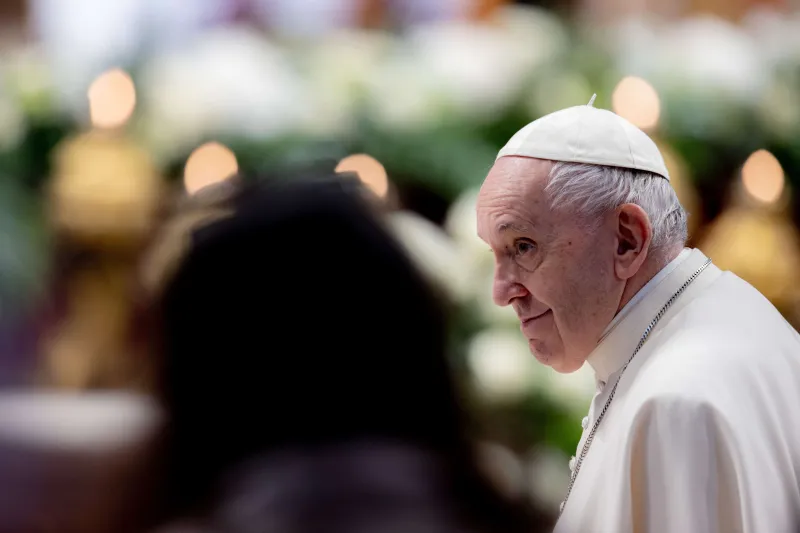
Pope Francis on Thursday distinguished between how catechists and theologians interact with Church teaching.
A theologian, he said, has a vocation to go beyond existing doctrine, because “he is trying to make theology more explicit.”
While a catechist, when instructing children and adults in the faith, “must give the correct doctrine, solid doctrine.”
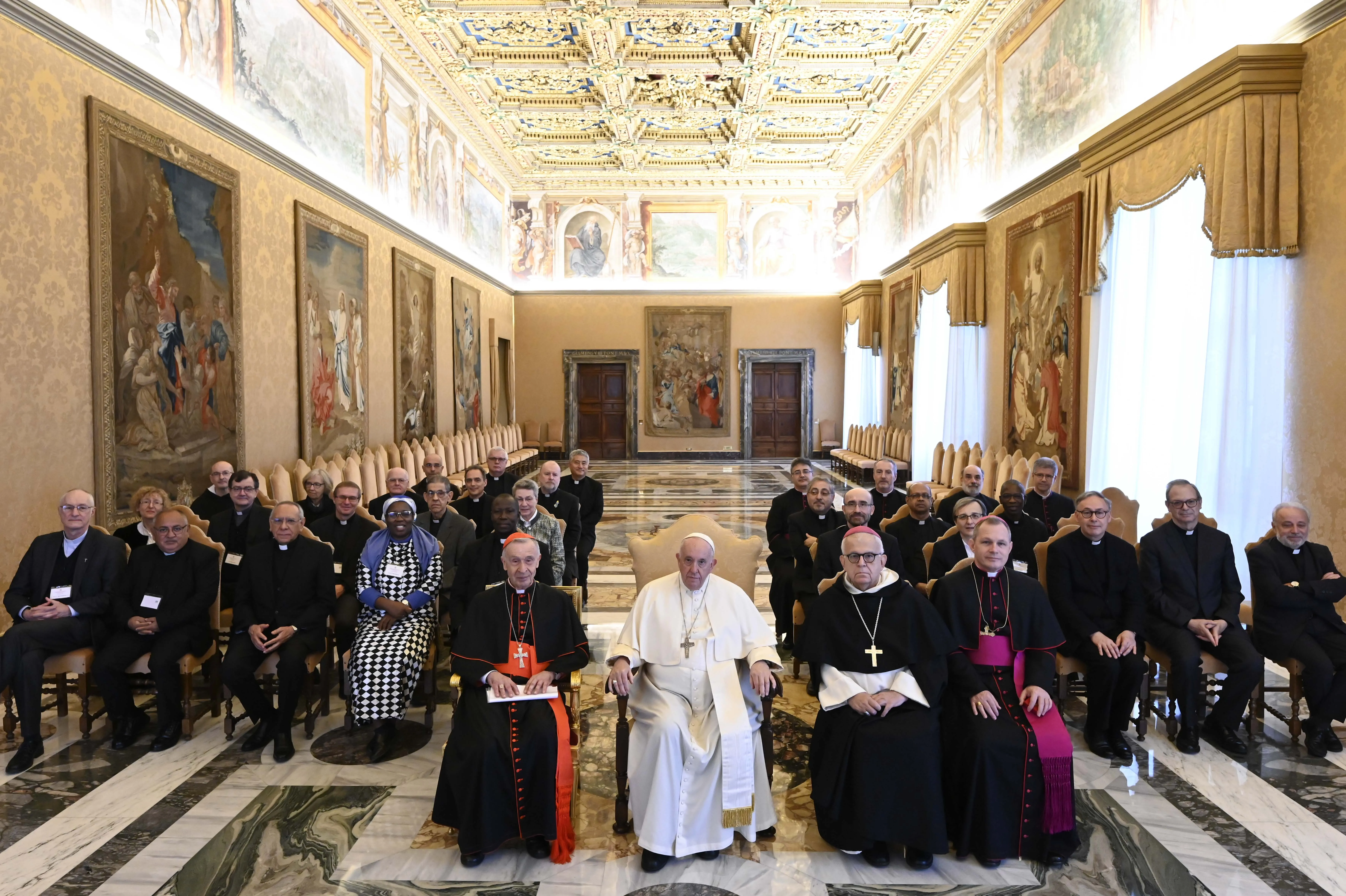
Pope Francis’ comments on the role of the theologian and the catechist were made in a meeting with the prestigious International Theological Commission (ITC) at the Vatican Nov. 24.
The International Theological Commission exists under and to advise the Vatican’s Dicastery for the Doctrine of the Faith. Members are appointed by the pope for five-year terms, during which time particular theological questions are studied and the results published.
The 10th commission, which has 28 members, was appointed in 2021.
“Theologians must go further, try to go beyond,” the pope said in his remarks to the commission. “But I want to distinguish this from the catechist: the catechist must give the correct doctrine, solid doctrine; not the possible new things, of which some are good…”
“The catechist teaches the solid doctrine,” he continued, adding that the theologian “ventures to go further, and it is the magisterium that will stop him.”
“But never [teach catechism] to children and people with new doctrines that are not certain,” he said.
Francis explained that this distinction comes from St. Ignatius of Loyola, “who I think understood something better than I do.”
The International Theological Commission is at the Vatican this week for the group’s annual plenary meeting.
Pope Francis expressed his appreciation for the commission’s willingness to explore three themes during its meetings.
The first, he said, is the “relevance of the fruitfulness of the Christological faith professed by the Council of Nicaea, at the completion of 1,700 years since its celebration.”
The commission will also examine some anthropological issues relevant today “and of crucial significance for the journey of the human family, in light of the divine plan of salvation.”
Pope Francis did not say which specific “anthropological issues” the theological commission will be studying.
The third theme the commission will deepen is “the theology of creation from a Trinitarian perspective, listening to the cry of the poor and the earth,” he said.
Two U.S. theologians are among the ITC’s members.
Robin Darling Young, a spirituality professor, and Reinhard Huetter, a theology professor, both teach at the Catholic University of America in Washington, D.C.
A French-American, Father Etienne Emmanuel Vetö, is also a member. He teaches theology at the Pontifical Gregorian University in Rome.
Marianne Schlosser, a well-known German theologian, and recipient of the 2018 Ratzinger Prize, has been a member of the commission since 2014.
If you value the news and views Catholic World Report provides, please consider donating to support our efforts. Your contribution will help us continue to make CWR available to all readers worldwide for free, without a subscription. Thank you for your generosity!
Click here for more information on donating to CWR. Click here to sign up for our newsletter.


We read that the three themes to be explored by the International Theological Commission are Nicaea, a Trinitarian theology of creation, and yet-undefined “anthropological issues.”
Regarding the possible anthropological issues, Three points:
FIRST, we at least have an encouraging clue from Cardinal Parolin: “I am very sorry for the loss of faith in our Europe, in our culture, in our countries, and these anthropological changes that are taking place, losing the identity of the human person” (https://www.catholicnewsagency.com/news/247167/cardinal-parolin-i-am-sad-to-see-the-loss-of-faith-and-reason-in-europe)
SECOND, a cry in the wilderness, this, as it is set aside by synodality’s Cardinal Hollerich: “I believe that the sociological-scientific foundation of this teaching [on sexual morality] is no longer true [….] I think it’s time we make a fundamental revision of the doctrine” (https://www.aol.com/news/liberal-cardinal-calls-revised-catholic-135429645-181222377.html). So much for Christian anthropology!
Will catechists and theologians “not walk together” on their diverging anthropological paths? Will the (bigoted and rigid?) catechists of, say, Veritatis Splendor and moral absolutes be ever more eclipsed by an ambulatory plebiscite “combined, aggregated and synthesized” by synod-ism—-with the process itself as THE message? Will even Nicaea be insinuated more as a procedural synodal artifact?
THIRD, will the Church deal coherently with the “anthropological-cultural change” (Parolin, a few years back) of the day, as more clearly articulated by Cardinal O’Malley: “The amazing thing is that historically the Church was persecuted mostly for the truths that we taught concerning Christ and the Church. The controversies were Arianism [Nicaea], transubstantiation or papal infallibility. Today, the attacks directed at the Church are directed at our teaching concerning the dignity of the human person, the sacredness of life and the importance of marriage…” (Cardinal O’Malley, National Prayer Breakfast, May 13, 2014).
What about consistency and clarity in both doctrine and theology (Vincent of Lerins, and Cardinal Newman!) about the human person and, say, binary/complementary human sexuality. Also “walking together” with the timeless wisdom of St. John Chrysostom: “The road to Hell is paved with the bones of priests and monks, and the skulls of bishops are the lamp posts that light the path.”
“The road to Hell is paved with the bones of priests and monks, and the skulls of bishops are the lamp posts that light the path.”
That would be, in essence, unfaithful priests, monks, and bishops, as we can know through both Faith and reason that The Faithful, those who remain in communion with Christ and His One, Holy, Catholic, And Apostolic Church, Through The Unity Of The Holy Ghost (Filioque), affirm The Word Of God in regards to sexual morality, and thus respect The Sanctity of the marital act within The Sacrament Of Holy Matrimony, and respect the inherent equal Dignity of every beloved son and daughter from the moment of conception to natural death.
“It is not possible to have Sacramental Communion without Ecclesial Communion”, due to The Unity Of The Holy Ghost” (Filioque), For “It Is Through Christ, With Christ, And In Christ, In The Unity Of The Holy Ghost”, that Holy Mother Church, outside of which there is no Salvation, due to The Unity Of The Holy Ghost (Filioque ) exists.
Pray for our Holy Father, Pope Benedict XVI, who has not rejected The Gift Of The Holy Ghost in regards to Papal
Infallibility and The Deposit Of Faith.
“For the Holy Spirit was not promised to the successors of Peter that by His revelation they might make known new doctrine, but that by His assistance they might inviolably keep and faithfully expound the Revelation, the Deposit of Faith, delivered through the Apostles. “
I’ll ask Francis his thoughts on whether it will rain next Wednesday.
Catechists have been literally holding the fort or forts. The Good News is evolving all the time. Conversion is an ongoing and a never ending process. It are the theologians who are yet to do justice to their enormous potential.
There is a distinct absence here of addressing reality.
Inter-disciplinarity in the natural sciences allows them to work alongside each other without confusion.
Trans-disciplinarity is a ceature of Modernism that penetrates among disciplines to recreate out of them and channel (the Postmodern) meta-narratives.
Again I say the use of the word “indietrism” is misleading; since the Modernist initiative/engagement is a subtle indoctrinating and mediated shifting into extreme pluralisms.
It is truly alarming that the Holy Father, who has the duty and the commission to teach and to warn, could just “appropriate” a word without proper contextualization except to blame rigidity and blame being backward-looking.
You have to read the entire LIFESITE article by Michael Haynes, “Pope tells theologians to consult ‘non-Catholics,’ avoid ‘going backward’ in Tradition”.
‘ The Pope spoke of the “appropriateness – in order to carry out with pertinence and incisiveness the work of deepening and inculturation of the Gospel – to open prudently to the contribution of the different disciplines through the consultation of experts, including non-Catholics, as provided for in the Statutes of the Commission.”
In this manner the theologians could practice “transdisciplinarity,” he said, suggesting that by consulting non-Catholics the theologians could draw from their knowledge as it comes from the “Light and Life offered by the Wisdom streaming from God’s Revelation.”
While he urged catechists to “give the right doctrine,” Francis told the ITC to “go further” than the “solid doctrine” as the magisterium will assume the role of informing the theologians when they have gone too far. ‘
https://www.lifesitenews.com/news/pope-tells-theologians-to-consult-non-catholics-avoid-going-backward-in-tradition/?utm_source=top_news&utm_campaign=usa
Here at ZENIT English you find the transcript of what the Holy Father said. According to this translation, he promotes transdisciplinarity as the “strong form” on inter-disciplinarity whereas multi-disciplinarity is the latter’s “weak form”. He claims here he is underlining and propelling what he put forth in Veritatis Gaudium.
But in Veritatis Gaudium transcript at VATICAN.VA, he discusses multi-disciplinarity, inter-disciplinarity and cross-disciplinarity; where in fact he had never mentioned trans-disciplinarity. He is confirming that transdisciplinarity is what he intentionally meant – as “streaming from the Light and Life of God’s Revelation”.
Before now November 2022, how could anyone have uncovered that?
lt is just wrong, even the secular scientists, sociologists and philosophers, acknowledge transdisciplinarity as Modernism.
If the Holy Father aims to “redeem transdisciplinarity” he at least must admit it is Modernism and he must assert he is doing so.
Also the best definition anyone can give to cross-disciplinarity is, as to having 2 or more qualifications in different fields whether as specialist or general practitioner.
Veritatis Gaudium is supposed to be an apostolic constitution.
https://zenit.org/2022/11/26/popes-three-guidelines-to-the-international-theological-commission/
https://www.vatican.va/content/francesco/en/apost_constitutions/documents/papa-francesco_costituzione-ap_20171208_veritatis-gaudium.html
Yes, what might be the difference, if any, between the generic mindsets of “transdisciplinarity” and transgender?
Fr. Hunwicke’s December 1 2022 page has some remarks shared about indietrism.
FSSPX NEWS has some complaints and observations about “overabundant communication”.
These are hard times for clergy, for sure. May I offer a recommendation? To guard the heart in charity, humility and piety. And if you would accept it from me I would add my request for you to remember me in such prayers, as those, of your own.
God bless you.
https://liturgicalnotes.blogspot.com/2022/12/indietrism-again.html
https://fsspx.news/en/news-events/news/how-explain-pope-francis%E2%80%99s-overabundant-communications-2-76087
https://fsspx.news/en/news-events/news/how-explain-pope-franciss-overabundant-communications-1-76063
While at this present moment the VATICAN.VA/SANTA SEDE website is mostly inaccessible, you can still search directly for Veritatis Gaudium and get the English posting of it at VATICAN.VA.
Begging pardon for making this too simplistic, but part of the scientific method is looking back to find new things, or to relocate something properly, or to gain an understanding that has slipped, or to trace the course of a transmission and pinpoint a beginning, or just to learn what one didn’t yet know, etc.
I went “looking back” on the internet and I found that by early 2021 the Redemptorists had already explicitly opted for methodological trans-disciplinarity in their approach to moral theology. Now it could be this got rooted much earlier, from the private audience they had with the Holy Father 2 years before in February 2019, on the 70th anniversary of the Alfonsian Academy.
See the second link, CSSR NEWS, “Towards a Transdisciplinary Approach”.
Did they themselves translate “cross-disciplinarity” as “trans-disciplinarity”? Or did the Holy Father already tip them off to do it that way? Actually in the report they expressly quote from the Holy Father about “designing bold steps”.
It’s not lengthy and I believe it should be read. Are any other religious pursuing the same or similar “developments”? Is any particular congregation in the lead?
https://www.vatican.va/content/francesco/en/apost_constitutions/documents/papa-francesco_costituzione-ap_20171208_veritatis-gaudium.html
https://www.cssr.news/2021/02/towards-a-transdisciplinary-approach-to-moral-theology/