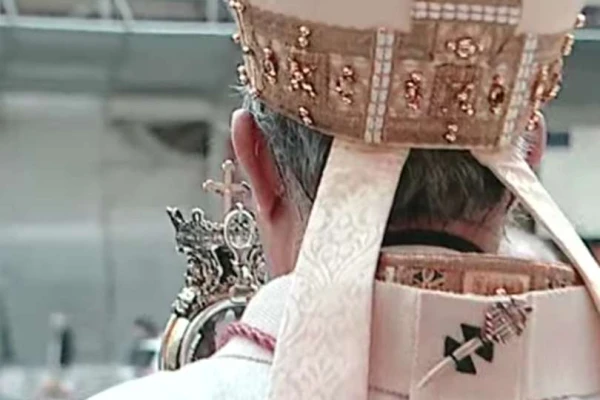
Bishop Georg Bätzing / Photo credit: Synodaler Weg / Maximilian von Lachner
CNA Newsroom, Sep 27, 2022 / 12:33 pm (CNA).
The president of the German Bishops’ Conference, Bishop Georg Bätzing, said that the shortest definition of religion is “interruption,” and that some forms of continuity people seek from religion are “frankly suspect.”
Bätzing spoke in a live-streamed Mass on Tuesday on the occasion of the bishops’ plenary assembly, which is being held in the central German town of Dulda from Sept. 26–29, reported CNA Deutsch, CNA’s German-language news partner.
In his homily the bishop of Limburg said, “all too surely asserted continuities, i.e., seamless connections according to the motto ‘that has always been so; that has always been believed so; what was wrong yesterday cannot be right today’ … are frankly suspect.”
Bätzing spoke of the “great images in which God’s people spelled out their historical experiences with faith and recognized God’s guidance in them.”
The German prelate, who expressed his disappointment in Pope Francis in May, said it was indeed “in our human nature to seek bridges between yesterday and tomorrow, to draw temporal lines and discover meaningful connections — which is often only possible in retrospect. We seek continuity. But the shortest definition of religion is and remains ‘interruption,’ as Johann Baptist Metz put it.”
Metz was an influential German priest and theologian who died in 2019.
This year’s fall plenary meeting of the German bishops is overshadowed by the recent turbulent meeting of the Synodal Way and the abuse report in the Osnabrück diocese with strongly incriminating statements about Bishop Franz-Josef Bode.
Bode announced he refused to resign despite a report published Sept. 20 saying he mishandled abuse cases.
The 71-year-old bishop has been vice president of the German bishops’ conference since 2017. He is also vice president of the German Synodal Way.
He has publicly supported women deacons and the development of a Church ceremony for blessing same-sex unions. At the latest meeting of the Synodal Way, participants voted to change the Church’s teaching on a number of related topics, including homosexuality and the ordination of women.
If you value the news and views Catholic World Report provides, please consider donating to support our efforts. Your contribution will help us continue to make CWR available to all readers worldwide for free, without a subscription. Thank you for your generosity!
Click here for more information on donating to CWR. Click here to sign up for our newsletter.
Pope Francis prays in front of the tomb of St. Mark the Evangelist inside St. Mark’s Basilica in Venice on April 28, 2024. / Credit: Daniel Ibañez/CNA
Rome Newsroom, Apr 28, 2024 / 09:35 am (CNA).
Pope Francis had a full slate of events Sunday during his day trip to Venice, a trip that tied together a message of unity and fraternity with the artistic patrimony of a city that has been a privileged place of encounter across the centuries.
“Faith in Jesus, the bond with him, does not imprison our freedom. On the contrary, it opens us to receive the sap of God’s love, which multiplies our joy, takes care of us like a skilled vintner, and brings forth shoots even when the soil of our life becomes arid,” the pope said to over 10,000 pilgrims gathered in St. Mark’s Square.
Framing his homily during the Mass on the theme of unity, one of the central points articulated throughout several audiences spread across the morning, Pope Francis reminded Christians: “Remaining united to Christ, we can bring the fruits of the Gospel into the reality we inhabit.”
Pope Francis delivers his homily during Mass in St. Mark’s Square in Venice, Italy, on April 28, 2024. Credit: Daniel Ibañez/CNA
“Fruits of justice and peace, fruits of solidarity and mutual care, carefully-made choices to preserve our environmental and human heritage,” the pope continued, seated center stage in a red velvet chair and vested in a white cope.
Pope Francis arrived in Venice early Sunday morning for a day trip to the prestigious Biennale art exhibition — which is celebrating its 60th anniversary — where the Holy See’s pavilion, titled “With My Eyes,” dovetails with this year’s broader theme: “Foreigners Everywhere.”
The pope’s visit also holds a deep meaning as Francis is the first pontiff to visit the Biennale — where the Vatican has held a pavilion since 2013.
In his homily, Pope Francis pointed out that our relationship with Christ is not “static” but an invitation to “grow in relationship with him, to converse with him, to embrace his word, to follow him on the path of the kingdom of God.”
Francis built upon this point to encourage “Christian communities, neighborhoods, and cities to become welcoming, inclusive, and hospitable places,” a point he linked to the image of the city of Venice as a “a place of encounter and cultural exchange.”
Pope Francis greets youth gathered in St. Mark’s Square during his visit to Venice, Italy, on April 28, 2024. Credit: Daniel Ibañez/CNA
Pope Francis observed that Venice “is called to be a sign of beauty available to all, starting with the last, a sign of fraternity and care for our common home,” the pope continued, highlighting the tenuous situation of Venice, a UNESCO World Heritage Site, which faces a myriad of problems ranging from excessive tourism to environmental challenges such as rising sea levels and erosion.
After the recitation of the Regina Caeli, the pope entered St. Mark’s Basilica to venerate the relics of the evangelist before leaving by helicopter to return to the Vatican as pilgrims and tourists bid farewell from land and sea.
Earlier in the morning the Holy Father met with female inmates, staff, and volunteers at Venice’s Women’s Prison on the Island of Giudecca, where he spoke on the topic of human dignity, suggesting that prison can “mark the beginning of something new, through the rediscovery of the unsuspected beauty in us and in others.“
The deeply symbolic visit was followed by a brief encounter with the artists responsible for the Holy See’s pavilion at the Biennale, where the pope encouraged artists to use their craft “to rid the world of the senseless and by now empty oppositions that seek to gain ground in racism, in xenophobia, in inequality, in ecological imbalance and aporophobia, that terrible neologism that means ‘fear of the poor.’”
The Holy Father traveled by a private vaporetto, or waterbus, bearing the two-tone flag of Vatican City, to the 16th-century baroque Basilica of Santa Maria della Salute, which sits on the Punta della Dogana, where he met with a large group of young people.
Reflecting on the visit as a “beautiful moment of encounter,” the pope encouraged the youth to “rise from sadness to lift our gaze upward.”
“Rise to stand in front of life, not to sit on the couch. Arise to say, ‘Here I am!’ to the Lord, who believes in us.” Building on this message of hope, which the pope emphasized is built upon perseverance, telling them “don’t isolate yourself” but “seek others, experience God together, find a group to walk with so you don’t grow tired.”
Pope Francis arrives outside St. Mark’s Basilica in Venice, Italy, on April 28, 2024. Credit: Daniel Ibañez/CNA
The pope made his way to St. Mark’s Square in a white open-top golf cart bearing the papal seal, where he closed his visit with Mass. At the end of the Mass Archbishop Francesco Moraglia, the patriarch of Venice, thanked the pope for his visit.
“Venice is a stupendous, fragile, unique city and has always been a bridge between East and West, a crossroads of peoples, cultures, and different faiths,” Moraglia noted.
“For this reason, in Venice, the great themes of your encyclicals — Fratelli Tutti and Laudato Si’ — are promptly reflected in respect and care for creation and the person, starting with the good summit of life that must always be respected and loved, especially when it is fragile and asks to be welcomed.”
Pope Francis blesses the crowds in St. Peter’s Square after praying the Angelus on July 2, 2023. / Vatican Media
Vatican City, Jul 2, 2023 / 05:30 am (CNA).
Every baptized person is called to be a modern-day prophet, living as a witness of Jesus to others, Pope Francis said on Sunday.
In his Angelus address July 2, the pope recalled that at our baptism, each of us received “the gift of the prophetic mission.”
The pope, addressing an estimated 15,000 pilgrims and tourists gathered in St. Peter’s Square, said a prophet is not a kind of magician who can tell the future.
“This is a superstitious idea and a Christian does not believe in superstitions, such as magic, tarot cards, horoscopes and other similar things,” he said, lamenting that “many, many Christians go to have their palms read.”
“A prophet is a living sign who points God out to others, a prophet is a reflection of Christ’s light on the path of his brothers and sisters,” he explained, inviting everyone to ask themselves: “Do I live as a witness of Jesus?”
“Do I bring a little bit of his light into the life of another person? Do I evaluate myself on this? I ask myself: What is my bearing witness like, what is my prophecy like?” he said.
Pope Francis gave his weekly Sunday address, and recited the Marian prayer the Angelus, from a window of the Apostolic Palace.
He said not only are each of the baptized called to be prophetic witnesses of Christ, they also should welcome other Christians in their identity as prophets.
“It is important to welcome each other as such, as bearers of God’s message, each one according to his state and vocation, and to do it right where we live — that is, in the family, in the parish, in the religious community, in other places in the Church and in society,” he said.
“The Spirit,” he added, “has distributed gifts of prophecy in the holy People of God. This is why it is good to listen to everyone.”
His advice for making an important decision is to pray about it first of all and to call on the Holy Spirit.
“But then listen and dialogue trusting that each person, even the littlest, has something important to say, a prophetic gift to share,” Francis said. “Thus, the truth is sought and the climate of listening to God and our brothers and sisters is spread…”
People should feel accepted and valued because they are gifts, he said, not only because they say what we like to hear.
Pope Francis said we could avoid or resolve a lot of conflicts by listening to others with the desire to understand.
“So, finally, let us ask ourselves: Do I know how to welcome my brothers and sisters as prophetic gifts?” he said. “Do I believe that I need them? Do I listen to them respectfully, with the desire to learn? Because each of us needs to learn from others.”
After praying the Angelus, Pope Francis recalled the importance of continuing to pray for peace around the world.
“Even in this summer time, let us not tire of praying for peace, in a special way for the Ukrainian people, [who are] so worn out.”
“And let us not neglect the other wars, unfortunately often forgotten,” he added, “and the numerous conflicts and clashes that bloody many places on earth.”
“Let us take an interest in what is happening, let us help those who are suffering, and let us pray, for prayer is the gentle force that protects and sustains the world,” he concluded.
London, England, Jun 15, 2021 / 06:05 am (CNA).
A record number of abortions took place in England and Wales in 2020, according to new statistics.The figures, released June 10, showed that there were 210,860 abo… […]
3 Comments
We read: “…Bishop Georg Bätzing, said that the shortest definition of religion is ‘interruption,’ and that some forms of continuity people seek from religion are ‘frankly suspect.’”
The man is a mental midget: First, he discounts the radical difference between ‘religion’ as a system of belief, and Christian “faith” in the actual person of Jesus Christ, Second Person of the self-disclosing Triune God. And, Second, he muddles the very singular event of this historical Incarnation… which is, yes, a discontinuity, but also and more so, a continuity (with the anticipatory revelation to the Chosen People; otherwise, Montanism).
Worse than “suspect,” then, is inventive disruption by supposed Successors of the Apostles, who would paper over the uniquely-singular “interruption” in all of human history—”Jesus Christ, the same yesterday, today and forever” (Heb 13:8). Emeritus Pope Benedict XVI does allow, of course, for discontinuity…but he is theologically precise, and therefore pastoral (!), by specifying “discontinuity WITHIN continuity.” Not much room there for the magic tricks conjured up by the sin-nod in post-Catholic and now post-Christian Germania.
The siren call of constantly regressive change is the most rigid and deepest rut of all.
Well, it seems that the “Communion of Saints”, which is about the continuity of belief and unity among the faithful has been dumped.
The communion of saints (communio sanctorum), when referred to persons, is the spiritual union of the members of the Christian Church, living and the dead, but excluding the damned. They are all part of a single “mystical body”, with Christ as the head, in which each member contributes to the good of all and shares in the welfare of all.
The communion of saints exists in the three states of the Church, the Churches Militant, Penitent, and Triumphant. The Church Militant (Latin: Ecclesia militans) consists of those alive on earth; the Church Penitent (Latin: Ecclesia poenitens) consists of those undergoing purification in purgatory in preparation for heaven; and the Church Triumphant (Latin: Ecclesia triumphans) consisting of those already in heaven.
It looks as though this has now been replaced by a new doctrine of divine “interruption”!
We read: “…Bishop Georg Bätzing, said that the shortest definition of religion is ‘interruption,’ and that some forms of continuity people seek from religion are ‘frankly suspect.’”
The man is a mental midget: First, he discounts the radical difference between ‘religion’ as a system of belief, and Christian “faith” in the actual person of Jesus Christ, Second Person of the self-disclosing Triune God. And, Second, he muddles the very singular event of this historical Incarnation… which is, yes, a discontinuity, but also and more so, a continuity (with the anticipatory revelation to the Chosen People; otherwise, Montanism).
Worse than “suspect,” then, is inventive disruption by supposed Successors of the Apostles, who would paper over the uniquely-singular “interruption” in all of human history—”Jesus Christ, the same yesterday, today and forever” (Heb 13:8). Emeritus Pope Benedict XVI does allow, of course, for discontinuity…but he is theologically precise, and therefore pastoral (!), by specifying “discontinuity WITHIN continuity.” Not much room there for the magic tricks conjured up by the sin-nod in post-Catholic and now post-Christian Germania.
The siren call of constantly regressive change is the most rigid and deepest rut of all.
Well, it seems that the “Communion of Saints”, which is about the continuity of belief and unity among the faithful has been dumped.
The communion of saints (communio sanctorum), when referred to persons, is the spiritual union of the members of the Christian Church, living and the dead, but excluding the damned. They are all part of a single “mystical body”, with Christ as the head, in which each member contributes to the good of all and shares in the welfare of all.
The communion of saints exists in the three states of the Church, the Churches Militant, Penitent, and Triumphant. The Church Militant (Latin: Ecclesia militans) consists of those alive on earth; the Church Penitent (Latin: Ecclesia poenitens) consists of those undergoing purification in purgatory in preparation for heaven; and the Church Triumphant (Latin: Ecclesia triumphans) consisting of those already in heaven.
It looks as though this has now been replaced by a new doctrine of divine “interruption”!
Huh?