


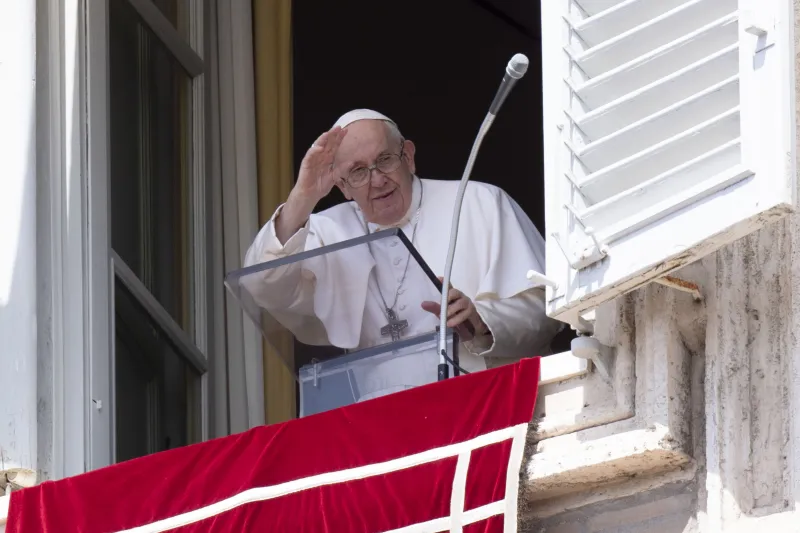
Vatican City, Sep 18, 2022 / 04:35 am (CNA).
Pope Francis said Sunday that Christians should not become discouraged or remain indifferent to stories of corruption, but instead “be creative in doing good with prudence.”
Speaking from the window of the Apostolic Palace, the pope said in his Angelus address on Sept. 18 that people can “start to complain and play the victim” in times of crisis, even in the Church.
“Brothers and sisters … in our world today there are stories of corruption like in the Gospel: dishonest conduct, unfair policies, selfishness that dominates the choices of individuals and institutions, and many other murky situations. But we Christians are not allowed to become discouraged, or worse, to let go of things, remaining indifferent,” Pope Francis said.
“On the contrary, we are called to be creative in doing good with prudence and the cleverness of the Gospel, using the goods of this world, not only material but all the gifts we have received from the Lord, not to enrich ourselves, but to generate fraternal love and social fellowship.”
The pope’s comments on corruption were inspired by a parable in Sunday’s Gospel in the Church’s liturgical calendar, Luke 16:1-13, a reading that the pope admitted can be difficult to understand at first glance.
Pope Francis said: “Jesus tells the story about corruption: a dishonest manager who steals and then after being discovered by his master, acts shrewdly to get out of the situation. We ask ourselves: what is this shrewdness about … and what does Jesus want to tell us?”
“Jesus uses this story as a way to put before us a provocation when he says: ‘The children of this age are more shrewd in dealing with their own generation than are the children of light.’”
Pope Francis commented that those who live by “certain worldly standards” today seem to know how to get by even when in trouble, while Christians can sometimes be “naive, not knowing how to take the initiative to find ways out of difficulties.”
“I am thinking of times of personal or social crisis, but also Church crisis: sometimes we give in to discouragement or we start to complain and play the victim. Instead, Jesus says we can also be clever according to the Gospel, awake and alert to discern reality and be creative to find good solutions for us and others,” he said.
Before praying the Angelus prayer with the crowd gathered in St. Peter’s Square, Pope Francis encouraged people to remember: “To inherit eternal life then, there is no need to accumulate goods in this world, but what matters is the charity we have lived in our fraternal relationships.”
The pope prayed for people in Ukraine and all victims of war. He said that he was sorry to hear about the fighting in Armenia on the border with Azerbaijan and is praying for a ceasefire.
“Let us pray to the Blessed Virgin Mary so that she may help us be like herself, poor in spirit and rich in mutual love,” he said.
If you value the news and views Catholic World Report provides, please consider donating to support our efforts. Your contribution will help us continue to make CWR available to all readers worldwide for free, without a subscription. Thank you for your generosity!
Click here for more information on donating to CWR. Click here to sign up for our newsletter.



Spreading the Good News is an effective way to combat corruption.
Indeed! God bless you.
All good points from the Holy Father. And, here’s another “clever” Gospel thought about corruption, as a cross-cultural phenomenon….if the German “synodal path” is still “Catholic,” then Islam is still “a religion of peace.”
But, the fly in the ointment, however, is the “wrong turn” taken by Muhammad himself after he had lost the clan protection against the culture of tribal blood-feud vengeance—that is, after the natural deaths of both his protective uncle and his wife who was fairly well-positioned in Meccan high society. His flight to Medina (the Hejira, 622 A.D.) marks a paradigm shift (!) within/from original Islam. It replaced the peaceful period of Islam with the later defensive/expansive and jihadist period, beginning in the last ten years of Muhammad’s life (d. 632 A.D.).
Within Islam and the Qur’an, the unresolved retention of this contradiction is defended as “abrogation.”
Today, in Germania, has a parallel “wrong turn” and recent paradigm shift (!) come when the Council and then the Church’s restorative leadership under Pope St. John Paul II and Benedict were replaced by the feuding Germanic tribe of Kasper/Marx/Batzing (and Hollerich)? And, by their synodal dismantling of the “real” Second Vatican Council (of the Documents) with the virtual “spirit of the council” and worse?
Within the Church, now, Cardinal Roche even brands the Novus Ordo (and the entire Tradition associated with it?) as not only an imperfect but still a grounded “development” but, in his words, as an “abrogation” (!). More unifying (and less Islamic) parsing of events seems not too much to ask within the perennial and Eucharistic Church.
During his tenure, Papa has generated a good deal of controversy on a wide range of topics. To his credit, he has said it is acceptable to criticize the pope. Ye t some comments are over the top, for example the following:
“A submission from Maryland, U.S. says the name Bergoglio means “Antichrist”.”
This however, is quite uncalled for!
Instead, let us pray for Papa!
“Pope Francis said Sunday that Christians should not become discouraged or remain indifferent to stories of corruption, but instead “be creative in doing good with prudence.”
Divine Mercy in My Soul, 1556
My daughter, tell souls that I am giving them My mercy as a defense. I Myself am fighting for them and am bearing the just anger of My Father.
Luke 16:1 The Parable of the Dishonest Steward.
I have seen these “Dishonest Stewards”! I have actually even done business with them. They are our precious Catholic Priests.
If you have a debt to God, in which you could never in a septillion lifetimes repay, go visit your local Catholic Priest, he will work something out for you.
“And the master commended that dishonest steward for acting prudently”
Divine Mercy in My Soul, 1448
Tell souls where they are to look for solace; that is, in the Tribunal of Mercy (the Sacrament of Reconciliation). There the greatest miracles take place (and) incessantly repeated. To avail oneself of this miracle, it is not necessary to go on a great pilgrimage or to carry out some external ceremony; it suffices to come with faith to the feet of My representative and to reveal to him one’s misery, and the miracle of Divine Mercy will be fully demonstrated. Were a soul like a decaying corpse so that from a human standpoint, there would be no (hope of) restoration and everything would already be lost, it is not so with God. The miracle of Divine Mercy restores that soul in full. Oh, how miserable are those who do not take advantage of the miracle of God’s mercy! You will call out in vain, but it will be too late.
Divine Mercy in My Soul, 699
I desire that the Feast of Mercy be a refuge and shelter for all souls, and especially for poor sinners. On that day the very depths of My tender mercy are open. I pour out a whole ocean of graces upon those souls who approach the fount of My mercy. The soul that will go to Confession and receive Holy Communion shall obtain complete forgiveness of sins and punishment. On that day all the divine floodgates through which grace flow are opened. Let no soul fear to draw near to Me, even though its sins be as scarlet.
Divine Mercy in my Soul, 635, The Blessed Virgin Mary :
you have to speak to the world about His great mercy and prepare the world for the Second Coming of Him who will come, not as a merciful Savior, but as a just Judge. Oh, how terrible is that day! Determined is the day of justice, the day of divine wrath. The angels tremble before it. Speak to souls about this great mercy while it is still the time for [granting] mercy. If you keep silent now, you will be answering for a great number of souls on that terrible day
http://www.apocalypseangel.com/married.html