
Limburg, Germany, Sep 19, 2019 / 12:06 pm (CNA).- The ‘secret preacher of block 17’ who witnessed to Christ in a Nazi concentration camp was beatified this week in Limburg, Germany.
Blessed Father Richard Henkes was a German Pallottine priest denounced by the Nazis for his outspoken preaching. He died in Dachau concentration camp in 1945 while caring for prisoners sick with typhus.
“The real reformers of the Church are the blessed and the saints,” said Cardinal Kurt Koch at Henkes’ beatification on Sept. 19. “For we can only achieve the utmost externally, in structural terms, when we are also prepared to strive to achieve our utmost internally, in faith.”
“Love is not without sacrifice,” Koch said. “The Christian martyrdom is only real if it is realized as the supreme act of love for God and for one’s brothers and sisters.”
From the pulpit and the classroom, Fr. Henkes spoke out against the Nazi ideology and condemned the regime’s crimes against human dignity, focusing one homily on their killing of the disabled. Henkes was first denounced in 1937 for one of his homilies, for which he had to stand trial.
In the following years of World War II, Henkes was interrogated and threatened by the Gestapo again and again as he continued to work as a youth chaplain and retreat master.
“In the face of this neo-pagan ideology, Father Henkes surmised that wherever God is reduced to insignificance and pushed out of the public eye, man is also reduced to insignificance,” Koch said.
“Only when God is exalted through us human beings, when we do what Mary did in the Magnificat – Magnificat anima mea: Let God be exalted through my soul – wherever that takes place, there man is not reduced to insignificance, but is given a share in the greatness of God’s love,” the cardinal said.
Fr. Henkes was finally arrested by the Gestapo in May 1943 because of the content of one of his homilies in Branitz. He was then imprisoned in the Dachau concentration camp, where he lived in the priests’ barracks, did compulsory labor, and secretly studied Czech with the future archbishop of Prague, Servant of God Cardinal Josef Beran.
Henkes had begun studying the Czech language before his imprisonment, and said that he hoped to continue serving the Czech people as a priest after the war. He secretly preached in block 17 of Dachau, where there were many Czech people.
In late 1944, a typhus epidemic overtook block 17. Fr. Henkes volunteered to be locked up with the sick prisoners, so that he could continue to minister to them and care for the dying.
He described the situation in Dachau in a letter smuggled out of the camp through a middleman: “People are dying in masses because they are completely starving. There are only skeletons. A gruesome picture. I have been vaccinated against typhus fever and I hope that the Lord God protects me … However, one thinks of how this will end up here. We can do nothing, we can only rely on the Lord God.”
After eight weeks in the quarantined barracks, Fr. Henkes became infected with typhus. He died within a week, on Feb. 22, 1945. Allied forces liberated Dachau concentration camp on April 29, 1945.
Shortly after the end of World War II, Catholics in the Czech Republic began calling for Henkes’ cause for sainthood to be opened.
Last Sunday, Henkes joined the ranks of the saints and beatified priests and religious who died witnessing to Christ amid the inhumanity and horror of the Nazi concentration camps. This includes not only St. Maximilian Kolbe and St. Teresa Benedicta of the Cross, who both were killed in Auschwitz, but also Henkes’ fellow prisoners in the priest barracks of Dachau, several of whom have already been beatified.
More than 2,500 Catholic priests and seminarians were imprisoned in Dachau concentration camp under the Nazi regime, of which 1,034 died in the camp.
Blessed Michal Kozal — a Polish bishop killed by lethal injection in Dachau in 1943 — was beatified by St. John Paul II in Warsaw in 1987.
Blessed Karl Leisner was secretly ordained a priest while imprisoned in Dachau in 1944 by a French bishop also held within the concentration camp. (Bishop Gabriel Piguet was able to obtain clandestine authorization from Leisner’s bishop before the ordination.) Leisner died of tuberculosis shortly after celebrating his first Mass.
Fr. Leisner was beatified, along with Fr. Provost Lichtenberg, by St. John Paul II during his visit to Berlin in 1996.
Blessed Fr. Engelmar Unzeitig, who also died in Dachau while caring for sick prisoners infected with typhus in 1945, was beatified in Germany in 2016. Fr. Unzeitig wrote in a letter from the concentration camp: “God’s almighty grace helps us overcome obstacles … love doubles our strength, makes us inventive, makes us feel content and inwardly free. If people would only realize what God has in store for those who love him!”
 […]
[…]


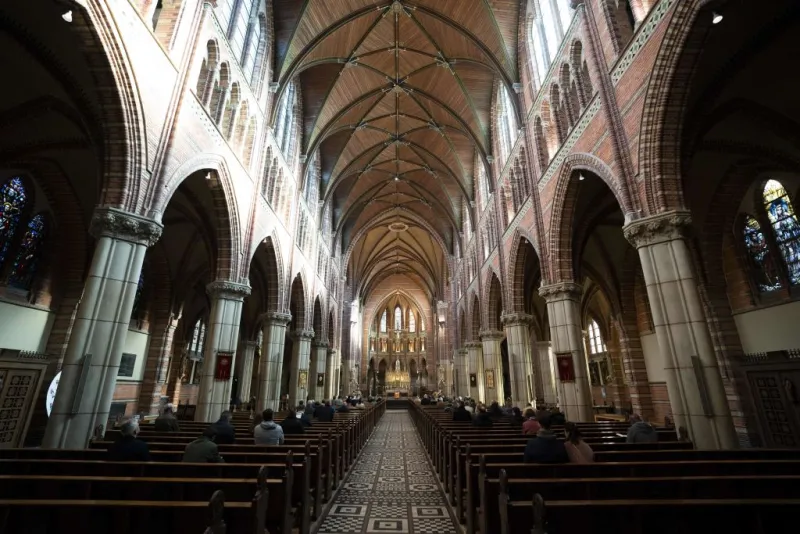


Shape of things to come.
Have they tried the TLM? Rumour has it that may bring in the younger set.
Gilberta: This is a common illogical and misleading falsehood that you should get rid of and deceptively advanced by promoters of the old pre-Vatican II Mass, that the Vatican II Mass attendance declines whereas with the Tridentine Mass attendance increases. There is totally no connection. Decrease in mass attendance is a result of a complex of social factors and can never be singularly attributed to the Vatican II Mass. Just take a look at the surging numbers and faith of emerging Catholic communities in Africa and Asia, they are nourished and sustained by the Vatican II Mass.
You shouldn’t comment on the subject if you are so devoid of knowledge as to believe there are such things as a “pre-Vatican II Mass” and a “Vatican II Mass.” They don’t exist. As far as your condescension goes, the prior suggestion was valid. Many Catholics do perfer to worship God instead of themselves.
DD;
You have no idea what you’re talking about. Have you ever even been to a Latin Mass? I have. There are people there who come 100 miles each way for the Mass, NOT wanting to go to the NO Mass a few miles away.
Deacon Dom,
I think the point is more about demographics. Traditional/Conservative Catholics are the only Catholic population in the West increasing demographically. Have you attended a TLM recently? They are full to overflowing with young families & numerous children in a similar way that Amish & Mennonite churches are. Hasidic communities also.
Western cultural Catholics are contracepting themselves into a virtual oblivion just like the popular culture that surrounds them.
Africa & Asia are different from the West & what works in those regions may look different also. But their surging numbers are fueled by people actually choosing to reproduce themselves. That’s what’s lacking in Holland & the West.
Good point Gilberta.
🙂
I offered the TLM for the first time on my ordination date in 2020. Such a relief to have full focus on whom I’m offering and not to play with the congregation with the banality of music that is so soul destroying! Great thing about the TLM is this focus on Christ and not the lame inaudible response to the prayers!
Interesting to see the response to my comment.
Today’s article (Sept. 7) in The Catholic Thing would seem to bolster the theory that the ditching of the TLM, in which Holland apparently played a role, wasn’t exactly a brilliant (or VII-mandated) move.